Ductless Mini-Split Systems
A ductless mini-split is another form of split refrigeration system. Like the conventional split systems covered in Lessons 4 and 5, the refrigeration equipment is divided between outdoor and indoor assemblies connected by refrigerant piping. The major difference is how conditioned air is delivered to the occupied space.
Instead of using a central air handler or furnace connected to a large supply and return duct system, a ductless mini-split uses one or more indoor units located within the spaces being conditioned. This allows individual rooms or zones to be cooled and, when the equipment is a heat pump, heated without installing conventional central ductwork.
Learning Objectives
Recognize a Mini-Split
Identify the outdoor unit, indoor unit, refrigerant piping, condensate drainage, and electrical or communication connections of a ductless mini-split system.
Understand Single-Zone Systems
Explain the basic arrangement in which one outdoor unit serves one indoor unit and one conditioned zone.
Understand Multi-Zone Systems
Recognize systems in which one outdoor unit serves multiple indoor units located in different rooms or zones.
Recognize Indoor Unit Styles
Identify common high-wall, ceiling cassette, floor-mounted, and concealed ducted indoor-unit configurations.
Indoor and Outdoor Equipment Are Separated
The term mini-split describes a family of split-system equipment in which an outdoor refrigeration unit is connected to one or more relatively compact indoor units. Refrigerant piping connects the indoor and outdoor portions of the system just as it does in the conventional split systems studied earlier.
The word ductless describes the air-distribution arrangement. A typical ductless indoor unit conditions air within the room or zone where it is installed rather than supplying a large central duct system serving the entire building.
One Outdoor Unit and One Indoor Unit
The simplest mini-split arrangement is a single-zone system. One outdoor unit is connected to one indoor unit, and that indoor unit conditions a particular room or zone.
This arrangement is useful where installing or extending conventional ductwork would be difficult or unnecessary. Examples can include building additions, individual rooms, garages or workshops, older buildings without central duct systems, and other spaces requiring independent temperature control.
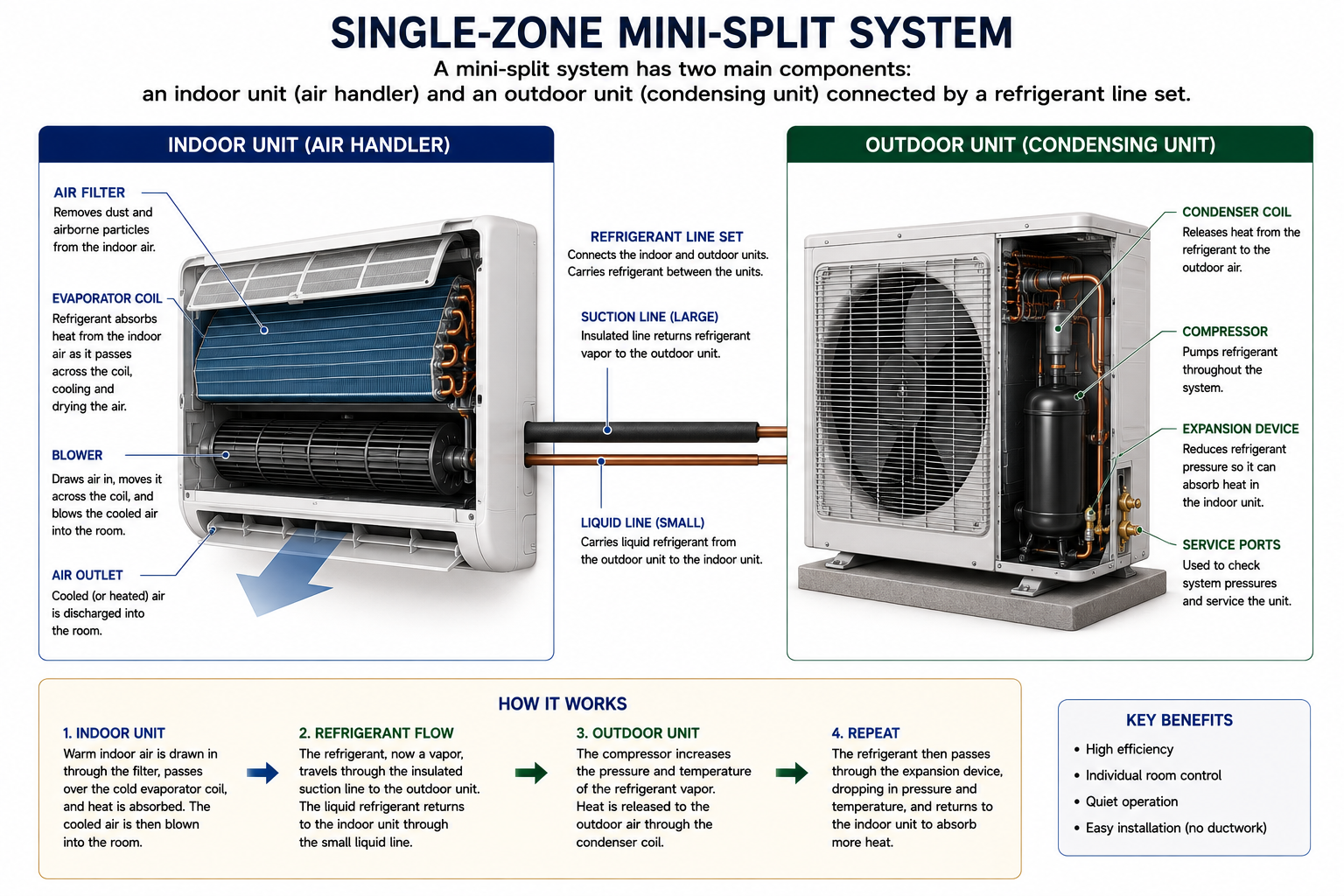
Outdoor Unit
The outdoor assembly contains the outdoor refrigeration equipment and exchanges heat with the outdoor air.
Refrigerant Connections
Refrigerant piping connects the outdoor unit to the indoor unit and allows refrigerant to circulate between them.
Indoor Unit
The indoor unit contains the indoor heat exchanger and fan needed to condition and circulate air within the room or zone.
Air Is Conditioned Within the Zone
A typical ductless indoor unit draws room air into the cabinet, passes the air through a filter and across the indoor coil, and then returns the conditioned air directly to the occupied space.
Because the indoor unit contains its own fan, it does not depend on a central furnace or air-handler blower to move air. It also does not require a conventional central return duct and supply duct system.
Room-Air Intake
The indoor unit draws air directly from the room or zone rather than receiving return air through a large central return duct.
Indoor Coil
The room air passes across the indoor refrigerant coil where heat is transferred between the air and refrigerant.
Indoor Fan
A fan within the indoor unit circulates conditioned air directly back into the occupied space.
Air Direction
Louvers or vanes direct the conditioned air leaving the indoor unit and may move automatically depending on the equipment design.
No Central Blower Is Required
Unlike the systems in Lessons 4 and 5, a ductless indoor unit does not rely on an air-handler blower or furnace blower to circulate room air. Each indoor unit contains the fan needed to serve its own zone.
More Than Refrigerant Piping
The indoor and outdoor units must be connected so that refrigerant, electrical power, control information, and condensate can be handled as required by the equipment design.
Refrigerant Piping
Refrigerant tubing connects the indoor coil to the outdoor refrigeration equipment. The exact pipe sizes, insulation requirements, allowable lengths, and installation practices are determined by the equipment manufacturer.
Electrical and Communication Wiring
Wiring between the indoor and outdoor equipment provides the electrical and control connections required by the particular system.
Condensate Drain
During cooling, moisture removed from room air collects at the indoor coil and must be drained to an appropriate location.
Exterior Penetration
The piping, wiring, and condensate drainage commonly pass through an exterior wall between the indoor unit and the outdoor portion of the installation.
Mini-Split Piping Is Covered Elsewhere
The Refrigerant Line Sets in Split Systems section includes material specifically addressing ductless and variable-capacity piping. Use the equipment manufacturer’s instructions for actual line sizing, insulation, allowable length, elevation, branching, and installation requirements.
One Outdoor Unit Can Serve Several Indoor Zones
A multi-zone mini-split system expands the basic concept by connecting multiple indoor units to an outdoor unit designed for that purpose. Each indoor unit serves a particular room or zone, allowing the building to be divided into independently conditioned areas when the system and controls are designed for independent zone operation.
This arrangement can eliminate the need for a separate outdoor unit at every indoor location while still providing individual indoor air-distribution equipment for several rooms.
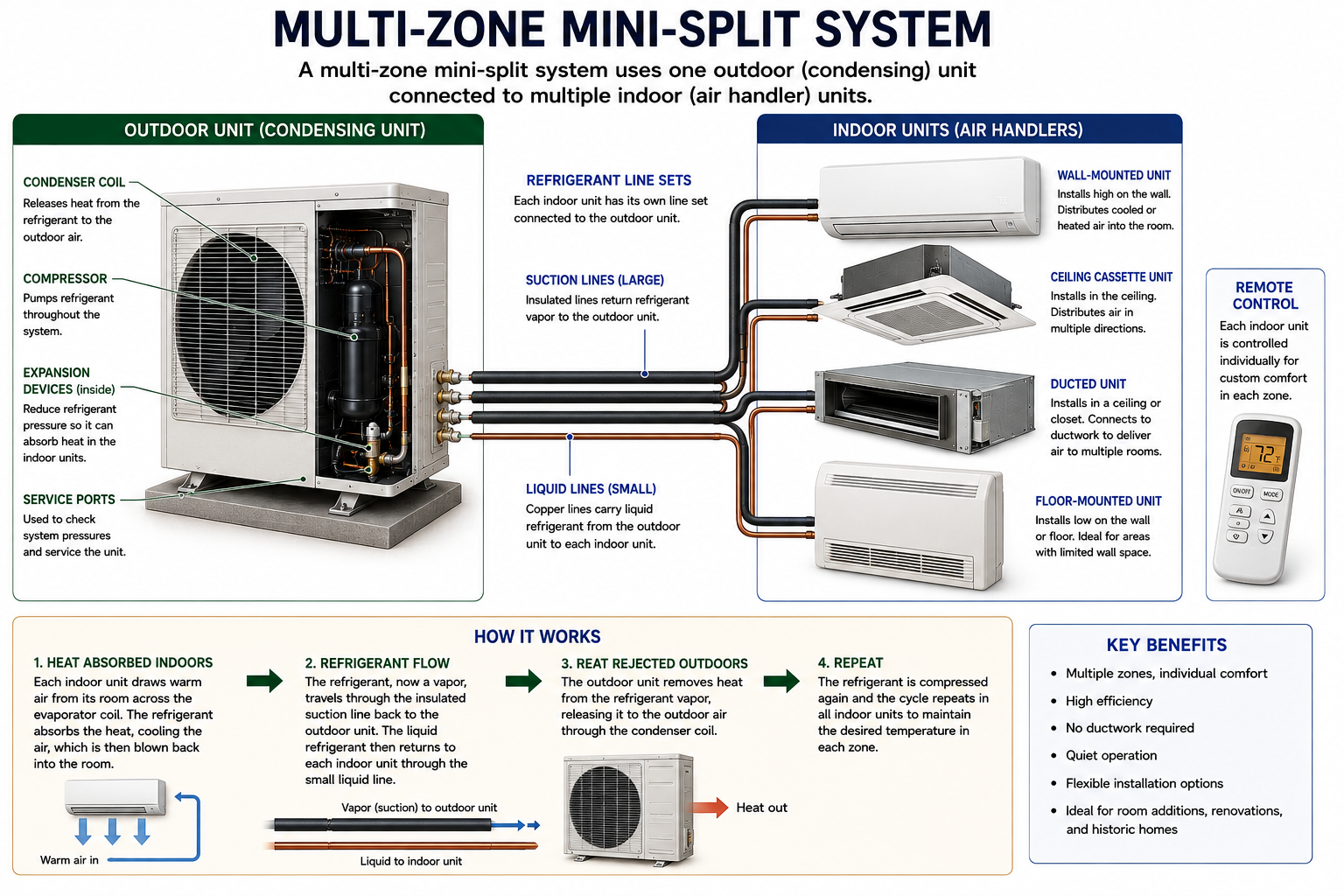
Multi-zone: an outdoor unit designed for multiple zones serves two or more indoor units.
Not Every Mini-Split Hangs High on a Wall
The high-wall indoor unit is probably the most recognizable mini-split configuration, but it is only one option. Manufacturers offer several indoor-unit styles to accommodate different building designs and air-distribution requirements.
High-Wall Unit
Mounted high on an interior wall and discharges conditioned air directly into the occupied space. This is one of the most recognizable ductless configurations.
Ceiling Cassette
Installed at the ceiling and commonly discharges conditioned air in several directions to distribute air through the room.
Floor-Mounted Unit
Installed low on a wall or near floor level where a high-wall or ceiling installation may not be practical.
Concealed Ducted Unit
Installed above a ceiling or in another concealed space and connected to short duct runs serving one or several nearby outlets.
“Mini-Split” Does Not Always Mean Completely Ductless
Many mini-split indoor units discharge directly into the conditioned space, but concealed ducted indoor units are also available. These use relatively short duct systems while remaining part of the same general split-system equipment family.
Conditioning the Spaces That Need It
One important characteristic of mini-split systems is the ability to condition individual areas without relying on one central supply duct system. In a single-zone system, the indoor unit serves its particular zone. In an appropriately designed multi-zone system, multiple indoor units can serve different spaces.
This can be useful when different rooms have different loads, occupancy schedules, exposures, or comfort requirements. It can also allow additions and other isolated spaces to be conditioned without extending the building’s existing central duct system.
An Indoor Head Does Not Automatically Condition Every Room
Conditioned air must physically move from the indoor unit to the area where heating or cooling is needed. Walls and closed doors restrict that movement. A single indoor unit located in one room should not automatically be expected to provide uniform conditioning to several separated rooms.
Many Mini-Splits Are Heat Pumps
Mini-split equipment may be designed for cooling only or for both heating and cooling. Many modern mini-split systems are air-source heat pumps and can reverse the refrigeration cycle to provide heating as well as cooling.
During cooling, the indoor coil absorbs heat from the occupied space and the outdoor unit rejects that heat outdoors. During heat-pump heating, the refrigeration cycle is reversed so that the indoor coil releases heat into the occupied space.
Heat-Pump Operation Deserves Its Own Treatment
This lesson is focused on identifying mini-split system configurations. Reversing valves, defrost operation, low-ambient heating performance, supplemental heat, and detailed heat-pump refrigeration operation should be studied separately rather than added to this introductory system-identification lesson.
Both Are Split Systems, but Air Distribution Is Different
| Characteristic | Conventional Ducted Split | Mini-Split |
|---|---|---|
| Outdoor Refrigeration Unit | Yes | Yes |
| Indoor Refrigeration Coil | Yes | Yes |
| Refrigerant Piping Between Units | Yes | Yes |
| Central Air Handler or Furnace | Normally yes | Not required for typical ductless configuration |
| Central Supply and Return Ducts | Yes | No in a typical ductless installation |
| Indoor Fan | Central blower | Fan within each indoor unit |
| Condensate Drainage | From central evaporator-coil section | From each cooling indoor unit as required |
| Individual Zone Equipment | Not inherent to the basic configuration | Common |
What Should You Look For?
Compact Outdoor Unit
Look for an outdoor unit connected to indoor equipment rather than directly to a central building duct system.
Room-Mounted Indoor Unit
A high-wall, ceiling, floor-mounted, or concealed indoor unit is an important visual clue.
Refrigerant Connections
Look for refrigerant piping running between the outdoor equipment and each indoor unit or approved distribution arrangement.
Condensate Drainage
Indoor units operating in cooling mode remove moisture from the air, so condensate must be drained or pumped away.
No Large Central Duct System
A typical ductless installation delivers conditioned air directly from the indoor unit rather than through conventional central supply and return ducts.
One or Several Indoor Units
One indoor unit suggests a single-zone arrangement, while several indoor units connected to suitable outdoor equipment indicate a multi-zone configuration.
Avoid These Identification Mistakes
“Ductless Means It Is Not a Split System”
Incorrect. The indoor and outdoor refrigeration equipment are physically separated and connected by refrigerant piping, making it a split-system configuration.
“Every Mini-Split Has One Indoor Unit”
Incorrect. Single-zone systems use one indoor unit, while multi-zone equipment can serve multiple indoor units.
“All Indoor Units Are Wall Mounted”
Incorrect. High-wall units are common, but ceiling cassettes, floor-mounted units, and concealed ducted units are also available.
“There Is No Condensate Because There Are No Ducts”
Incorrect. Moisture can still condense on the indoor coil during cooling and must be removed through an appropriate drainage system.
“One Indoor Head Will Cool Every Room”
Incorrect. Air distribution depends on the building layout and airflow path. Closed doors and walls can prevent conditioned air from reaching separated spaces.
“Mini-Split Means Heat Pump”
Not necessarily. Many mini-splits are heat pumps, but the equipment configuration should be confirmed from the model and manufacturer information rather than assumed from appearance alone.
Review Questions
1. Why is a ductless mini-split still considered a split system?
Answer: The refrigeration equipment is divided between separate indoor and outdoor assemblies connected by refrigerant piping.
2. What does the word “ductless” describe?
Answer: It describes the air-distribution arrangement. A typical ductless indoor unit conditions and circulates air directly within its room or zone rather than relying on a conventional central supply and return duct system.
3. What is a single-zone mini-split?
Answer: A system in which one outdoor unit serves one indoor unit and one conditioned zone.
4. What is a multi-zone mini-split?
Answer: A system in which outdoor equipment designed for multiple zones serves two or more indoor units located in separate spaces or zones.
5. Name four common indoor-unit styles.
Answer: High-wall units, ceiling cassettes, floor-mounted units, and concealed ducted units.
6. Why does a mini-split indoor unit require condensate drainage during cooling?
Answer: Moisture from the room air can condense on the cold indoor coil. That water must be collected and drained or pumped to an appropriate location.
7. Does a typical ductless mini-split require a central furnace or air-handler blower?
Answer: No. Each indoor unit contains its own fan to circulate air within the zone it serves.
8. Why might one indoor unit fail to provide uniform conditioning to several rooms?
Answer: Conditioned air must be able to move between the spaces. Walls, closed doors, and building layout can restrict airflow from one room to another.
9. Are all mini-split systems heat pumps?
Answer: No. Many modern mini-splits provide both heating and cooling, but equipment capabilities should be confirmed from the model and manufacturer information.
Lesson 6 Summary
- A ductless mini-split is a split refrigeration system with separate indoor and outdoor equipment.
- The term ductless refers primarily to air distribution rather than to the arrangement of the refrigeration circuit.
- A single-zone mini-split uses one outdoor unit and one indoor unit to serve one zone.
- Multi-zone equipment can serve multiple indoor units located in different rooms or zones.
- Common indoor-unit styles include high-wall units, ceiling cassettes, floor-mounted units, and concealed ducted units.
- A typical ductless indoor unit contains its own coil and fan and circulates room air without a central furnace or air-handler blower.
- Refrigerant piping, electrical or communication wiring, and condensate drainage are important connections between or associated with the indoor and outdoor equipment.
- Condensate must be removed from indoor units operating in cooling mode.
- One indoor unit should not automatically be expected to condition several separated rooms because walls and closed doors restrict air movement.
- Many mini-splits are heat pumps and can provide both heating and cooling, but mini-split equipment should not automatically be assumed to be a heat pump without identifying the actual system.
- The detailed installation requirements for refrigerant piping should come from the equipment manufacturer and the existing line-set material rather than being duplicated in this system-identification lesson.