Hydrocarbon Refrigerants: R-290 and R-600a
Hydrocarbon refrigerants provide excellent refrigeration performance with zero ozone depletion potential and extremely low global warming potential. Two hydrocarbons technicians increasingly encounter are R-290, which is refrigerant-grade propane, and R-600a, which is refrigerant-grade isobutane.
Their environmental characteristics are excellent, but their safety requirements are substantially different from the A1 and A2L refrigerants covered earlier. R-290 and R-600a are classified A3, the higher-flammability category in the ASHRAE refrigerant safety classification system. Equipment charge, ignition control, ventilation, refrigerant identification, specialized service procedures, and equipment design therefore become especially important.
What You Will Learn
After completing this lesson, you should be able to:
Identify Hydrocarbon Refrigerants
Recognize R-290 as refrigerant-grade propane and R-600a as refrigerant-grade isobutane.
Explain the A3 Classification
Explain why hydrocarbon refrigerants require substantially different flammability precautions from A1 and A2L refrigerants.
Recognize Common Applications
Identify equipment in which R-290 and R-600a are commonly encountered.
Understand Charge Limitations
Explain why refrigerant charge quantity is an important part of hydrocarbon equipment safety design.
Apply Safe Service Practices
Recognize requirements involving ventilation, ignition control, refrigerant detection, proper tools, hot work, and leak repair.
Avoid Improper Substitution
Explain why ordinary fuel propane or isobutane must never be substituted for refrigerant-grade R-290 or R-600a.
Refrigerants Made From Hydrogen and Carbon
Hydrocarbon refrigerants are compounds made primarily from hydrogen and carbon. Several hydrocarbons have useful refrigeration properties, but R-290 and R-600a are among the most important for technicians working with modern small refrigeration equipment.
Hydrocarbons occur naturally and contain no chlorine or fluorine. Their direct environmental impact as refrigerants is extremely low compared with many CFC, HCFC, and HFC refrigerants.
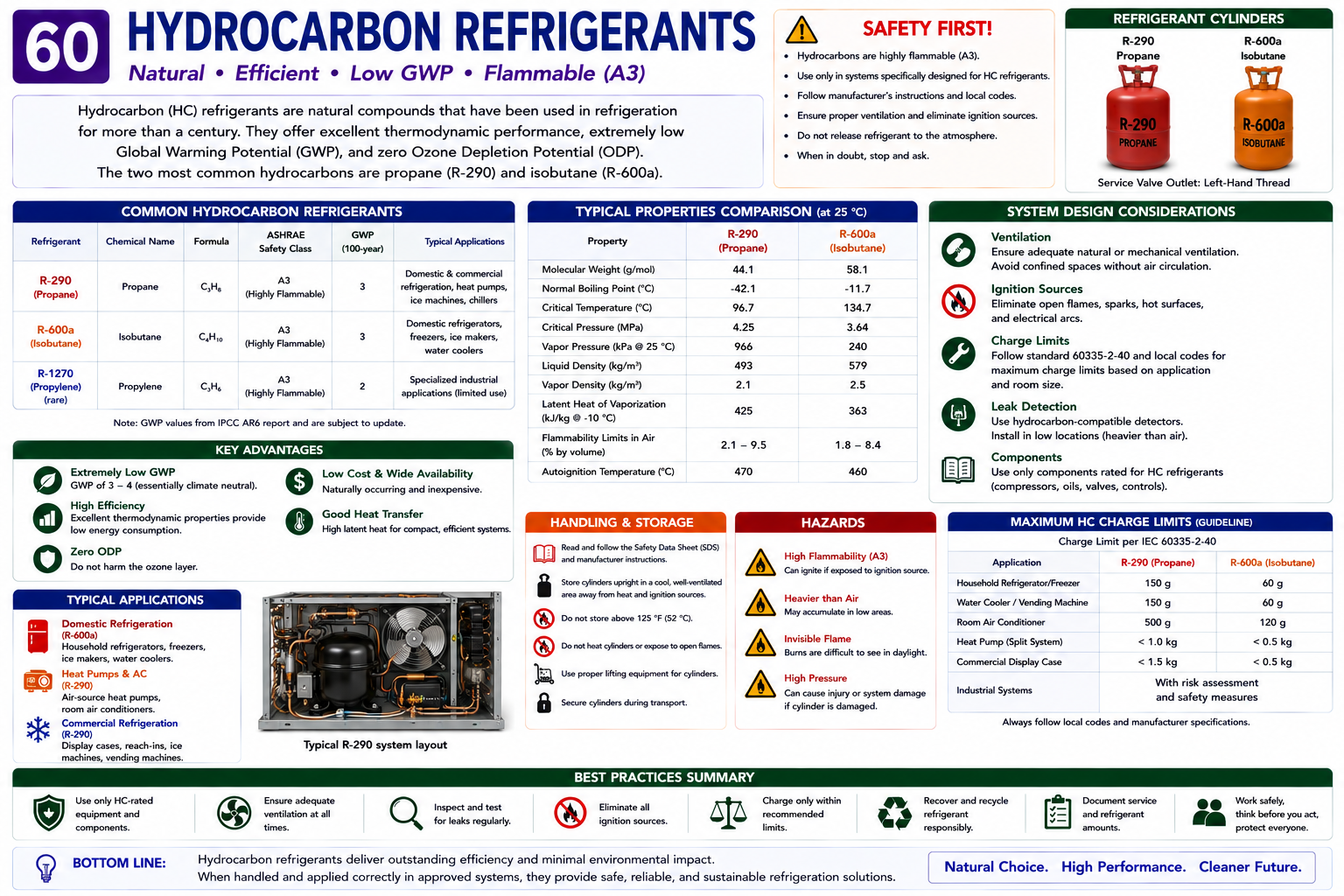
R-290 and R-600a combine excellent environmental characteristics with high flammability. Safe use depends on equipment specifically designed for the refrigerant and strict adherence to approved service procedures.
Higher Flammability Than A2L Refrigerants
R-290 and R-600a are classified A3. The letter A identifies the lower-toxicity classification, while the number 3 identifies the higher-flammability refrigerant category.
This is an important distinction from R-32, R-454B, R-1234yf, and R-1234ze(E), which are classified A2L.
| Classification | General Flammability Characteristic | Examples |
|---|---|---|
| A1 | No flame propagation under classification test conditions | R-134a, R-410A |
| A2L | Lower flammability with low burning velocity | R-32, R-454B |
| A3 | Higher flammability | R-290, R-600a |
A3 hydrocarbon refrigerants are not simply “another type of A2L.” Their greater flammability requires equipment designs, allowable charges, tools, and service procedures appropriate to A3 refrigerants.
Refrigerant Flammability Classifications
For a review of A1, A2L, and A3 classifications, ignition sources, and refrigerant accumulation, return to Introduction to A2L Refrigerants.
R-290 — Refrigerant-Grade Propane
R-290 is the refrigerant designation for propane used as a refrigerant. It is a single-component refrigerant with excellent thermodynamic properties and very low environmental impact.
R-290 has become increasingly common in self-contained commercial refrigeration equipment and other applications specifically designed for hydrocarbon refrigerants.
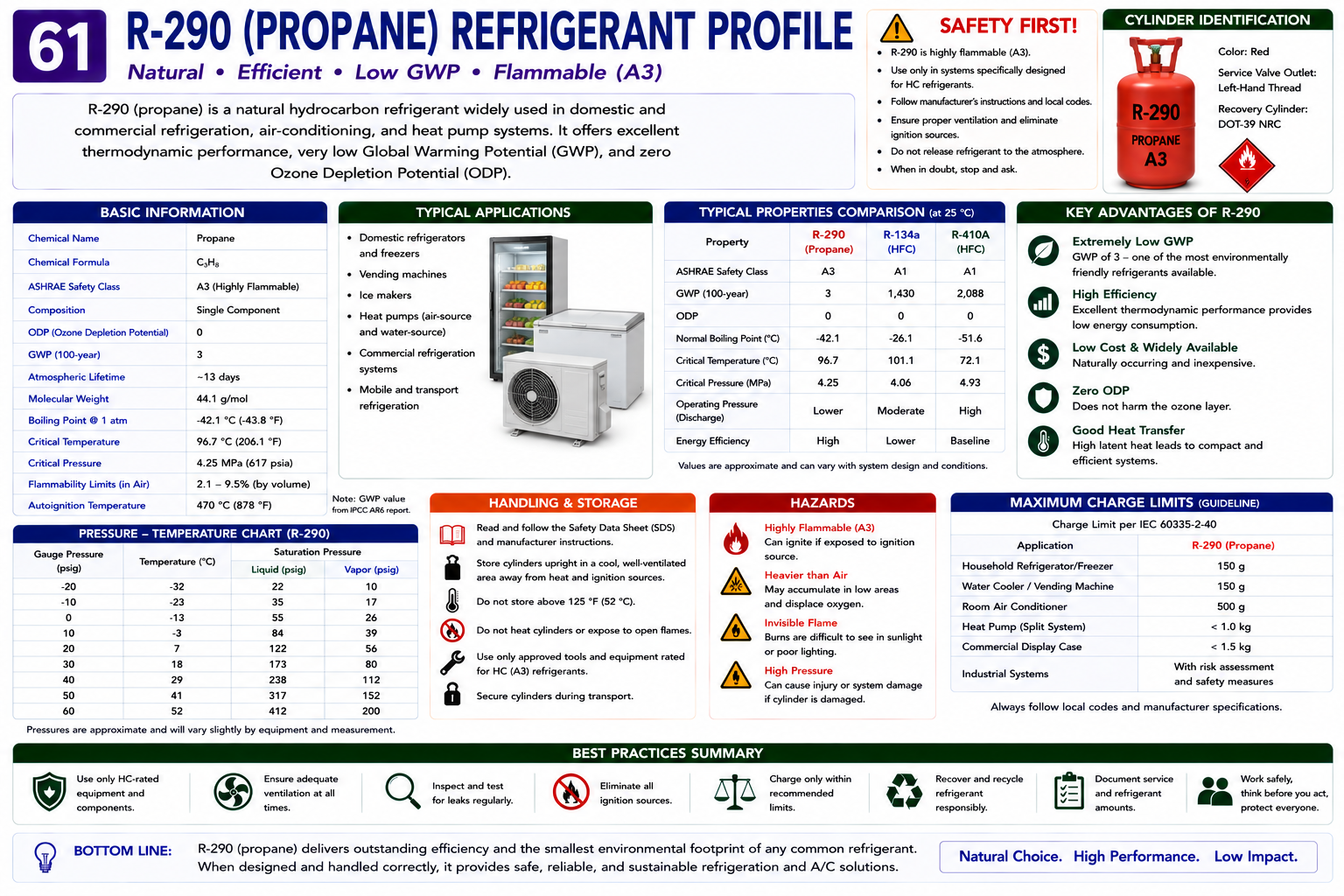
Designation
R-290
Chemical
Propane.
Composition
Single-component refrigerant.
Safety Classification
ASHRAE A3.
ODP
0
GWP
Approximately 3 in current EPA SNAP tables.
Where Technicians Encounter R-290
R-290 is particularly important in modern commercial refrigeration. Equipment designed for R-290 can include stand-alone refrigerators and freezers, food-service equipment, refrigerated display equipment, vending equipment, and certain commercial ice machines.
EPA SNAP acceptability depends on the particular end use and applicable use conditions. R-290 should never be assumed acceptable for an application simply because another type of R-290 appliance exists.
Reach-In Refrigeration
Commercial refrigerators and freezers designed specifically for R-290.
Food-Service Equipment
Self-contained refrigerated preparation, storage, and dispensing equipment.
Display Equipment
Some self-contained merchandising refrigerators and freezers.
Ice Machines
R-290 is acceptable subject to use conditions in specified self-contained commercial ice-machine applications.
The fact that R-290 is acceptable in one equipment category does not make it a universal refrigerant for every commercial refrigeration or air-conditioning system.
R-600a — Refrigerant-Grade Isobutane
R-600a is the refrigerant designation for isobutane used as a refrigerant. Like R-290, it is a single-component hydrocarbon refrigerant with zero ozone depletion potential and extremely low GWP.
R-600a is especially important in household refrigerators and freezers and can also appear in other small refrigeration equipment designed specifically for the refrigerant.
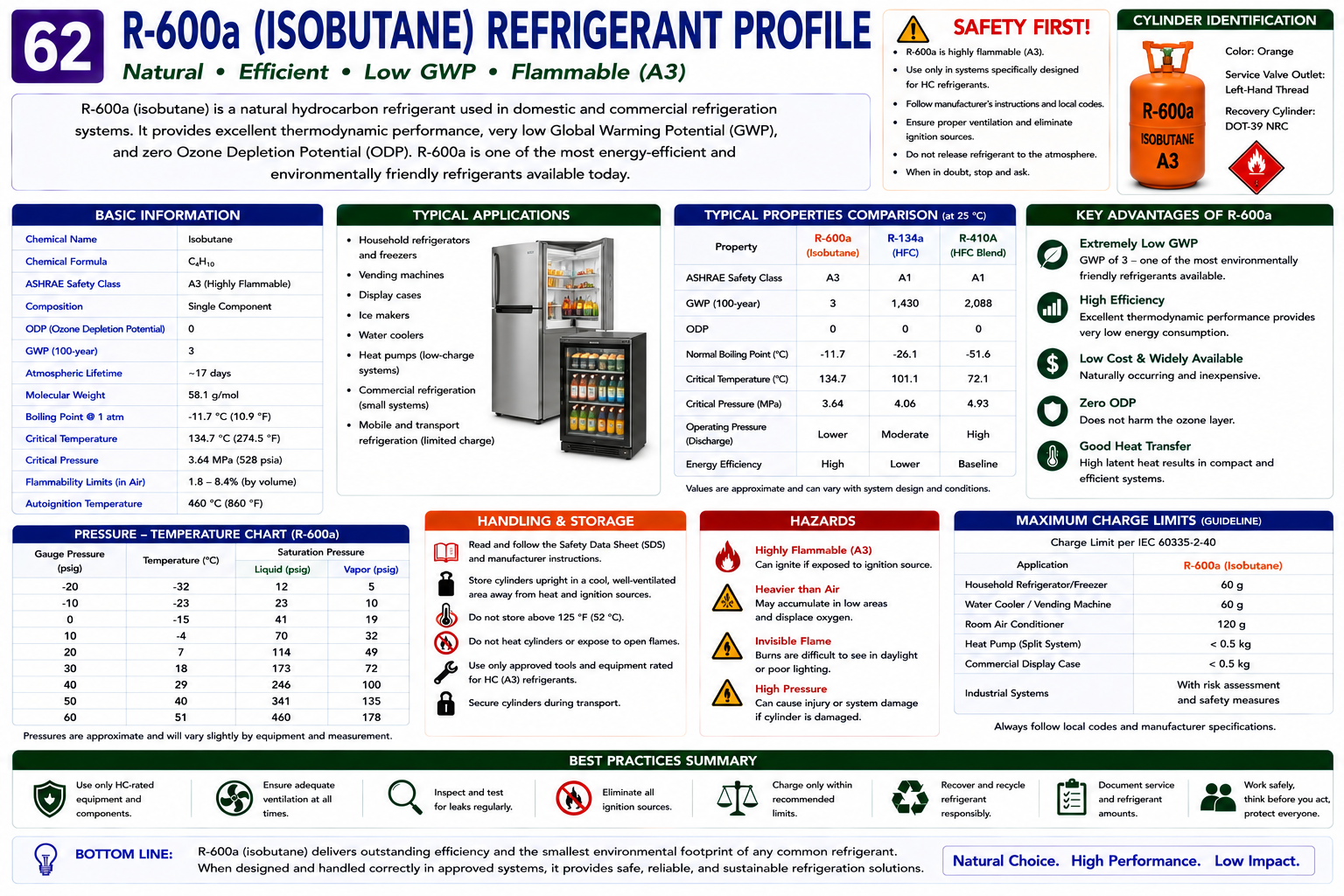
Designation
R-600a
Chemical
Isobutane.
Composition
Single-component refrigerant.
Safety Classification
ASHRAE A3.
ODP
0
GWP
Approximately 3 in current EPA SNAP tables.
Household Refrigeration Is a Major Application
R-600a has become widely used in household refrigerators and freezers. The small refrigeration capacity and compact sealed system of these appliances make them well suited to refrigerant designs using limited hydrocarbon charges.
Technicians who service household refrigeration should therefore expect to encounter R-600a frequently in newer equipment.
A modern refrigerator may contain R-600a rather than R-134a or another refrigerant. Never assume the refrigerant based on equipment appearance or age alone.
Both Are Hydrocarbons — But They Are Different Refrigerants
| Characteristic | R-290 | R-600a |
|---|---|---|
| Chemical | Propane | Isobutane |
| Composition | Single component | Single component |
| ASHRAE Safety Class | A3 | A3 |
| ODP | 0 | 0 |
| GWP | Approximately 3 | Approximately 3 |
| Temperature Glide | None | None |
| Common Association | Commercial self-contained refrigeration | Household refrigerators and freezers |
| Interchangeable? | No | No |
R-290 and R-600a are not interchangeable simply because both are hydrocarbons and both are classified A3.
R-290 Is Not Barbecue Propane
R-290 is propane, but refrigeration systems require refrigerant-grade material manufactured to the purity and contamination requirements appropriate for refrigeration equipment.
Fuel propane intended for heating, cooking, or engines may contain odorants, moisture, hydrocarbons other than propane, and other contaminants that are unacceptable in a sealed refrigeration system.
Never charge ordinary fuel propane into an R-290 refrigeration system. Use only refrigerant meeting the required refrigerant specification and supplied for refrigeration service.
The Same Rule Applies to Isobutane
R-600a must also be refrigerant-grade material intended for refrigeration service. A container of isobutane sold for another purpose is not automatically suitable for use as refrigerant.
Moisture, noncondensables, odorants, oils, and other contamination can damage a sealed refrigeration system or alter its operation. Use the specified refrigerant product.
Flammability Must Be Treated as a Primary Hazard
A3 refrigerants can form readily ignitable mixtures with air. Safe equipment therefore depends on preventing uncontrolled refrigerant releases, limiting the quantity that can be released, controlling ignition sources, and using equipment designed for the refrigerant.
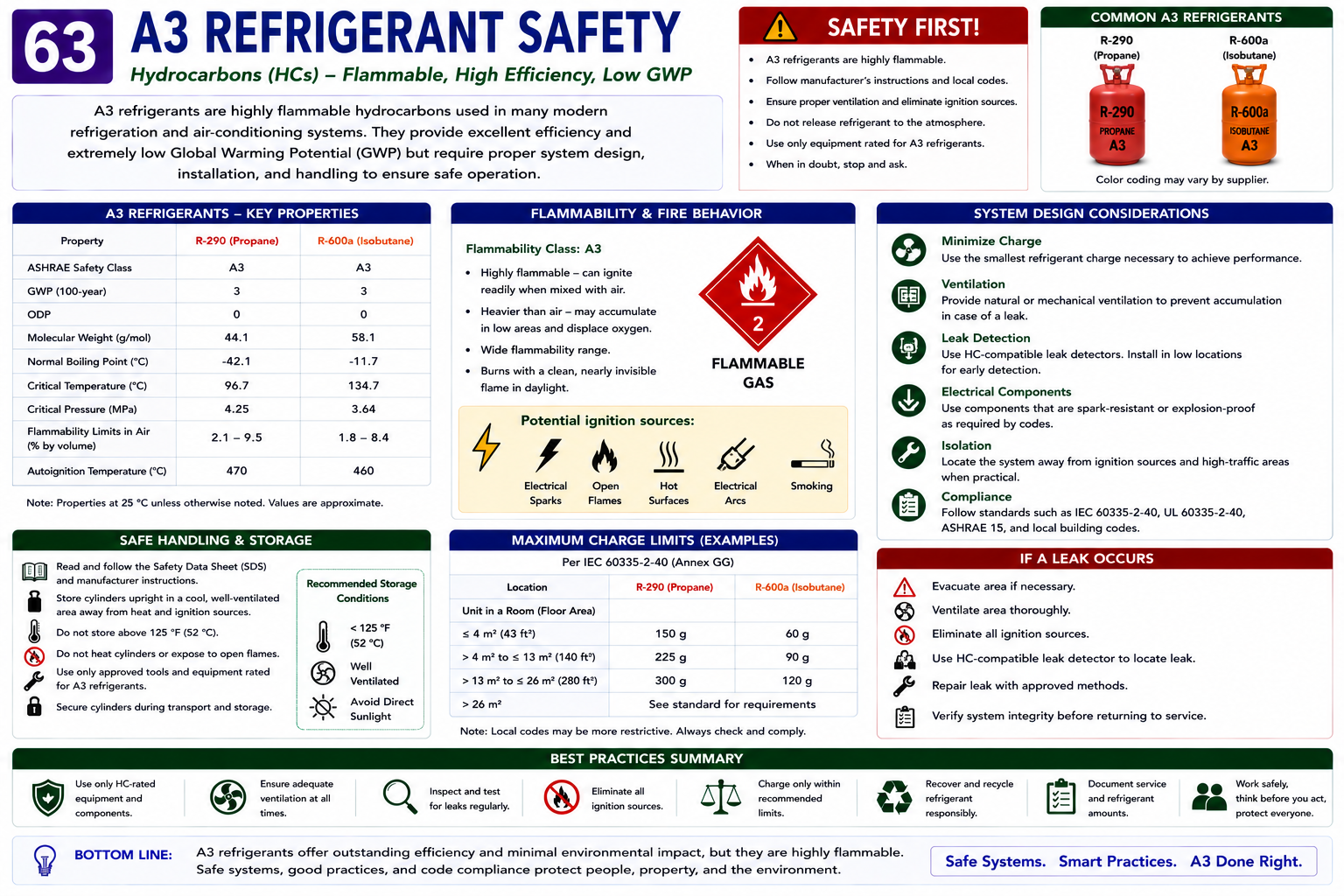
Open Flames
Torches, pilot flames, matches, lighters, and similar ignition sources must be controlled.
Electrical Sparks
Relays, switches, motors, damaged wiring, and inappropriate equipment can produce potential ignition sources.
Static and Mechanical Sparks
Service operations and tools must be evaluated for possible ignition sources.
Refrigerant Accumulation
A leak in an enclosed space can create an ignitable refrigerant-air mixture.
Control the Conditions Required for Combustion
For a hydrocarbon refrigerant to burn, fuel, oxygen, and an adequate ignition source must be present at the same time. Safe service attempts to prevent those conditions from occurring together.
Fuel
Released R-290 or R-600a can supply combustible fuel.
Oxygen
Normal atmospheric air supplies oxygen.
Ignition
A flame, spark, electrical arc, or sufficiently energetic source can provide ignition.
Control refrigerant release, provide appropriate ventilation, and eliminate ignition sources before servicing the sealed refrigeration circuit.
Small Refrigerant Charges Are an Important Safety Strategy
Hydrocarbon refrigeration equipment is designed to use carefully controlled refrigerant quantities. Limiting the amount of refrigerant available to escape during a leak is one way equipment standards reduce flammability risk.
The maximum permitted charge is not one universal number for every hydrocarbon appliance. It depends on the refrigerant, equipment category, applicable safety standard, installation, and current regulatory use conditions.
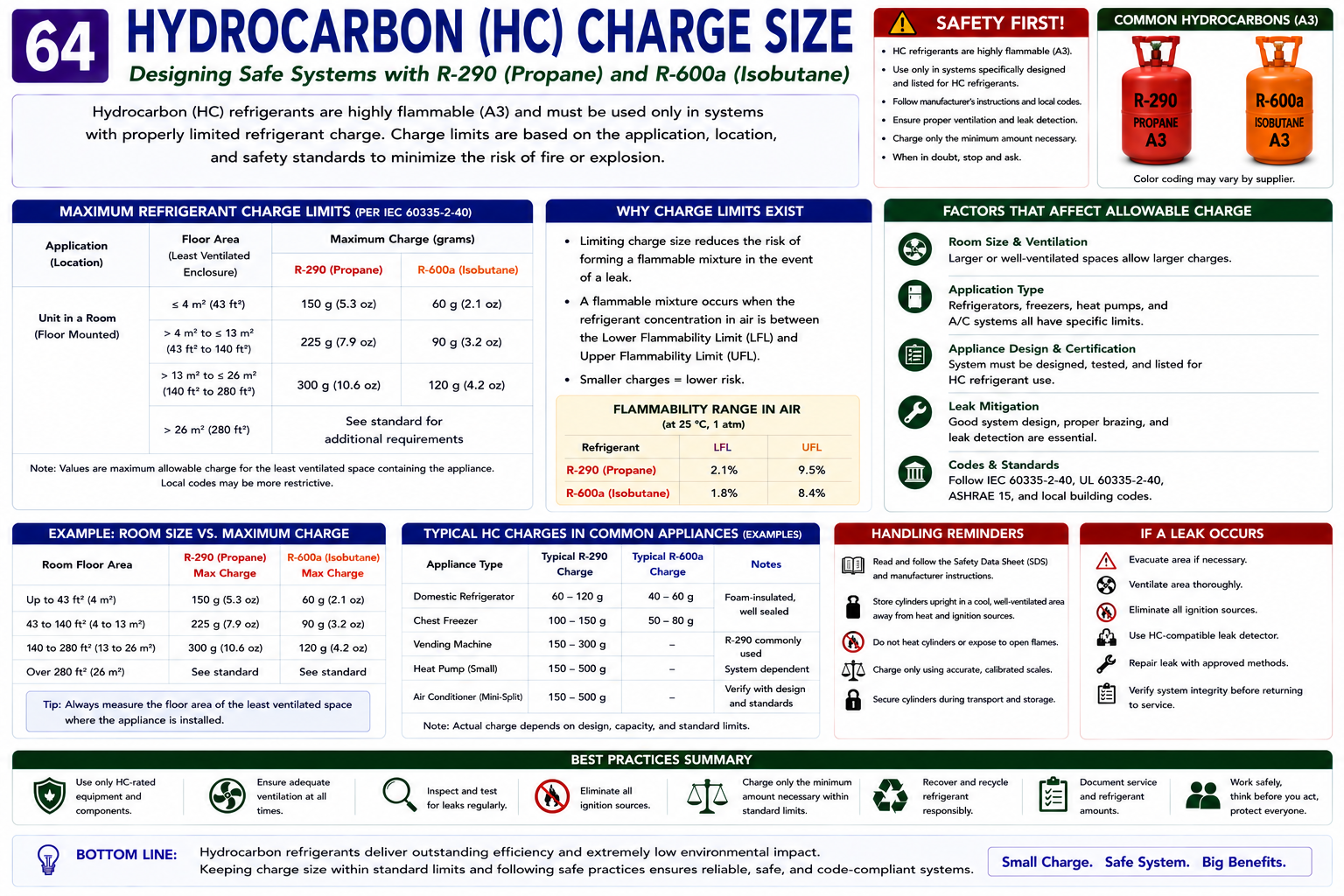
Never memorize one hydrocarbon charge limit and apply it to every appliance. Determine the allowable charge from the equipment nameplate, manufacturer documentation, applicable listing, and current requirements.
A Few Grams Can Matter
Small hydrocarbon systems often contain much less refrigerant than larger traditional refrigeration systems. Because the total charge is small, relatively minor charging errors can represent a significant percentage of the system charge.
An accurate refrigerant scale is therefore especially important when charging a system by weight.
Charge the amount specified by the equipment manufacturer and verify operation using the appropriate service procedure. Pressure alone is not an accurate method of establishing refrigerant charge.
R-290 and R-600a Have Different P-T Characteristics
Both refrigerants are hydrocarbons and both are single-component refrigerants, but each has its own pressure-temperature relationship.
Use P-T data for the exact refrigerant. Never diagnose an R-600a appliance using R-290 pressure information or assume that pressure similarity makes refrigerants interchangeable.
The relationship between saturation pressure, saturation temperature, superheat, subcooling, and refrigerant state remains the same refrigeration theory discussed in Introduction to the Pressure-Enthalpy Diagram. The refrigerant-specific P-T values are what change.
No Blend Glide or Fractionation
R-290 and R-600a are single-component refrigerants. They do not experience blend fractionation and do not have separate bubble-point and dew-point saturation temperatures.
R-290
Single component.
No temperature glide.
No fractionation.
R-600a
Single component.
No temperature glide.
No fractionation.
Evaluate the Area Before Opening the System
Before opening an R-290 or R-600a refrigeration circuit, identify the refrigerant and evaluate the work location. Consider where refrigerant could escape, where vapor could accumulate, how the area is ventilated, and which ignition sources are present.
Identify
Confirm the refrigerant from the appliance nameplate and markings.
Ventilate
Provide the ventilation required for the service location and procedure.
Control Ignition
Remove or control flames, sparks, electrical arcs, and other ignition sources.
Use Correct Tools
Use service equipment suitable for hydrocarbon refrigerants and the specific procedure.
Hydrocarbon Equipment Requires Appropriate Service Equipment
Do not assume tools used with A1 refrigerants are automatically suitable for an A3 refrigerant. Equipment that handles refrigerant or contains electrical components must be evaluated for its intended hydrocarbon service.
Leak Detector
Use a leak detector suitable for the specific hydrocarbon refrigerant.
Recovery Equipment
When recovery is required by the application or service procedure, use equipment suitable for A3 hydrocarbon refrigerants.
Vacuum Pump
Follow approved procedures and verify suitability for hydrocarbon service.
Refrigerant Scale
Accurate weighing is essential because hydrocarbon charges can be small.
Electrical Test Equipment
Use appropriate instruments and consider possible ignition sources in the work environment.
Ventilation Equipment
Use equipment appropriate for the work area and flammable-refrigerant service where mechanical ventilation is required.
Never Search for a Hydrocarbon Leak With a Flame
Hydrocarbon refrigerant leaks must be located using appropriate electronic or other approved leak-detection methods.
The old practice of using a flame-type leak detector is completely inappropriate for a flammable hydrocarbon refrigerant.
Never use an open flame to locate a refrigerant leak in R-290 or R-600a equipment.
Use Approved Procedures and Dry Nitrogen
After a repair, pressure testing should follow the equipment manufacturer’s service procedure. Dry nitrogen is commonly used for refrigeration pressure testing where specified.
Oxygen must never be used to pressurize a refrigeration system, and compressed air should not be introduced where it can create a combustible mixture or contaminate the system.
Oxygen combined with oil, refrigerant, or combustible material under pressure can create an extreme fire or explosion hazard.
Make the System Safe Before Brazing
Never apply a torch to a refrigeration circuit containing a flammable hydrocarbon refrigerant. The refrigerant must first be removed or otherwise handled according to the approved equipment service procedure, and the circuit must be placed in the safe condition required before hot work begins.
Service procedures for small hydrocarbon appliances may also differ from the brazing practices familiar from larger traditional systems, so the manufacturer procedure should be followed rather than assumed.
Do not braze, solder, cut, or apply heat to a circuit that may contain an ignitable hydrocarbon refrigerant-air mixture.
Know the Rule for the Specific Refrigerant and End Use
Hydrocarbon refrigerants require an important regulatory distinction. EPA has exempted certain hydrocarbon substitutes from the federal Section 608 venting prohibition in specified approved end uses because EPA determined those releases do not pose the same environmental threat addressed by the prohibition.
That exemption is not a universal instruction to release hydrocarbon refrigerants. The technician must still follow the applicable end-use rules, equipment manufacturer’s procedure, workplace safety requirements, local codes, and procedures necessary to prevent a flammable refrigerant concentration from developing.
“Hydrocarbon” does not automatically mean “vent it.” Determine the refrigerant, equipment end use, current EPA requirements, and safe service procedure before handling the charge.
Acceptability Is Application-Specific
EPA SNAP currently lists R-290 and R-600a as acceptable subject to use conditions in specified refrigeration applications. Those use conditions are part of the approval and can include equipment construction, charge restrictions, markings, and other safety provisions.
R-290, for example, appears in current EPA listings for several types of self-contained commercial equipment, while R-600a is particularly important in household refrigeration and certain stand-alone equipment.
Do not ask simply, “Is R-290 approved?” Ask, “Is R-290 acceptable for this specific end use, and what use conditions apply?” The same principle applies to R-600a.
Hydrocarbon Systems Are Purpose-Built
Equipment designed for R-290 or R-600a accounts for flammability throughout the appliance design. Components, electrical devices, refrigerant charge, airflow, enclosure construction, tubing, markings, and service procedures are selected with the refrigerant in mind.
Do not convert an appliance designed for R-134a, R-404A, R-410A, or another refrigerant to R-290 or R-600a simply by replacing the refrigerant charge.
Hydrocarbon Refrigerants Must Remain Identifiable
Do not add R-290 to R-134a, R-404A, R-600a, or another refrigerant. Do not add R-600a to R-290 or another refrigerant.
An uncontrolled field mixture has no approved refrigerant designation and can create unpredictable P-T characteristics, flammability characteristics, lubricant behavior, and equipment performance.
R-290 equipment gets R-290. R-600a equipment gets R-600a.
Follow the Compressor Manufacturer’s Specification
Hydrocarbon refrigerants can be compatible with several refrigeration lubricant types depending on the compressor and application. The correct lubricant cannot be determined merely from the fact that the system contains R-290 or R-600a.
Use the oil type and viscosity specified by the compressor or appliance manufacturer.
Refrigerant and Oil Compatibility
For a review of lubricant selection, oil circulation, viscosity, POE moisture absorption, and contamination, return to Refrigerants and Lubricants.
Excellent Direct Environmental Performance
R-290 and R-600a contain no chlorine and have zero ozone depletion potential. Their GWP values are extremely low compared with HFC refrigerants such as R-134a, R-404A, and R-410A.
R-290
ODP: 0
GWP: approximately 3
R-600a
ODP: 0
GWP: approximately 3
Hydrocarbon refrigerants demonstrate why refrigerant selection always involves tradeoffs. Very low environmental impact does not mean minimal service hazard.
Good Refrigeration Properties With Small Charges
Hydrocarbon refrigerants can provide favorable heat-transfer and thermodynamic characteristics, allowing efficient refrigeration equipment to be designed around them.
Modern appliance design combines those useful properties with controlled refrigerant charges and safety features appropriate to A3 refrigerants.
The efficiency of an R-290 or R-600a appliance is not simply a property of the refrigerant. Compressor design, heat exchangers, metering, controls, insulation, charge quantity, and operating conditions all contribute to equipment performance.
Treat the Work Area as a Safety Problem First
If a significant hydrocarbon refrigerant leak is suspected, avoid creating ignition sources and follow the equipment manufacturer’s leak-response procedure. Provide appropriate ventilation and determine whether refrigerant could have accumulated in the area.
Avoid Ignition
Do not operate equipment that could create a spark or flame unless the approved procedure establishes that it is safe.
Ventilate
Provide appropriate ventilation according to the situation and service procedure.
Detect
Use equipment suitable for detecting the hydrocarbon refrigerant.
Repair Safely
Follow the manufacturer procedure before opening or applying heat to the refrigeration circuit.
What to Remember About R-290 and R-600a
Hydrocarbon refrigerants combine refrigerant identification, safety classification, equipment-specific charge limits, SNAP use conditions, environmental performance, and specialized service safety.
Remember that R-290 is propane and R-600a is isobutane. Both are single-component A3 hydrocarbon refrigerants with zero ODP and extremely low GWP. Their high flammability requires equipment designed specifically for them, carefully controlled charge quantities, ignition-source control, ventilation, and appropriate service procedures. Never substitute ordinary fuel propane or isobutane for refrigerant-grade material.
Avoid These Hydrocarbon Refrigerant Errors
“R-290 is the same as barbecue propane.”
No. Refrigeration equipment requires refrigerant-grade R-290 meeting appropriate purity requirements.
“R-600a is basically R-290.”
No. Isobutane and propane are different refrigerants with different P-T characteristics and equipment designs.
“A3 is basically A2L.”
No. A3 is the higher-flammability refrigerant classification.
“A small refrigerant charge is not dangerous.”
No. Charge limitation reduces risk but does not eliminate the need for ignition control and proper service practices.
“There is one EPA charge limit for all R-290 appliances.”
No. Applicable limits and use conditions depend on equipment category, design, applicable standards, and current requirements.
“R-290 can replace an HFC because it has better GWP.”
No. Hydrocarbons must be used only in equipment designed and approved for them.
“All hydrocarbons can automatically be vented.”
No. EPA exemptions are refrigerant- and end-use-specific, and safe handling requirements still apply.
“An open flame is a quick way to find the leak.”
Absolutely not. Use approved leak-detection equipment suitable for flammable hydrocarbon refrigerants.
Hydrocarbon Refrigerants
- What chemical does the refrigerant designation R-290 identify?
- What chemical does R-600a identify?
- Are R-290 and R-600a single-component refrigerants or blends?
- What is the ASHRAE safety classification of R-290?
- What is the ASHRAE safety classification of R-600a?
- How does A3 differ generally from A2L?
- What is the ozone depletion potential of R-290 and R-600a?
- Approximately what GWP does EPA list for each?
- Why is R-290 not the same thing as ordinary fuel propane for refrigeration service?
- What major application is commonly associated with R-600a?
- Name two applications in which technicians may encounter R-290.
- Why is refrigerant charge quantity particularly important in hydrocarbon equipment?
- Is there one universal hydrocarbon refrigerant charge limit for every appliance?
- Why must ignition sources be controlled during hydrocarbon service?
- Why should an open flame never be used to locate an R-290 or R-600a leak?
- Can an R-134a refrigerator simply be converted to R-600a by changing the refrigerant?
- Can R-290 and R-600a be mixed?
- Why must the appliance nameplate be checked before servicing newer refrigeration equipment?
- Does extremely low GWP eliminate refrigerant safety concerns?
- Why must the technician determine the specific EPA end use before assuming a hydrocarbon venting exemption applies?
What You Should Have Learned
R-290 Is Propane
R-290 is refrigerant-grade propane used in equipment specifically designed for hydrocarbon refrigerants.
R-600a Is Isobutane
R-600a is refrigerant-grade isobutane and is widely associated with modern household refrigeration.
Both Are A3
Hydrocarbon refrigerants require greater flammability precautions than A2L refrigerants.
Both Have Excellent Environmental Characteristics
R-290 and R-600a have zero ODP and extremely low GWP.
Charge Quantity Matters
Hydrocarbon appliance safety depends in part on carefully controlled refrigerant charge.
Use Refrigerant-Grade Material
Fuel-grade propane or isobutane must not be substituted for approved refrigeration refrigerant.
Ignition Control Is Essential
Ventilation, appropriate tools, leak detection, and elimination of ignition sources are fundamental A3 service practices.
Equipment Is Refrigerant-Specific
Do not convert equipment to R-290 or R-600a merely by replacing its original refrigerant.