R-410A Refrigerant
R-410A became the dominant refrigerant in residential and light-commercial air-conditioning and heat-pump equipment during the transition away from R-22. It provided zero ozone depletion potential while allowing manufacturers to design efficient systems specifically around its higher operating pressures.
R-410A is now itself part of another refrigerant transition. Its relatively high global warming potential has led new residential and light-commercial equipment toward lower-GWP refrigerants, particularly A2L refrigerants such as R-32 and R-454B. However, the enormous installed base of R-410A equipment means technicians will continue servicing it for many years.
What You Will Learn
After completing this lesson, you should be able to:
Identify R-410A
Recognize R-410A as an HFC refrigerant blend containing R-32 and R-125.
Recognize High Operating Pressure
Explain why R-410A systems require equipment, tools, gauges, hoses, and recovery equipment rated for substantially higher pressures than traditional R-22 systems.
Understand Blend Behavior
Recognize R-410A as a near-azeotropic blend with very small temperature glide.
Recognize Lubricant Requirements
Explain why POE lubricant and moisture control are important in R-410A systems.
Compare R-410A With R-22
Explain why R-410A replaced R-22 in many new-equipment applications but is not a retrofit refrigerant for R-22 equipment.
Understand the A2L Transition
Explain why newer equipment is moving from R-410A toward lower-GWP refrigerants such as R-32 and R-454B.
A High-Pressure HFC Blend
R-410A is an HFC refrigerant blend consisting of approximately equal proportions of R-32 and R-125. It was developed for air-conditioning and heat-pump applications and became widely used as manufacturers transitioned away from R-22.
The blend behaves nearly azeotropically. Its temperature glide is very small compared with a strongly zeotropic refrigerant such as R-407C.
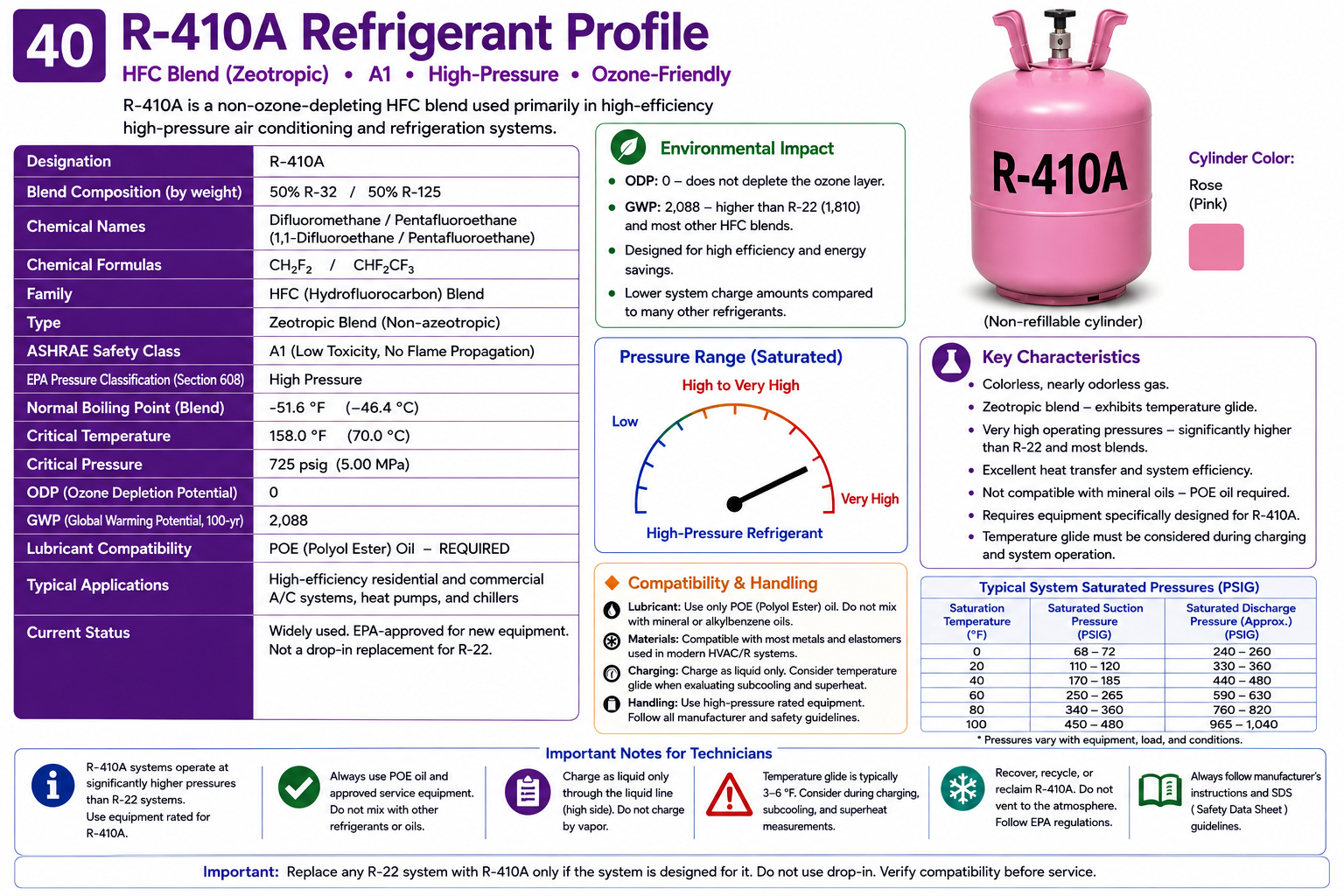
Designation
R-410A
Family
HFC blend
Components
R-32 / R-125 in approximately equal proportions.
Blend Behavior
Near-azeotropic with very small temperature glide.
Safety Classification
ASHRAE A1.
Typical Lubricant
Commonly associated with POE lubricant.
A New Refrigerant Required New Equipment
As R-22 was phased out for new air-conditioning equipment, R-410A became one of the principal refrigerants used in newly designed residential and light-commercial systems.
R-410A did not become successful because technicians could put it into existing R-22 equipment. Instead, manufacturers redesigned compressors, heat exchangers, tubing, valves, controls, service ports, and other components specifically for R-410A’s characteristics and higher operating pressures.
R-410A replaced R-22 in many new-equipment applications. It did not become a direct replacement refrigerant for existing R-22 systems.
R-410A Operates at Much Higher Pressures Than R-22
The most immediately noticeable difference between R-410A and R-22 is operating pressure. Under comparable air-conditioning conditions, R-410A pressures are substantially higher.
This difference affects the construction of the refrigeration system and every pressure-containing service tool connected to it.
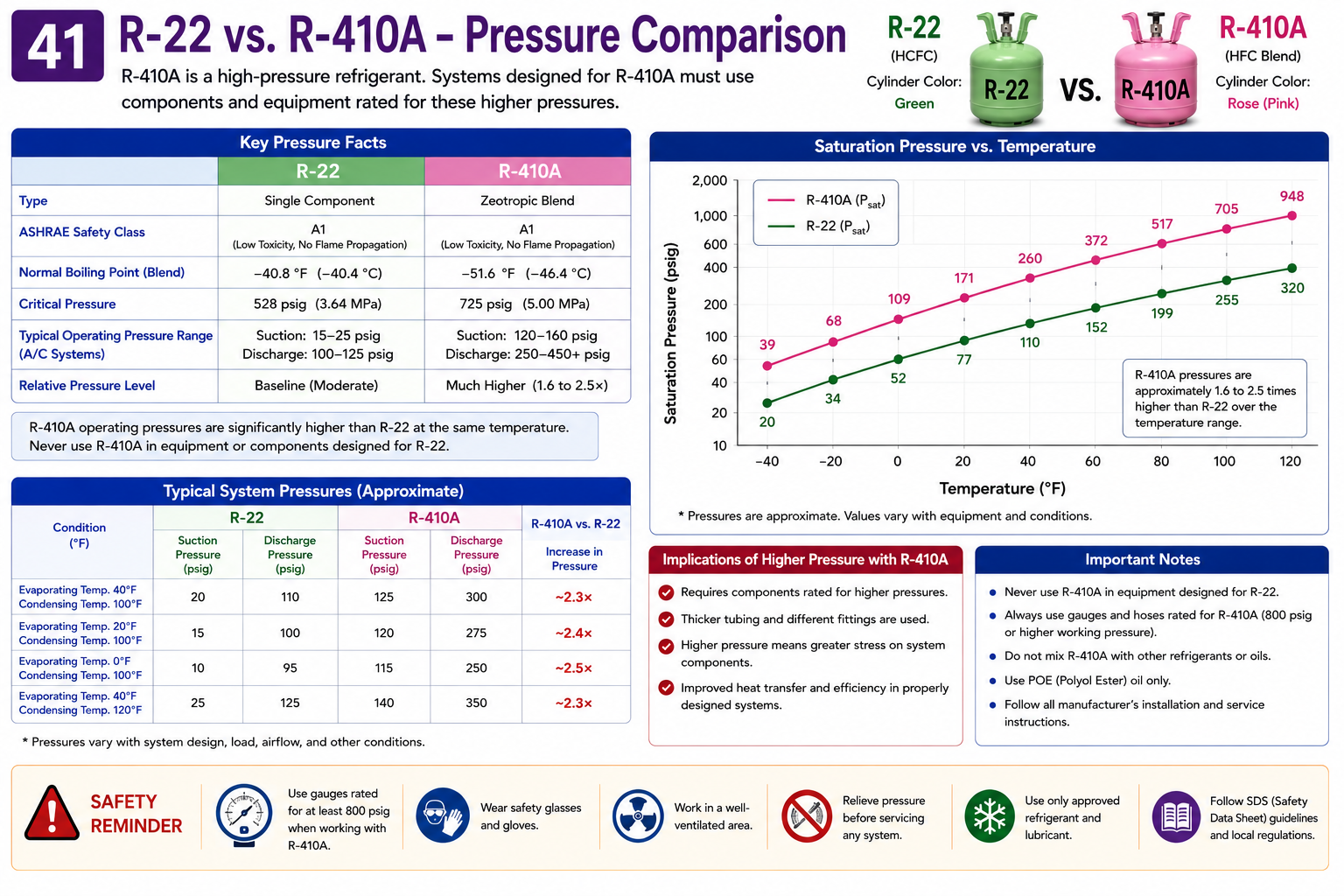
The exact operating pressure depends on refrigerant temperature, indoor and outdoor conditions, load, airflow, equipment design, and system condition. Do not diagnose an R-410A system from a memorized “normal pressure.”
Tools Must Be Rated for R-410A Pressure
When R-410A entered widespread service, technicians could not safely assume that every gauge set, hose, recovery machine, or cylinder used for older refrigerants was appropriate for the higher pressures involved.
Pressure-containing service equipment must have working-pressure ratings suitable for the refrigerant and conditions in which it will be used.
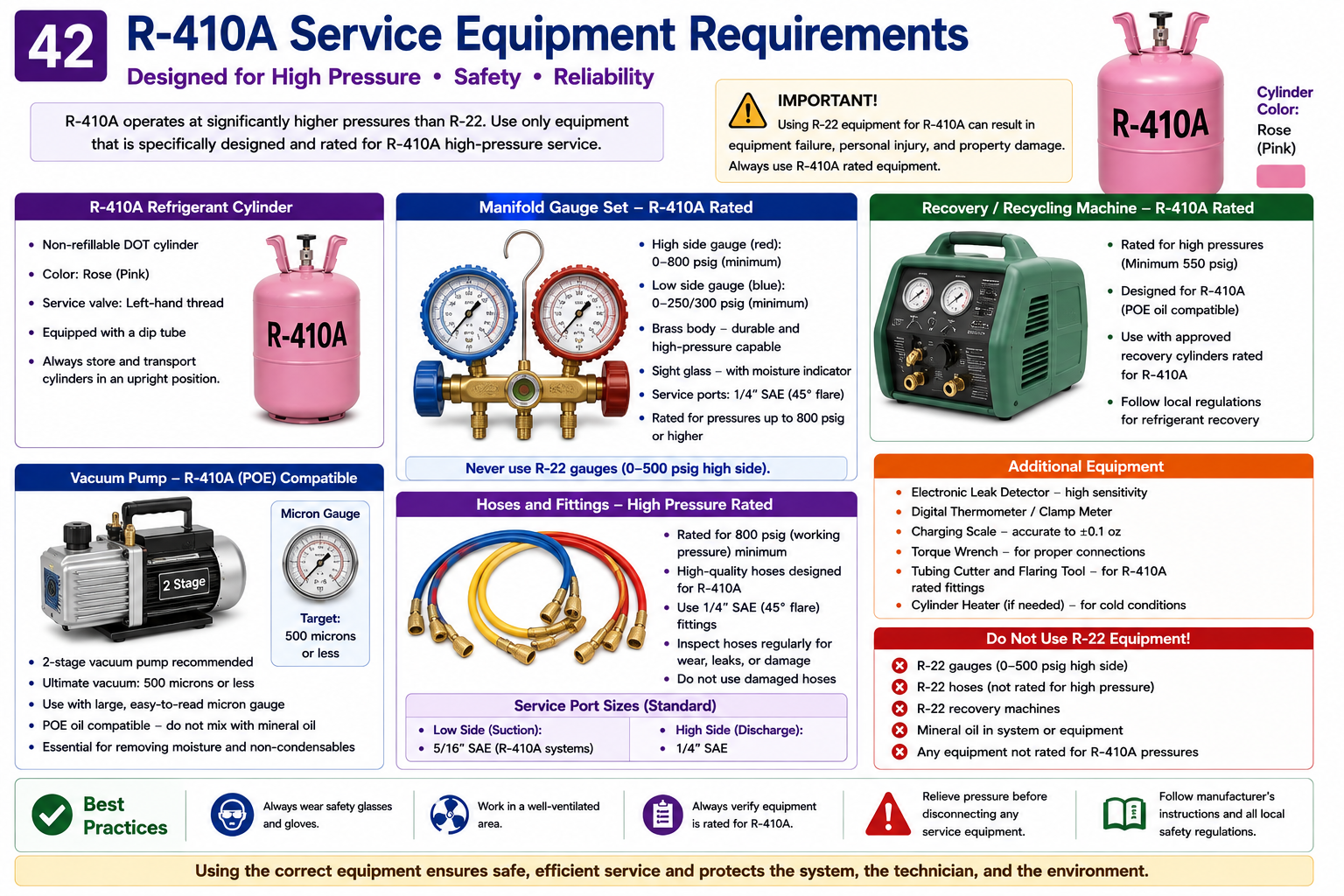
Manifold Gauges
Use gauge equipment with pressure ratings suitable for R-410A service.
Charging Hoses
Hoses must have suitable working and burst-pressure ratings.
Recovery Machine
The recovery unit must be approved and capable of handling the refrigerant and pressure range.
Recovery Cylinder
Use an appropriate refillable recovery cylinder and never exceed allowable filling limits.
Vacuum Equipment
Use proper evacuation tools and procedures to remove air and moisture before charging.
Refrigerant Scale
Accurate weighing is important when recovering or charging refrigerant.
Use R-410A P-T Data
R-410A has its own pressure-temperature relationship. Because pressures are much higher than those familiar from R-22 systems, technicians must avoid judging charge or system condition from R-22 experience.
Use an R-410A P-T chart, electronic manifold, or approved digital reference to determine saturation temperature from measured pressure.
Pressure means nothing without refrigerant identity and temperature context. Always use the correct R-410A P-T relationship.
Saturation, Superheat, and Subcooling
For a review of saturation pressure, saturation temperature, superheat, subcooling, and refrigerant state, revisit Introduction to the Pressure-Enthalpy Diagram.
R-410A Has Very Little Temperature Glide
R-410A contains two refrigerants, but the blend behaves nearly azeotropically. Its temperature glide is small enough that it behaves much more like a single-component refrigerant during normal phase change than a blend such as R-407C.
The distinction is still worth understanding because R-410A is chemically a blend even though its service behavior differs from strongly zeotropic blends.
R-407C
Zeotropic blend with significant temperature glide. Bubble and dew differences are important in ordinary diagnosis.
R-410A
Near-azeotropic blend with very small glide. Its phase-change behavior is much closer to that of a single-component refrigerant.
Temperature Glide
For a detailed practical example of bubble point, dew point, and significant temperature glide, review R-407C Refrigerant.
Follow Blend-Charging Procedures
R-410A is commonly supplied and removed from the refrigerant cylinder as liquid. This preserves the intended composition of the blend.
As always, liquid withdrawal from the cylinder does not mean uncontrolled liquid refrigerant should be allowed to enter the compressor.
Follow the equipment manufacturer’s charging procedure. If refrigerant is introduced through the suction side while the compressor is operating, control the refrigerant flow to prevent liquid slugging or floodback.
R-410A Systems Commonly Use POE
R-410A equipment commonly uses polyol ester, or POE, lubricant. POE provides suitable refrigerant-lubricant interaction for these systems but readily absorbs atmospheric moisture.
Proper service therefore requires careful moisture control whenever the sealed refrigeration circuit is opened.
Keep Oil Sealed
Do not leave POE lubricant containers open to atmospheric air.
Minimize Open-System Time
Keep tubing and system components protected while repairs are being made.
Use Appropriate Filter-Driers
Replace filter-driers when required after opening or repairing the refrigeration system.
Evacuate Properly
Remove air and moisture before the system is returned to service.
Refrigerants and Lubricants
POE moisture absorption, oil circulation, refrigerant migration, and contamination were covered in Refrigerants and Lubricants.
Two Refrigerants Used for Similar Applications
R-22 and R-410A were both widely used for residential and light-commercial air conditioning and heat pumps, but that common application should never be confused with refrigerant interchangeability.
| Characteristic | R-22 | R-410A |
|---|---|---|
| Family | HCFC | HFC blend |
| Composition | Single component | R-32 / R-125 |
| ASHRAE Safety Class | A1 | A1 |
| Ozone Depletion Potential | Greater than zero | 0 |
| Operating Pressure | Lower | Substantially higher |
| Traditional Lubricant | Often mineral oil | Typically POE |
| Temperature Glide | None | Very small |
| Current Role | Legacy refrigerant | Large installed base transitioning away from new-system use |
Never charge R-410A into an R-22 system. R-22 equipment was not designed for R-410A’s operating pressures or refrigerant/lubricant characteristics.
R-410A Is A1
R-410A is classified A1 under the ASHRAE refrigerant safety-classification system. This places it in the lower-toxicity group with no flame propagation under the applicable classification criteria.
That classification does not eliminate pressure, frostbite, oxygen-displacement, confined-space, or decomposition hazards.
High Pressure
Components and tools must be appropriate for the pressures that can occur.
Cold Burns
Liquid refrigerant rapidly expanding to a lower pressure can cause severe frostbite.
Oxygen Displacement
A substantial release can reduce oxygen concentration, particularly in confined or poorly ventilated areas.
Heat Decomposition
Exposure to flame or extreme heat can produce hazardous decomposition products.
Zero ODP, But High GWP
R-410A contains no chlorine and therefore has an ozone depletion potential of zero. This was one of the reasons it became an important successor to R-22 in newly designed equipment.
However, R-410A is composed entirely of HFC refrigerants and has a 100-year global warming potential of approximately 2,088 under the value used by EPA’s current Technology Transitions program.
Ozone Depletion Potential
0
No chlorine is present in R-410A.
Global Warming Potential
Approximately 2,088
This high GWP is a major reason newer comfort-cooling equipment is moving to lower-GWP refrigerants.
The transition from R-22 to R-410A addressed ozone depletion. The current transition away from R-410A in new equipment is primarily driven by the climate impact of high-GWP HFC refrigerants.
New Comfort-Cooling Equipment Is Changing Again
Modern residential and light-commercial air-conditioning and heat-pump equipment is transitioning from high-GWP R-410A toward lower-GWP refrigerants.
Two refrigerants technicians are increasingly likely to encounter are R-32 and R-454B. Both are classified A2L, meaning their safety characteristics differ from the A1 R-410A systems technicians have serviced for many years.
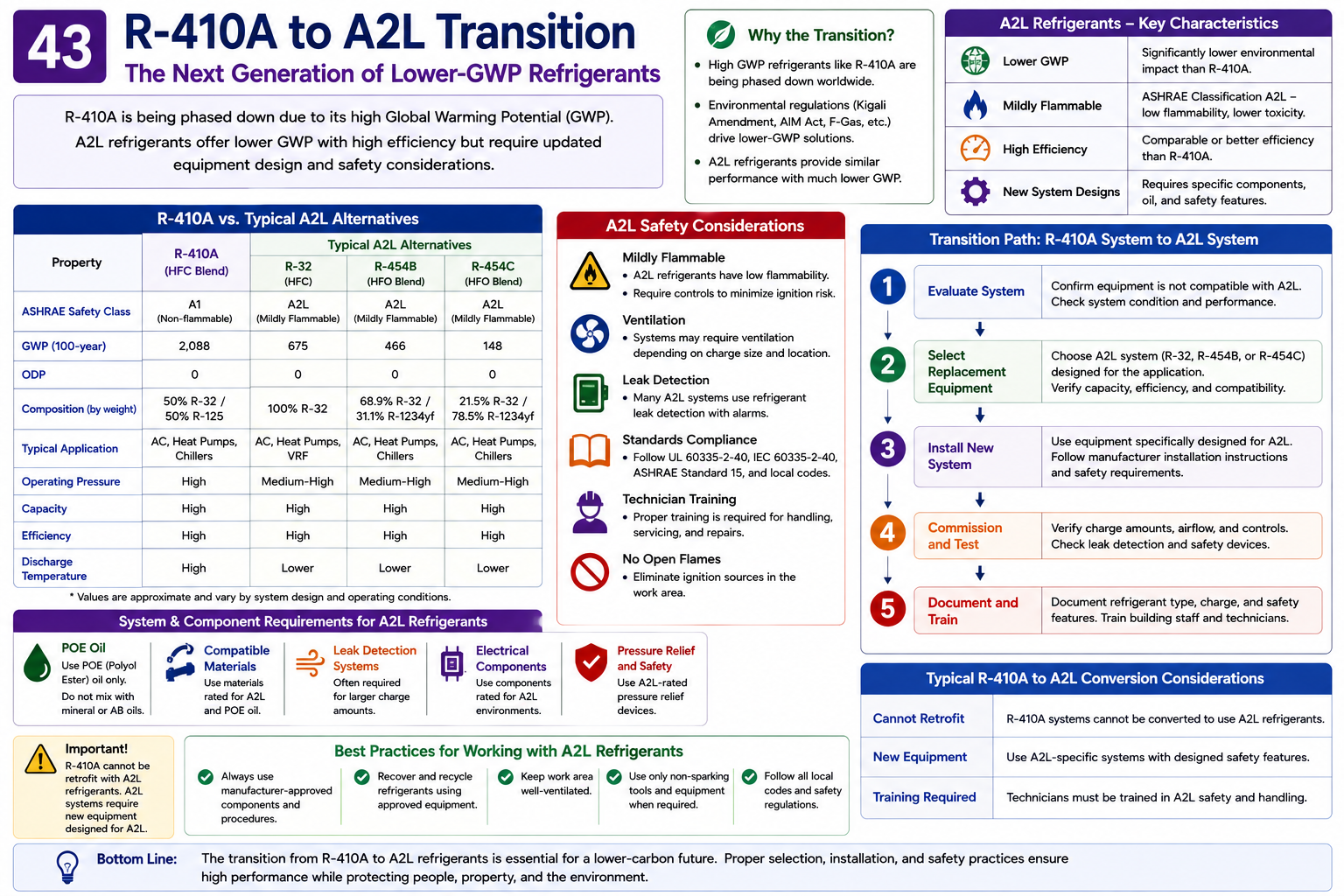
The movement from R-410A to A2L refrigerants primarily involves new equipment designed for those refrigerants. An existing R-410A system should not simply be charged with R-32 or R-454B.
Lower GWP Requires Different Refrigerant Choices
EPA’s current Technology Transitions requirements establish a GWP limit of 700 for new stationary residential and light-commercial air-conditioning and heat-pump systems covered by the rule.
R-410A’s GWP is well above that limit, while refrigerants such as R-32 and R-454B fall below it. This is one reason these refrigerants are appearing in newly manufactured comfort-cooling equipment.
The next lesson introduces A2L refrigerants as a group before we study R-32 and R-454B individually.
The Installed Base Remains Serviceable
The refrigerant transition does not mean existing R-410A systems suddenly become unusable or must automatically be replaced.
EPA allows components designed for R-410A to continue to be manufactured, imported, sold, and used for servicing existing R-410A systems under applicable requirements. Those service components are distinguished from components used to construct a new R-410A system.
Technicians will be servicing R-410A equipment for many years. The move to A2L refrigerants changes new equipment while a large installed population of R-410A systems remains in operation.
R-410A, R-32, and R-454B Are Different Refrigerants
R-32 is one component of R-410A, but that does not make pure R-32 interchangeable with R-410A. R-454B also contains R-32, but it is a separately formulated blend with different properties and safety characteristics.
Adding either refrigerant to an R-410A system creates an improper mixture and does not convert the system to an A2L refrigerant.
Never top off an R-410A system with R-32, R-454B, or another refrigerant. Service the equipment with the refrigerant for which it was designed unless an approved conversion procedure specifically applies.
R-410A Must Be Recovered
R-410A is an HFC refrigerant and must be properly recovered during stationary refrigeration and air-conditioning service. Its zero ozone depletion potential does not permit intentional venting.
Recovery equipment, hoses, cylinders, and fittings must be appropriate for R-410A and its pressure characteristics.
Use low-loss fittings and proper recovery procedures, avoid unnecessary hose losses, and recover refrigerant rather than intentionally releasing it to the atmosphere.
What to Remember About R-410A
R-410A combines several important Section 608 concepts: high-pressure equipment, refrigerant blends, recovery, POE lubricant, high GWP, refrigerant transitions, and equipment compatibility.
Remember that R-410A is an A1 HFC blend containing R-32 and R-125. It has zero ODP, operates at substantially higher pressures than R-22, commonly uses POE lubricant, and has a high GWP. R-410A is not a retrofit refrigerant for R-22 equipment, and R-32 or R-454B should not be placed into existing R-410A equipment unless the equipment was specifically designed and approved for that refrigerant.
Avoid These R-410A Errors
“R-410A is just high-pressure R-22.”
No. The refrigerants differ in chemistry, pressure, lubricant requirements, equipment design, and environmental characteristics.
“Any gauge set can be used on R-410A.”
No. Pressure-containing tools must be rated appropriately for the refrigerant and expected pressures.
“R-410A can be put into an R-22 system.”
No. R-22 equipment was not designed for R-410A’s substantially higher operating pressures.
“Because R-32 is half of R-410A, pure R-32 can top it off.”
No. R-32 and R-410A are different refrigerants with different compositions and safety characteristics.
“R-410A is banned, so existing equipment cannot be repaired.”
No. Existing R-410A equipment can continue to be serviced, and service components remain available under applicable EPA requirements.
“A1 means R-410A has no safety hazards.”
No. High pressure, frostbite, oxygen displacement, and decomposition hazards still require proper handling.
R-410A Refrigerant
- What refrigerant family does R-410A belong to?
- What two refrigerants make up R-410A?
- Is R-410A a single-component refrigerant or a blend?
- How would you describe the temperature glide of R-410A?
- What is the ASHRAE safety classification of R-410A?
- How do R-410A operating pressures compare with R-22?
- Why must gauges and hoses used on R-410A have appropriate pressure ratings?
- What lubricant is commonly used in R-410A systems?
- What moisture-related characteristic of POE oil is important during service?
- Why is R-410A not a direct replacement for R-22?
- What is the ozone depletion potential of R-410A?
- Why is the industry moving away from R-410A in new comfort-cooling equipment?
- Name two A2L refrigerants being used in newer comfort-cooling equipment.
- Can R-32 be used to top off an R-410A system?
- Can existing R-410A equipment continue to be serviced?
What You Should Have Learned
R-410A Is an HFC Blend
It contains approximately equal proportions of R-32 and R-125.
R-410A Is A1
It is in the lower-toxicity, no-flame-propagation ASHRAE classification.
R-410A Is High Pressure
Its operating pressures are substantially higher than R-22, requiring appropriately designed equipment and service tools.
R-410A Has Very Little Glide
It is a near-azeotropic blend and behaves much like a single-component refrigerant during phase change.
POE Lubricant Is Common
Moisture control is important because POE readily absorbs atmospheric moisture.
R-410A Is Not an R-22 Retrofit
The systems differ substantially in pressure, equipment design, and lubricant requirements.
R-410A Has High GWP
Its zero ODP solved the ozone issue associated with R-22, but its climate impact is driving another refrigerant transition.
Existing R-410A Systems Remain Important
The transition affects new equipment while a very large installed base of R-410A equipment continues to require service.