Positive and Negative Duct Pressure
A pressure reading is positive or negative only in relation to a selected reference. In most HVAC duct measurements, the surrounding room or atmosphere is the reference: pressure above that reference is positive, while pressure below it is negative.
This lesson applies that principle to supply ducts, return ducts, air leakage, closed rooms, inadequate return paths, and ducts located outside the conditioned space. Understanding these relationships helps technicians recognize why duct problems can affect airflow, comfort, energy use, indoor air quality, and building pressure.
What You Will Learn
By the end of this lesson you should be able to:
Identify the pressure reference.
Explain why positive and negative pressure have meaning only when the reference pressure is known.
Recognize supply pressure.
Explain why supply ducts normally operate at positive static pressure relative to the surrounding space.
Recognize return pressure.
Explain why return ducts normally operate at negative static pressure relative to the surrounding space.
Predict leakage direction.
Determine whether air will leak out of or into a duct from the pressure difference across the duct wall.
Interpret room pressure.
Describe how closed doors and inadequate return paths can create pressure differences between rooms.
Evaluate duct location.
Explain why leakage from ducts in attics, crawlspaces, garages, and other unconditioned areas can create additional building and air-quality problems.
Positive or Negative Compared with What?
A pressure instrument compares pressure at one connection with pressure at another connection or reference. When a technician inserts one tube into a duct and leaves the other connection open to the room, the instrument displays duct pressure relative to the room.
Positive Pressure
The test location is at a higher pressure than the reference. With the room used as the reference, air tends to move from the duct toward the room through any available opening.
Negative Pressure
The test location is at a lower pressure than the reference. With the room used as the reference, air tends to move from the room into the duct through any available opening.
Zero Differential
A zero reading means the two measured locations are at the same pressure within the instrument’s resolution. It does not mean that neither location has atmospheric pressure.
Pressure Difference
The magnitude of the pressure difference helps drive airflow through an opening, but the resulting airflow also depends on the opening’s size and resistance.
The same location can be positive relative to one point and negative relative to another. Always identify both sides of the measurement before interpreting the plus or minus sign.
Supply Positive, Return Negative
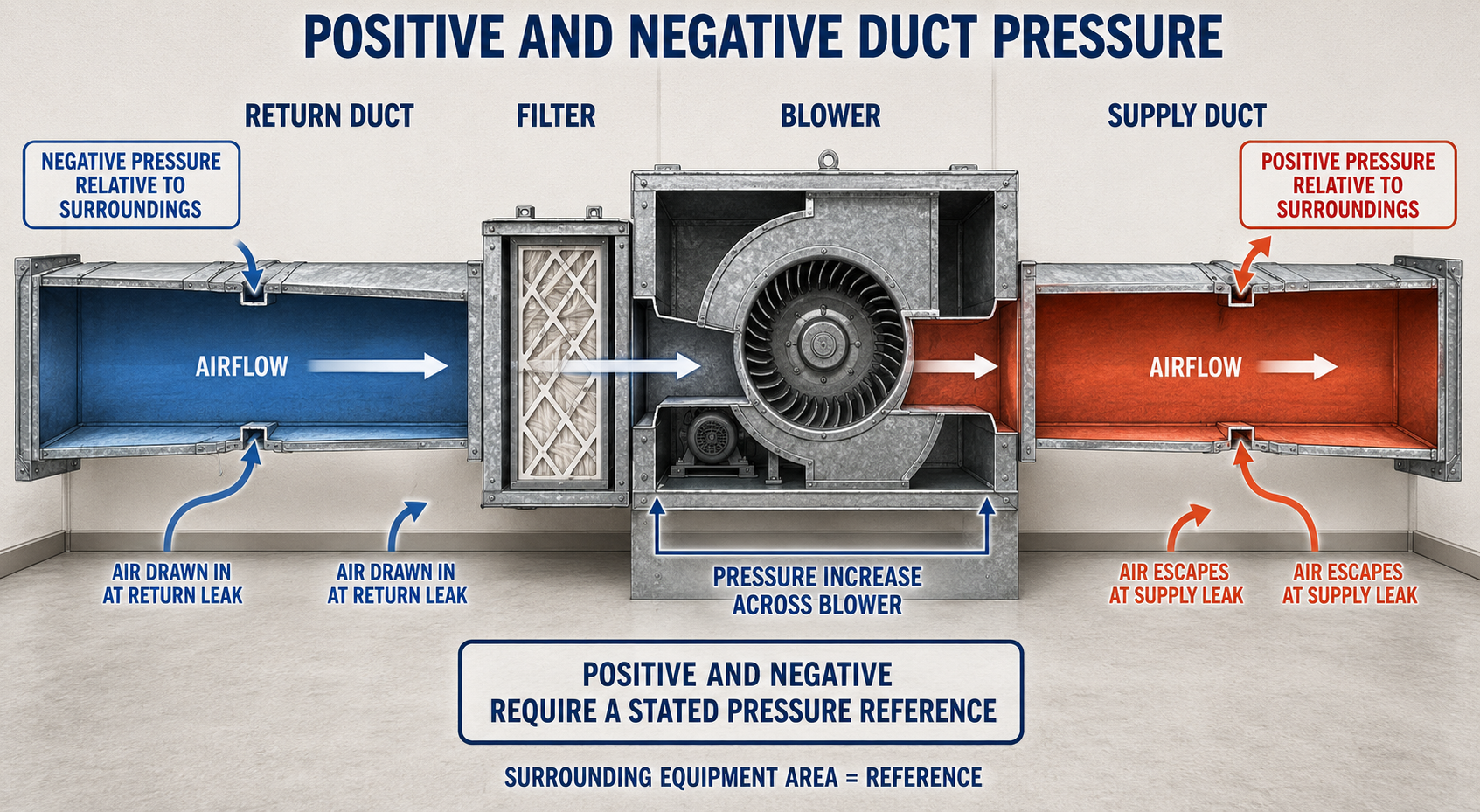
The blower creates a pressure rise between its inlet and outlet. The return system upstream of the blower is normally below the pressure of the surrounding space, while the supply system downstream of the blower is normally above it. The pressure generally moves closer to the occupied-space pressure as air travels toward the return grille or leaves a supply register.
Normally Negative
The blower draws air toward its inlet. Return ducts, filter sections located upstream of the blower, and return plenums normally operate below the pressure of the surrounding area.
Normally Positive
The blower discharges air toward the supply system. Supply plenums, trunks, branches, and boots normally operate above the pressure of the surrounding area.
A supply duct can have positive pressure and a return duct can have negative pressure while the system still has inadequate airflow. The reading must be compared with equipment data, expected pressure relationships, and other diagnostic measurements.
Pressure Difference Determines Leakage Direction
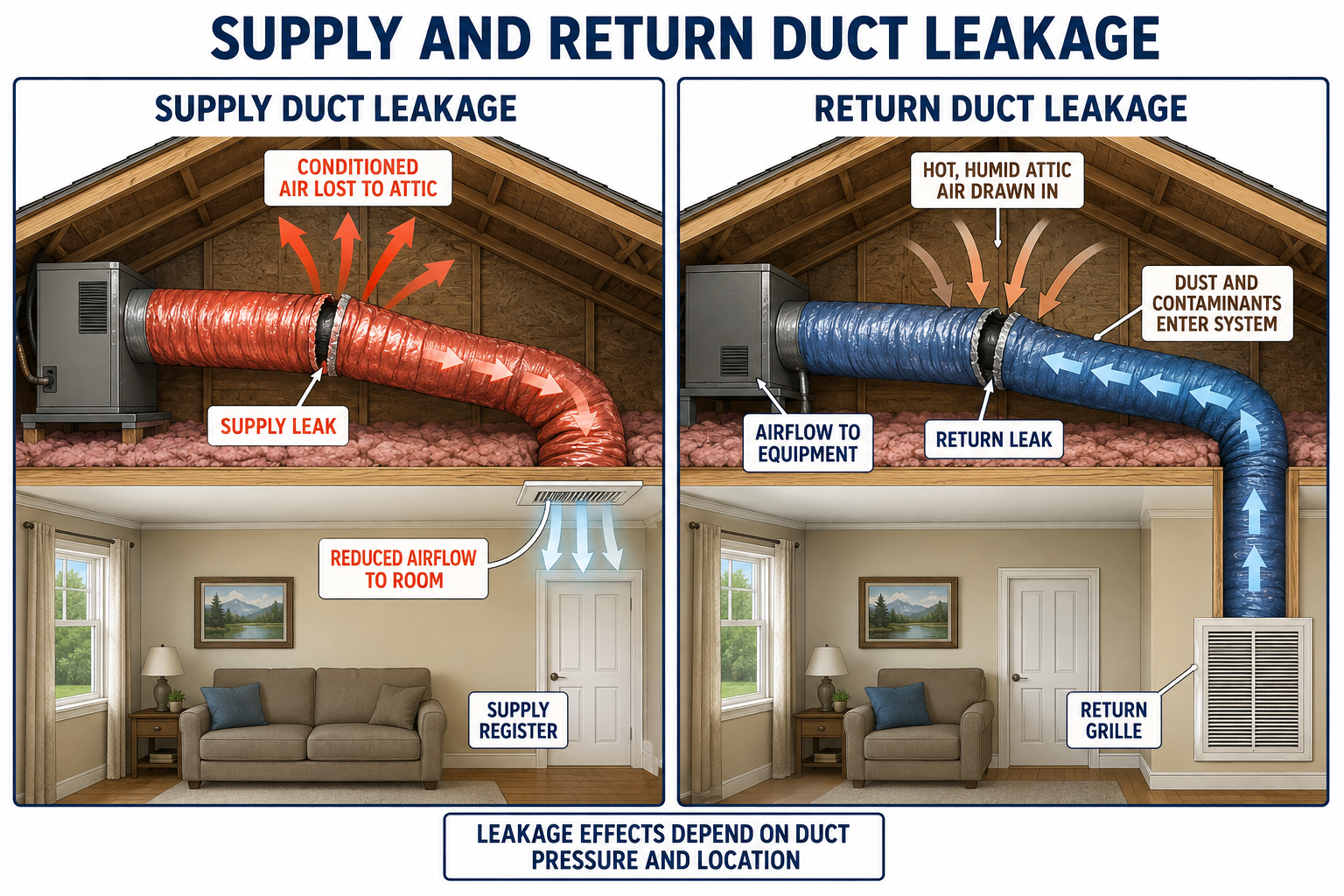
Air moves through a duct leak because pressure differs across the duct wall. The direction is predictable from the sign of the duct pressure relative to the space around the duct. The amount of leakage depends on the pressure difference and the size and shape of the leakage path.
Supply Leakage
Positive supply pressure pushes conditioned air outward through loose joints, disconnected ducts, damaged flex duct, unsealed boots, cabinet openings, and other leakage paths.
Return Leakage
Negative return pressure pulls surrounding air inward through return joints, filter-rack gaps, cabinet openings, building cavities used as returns, and other leakage paths.
Leakage Near the Blower
Pressure differences are often greatest near the blower, so an opening near the air handler can move substantially more air than an equal opening in a lower-pressure part of the system.
Operating Condition
Leakage effects can change with blower speed, filter condition, damper position, door position, zoning operation, and other conditions that alter system pressure.
Repair disconnected or damaged ducts and seal joints with materials intended for duct systems, such as listed duct mastic or appropriate listed tape. Ordinary cloth-backed household duct tape is not a durable duct-sealing repair.
Supply and Return Leakage Can Unbalance the Building
When ducts are entirely inside the conditioned enclosure, leakage may still reduce delivered airflow and cause comfort or balance problems. When leakage communicates with an attic, crawlspace, garage, mechanical closet, or outdoors, it can also change the pressure of the building relative to outdoors.
May Depressurize the Building
The return system removes air from the occupied space, but part of the supply airflow is lost outside the conditioned enclosure. The building may become negative relative to outdoors and draw outdoor air inward through envelope leaks.
May Pressurize the Building
The return pulls additional air from outside the conditioned enclosure and the supply delivers that added air into the building. The building may become positive relative to outdoors and push indoor air outward through envelope leaks.
Actual building pressure depends on the combined supply leakage, return leakage, exhaust appliances, ventilation equipment, open doors and windows, wind, stack effect, and building-envelope leakage. A single duct defect should not be assumed to be the only pressure influence.
Building depressurization can interfere with naturally drafted combustion appliances and can contribute to spillage or backdrafting. When duct repairs, return modifications, or pressure testing could affect combustion-air or venting conditions, follow applicable codes, manufacturer instructions, and established combustion-safety procedures.
A Supply Register Needs a Return-Air Path
A room supplied with air must have a path for approximately that air quantity to leave and return to the air handler. An open doorway may provide the path during normal use, but closing the door can greatly increase resistance if the room lacks a dedicated return, transfer grille, jump duct, or adequate door undercut.
Supplied Room
A closed room with a supply register but an inadequate return path can become positive relative to the hallway or main body of the building.
Return Area
The central-return area can become negative because the return is drawing air while closed rooms restrict the path for supplied air to return.
Comfort Effect
Restricted return paths can reduce supply airflow to affected rooms, change air balance, increase temperature differences, and create door movement or noticeable air movement at door gaps.
Building Effect
Room-to-room pressure differences can drive air through wall, ceiling, floor, attic, crawlspace, and envelope leakage paths rather than through an intended return route.
A grille may look large while the filter, duct, boot, transfer path, or return connection behind it is restrictive. Evaluate the complete air path and verify performance with appropriate measurements.
Location Changes the Consequences of Leakage
Ducts routed through unconditioned or contaminated areas require special attention. The pressure relationships are the same, but the air lost or drawn in may carry a much larger energy, moisture, or air-quality penalty than leakage between ducts and the conditioned space.
Attics
Supply leakage can waste heated or cooled air, while return leakage can draw very hot, cold, dusty, or humid attic air into the system.
Crawlspaces
Return leakage can draw moisture, odors, soil gases, insulation particles, or other contaminants from the crawlspace into the return airstream.
Garages
Return leakage or an improper return opening can pull vehicle exhaust, fuel vapors, chemicals, and other garage contaminants toward occupied areas and must be treated as a serious defect.
Mechanical Closets
Return leaks can alter closet pressure and may affect combustion air or venting where naturally drafted fuel-burning equipment is present.
Do not stop at visible trunk ducts. Include plenums, takeoffs, boots, filter racks, air-handler panels, platform returns, building cavities, flex-duct connections, and penetrations when inspecting for leakage and pressure-related defects.
Use Pressure Relationships as Evidence
Positive and negative pressure explain the direction air tends to move, but the sign alone does not identify the defect. A technician combines operating observations, pressure measurements, airflow information, temperature measurements, equipment data, and a physical inspection before reaching a conclusion.
Confirm the Reference
Record what each instrument connection is sensing. A duct-to-room reading, room-to-outdoors reading, and pressure drop across a component answer different questions.
Confirm the Sign
Check tubing connections and instrument zero before deciding that an unexpected plus or minus value represents an actual system condition.
Control the Test Condition
Record blower mode, speed, filter condition, damper positions, zone calls, door positions, and other factors that can change pressure relationships.
Compare Related Measurements
Use readings from both sides of the system or component when appropriate. A group of related measurements is more useful than one isolated pressure value.
Lesson 7 introduces airflow and duct-pressure instruments, while Lesson 8 explains correct static-pressure measurement locations and procedures. This lesson establishes the pressure relationships those measurements will reveal.
Avoid These Pressure Errors
“Negative Pressure Means Vacuum”
HVAC return pressure is only slightly below the selected reference pressure. It is not an absence of air or an absolute vacuum.
“Positive Pressure Is Always Good”
Positive pressure is normal in a supply duct, but excessive pressure may accompany restriction, improper blower setup, closed dampers, or insufficient outlet area.
“All Duct Leaks Blow Air Out”
Supply leaks usually blow outward, but negative-pressure return leaks draw surrounding air inward.
“A Closed Door Does Not Affect HVAC”
A door can become part of the air-distribution system by restricting the return path and creating room-to-room pressure differences.
“Leakage Inside the House Does Not Matter”
Leakage inside the conditioned enclosure may have a smaller energy penalty than leakage outside, but it can still reduce delivered airflow and disturb comfort and balance.
“The Sign Identifies the Fault”
The sign describes pressure relative to a reference. Diagnosis requires magnitude, location, operating condition, inspection, and comparison with expected performance.
Can You Interpret Positive and Negative Pressure?
- Why must a pressure reference be identified before a positive or negative reading can be interpreted?
- Relative to the surrounding room, which side of the blower normally operates at negative static pressure?
- Relative to the surrounding room, which side normally operates at positive static pressure?
- Which direction does air normally move through a supply-duct leak?
- Which direction does air normally move through a return-duct leak?
- Why can an opening near the blower move more air than an equal opening in a lower-pressure section?
- How can supply leakage outside the conditioned enclosure affect building pressure?
- How can return leakage outside the conditioned enclosure affect building pressure?
- Why can a bedroom become positive when its door is closed?
- Name three intentional return-air paths that can serve a closed room.
- Why is return leakage from a garage, attic, or crawlspace especially concerning?
- Why is the sign of one pressure reading not enough to diagnose a duct problem?
What You Should Have Learned
Positive and negative pressure describe a difference between two locations, so the reference must always be identified.
The return side of the blower normally operates at negative static pressure relative to its surroundings.
The supply side of the blower normally operates at positive static pressure relative to its surroundings.
Supply leakage pushes conditioned air outward, while return leakage draws surrounding air inward.
Duct leakage outside the conditioned enclosure can change building pressure and increase energy, moisture, contaminant, and combustion-safety concerns.
A closed supplied room needs an adequate return path or it can become positive relative to the central-return area.
Duct location changes the consequences of leakage even though the underlying pressure relationships remain the same.
Technicians diagnose pressure-related problems by combining referenced measurements, controlled operating conditions, equipment information, and physical inspection.