Back to: NASCLA Master Electrical Contractor Exam Preparation
Electrical wiring methods must be selected for the environment in which they are installed. Moisture, water, chemicals, salt, corrosive vapors, combustible dust, flammable gases, and other environmental conditions can affect conductor insulation, raceways, boxes, fittings, equipment enclosures, grounding connections, and the suitability of an entire electrical installation.
For the NASCLA Electrical Contractor Exam, you should be able to distinguish dry, damp, and wet locations; recognize corrosion and deterioration concerns; select wiring methods and equipment suitable for environmental exposure; and identify the basic NEC classification system for locations where fire or explosion hazards can exist.
Environment Determines Wiring-Method Suitability
A wiring method that is acceptable inside a dry building may not be suitable outdoors, underground, in a washdown area, near corrosive chemicals, or where flammable vapors are present. The NEC therefore requires electrical equipment and wiring methods to be selected for the actual conditions of use.
The first step is identifying the condition correctly. A wet location is not automatically a hazardous classified location. A corrosive environment is not automatically a hazardous classified location. Each condition creates different electrical concerns and can involve different NEC requirements.
Environmental Exposure Is Not the Same as Hazard Classification
A location can be wet without being hazardous classified. It can be corrosive without being hazardous classified. It can also be both corrosive and hazardous classified at the same time.
Do not select hazardous-location requirements simply because an installation is outdoors, wet, dirty, industrial, or corrosive. Hazardous classification is based on the potential presence of specific flammable or combustible materials capable of creating a fire or explosion hazard.
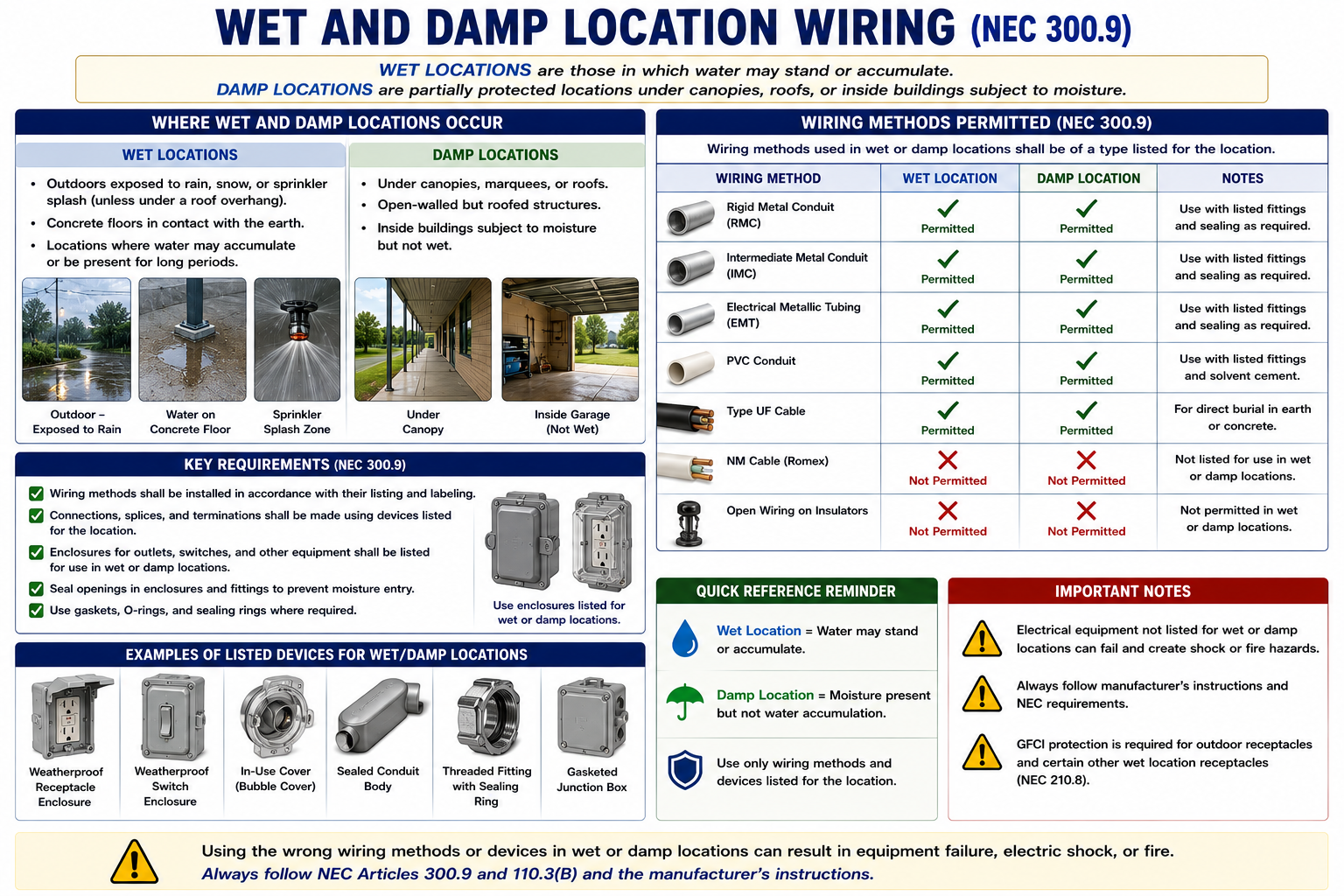
Dry, Damp, and Wet Locations
Article 100 definitions establish the terminology used throughout the NEC. Correctly identifying the location is essential because conductor types, raceways, enclosures, fittings, devices, and equipment can have different suitability requirements.
Dry Location
A location not normally subject to dampness or wetness. A temporarily damp or wet condition during construction does not necessarily change the normal classification of the finished location.
Damp Location
A location protected from weather and not subject to saturation with water or other liquids but subject to moderate degrees of moisture.
Wet Location
A location subject to saturation with water or other liquids, including certain underground locations and locations exposed directly to weather.
Moisture Without Direct Saturation
Damp locations can exist where moisture, condensation, or protected weather exposure is expected even though the equipment is not normally subjected to direct saturation with water.
Examples can include protected exterior areas, some partially enclosed structures, and locations where moderate moisture is normally present. The actual classification depends on the installation conditions rather than simply whether the location is indoors or outdoors.
Indoors Does Not Automatically Mean Dry
Laundries, food-processing areas, washdown spaces, agricultural buildings, and other indoor areas can contain damp or wet conditions. Determine the environmental exposure rather than assuming every interior installation is a dry location.
Water Changes Equipment and Wiring Requirements
Wet locations require wiring methods, conductors, boxes, fittings, enclosures, and equipment suitable for exposure to water or other liquids. Outdoor weather exposure and underground installations are common situations where wet-location requirements become important.
The entire installation must be considered. A wet-location enclosure does not make an unsuitable conductor acceptable, and wet-location conductors do not compensate for an enclosure or fitting that is not appropriate for the environment.
Evaluate the Complete Wiring System
Environmental suitability applies to more than the raceway. Check conductors, cables, boxes, fittings, connectors, covers, gaskets, support hardware, devices, enclosures, and other components individually.
A single unsuitable component can make the installation noncompliant even when the rest of the wiring system is correctly selected.
Conductor Insulation Must Be Suitable
Conductors installed in wet locations must have insulation identified for wet-location use. Common individual conductor designations such as THWN-2 and XHHW-2 are examples of conductor constructions used in wet locations when their markings and installation conditions permit.
Many conductors carry multiple markings. A conductor marked THHN/THWN-2, for example, can use the applicable wet-location portion of its listing when installed in a wet environment.
THHN Alone Does Not Establish Wet-Location Suitability
THHN is commonly associated with a 90°C dry-location rating. When a conductor is installed in a wet location, look for an additional wet-location designation such as THWN-2 rather than assuming the THHN marking alone makes it acceptable.
Underground Raceway Interiors Are Wet Locations
As covered in Lesson 53, the interior of an underground raceway is considered a wet location. This remains true even when the conduit joints are carefully assembled and the raceway appears to remain dry.
Moisture can enter through condensation, temperature differences, fittings, equipment, or other pathways. Wet-location conductor selection is therefore required by the environmental classification rather than by whether water is visible during installation.
Keep Water From Entering or Accumulating
Boxes, conduit bodies, and fittings installed in damp or wet locations must be installed so moisture does not enter or accumulate in a manner prohibited by the NEC. Components installed in wet locations must be listed or otherwise suitable for that use as required by the applicable provisions.
Covers, gaskets, hubs, connectors, plugs, and other fittings must work together with the enclosure to maintain the required environmental protection.
Enclosure Ratings Describe Specific Protection
Electrical enclosures can be marked with enclosure type designations indicating the environmental conditions for which they are designed. Different enclosure types provide different degrees of protection against water, dust, corrosion, and other conditions.
Do not assume that all outdoor-rated enclosures provide the same protection. Select an enclosure type appropriate to the actual exposure and equipment requirements.
Indoor Protection
Some enclosure types primarily protect against accidental contact and limited falling dirt in dry indoor environments.
Weather Exposure
Outdoor enclosure types provide specified levels of protection against rain, snow, sleet, or other weather conditions.
Water Exposure
Some enclosure types provide additional protection against hose-directed water, splashing, or other more severe water exposure.
Corrosion Resistance
Certain enclosure designations include additional corrosion-resistance characteristics for demanding environments.
Do Not Memorize One “Outdoor Box” Rating
The correct enclosure depends on the condition described in the question. Determine whether the concern is rain, water spray, dust, corrosion, hazardous material, or another environmental condition and then use the applicable NEC table, listing, or equipment marking.
Chemicals and Environment Can Attack Electrical Equipment
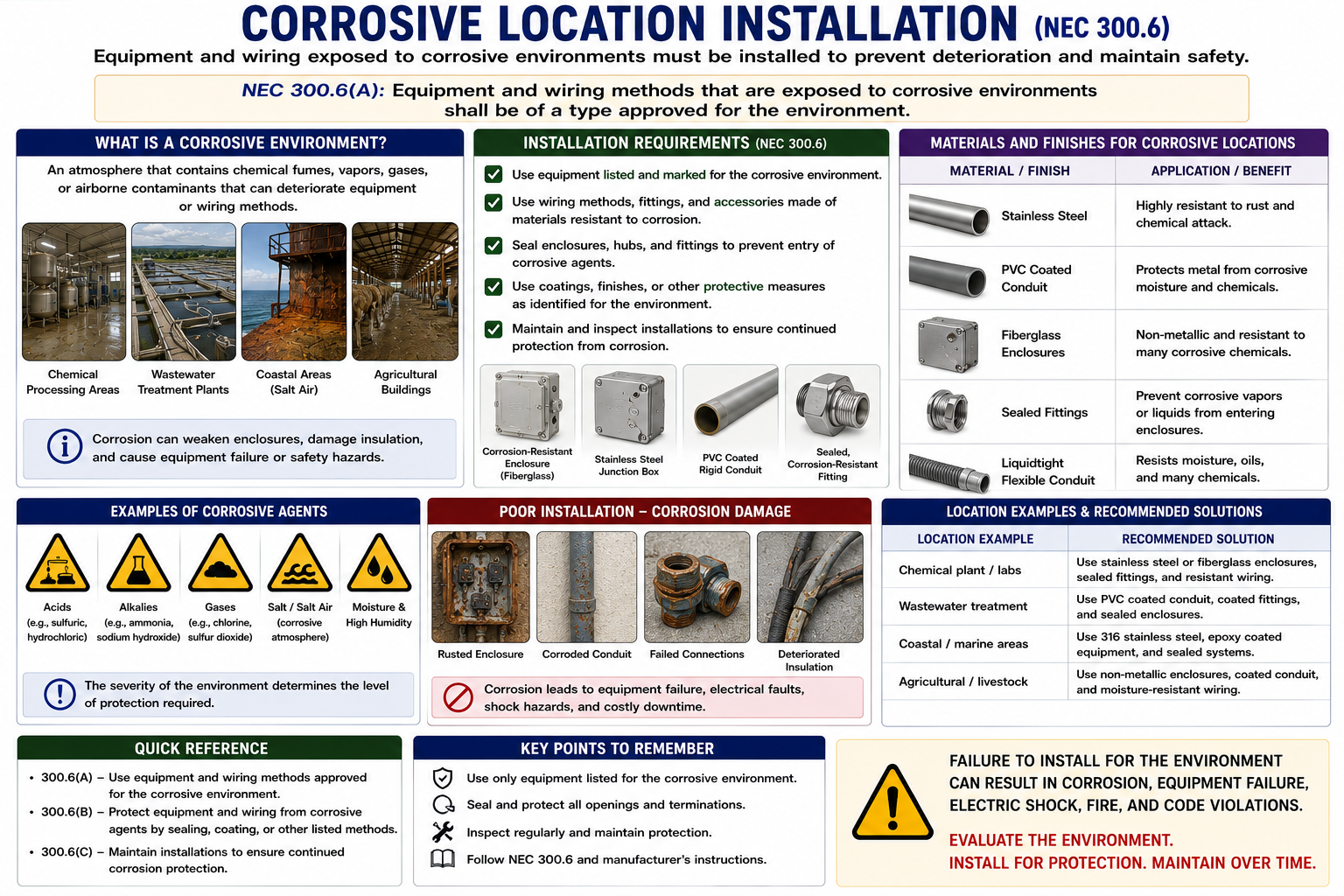
Corrosion can damage raceways, boxes, fittings, cable armor, enclosures, supports, bonding connections, and equipment. NEC 300.6 requires wiring-system materials to be suitable for the environment and establishes protection requirements for equipment subject to corrosion and deterioration.
Corrosive conditions can result from chemicals, salts, moisture, agricultural environments, industrial processes, coastal exposure, cleaning agents, deicing chemicals, and other influences.
Suitability Applies to More Than the Raceway
Protection against corrosion and deterioration applies to raceways, cable armor, boxes, cabinets, elbows, couplings, fittings, supports, support hardware, and other parts of the wiring system.
A corrosion-resistant enclosure does not solve the problem if the straps, fasteners, fittings, or grounding connections deteriorate around it.
Corrosion Protection Must Match the Condition
Ferrous metal wiring components can require corrosion-resistant coatings or other approved protection. Where equipment is in direct contact with earth, embedded in concrete, or subject to severe corrosive influences, the material or protective system must be approved for the condition.
An ordinary coating should not automatically be assumed adequate for every outdoor, underground, chemical, or coastal installation.
Airspace Can Be Required
In certain indoor wet locations, exposed wiring systems can require an airspace between the wiring system and the wall or supporting surface. This helps prevent moisture from remaining trapped against metallic wiring components and supports corrosion control.
Specific exceptions can apply to nonmetallic raceways, boxes, and fittings installed on concrete, masonry, tile, or similar surfaces. Always verify the exact 300.6 requirements for the installation described.
Choose Materials for the Environment
Metallic Systems
Confirm that the raceway, fittings, enclosures, and coatings are approved for the corrosive exposure.
Nonmetallic Systems
Nonmetallic materials can resist many corrosive environments, but they must still be specifically suitable for the chemicals, temperature, physical exposure, and installation conditions.
Support Hardware
Straps, screws, bolts, brackets, and other supports must withstand the same environmental conditions as the wiring method.
Connections
Grounding, bonding, and electrical connections must remain reliable despite moisture, chemicals, oxidation, and environmental deterioration.
Corrosion Can Become an Electrical Safety Problem
Corrosion is not merely cosmetic. It can weaken enclosures, damage raceways, increase connection resistance, compromise grounding and bonding paths, expose energized conductors, or allow water and contaminants to reach live parts.
Fire and Explosion Hazards Require a Different Analysis
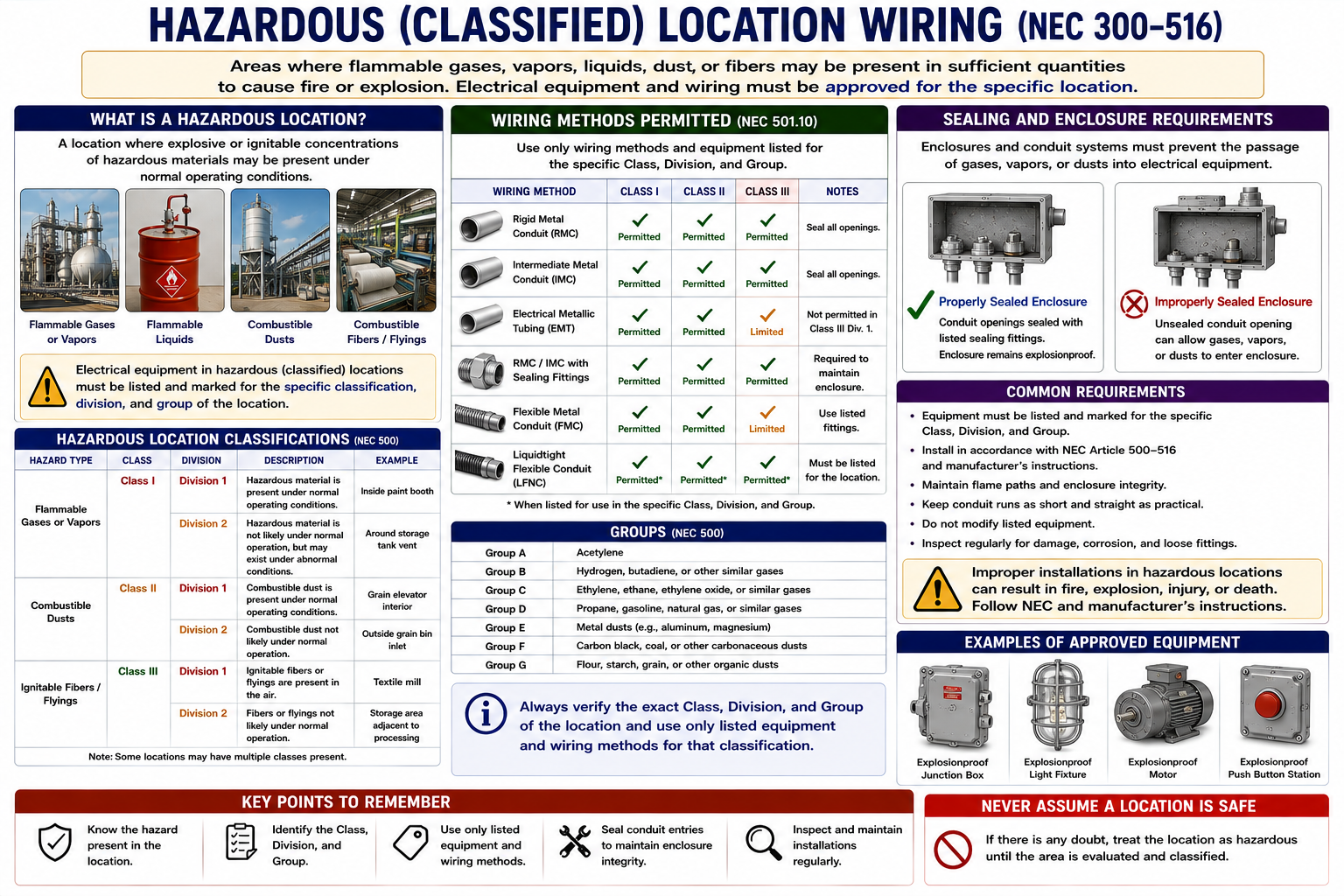
A hazardous classified location is an area where fire or explosion hazards can exist because flammable gases or vapors, combustible dusts, or easily ignitible fibers or flyings are or may be present in sufficient quantities or under conditions addressed by the NEC classification rules.
Electrical equipment can provide an ignition source through arcs, sparks, hot surfaces, switching contacts, motors, luminaires, or equipment failure. Hazardous-location rules are intended to prevent electrical equipment from igniting the surrounding atmosphere or material.
Class Identifies the Type of Hazard
The traditional NEC Class/Division system separates hazardous locations according to the type of hazardous material present.
Class I
Locations involving flammable gases, flammable liquid-produced vapors, or combustible liquid-produced vapors capable of creating an ignitible mixture.
Class II
Locations hazardous because of the presence of combustible dust.
Class III
Locations hazardous because of easily ignitible fibers or flyings.
Flammable Gases and Vapors
Class I locations involve flammable gases or vapors that can form ignitible mixtures with air. Examples can occur around fuel handling, solvent processes, chemical operations, and other installations where flammable gases or vapors are present.
Article 501 contains the primary requirements for Class I locations using the Division classification system.
Combustible Dust
Class II locations involve combustible dust capable of creating a fire or explosion hazard. Dust hazards can occur in industries handling grain, pulverized materials, certain metals, carbonaceous materials, and other combustible particulate products.
Article 502 contains the primary requirements for Class II locations using the Division system.
Ignitible Fibers and Flyings
Class III locations involve easily ignitible fibers or flyings that present a fire hazard. These materials are generally larger than combustible dust particles and are not normally suspended in the air in quantities sufficient to create the same type of explosive dust cloud associated with Class II locations.
Article 503 contains the primary requirements for Class III locations using the Division system.
I = Gas/Vapor • II = Dust • III = Fibers
A useful starting point for the traditional classification system is:
Class I — gases and vapors
Class II — combustible dust
Class III — ignitible fibers and flyings
Division Describes the Likelihood of the Hazard
After identifying the Class, the Division system considers the likelihood that the hazardous material will be present in an ignitible concentration.
Division 1
The hazardous material is present or can normally be present under conditions described by the applicable classification rules.
Division 2
The hazardous material is normally contained or not normally present in an ignitible concentration but can become hazardous under abnormal conditions described by the classification rules.
Class = What • Division = How Likely
For introductory exam navigation, think of the Class as identifying what type of combustible material creates the hazard and the Division as describing how likely the hazardous condition is to be present.
The exact NEC definitions contain additional conditions, so use Article 500 when a question requires the formal classification.
Hazardous Materials Are Further Grouped
Within hazardous classification, materials can also be assigned to groups according to their ignition and combustion characteristics. The equipment selected for a classified location must be suitable not only for the Class and Division but also for the applicable material group and other operating conditions.
Do not assume that equipment approved for one hazardous material is automatically suitable for every material within the same Class.
Hot Surfaces Can Be Ignition Sources
Hazardous-location equipment must be evaluated for surface temperature as well as sparks and arcs. Equipment operating temperatures must remain within the limits appropriate to the hazardous material involved.
A motor, luminaire, enclosure, heater, or other electrical component can present an ignition hazard even when it produces no visible spark.
Different Methods Control Ignition Risk
The NEC recognizes multiple protection techniques for hazardous classified locations. The required technique depends on the classification, equipment, wiring method, and applicable article.
Explosionproof Equipment
Equipment is constructed to contain an internal explosion and prevent ignition of the surrounding atmosphere under its listing conditions.
Dust-Ignitionproof Equipment
Equipment is designed for applicable combustible-dust environments and limits ignition risks associated with dust entry and equipment temperatures.
Purging and Pressurization
A protective gas or pressure system can be used under applicable rules to prevent the hazardous atmosphere from entering equipment.
Intrinsically Safe Systems
Energy is limited so the circuit cannot release sufficient electrical or thermal energy to ignite the specified hazardous atmosphere under the applicable conditions.
Explosionproof Is Not a Generic Word for All Hazardous Equipment
Different hazardous environments use different protection techniques. Do not describe every approved hazardous-location enclosure or device as explosionproof.
Use the terminology and equipment suitability required by the applicable NEC article and listing.
Ordinary Wiring Methods May Be Restricted
Hazardous classified locations place additional requirements on raceways, cable systems, fittings, seals, boxes, enclosures, equipment, and installation practices. The permitted methods depend on the specific Class, Division or Zone, and application.
A wiring method permitted in an ordinary dry or wet location is not automatically permitted in a hazardous classified location.
Hazardous-Location Seals Have a Specific Purpose
Classified-location installations can require sealing fittings to reduce the passage of gases, vapors, flames, or other hazardous effects through raceway systems and to limit pressure propagation under the conditions addressed by the NEC.
Hazardous-location sealing rules should not be confused with ordinary sealing used to control condensation or moisture movement in nonclassified raceways.
Moisture Seal ≠ Hazardous-Location Seal
A seal used to prevent warm air from circulating into a cold raceway is addressing condensation. A sealing fitting required by a hazardous-location article addresses ignition and hazardous-atmosphere concerns.
Similar words do not mean the requirements are interchangeable.
The NEC Also Recognizes Zone Classification
The NEC includes Zone classification systems in addition to the traditional Class/Division system. Class I gas and vapor locations can use applicable Zone 0, Zone 1, and Zone 2 provisions, while combustible-dust environments can use applicable Zone 20, Zone 21, and Zone 22 provisions.
For exam questions, first determine which classification system the problem specifies. Do not mix Division and Zone terminology within the same analysis unless the applicable NEC provisions specifically require comparison or conversion.
Hazardous Area Classification Is Documented
Hazardous-location classification is not intended to be an informal field guess. NEC Article 500 includes documentation requirements for areas requiring classification and for the basis of the classification.
Electrical contractors must use the established classification information to select wiring methods and equipment appropriate to the designated area.
Do Not Guess a Hazardous Classification
Whether an area is Class I Division 1, Class I Division 2, unclassified, or another classification can depend on process materials, ventilation, equipment design, containment, release sources, and the physical extent of the hazardous area.
Use the approved classification documentation and applicable NEC requirements rather than assigning a classification based only on appearance.
One Location Can Have Several Environmental Requirements
An installation can be outdoors, wet, corrosive, and hazardous classified simultaneously. Meeting the requirements for one condition does not cancel the others.
For example, equipment in a classified coastal processing area might need to satisfy hazardous-location requirements, wet-location requirements, and corrosion-resistance requirements at the same time.
Apply Every Condition Described
When a problem contains several environmental clues, make a separate list of each condition before selecting the wiring method or equipment.
Ask whether the installation is wet or damp, corrosive, hazardous classified, subject to physical damage, underground, or exposed to another special condition. Then verify the NEC requirements for each applicable condition.
Corrosive Does Not Mean Class I
A chemical can corrode electrical equipment without creating a flammable gas or vapor hazard. Conversely, a flammable gas can create a Class I location without necessarily producing severe corrosion.
The words chemical, industrial, fuel, or processing do not establish the classification by themselves. Identify the actual hazard described.
Dust Does Not Automatically Mean Class II
Ordinary dirt, construction dust, and noncombustible dust do not automatically create a Class II hazardous location. Class II classification involves combustible dust under the conditions addressed by Article 500 and Article 502.
Determine the material and classification rather than treating every dusty environment as hazardous classified.
A Wet Location Is Not Automatically Corrosive
Water exposure creates wet-location requirements, but the presence and severity of corrosion depend on the material, contaminants, chemicals, salts, environmental conditions, and equipment construction.
Evaluate moisture suitability and corrosion resistance separately where necessary.
Analyze Environmental Questions Systematically
Identify the Environment
Determine whether the location is dry, damp, wet, corrosive, hazardous classified, or subject to more than one condition.
Identify the Hazard
If classified, determine whether the material is a gas or vapor, combustible dust, or ignitible fibers or flyings.
Determine Classification
Identify the applicable Class and Division or Zone from the problem and classification documentation.
Select the Wiring Method
Verify that the raceway or cable is permitted for every environmental and classified condition involved.
Check Components
Verify conductor insulation, fittings, boxes, seals, enclosures, supports, covers, and equipment individually.
Check Corrosion Protection
Determine whether materials or coatings are suitable for corrosive influences and deterioration.
Check Equipment Approval
For hazardous classified locations, confirm that equipment is suitable for the Class, Division or Zone, material group, temperature, and other applicable conditions.
Start With the Condition, Then Find the Article
Environmental questions become easier when you identify the condition before searching the Code. For moisture and corrosion, begin with the general wiring requirements and the applicable wiring-method article. For hazardous classified locations, begin with Article 500 and then move to the article addressing the specific Class or classification system.
Code Locations to Know
Article 100
Definitions, including terminology used for dry, damp, wet, and hazardous classified locations.
300.5(B)
Establishes underground raceway and enclosure interiors as wet locations.
300.6
Protection against corrosion and deterioration.
300.7
Raceways exposed to different temperatures, including sealing where condensation is a problem.
310.10
Uses and applications of insulated conductors, including environmental suitability.
314.15
Boxes, conduit bodies, and fittings in damp or wet locations.
Article 500
General requirements for hazardous classified locations using Classes I, II, and III and Divisions 1 and 2.
Article 501
Class I locations involving flammable gases and vapors.
Article 502
Class II locations involving combustible dust.
Article 503
Class III locations involving ignitible fibers and flyings.
Article 504
Intrinsically safe systems.
Article 505
Zone classification for applicable Class I gas and vapor locations.
Article 506
Zone classification for combustible dust and ignitible fiber or flying locations.
Key Points to Remember
- Environmental conditions affect conductor, cable, raceway, box, fitting, enclosure, support, and equipment selection.
- Dry, damp, and wet locations are different environmental classifications.
- An indoor location can be damp or wet.
- Conductors installed in wet locations must be suitable for wet-location use.
- THHN alone should not be treated as a wet-location designation; look for an appropriate wet-location marking such as THWN-2.
- Underground raceway interiors are wet locations.
- Boxes, conduit bodies, fittings, covers, and connectors must be suitable for the environmental exposure.
- An enclosure rating describes specific environmental protection and should not be reduced to a generic “outdoor-rated” label.
- NEC 300.6 addresses protection against corrosion and deterioration.
- Corrosion protection applies to raceways, boxes, fittings, supports, hardware, enclosures, and other components.
- Corrosion can compromise grounding and bonding as well as physical enclosure integrity.
- A corrosive location is not automatically a hazardous classified location.
- A wet location is not automatically a hazardous classified location.
- Hazardous classified locations involve fire or explosion hazards associated with specified combustible materials.
- Article 500 provides the foundation for the traditional Class/Division hazardous-location system.
- Class I involves flammable gases and vapors.
- Class II involves combustible dust.
- Class III involves easily ignitible fibers or flyings.
- Division 1 generally represents conditions where the hazardous material is normally or frequently present under the classification rules.
- Division 2 generally represents conditions where the hazardous material is not normally present in an ignitible concentration but can become present under abnormal conditions.
- Class identifies the type of hazard; Division addresses the likelihood or conditions of presence.
- Material groups and equipment temperature ratings also affect hazardous-location equipment selection.
- Not all hazardous-location equipment is properly described as explosionproof.
- Hazardous-location sealing and ordinary condensation sealing serve different purposes.
- The NEC also provides Zone classification systems.
- Hazardous area classification should be based on documented classification information rather than field guesswork.
- A single installation can simultaneously be wet, corrosive, and hazardous classified.
- When several environmental conditions apply, the installation must satisfy the requirements for all of them.
Leave a Reply
You must be logged in to post a comment.