High-Pressure Switches
A high-pressure switch monitors refrigerant pressure on the high side of an HVAC/R system. When pressure rises to the control’s cut-out point, the switch opens the controlled circuit to stop the compressor or initiate another protective response.
High-pressure cutouts are commonly treated as safety controls. Many use manual-reset lockout so the equipment cannot restart automatically after a serious high-pressure condition. The cause must be identified and corrected before the control is reset.
What You Will Learn
By the end of this lesson you should be able to:
Locate the high-pressure switch.
Identify where the control senses discharge-side or condensing pressure.
Explain open-high contact action.
Describe how the controlled contact path opens as pressure rises to cut-out.
Explain manual-reset lockout.
Describe why pressure recovery alone does not restart equipment after a manual-reset trip.
Recognize common trip conditions.
Identify airflow, waterflow, refrigerant, valve, restriction, and ambient conditions that can raise high-side pressure.
Reset the control responsibly.
Explain why the cause must be corrected and pressure must return to an allowable level before reset.
Diagnose before replacing the switch.
Separate an actual high-pressure condition from a sensing, wiring, setting, or control problem.
Monitoring Discharge or Condensing Pressure
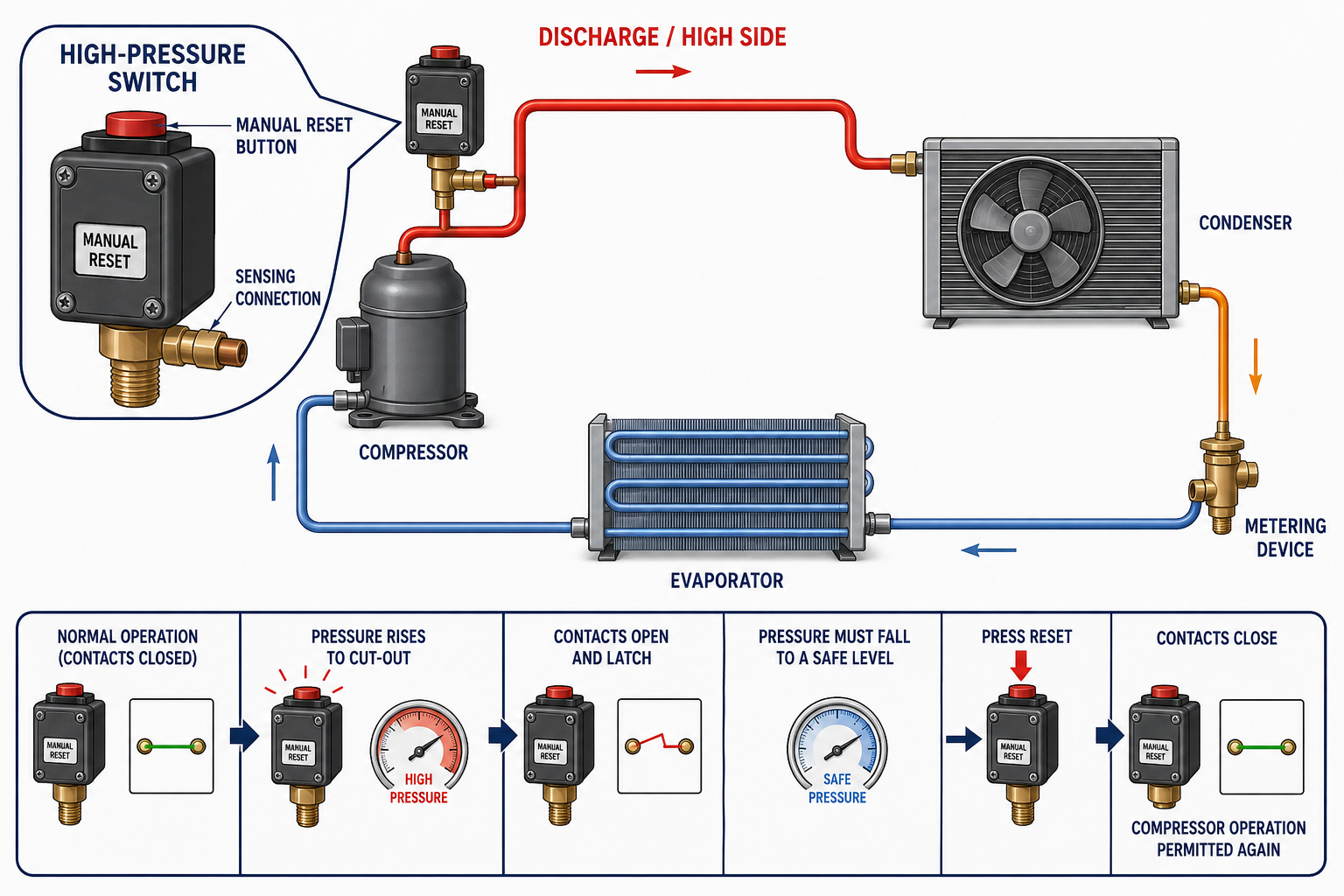
The high-pressure switch is connected where it can sense pressure on the high side of the refrigeration system. Depending on equipment design, the connection may be located at the compressor discharge, condenser, receiver, liquid line, or another manufacturer-selected high-side location.
Pressure acts through a fitting, capillary tube, hose, or direct connection on the switch’s sensing element. The control responds to the pressure at that connection, so restrictions, trapped pressure, closed service valves, leaks, or damage in the sensing path can affect its operation.
High-side pressure depends on refrigerant type. Converting measured pressure to saturation temperature helps the technician compare the condensing condition with outdoor-air, water, or other condenser-medium temperature.
Contacts Open as Pressure Rises
Cut-Out
When sensed pressure rises to the high-pressure cut-out setting, the controlled normally closed contact path opens and interrupts the compressor or control circuit.
Reset Becomes Possible
After the cause is corrected, pressure must fall to the control’s required reset condition before a manual-reset mechanism can restore the contact path.
High-pressure controls are available with different contact arrangements and reset methods. Use the control label and wiring diagram to identify the controlled terminals, cut-out setting, required reset condition, and whether the model resets manually or automatically.
Pressure Recovery Alone Does Not Restart the Equipment
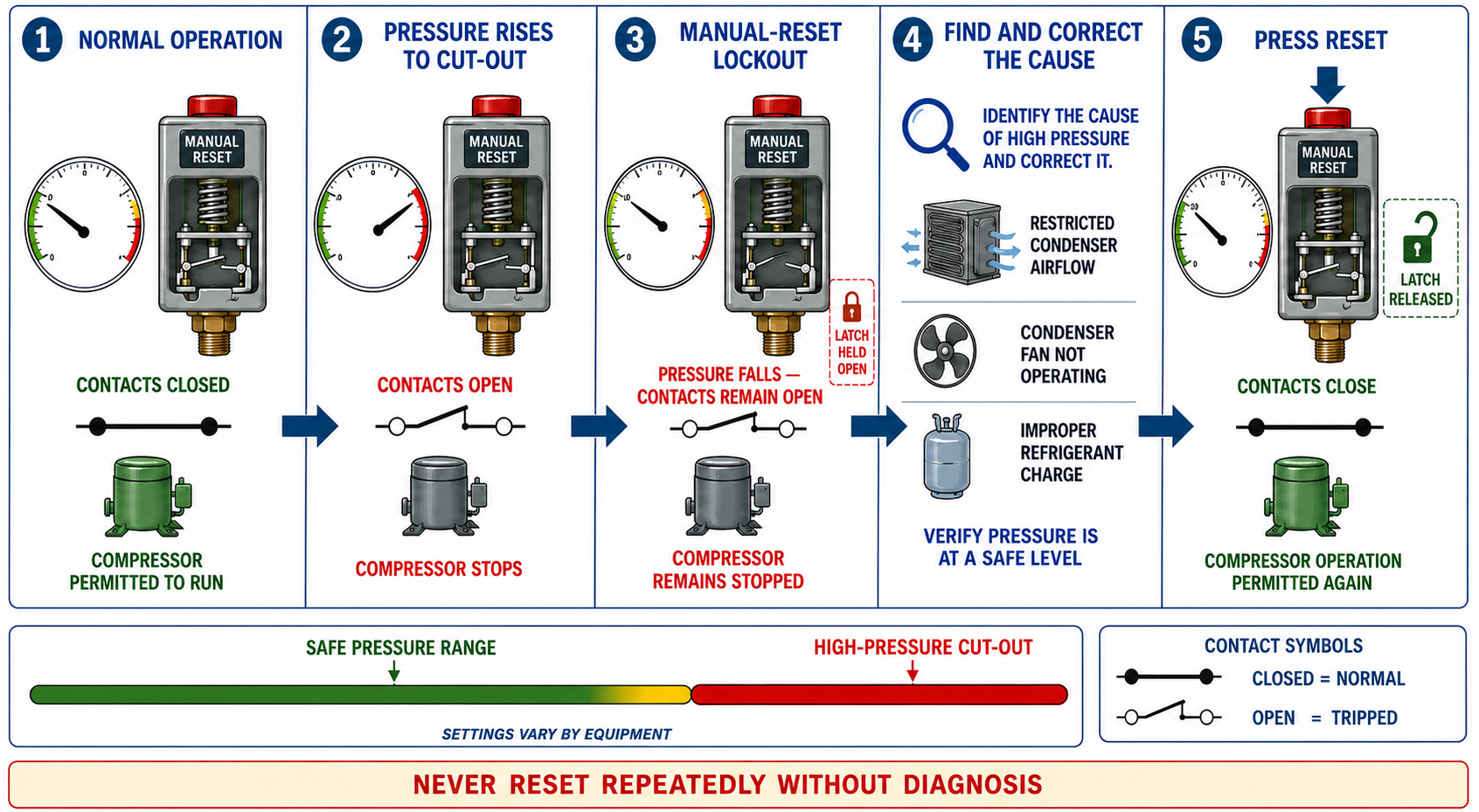
A manual-reset high-pressure control locks out when pressure reaches its cut-out point. Even after pressure falls, the contacts remain in the tripped state until the control permits reset and the reset button or lever is pressed and released.
1. High Pressure Occurs
System pressure rises to the specified cut-out point.
2. Control Trips
The high-pressure contact path opens and stops the controlled equipment.
3. Control Remains Locked Out
The circuit does not automatically restore merely because pressure begins to fall.
4. Cause Is Diagnosed
The technician determines why pressure rose and corrects the underlying condition.
5. Pressure Reaches the Reset Condition
Pressure must fall to the value required by the exact control before reset is possible.
6. Control Is Reset
The reset mechanism is pressed and released, restoring the contact path if all reset conditions are satisfied.
Many manual-reset controls use a trip-free mechanism that cannot be defeated by holding or tying down the reset button. Follow the exact manufacturer’s reset instructions rather than attempting to force the mechanism.
Preventing Unattended Restart
A serious high-pressure condition can threaten equipment and create additional hazards. Manual-reset lockout prevents the compressor from repeatedly restarting as pressure falls and then tripping again when the cause has not been corrected.
Pressure Can Restore Operation
An automatic-reset model can close its contacts after pressure falls to the specified cut-in or reset point.
Deliberate Action Is Required
A manual-reset model remains locked out until pressure permits reset and a person deliberately operates the reset mechanism.
Not every high-pressure control is manual reset: Automatic-reset high-pressure controls exist for suitable applications. Determine the actual model and equipment requirements instead of identifying reset action by appearance alone.
Why High-Side Pressure Rises
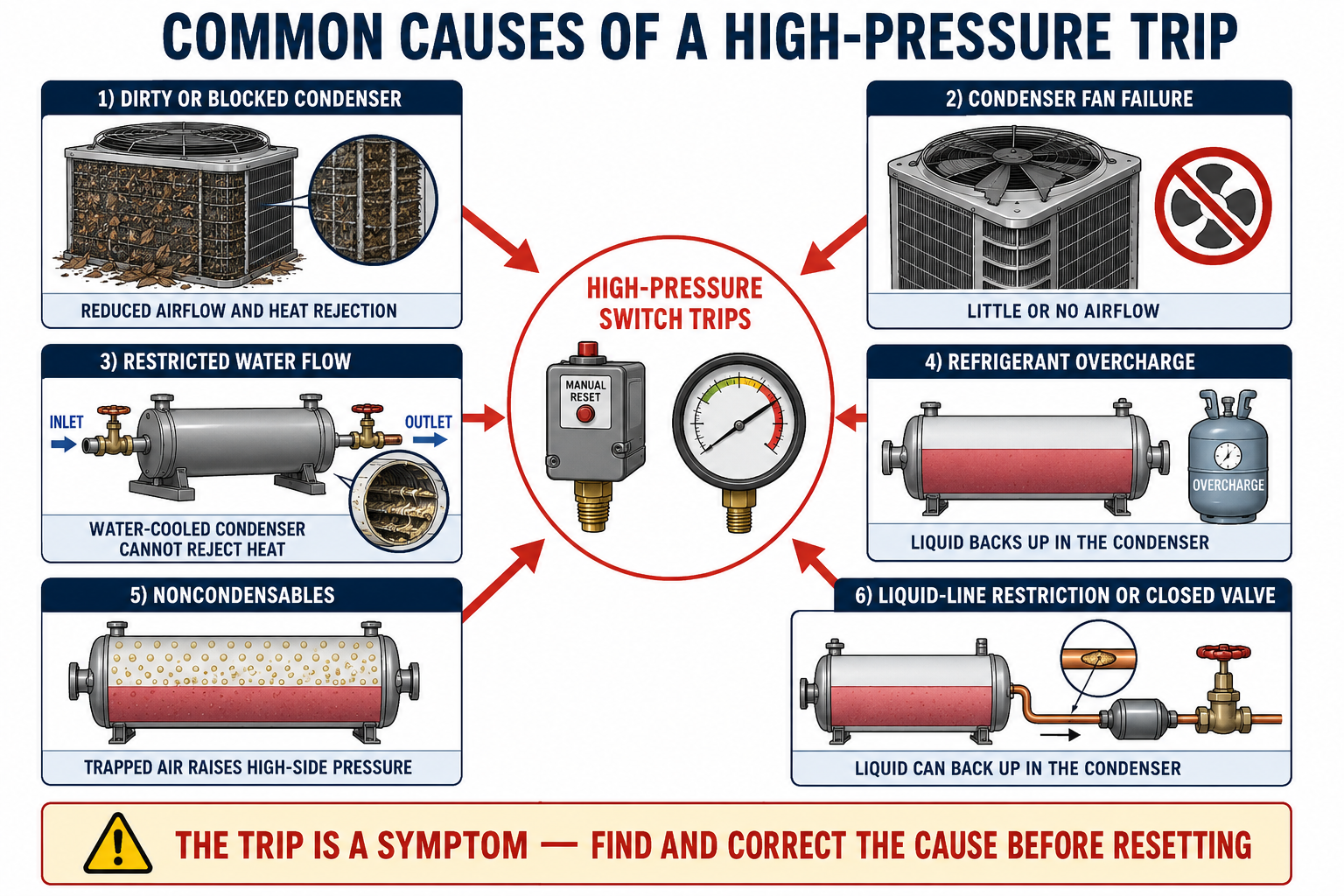
Dirty or Blocked Condenser
Dirt, debris, bent fins, blocked air paths, or scale can reduce condenser heat transfer and raise condensing pressure.
Condenser Fan Problem
A failed motor, incorrect rotation, damaged blade, incorrect speed, cycling-control problem, or blocked airflow can reduce heat rejection.
Waterflow Problem
On a water-cooled condenser, inadequate waterflow, warm entering water, fouling, pump failure, or a valve problem can raise condensing pressure.
Hot-Air Recirculation
Discharge air that returns to the condenser inlet can increase entering-air temperature and reduce the condenser’s ability to reject heat.
Refrigerant Overcharge
Excess refrigerant can reduce effective condenser volume, back liquid into the condenser, and contribute to elevated high-side pressure.
Noncondensable Gas
Air or another noncondensable gas in the sealed system adds partial pressure and can cause abnormally high head pressure.
Restriction or Closed Valve
A closed discharge or liquid valve, crushed line, or severe restriction can create excessive pressure upstream of the blockage.
High Condenser Load
Extreme ambient temperature, excessive refrigeration load, or operating conditions outside the equipment rating can increase condensing pressure.
Find and Correct the Cause
Inspect the Condenser
Check coil cleanliness, airflow paths, fan operation, waterflow, entering-medium temperature, and evidence of recirculation.
Check Valve Positions
Verify service valves, hand valves, solenoid valves, and other flow-control devices are in the required operating positions.
Evaluate Refrigerant Conditions
Use pressure, saturation temperature, line temperature, subcooling, system history, and manufacturer charging procedures to evaluate the refrigerant side.
Verify the Switch
Confirm the model, setting, pressure rating, contact path, sensing connection, and actual operating pressure before condemning the control.
Never hold the contactor closed, force the reset mechanism, or repeatedly reset a tripping high-pressure control. If the cause has not been corrected, restarting can rapidly return the system to damaging pressure.
Determine Whether the Switch Operated Correctly
1. Confirm the Complaint
Determine whether the control is currently tripped, intermittently trips, or has been reset before you arrived.
2. Identify the Control
Read the model, pressure range, cut-out setting, reset type, contact arrangement, and electrical rating.
3. Measure High-Side Pressure
Use appropriate test instruments and the correct refrigerant scale to determine whether pressure reached the specified cut-out point.
4. Check Contact State
Use the wiring diagram and safe electrical test procedures to determine whether the controlled contact path is open or closed as expected.
5. Inspect the Sensing Path
Check the pressure connection, capillary tube, hose, fittings, and service valves for restrictions, damage, leakage, or trapped pressure.
6. Correct and Verify
Correct the cause, allow pressure to reach the required reset condition, reset only as instructed, and verify operation through an appropriate test cycle.
A defective switch may open at the wrong pressure, fail to open, fail to reset, have damaged contacts, or lose its pressure-sensing integrity. Replacement is justified only after measured pressure and electrical contact action are compared with the exact specifications.
High Pressure and Electricity Require Control
Stay Within Equipment Ratings
Never intentionally raise pressure beyond the ratings of the control, equipment, test instruments, hoses, or system components to test a cutout.
De-Energize for Resistance Tests
Turn off power, verify the circuit is de-energized, and isolate the contact path as required before measuring resistance or continuity.
Use Appropriate Instruments
Use gauges, probes, hoses, fittings, and electrical meters rated for the refrigerant, pressure, voltage, and environment involved.
Follow Manufacturer Procedures
Use the equipment and control manufacturer’s service information for settings, reset conditions, test procedures, refrigerant handling, and component replacement.
A bypass removes the protection intended to stop equipment during excessive pressure. Any temporary diagnostic action must be specifically authorized by applicable procedures and performed only by a qualified person who maintains control of the equipment.
Avoid These High-Pressure Control Errors
“A tripped switch is the failed component.”
The switch may have correctly stopped the system because pressure reached its cut-out setting.
“If pressure fell, it is safe to reset.”
Pressure may fall after the compressor stops even though the condenser, refrigerant, valve, or airflow problem remains.
“Every high-pressure switch is manual reset.”
Manual-reset models are common safety controls, but automatic-reset high-pressure controls also exist.
“High head pressure always means overcharge.”
Overcharge is one possibility. Poor heat rejection, noncondensables, restrictions, closed valves, high load, and sensing problems must also be considered.
Can You Explain High-Pressure Switch Operation?
- Where is a high-pressure switch connected in the refrigeration system?
- What happens to an open-high contact path when pressure reaches cut-out?
- Why does a manual-reset control remain open after pressure falls?
- What must occur before a manual-reset high-pressure control can be reset?
- Why is manual-reset lockout used on many high-pressure safety controls?
- Name four condenser-side conditions that can raise high-side pressure.
- How can refrigerant overcharge contribute to high pressure?
- How can noncondensable gas affect high-side pressure?
- Why should saturation temperature be considered with a pressure reading?
- Why can pressure fall after a trip even when the original fault remains?
- What should be checked before condemning the pressure switch?
- Why must a high-pressure safety never be permanently bypassed?
What You Should Have Learned
A high-pressure switch senses refrigerant pressure on the high side of the system.
An open-high control opens its controlled contact path at cut-out as pressure rises.
A manual-reset control locks out and does not automatically restore operation when pressure falls.
The underlying cause must be corrected and pressure must reach the specified reset condition before reset.
Poor condenser airflow or waterflow, hot-air recirculation, overcharge, noncondensables, restrictions, and closed valves can cause high pressure.
Pressure should be converted to saturation temperature and compared with the condenser medium and operating conditions.
A tripped high-pressure switch may be operating correctly and should not be replaced without pressure and electrical testing.
A high-pressure safety must never be repeatedly reset, forced closed, or permanently bypassed.