Fixed and Adjustable Pressure Switches
Pressure switches may be built with factory-established operating points or with settings that can be adjusted in the field. The correct choice depends on the required pressure function, reset action, contact arrangement, pressure range, electrical load, refrigerant compatibility, and equipment specifications.
Adjustability does not make a control universal. Every adjustable switch has limits, and every replacement must match the complete application rather than only the pressure printed on the old control.
What You Will Learn
By the end of this lesson you should be able to:
Distinguish fixed from adjustable controls.
Explain how factory-established and field-adjustable operating points differ.
Identify adjustable values.
Recognize range, cut-in, cut-out, differential, and adjustment relationships.
Interpret pressure ratings.
Separate operating range, maximum working pressure, and allowable overpressure.
Interpret electrical ratings.
Recognize that pilot-duty, resistive, motor, full-load, and locked-rotor ratings are not interchangeable.
Select a compatible replacement.
Compare pressure, electrical, mechanical, refrigerant, contact, reset, and environmental requirements.
Verify operation after adjustment.
Explain why the scale is a setting reference and measured operation is the final check.
Factory-Set or Field-Adjustable
Factory-Established Operation
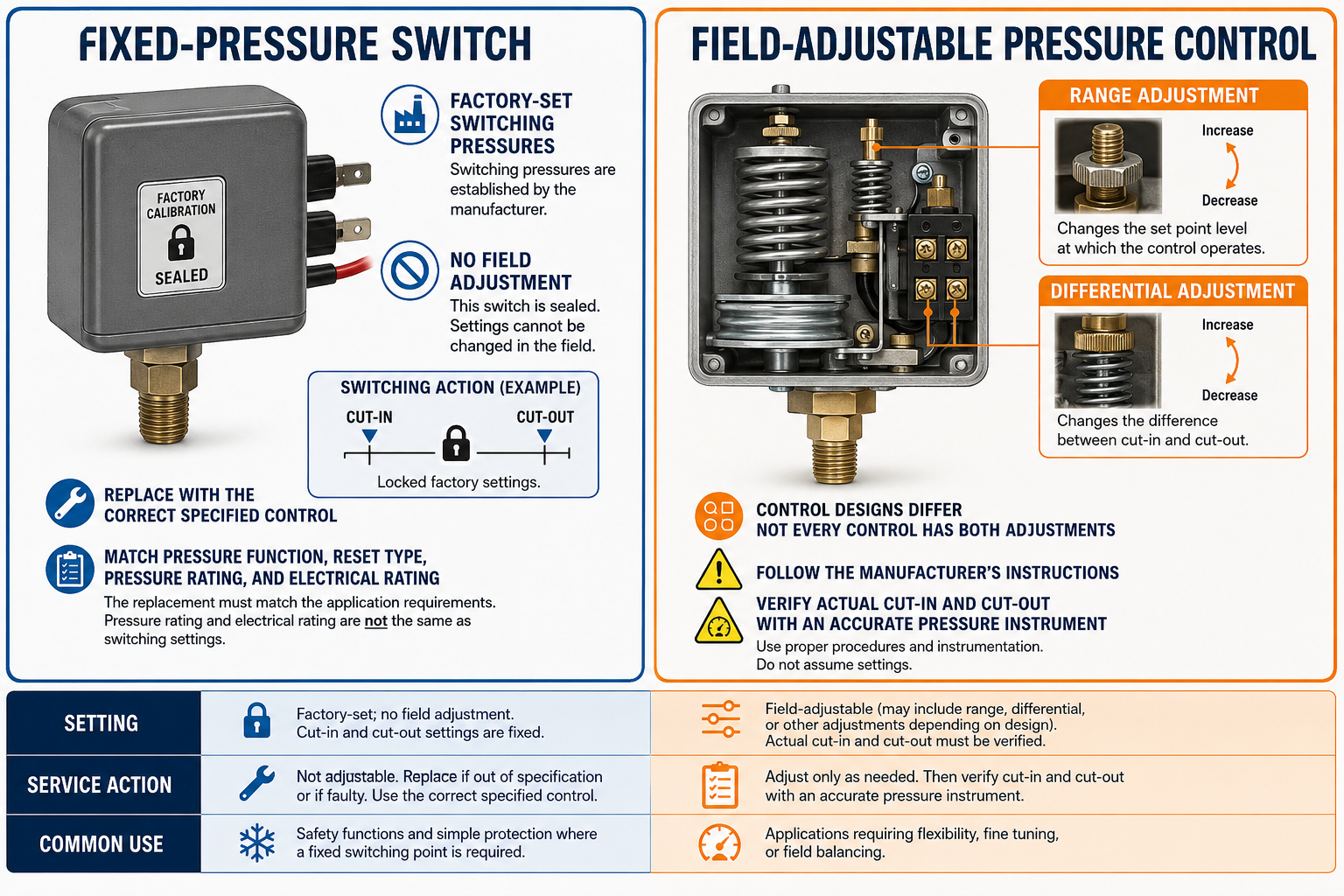
The operating pressure or pressures are established by the control’s design. The technician selects the correct part number rather than changing the operating point in the field.
Field-Set Within Limits
One or more operating values can be adjusted within the manufacturer’s stated range. The adjustment method and the values affected depend on the exact model.
A fixed switch must be selected by its specified cut-out, cut-in or reset relationship, tolerances, switch action, and reset method. A similar-looking switch with a different operating point can provide incorrect control or protection.
Compact Controls for Defined Applications
Fixed pressure switches are common where the equipment manufacturer has determined the required operating point and does not intend the value to be changed during normal service. They may be used for low-pressure cutout, high-pressure cutout, fan cycling, proof-of-pressure, or other equipment-specific functions.
Defined Cut-Out
The contacts change state at a factory-specified pressure, subject to the manufacturer’s tolerance.
Defined Reset Relationship
An automatic-reset model has a specified reset pressure or differential, while a manual-reset model has a required reset condition.
Application-Specific Construction
The pressure connection, contact rating, enclosure, refrigerant compatibility, and mounting arrangement are selected for the intended equipment.
Replacement by Specification
The replacement must match the original function and ratings; physical fit or connector size alone is not enough.
A screw, sealed opening, or mechanical feature is not proof of an approved adjustment. Altering a fixed safety control can change its calibration, damage the device, and defeat its listed protective function.
Adjustment Depends on the Control Design
An adjustable pressure control provides a scale and adjustment mechanism for one or more operating values. One model may directly display cut-in and differential, another may display cut-out and differential, and another may use a range pointer with a fixed or offset differential.
Range Adjustment
The range adjustment moves an operating point or moves both operating points together while maintaining a specified differential relationship.
Differential Adjustment
On controls with an adjustable differential, a separate adjustment changes the pressure difference between contact opening and closing.
Fixed Differential
Some controls allow the operating range to be adjusted but use a factory-established pressure difference between cut-in and cut-out.
Offset Relationship
On some designs, the scale indicates one operating point and the other point is determined by adding or subtracting the differential.
Read the exact instructions: Turning a range or differential screw clockwise does not produce the same result on every control. Identify the model and follow its adjustment procedure.
Adjustable Does Not Mean Unlimited
Designed Adjustment Area
The control is intended to operate within the range and differential limits stated for that model.
Unreliable or Damaging
Forcing a pointer beyond its indicated limits can damage adjustment threads, distort the mechanism, or produce inaccurate operation.
Mechanical scales and pointers are setting references. After adjustment, use reliable pressure instruments and operate the equipment through the required cycles to verify the actual cut-in, cut-out, and system operation.
Operating Range Is Not the Maximum Allowable Pressure
Operating Range
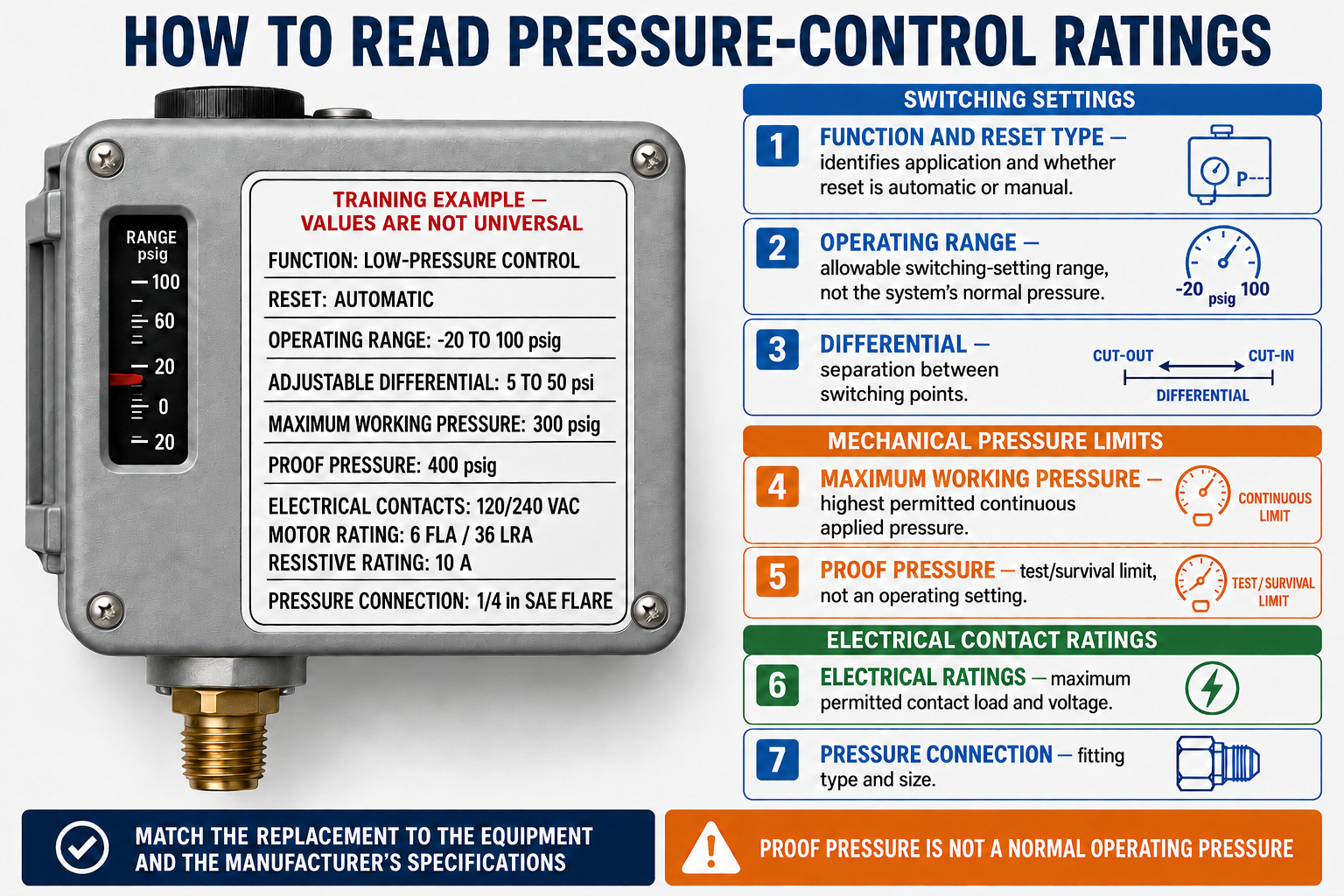
The span of pressure values over which an adjustable operating point is designed to be set.
Differential Range
The permitted difference between cut-in and cut-out on a control with adjustable differential.
Maximum Working Pressure
The highest pressure permitted for normal service according to the manufacturer’s rating.
Maximum Overpressure
A manufacturer-defined pressure limit associated with abnormal exposure; it is not an allowable operating setpoint or normal working pressure.
The existence of an overpressure rating does not authorize operating or intentionally testing the control at that value. Follow the manufacturer’s approved test procedure and remain within every component and instrument rating.
The Contacts Must Match the Load
A pressure switch may control a relay or contactor coil, provide an input to an electronic controller, or directly switch a load when specifically rated to do so. The electrical demand on the contacts depends on the type of load and the circuit voltage.
Pilot Duty
Applies to electromagnetic control loads such as contactor and relay coils within the stated voltage and volt-ampere rating.
Resistive or Non-Inductive Load
Applies to loads that do not have the same starting-current and inductive characteristics as a motor or coil.
Motor Full-Load Rating
Specifies the current the contacts can carry while an approved motor load is operating.
Locked-Rotor or Starting Rating
Accounts for the much higher current present when a motor starts or cannot rotate.
A contact rating for a resistive load does not automatically permit the same current for a motor, compressor, contactor coil, or DC circuit. Match the load category, voltage, phase, current, and switching duty specified by the manufacturer.
The Same Pressure Range Can Perform Different Functions
Open-Low or Open-High
The contact action must match whether the controlled circuit opens on falling pressure or rising pressure.
SPST, SPDT, or DPST
The number and arrangement of contact paths must support the equipment wiring and any alarm or auxiliary circuit.
Automatic Reset
The contacts return when pressure reaches the specified reset or cut-in point.
Manual-Reset Lockout
The control remains tripped until pressure permits reset and the reset mechanism is deliberately operated.
Safety-control replacement: Preserve the reset method and protective function specified by the equipment manufacturer. Replacing a manual-reset safety with an automatic-reset control can permit unattended repeated cycling.
The Control Must Physically Suit the System
Pressure Connection
Match the connection type, thread or flare size, capillary arrangement, sealing method, and pressure location.
Refrigerant Compatibility
Wetted materials, seals, pressure range, and listing must be compatible with the refrigerant and oil used in the system.
Mounting and Orientation
Use the required bracket, position, vibration protection, drainage arrangement, and access for adjustment or reset.
Enclosure Rating
The enclosure must suit moisture, dust, weather, mechanical damage, and the installation environment.
Do not assume compatibility from fitting size, control appearance, hose color, or system pressure alone. Identify the refrigerant from equipment and service labels and verify that the control is approved for that application.
Match the Complete Application
1. Control Function
Determine whether the device provides operating control, safety cutout, fan cycling, pump-down control, or another specified function.
2. Pressure Operation
Match the range, cut-in, cut-out, differential, maximum working pressure, and required tolerances.
3. Switch Action
Match open-low, open-high, contact arrangement, terminal identification, and automatic or manual reset.
4. Electrical Load
Match circuit voltage, current, phase, load category, pilot duty, motor ratings, and controller requirements.
5. Physical Requirements
Match pressure connection, capillary length, mounting, enclosure, dimensions, access, and environmental rating.
6. Approval and Compatibility
Verify refrigerant and oil compatibility, required listings, equipment-manufacturer approval, and any code or jurisdictional requirements.
Set, Measure, and Confirm
- Identify the exact control model and obtain its adjustment instructions.
- Confirm the required cut-in, cut-out, differential, and reset action from the equipment specifications.
- Attach appropriate pressure instruments at a location that represents the pressure sensed by the control.
- Make adjustments only within the stated range and in the specified direction.
- Operate the equipment through the number of cycles required by the manufacturer.
- Record the actual pressures at which the contacts open and close or the control locks out.
- Confirm that the complete equipment sequence is safe and correct before leaving the system in service.
If the scale indication and measured operating points disagree beyond the permitted tolerance, do not compensate blindly. Recheck the procedure, instruments, sensing connection, adjustment relationship, and control condition.
Avoid These Selection and Adjustment Errors
“An adjustable control can replace any fixed switch.”
The replacement must also match switch action, reset method, ratings, tolerances, compatibility, mounting, and the equipment’s approved protective function.
“The pointer proves the operating pressure.”
The scale is an adjustment reference. Actual contact operation must be verified with reliable pressure instruments.
“Maximum overpressure is an acceptable setpoint.”
Overpressure is not a normal operating value and must not be used as an adjustment or test target.
“If the amperage is below the rating, the contacts are suitable.”
The load type, voltage, phase, starting current, pilot duty, and AC or DC rating must also match.
Can You Select and Evaluate a Pressure Switch?
- What is the basic difference between a fixed and an adjustable pressure switch?
- Why should a fixed control never be altered in the field?
- What can a range adjustment change?
- What does a differential adjustment change?
- Why must the exact manufacturer’s adjustment procedure be used?
- What is the difference between operating range and maximum working pressure?
- Why is maximum overpressure not an acceptable test pressure?
- Why can a resistive electrical rating not automatically be used for a motor load?
- Why must automatic or manual reset be matched during replacement?
- What mechanical and environmental features must be checked?
- Why must the actual operating pressures be measured after adjustment?
- Name six categories of information needed to select a replacement control.
What You Should Have Learned
Fixed controls use factory-established operating values, while adjustable controls permit specified values to be set within designed limits.
An adjustable control may have range, differential, fixed-differential, or offset relationships that must be interpreted from its instructions.
Operating range, maximum working pressure, and maximum overpressure describe different limits.
Electrical ratings must match voltage, current, phase, load type, starting duty, and AC or DC application.
Contact action, terminal arrangement, and automatic or manual reset must match the equipment sequence.
Pressure connection, refrigerant compatibility, mounting, enclosure, and environmental requirements are part of correct selection.
An adjustable pressure switch is not universal and must not be operated beyond its stated scale or ratings.
After adjustment or replacement, measured contact operation and the complete equipment sequence must be verified.