Cut-In, Cut-Out, and Differential
A pressure switch changes electrical contact state at specific pressure values. Cut-in identifies the pressure at which the controlled circuit closes, cut-out identifies the pressure at which it opens, and differential describes the pressure difference between those two operating points.
The arithmetic is simple only after the technician identifies the switch action. A low-pressure open-low control and a high-pressure open-high control can use the same three terms while responding to pressure in opposite directions.
What You Will Learn
By the end of this lesson you should be able to:
Define cut-in and cut-out.
Relate cut-in to closing the controlled circuit and cut-out to opening it.
Define pressure differential.
Explain the difference between the two contact operating pressures.
Interpret open-low operation.
Explain why cut-in is above cut-out on a typical automatic-reset low-pressure control.
Interpret open-high operation.
Explain why cut-out is above cut-in on a typical automatic-reset high-pressure control.
Calculate a missing value.
Use cut-in, cut-out, and differential relationships after confirming the control design.
Evaluate cycling behavior.
Recognize how differential affects cycle frequency and pressure or temperature swing.
Cut-In Closes and Cut-Out Opens
Controlled Circuit Closes
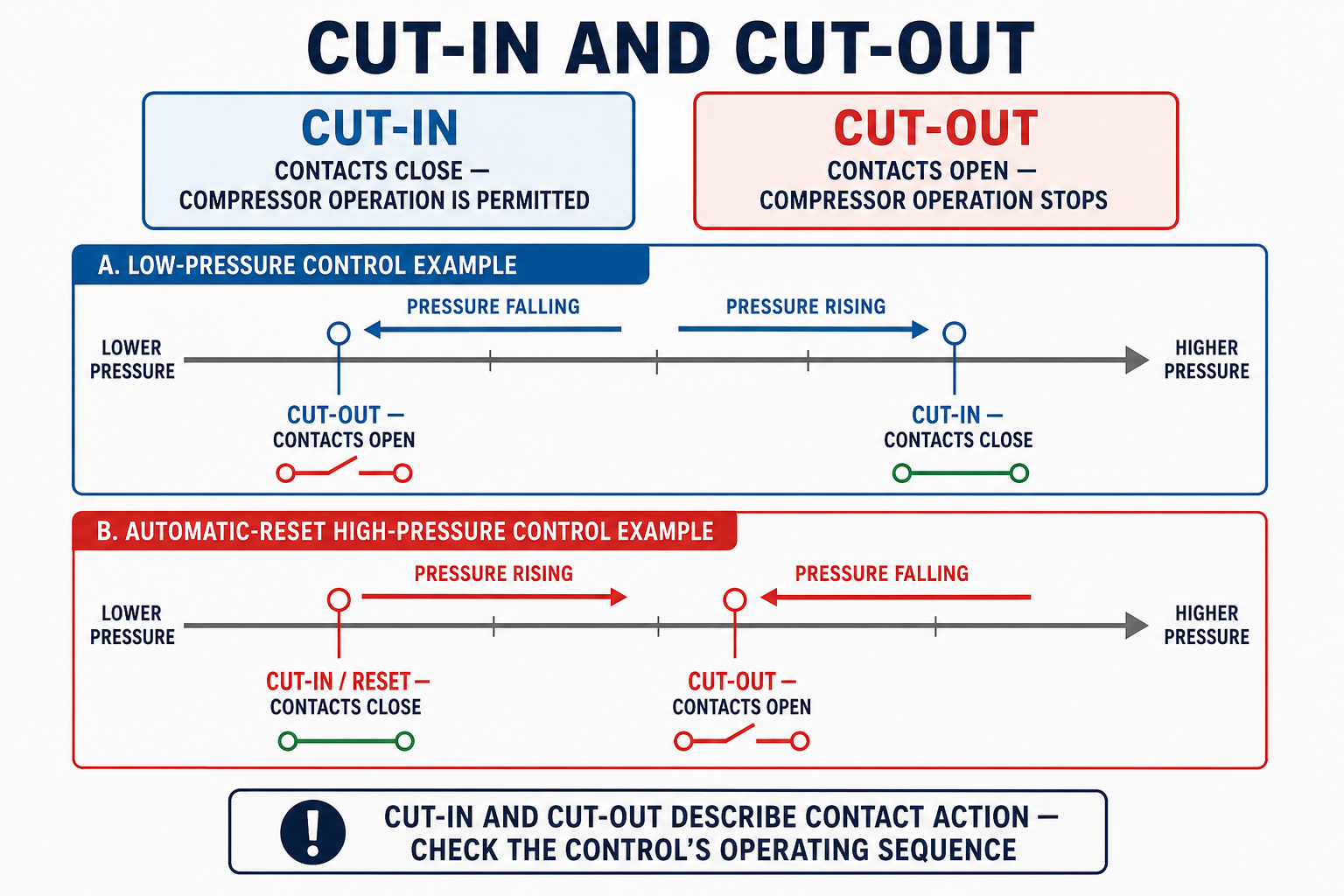
Cut-in is the sensed pressure at which the contact path being described closes and permits current to flow.
Controlled Circuit Opens
Cut-out is the sensed pressure at which the contact path being described opens and interrupts current flow.
Cut-out can occur as pressure falls on an open-low control or as pressure rises on an open-high control. Always identify the switch action before deciding which operating pressure is higher.
State Which Circuit You Are Describing
An SPDT pressure switch transfers a common terminal between two contact paths. When one path opens, the other closes. The words cut-in and cut-out usually refer to the contact path controlling the primary load, but an alarm or auxiliary path may act in the opposite way.
Common to Normally Closed
This path may control the compressor or another load and open at the selected pressure event.
Common to Normally Open
This path may close at the same event to energize an alarm, controller input, or alternate load.
Terminal Identification
Letter markings, numbers, colors, and physical terminal positions vary among manufacturers and models.
Required Reference
Use the diagram for the exact control to identify the terminals and contact state at the low and high pressure events.
The Distance Between Operating Points
minus
Lower operating pressure
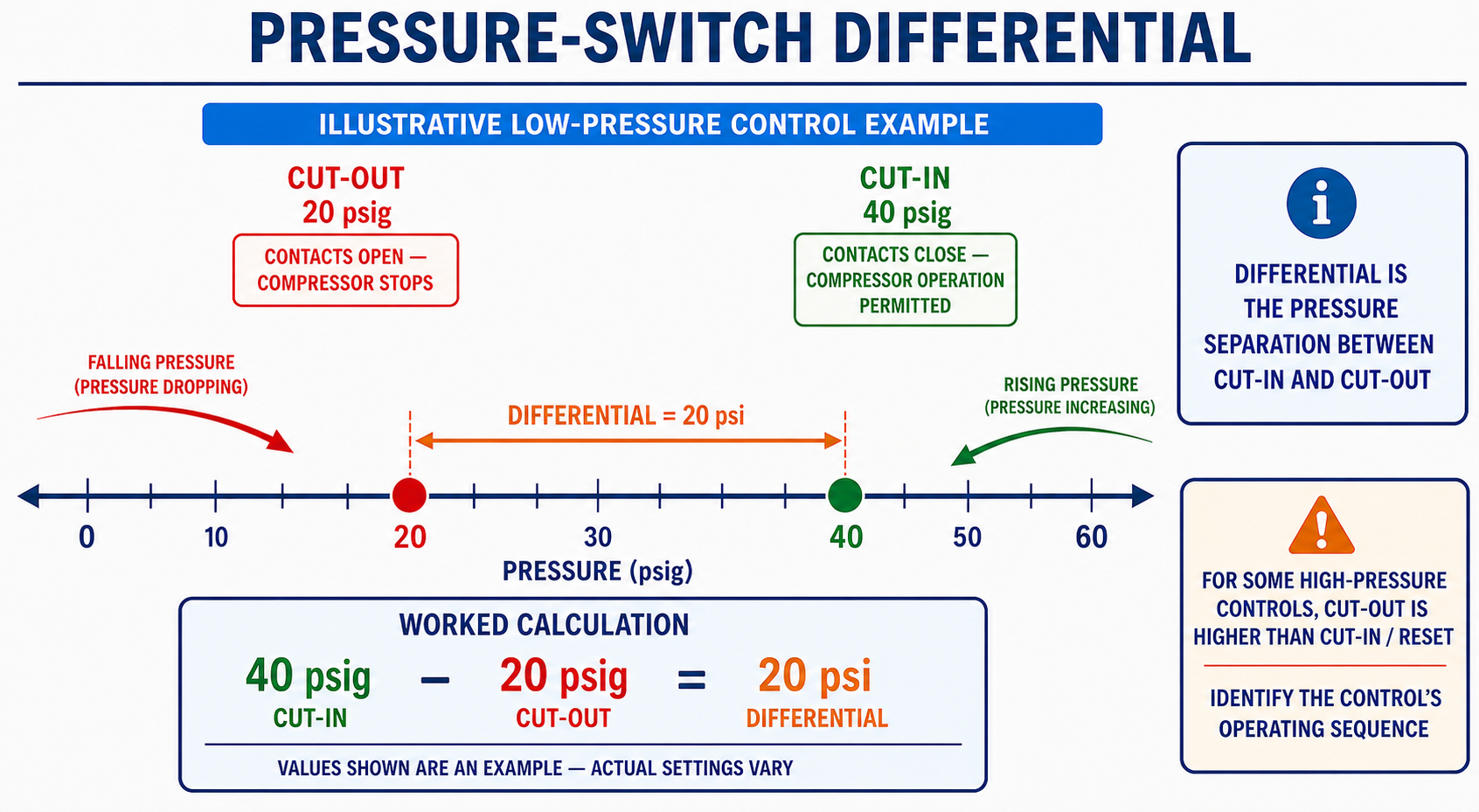
Differential is normally expressed as a positive pressure value. It describes the separation between the two operating points, not by itself which point is cut-in or cut-out.
The pressure must move across the interval between the two operating points before the contacts return to their previous state. This separation helps prevent rapid contact operation around a single pressure.
Low-Pressure Control: Cut-In Is Higher
On a typical automatic-reset open-low control, falling pressure opens the controlled circuit at cut-out. Pressure must then rise to the higher cut-in point before the circuit closes.
Cut-In − Differential
40 psig − 20 psi = 20 psig cut-out.
Cut-Out + Differential
20 psig + 20 psi = 40 psig cut-in.
Example only: These numbers demonstrate the relationship and are not universal settings. Use the equipment manufacturer’s specified pressures for the actual refrigerant and application.
High-Pressure Control: Cut-Out Is Higher
On a typical automatic-reset open-high control, rising pressure opens the controlled circuit at the higher cut-out point. Pressure must then fall to the lower cut-in point before the circuit closes.
Cut-Out − Differential
400 psig − 75 psi = 325 psig cut-in.
Cut-In + Differential
325 psig + 75 psi = 400 psig cut-out.
A manual-reset high-pressure control does not automatically close the controlled path at a calculated cut-in pressure. Pressure must fall to the model’s permitted reset condition, the cause must be corrected, and the reset mechanism must be deliberately operated.
Start With Switch Action
Cut-In Is Higher
Differential = cut-in − cut-out.
Cut-out = cut-in − differential.
Cut-in = cut-out + differential.
Cut-Out Is Higher
Differential = cut-out − cut-in.
Cut-in = cut-out − differential.
Cut-out = cut-in + differential.
First identify whether the controlled path opens on falling or rising pressure. Second place cut-in and cut-out correctly on a pressure scale. Third subtract the lower pressure from the higher pressure and solve for the missing value.
Not Every Control Lets You Change the Separation
Fixed Differential
The manufacturer establishes the pressure separation between contact events. Adjusting the range, if permitted, moves the operating relationship according to the control design.
Adjustable Differential
A separate adjustment changes the separation between cut-in and cut-out within stated minimum and maximum limits.
Displayed Operating Points
Some controls display cut-in and cut-out directly, allowing both operating values to be read from the scale.
Displayed Setpoint and Differential
Other controls display one operating point and the differential, requiring the second point to be calculated.
Do not assume scale meaning: A RANGE pointer may indicate cut-in on one control and cut-out on another. The differential adjustment may move the low event or high event depending on the mechanism.
Differential Influences Cycle Frequency
Smaller Pressure Change
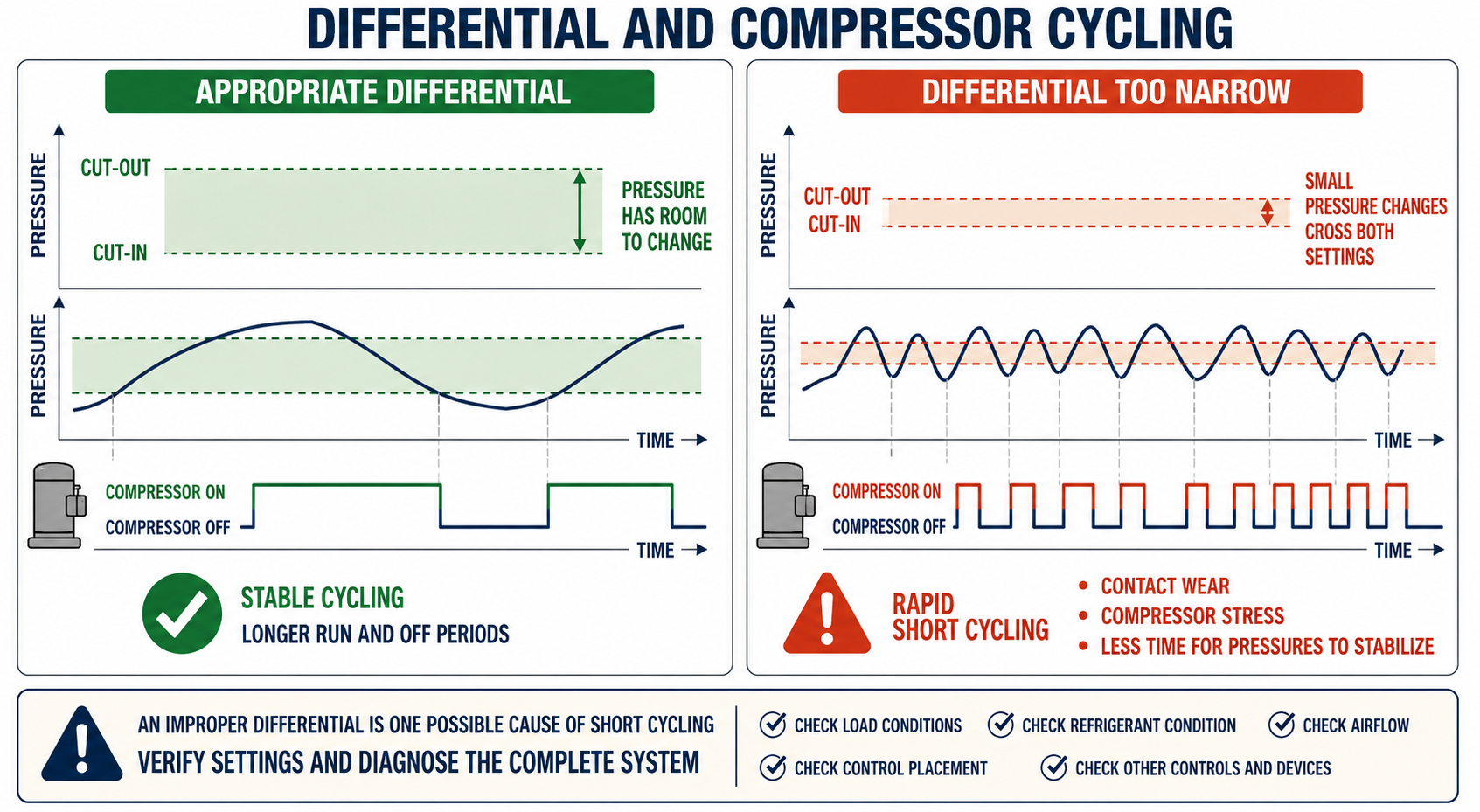
The system needs less pressure movement to reach the opposite contact event, which can increase cycle frequency under some operating conditions.
Larger Pressure Change
The system must move through a greater pressure interval, which can lengthen cycles but may produce a larger temperature or pressure swing.
Rapid cycling can also result from refrigerant problems, low load, airflow or waterflow problems, oversized equipment, control-location issues, leaking valves, pressure equalization, faulty wiring, or another control repeatedly changing state.
Operating Pressures Represent Different Temperatures for Different Refrigerants
The same pressure does not represent the same saturated refrigerant temperature for every refrigerant. A low-pressure control used for temperature-related cycling must be set using the correct refrigerant pressure-temperature relationship and the equipment manufacturer’s instructions.
Identify the Refrigerant
Use equipment and service labels rather than pressure alone to identify the refrigerant.
Use the Correct P-T Data
Convert pressure to saturation temperature using accurate information for the identified refrigerant.
Account for Glide When Required
For a zeotropic blend, use the bubble or dew value appropriate to the measurement and application.
Verify Actual Product or Air Temperature
Pressure-based control should be checked against the temperature and operating result the equipment is intended to maintain.
Calculate First, Then Measure Operation
- Identify the exact control model, contact path, switch action, and reset method.
- Determine whether the scale indicates cut-in, cut-out, both operating points, or one point plus differential.
- Obtain the required operating values from the equipment manufacturer’s specifications.
- Calculate the missing operating point and confirm that every value is within the control’s adjustment range.
- Attach appropriate pressure instruments where they represent the pressure sensed by the control.
- Operate the system and record the actual pressure at each contact event.
- Repeat the test through the number of cycles required by the manufacturer and confirm correct equipment operation.
Checking only cut-out is not enough on an automatic-reset control. A correct diagnosis or adjustment requires verifying both the opening and closing pressures and comparing the measured differential with the specification.
Avoid These Calculation Errors
“Cut-out is always the higher pressure.”
Cut-out is higher on an open-high control but lower on an open-low control.
“Cut-in means the compressor starts.”
Cut-in means the described contact path closes. Whether the compressor starts depends on the rest of the control circuit and operating sequence.
“Differential tells me which pressure is cut-in.”
Differential only gives the numerical separation. Switch action determines which event occurs at the higher pressure.
“A wider differential is always better.”
A wider differential can reduce cycling frequency but may create an unacceptable pressure or temperature swing.
Can You Calculate the Operating Points?
- What electrical event does cut-in describe?
- What electrical event does cut-out describe?
- Why do cut-in and cut-out not identify pressure direction by themselves?
- What is pressure differential?
- On an open-low control, which pressure is normally higher?
- An open-low control cuts in at 45 psig with a 25 psi differential. What is cut-out?
- On an open-high control, which pressure is normally higher?
- An open-high control cuts out at 425 psig with a 75 psi differential. What is cut-in?
- Why must an SPDT contact path be identified before interpreting operation?
- How can a differential that is too narrow affect cycling?
- Why is differential not the only possible cause of short cycling?
- Why must both operating pressures be measured after adjustment?
What You Should Have Learned
Cut-in is the pressure at which the controlled contact path closes.
Cut-out is the pressure at which the controlled contact path opens.
Differential is the positive numerical difference between the higher and lower operating pressures.
On a typical open-low control, cut-in is higher than cut-out.
On a typical open-high control, cut-out is higher than cut-in.
Fixed and adjustable differentials must be interpreted according to the exact control scale and instructions.
A narrow differential can increase cycling frequency, while a wider differential can increase the pressure or temperature swing.
Calculated settings must be confirmed by measuring the actual opening and closing pressures during operation.