Grid-Tied, Battery-Backed, and Off-Grid PV Systems
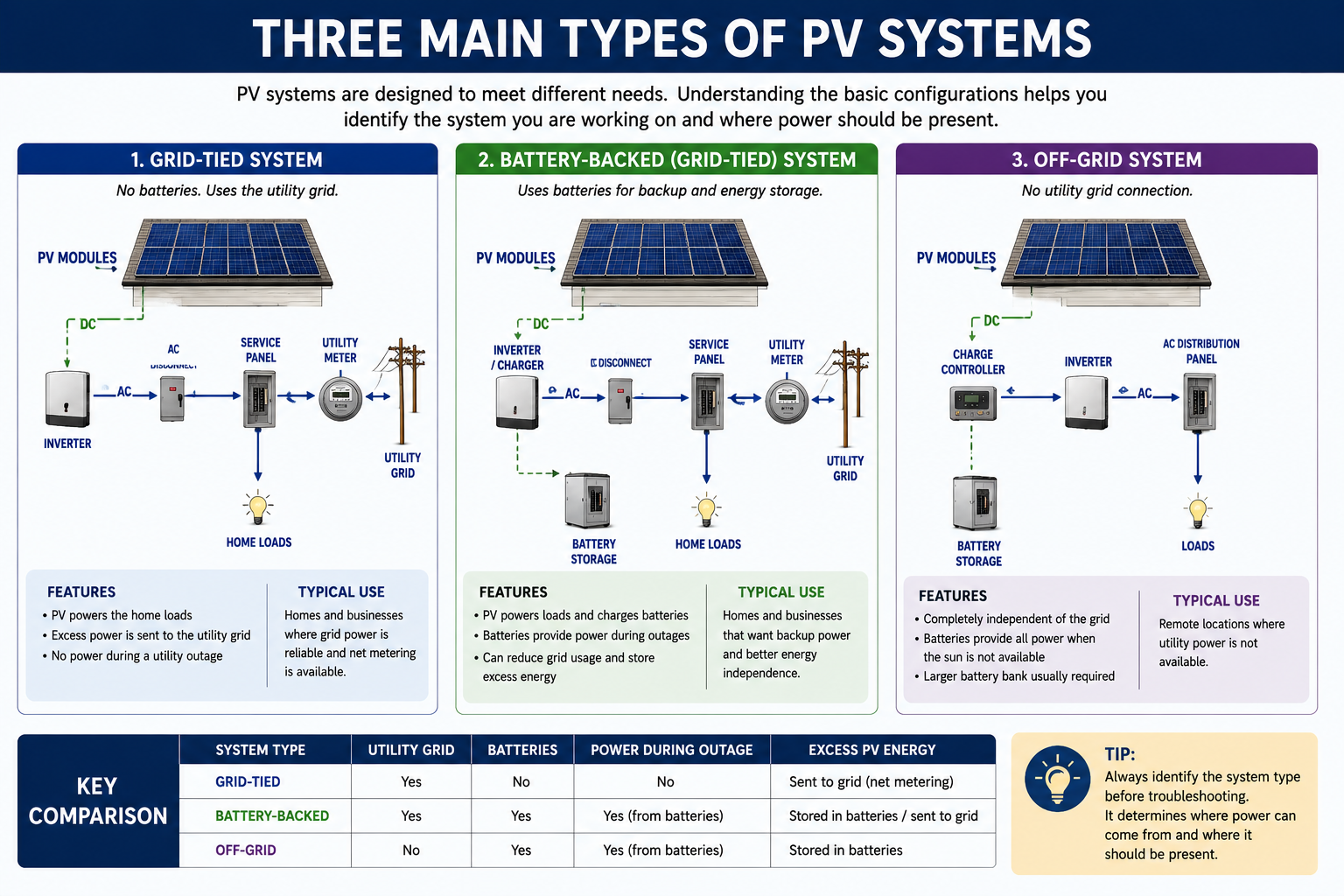
PV systems can be connected to the electrical utility, combined with battery storage, or designed to operate independently from the grid. The configuration determines which equipment is present, where power can come from, what happens during a utility outage, and how the technician should approach troubleshooting.
This lesson compares the three broad system arrangements most useful to recognize in the field: grid-tied systems without battery backup, grid-connected systems with battery storage and backup capability, and off-grid systems that operate without a utility connection.
System Configuration Changes the Troubleshooting Path
Two PV installations may use similar modules but operate very differently because of the way they are connected to the utility and whether battery storage is included. A grid-tied system normally depends on utility conditions for normal inverter operation. A battery-backed system adds stored energy and transfer or isolation functions. An off-grid system has no utility source and must supply its own electrical loads from local generation and storage.
Before taking measurements, identify which arrangement is present. That tells the technician which energy sources may be available, which equipment should be operating, and what system behavior is normal under the current conditions.
PV Operating With the Utility Grid
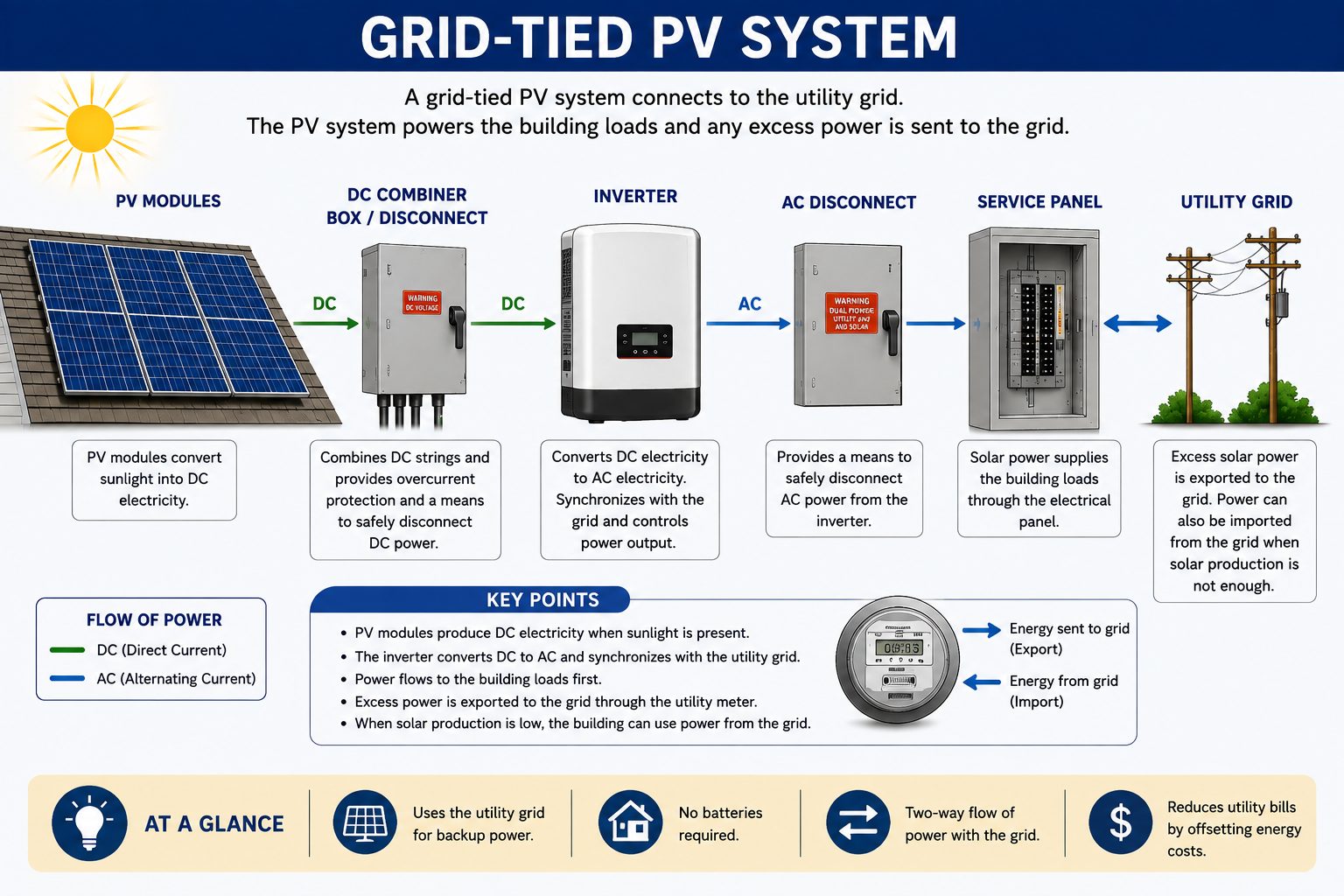
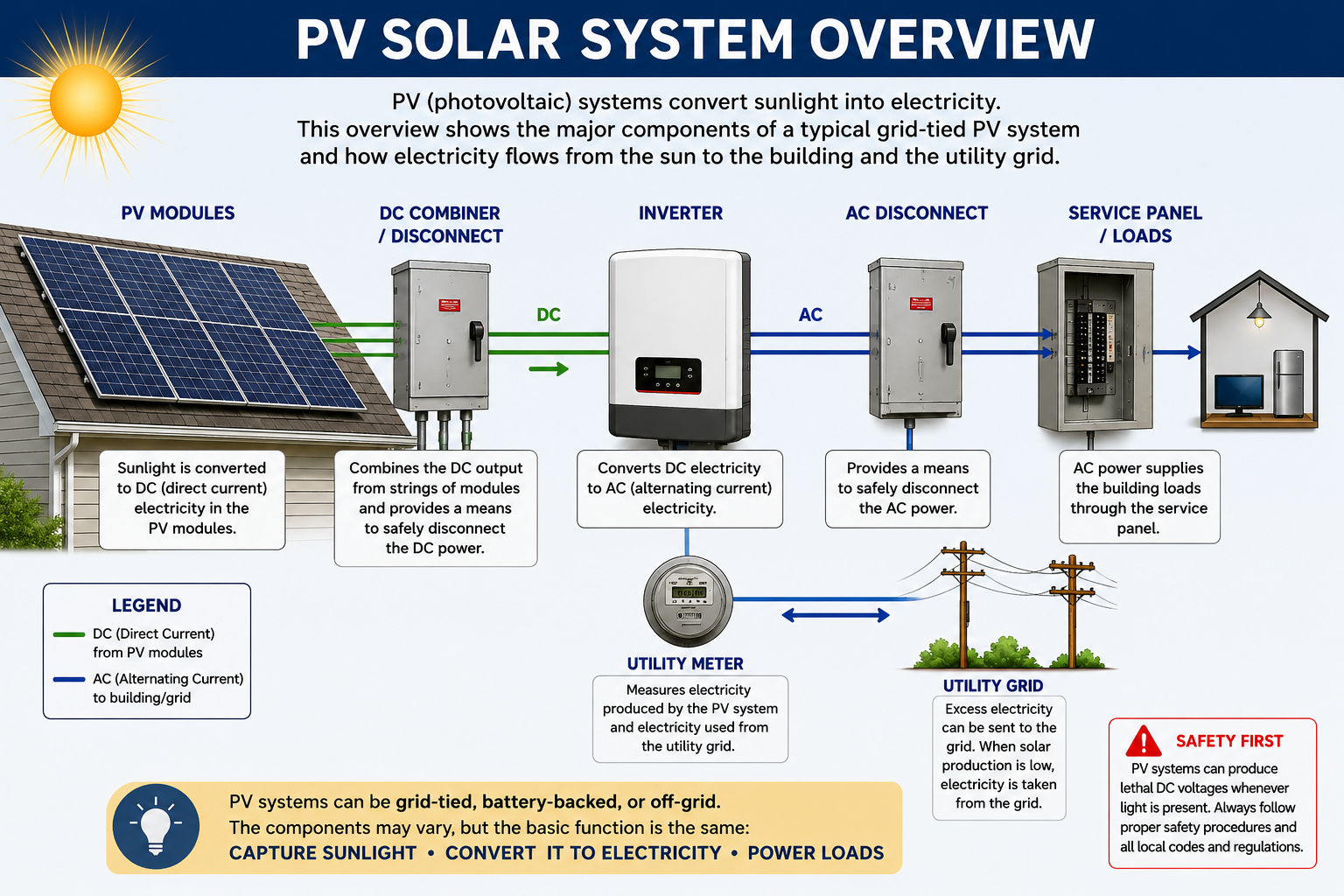
A grid-tied PV system is electrically connected to the utility system. During normal operation, the PV array generates DC electricity, the inverter converts that energy to AC, and the AC power is connected to the building electrical system.
PV production may serve building loads while the utility remains available to supply additional power when needed. When PV generation exceeds local demand, an appropriately configured system may export excess power through the utility interconnection.
PV Array
Generates DC electrical power whenever sufficient sunlight reaches the modules.
Grid-Interactive Inverter
Converts PV-generated DC electricity into AC electricity compatible with the electrical system and operates in coordination with utility conditions.
Building Loads
Use available PV-generated power while the utility supplies additional energy whenever PV production is insufficient.
Utility Connection
Provides the electrical reference and additional power needed by the building and may accept excess PV generation where the interconnection permits export.
Ordinary Grid-Tied Solar Usually Does Not Provide Backup During an Outage
A common misunderstanding is that rooftop solar panels will continue powering the building whenever sunlight is available, even if the utility fails. Conventional grid-connected PV systems are generally designed to stop energizing the grid when utility power is lost.
This anti-islanding behavior protects utility personnel and electrical equipment from an unintended energized island. A PV system intended to continue operating during an outage requires equipment specifically configured for backup or islanded operation.
Why a Standard Grid-Tied Inverter Stops Producing
A grid-interactive inverter continuously evaluates electrical conditions at the utility connection. If acceptable grid conditions are lost, the inverter stops exporting AC power as required by its protective functions and interconnection configuration.
From the technician’s perspective, a non-producing inverter during a confirmed utility outage may be operating normally rather than indicating an inverter failure.
Diagnostic point: Before troubleshooting a grid-tied inverter for “no output,” verify that acceptable utility AC power is actually present at the system.
Adding Storage Changes the System
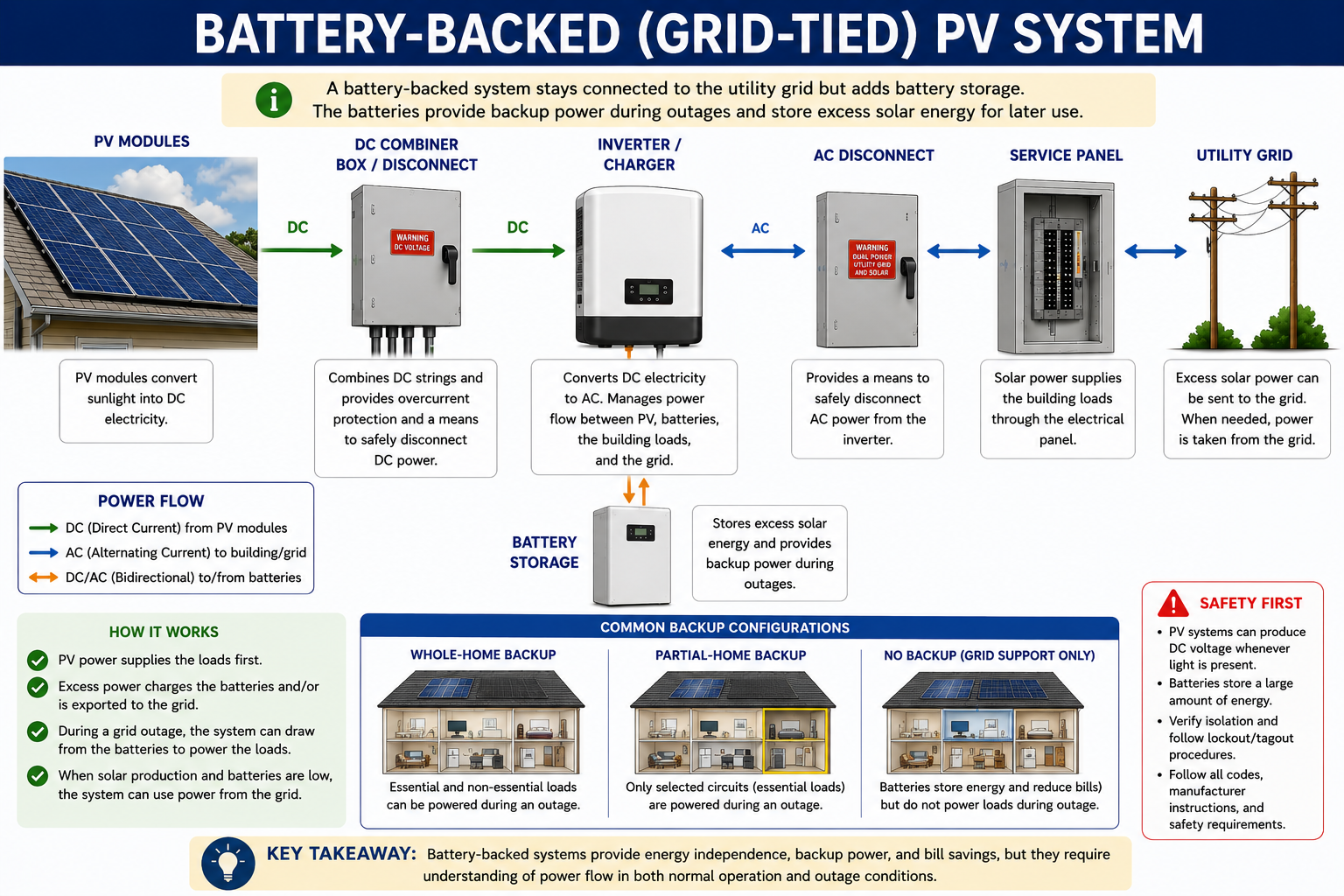
A grid-connected PV system can also include battery energy storage. Depending on the design, solar energy may charge the battery while the system remains connected to the utility, and stored energy may later support building loads.
Battery-equipped systems require additional equipment and controls to manage charging, discharging, isolation from the utility, and backup operation. These functions become especially important during a utility outage.
The System Must Separate From the Utility
For a battery-backed system to continue supplying loads during a utility outage, the backed-up portion of the installation must be electrically isolated from the utility system. The exact method depends on the equipment and may involve a transfer device, system controller, backup gateway, hybrid inverter, or other manufacturer-specific equipment.
Once isolated, appropriately designed inverter equipment can establish the AC voltage and frequency needed by the backup loads while available battery and PV energy support the isolated electrical system.
Utility Power Is Available
The system operates normally while connected to the grid. PV production may serve loads, charge the battery, or export energy according to the equipment settings.
Utility Power Is Lost
The system detects the outage and stops any condition that could energize the utility conductors from the customer side.
The Backup System Is Isolated
Transfer or isolation equipment separates the backed-up loads from the utility connection.
Local Sources Supply the Backup Loads
Battery storage and available PV generation supply the loads permitted by the system’s backup configuration and available capacity.
Battery Backup Does Not Necessarily Mean the Entire Building Is Backed Up
Many installations supply only selected circuits during an outage. These circuits may be connected to a dedicated backup-load panel or otherwise controlled by the storage system.
When investigating an outage complaint, determine which loads are actually intended to receive backup power. A circuit that loses power during an outage may be operating exactly as designed if it is not part of the backup system.
Operating Without a Utility Connection
An off-grid, or stand-alone, PV system is not connected to a utility electrical supply. The site must therefore produce and manage its own electrical energy.
PV generation typically charges battery storage while energy is available. Stored energy is then used when solar production is insufficient or unavailable. Some systems also incorporate another generation source, such as an engine-driven generator, to support loads or recharge batteries when needed.
There Is No Utility Source to Fall Back On
In a grid-connected installation, inadequate PV production may be masked because the utility continues supplying the building loads. An off-grid system has no such external source unless another local generator is installed.
This makes energy balance particularly important. The technician must consider PV production, battery state of charge, charging operation, inverter capacity, load demand, generator operation where present, and the customer’s recent energy usage.
Generation Problem
The PV system may not be producing enough energy to operate loads and restore battery charge.
Storage Problem
The battery system may not be accepting charge, retaining sufficient energy, or permitting discharge.
Conversion Problem
Inverter or charger equipment may not be transferring energy correctly between the DC and AC portions of the installation.
Load Problem
The system may be functioning correctly while electrical demand exceeds available generation, storage, or inverter capacity.
What Changes for the Technician?
Grid-Tied Without Storage
Expect a utility connection and grid-interactive inverter operation. Loss of acceptable grid conditions normally stops PV AC output.
Grid-Tied With Battery Storage
Expect the utility, PV generation, stored battery energy, charging controls, and equipment that manages isolation and backup operation.
Off-Grid
Expect no utility source. Local generation, battery storage, inverter equipment, and optional backup generation must support the electrical loads.
Questions to Answer When You Arrive
The technician should be able to classify the system before beginning detailed electrical troubleshooting.
Is There a Utility Connection?
Locate the service, utility meter, main distribution equipment, and PV interconnection.
Is Battery Storage Installed?
Locate battery equipment, related disconnects, inverter or charger equipment, and any battery-management or communications components.
Are Backup Loads Identified?
Determine whether there is a dedicated backup-load panel or another arrangement controlling which circuits remain energized during an outage.
Is Another Generator Present?
Off-grid and some battery-backed systems may incorporate an engine-driven generator or another local source that changes the available energy paths.
More Sources Mean More Ways for Equipment to Remain Energized
A grid-connected PV system may contain power from both the utility and the PV array. Battery-backed systems add stored electrical energy, and off-grid systems may include batteries, PV generation, generators, or several of these sources simultaneously.
Do not assume that opening one breaker or disconnect removes every energy source. Identify all possible sources and follow the equipment manufacturer’s shutdown procedure, applicable electrical requirements, workplace-safety procedures, lockout/tagout practices, and required PPE before service.
What You Should Take From This Lesson
Grid-Tied Systems Depend on Grid Conditions
A conventional grid-interactive PV inverter normally stops energizing the AC system when acceptable utility conditions are lost.
Battery Storage Adds Another Energy Source
Battery-equipped systems can store energy and, when properly configured, may support designated loads during a utility outage.
Off-Grid Systems Must Supply Their Own Loads
Without a utility connection, local PV generation, battery storage, inverter equipment, and optional backup generation must maintain the energy balance.
Identify the Configuration Before Testing
The system type determines the expected power sources, operating modes, equipment, outage behavior, and troubleshooting sequence.
PV Modules, Strings, and Arrays
The next lesson moves into the DC generating portion of the PV system. It explains how individual modules are combined into strings and arrays and how series and parallel relationships affect voltage and current.
PV Solar System Fundamentals
Return to the Part I landing page for all six PV Solar System Fundamentals lessons.
Technical References
The system configurations and operating concepts in this lesson are supported by U.S. Department of Energy guidance on grid-connected PV, solar-plus-storage, distributed energy resources, inverters, and resilient operation.