EPA Section 608 Type III: Low-Pressure Appliances
Type III certification applies to technicians who service or dispose of low-pressure refrigeration appliances. Large centrifugal chillers are the most familiar examples. These systems require a different way of thinking because much of the refrigeration circuit normally operates below atmospheric pressure. Instead of every leak forcing refrigerant outward, many leaks allow air and moisture to enter the system.
Low-pressure service therefore emphasizes air infiltration, purge units, leak detection, recovery to an absolute-pressure endpoint, protection against freezing during evacuation and charging, and careful control of system pressure before opening the appliance. Understanding why these systems behave differently is more useful than memorizing Type III procedures as isolated exam facts.
Learning Objectives
Understand Low-Pressure Operation
Explain why low-pressure chillers can operate below atmospheric pressure and why leaks may allow air and moisture into the appliance.
Understand Purge Units and Leak Detection
Describe how noncondensables enter low-pressure systems, how purge units remove them, and why excessive purging can indicate leakage.
Apply Type III Recovery Requirements
Use the correct low-pressure recovery endpoint and understand the precautions necessary during recovery and evacuation.
Recharge Low-Pressure Equipment Safely
Explain why vapor is introduced before liquid, why water must be protected from freezing, and why charging procedures differ from many high-pressure systems.
What Equipment Does Type III Cover?
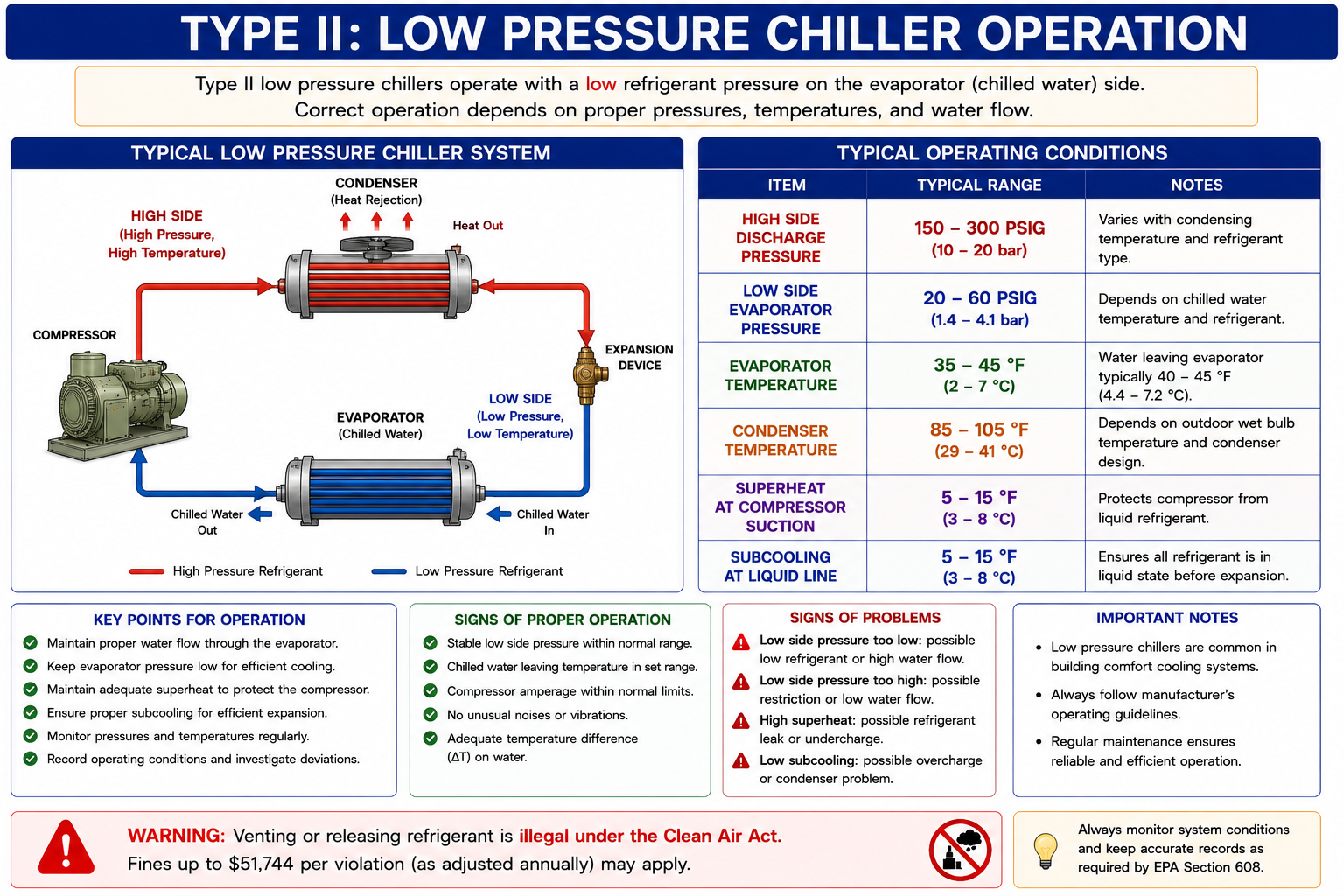
EPA Type III technician certification covers servicing or disposing of low-pressure appliances. These appliances use refrigerants whose pressure-temperature characteristics allow significant portions of the refrigeration system to operate below atmospheric pressure under normal conditions.
Large centrifugal chillers are the most common Type III examples encountered in Section 608 training. These systems are frequently used for large commercial buildings, hospitals, campuses, industrial facilities, and district cooling applications.
Why Air Can Leak Into the System
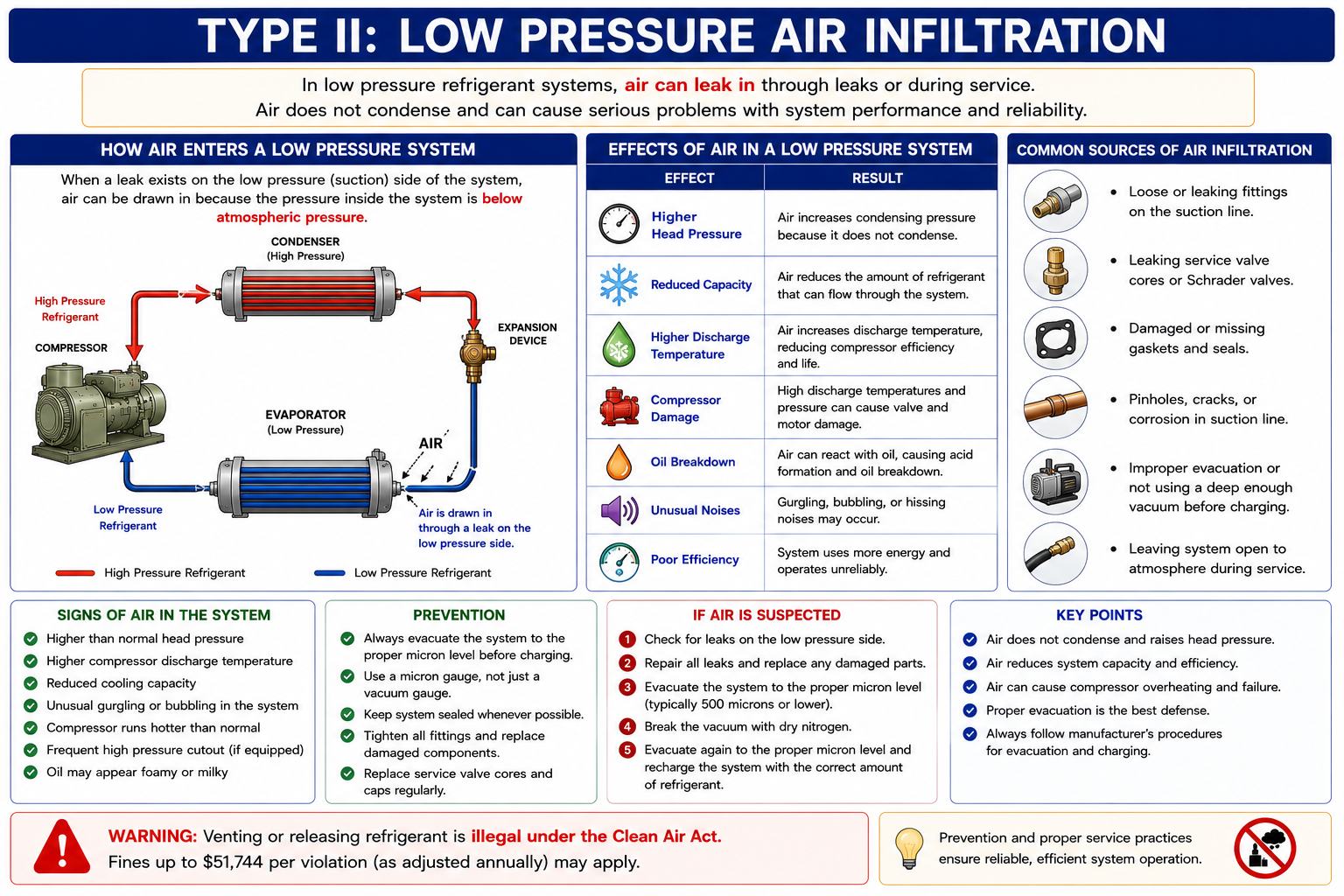
Atmospheric pressure surrounds the outside of the refrigeration system. When pressure inside a low-pressure appliance is below atmospheric pressure, the pressure difference tends to push outside air inward through any opening or leak.
This is the opposite of the situation technicians normally visualize with a high-pressure system. A high-pressure leak usually forces refrigerant outward. A low-pressure leak can draw air, moisture, and other noncondensable gases inward.
No Refrigerant Puddle Does Not Mean No Leak
A low-pressure system can have a significant leak even when refrigerant is not visibly escaping. Air infiltration, rising purge activity, moisture contamination, and performance changes may provide stronger evidence.
Noncondensables Reduce Chiller Performance
Air entering a refrigeration system becomes a noncondensable gas. Unlike refrigerant vapor, the air does not condense at the temperatures and pressures at which the refrigerant normally condenses.
Noncondensables accumulate in portions of the system such as the condenser and raise total pressure. This can increase compressor work, reduce heat-transfer effectiveness, raise operating cost, and interfere with normal refrigerant performance.
Moisture entering with the air can also contribute to corrosion, chemical reactions, oil contamination, and other reliability problems.
The Purge Unit Removes Air From the Refrigeration System
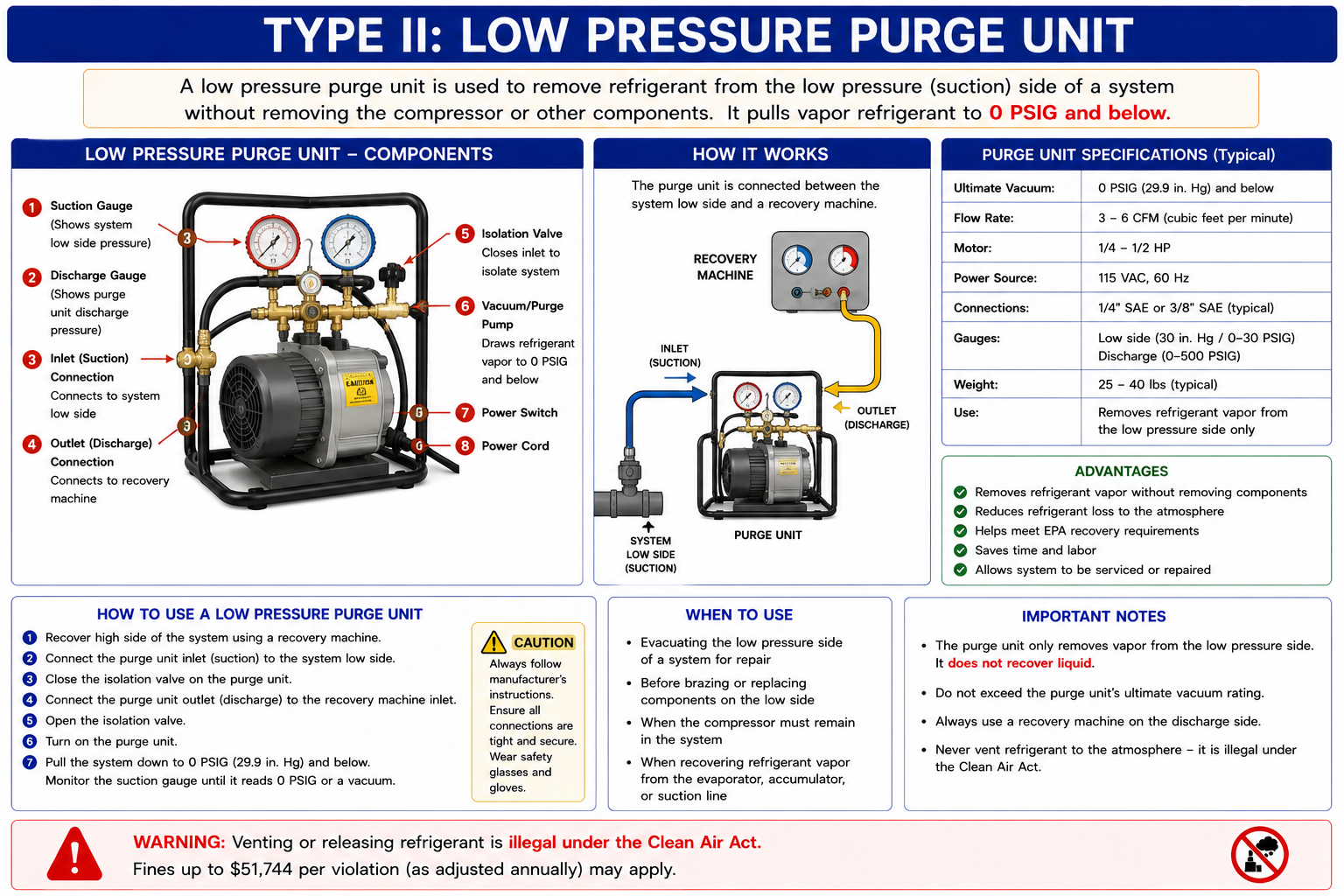
Low-pressure chillers commonly use a purge unit to remove noncondensable gases that have entered the refrigeration circuit. The purge system separates refrigerant vapor from the air so that as much refrigerant as practical remains in the appliance while the noncondensables are removed.
A Purge Unit Can Become a Leak Indicator
A small amount of purge operation may occur during normal operation because minor amounts of air can enter during service or through very small leakage paths. However, unusually frequent or prolonged purge operation can indicate that excessive air is entering the appliance.
EPA’s Type III examination topics specifically identify excessive purging as a sign of leakage into a low-pressure system. A technician should investigate the source rather than allowing the purge system to compensate indefinitely for an active leak. :contentReference[oaicite:1]{index=1}
You May Need to Raise the System Pressure to Find the Leak
Leak detection is difficult when the appliance operates below atmospheric pressure because outside air may be moving inward through the leak. To find the leak, the system may need to be carefully brought toward or slightly above atmospheric pressure using an approved procedure.
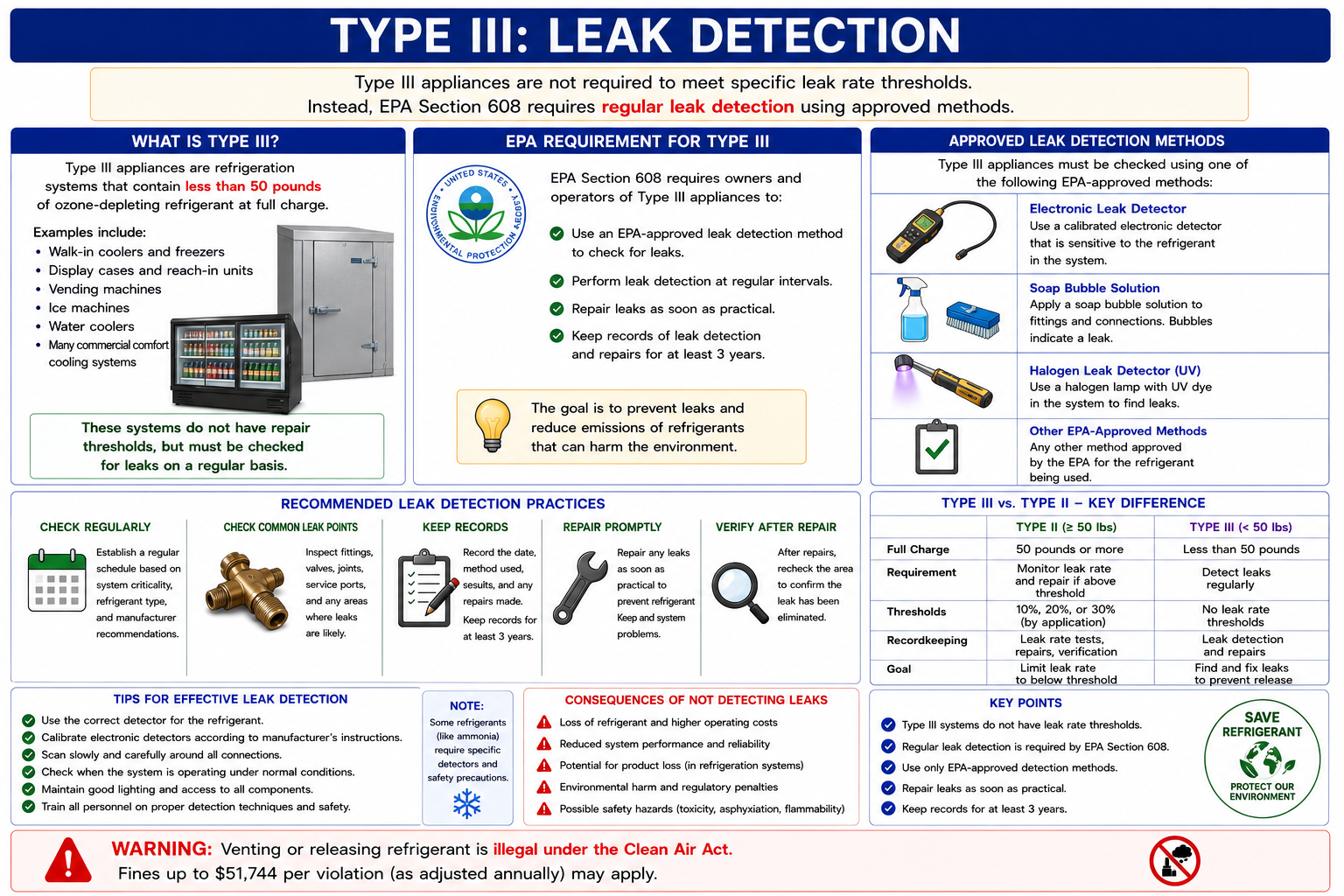
EPA’s current Type III test topics list the preferred leak-test pressurization methods in this order: first use hot water or a built-in heating or pressurization device; nitrogen is a secondary method where appropriate. :contentReference[oaicite:2]{index=2}
Do Not Add High Pressure to a Low-Pressure Chiller
Low-pressure equipment is not designed for the pressures commonly encountered in high-pressure refrigeration systems. Follow the appliance manufacturer and applicable service procedures when pressurizing for leak detection.
Low-Pressure Equipment Is Brought Up to Atmospheric Pressure
EPA treats low-pressure appliances differently when a non-major repair will not be followed by evacuation of the appliance to the atmosphere. Instead of evacuating the appliance down to 0 psig, the low-pressure appliance must be pressurized to a pressure no higher than 0 psig before it is opened. :contentReference[oaicite:3]{index=3}
EPA also limits how that pressure increase may be achieved. For low-pressure appliances using refrigerants with boiling points at or below 85°F at standard atmospheric pressure, methods such as nitrogen that would require subsequent purging may not be used. For refrigerants with boiling points above 85°F, heat must be used to raise pressure as much as possible; nitrogen may then be used only to raise the system from that attainable pressure to atmospheric pressure. :contentReference[oaicite:4]{index=4}
Low-Pressure Recovery Requires Careful Planning
A large chiller may contain hundreds or thousands of pounds of refrigerant. Before recovery begins, the technician must identify the refrigerant, determine the expected charge, prepare sufficient recovery-cylinder or recovery-vessel capacity, verify recovery-machine compatibility, and protect the water side of the heat exchangers.
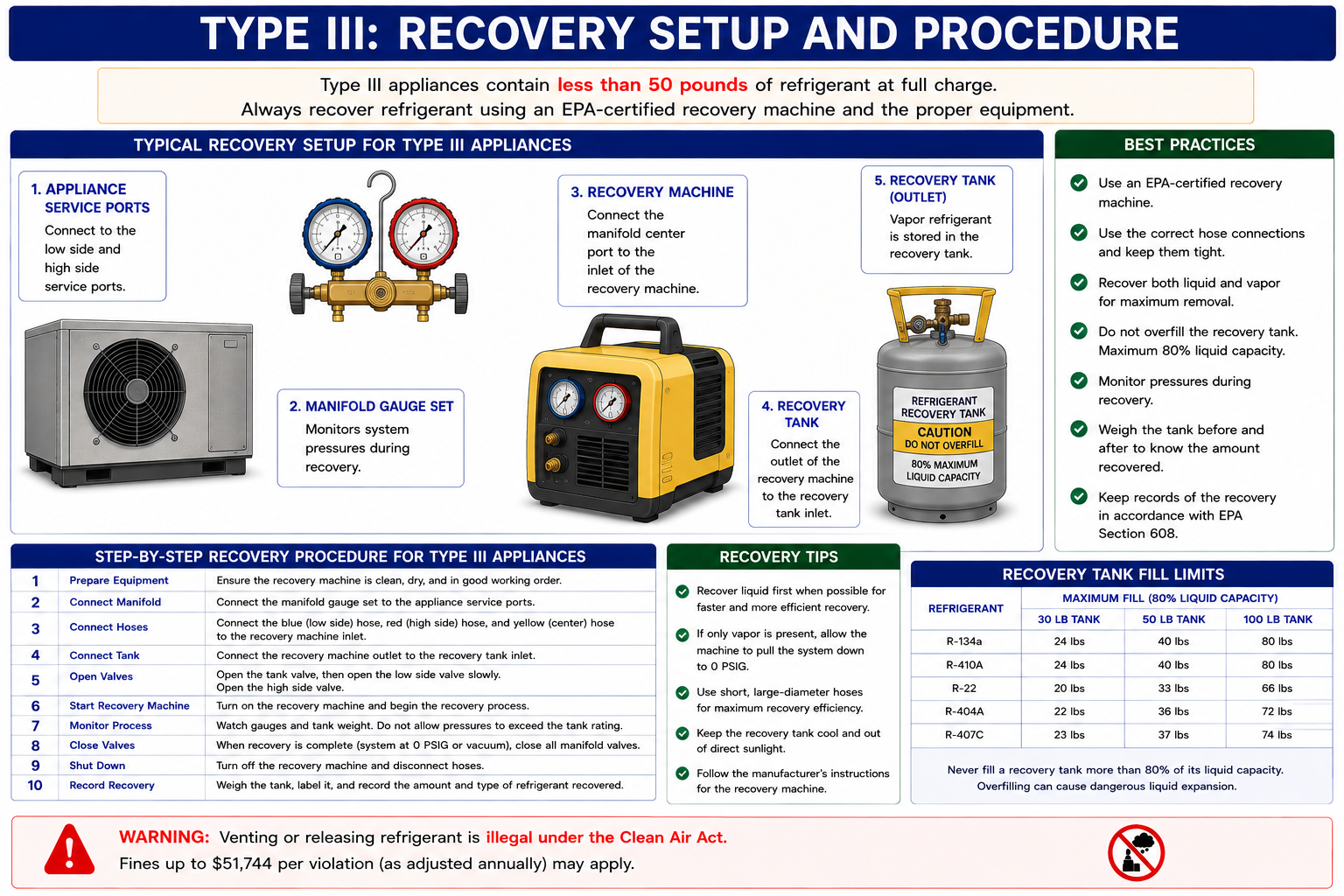
Verify the Actual Connection Diagram
Large chillers differ substantially by manufacturer and design. Follow the chiller and recovery-machine manufacturer’s procedures rather than assuming every Type III appliance uses an identical hose arrangement.
Bulk Liquid Removal Speeds Recovery
EPA’s Type III test topics emphasize recovering liquid early in the recovery process because liquid transfer removes a large refrigerant mass much more efficiently than vapor recovery alone. :contentReference[oaicite:5]{index=5}
After accessible liquid has been transferred, vapor recovery continues until the required low-pressure recovery endpoint is reached.
25 mm Hg Absolute
The current EPA evacuation requirement for a low-pressure appliance is 25 millimeters of mercury absolute. The same endpoint applies whether the recovery or recycling equipment was manufactured before or on or after November 15, 1993. :contentReference[oaicite:6]{index=6}
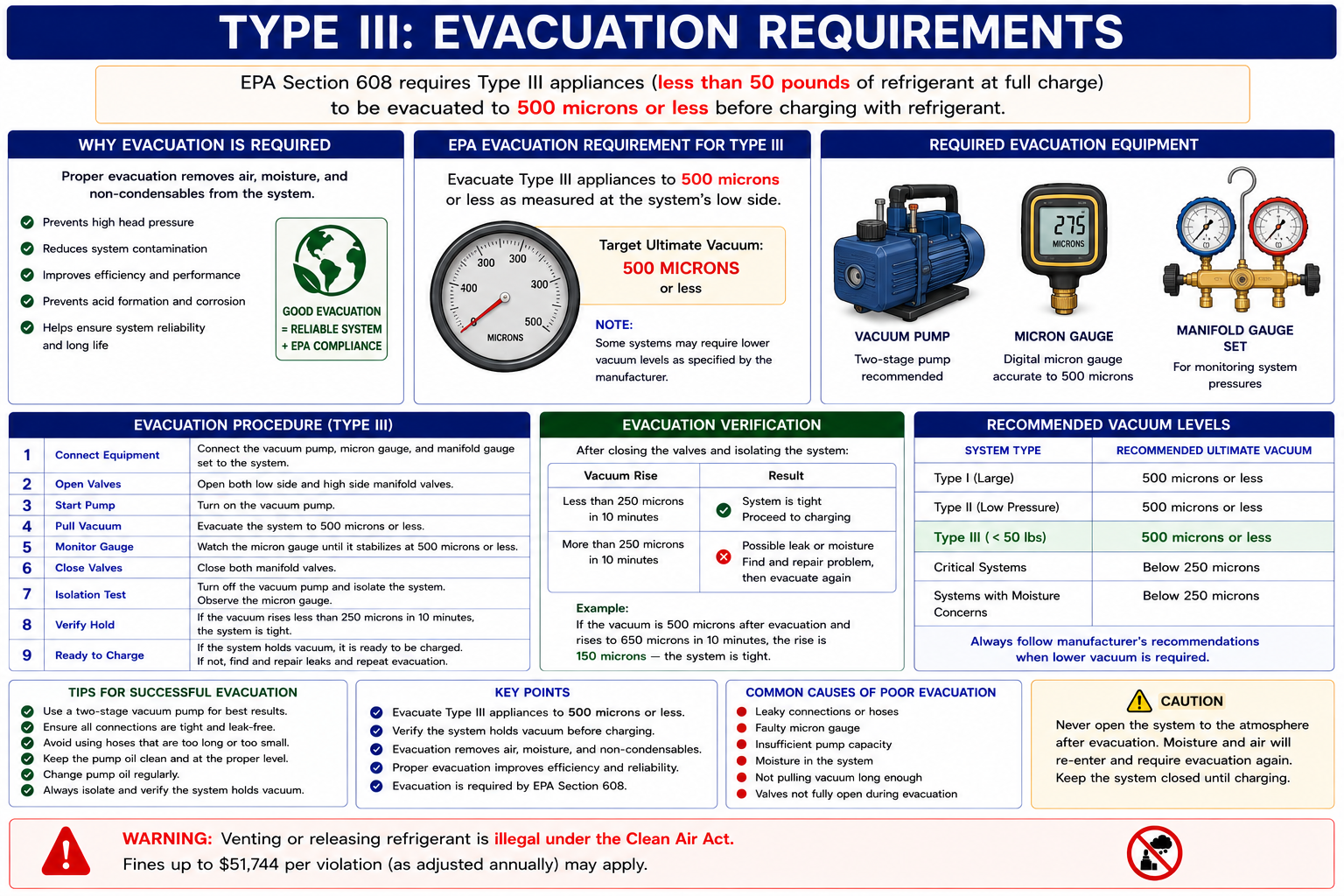
Absolute Pressure Is Not the Same as Gauge Vacuum
The Type III requirement is stated as 25 mm Hg absolute. Do not confuse an absolute-pressure reading with inches of mercury vacuum shown on a compound manifold gauge.
Low-Pressure Work Requires a Different Pressure Reference
Gauge pressure compares system pressure with atmospheric pressure. Absolute pressure compares pressure with a perfect vacuum. Because low-pressure chillers can operate below atmospheric pressure, absolute pressure provides a clearer way to describe the required recovery condition.
Technicians working with low-pressure refrigerants must therefore become comfortable interpreting both gauge vacuum and absolute-pressure measurements rather than treating them as interchangeable.
Pressure Rise Can Reveal Trapped Refrigerant
EPA’s current Type III test topics specifically note the need to wait after reaching the required recovery vacuum to determine whether appliance pressure rises again. :contentReference[oaicite:7]{index=7}
A pressure increase can occur because liquid refrigerant remains trapped in the system or refrigerant dissolved in the oil continues to boil out as pressure falls. If pressure rises, additional recovery may be required.
Deep Refrigerant-Side Vacuum Can Freeze Water
As pressure in the evaporator falls during refrigerant recovery, the saturation temperature of the remaining refrigerant also falls. The evaporator can become cold enough to freeze water remaining inside the chiller tubes.
EPA’s Type III test topics therefore emphasize the need to circulate or remove water from the chiller during refrigerant evacuation to prevent freezing. :contentReference[oaicite:8]{index=8}
Frozen Tubes Can Destroy a Chiller
Water expands when it freezes. Ice formation inside evaporator tubes can split tubes and allow large quantities of water to enter the refrigeration circuit. Protecting the water side is therefore a major part of Type III recovery.
Oil Can Hold Refrigerant After Bulk Recovery
Low-pressure chiller oil can contain substantial dissolved refrigerant. As system pressure is reduced, refrigerant boils out of the oil and can cause system pressure to rise after the recovery machine appears to have reached the required endpoint.
EPA’s Type III examination topics specifically identify heating chiller oil to approximately 130°F before removal as a way to reduce the amount of refrigerant released with the oil. :contentReference[oaicite:9]{index=9}
Follow Manufacturer Procedures When Heating Oil
The purpose of warming the oil is to drive dissolved refrigerant out so it can be recovered. Do not apply uncontrolled heat or exceed equipment-manufacturer limits.
EPA Limits Pressure Before Opening the Oil System
EPA’s general service-practice requirement prohibits changing refrigeration oil at pressures above 5 psig. The appliance or isolated oil-containing portion must be evacuated or pressurized to no greater than 5 psig before oil is removed, or the oil must be drained into a system receiver that is then brought to no greater than 5 psig. :contentReference[oaicite:10]{index=10}
Type III Appliances Can Be Subject to the Same Leak Rules as Other Large Appliances
Low-pressure appliances containing 50 pounds or more of Class I or Class II ozone-depleting refrigerant can be subject to the current Section 608 leak-repair requirements when the applicable annual leak-rate threshold is exceeded. The threshold depends on whether the appliance is comfort cooling, commercial refrigeration, industrial process refrigeration, or another covered category. :contentReference[oaicite:11]{index=11}
As covered in Lesson 37, separate AIM Act refrigerant-management requirements may now apply to certain HFC or substitute-refrigerant appliances. The refrigerant, full charge, appliance use, and applicable regulation must be identified before applying a leak threshold.
Excessive Purge Operation Can Help Identify a Problem
A low-pressure chiller may not lose large amounts of refrigerant outward through a leak while operating below atmospheric pressure. Instead, unusually frequent purge operation may indicate that air is entering the appliance and the leak needs to be located.
Introduce Vapor Before Liquid
EPA’s Type III test topics emphasize introducing refrigerant vapor before liquid refrigerant when recharging a low-pressure chiller. :contentReference[oaicite:12]{index=12}
Introducing liquid refrigerant into a deeply evacuated chiller can cause very rapid boiling and cooling. If water remains in the evaporator tubes, that cooling can freeze the water and damage the heat exchanger.
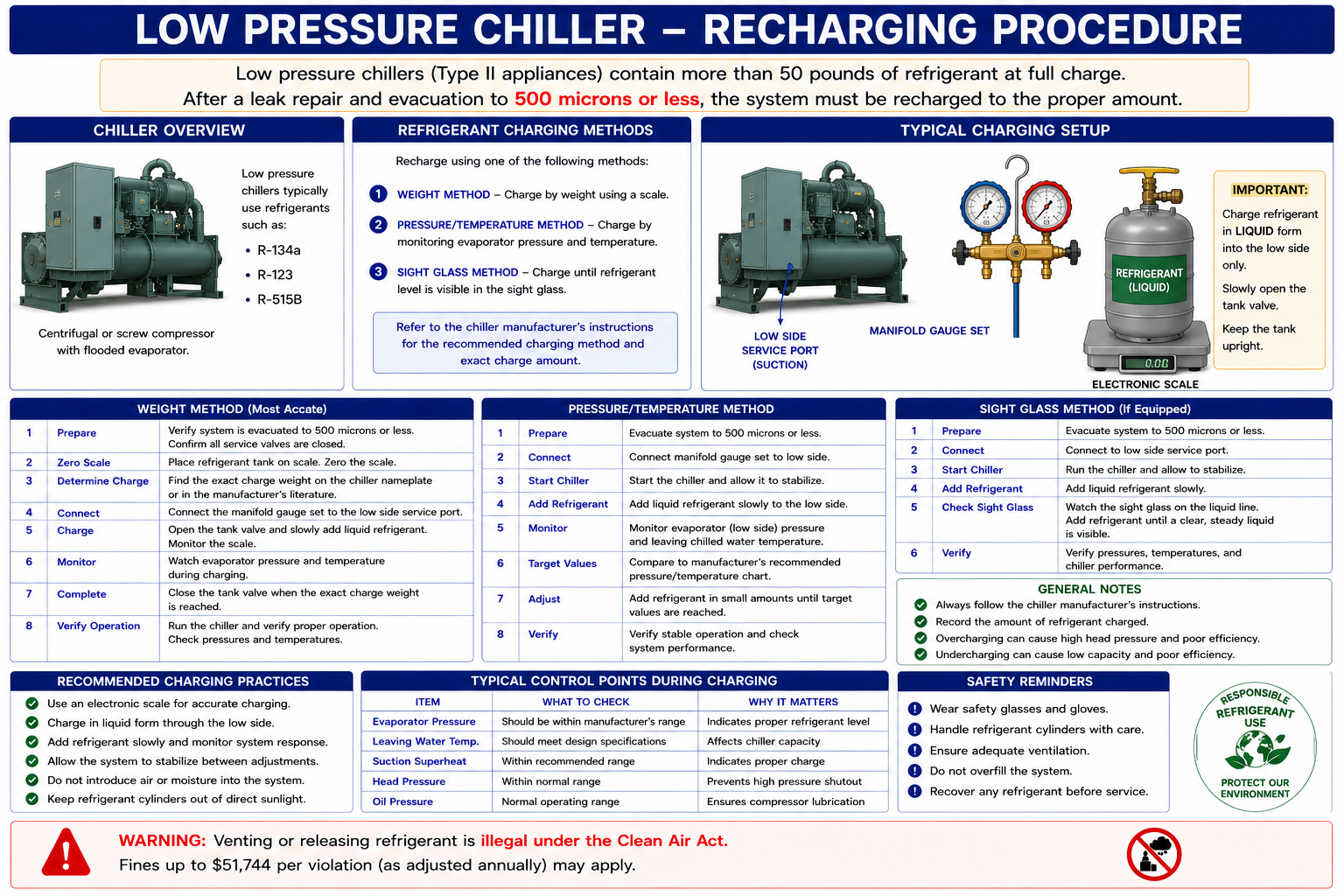
Follow the Chiller Manufacturer’s Charging Procedure
EPA’s current Type III test topics specifically identify charging centrifugal chillers through the evaporator charging valve. :contentReference[oaicite:13]{index=13}
Actual charging procedures vary with equipment design. The technician should follow the chiller manufacturer’s sequence for vapor charging, transition to liquid charging, operating water pumps, and returning the machine to normal conditions.
Low-Pressure Chillers Still Need Overpressure Protection
Although a low-pressure chiller normally operates below atmospheric pressure, abnormal conditions can cause internal pressure to rise. The appliance therefore incorporates pressure-relief protection appropriate to its design.
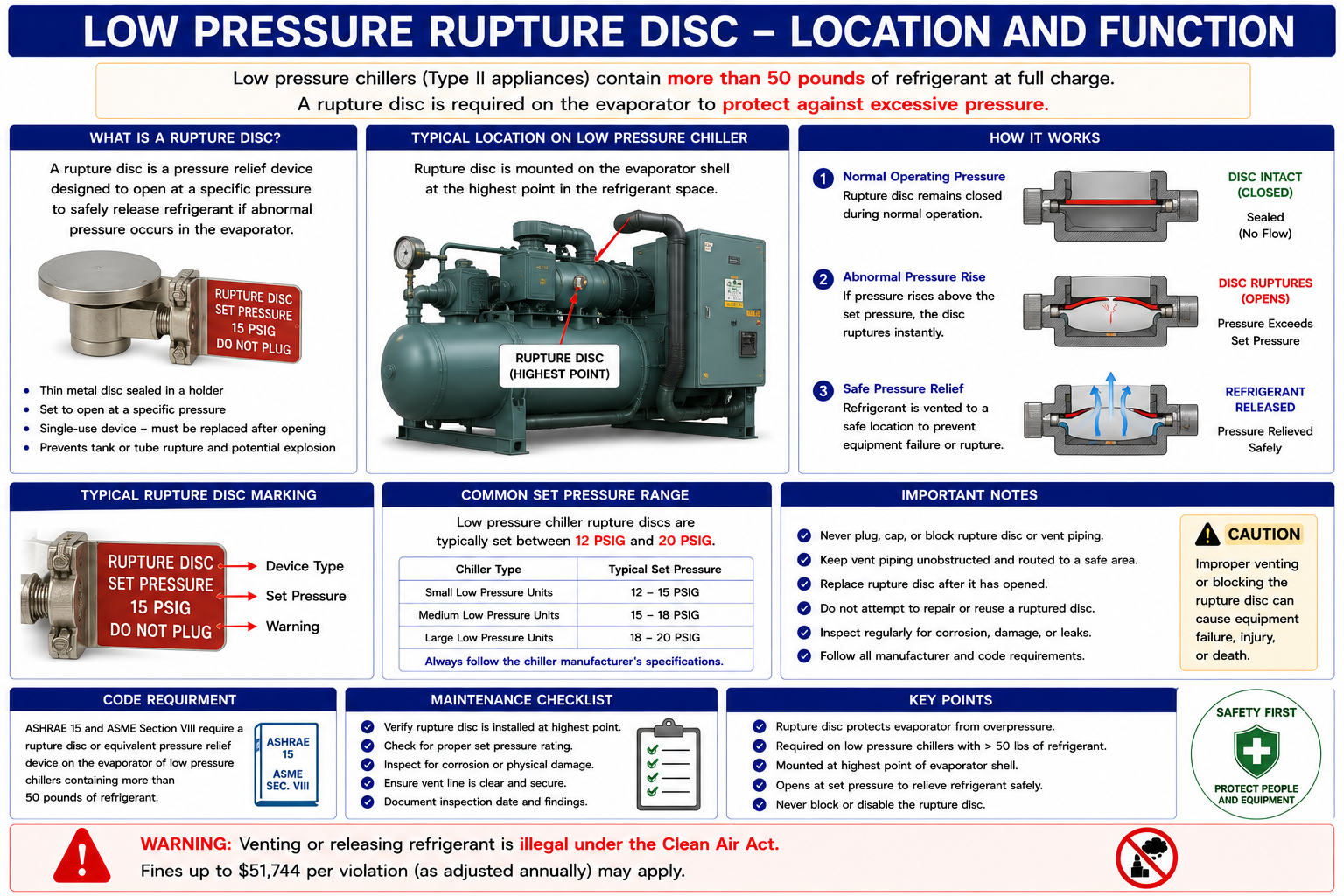
Never Defeat a Pressure-Relief Device
Pressure-relief devices are safety components. Replacement settings, discharge routing, and installation must follow the appliance manufacturer and applicable code requirements. This is an equipment-safety requirement rather than a universal Section 608 recovery specification.
Opening a Low-Pressure Appliance Requires a Different Procedure
For qualifying non-major maintenance, service, or repair that will not be followed by evacuation of the appliance to the atmosphere, EPA requires a low-pressure appliance to be pressurized to no higher than 0 psig before opening. :contentReference[oaicite:14]{index=14}
Because the appliance may originally be under vacuum, carefully warming the refrigerant can bring internal pressure toward atmospheric pressure and reduce air infiltration when the system is opened.
Major Repair Requires the Full Applicable Recovery Procedure
EPA’s definition of major maintenance, service, or repair includes removal of the compressor, condenser, evaporator, or auxiliary heat-exchange coil, as well as other specified large openings of the refrigeration circuit.
When major repair is performed, the technician must apply the normal applicable recovery requirement rather than the limited non-major-repair exception.
EPA Recognizes When Deep Recovery Is Physically Unattainable
If a leak prevents an appliance from reaching the normal required evacuation level or would substantially contaminate the recovered refrigerant, EPA allows the technician to isolate leaking components from non-leaking components wherever possible.
Non-leaking portions are evacuated to the normal required level, while leaking portions are evacuated to the lowest level attainable without substantially contaminating the refrigerant. The pressure in the leaking portion may not exceed 0 psig. :contentReference[oaicite:15]{index=15}
Low-Pressure Refrigerants Require Comfort With Vacuum Readings
Technicians working on low-pressure systems must understand the relationship between refrigerant saturation temperature and absolute pressure. As pressure falls, saturation temperature falls. This relationship explains both normal low-pressure chiller operation and the risk of freezing during deep recovery.
A pressure-temperature chart for the actual refrigerant should be used rather than assuming one low-pressure refrigerant behaves exactly like another.
Large Equipment Can Create Large Hazards
Type III systems may contain very large refrigerant charges, substantial electrical power, rotating machinery, large quantities of chilled and condenser water, pressurized nitrogen used during service, and heavy components. A system operating below atmospheric pressure is not automatically a low-hazard system.
Atmospheric Exposure
A major refrigerant release in a machinery room can displace breathable air and create an asphyxiation hazard.
Tube Freezing
Improper recovery or charging can lower refrigerant temperature enough to freeze water in heat-exchanger tubes.
Electrical Energy
Centrifugal chiller motors, drives, starters, and control equipment can operate at substantial voltage and power levels.
Pressure Control
Recovery equipment, nitrogen cylinders, refrigerant storage vessels, and relief devices remain pressure hazards.
Avoid Applying High-Pressure Logic to a Low-Pressure System
“Leaks Always Push Refrigerant Out”
Incorrect. When system pressure is below atmospheric pressure, leaks commonly allow air and moisture to enter.
“Purge Operation Fixes the Leak”
Incorrect. The purge unit removes noncondensables but does not repair the opening allowing them into the system.
“Low Pressure Means No Pressure Hazard”
Incorrect. Abnormal conditions can raise pressure, and service equipment and storage cylinders remain pressurized.
“Charge Liquid Into a Deep Vacuum”
Incorrect. Vapor is introduced first to reduce the risk of freezing water in the evaporator tubes.
“25 mm Hg Means 25 Inches Vacuum”
Incorrect. EPA’s Type III endpoint is 25 millimeters of mercury absolute.
“One Vacuum Reading Means Recovery Is Finished”
Incorrect. Wait and observe whether pressure rises from refrigerant trapped as liquid or dissolved in oil.
Work Through the System in the Correct Order
Identify the Refrigerant
Confirm the refrigerant and its pressure-temperature characteristics before service.
Determine System Pressure
Know whether the portion of the appliance being serviced is below, at, or above atmospheric pressure.
Protect the Water Side
Circulate or remove water as required so refrigerant-side vacuum does not freeze water in the evaporator tubes.
Recover Liquid and Vapor
Remove bulk liquid first where practical and continue vapor recovery to the required endpoint.
Verify the Endpoint
Reach 25 mm Hg absolute when the normal Table 1 requirement applies and observe whether pressure rises again.
Recharge Correctly
Introduce vapor first, then follow the manufacturer’s procedure for controlled liquid charging.
What You Need to Remember
- Type III certification applies to servicing or disposing of low-pressure appliances.
- Large centrifugal chillers are common examples of low-pressure appliances.
- Low-pressure systems can operate below atmospheric pressure.
- Leaks in low-pressure systems may allow air and moisture into the appliance.
- Excessive purge-unit operation can indicate air infiltration through a leak.
- The purge unit removes noncondensable gases from the refrigeration system.
- Controlled heat is the preferred first method for raising pressure during low-pressure leak testing; nitrogen may be used only where appropriate.
- Low-pressure equipment must not be subjected to high test pressures intended for high-pressure appliances.
- Recovering liquid first speeds recovery.
- Vapor must also be recovered after bulk liquid removal.
- EPA’s normal low-pressure appliance recovery requirement is 25 mm Hg absolute.
- The 25 mm Hg absolute requirement applies with both pre- and post-November 15, 1993 recovery equipment.
- Absolute pressure and gauge vacuum are different measurements.
- After reaching the required recovery level, wait to see whether appliance pressure rises from trapped refrigerant or refrigerant dissolved in oil.
- Water should be circulated or removed during low-pressure chiller evacuation to prevent freezing.
- EPA Type III test topics identify warming oil to approximately 130°F before removal to reduce refrigerant loss from the oil.
- EPA prohibits opening an oil system for an oil change above 5 psig.
- When charging a low-pressure centrifugal chiller, introduce refrigerant vapor before liquid.
- Introducing liquid into a deep vacuum can freeze water in evaporator tubes.
- EPA’s Type III test topics identify charging centrifugal chillers through the evaporator charging valve.
- For qualifying non-major repair, a low-pressure appliance is pressurized to no higher than 0 psig before it is opened.
- Where a leak makes the normal recovery level unattainable, isolate leaking components wherever possible and recover non-leaking sections normally.
- A purge unit does not eliminate the need to find and repair leaks.
- Low-pressure operation does not eliminate overpressure, electrical, refrigerant-exposure, or machinery-room hazards.
Review Questions
1. What certification is required for servicing low-pressure appliances?
Answer: Type III certification, or Universal certification that includes Type III qualification.
2. Why can a leak in a low-pressure chiller allow air into the system?
Answer: When pressure inside the appliance is below atmospheric pressure, the higher outside atmospheric pressure pushes air and moisture inward through the leak.
3. What is the purpose of a purge unit?
Answer: The purge unit removes air and other noncondensable gases that enter the low-pressure refrigeration system while minimizing refrigerant loss.
4. What can unusually frequent purge operation indicate?
Answer: It can indicate excessive air infiltration caused by a leak in the low-pressure system.
5. What is EPA’s normal recovery endpoint for a low-pressure appliance?
Answer: 25 millimeters of mercury absolute.
6. Why should the technician wait after reaching the required recovery vacuum?
Answer: Pressure may rise if liquid refrigerant remains trapped or refrigerant dissolved in the oil continues to boil out. A pressure rise indicates that additional recovery may be necessary.
7. Why must water be circulated or removed during low-pressure chiller evacuation?
Answer: Deep refrigerant-side vacuum can lower refrigerant temperature enough to freeze water in the heat-exchanger tubes, potentially damaging the chiller.
8. Why is refrigerant vapor introduced before liquid when recharging a low-pressure chiller?
Answer: Vapor raises system pressure and saturation temperature gradually. Introducing liquid directly into a deep vacuum can cause rapid cooling and freeze water in the evaporator tubes.
9. What pressure must a low-pressure appliance be brought to before opening it for a qualifying non-major repair?
Answer: It must be pressurized to a pressure no higher than 0 psig.
10. Does a purge unit repair a refrigeration-system leak?
Answer: No. It removes noncondensable gases that entered the system. The leak that allowed them to enter must still be located and corrected.
11. Why can refrigerant remain in chiller oil after bulk refrigerant recovery?
Answer: Refrigerant dissolves in the oil. As pressure falls or the oil warms, that refrigerant can boil out and return to the vapor space.
12. Is 25 mm Hg absolute the same measurement as 25 inches Hg vacuum on a manifold gauge?
Answer: No. EPA’s Type III recovery endpoint is an absolute-pressure measurement expressed in millimeters of mercury.
Lesson 38 Summary
- Type III certification applies to low-pressure refrigeration appliances.
- Large centrifugal chillers are common Type III appliances.
- Low-pressure appliances often operate below atmospheric pressure.
- Leaks can allow air and moisture into a low-pressure system.
- Noncondensable gases increase system pressure and reduce chiller efficiency.
- Purge units remove noncondensables but do not repair the leaks that allowed them into the system.
- Excessive purge operation can be evidence of a refrigeration-system leak.
- Controlled heating is the preferred way to raise pressure for many low-pressure leak-detection procedures.
- Low-pressure chillers must not be exposed to excessive test pressure.
- Liquid refrigerant should normally be removed before relying entirely on vapor recovery.
- EPA’s normal Type III recovery endpoint is 25 mm Hg absolute.
- The Type III recovery endpoint is the same for pre- and post-November 15, 1993 recovery equipment.
- Absolute pressure must not be confused with gauge vacuum.
- Pressure should be observed after the required recovery level is reached because refrigerant can remain trapped or dissolved in oil.
- Water should be circulated or removed during evacuation to prevent tube freezing.
- Refrigerant dissolved in oil must be considered during recovery and oil service.
- EPA’s Type III test topics identify warming oil to about 130°F before removal to minimize refrigerant release.
- EPA prohibits changing refrigerant oil at pressures above 5 psig.
- Low-pressure chillers are charged with vapor first before controlled liquid refrigerant is introduced.
- Charging liquid directly into a deep vacuum can freeze water in evaporator tubes.
- For qualifying non-major service, low-pressure appliances are brought up toward atmospheric pressure before opening.
- Leaking portions of an appliance must still be recovered as completely as practical under EPA’s leaking-equipment provisions.
- Low-pressure equipment still requires protection against overpressure, refrigerant exposure, electrical hazards, and machinery-room hazards.