EPA Section 608 Universal Review and Exam Preparation
Universal certification brings together the Core, Type I, Type II, and Type III knowledge required to work across the major categories of stationary refrigeration and air-conditioning equipment covered by EPA Section 608. The challenge is not simply remembering many regulations and service procedures. It is recognizing which rule applies to the appliance, refrigerant, charge size, operating pressure, and service operation described in the question.
This final Part VII lesson is designed as an integrated review rather than another full technical lesson. It organizes the major certification categories, recovery requirements, refrigerant-management concepts, leak-repair rules, safety principles, and frequently tested numbers into one decision-making framework. The goal is to help you recognize the correct rule from the facts of a scenario instead of relying on isolated memorization.
Learning Objectives
Integrate All Certification Types
Connect Core, Type I, Type II, Type III, and Universal certification into one organized framework.
Select the Correct Recovery Requirement
Determine the appropriate recovery endpoint from appliance type, refrigerant pressure classification, charge size, compressor condition, and recovery-equipment age.
Recognize Key EPA Numbers
Review the high-value percentages, pressures, charge thresholds, deadlines, and certification distinctions that commonly appear in Section 608 material.
Solve Service Scenarios
Use a structured process to identify the appliance, refrigerant, regulation, hazard, and required technician action before choosing an answer.
Core + Type I + Type II + Type III
Universal certification demonstrates qualification across all three Section 608 equipment certification categories. A Universal technician has successfully completed the required Core examination together with the Type I, Type II, and Type III examinations.
Universal certification does not mean that every refrigeration-related activity is covered by Section 608. Motor vehicle air-conditioning service is separately addressed under EPA Section 609, and additional workplace-safety, transportation, equipment, building-code, and manufacturer requirements may apply to particular jobs.
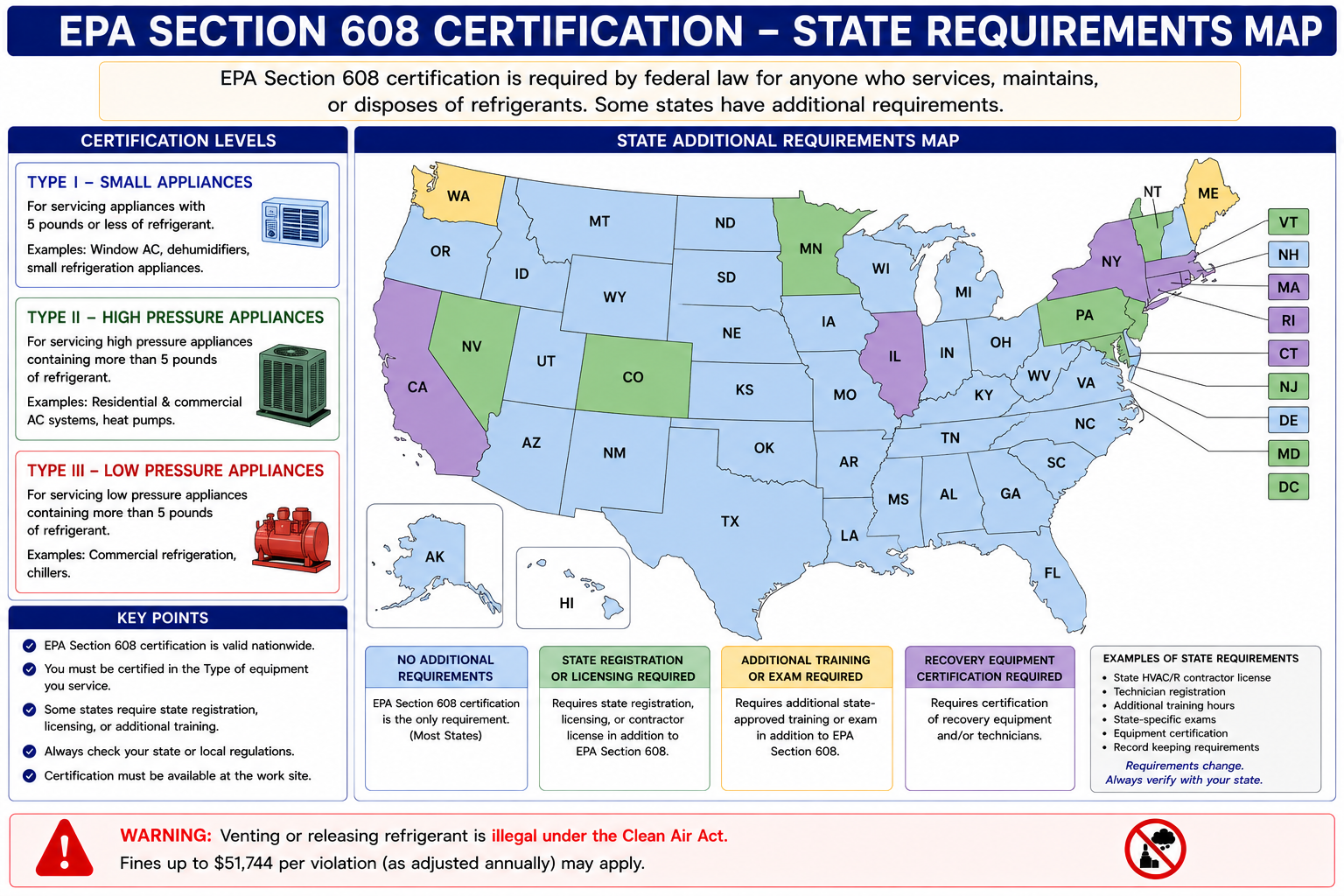
Know What Each Part Is Testing
Core
Environmental effects, refrigerant characteristics, regulations, refrigeration principles, recovery, recycling, reclamation, evacuation, dehydration, cylinders, safety, and general service practices.
Type I
EPA-defined small appliances, self-contained and system-dependent recovery, compressor condition, percentage recovery requirements, and safe-disposal responsibilities.
Type II
High-pressure and very-high-pressure appliances, recovery endpoints, large-system service practices, major repairs, leak requirements, and refrigerant-management records.
Type III
Low-pressure appliances, centrifugal chillers, air infiltration, purge systems, absolute pressure, low-pressure recovery, leak detection, and vapor-first charging.
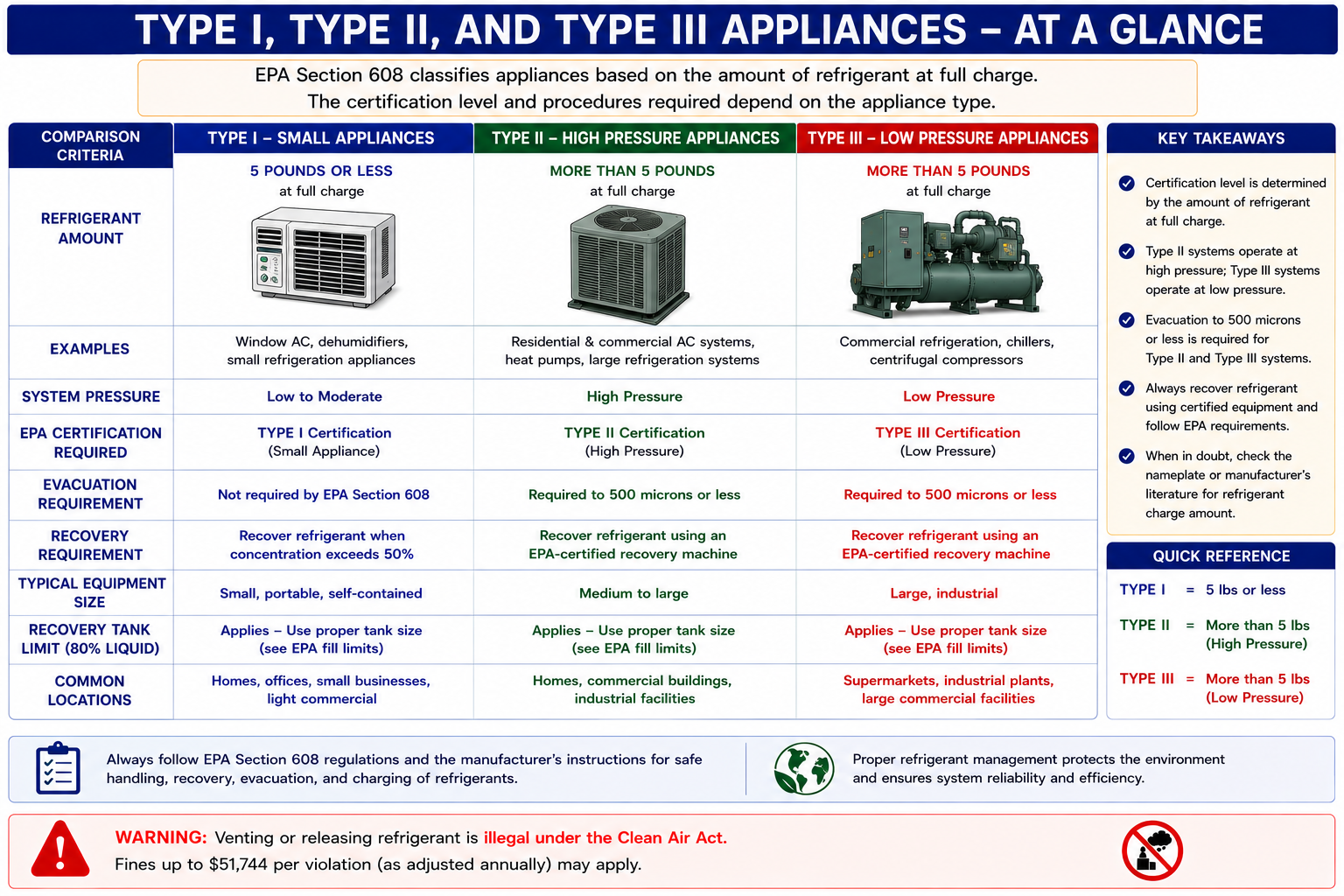
Start by Identifying the Appliance
| Certification | Primary Equipment Category | Typical Examples |
|---|---|---|
| Type I | EPA-defined small appliances | Household refrigerators, room air conditioners, dehumidifiers, water coolers, certain vending and ice equipment |
| Type II | High-pressure and very-high-pressure appliances except small appliances and MVACs | Many comfort-cooling systems, commercial refrigeration systems, rooftop equipment, heat pumps, and process refrigeration equipment |
| Type III | Low-pressure appliances | Large low-pressure centrifugal chillers |
| Universal | Types I, II, and III | Stationary HVAC/R work across all three certification categories |
Do Not Select Certification From Refrigerant Charge Alone
A five-pound charge does not automatically mean Type I, and a large cabinet does not automatically mean Type III. Apply the complete appliance definition and refrigerant characteristics.
ODP and GWP Are Different
CFC and HCFC refrigerants contain chlorine and can contribute to stratospheric ozone depletion. HFC refrigerants contain no chlorine or bromine and therefore have zero Ozone Depletion Potential, although many HFCs have substantial Global Warming Potential.
ODP uses CFC-11 as its reference substance with an ODP of 1.0. GWP uses carbon dioxide as the reference gas with a GWP of 1. GWP is commonly expressed using a 100-year time horizon.
Identify Before You Connect
Correct refrigerant identification affects recovery equipment, expected pressures, lubricant compatibility, safety classification, charging method, recovery-cylinder selection, and whether recovered refrigerant can remain useful.
Use equipment nameplates, refrigerant labels, manufacturer literature, and appropriate identification equipment. Do not rely solely on cylinder color, operating pressure, or appliance appearance.
Never Mix Refrigerants for Convenience
Cross-contamination can make refrigerant unsuitable for reuse, complicate reclamation, and create unpredictable pressure-temperature behavior. Unknown refrigerant should remain segregated from known refrigerant.
Recover, Recycle, and Reclaim
Recover
Remove refrigerant from an appliance and store it externally without necessarily processing or testing it.
Recycle
Clean recovered refrigerant for permitted reuse through processes such as oil separation, filtration, and moisture removal without completing full reclamation requirements.
Reclaim
Reprocess used refrigerant to the applicable purity specification and verify that purity using required analytical methods.
Know Which Machine Performs Which Job
A recovery machine removes refrigerant from an appliance and transfers it to an external container. A vacuum pump is used after refrigerant recovery to remove air, noncondensable gases, and water vapor from the refrigeration circuit.
The recovery endpoint required by EPA before opening an appliance is therefore different from the deep evacuation used after repairs to dehydrate a refrigeration system before charging.
A Vacuum Pump Is Not a Recovery Machine
Do not vent refrigerant through a vacuum pump as a substitute for proper recovery.
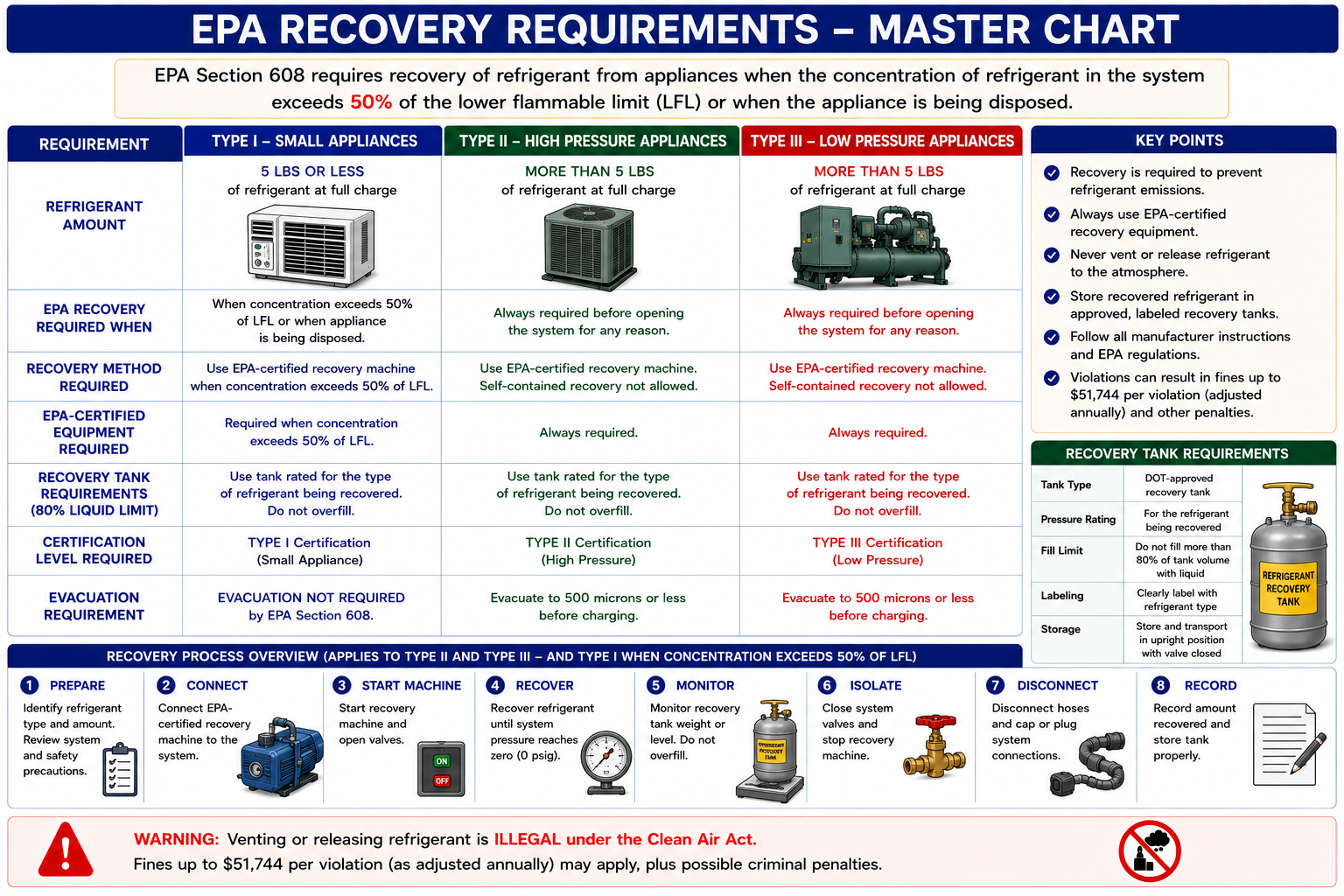
Different Appliances Have Different Endpoints
| Appliance / Condition | Required Recovery Endpoint |
|---|---|
| Type I with pre-November 15, 1993 recovery equipment | 80% recovery |
| Type I with newer equipment and operating compressor | 90% recovery |
| Type I with newer equipment and inoperative compressor | 80% recovery |
| Type I alternative | 4 inches Hg vacuum |
| Very-high-pressure appliance | 0 inches Hg vacuum |
| High-pressure appliance under 200 lb full charge | 0 inches Hg vacuum |
| High-pressure appliance 200 lb or more with pre-1993 equipment | 4 inches Hg vacuum |
| High-pressure appliance 200 lb or more with post-1993 equipment | 10 inches Hg vacuum |
| Medium-pressure appliance under 200 lb with pre-1993 equipment | 4 inches Hg vacuum |
| Medium-pressure appliance under 200 lb with post-1993 equipment | 10 inches Hg vacuum |
| Medium-pressure appliance 200 lb or more with pre-1993 equipment | 4 inches Hg vacuum |
| Medium-pressure appliance 200 lb or more with post-1993 equipment | 15 inches Hg vacuum |
| Low-pressure appliance | 25 mm Hg absolute |
Do Not Memorize the Table Without Its Conditions
The numbers only make sense when connected to appliance type, full charge, compressor condition, and recovery-equipment age.
Small Appliance Questions
A small appliance must meet EPA’s complete definition, including factory manufacture, factory charging, hermetic sealing, and a refrigerant charge of five pounds or less.
With newer recovery equipment, the key distinction is compressor condition: 90 percent with an operating compressor and 80 percent with a failed compressor. The alternative recovery endpoint is four inches of mercury vacuum.
Pressure Category, Charge, and Repair Type Matter
Type II questions may require the technician to identify the refrigerant pressure category, full charge, equipment age, whether a repair is major, and whether a leak-repair regulation applies.
System-dependent recovery equipment may not be used on appliances containing more than 15 pounds of refrigerant. Bulk liquid recovery can greatly increase recovery speed, but remaining vapor must still be recovered to the required endpoint.
0 psig Does Not Mean Empty
Refrigerant vapor and trapped liquid may remain inside an appliance even when gauge pressure equals atmospheric pressure.
Think Below Atmospheric Pressure
Low-pressure systems require a different mental model. Leaks often allow air and moisture into the appliance, purge-unit operation can indicate leakage, and system pressure may need to be carefully raised toward atmospheric pressure before qualifying service.
The normal Type III recovery endpoint is 25 mm Hg absolute. Technicians must protect the water side from freezing during evacuation and introduce refrigerant vapor before liquid when recharging a deeply evacuated centrifugal chiller.
Know Which Regulation You Are Applying
Under the current Section 608 leak-repair provisions in 40 CFR Part 82, appliances with a full charge of 50 pounds or more of Class I or Class II ozone-depleting refrigerant may become subject to required corrective action when the applicable annualized leak-rate threshold is exceeded.
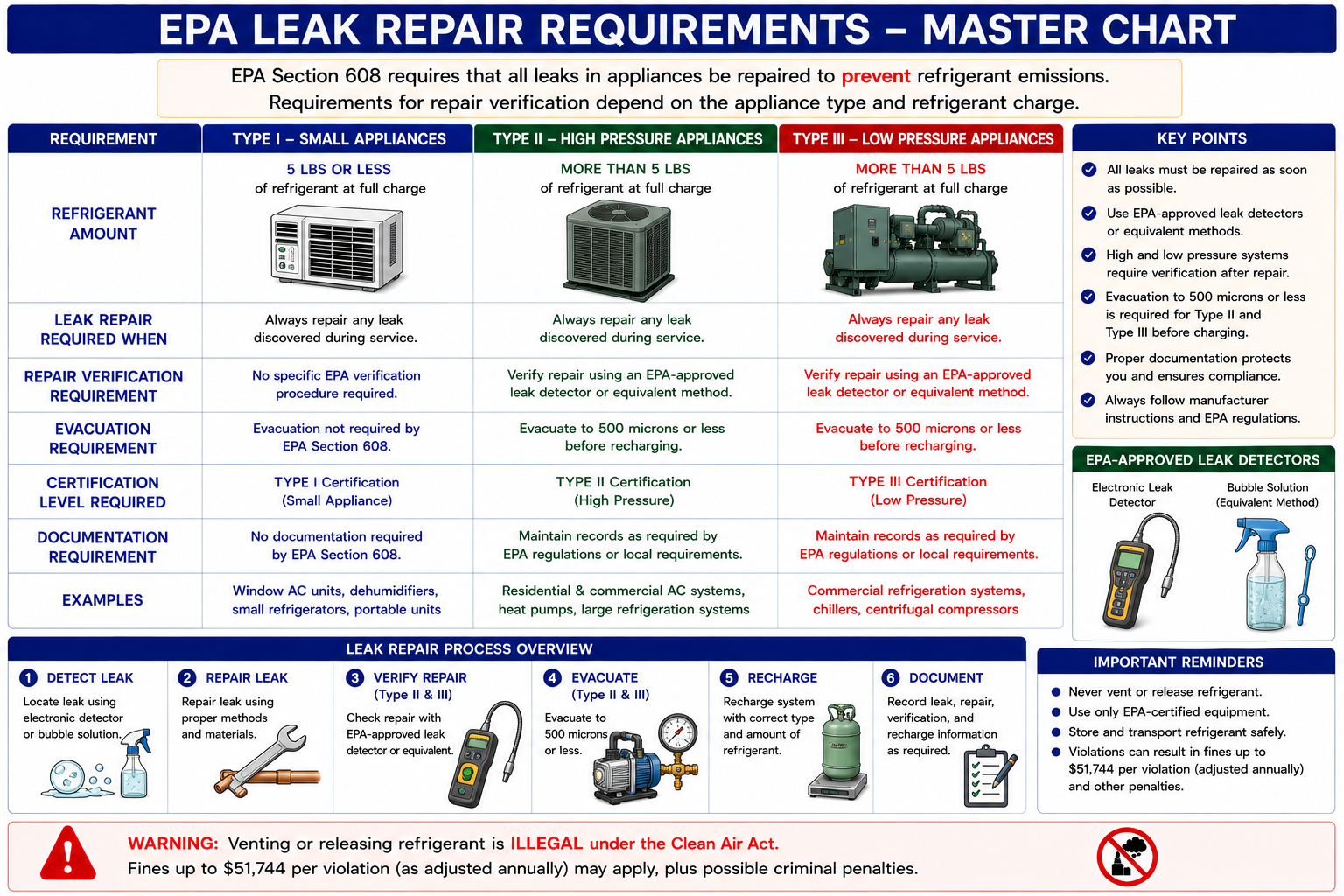
| Appliance Category | Section 608 Trigger Rate |
|---|---|
| Comfort cooling and other covered appliances | 10% per year |
| Commercial refrigeration | 20% per year |
| Industrial process refrigeration | 30% per year |
Do Not Apply the 50-Pound Section 608 Rule to Every HFC System
The current Part 82 Section 608 leak-repair provision applies to qualifying appliances containing ozone-depleting refrigerant. Separate AIM Act requirements now apply to many covered appliances containing 15 pounds or more of regulated HFC or other qualifying refrigerant.
The AIM Act Adds Another Refrigerant-Management Layer
Beginning January 1, 2026, EPA’s 40 CFR Part 84 refrigerant-management requirements apply leak-repair provisions to many covered refrigerant-containing appliances with a full charge of 15 pounds or more.
This does not replace the Section 608 certification material. It means that a technician working in the field must identify which current regulatory program applies to the actual refrigerant and appliance.
Exam Knowledge and Field Compliance
Section 608 certification questions may test traditional Part 82 requirements. Current field work may also require compliance with Part 84. A professional technician must distinguish the two instead of assuming one historical threshold applies to every refrigerant.
Repair, Verify, and Document
For appliances subject to the Section 608 leak-repair requirements, qualifying leaks generally must be repaired within 30 days. When an industrial process shutdown is required, the normal repair period is extended to 120 days.
Covered repairs require initial verification testing followed by follow-up verification testing. The follow-up test confirms that the repair remains effective under or near normal operating conditions.
Use EPA’s Definition
Major maintenance, service, or repair includes removal of the compressor, condenser, evaporator, or auxiliary heat-exchange coil, along with certain other large openings identified by EPA.
Do not classify a repair as major because it is expensive, difficult, or time-consuming. Use the regulatory definition.
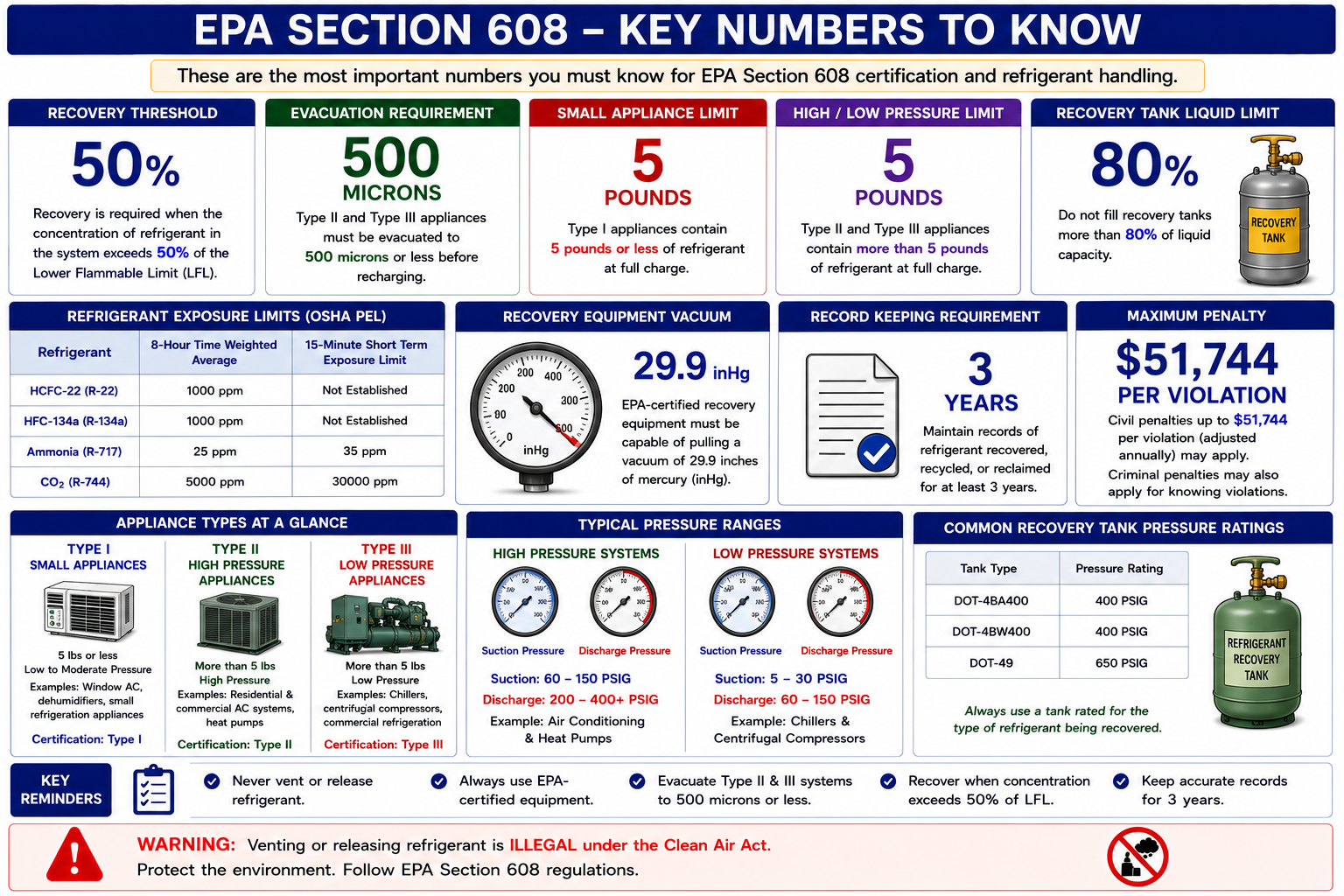
Numbers Worth Organizing
| Number | What It Represents |
|---|---|
| 5 lb | Maximum refrigerant charge within EPA’s small-appliance definition when the other definition requirements are also met |
| 80% | Type I recovery in several specified conditions, including newer equipment with an inoperative compressor |
| 90% | Type I recovery with newer recovery equipment and a functional compressor |
| 4 in. Hg vacuum | Alternative small-appliance recovery endpoint |
| 15 lb | Section 608 boundary above which system-dependent recovery equipment may not be used; also an important current Part 84 appliance-charge threshold under separate AIM Act provisions |
| 25 mm Hg absolute | Normal Type III low-pressure recovery endpoint |
| 50 lb | Current Section 608 Part 82 leak-repair applicability threshold for qualifying ODS appliances |
| 10% | Comfort-cooling and other covered appliance leak-rate threshold under the applicable Section 608 rule |
| 20% | Commercial refrigeration leak-rate threshold |
| 30% | Industrial process refrigeration leak-rate threshold |
| 30 days | Normal Section 608 covered leak-repair period |
| 120 days | Repair period when an industrial process shutdown is required |
| 5 psig | Maximum pressure before opening applicable oil systems for oil change under EPA service-practice requirements |
Never Memorize a Number Without Its Meaning
The number 15 can refer to system-dependent recovery limitations, a modern AIM Act charge threshold, or a post-1993 medium-pressure recovery endpoint depending on context. Always connect the number to the appliance and regulation.
Certification Questions Are Also Service Questions
Refrigerant service combines pressure, cold-contact, eye, electrical, atmospheric, flammability, chemical, and mechanical hazards. EPA certification does not replace OSHA requirements, manufacturer procedures, Safety Data Sheets, or equipment-specific training.
Liquid Refrigerant
Rapid evaporation can cause serious frostbite and eye injury.
Pressure
Systems, hoses, cylinders, recovery equipment, and nitrogen cylinders contain stored energy.
Atmospheric Hazards
Large refrigerant releases can create hazardous concentrations or displace breathable air.
Flammable Refrigerants
A2L and A3 refrigerants require appropriate equipment, ventilation, and ignition-source control.
Pressure Testing Requires the Correct Gas
Dry nitrogen is commonly used for approved refrigeration pressure testing and brazing procedures. A suitable regulator must always be used because the cylinder contains gas at very high pressure.
Never Substitute Oxygen
Oxygen can react violently with refrigerant oils and other materials. Compressed air also introduces oxygen and moisture into the refrigeration circuit.
Pressure, Temperature, and Weight Matter
Refrigerant cylinders are pressure vessels. Cylinder pressure rises as refrigerant temperature rises, and liquid refrigerant requires sufficient vapor space for thermal expansion.
Recovery-cylinder fill should be controlled by weight using the cylinder specifications and applicable requirements. Pressure alone cannot reliably determine how much refrigerant is in a cylinder containing both liquid and vapor.
Know the Standard Hose Functions
The traditional manifold arrangement uses the blue hose on the low side, red hose on the high side, and yellow center hose as the service connection.
During standard recovery, refrigerant flows from the system through the manifold, out the center service hose to the recovery machine, and then from the recovery machine to the recovery cylinder.
Stop Looking for Keywords and Work the Problem
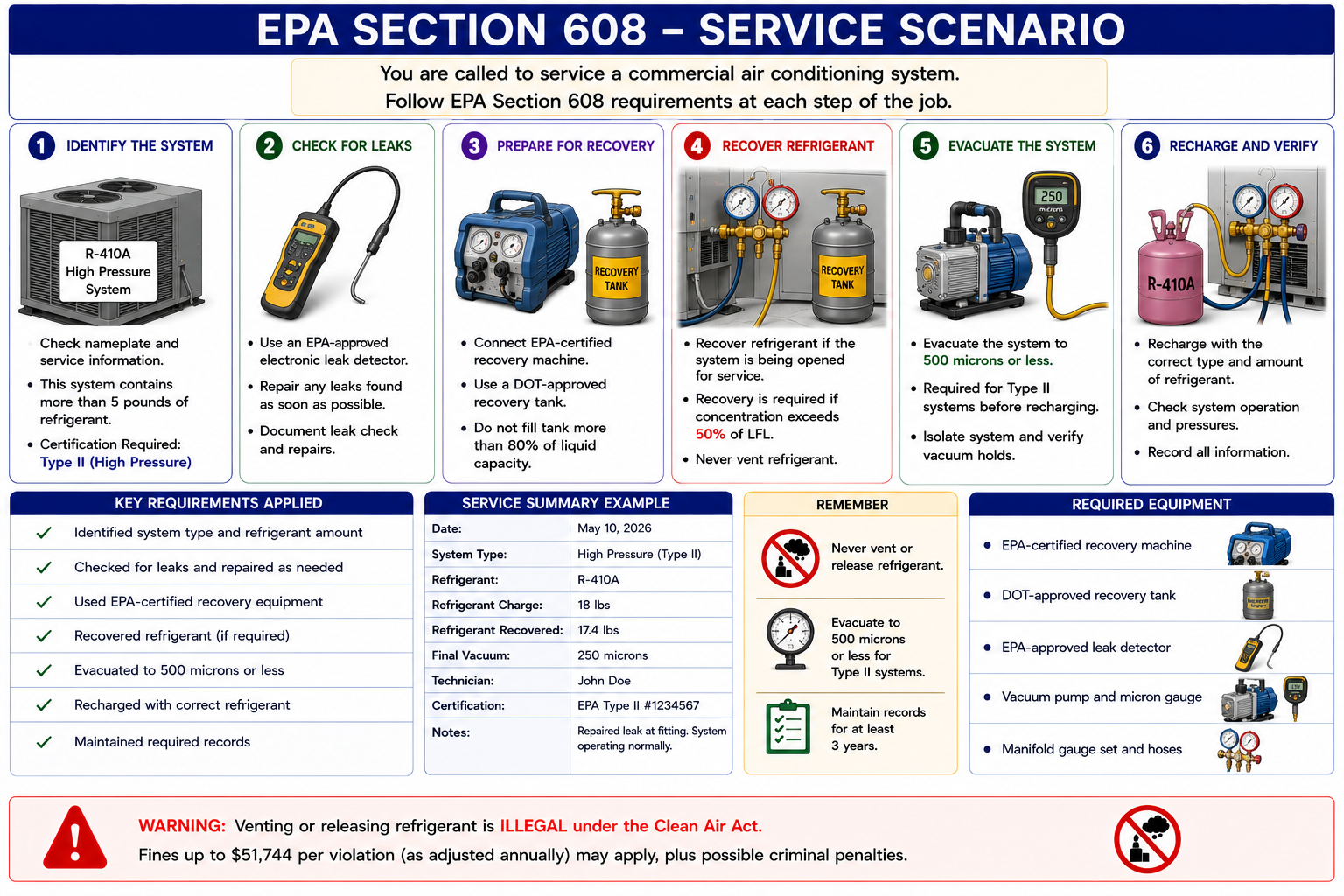
Identify the Appliance
Is it a small appliance, high-pressure appliance, very-high-pressure appliance, low-pressure appliance, or MVAC?
Identify the Refrigerant
Determine refrigerant family, pressure characteristics, environmental status, and safety classification.
Determine Charge Size
Charge size may change recovery, equipment, leak-repair, and recordkeeping requirements.
Identify the Operation
Is the question about recovery, repair, disposal, charging, evacuation, leak testing, oil service, or cylinder handling?
Identify the Regulation
Determine whether the question involves Section 608, Section 609, AIM Act Part 84, workplace safety, transportation, or manufacturer requirements.
Apply the Number Last
Only after the situation is identified should you select the percentage, pressure, charge threshold, or deadline that applies.
Watch for Almost-Correct Answers
Recovery vs. Evacuation
A recovery machine captures refrigerant. A vacuum pump removes air and moisture after refrigerant recovery.
ODP vs. GWP
Zero ODP does not mean zero climate impact.
Type I vs. Small Charge
Five pounds or less is only one part of EPA’s small-appliance definition.
0 psig vs. Empty
An appliance can still contain refrigerant at atmospheric gauge pressure.
Section 608 vs. Section 609
Motor vehicle air conditioning is not Type I simply because the refrigerant charge is small.
Section 608 vs. AIM Act
Current HFC leak rules may come from Part 84 rather than the older Part 82 ODS leak-repair provision.
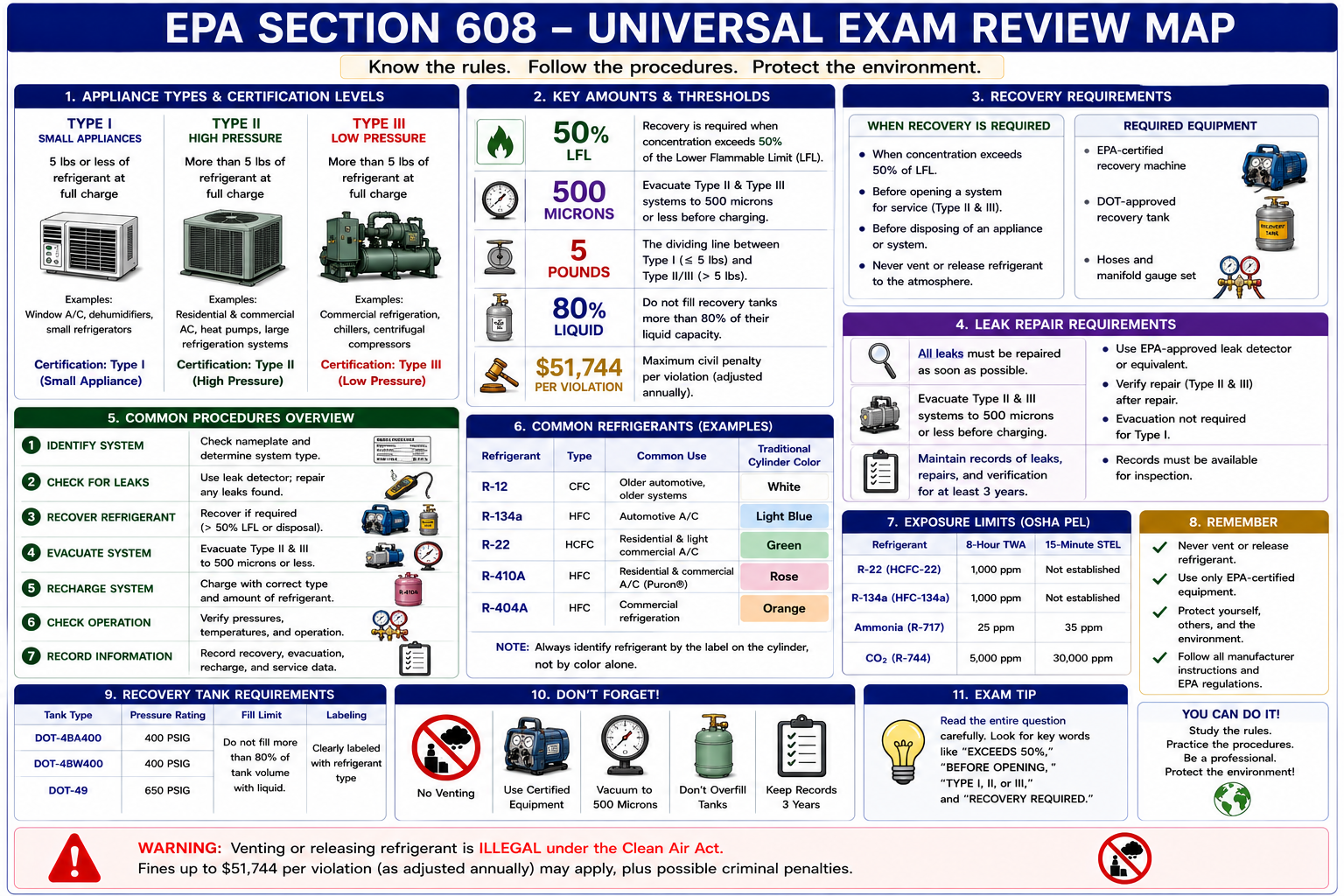
Connect the Concepts
What You Need to Remember
- Universal certification represents qualification across Type I, Type II, and Type III Section 608 equipment categories.
- The Core examination covers environmental effects, refrigerant characteristics, regulations, refrigeration principles, recovery, recycling, reclamation, evacuation, dehydration, safety, and cylinders.
- Type I applies to EPA-defined small appliances.
- Type II applies to high-pressure and very-high-pressure appliances except small appliances and MVACs.
- Type III applies to low-pressure appliances.
- Motor vehicle air-conditioning service is addressed separately under Section 609.
- CFCs and HCFCs contain chlorine and can contribute to ozone depletion.
- HFC refrigerants have zero ODP but may have substantial GWP.
- CFC-11 is the ODP reference substance with an ODP of 1.0.
- Carbon dioxide is the GWP reference gas with a GWP of 1.
- Recover, recycle, and reclaim have different regulatory meanings.
- A recovery machine and a vacuum pump perform different functions.
- Do not identify refrigerant by cylinder color alone.
- Do not mix different refrigerants in a recovery cylinder.
- Type I newer-equipment recovery is 90 percent with an operating compressor and 80 percent with an inoperative compressor.
- The Type I alternative endpoint is 4 inches Hg vacuum.
- Very-high-pressure appliances recover to 0 inches Hg vacuum under the normal EPA table.
- High-pressure appliances under 200 pounds full charge recover to 0 inches Hg vacuum.
- High-pressure appliances of 200 pounds or more recover to 4 inches Hg vacuum with older equipment or 10 inches with newer equipment.
- Medium-pressure appliances under 200 pounds recover to 4 inches Hg vacuum with older equipment or 10 inches with newer equipment.
- Medium-pressure appliances of 200 pounds or more recover to 4 inches Hg vacuum with older equipment or 15 inches with newer equipment.
- Low-pressure appliances recover to 25 mm Hg absolute.
- System-dependent recovery equipment may not be used on appliances containing more than 15 pounds of refrigerant.
- Current Section 608 leak-repair provisions apply to qualifying appliances containing 50 pounds or more of ozone-depleting refrigerant.
- Applicable Section 608 leak-rate thresholds are 10 percent for comfort cooling, 20 percent for commercial refrigeration, and 30 percent for industrial process refrigeration.
- Covered Section 608 leaks generally must be repaired within 30 days.
- An industrial process shutdown can provide a 120-day repair period.
- Beginning in 2026, separate AIM Act requirements apply to many covered refrigerant-containing appliances with 15 pounds or more of refrigerant.
- Initial and follow-up verification testing may be required after repairs covered by the applicable leak-repair regulation.
- Low-pressure systems may draw air and moisture inward through leaks.
- Excessive purge operation can indicate leakage into a low-pressure chiller.
- Protect chiller water from freezing during deep refrigerant recovery.
- Charge low-pressure chillers with vapor before introducing liquid.
- Liquid refrigerant can cause serious cold-contact injury.
- Large refrigerant releases can create oxygen-displacement hazards.
- Use dry nitrogen with appropriate pressure regulation for approved refrigeration pressure-testing procedures.
- Never use oxygen as a substitute for nitrogen in refrigeration pressure testing.
- Use a scale to monitor recovery-cylinder fill.
- EPA Section 608 technician certification credentials do not expire.
Review Questions
1. What qualifications make a technician Universal under Section 608?
Answer: Qualification across Type I, Type II, and Type III certification together with the required Core examination.
2. What is the required Type I recovery percentage with newer equipment when the compressor operates?
Answer: 90 percent.
3. What Type I percentage applies when the compressor does not operate?
Answer: 80 percent with newer recovery equipment.
4. What is the normal EPA recovery endpoint for a low-pressure appliance?
Answer: 25 millimeters of mercury absolute.
5. What is the current Section 608 leak-rate threshold for commercial refrigeration subject to the Part 82 leak rule?
Answer: 20 percent per year.
6. What is the Section 608 threshold for industrial process refrigeration?
Answer: 30 percent per year.
7. Why can excessive purge operation indicate a low-pressure chiller leak?
Answer: Air entering through a leak must be repeatedly removed by the purge system, causing abnormal purge activity.
8. Why should a recovery cylinder be weighed rather than judged only by pressure?
Answer: When liquid and vapor are present, cylinder pressure primarily reflects refrigerant type and temperature and does not reliably indicate the mass of refrigerant in the cylinder.
9. Is a vacuum pump an acceptable substitute for a refrigerant recovery machine?
Answer: No. Refrigerant must first be properly recovered. A vacuum pump is used to evacuate air and moisture after refrigerant recovery.
10. Does Universal certification cover motor vehicle air-conditioning service under Section 609?
Answer: No. Section 609 is a separate EPA technician-certification program for motor vehicle air-conditioning service.
11. Why is the 50-pound leak threshold not automatically applied to every HFC appliance in 2026?
Answer: The current Section 608 Part 82 leak-repair provisions apply to qualifying appliances containing ozone-depleting refrigerant. Separate Part 84 AIM Act rules now apply to many covered HFC and other qualifying refrigerant appliances.
12. What should you identify first when answering a complicated Section 608 scenario?
Answer: Identify the appliance and refrigerant first, then determine charge size, service operation, applicable regulation, and finally the numerical requirement.
Lesson 39 Summary
- Universal certification integrates Core, Type I, Type II, and Type III Section 608 knowledge.
- The best way to solve Section 608 questions is to identify the appliance, refrigerant, charge, service operation, and applicable regulation before applying a number.
- Core knowledge includes environmental science, refrigerant properties, refrigeration fundamentals, refrigerant management, safety, recovery, evacuation, and cylinders.
- Type I covers EPA-defined small appliances.
- Type II covers high-pressure and very-high-pressure appliances except small appliances and MVACs.
- Type III covers low-pressure appliances.
- Recovery, recycling, reclamation, evacuation, and dehydration are different processes.
- EPA recovery endpoints vary by appliance category, charge size, compressor condition, and recovery-equipment age.
- Current Section 608 leak-repair requirements and current AIM Act leak-repair requirements have different scopes and must not be confused.
- Safety requirements remain important regardless of certification category.
- Refrigerant identification should always occur before recovery, charging, or service-equipment selection.
- Cross-contamination should be prevented by keeping different refrigerants separated.
- Low-pressure systems require different leak-detection, recovery, and charging strategies because they often operate below atmospheric pressure.
- Recovery cylinders must be monitored by weight and protected from overfill and excessive temperature.
- Professional refrigerant service requires understanding why a rule applies rather than merely memorizing an examination answer.