EPA Section 608 Type II: Medium-, High-, and Very-High-Pressure Appliances
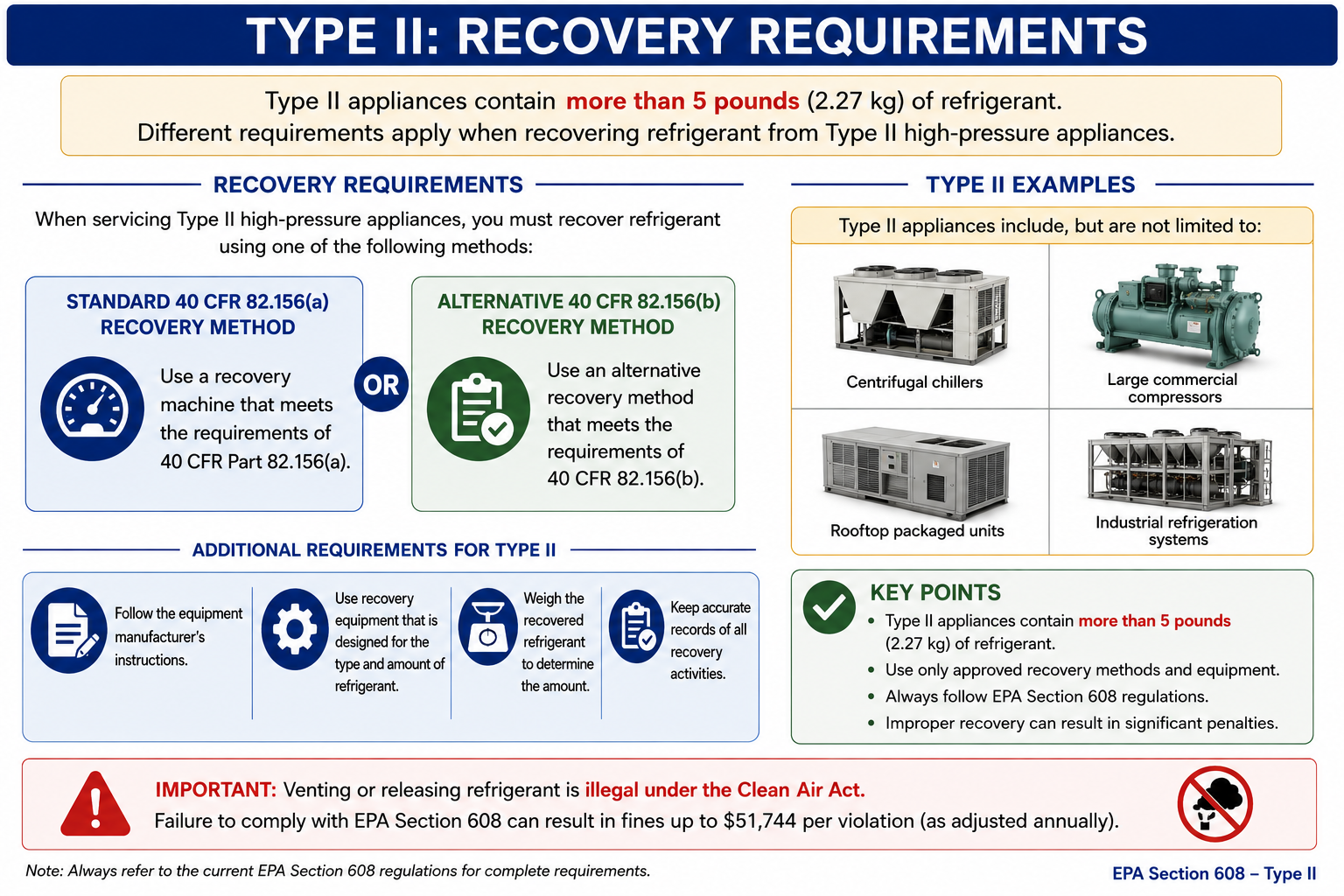
Type II certification applies to technicians servicing or disposing of high-pressure and very-high-pressure appliances other than small appliances and motor vehicle air conditioners. These categories include much of the comfort-cooling and commercial refrigeration equipment encountered by HVAC/R technicians. EPA service-practice rules also contain requirements for medium-pressure appliances, so technicians preparing for broad stationary refrigeration work must understand those evacuation requirements as well.
Type II work requires more than recognizing appliance pressure. Technicians must understand refrigerant recovery levels, major versus non-major repairs, recovery equipment, liquid and vapor recovery, leak detection, leak-rate calculations, verification testing, recordkeeping, and the distinction between traditional Section 608 leak-repair requirements and newer refrigerant-management requirements that now apply to some HFC equipment.
Learning Objectives
Recognize Type II Equipment
Identify common high-pressure and very-high-pressure appliances and understand where medium-pressure appliance requirements appear in EPA service regulations.
Apply Recovery Requirements
Determine the required evacuation level based on appliance pressure category, refrigerant charge, recovery-equipment age, and type of service being performed.
Understand Leak-Repair Rules
Apply leak-rate thresholds, repair deadlines, verification testing, and related requirements while distinguishing Section 608 rules from newer AIM Act requirements.
Document Type II Service
Recognize technician and owner/operator recordkeeping responsibilities associated with refrigerant additions, leak inspections, verification tests, recovery, and disposal.
What Type II Officially Covers
EPA currently defines Type II certification as certification for technicians who service or dispose of high-pressure or very-high-pressure appliances, except small appliances and motor vehicle air conditioners. Much of the equipment encountered in residential air conditioning, commercial refrigeration, supermarket refrigeration, and many industrial applications falls within this portion of Section 608.
EPA’s stationary service-practice requirements also include a separate medium-pressure appliance category when specifying required evacuation levels. Medium-pressure equipment therefore remains important in Section 608 service practice even though EPA’s current technician-certification description identifies Type II specifically as high- and very-high-pressure equipment.

Certification Category and Pressure Category Are Related but Not Identical Concepts
EPA currently describes Type II certification as high- and very-high-pressure appliance certification. The service regulations separately list evacuation requirements for medium-pressure appliances. Read the specific appliance and refrigerant information before choosing a regulatory requirement.
Much of Everyday HVAC/R Falls Into Type II
Comfort Cooling
Many residential and commercial split systems, packaged systems, heat pumps, and rooftop units use high-pressure refrigerants and require Type II or Universal certification for covered service.
Commercial Refrigeration
Walk-in refrigeration, supermarket systems, food-service refrigeration, and cold-storage equipment commonly use refrigerants and system configurations associated with Type II service.
Industrial Refrigeration
Industrial process refrigeration can include large custom systems used in manufacturing, chemical processing, food production, ice rinks, and other industrial processes.
Very-High-Pressure Equipment
Some specialized systems use very-high-pressure refrigerants and require equipment, gauges, hoses, recovery machines, and procedures capable of safely handling those pressures.
Identify the Refrigerant Before Applying the Rule
An appliance’s pressure classification depends on the refrigerant used, not merely the physical size of the equipment or its normal suction pressure on a particular day. The same cabinet configuration could have different service characteristics if designed for a different refrigerant.
This is another reason refrigerant identification must occur before recovery equipment is connected. The technician needs to know the expected pressure, required hose and equipment ratings, recovery requirements, safety classification, and charging procedure.
Recovery Levels Depend on Appliance and Equipment Conditions
EPA specifies required evacuation levels for appliances other than small appliances, MVACs, and MVAC-like appliances. The required level depends on the appliance pressure category, refrigerant charge, and whether the recovery or recycling equipment was manufactured before or after November 15, 1993.
| Appliance | Pre-November 15, 1993 Recovery Equipment | Post-November 15, 1993 Recovery Equipment |
|---|---|---|
| Very-high-pressure appliance | 0 inches Hg vacuum | 0 inches Hg vacuum |
| High-pressure appliance with less than 200 lb full charge | 0 inches Hg vacuum | 0 inches Hg vacuum |
| High-pressure appliance with 200 lb or more full charge | 4 inches Hg vacuum | 10 inches Hg vacuum |
| Medium-pressure appliance with less than 200 lb full charge | 4 inches Hg vacuum | 10 inches Hg vacuum |
| Medium-pressure appliance with 200 lb or more full charge | 4 inches Hg vacuum | 15 inches Hg vacuum |
These Are Recovery Endpoints
The vacuum levels in the EPA recovery table describe refrigerant recovery requirements before opening or disposing of covered appliances. They are not the same as the deep evacuation used to dehydrate a repaired refrigeration system before charging.
Refrigerant Can Remain at Atmospheric Pressure
A system at 0 psig is at approximately atmospheric pressure. Refrigerant vapor can still remain inside the appliance, and liquid refrigerant may remain trapped in oil, receivers, accumulators, evaporators, condensers, or other portions of the refrigeration circuit.
When a recovery requirement specifies 0 inches of mercury vacuum or 0 psig under an applicable exception, the technician must still perform a good-faith recovery using appropriate equipment. Simply opening the system and waiting for pressure to fall is not recovery.
Large Appliances Require Self-Contained Recovery Equipment
EPA’s Type II test topics specifically require technicians to understand the prohibition on using system-dependent recovery equipment on appliances containing more than 15 pounds of refrigerant. System-dependent equipment relies on the appliance compressor or other components within the appliance to move refrigerant.
For larger systems, technicians use self-contained recovery equipment capable of removing refrigerant independently from appliance components.
Remember the 15-Pound Boundary
System-dependent recovery equipment must not be used on appliances containing more than 15 pounds of refrigerant under the Section 608 service requirements. Use appropriately certified self-contained recovery equipment.
Move the Bulk Refrigerant Efficiently
When a Type II appliance contains significant liquid refrigerant, removing liquid before relying entirely on vapor recovery can greatly reduce recovery time. A pound of liquid refrigerant occupies much less volume than a pound of vapor.
After the accessible liquid is removed, vapor recovery must continue until the appliance reaches the applicable recovery endpoint. Recovering liquid is therefore an efficiency technique, not a substitute for complete recovery.
Identify Liquid Locations
Receivers, condensers, liquid lines, and other components may contain substantial liquid depending on operating condition and system design.
Recover Bulk Liquid
Use the recovery-machine manufacturer’s approved liquid-recovery procedure.
Recover Remaining Vapor
Continue recovery after liquid transfer until the applicable EPA endpoint has been reached.
EPA Gives “Major” a Specific Meaning
Under the Section 608 definitions, major maintenance, service, or repair includes work involving removal of the compressor, condenser, evaporator, or auxiliary heat-exchange coil. EPA’s current definition also includes service that uncovers an opening of more than four square inches of flow area for more than 15 minutes.

“Major” Does Not Mean Expensive
A repair is not major because it takes many hours or costs a large amount of money. For Section 608 purposes, apply EPA’s regulatory definition.
Some Repairs Permit Less Extensive Recovery
EPA provides limited exceptions to the normal evacuation requirements when a repair is not major and the appliance will not be evacuated to the atmosphere after the repair. For high- and very-high-pressure appliances, the equipment or isolated component must generally be brought to 0 psig before it is opened under this provision.
This exception does not authorize venting. Refrigerant must still be recovered using appropriate procedures, and the technician should isolate the smallest practical portion of the appliance when system design allows.
Leak Rules Depend on Refrigerant and Appliance
Leak-repair regulations have changed over time, so technicians must distinguish between current requirements rather than applying one memorized threshold to every appliance.
Under the current Section 608 rules in 40 CFR Part 82, Subpart F, the appliance leak-repair provisions apply to appliances with a full charge of 50 pounds or more of Class I or Class II ozone-depleting refrigerant or a blend containing those refrigerants. Since April 10, 2020, those particular Section 608 leak-repair provisions do not apply to appliances containing solely substitute refrigerants such as HFCs.

Do Not Apply the Section 608 50-Pound Rule to Every HFC Appliance
The Section 608 leak-repair provisions in 40 CFR 82.157 currently apply to qualifying appliances containing Class I or Class II ozone-depleting refrigerant. Newer HFC and substitute-refrigerant leak requirements may instead apply under the AIM Act regulations discussed later in this lesson.
10 Percent, 20 Percent, and 30 Percent
For qualifying appliances subject to the current Section 608 leak-repair provisions, EPA uses different annualized leak-rate thresholds depending on how the appliance is used.
| Appliance Category | Section 608 Leak-Rate Threshold |
|---|---|
| Comfort cooling and other covered appliances | 10% |
| Commercial refrigeration | 20% |
| Industrial process refrigeration | 30% |
The Regulatory Calculation Is Annualized
A leak rate expresses refrigerant loss as an annualized percentage of the appliance’s full charge. It does not simply mean that the appliance has already lost that percentage of its refrigerant charge.
When refrigerant is added to a covered appliance, the owner or operator calculates the leak rate using an approved method except for specified situations such as initial charging, immediately following a retrofit, or qualifying seasonal variances.

Calculate the Rule That Applies Today
EPA regulations provide methods for calculating leak rate. Technicians and owners should use the current regulatory method rather than relying on an equation copied from an old certification manual.
Corrective Action Begins When the Threshold Is Exceeded
For an appliance subject to Section 608 leak-repair requirements, an owner or operator generally must repair leaks within 30 days after the appliance exceeds the applicable leak rate or develop a retrofit or retirement plan within the required period.
Where an industrial process shutdown is necessary, EPA provides a 120-day repair period. The regulations also contain specific provisions for extensions when qualifying circumstances prevent completion within the normal deadline.

Did the Repair Work?
When a leak subject to the Section 608 leak-repair provisions is repaired, an initial verification test must demonstrate that the repair attempt has been successful.
If the repair does not require opening or evacuating the appliance, the initial verification test is performed after repair and before additional refrigerant is added. If the repair requires evacuation of the appliance or isolated portion, the initial verification test must be completed before refrigerant is added back to that portion.

Verify the Repair Under Operating Conditions
A follow-up verification test is required after a successful initial verification test for repairs covered by the leak-repair rule. EPA currently requires the follow-up test within 10 days of the successful initial verification test or within 10 days of the appliance reaching normal operating characteristics and conditions when the appliance or isolated portion was evacuated for repair.
The purpose is to verify that the repaired leak remains corrected when the appliance experiences realistic operating pressures, temperatures, vibration, and thermal expansion.
The AIM Act Added Separate Leak-Repair Rules
Technicians working in the field in 2026 must be aware of another regulatory layer. Beginning January 1, 2026, EPA’s refrigerant-management regulations under the AIM Act apply leak-repair requirements to certain appliances containing 15 pounds or more of regulated HFCs or substitutes with a GWP greater than 53.
The AIM Act rule uses the same basic 10-percent, 20-percent, and 30-percent leak-rate structure for covered appliance categories, but its applicability is different from the Section 608 ozone-depleting-refrigerant rule. The AIM Act rule also contains specific exclusions, including appliances containing solely ozone-depleting refrigerant and equipment in the residential and light-commercial air-conditioning and heat-pump subsector.
Two Rules Can Appear Similar Without Having the Same Scope
Section 608 / Part 82: current leak-repair provisions apply to qualifying appliances with 50 pounds or more of ozone-depleting refrigerant. AIM Act / Part 84: beginning in 2026, separate leak-management requirements apply to many covered appliances with 15 pounds or more of regulated HFC or other qualifying refrigerant. Determine which rule applies before using a threshold.
Exam Preparation and Field Compliance Are Not Always Identical
Section 608 certification material historically emphasizes the 50-pound ozone-depleting-refrigerant leak-repair requirements. Those rules remain important Section 608 examination material and remain legally applicable to qualifying ODS appliances.
However, a technician working today may encounter HFC equipment subject to the newer AIM Act requirements. Professional practice therefore requires knowing both the certification material and the current regulations affecting the appliance being serviced.
For the EPA Exam
When a question specifically identifies the Section 608 leak-repair rule, apply the Section 608 applicability and thresholds. In actual service work, identify the refrigerant, appliance use, charge size, and applicable current regulation before deciding which leak-management rule applies.
Verification Is More Than Looking at the Gauge
For appliances subject to the Section 608 leak-repair provisions that exceed the applicable threshold, leak inspections must be performed by a certified technician using methods appropriate for the appliance. Visible and accessible components must be inspected subject to the regulatory exceptions for inaccessible components.
Leak detection may involve electronic instruments, soap-bubble solutions, ultrasonic methods, fluorescent methods when appropriate, pressure testing, or other procedures suited to the refrigerant and appliance.
Section 608 Creates a Service History
Recordkeeping is an important part of refrigerant management because refrigerant additions, leak rates, repairs, verification tests, and disposal activities may occur over many months or years and may involve different technicians.

Technicians must keep proof of Section 608 certification at their place of business. When servicing appliances containing 50 pounds or more of ozone-depleting refrigerant, technicians must provide the owner or operator with documentation indicating refrigerant added and records of applicable leak inspections and verification tests.
Technicians disposing of appliances containing more than five pounds but less than 50 pounds of refrigerant also have specific recovery and disposal recordkeeping responsibilities. These requirements apply to both ozone-depleting and substitute refrigerants in that disposal category.
Technician Documentation Supports Compliance
For covered Section 608 appliances containing 50 pounds or more of ozone-depleting refrigerant, owners or operators must maintain service records documenting service dates, service type, and refrigerant added. Records of required leak inspections and verification tests must also be retained.
An appliance that leaks 125 percent or more of its full charge in a calendar year is subject to an EPA reporting requirement under the current Section 608 rules. The report describes efforts to identify and repair the leaks.
Why Accurate Service Tickets Matter
A service invoice recording the amount and type of refrigerant added can become part of the regulatory history used to calculate leak rates and demonstrate compliance. “Added refrigerant” without a quantity is poor documentation and may not provide the information the owner needs.
Refrigerant Dissolves in Compressor Oil
Refrigeration oil can contain a significant amount of dissolved refrigerant. Opening an oil sump while pressure remains high can therefore release substantial refrigerant even if much of the system charge has already been recovered.
EPA service-practice requirements prohibit changing oil at pressures above 5 psig. The refrigerant contained in the oil must be properly managed using an acceptable recovery procedure.
Oil Is Not Refrigerant-Free
Do not treat compressor oil as an ordinary liquid simply because the visible refrigerant charge has been recovered. Dissolved refrigerant can rapidly boil from the oil as pressure is reduced.
Type II Questions Often Require Refrigeration Knowledge
EPA’s current Type II test topics include pressure-temperature relationships for common high-pressure refrigerants. Technicians should understand that refrigerant saturation pressure corresponds to a specific saturation temperature and that the relationship is refrigerant-specific.
Gauge pressure and absolute pressure are not the same measurement. To convert a positive gauge pressure to approximate absolute pressure at standard atmospheric conditions, approximately 14.7 psi is added to the gauge reading.
Know Where Liquid and Vapor Are Located
Type II technicians must understand the normal state of refrigerant throughout the system because recovery, charging, troubleshooting, and component isolation depend on it.
Receiver
Stores liquid refrigerant on the high side and can contain a substantial portion of the system charge.
Condenser
Rejects heat and changes high-pressure refrigerant vapor into liquid during normal operation.
Evaporator
Absorbs heat as lower-pressure refrigerant boils from liquid toward vapor.
Accumulator
Protects the compressor by separating liquid from suction vapor and can retain refrigerant and oil during recovery.
Large Systems Can Fill Cylinders Quickly
Type II appliances can contain tens, hundreds, or thousands of pounds of refrigerant. The technician must plan cylinder capacity before recovery begins and continuously monitor cylinder weight while refrigerant is transferred.
Do not rely on cylinder pressure to determine fill quantity. Liquid refrigerant expands as temperature rises, so adequate vapor space must remain in the cylinder.
Never Lose Track of Cylinder Weight
Bulk liquid recovery can move refrigerant rapidly. A cylinder that appeared nearly empty at the beginning of the job can reach its allowable fill much sooner than expected.
Keep It Identified and Separated
Refrigerant removed from a Type II appliance may be returned to the same owner’s equipment when appropriate, recycled, or sent for reclamation. Refrigerant transferred to a new owner for use as refrigerant generally must be reclaimed by an EPA-certified reclaimer.
Different refrigerants must not be mixed in the same recovery cylinder. Cross-contamination can make refrigerant unsuitable for reuse, complicate reclamation, and create uncertainty about pressure-temperature behavior.
Higher Pressure Increases Stored Energy
High-pressure and very-high-pressure refrigeration systems contain significant stored energy. Hoses, gauges, recovery machines, cylinders, fittings, and service tools must be rated for the refrigerant and expected pressure.
Technicians should also consider frostbite, eye exposure, oxygen displacement, flammability, electrical energy, rotating equipment, hot surfaces, nitrogen pressure, and decomposition products during Type II work.
Never Energize a Hermetic Compressor Under Deep Vacuum
EPA’s Type II test topics specifically identify this safety concern. Electrical arcing under vacuum can damage compressor insulation and create an unsafe condition. Follow manufacturer procedures when operating or testing a compressor.
Avoid Applying One Rule to Every System
“Type II Means Every Medium-Pressure Appliance”
EPA’s current certification description specifically identifies high- and very-high-pressure appliances. Medium-pressure evacuation requirements still exist in the service regulations and must be understood separately.
“0 psig Means No Refrigerant”
Incorrect. Refrigerant vapor and trapped liquid may remain even when gauge pressure equals atmospheric pressure.
“50 Pounds Applies to Every Refrigerant”
Incorrect. The current Section 608 leak-repair rule uses the 50-pound threshold for qualifying ozone-depleting refrigerants, while newer AIM Act rules have different applicability.
“All Appliances Use a 10% Leak Rate”
Incorrect. Commercial refrigeration uses 20 percent and industrial process refrigeration uses 30 percent under the applicable rules.
“Repair Means No Verification Is Needed”
Incorrect when the appliance is subject to the leak-repair rule. Initial and follow-up verification tests are required for covered repairs.
“A Big Repair Is a Major Repair”
Incorrect. EPA provides a specific regulatory definition of major maintenance, service, or repair.
Work Through the Appliance Before Applying the Number
Identify the Refrigerant
Determine refrigerant type, pressure category, safety classification, and whether it is an ozone-depleting substance or substitute.
Identify the Appliance
Determine whether the equipment is comfort cooling, commercial refrigeration, industrial process refrigeration, or another appliance category.
Determine Charge Size
Charge size may affect recovery levels, leak-repair applicability, inspection requirements, recordkeeping, and which regulations apply.
Identify the Service Operation
Determine whether the work involves recovery, non-major service, major repair, disposal, oil change, leak repair, or another operation.
Apply the Correct Regulation
Distinguish Section 608 Part 82 requirements from newer AIM Act Part 84 requirements where applicable.
Document the Work
Record refrigerant additions, recovery, leak inspection, verification testing, and other information required for the appliance and service activity.
What You Need to Remember
- EPA currently defines Type II certification as certification for servicing or disposing of high-pressure and very-high-pressure appliances except small appliances and MVACs.
- EPA service-practice regulations also contain evacuation requirements for medium-pressure appliances.
- Very-high-pressure appliances require recovery to 0 inches Hg vacuum with either pre- or post-November 15, 1993 recovery equipment.
- High-pressure appliances with less than 200 pounds full charge require 0 inches Hg vacuum.
- High-pressure appliances with 200 pounds or more require 4 inches Hg vacuum with pre-1993 equipment or 10 inches Hg vacuum with post-1993 equipment.
- Medium-pressure appliances with less than 200 pounds require 4 inches Hg vacuum with pre-1993 equipment or 10 inches Hg vacuum with post-1993 equipment.
- Medium-pressure appliances with 200 pounds or more require 4 inches Hg vacuum with pre-1993 equipment or 15 inches Hg vacuum with post-1993 equipment.
- The EPA recovery vacuum is not the same as the deep vacuum used for system dehydration.
- System-dependent recovery equipment may not be used on appliances containing more than 15 pounds of refrigerant.
- Recovering liquid before vapor can substantially speed recovery.
- Vapor recovery must continue after liquid removal until the required recovery endpoint is reached.
- EPA defines major repair based on specific components and service conditions rather than cost or job duration.
- Major repair includes removal of the compressor, condenser, evaporator, or auxiliary heat-exchange coil.
- Current Section 608 leak-repair provisions apply to qualifying appliances containing 50 pounds or more of Class I or Class II ozone-depleting refrigerant.
- Section 608 leak-rate thresholds are 10% comfort cooling and other covered appliances, 20% commercial refrigeration, and 30% industrial process refrigeration.
- A qualifying leak generally must be repaired within 30 days.
- An industrial process shutdown can provide a 120-day repair period.
- Covered repairs require both initial and follow-up verification tests.
- The follow-up verification test is generally required within 10 days of successful initial verification or the appliance reaching normal operating conditions.
- Beginning January 1, 2026, separate AIM Act regulations apply leak-repair requirements to many covered appliances containing 15 pounds or more of regulated HFC or other qualifying refrigerant.
- Do not confuse the Section 608 Part 82 leak-repair rule with the newer AIM Act Part 84 rule.
- Technicians must maintain proof of certification at their place of business.
- Technicians servicing qualifying 50-pound-or-more ODS appliances must provide documentation of refrigerant additions and applicable leak inspections and verification tests.
- Changing refrigerant oil at a pressure above 5 psig violates EPA service-practice requirements.
- Never energize a hermetic compressor under deep vacuum.
- Use appropriately rated recovery equipment, hoses, gauges, cylinders, and other service tools.
Review Questions
1. What appliances does EPA currently identify as Type II?
Answer: Type II certification applies to servicing or disposing of high-pressure and very-high-pressure appliances other than small appliances and motor vehicle air conditioners.
2. What recovery level is required for a high-pressure appliance containing less than 200 pounds of refrigerant?
Answer: Zero inches of mercury vacuum with either pre- or post-November 15, 1993 recovery equipment.
3. What recovery level applies to a high-pressure appliance containing 200 pounds or more when post-November 15, 1993 recovery equipment is used?
Answer: Ten inches of mercury vacuum.
4. May system-dependent recovery equipment be used on an appliance containing 25 pounds of refrigerant?
Answer: No. EPA’s Type II requirements prohibit system-dependent recovery equipment on appliances containing more than 15 pounds of refrigerant.
5. What components are associated with EPA’s definition of major repair?
Answer: Major maintenance, service, or repair includes removal of the compressor, condenser, evaporator, or auxiliary heat-exchange coil, as well as certain large or extended openings defined by the regulation.
6. What full-charge threshold applies to the current Section 608 leak-repair rule?
Answer: The current Section 608 leak-repair provisions apply to qualifying appliances containing 50 pounds or more of Class I or Class II ozone-depleting refrigerant or a blend containing such refrigerant.
7. What is the Section 608 leak-rate threshold for comfort-cooling equipment?
Answer: Ten percent per year for appliances subject to the current Section 608 leak-repair rule.
8. What is the threshold for commercial refrigeration?
Answer: Twenty percent per year under the applicable leak-repair rule.
9. What is the threshold for industrial process refrigeration?
Answer: Thirty percent per year under the applicable leak-repair rule.
10. How soon must a follow-up verification test normally occur?
Answer: Within 10 days of a successful initial verification test, or within 10 days after the appliance reaches normal operating characteristics and conditions if the appliance or isolated component was evacuated for repair.
11. Do the Section 608 50-pound leak rules automatically apply to an appliance containing 50 pounds of HFC refrigerant?
Answer: No. The current Section 608 leak-repair provisions in 40 CFR 82.157 apply to qualifying appliances containing ozone-depleting refrigerant, not appliances containing solely substitute refrigerants. Separate AIM Act requirements may apply to HFC equipment.
12. What important new refrigerant-management threshold became applicable under the AIM Act beginning January 1, 2026?
Answer: Separate leak-repair requirements under 40 CFR Part 84 now apply to many covered refrigerant-containing appliances with a full charge of 15 pounds or more of regulated HFC or other qualifying refrigerant, subject to the rule’s specific applicability and exclusions.
Lesson 37 Summary
- EPA officially identifies Type II certification with high-pressure and very-high-pressure appliances except small appliances and MVACs.
- Medium-pressure appliances remain important because EPA’s service regulations specify separate evacuation requirements for them.
- Required recovery levels depend on appliance pressure category, refrigerant charge, and recovery-equipment manufacture date.
- Zero psig does not mean that an appliance contains no refrigerant.
- System-dependent recovery equipment cannot be used on appliances containing more than 15 pounds of refrigerant.
- Bulk liquid recovery can greatly reduce recovery time but must be followed by vapor recovery.
- EPA provides a specific definition of major maintenance, service, or repair.
- Current Section 608 leak-repair requirements under Part 82 apply to qualifying appliances with 50 pounds or more of ozone-depleting refrigerant.
- Section 608 leak-rate thresholds are 10 percent for comfort cooling and other covered appliances, 20 percent for commercial refrigeration, and 30 percent for industrial process refrigeration.
- Covered leaks generally must be repaired within 30 days, with different timing where an industrial process shutdown is required or another regulatory extension applies.
- Covered leak repairs require initial and follow-up verification testing.
- Follow-up verification is generally required within 10 days of successful initial verification or return to normal operating conditions.
- The AIM Act created a separate refrigerant-management framework that became applicable to many covered HFC appliances beginning January 1, 2026.
- The AIM Act rule and the Section 608 leak-repair rule have different applicability thresholds and must not be confused.
- Accurate refrigerant service records are essential for calculating leak rates and demonstrating compliance.
- Technicians must provide required service documentation for covered appliances.
- Refrigeration oil can contain significant dissolved refrigerant and must be properly handled during oil changes.
- EPA prohibits changing refrigerant oil at pressures above 5 psig.
- Type II technicians must understand pressure-temperature relationships, component refrigerant state, recovery-cylinder management, and refrigerant identification.
- High-pressure service requires tools and equipment rated for the refrigerant and expected pressure.
- Professional technicians must distinguish exam-specific Section 608 knowledge from additional current regulations that apply in the field.