EPA Section 608 Type I: Small Appliances
Type I certification applies to technicians who service EPA-defined small appliances. The words small appliance have a specific regulatory meaning and do not simply refer to equipment that is physically small or contains a small amount of refrigerant. Understanding that definition is the starting point for every Type I service and examination question.
Small appliances present their own recovery challenges because their refrigerant charges are relatively small, their service access may be limited, and the appliance compressor may or may not be operational. Type I technicians must understand self-contained and system-dependent recovery equipment, the different recovery requirements for operating and inoperative compressors, proper access procedures, safe disposal requirements, and the importance of minimizing refrigerant loss from systems that may contain only a few ounces or pounds of refrigerant.
Learning Objectives
Identify a Small Appliance
Apply EPA’s complete small-appliance definition rather than relying only on appliance size or refrigerant charge.
Understand Recovery Equipment
Distinguish self-contained recovery equipment from system-dependent recovery equipment and understand when each method can remove refrigerant.
Apply Type I Recovery Requirements
Determine the required refrigerant recovery percentage based on recovery-equipment age and whether the appliance compressor is operational.
Service and Dispose Responsibly
Use appropriate access, recovery, documentation, and disposal practices to prevent refrigerant emissions from small appliances.
What Equipment Does Type I Cover?
EPA Type I technician certification is intended for technicians servicing small appliances. The certification category is determined by EPA’s definition of the appliance, not simply by how small the cabinet appears or how little refrigerant it contains.
A technician working on a qualifying household refrigerator may need Type I certification, while another physically small refrigeration system may fall into a different certification category because it does not meet the complete small-appliance definition.
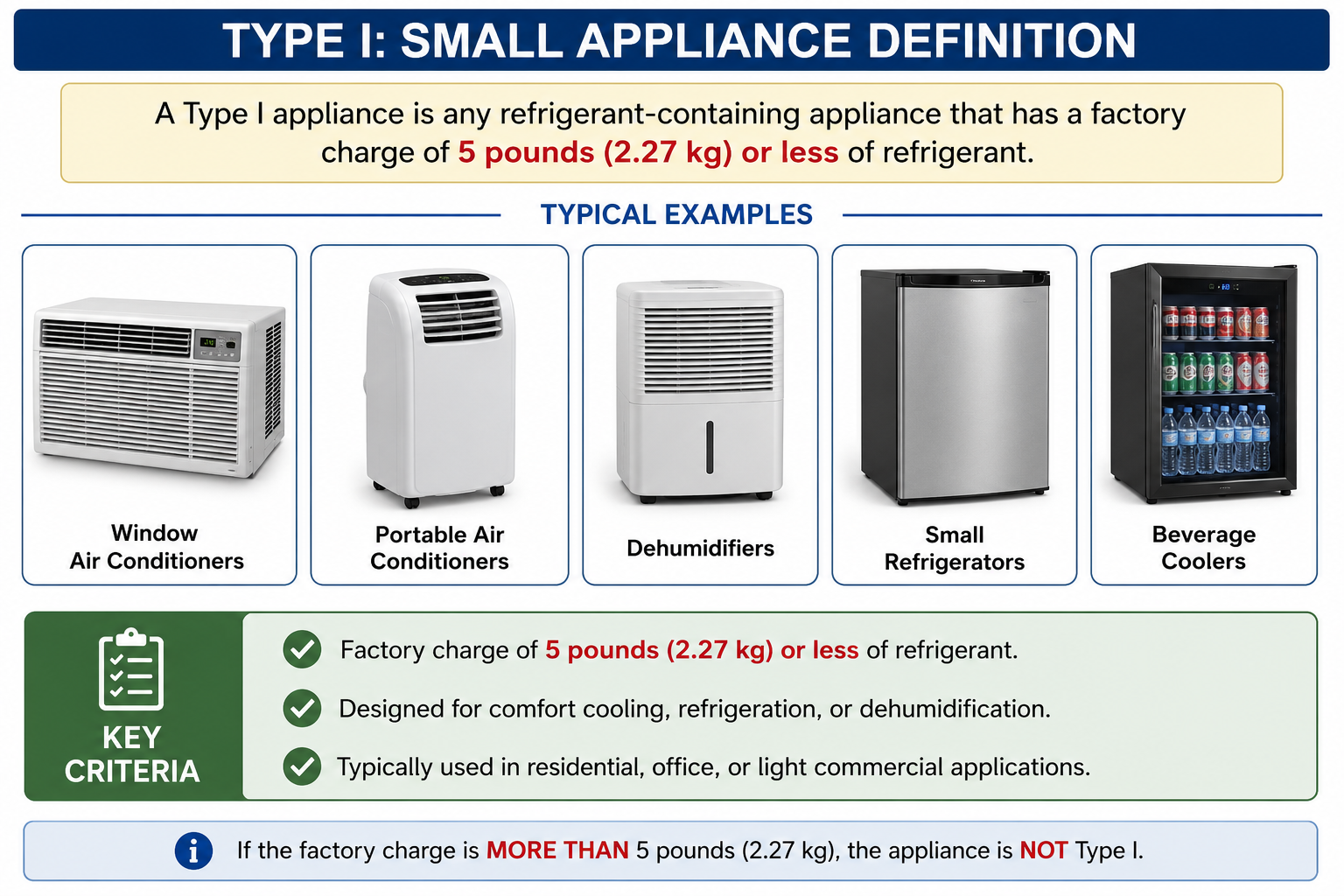
Five Pounds Is Only Part of the Definition
EPA defines a small appliance as an appliance that is fully manufactured, charged, and hermetically sealed in a factory with five pounds or less of refrigerant. The definition also covers specified appliance categories commonly encountered in residential, light commercial, and self-contained refrigeration applications.
The phrase hermetically sealed is important. These appliances are manufactured and charged as complete refrigerating systems rather than being field-assembled and field-charged in the same way as a residential split air-conditioning system.
Do Not Use the Five-Pound Rule by Itself
An appliance containing four pounds of refrigerant is not automatically a Type I small appliance. It must also satisfy the other parts of EPA’s definition. Likewise, a system that was assembled and charged in the field does not become a small appliance simply because its total charge is five pounds or less.
Recognize the Typical Examples
EPA identifies several familiar categories of small appliances. These examples help technicians recognize the type of equipment Type I certification is intended to cover.
Household Refrigerators and Freezers
Factory-charged domestic refrigeration equipment is one of the most common Type I applications.
Room Air Conditioners
Factory-sealed window and room air-conditioning equipment can qualify as small appliances when the complete definition is met.
Packaged Terminal Equipment
Packaged terminal air conditioners and packaged terminal heat pumps are included among EPA’s small-appliance examples.
Dehumidifiers
Self-contained refrigerating dehumidifiers commonly fall within the small-appliance category.
Vending and Ice Equipment
Certain vending machines and under-the-counter ice makers are included when they meet the regulatory definition.
Drinking Water Coolers
Factory-sealed drinking water coolers are another common example of Type I equipment.
Small Refrigerant Charge Does Not Automatically Mean Small Appliance
A residential split-system air conditioner assembled and charged in the field is not an EPA small appliance merely because its refrigerant charge happens to be less than five pounds. The same principle applies to other field-installed refrigeration systems that do not meet EPA’s complete small-appliance definition.
Motor vehicle air-conditioning systems are also not Type I small appliances. Motor vehicle air-conditioning service is regulated separately under EPA Section 609.
Automotive A/C Is Not Type I
A motor vehicle air conditioner does not become a Section 608 small appliance because it contains less than five pounds of refrigerant. MVAC service falls under the separate Section 609 program.
Small Charges Create Their Own Recovery Problems
Recovering refrigerant from a small appliance may appear easier because the refrigerant charge is small, but the opposite can occur. A household refrigerator may contain only a few ounces of refrigerant, so refrigerant left in hoses, recovery equipment, or isolated portions of the appliance can represent a significant percentage of the entire charge.
Small appliances may also lack conventional high-side and low-side service valves. Technicians may need approved access tools or temporary access fittings to connect recovery equipment without unnecessarily releasing refrigerant.
Self-Contained and System-Dependent Recovery Equipment
Type I technicians must understand two different recovery-equipment concepts: self-contained recovery equipment and system-dependent recovery equipment. Older training material may also use the informal terms active recovery and passive recovery.

Self-Contained Recovery
The recovery equipment has its own means of moving refrigerant and can remove refrigerant without relying on components contained in the appliance.
System-Dependent Recovery
The recovery method depends on components or conditions within the appliance to assist in moving refrigerant from the appliance into an external container.
Use the EPA Terminology
The terms self-contained and system-dependent are the regulatory terms. Active and passive are useful descriptions, but technicians should recognize the EPA terminology used in Section 608 material.
The Recovery Machine Provides the Refrigerant-Moving Force
A self-contained recovery machine contains the components necessary to remove refrigerant from the appliance without assistance from components in the appliance itself. This means recovery can continue even when the appliance compressor is not capable of operating.
This is especially useful when servicing failed refrigerators, air conditioners, and other appliances whose electrical or mechanical condition prevents normal operation.
The technician must still use equipment certified for the application and refrigerant and must follow the recovery-machine manufacturer’s instructions.
The Appliance Helps Move the Refrigerant
System-dependent recovery equipment requires assistance from components contained within the appliance to remove refrigerant. Pressure in the appliance, operation of the appliance compressor, heating of components, or other approved procedures may assist refrigerant movement depending on the appliance and recovery method.
The major limitation becomes obvious when the compressor does not operate. Without normal refrigerant circulation, refrigerant can remain trapped in different portions of the appliance, making recovery more difficult.
An Inoperative Compressor Changes the Recovery Strategy
If the compressor cannot move refrigerant through the system, connecting to only one side may leave refrigerant trapped elsewhere in the appliance. The technician must use an appropriate recovery procedure and adequate access to the portions of the system containing refrigerant.
Provide Access Without Creating Unnecessary Releases
A Type I recovery setup must provide a controlled path from the appliance into approved recovery equipment and a suitable receiving container. The exact connection arrangement depends on the appliance, recovery equipment, available access points, compressor condition, and manufacturer procedures.

Verify the Connections for the Actual Appliance
Small appliances vary greatly in construction and service access. Follow the appliance and recovery-equipment manufacturer instructions rather than assuming that every refrigerator, room air conditioner, dehumidifier, or other small appliance uses an identical connection arrangement.
Small Appliances May Not Have Permanent Service Ports
Many factory-sealed small appliances are manufactured without conventional permanent service valves. A technician may need to install an approved access fitting or use a suitable temporary access method to recover or service the refrigerant.
Access equipment must be selected and installed so the system can be safely connected without unnecessarily releasing refrigerant. Temporary piercing-type access devices may be useful during service, but long-term system repair should follow manufacturer requirements and accepted refrigeration practices.
A Functional Compressor Can Assist Recovery
When the appliance compressor operates, refrigerant can circulate through the refrigeration system and may be moved toward the recovery connection. This can improve the effectiveness of some recovery methods.
The ability of an operating compressor to assist refrigerant movement is one reason EPA’s small-appliance recovery requirements distinguish between appliances with operating compressors and appliances whose compressors do not function.
Refrigerant Can Remain Trapped on Both Sides of the System
When a compressor does not operate, it may act as a restriction between portions of the refrigeration circuit. Refrigerant can remain on both the high side and low side rather than being circulated toward one recovery connection.
For system-dependent recovery from a small appliance with an inoperative compressor, providing access to both sides of the system can be necessary so refrigerant does not remain isolated behind the failed compressor or other restrictions.
Do Not Assume One Access Point Reaches the Entire Charge
With an inoperative compressor, verify that the recovery procedure provides access to refrigerant throughout the appliance. The objective is to recover the required amount of refrigerant, not simply to reduce pressure at one convenient connection.
The Required Percentage Depends on Equipment Age and Compressor Condition
Before opening a small appliance or disposing of it, refrigerant must be recovered according to EPA requirements. For small appliances, the applicable recovery percentage depends primarily on when the recovery equipment was manufactured and, for newer equipment, whether the appliance compressor is functional.

| Recovery Condition | EPA Requirement |
|---|---|
| Recovery equipment manufactured before November 15, 1993 | Recover 80% of the refrigerant in the small appliance |
| Recovery equipment manufactured on or after November 15, 1993 and appliance compressor is functional | Recover 90% of the refrigerant in the small appliance |
| Recovery equipment manufactured on or after November 15, 1993 and appliance compressor is not functional | Recover 80% of the refrigerant in the small appliance |
| Alternative recovery endpoint | Evacuate the appliance to 4 inches of mercury vacuum |
The Compressor Condition Affects Recoverability
The different recovery percentages recognize that an operating compressor can help move refrigerant through the appliance, allowing newer recovery equipment to remove a greater percentage of the charge under the specified conditions.
When the compressor is inoperative, refrigerant may remain trapped in portions of the system and recovery is more difficult. EPA therefore uses the lower 80-percent recovery requirement under that condition.
Understand the Relationship Rather Than Memorizing Two Numbers
Newer equipment + working compressor = 90%. Newer equipment + failed compressor = 80%. Connecting the percentages to compressor condition makes the rule easier to remember and apply.
EPA Provides Another Compliance Method
Instead of demonstrating the specified percentage of refrigerant recovery, EPA regulations allow a small appliance to be evacuated to four inches of mercury vacuum.
This measurement should not be confused with deep evacuation performed after repair. The four-inch vacuum value is a Section 608 refrigerant-recovery endpoint for small appliances. Deep system dehydration after refrigerant removal is a different service operation and typically requires a much deeper vacuum measured with a micron gauge.
Recovery Vacuum Is Not Dehydration Vacuum
Reaching the Section 608 recovery endpoint does not mean the refrigeration system has been properly dehydrated for charging. Recovery and evacuation/dehydration remain separate procedures performed for different purposes.
The Machine Must Be Appropriate for Small Appliances
Recovery and recycling equipment used to satisfy Section 608 requirements must meet applicable EPA equipment standards and be certified by an EPA-approved equipment testing organization.
Small-appliance recovery equipment is required to demonstrate the ability to achieve the applicable refrigerant recovery performance. A machine being physically capable of connecting to an appliance does not by itself establish that it meets EPA recovery-equipment requirements.
Technician Certification and Machine Certification Are Different
The technician must hold the appropriate Section 608 credential for covered service work, and the recovery equipment must independently satisfy applicable EPA equipment standards. One does not replace the other.
Capture Refrigerant in an Appropriate Container
Recovered refrigerant must be transferred into an appropriate recovery container rather than released into the atmosphere. The container must be suitable for the refrigerant, pressure, amount being recovered, and recovery method.
When a refillable recovery cylinder is used, cylinder condition, refrigerant identity, allowable fill, temperature, and weight must be monitored just as they are during recovery from larger appliances.
Do Not Mix Refrigerants
Identify the refrigerant before recovery and keep different refrigerants separated. Mixing a few ounces from multiple small appliances can contaminate an entire recovery cylinder and greatly complicate reuse or reclamation.
Small Appliances Can Contain Very Different Refrigerants
Small appliances have used many refrigerants over the decades. Depending on appliance age and application, a technician may encounter CFCs, HCFCs, HFCs, HFOs, hydrocarbon refrigerants, and other refrigerant technologies.
Do not assume refrigerant type from appliance appearance, age, pressure, or cylinder color. Read the appliance nameplate and service information before connecting recovery equipment.
Modern Small Appliances May Use A3 Refrigerants
Many modern household refrigerators and other small appliances use hydrocarbon refrigerants such as R-600a isobutane. These refrigerants are classified A3 and have substantially greater flammability than the traditional A1 refrigerants many technicians first learned to service.
Recovery equipment, work-area ventilation, ignition-source control, service tools, refrigerant quantity, and manufacturer procedures must all be appropriate for the refrigerant involved.
Do Not Use Equipment Solely Because the Connections Fit
A recovery machine intended only for nonflammable refrigerants should not automatically be used with an A3 hydrocarbon refrigerant. Verify that the equipment and service procedure are approved for the actual refrigerant.
Avoid Creating a Dangerous Pressurized Mixture
Air should not be intentionally introduced into refrigeration systems or recovery cylinders to raise pressure or speed refrigerant removal. Besides introducing moisture and noncondensables, pressurized refrigerant-air mixtures can create additional hazards.
Use recovery procedures approved for the appliance and refrigerant rather than attempting to force refrigerant from the system with compressed air or oxygen.
Never Use Oxygen for Refrigerant Recovery or Pressure Testing
Oxygen can react violently with refrigeration oils and other materials. Approved HVAC/R pressure testing uses properly regulated dry nitrogen when nitrogen pressure testing is appropriate.
Small Appliances Still Deserve Proper Leak Repair
A small refrigerant charge does not make repeated refrigerant loss acceptable service practice. If an appliance is economically repairable, the technician should identify and correct the cause of refrigerant loss rather than repeatedly adding refrigerant without addressing the leak.
The extensive leak-repair provisions that apply to certain larger appliances are not simply transferred to every small appliance, but the Section 608 venting prohibition and good refrigerant-management principles still apply.
Recover Before Opening the System
Before cutting tubing, removing a compressor, replacing a filter-drier, opening a sealed-system component, or otherwise opening a small appliance refrigeration circuit, recover refrigerant according to the applicable Section 608 requirements.
After repair, the system may require leak testing, evacuation, dehydration, and accurate charging according to manufacturer specifications. Those operations occur after the refrigerant has been properly recovered.
Identify
Determine the refrigerant and verify that the appliance meets the Type I small-appliance definition.
Recover
Remove refrigerant using certified recovery equipment and achieve the applicable Type I recovery requirement.
Repair
Open and repair the refrigeration circuit using appropriate equipment and procedures.
Leak Test
Verify that repaired connections and components are leak-free using an appropriate test procedure.
Evacuate and Dehydrate
Remove air and moisture to the appliance manufacturer’s required service condition.
Recharge
Charge the appliance with the correct refrigerant and amount specified by the manufacturer.
Refrigerant Must Be Recovered Before Final Disposal
Small appliances eventually leave service and enter the waste stream. Refrigerators, freezers, room air conditioners, dehumidifiers, water coolers, and similar equipment may be transferred through appliance retailers, municipalities, scrap processors, waste companies, recycling facilities, or landfills.
Section 608 safe-disposal requirements are designed to prevent the remaining refrigerant from being released when the appliance is crushed, shredded, dismantled, or otherwise processed.

Disposal Rules Differ From Service Rules
EPA distinguishes between servicing a small appliance and recovering refrigerant from a small appliance that has entered the waste stream for disposal. Persons recovering refrigerant from small appliances in the waste stream for purposes of final disposal are not required to hold Section 608 technician certification solely for that disposal recovery activity.
They must still recover the refrigerant to the required level using appropriate recovery equipment. The absence of a technician-certification requirement for this specific disposal activity is not permission to vent the refrigerant.
Service and Final Disposal Are Different Situations
A person repairing the sealed refrigeration system of an operating small appliance performs technician work. A person recovering refrigerant from an appliance already in the waste stream for final disposal operates under the safe-disposal provisions. Read the scenario carefully on examination questions.
The Refrigerant Cannot Simply Be Assumed Gone
Final disposers of small appliances must ensure that refrigerant has been recovered before the equipment is processed for disposal. Where refrigerant was removed earlier in the disposal chain, the final disposer must obtain the required statement or documentation identifying that the refrigerant was previously recovered.
This system allows refrigerant to be removed at an earlier point in the waste stream while still giving the final disposer a way to verify that the appliance can be processed without knowingly releasing its remaining refrigerant charge.
What Happens to the Refrigerant After Recovery?
Refrigerant removed from a small appliance may be recycled for appropriate same-owner reuse, sent to an EPA-certified reclaimer, or managed through another lawful refrigerant-disposition process depending on its identity, condition, ownership, and intended use.
Recovered refrigerant should remain clearly identified. Refrigerant from appliances of uncertain history should not be mixed casually with a cylinder containing known clean refrigerant.
Do Not Turn a Recovery Cylinder Into a Mixed-Refrigerant Container
Small amounts add up. Repeatedly combining unidentified refrigerants from discarded appliances can create a contaminated mixture that is difficult and expensive to process.
A Small Appliance Can Still Create Serious Hazards
Small refrigerant quantity does not mean small hazard. Refrigerant can cause frostbite and eye injury, hydrocarbon refrigerants can create flammable mixtures, compressor terminals and electrical components can present shock hazards, and a sealed system can remain pressurized even when the appliance is unplugged.
Electrical Safety
Disconnect and verify electrical power as appropriate before servicing appliance components.
Eye and Skin Protection
Protect against liquid refrigerant released from pressurized tubing, fittings, or access devices.
Ventilation
Provide appropriate ventilation, especially when working with flammable refrigerants or in small enclosed work areas.
Ignition Control
Identify and control potential ignition sources before servicing appliances containing flammable refrigerants.
Avoid the Traps
“Five Pounds Means Type I”
Incorrect. The appliance must satisfy EPA’s complete small-appliance definition.
“Automobile A/C Is a Small Appliance”
Incorrect. Motor vehicle air-conditioning service is addressed separately under Section 609.
“80 Percent Always Applies”
Incorrect. Newer recovery equipment with an operating compressor requires 90-percent recovery.
“90 Percent Always Applies”
Incorrect. An inoperative compressor changes the requirement to 80 percent under the applicable newer-equipment provision.
“One Access Port Is Always Enough”
Incorrect. An inoperative compressor or appliance configuration may isolate refrigerant in different portions of the system.
“Small Charge Means Venting Does Not Matter”
Incorrect. Section 608 refrigerant-management requirements still apply to covered refrigerant service.
Work Through the Question in Order
Is It a Small Appliance?
Check the complete EPA definition rather than relying on physical size or charge alone.
What Refrigerant Is Present?
Identify the refrigerant so equipment compatibility, safety, and recovery requirements can be evaluated.
Does the Compressor Operate?
Compressor condition affects both the recovery procedure and the applicable percentage requirement.
What Recovery Equipment Is Being Used?
Determine whether the equipment is self-contained or system-dependent and whether the pre- or post-November 15, 1993 requirement applies.
What Endpoint Is Required?
Apply the appropriate 80-percent, 90-percent, or four-inch-vacuum recovery provision.
Service or Disposal?
Determine whether the question concerns technician service work or appliance disposal because different responsibilities can apply.
What You Need to Remember
- Type I certification is for technicians servicing EPA-defined small appliances.
- A small appliance must be fully manufactured, charged, and hermetically sealed in a factory with five pounds or less of refrigerant and meet EPA’s applicable definition.
- Five pounds or less of refrigerant by itself does not make every appliance a Type I small appliance.
- Common small appliances include household refrigerators and freezers, room air conditioners, packaged terminal air conditioners and heat pumps, dehumidifiers, certain ice makers, vending machines, and drinking water coolers.
- Motor vehicle air conditioners are not Type I small appliances; MVAC service is addressed under Section 609.
- Self-contained recovery equipment removes refrigerant without assistance from components contained in the appliance.
- System-dependent recovery equipment requires assistance from components or conditions within the appliance to remove refrigerant.
- An operating compressor can assist refrigerant recovery.
- An inoperative compressor may leave refrigerant trapped in different portions of the refrigeration circuit.
- When using recovery equipment manufactured before November 15, 1993, recover 80 percent of the refrigerant from a small appliance.
- With recovery equipment manufactured on or after November 15, 1993 and a functional compressor, recover 90 percent of the refrigerant.
- With recovery equipment manufactured on or after November 15, 1993 and a nonfunctional compressor, recover 80 percent of the refrigerant.
- EPA also permits the small appliance to be evacuated to four inches of mercury vacuum as an alternative recovery endpoint.
- The four-inch recovery vacuum is not the same as the deep evacuation used to dehydrate a repaired refrigeration system.
- Recovery equipment used to meet Section 608 requirements must satisfy applicable EPA equipment standards.
- Identify the refrigerant before selecting recovery equipment.
- Modern small appliances may contain flammable hydrocarbon refrigerants such as R-600a.
- Do not mix different refrigerants in the same recovery container.
- Recover refrigerant before opening the sealed refrigeration circuit.
- Persons recovering refrigerant from small appliances already in the waste stream for final disposal are not required to hold Section 608 technician certification solely for that disposal recovery activity, but the refrigerant must still be properly recovered.
- Final disposers must ensure that refrigerant has been recovered from small appliances before final processing.
- Small refrigerant charge does not eliminate pressure, frostbite, electrical, flammability, or environmental hazards.
Review Questions
1. What type of Section 608 certification applies to servicing EPA-defined small appliances?
Answer: Type I certification.
2. Does any refrigeration system containing five pounds or less of refrigerant qualify as a small appliance?
Answer: No. The appliance must satisfy EPA’s complete small-appliance definition, including the applicable factory-manufactured, factory-charged, and hermetically sealed requirements.
3. Is an automobile air-conditioning system a Type I small appliance?
Answer: No. Motor vehicle air-conditioning service is addressed separately under EPA Section 609.
4. What is self-contained recovery equipment?
Answer: Recovery or recycling equipment capable of removing refrigerant from an appliance without assistance from components contained in the appliance.
5. What is system-dependent recovery equipment?
Answer: Recovery equipment that requires assistance from components or conditions within the appliance to remove refrigerant.
6. How much refrigerant must be recovered when using recovery equipment manufactured on or after November 15, 1993 and the appliance compressor operates?
Answer: At least 90 percent of the refrigerant in the small appliance.
7. How much refrigerant must be recovered with newer recovery equipment when the appliance compressor does not operate?
Answer: At least 80 percent of the refrigerant in the small appliance.
8. What recovery percentage applies when using recovery equipment manufactured before November 15, 1993?
Answer: 80 percent of the refrigerant in the small appliance.
9. What alternative recovery endpoint does EPA permit for small appliances?
Answer: The appliance may be evacuated to four inches of mercury vacuum.
10. Why might both sides of a small appliance require access when the compressor does not operate?
Answer: The failed compressor or other restrictions can isolate refrigerant in different portions of the refrigeration circuit, so one access point may not provide an effective path for removing the entire recoverable charge.
11. Can a standard recovery machine intended only for nonflammable refrigerants automatically be used on an R-600a refrigerator?
Answer: No. R-600a is a flammable hydrocarbon refrigerant, and the recovery equipment and service procedure must be appropriate for that refrigerant.
12. Does the person removing refrigerant from a discarded small appliance in the waste stream always need Section 608 technician certification?
Answer: No. EPA does not require Section 608 technician certification solely for refrigerant recovery from small appliances in the waste stream for final disposal, but the refrigerant must still be recovered to the required level using appropriate equipment.
Lesson 36 Summary
- Type I certification applies to EPA-defined small appliances.
- A small appliance must satisfy EPA’s complete definition and cannot be identified by refrigerant charge alone.
- Small-appliance examples include household refrigerators and freezers, room air conditioners, PTACs, PTHPs, dehumidifiers, certain ice makers, vending machines, and drinking water coolers.
- Motor vehicle air conditioners are regulated separately under Section 609.
- Self-contained recovery equipment removes refrigerant without relying on appliance components.
- System-dependent recovery equipment requires assistance from components or conditions within the appliance.
- The appliance compressor can assist refrigerant movement when it is operational.
- A failed compressor may isolate refrigerant in different portions of the system and require additional access.
- Pre-November 15, 1993 recovery equipment requires recovery of 80 percent of the refrigerant from a small appliance.
- Newer recovery equipment requires 90-percent recovery when the appliance compressor operates.
- Newer recovery equipment requires 80-percent recovery when the appliance compressor does not operate.
- Evacuation to four inches of mercury vacuum is an alternative EPA small-appliance recovery endpoint.
- The Section 608 four-inch recovery endpoint should not be confused with deep evacuation for system dehydration.
- Recovery equipment must meet applicable EPA equipment requirements.
- Small appliances may use refrigerants with very different environmental, pressure, and flammability characteristics.
- Modern household refrigeration equipment may contain A3 hydrocarbon refrigerants such as R-600a.
- Refrigerant must be identified before selecting recovery equipment and service procedures.
- Different refrigerants should not be mixed in the same recovery container.
- Refrigerant must be recovered before the sealed refrigeration circuit is opened for covered service.
- Small appliances entering the waste stream remain subject to safe-disposal refrigerant recovery requirements.
- EPA provides a specific disposal-related exception from technician certification for persons recovering refrigerant from small appliances in the waste stream, but this does not permit refrigerant venting.
- Final disposers must ensure that refrigerant has been removed before small appliances are processed for disposal.
- Small refrigerant quantities can still present serious pressure, cold-contact, electrical, flammability, and environmental hazards.