EPA Section 608 Core Review
The Core portion of EPA Section 608 certification brings together the environmental, regulatory, refrigeration, recovery, safety, and refrigerant-handling principles that apply across all certification types. Most of these subjects have already been developed in detail earlier in this course; this lesson reorganizes them into the relationships and distinctions you need to recognize when applying that knowledge to Section 608 examination questions and actual service work.
The goal is not to memorize isolated answers. A technician should be able to identify the refrigerant, understand why it presents a particular environmental or safety concern, determine what service operation is being performed, select the appropriate equipment, and apply the correct refrigerant-management practice.
Learning Objectives
Review Environmental Principles
Connect chlorine-containing refrigerants with ozone depletion and distinguish Ozone Depletion Potential from Global Warming Potential.
Review Refrigerant Identification
Recognize CFC, HCFC, HFC, HFO, blend, and other refrigerant categories and understand why correct identification is essential before service.
Review Service Practices
Distinguish recovery, recycling, reclamation, evacuation, and dehydration and understand when each process is used.
Review Safety and Regulatory Responsibilities
Apply safe refrigerant handling, cylinder practices, recovery requirements, venting restrictions, and other Section 608 principles.
Understand the Question Before Looking for the Answer
Many Core questions test whether the technician can distinguish between concepts that sound similar. ODP is not GWP. Recovery is not evacuation. Recycling is not reclamation. A recovery cylinder is not a disposable refrigerant cylinder. An allowable incidental release is not permission to intentionally vent refrigerant.
A useful approach is to identify what the question is actually asking about before selecting an answer: environmental effect, refrigerant type, refrigeration cycle, service operation, safety hazard, cylinder practice, recovery procedure, or regulatory requirement.
Why CFCs and HCFCs Damage the Ozone Layer
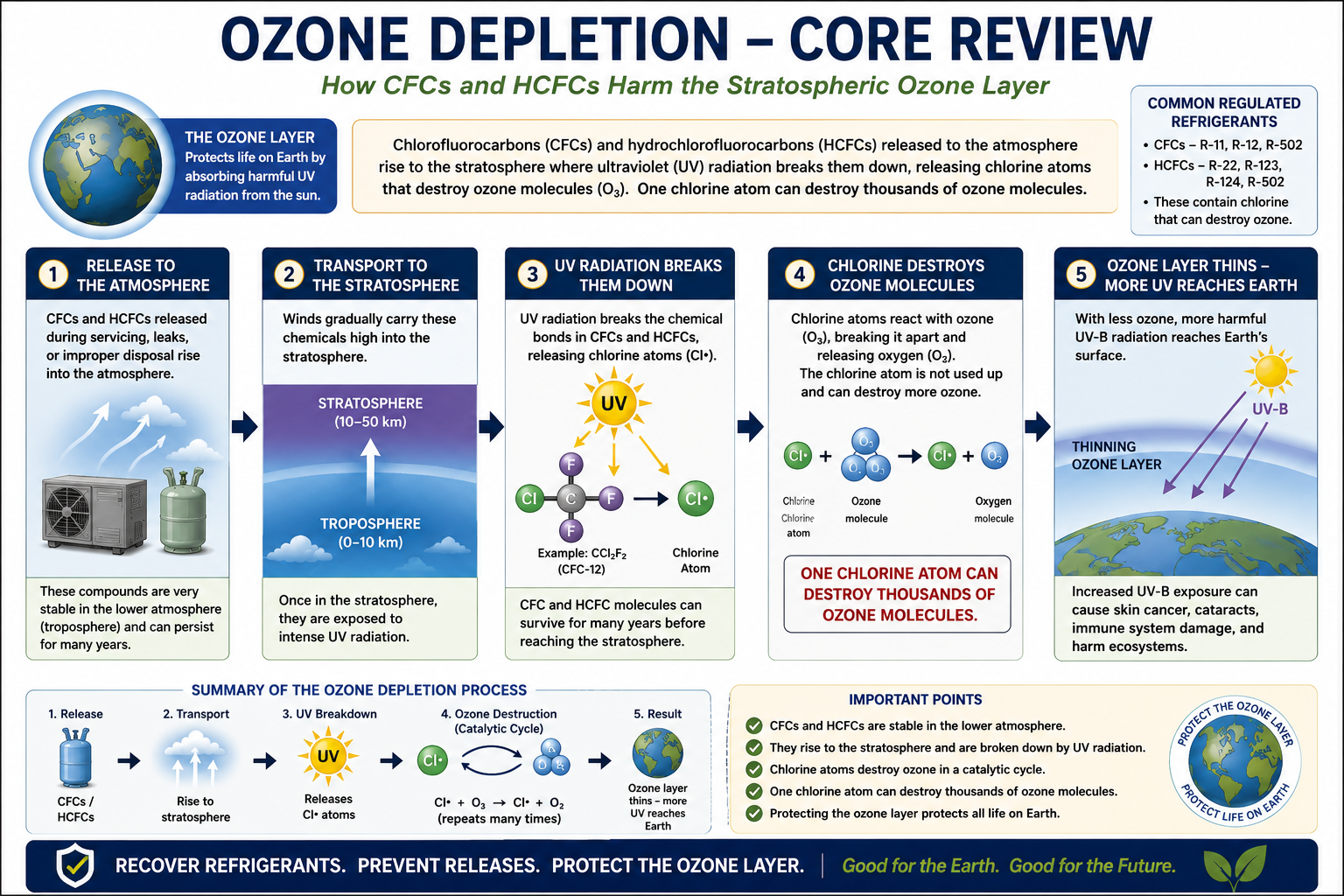
Stratospheric ozone protects life on Earth by absorbing a portion of the sun’s harmful ultraviolet radiation. Ozone-depleting refrigerants interfere with this protective layer because they contain chlorine or, in some ozone-depleting substances, bromine.
CFCs and HCFCs are sufficiently stable that some molecules can survive in the lower atmosphere long enough to reach the stratosphere. Strong ultraviolet radiation can break the molecules apart and release chlorine atoms. Those chlorine atoms can participate in reactions that destroy ozone molecules and can continue through repeated reaction cycles.
Why HFCs Are Different
HFC refrigerants contain hydrogen, fluorine, and carbon but no chlorine or bromine. They therefore have zero Ozone Depletion Potential. Many HFCs, however, are greenhouse gases with significant Global Warming Potential, so zero ODP does not mean zero environmental impact.
Two Measurements, Two Environmental Effects
Ozone Depletion Potential (ODP) compares a substance’s potential to damage stratospheric ozone with a reference substance. CFC-11 is assigned an ODP of 1.0. Chlorine-containing CFCs generally have higher ODPs than HCFCs, while HFCs have zero ODP.
Global Warming Potential (GWP) compares the climate-warming effect of a greenhouse gas with carbon dioxide over a specified time horizon. Carbon dioxide is assigned a GWP of 1. Refrigerant GWPs are commonly expressed over a 100-year time horizon.
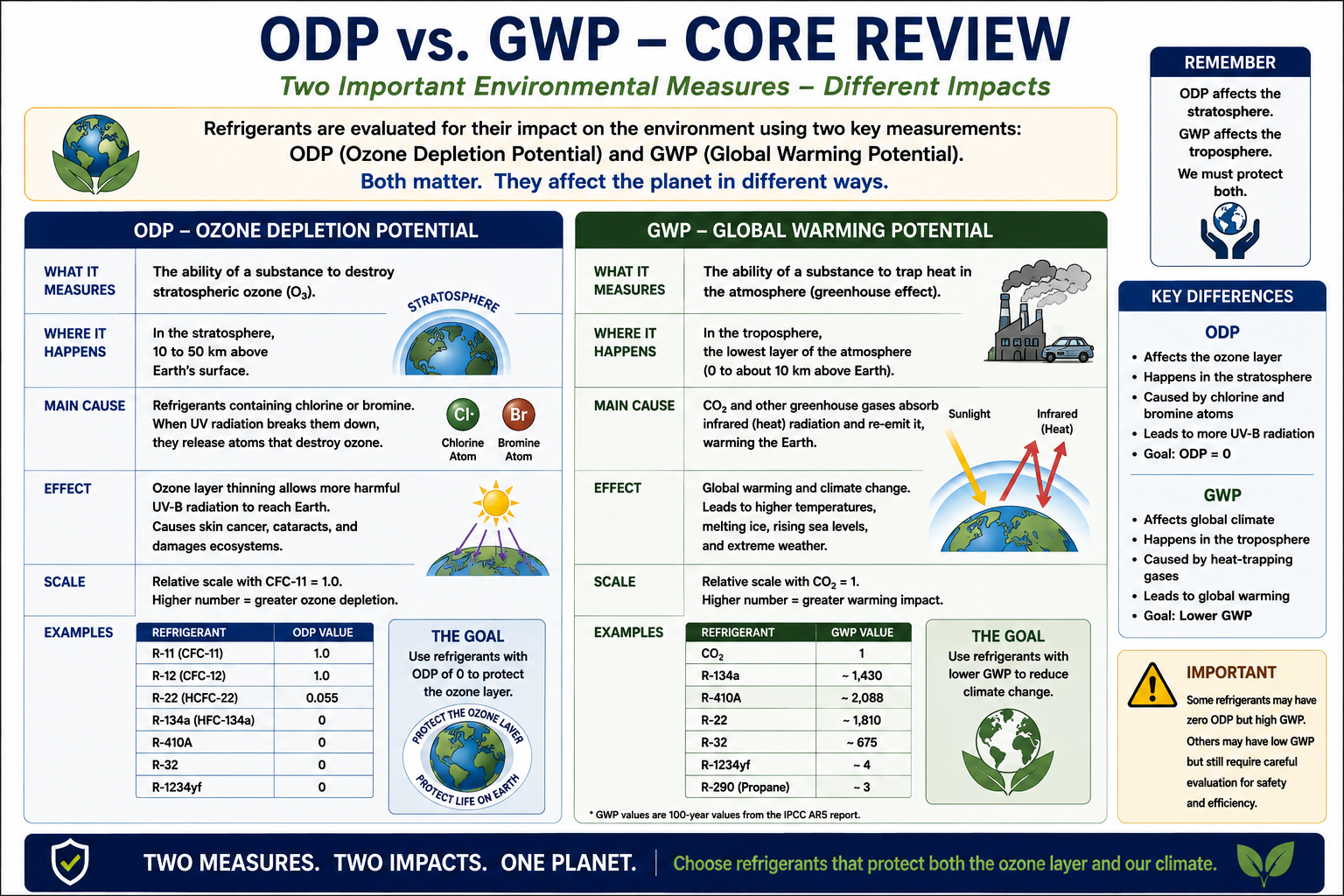
| Characteristic | ODP | GWP |
|---|---|---|
| Full Name | Ozone Depletion Potential | Global Warming Potential |
| Primary Concern | Stratospheric ozone destruction | Climate warming |
| Reference | CFC-11 = 1.0 | CO2 = 1 |
| Important Chemical Factor | Ozone-depleting chlorine or bromine | Atmospheric heat-trapping effect and lifetime |
International Agreement and U.S. Regulation
The Montreal Protocol on Substances that Deplete the Ozone Layer is the international agreement that established global controls on production and consumption of ozone-depleting substances. The United States implements ozone-protection requirements through the Clean Air Act and EPA regulations.
For the Section 608 technician, the important concept is that production phaseouts and refrigerant service rules are related but not identical. Ending production of a refrigerant does not mean every existing appliance using that refrigerant suddenly becomes illegal to operate.
Phaseout Does Not Mean Immediate Equipment Replacement
Existing equipment may often continue to operate and be serviced using legally available refrigerant, including recovered and reclaimed refrigerant, subject to applicable regulations and manufacturer requirements.
Know What Is in the System Before You Service It
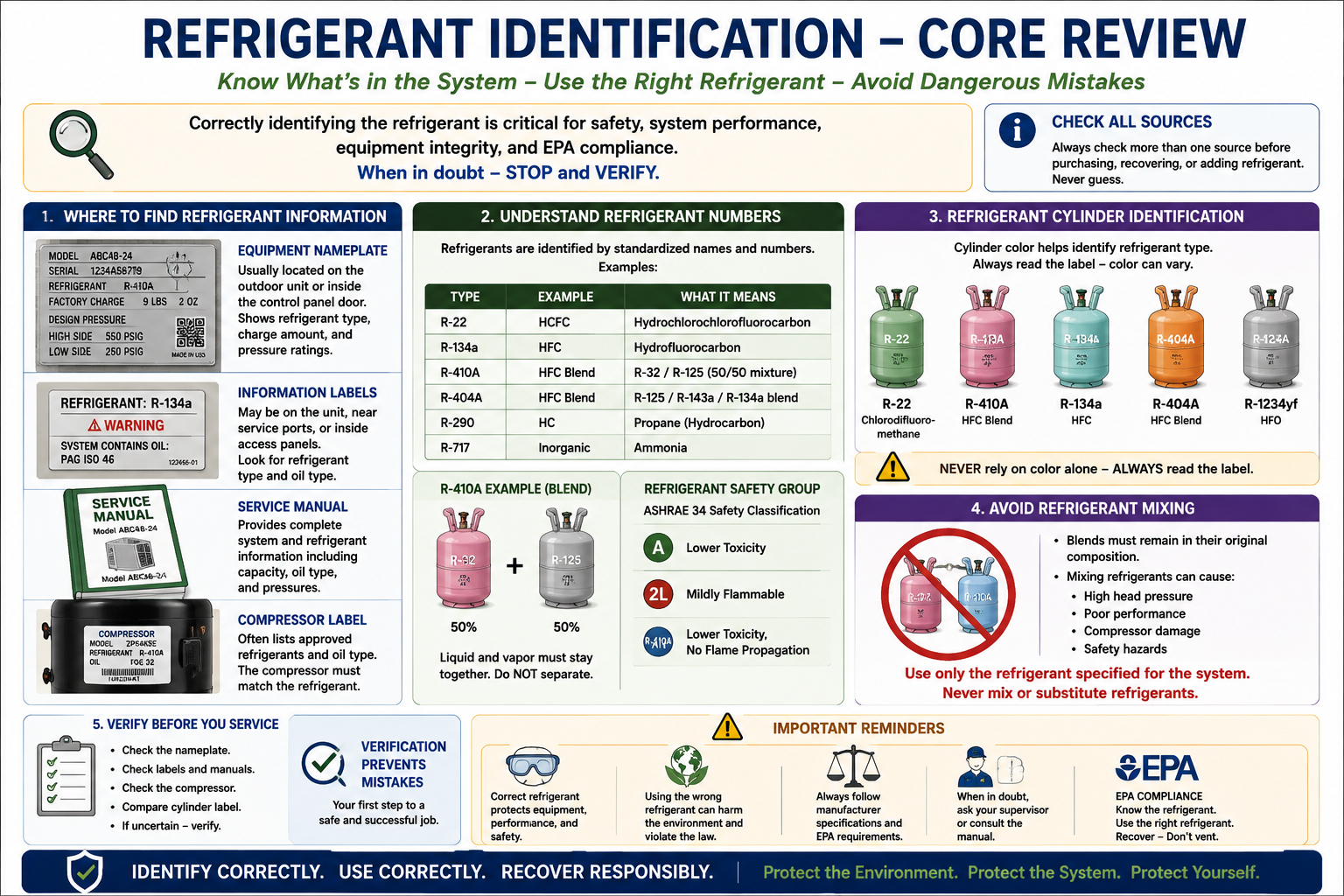
Technicians must distinguish among refrigerant families and individual refrigerants. R-12 is a CFC, R-22 is an HCFC, and R-134a is an HFC. Modern equipment may also use HFOs, HFO-containing blends, A2L refrigerants, hydrocarbons, carbon dioxide, ammonia, and other refrigerants.
Correct refrigerant identification affects pressure expectations, recovery equipment, lubricant compatibility, safety precautions, cylinder selection, charging procedures, and whether recovered material can remain useful.
Do Not Identify Refrigerant by Cylinder Color Alone
Cylinder color has historically been associated with particular refrigerants and remains useful background knowledge for older equipment and examination preparation, but technicians must identify refrigerant from the cylinder label and other reliable information.
Blends Require Additional Attention
A refrigerant blend contains two or more refrigerant components. Zeotropic and near-azeotropic blends may exhibit temperature glide because the mixture does not behave exactly like a single-component refrigerant during phase change.
Some blends can also experience fractionation, meaning the composition can change when components escape or are separated preferentially. For this reason, many blends are charged as liquid so the intended composition enters the system.
Oil Compatibility Matters
Refrigerant and compressor lubricant must be compatible with each other and with the equipment. Older CFC and HCFC systems commonly used mineral or alkylbenzene lubricants, while many HFC and newer systems use synthetic lubricants such as polyolester oil.
This is one reason refrigerant replacements are not simply “drop-ins.” A replacement refrigerant may have different pressure characteristics, capacity, temperature glide, flammability classification, lubricant requirements, seals, controls, or charging procedures.
There Is No Universal Drop-In Replacement
Never substitute refrigerants based solely on pressure similarity or refrigerant number. Verify equipment compatibility, lubricant requirements, manufacturer approval, safety classification, and applicable regulations.
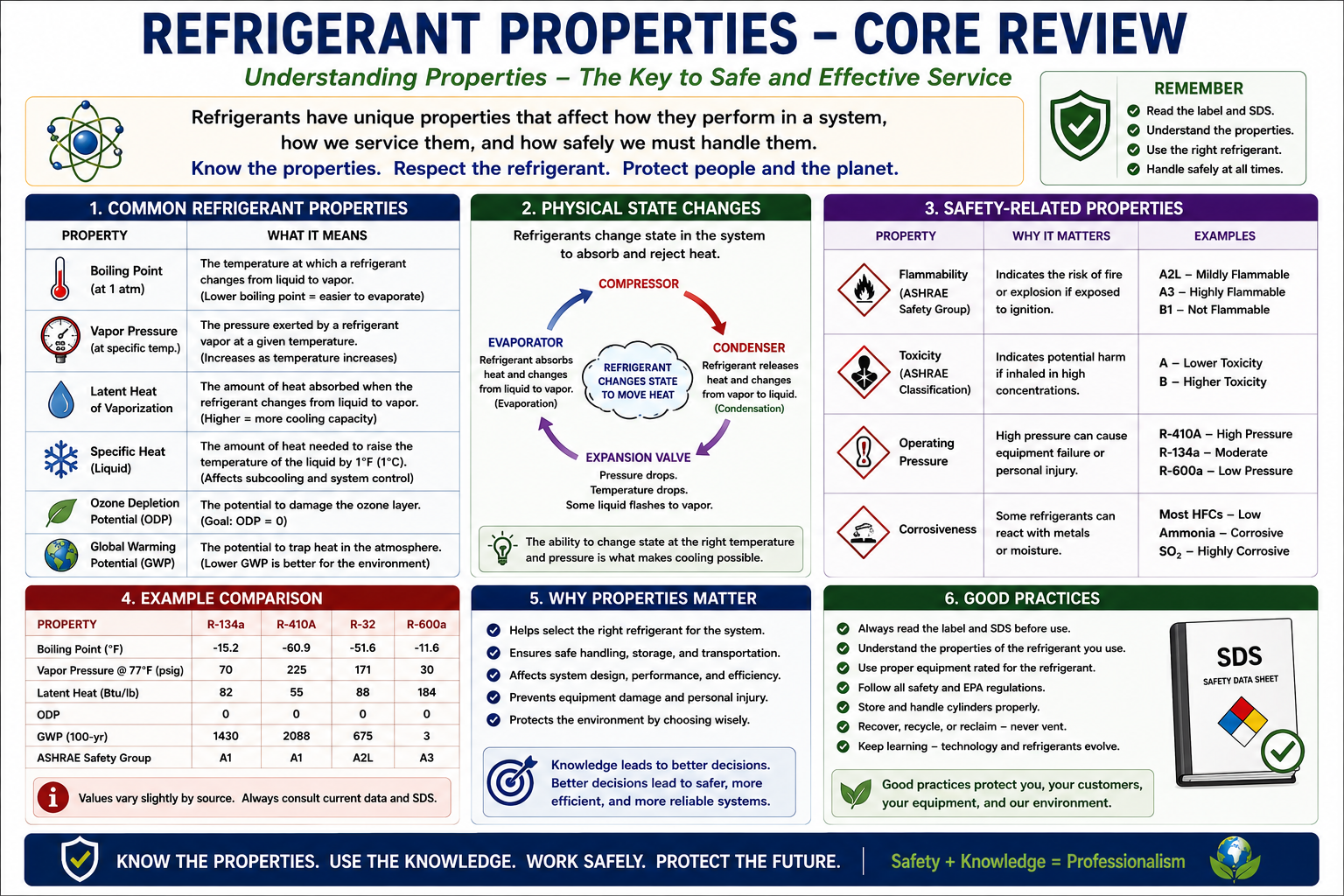
Refrigerant Changes State to Move Heat
Core questions may require the technician to understand where refrigerant is liquid, vapor, or a mixture within the refrigeration cycle. In the evaporator, refrigerant absorbs heat and boils. The compressor raises vapor pressure and temperature. The condenser rejects heat and condenses vapor into liquid. The metering device creates the pressure reduction required for the refrigerant to enter the evaporator at a lower saturation temperature.
Pressure and saturation temperature are directly related for a particular refrigerant. That relationship is why pressure-temperature charts are useful for evaluating system conditions, checking superheat and subcooling, and identifying possible contamination.
Know the Connections and What the Gauges Tell You
Traditional manifold gauge sets use blue for the low-side connection, red for the high-side connection, and yellow for the center service hose. The center hose may connect to a refrigerant source, vacuum pump, recovery machine, or other service equipment depending on the operation.
Gauge pressure is referenced to atmospheric pressure. Absolute pressure includes atmospheric pressure. At standard sea-level atmospheric pressure, approximately 14.7 psi separates zero psig from zero psia.
Vacuum Is Pressure Below Atmospheric Pressure
A compound low-side gauge can display both positive gauge pressure and vacuum. Deep evacuation is measured much more accurately with a micron gauge than with the vacuum portion of a manifold gauge.
Know the Three R Definitions
Recover
Remove refrigerant from an appliance and store it in an external container without necessarily processing or testing it.
Recycle
Clean recovered refrigerant for reuse through processes such as oil separation, filtration, and moisture removal without meeting full reclamation requirements.
Reclaim
Reprocess used refrigerant to the applicable purity specification and verify that purity using prescribed analytical methods.
Three Service Operations With Different Purposes
Recovery removes refrigerant from the appliance and captures it externally. Evacuation uses a vacuum pump to remove air, noncondensable gases, and water vapor from a closed refrigeration system after refrigerant has been properly removed. Dehydration is the process of removing moisture from the refrigeration system.
A Vacuum Pump Is Not a Recovery Machine
Do not use a vacuum pump as a substitute for required refrigerant recovery. Refrigerant must first be captured using appropriate recovery equipment before deep evacuation is performed.
Moisture Can Damage the System
Moisture inside a refrigeration system can freeze at metering devices, contribute to corrosion, interact with refrigerant or lubricant chemistry, and contribute to acid formation. Moisture is therefore both a reliability and contamination problem.
Evacuation lowers system pressure, which lowers the boiling temperature of water and helps remove moisture as vapor. Filter-driers provide additional moisture and contaminant control during normal system operation.
Recovery Speed Depends on the Entire Flow Path
Recovery speed is affected by refrigerant temperature, appliance pressure, hose diameter, hose length, service-port restrictions, valve cores, recovery-machine capacity, cylinder pressure, and whether the refrigerant is being transferred as liquid or vapor.
When the appliance and equipment allow it, recovering liquid first is generally faster because a large mass of refrigerant occupies much less volume as liquid than as vapor. Vapor recovery is still required to remove the refrigerant remaining after bulk liquid transfer.
Use Short Hoses
Longer hoses add volume and pressure drop.
Reduce Restrictions
Small access ports and valve cores can limit refrigerant flow.
Recover Liquid First
When permitted by the appliance and machine, bulk liquid removal can greatly reduce recovery time.
Control Cylinder Pressure
High recovery-cylinder pressure increases recovery-machine discharge pressure and can slow the process.
Never Mix Refrigerants for Convenience
Different refrigerants should not be intentionally mixed in the same recovery cylinder. Mixing refrigerants can make reuse impossible, complicate reclamation, create unpredictable pressure-temperature relationships, and significantly reduce the value of recovered refrigerant.
Before recovery begins, verify the refrigerant and confirm that the receiving cylinder is appropriate for that refrigerant. Recovery equipment should also be cleared according to manufacturer procedures when changing refrigerants.
Unknown Means Unknown
If refrigerant identity cannot be confirmed, do not add it to a cylinder containing known refrigerant. Segregate unknown material for appropriate identification or disposition.
Recover Refrigerant Instead of Releasing It
EPA prohibits intentional venting of ozone-depleting refrigerants and their substitutes during maintenance, service, repair, and disposal, except for releases specifically excluded from the prohibition.
EPA recognizes de minimis releases that occur during good-faith efforts to recover, recycle, or safely dispose of refrigerant, including small releases during hose connection and disconnection. This does not permit a technician to deliberately release a charge because recovery is inconvenient.
Use Equipment That Meets EPA Requirements
Recovery and recycling equipment used for Section 608 work must meet applicable EPA performance standards and be certified by an EPA-approved testing organization. The requirements differ according to equipment type, manufacture date, application, and whether flammable refrigerants are involved.
Technicians should verify the certification label and manufacturer instructions rather than assuming that every recovery machine is appropriate for every refrigerant.
Equipment Certification and Technician Certification Are Different
EPA-approved organizations test and certify recovery equipment performance. Separately, EPA-approved certifying programs test technicians. A certified technician still needs compliant recovery equipment, and certified equipment still requires a qualified technician to use it correctly.
Certification Controls Access to Refrigerant
EPA restricts sales of ozone-depleting refrigerants and non-exempt substitute refrigerants. Section 608-certified technicians may purchase refrigerant consistent with stationary refrigeration and air-conditioning work, and qualifying employers or their authorized representatives may purchase refrigerant when the applicable EPA requirements are met.
Section 609 certification applies to motor vehicle air-conditioning work and does not by itself authorize the purchase of refrigerant intended for stationary refrigeration and air-conditioning equipment.
Refrigerant Service Combines Several Hazards
Refrigerants and refrigeration equipment can expose technicians to pressure hazards, liquid-refrigerant frostbite, eye injury, oxygen displacement, chemical exposure, flammability, hot surfaces, electrical hazards, and hazardous decomposition products.
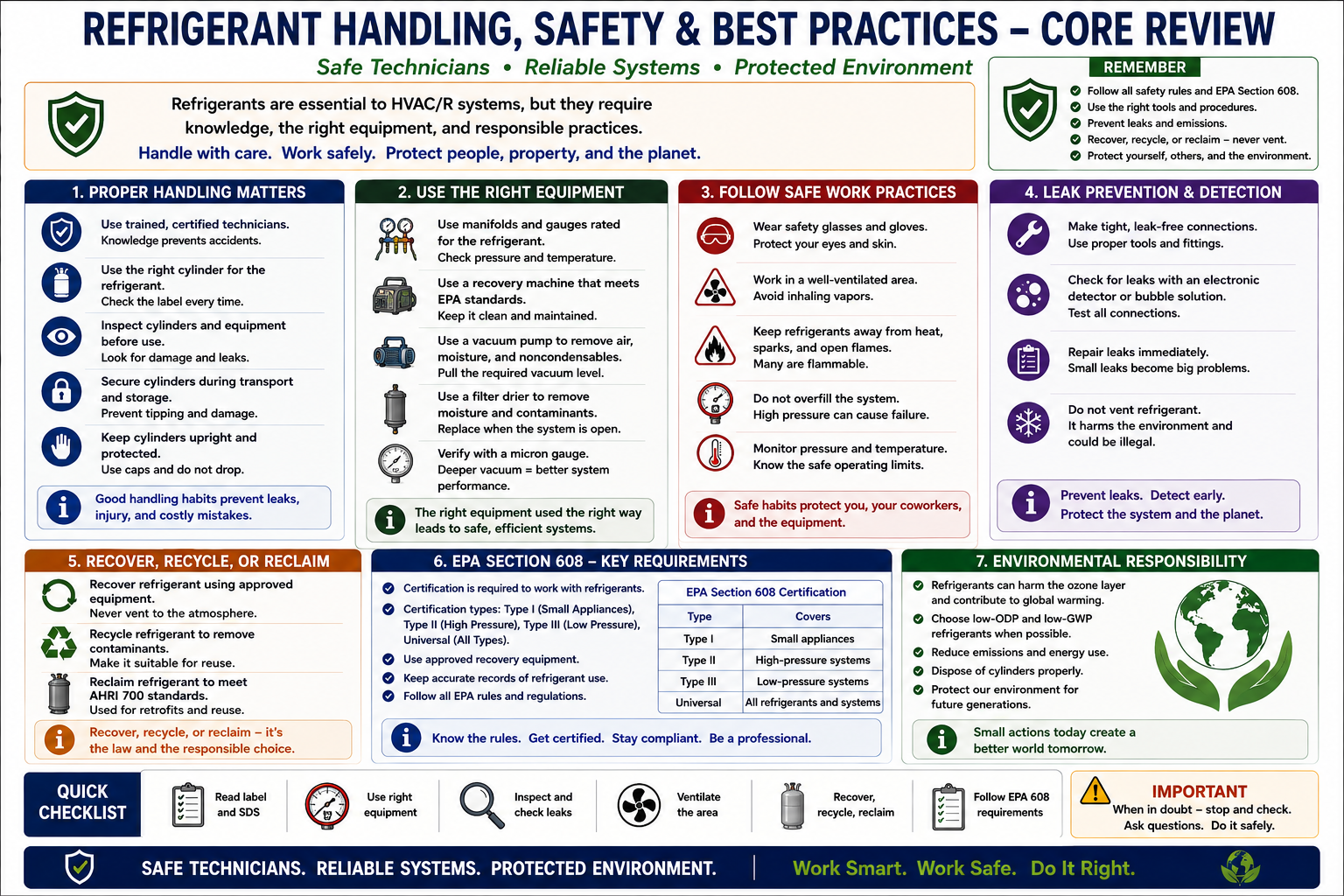
Protect Eyes and Skin
Rapidly evaporating liquid refrigerant can cause serious cold-contact injury.
Provide Ventilation
Large refrigerant releases can create hazardous concentrations and displace breathable air.
Control Pressure
Systems, cylinders, nitrogen bottles, and service equipment contain stored energy.
Control Heat and Flame
Refrigerants may decompose at high temperatures, and flammable refrigerants require appropriate ignition-source controls.
Use Nitrogen Safely for Pressure Testing
Dry nitrogen is commonly used for refrigeration-system pressure testing and brazing procedures. Because the storage cylinder contains gas at very high pressure, a suitable regulator must be used to reduce and control the pressure supplied to the refrigeration system.
Never Use Oxygen or Compressed Air as a Substitute for Nitrogen
Oxygen can react violently with oils and lubricants, while compressed air introduces oxygen and moisture into the refrigeration system. Use dry nitrogen and appropriate pressure-control equipment for approved pressure-testing procedures.
Refrigerant Cylinders Are Pressure Vessels
Refrigerant cylinders must be protected from excessive heat, physical damage, improper filling, and incorrect use. Recovery cylinders are refillable containers designed to receive recovered refrigerant, while disposable or nonrefillable cylinders must never be used as recovery vessels.
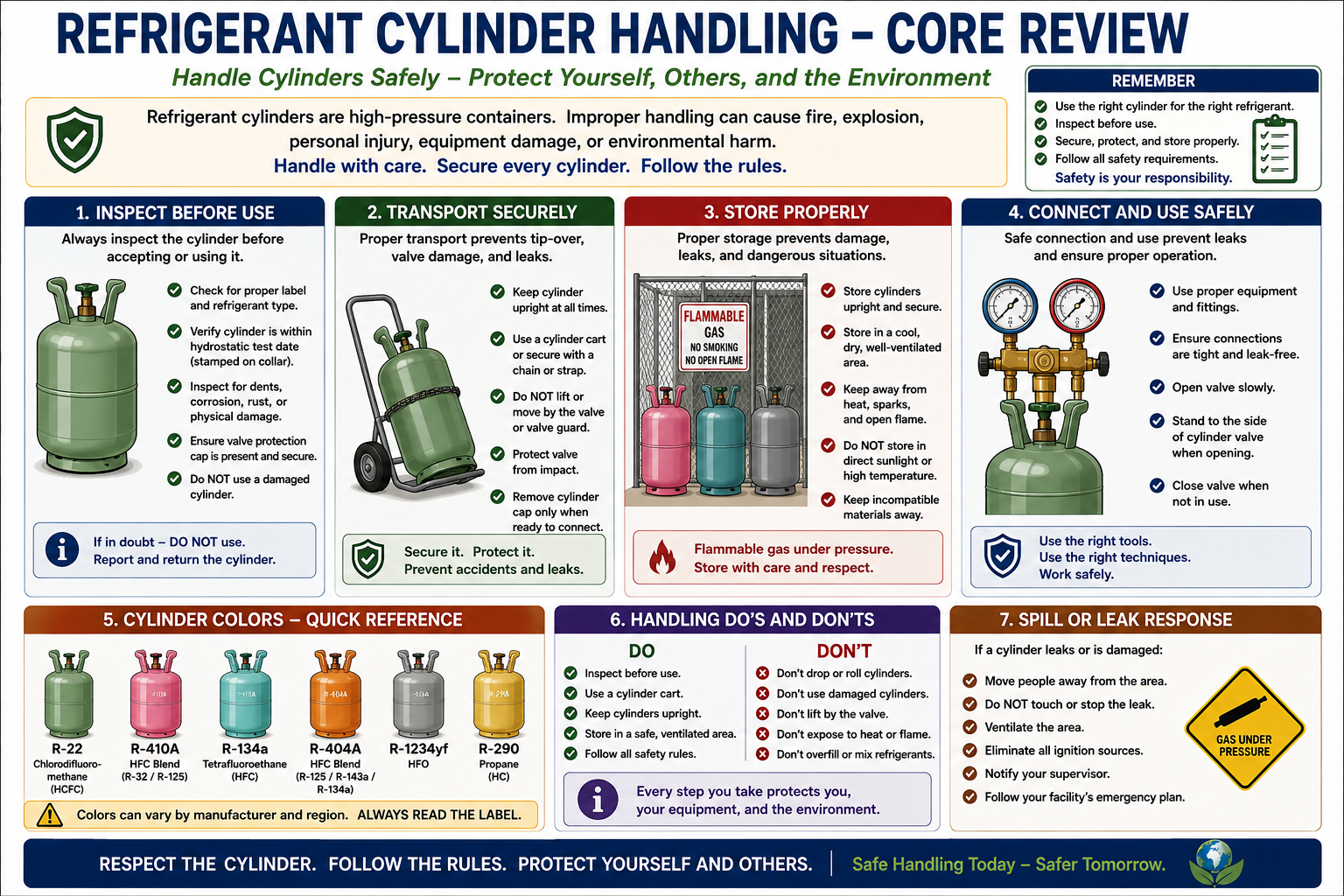
Heat Raises Cylinder Pressure
Refrigerant pressure increases as temperature increases. Cylinders must be protected from excessive heat, direct flame, and other conditions that could create unsafe pressure.
Leave Room for Liquid Expansion
Liquid refrigerant expands as its temperature increases. A recovery cylinder must therefore have sufficient vapor space so the liquid does not hydraulically fill the cylinder as it warms.
Use the recovery cylinder markings, manufacturer instructions, refrigerant properties, scale readings, and applicable filling requirements to determine the maximum allowable refrigerant weight. Do not estimate cylinder contents from pressure alone.
Secure, Protect, Identify
Cylinders should be protected against falling, rolling, valve damage, excessive temperature, and physical abuse. Labels and markings must remain readable so the refrigerant and cylinder specifications can be identified.
Transportation of refrigerant cylinders may also be subject to Department of Transportation requirements. Section 608 certification is not a substitute for applicable hazardous-material transportation rules.
EPA and DOT Have Different Roles
EPA regulates refrigerant management under Section 608. DOT regulates transportation of hazardous materials, including many refrigerant cylinders. A technician may need to comply with both sets of requirements.
Know Where to Find Refrigerant-Specific Information
The Safety Data Sheet provides product-specific hazard information, first-aid measures, fire-fighting information, accidental-release procedures, handling and storage requirements, exposure controls, PPE guidance, physical properties, and stability information.
Do not assume that all refrigerants present the same toxicity, flammability, decomposition, or exposure hazards. When an unfamiliar refrigerant is encountered, consult the current SDS before beginning work.
Work Through the Scenario
A strong Section 608 technician should be able to approach an unfamiliar question in the same sequence used on a service call.
Identify the Refrigerant
Determine the refrigerant family, safety classification, pressure characteristics, and environmental concerns.
Identify the Operation
Determine whether the question involves charging, recovery, evacuation, leak testing, disposal, cylinder handling, or another service operation.
Identify the Hazard
Consider pressure, temperature, oxygen displacement, flammability, chemical exposure, electrical hazards, and other conditions.
Apply the Regulation or Procedure
Select the requirement or service practice that matches the refrigerant, appliance, and operation rather than relying on a memorized rule from an unrelated situation.
What You Need to Remember
- Stratospheric ozone protects the Earth from harmful ultraviolet radiation.
- CFCs contain chlorine and generally have substantial Ozone Depletion Potential.
- HCFCs also contain chlorine but generally have lower ODP than CFCs.
- HFC refrigerants contain no chlorine or bromine and therefore have zero ODP.
- Zero ODP does not mean zero GWP.
- CFC-11 is the reference substance for ODP and is assigned an ODP of 1.0.
- Carbon dioxide is the reference gas for GWP and is assigned a GWP of 1.
- The Montreal Protocol is the international agreement controlling ozone-depleting substances.
- Ending production of a refrigerant does not automatically require immediate replacement of all equipment using it.
- Identify refrigerant from reliable labels and service information, not cylinder color alone.
- Refrigerant blends may experience fractionation and may require liquid charging.
- Refrigerant and lubricant compatibility must be verified before retrofit or service.
- There is no universal refrigerant that can safely be treated as a direct drop-in replacement for every older refrigerant.
- Blue manifold hose = low side, red = high side, yellow = center service hose.
- Recover means capture refrigerant externally.
- Recycle means clean refrigerant for reuse without completing full reclamation requirements.
- Reclaim means process refrigerant to the applicable purity specification and verify that purity analytically.
- Recovery is not the same operation as evacuation.
- A vacuum pump is not a substitute for a recovery machine.
- Evacuation removes air, water vapor, and noncondensables after refrigerant recovery.
- Moisture can contribute to freezing, corrosion, chemical reactions, and acid formation.
- Recovering liquid first can speed recovery when the appliance and equipment permit it.
- Long hoses, small hoses, valve cores, high cylinder pressure, and other restrictions can slow recovery.
- Do not mix different refrigerants in the same recovery cylinder.
- Intentional venting of regulated refrigerants during service is prohibited except for specifically exempted releases.
- De minimis releases associated with good-faith recovery are not permission to intentionally vent refrigerant.
- Recovery and recycling equipment must meet applicable EPA requirements.
- Refrigerant sales are restricted to qualifying purchasers under EPA regulations.
- Liquid refrigerant can cause serious cold-contact injury.
- Large refrigerant releases can displace breathable air.
- Use regulated dry nitrogen rather than oxygen or compressed air for approved refrigeration-system pressure testing.
- Refrigerant cylinders are pressure vessels and must be protected from excessive heat and physical damage.
- Never use a disposable refrigerant cylinder as a recovery cylinder.
- Use a scale to monitor recovery-cylinder fill.
- Cylinder pressure increases as cylinder temperature increases.
- EPA refrigerant-management requirements and DOT cylinder-transportation requirements serve different purposes.
- Use the current Safety Data Sheet for refrigerant-specific hazard information.
Review Questions
1. Why do CFC refrigerants damage stratospheric ozone?
Answer: CFC molecules can survive long enough to reach the stratosphere, where ultraviolet radiation breaks them apart and releases chlorine atoms. The chlorine participates in reactions that destroy ozone molecules.
2. Why do HFC refrigerants have zero ODP?
Answer: HFC refrigerants do not contain chlorine or bromine, the halogens associated with refrigerant-related stratospheric ozone depletion.
3. What is the difference between ODP and GWP?
Answer: ODP compares a substance’s potential to damage stratospheric ozone, while GWP compares its climate-warming effect with carbon dioxide over a specified period.
4. What is the difference between recovery and evacuation?
Answer: Recovery removes and captures refrigerant from an appliance. Evacuation is performed after proper refrigerant removal and uses a vacuum pump to remove air, water vapor, and other noncondensable gases from the refrigeration circuit.
5. What is the difference between recycling and reclamation?
Answer: Recycling cleans recovered refrigerant for reuse without meeting all reclamation requirements. Reclamation processes refrigerant to the applicable purity specification and verifies that purity using prescribed analytical methods.
6. Why should liquid refrigerant often be recovered before vapor?
Answer: The same mass of refrigerant occupies much less volume as a liquid, allowing large quantities of refrigerant to be transferred more quickly.
7. Why should different refrigerants never be mixed in the same recovery cylinder?
Answer: Mixing can make the refrigerant unsuitable for reuse, complicate reclamation, produce uncertain pressure-temperature behavior, and reduce the value of the recovered refrigerant.
8. Is a small release during hose disconnection automatically an illegal venting violation?
Answer: Not necessarily. EPA recognizes de minimis releases that occur during good-faith attempts to recover, recycle, or safely dispose of refrigerant. Deliberately releasing refrigerant instead of recovering it is different.
9. Why is oxygen unsafe for pressure-testing a refrigeration system?
Answer: Oxygen can react violently with oils and lubricants. Dry nitrogen with proper pressure regulation is used for approved refrigeration pressure-testing procedures.
10. Why must a recovery cylinder have vapor space?
Answer: Liquid refrigerant expands as temperature increases. Vapor space allows that expansion and prevents the cylinder from becoming hydraulically full.
11. Can cylinder pressure be used by itself to determine how much refrigerant is in a recovery cylinder?
Answer: No. When liquid and vapor are both present, pressure is strongly determined by refrigerant type and temperature. Cylinder weight should be monitored with a scale.
12. What document provides refrigerant-specific first aid, exposure, PPE, storage, fire, and reactivity information?
Answer: The Safety Data Sheet, or SDS.
Lesson 35 Summary
- The Section 608 Core combines environmental science, refrigerant knowledge, refrigeration fundamentals, service practices, safety, and regulatory requirements.
- CFC and HCFC refrigerants contain chlorine and can contribute to stratospheric ozone depletion.
- HFC refrigerants have zero ODP but may still have substantial Global Warming Potential.
- ODP and GWP measure different environmental effects.
- The Montreal Protocol established international controls on ozone-depleting substances.
- Refrigerant identification must come from reliable labels and service information rather than cylinder color alone.
- Refrigerant blends and substitute refrigerants may require different lubricants, charging methods, equipment, and safety precautions.
- Pressure and saturation temperature are related for a particular refrigerant.
- Recovery, recycling, reclamation, evacuation, and dehydration are different operations with different purposes.
- Recovery equipment captures refrigerant; a vacuum pump evacuates a refrigeration circuit after refrigerant recovery.
- Moisture, air, acids, and noncondensables can damage refrigeration systems and reduce performance.
- Recovery speed depends on refrigerant state, temperature, hoses, restrictions, recovery equipment, and recovery-cylinder conditions.
- Different recovered refrigerants should be kept separate.
- EPA prohibits intentional venting of regulated refrigerants except for releases specifically excluded from the prohibition.
- Recovery and recycling equipment used for covered work must meet applicable EPA requirements.
- EPA restricts the sale of regulated refrigerants to qualifying purchasers.
- Refrigerant service can involve pressure, frostbite, eye, inhalation, oxygen-displacement, flammability, electrical, and decomposition hazards.
- Dry nitrogen is used for approved refrigeration pressure-testing procedures; oxygen must not be substituted.
- Recovery cylinders must be suitable for the refrigerant, properly identified, protected from excessive heat and damage, and monitored by weight.
- Refrigerant cylinder pressure changes with temperature.
- The Safety Data Sheet provides refrigerant-specific chemical safety information.
- Understanding why a practice is correct is more useful than memorizing an isolated examination answer.