Duct Materials, Components, and Construction
Duct systems are assembled from materials, fittings, connectors, insulation, supports, dampers, access openings, and air terminals. A technician must be able to identify these parts, understand their intended purpose, and recognize construction conditions that can restrict airflow, leak air, collect moisture, produce noise, or interfere with service.
This lesson introduces the sheet metal, fiberglass duct board, flexible duct, insulated duct, common duct shapes, fittings, plenums, trunks, branches, boots, collars, dampers, access doors, joining methods, sealing materials, insulation, and installation details encountered in residential and light-commercial systems.
What You Will Learn
By the end of this lesson you should be able to:
Identify common duct materials.
Distinguish galvanized sheet metal, fiberglass duct board, flexible duct, and externally insulated metal duct.
Recognize duct shapes.
Identify round, rectangular, oval, and flat-oval ductwork and explain why different shapes are used.
Identify system components.
Recognize plenums, trunks, branches, collars, takeoffs, boots, dampers, access doors, registers, grilles, and diffusers.
Recognize common fittings.
Identify elbows, tees, wyes, reducers, transitions, offsets, end caps, and turning-vane fittings.
Evaluate connections and sealing.
Separate mechanical attachment, air sealing, insulation, and vapor-retarder requirements.
Inspect installed ductwork.
Recognize damaged materials, poor supports, open joints, compressed flexible duct, missing insulation, and inaccessible service components.
Different Materials Require Different Inspection Methods
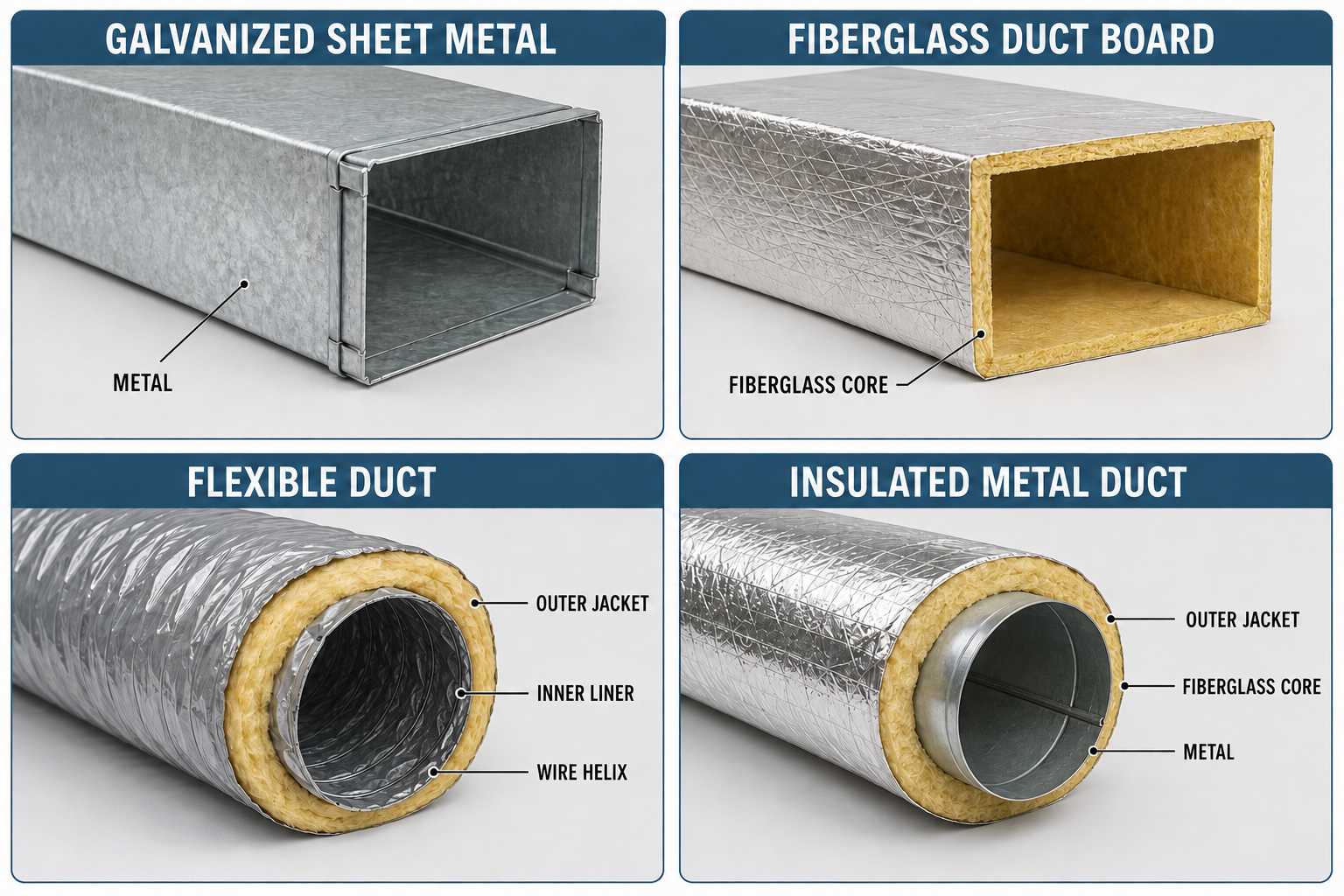
Galvanized Sheet Metal
Galvanized steel is commonly formed into round, rectangular, oval, and flat-oval ducts and fittings. It is durable and dimensionally stable but still requires proper joints, reinforcement, support, sealing, and insulation where applicable.
Fiberglass Duct Board
Fiberglass duct board is a rigid, self-supporting material formed into duct sections. The fiberglass provides thermal and acoustical properties, while the exterior facing helps protect the material and control vapor movement.
Flexible Duct
Insulated flexible duct commonly contains a flexible inner air liner supported by a helical wire, surrounding fiberglass insulation, and an outer protective vapor-retarder jacket.
Insulated Metal Duct
Metal duct may be insulated externally with fiberglass and a protective facing or internally with an approved duct liner. The metal remains the structural air passage.
A repair method appropriate for galvanized sheet metal may damage duct board or flexible duct. Use materials, fasteners, sealants, tapes, adhesives, and procedures approved for the specific duct construction and application.
Durable Construction Still Requires Proper Assembly
Material Thickness
The required metal thickness depends on duct dimensions, shape, pressure class, reinforcement, application, and the construction standard or code governing the installation.
Longitudinal Seams
Longitudinal seams join the edges that run along a duct section. Common examples include Pittsburgh seams, snap-lock seams, spiral seams, and welded seams.
Transverse Joints
Transverse joints connect one duct section to the next. Their construction must provide mechanical strength, alignment, and a surface that can be sealed as required.
Reinforcement
Larger ducts and higher-pressure applications may require reinforcing beads, cross-breaking, external angles, stiffeners, tie rods, or other approved reinforcement.
Sheet-metal seams, joints, access doors, takeoffs, equipment connections, and boots can all leak. The presence of mechanically sound metal duct does not eliminate the need for appropriate air sealing.
The Board Forms the Air Passage
Rigid Fiberglass Structure
The fiberglass board is cut, grooved, folded, and closed to form a self-supporting rectangular duct rather than being wrapped around an underlying metal duct.
Exterior Facing
The exterior facing protects the fiberglass, provides a surface for approved closure materials, and can serve as part of the vapor-retarder system.
Closures and Joints
Longitudinal closures and section joints require approved materials and procedures that preserve structural integrity, air sealing, and the exterior facing.
Damage Inspection
Inspect for crushed corners, delamination, loose facing, open closures, damaged interior surfaces, water exposure, biological contamination, and unsupported sections.
Do not confuse the materials: Fiberglass duct board forms the duct itself. Externally insulated sheet-metal duct contains a separate metal air passage beneath the insulation.
Every Layer Has a Different Purpose
Inner Liner
The inner liner contains the moving air and is attached to collars, boots, takeoffs, or fittings according to the duct manufacturer’s installation instructions.
Wire Helix
A helical wire supports the flexible inner liner and allows the duct to bend while helping it maintain an open air passage.
Fiberglass Insulation
The insulation reduces heat transfer between the air in the duct and the surrounding space.
Outer Jacket
The outer jacket protects the insulation and commonly provides the vapor-retarder layer needed to limit moisture movement toward a cold duct surface.
The inner liner must be mechanically secured and sealed to the fitting as required. The insulation is then restored, and the outer jacket is closed and sealed separately. Pulling only the outer jacket over a collar does not create a secure air connection.
Compression, excess length, sharp bends, sag, twisting, crushing, and inadequate support increase resistance and can greatly reduce airflow. Flexible duct installation will be examined in detail later in this section.
Shape Affects Construction, Space, and Airflow
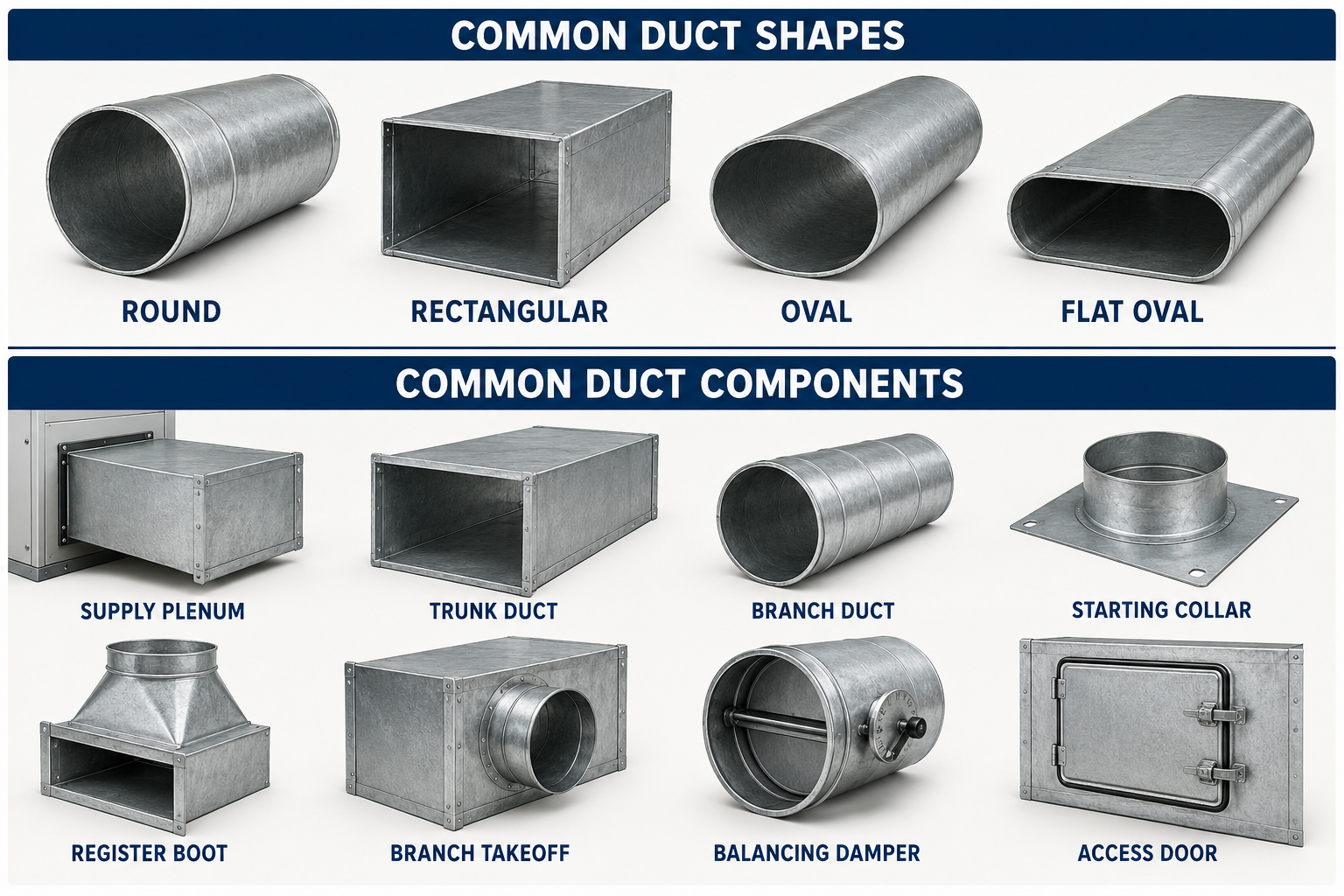
Round Duct
Round duct provides a favorable relationship between cross-sectional area, material use, structural strength, and airflow resistance.
Rectangular Duct
Rectangular duct fits many framing cavities and equipment connections but may require additional reinforcement as its dimensions increase.
Oval Duct
Oval duct provides a lower profile than round duct while retaining curved surfaces and is used where height or appearance limits a round installation.
Flat-Oval Duct
Flat-oval duct has relatively straight sides joined by rounded ends and can provide useful airflow area where vertical clearance is limited.
Equal dimensions do not mean equal capacity: A round diameter, rectangular width and height, or oval width and height must be evaluated by actual cross-sectional area and resistance. Different shapes with one matching dimension do not automatically carry the same airflow.
Identify the Function Before Evaluating the Part
Supply Plenum
The supply plenum receives air leaving the equipment and provides a connection to the main supply trunk, branches, or takeoffs.
Return Plenum
The return plenum collects air from the return system and connects it to the filter, blower cabinet, furnace, fan coil, air handler, or packaged equipment.
Trunk Duct
A trunk is a main duct that carries a large portion of the system airflow and supplies or collects air from multiple branches.
Branch Duct
A branch is a smaller duct that leaves or joins a trunk and serves one terminal, one room, or a smaller group of spaces.
Starting Collar
A starting collar provides a connection between a flat duct or plenum surface and a round branch duct.
Branch Takeoff
A branch takeoff connects a branch to a trunk or plenum and can be shaped to improve entry into the branch and reduce resistance.
Register Boot
A register boot connects a supply branch to a floor, wall, or ceiling register opening and commonly changes duct shape or direction.
Balancing Damper
A balancing damper adds controlled resistance to a branch so airflow can be adjusted during system balancing.
Access Door
An access door provides entry for inspection, cleaning, adjustment, testing, or service and must close securely without creating unacceptable leakage.
Flexible Connector
A flexible connector can isolate vibration between equipment and metal ductwork, but it must remain aligned and must not collapse into the airstream.
Fittings Change Direction, Size, or Airflow Path
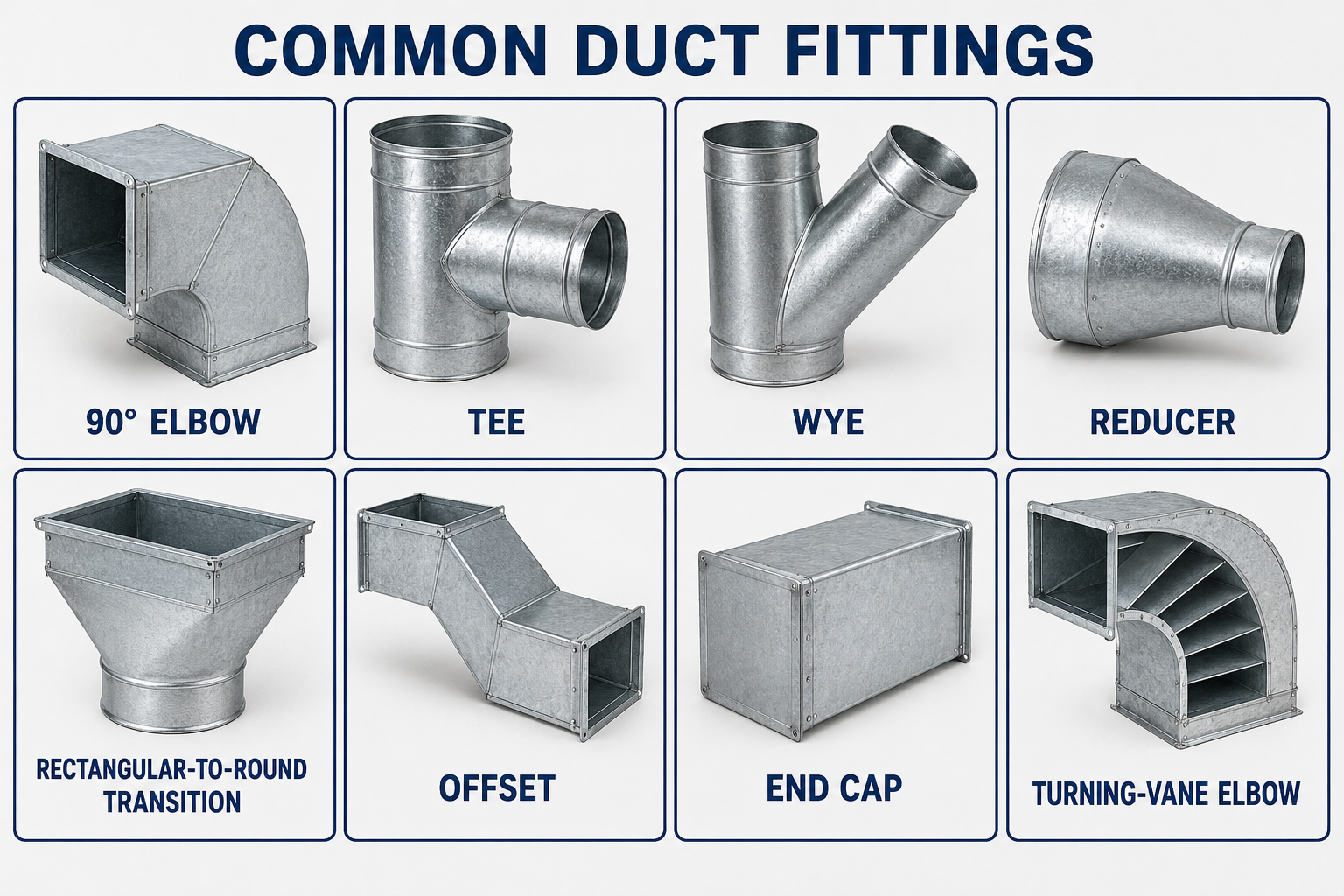
Elbow
An elbow changes airflow direction. Radius, aspect ratio, internal construction, and nearby fittings affect the resistance and airflow pattern through the turn.
Tee
A tee joins or divides air paths at approximately a right angle and can create substantial resistance when airflow must make an abrupt turn.
Wye
A wye divides or combines airflow through angled branches and generally provides a more gradual change in direction than an abrupt tee.
Reducer
A reducer changes from a larger duct size to a smaller duct size while maintaining the same general shape.
Transition
A transition changes duct size, shape, or both. Gradual transitions generally produce a more controlled airflow change than abrupt transitions.
Offset
An offset shifts the duct centerline while keeping the inlet and outlet generally parallel so the duct can pass around an obstruction.
End Cap
An end cap closes the end of a trunk, plenum, or branch and must be mechanically secure and sealed as required.
Turning-Vane Elbow
Properly constructed turning vanes divide the airflow through a rectangular elbow and guide it around the turn to reduce separation and uneven flow.
Elbows, takeoffs, transitions, dampers, boots, tees, wyes, and other fittings create resistance. Their effect cannot be evaluated by measuring only the straight length of duct.
Mechanical Strength and Airtightness Are Different Requirements
Holds the Assembly Together
Screws, rivets, approved clamps, draw bands, tabs, cleats, flanges, locks, and other fastening methods prevent duct sections and connections from separating.
Limits Air Leakage
Mastic, approved tapes, gaskets, sealants, and closure systems seal joints, seams, penetrations, access doors, takeoffs, boots, and equipment connections.
Mastic
Duct mastic is applied over compatible seams and joints to create a durable air seal. Large openings may require reinforcing mesh or a mechanical repair before sealing.
Approved Metal Tape
Listed or otherwise approved metal-faced duct tape may be used where permitted and must be applied to a clean, dry, compatible surface according to its instructions.
Gaskets
Gaskets seal mating surfaces such as access doors, equipment panels, flanges, filter racks, and manufactured duct connections.
Boot-to-Building Connection
The duct boot must be secured and sealed to the surrounding floor, wall, ceiling, or air barrier so air does not escape into concealed construction.
Use mastic, approved metal tape, gaskets, aerosol sealant, or another material intended and approved for the application. The familiar cloth-backed product commonly called duct tape can dry, loosen, and fail over time.
Insulation Must Remain Continuous and Dry
Thermal Resistance
Duct insulation reduces unwanted heat gain into cooling air and heat loss from heating air, especially where ducts pass through unconditioned spaces.
Vapor Retarder
A properly installed vapor-retarder facing limits moisture movement toward a cold duct surface where condensation could occur.
Compression
Compressed fiberglass insulation provides less thermal resistance than the same insulation installed at its intended thickness.
Open Seams and Tears
Open jacket seams, punctures, poorly sealed penetrations, and damaged facing can allow moisture to reach cold surfaces and can contribute to condensation.
Wet Insulation
Wet insulation can lose performance, damage adjacent materials, support contamination, and conceal an air leak or condensation problem.
Internal Liner
Internal duct liner must remain securely attached and in suitable condition so it does not obstruct airflow, release material, retain contamination, or interfere with cleaning.
Ductwork Must Maintain Its Intended Shape and Position
Support Spacing
Supports must follow the applicable duct standard, manufacturer instructions, code requirements, duct material, dimensions, weight, insulation, and installation orientation.
Support Width
Supports must be wide enough and shaped appropriately so they do not crush insulation, deform duct board, or reduce the internal area of flexible duct.
Alignment
Duct sections should remain aligned without excessive strain on joints, fittings, equipment cabinets, boots, or flexible connectors.
Service Access
Ductwork must not prevent access to filters, coils, drain pans, blower assemblies, dampers, controls, access doors, electrical panels, or other service points.
Physical Protection
Ducts must be protected from crushing, sharp objects, standing water, weather exposure, pests, storage damage, and contact with materials that can damage the duct or insulation.
Required Clearances
Ducts and insulation must maintain clearances required from vents, flues, chimneys, heat-producing equipment, electrical equipment, and other building systems.
Do not apply one universal support distance: Required spacing and support construction vary with duct material, size, orientation, manufacturer instructions, adopted code, and applicable construction standard.
Follow a Repeatable Visual Inspection
- Identify the duct material, shape, size, insulation, and pressure application.
- Trace each duct to determine whether it is supply, return, outdoor air, exhaust, relief, or another air path.
- Identify plenums, trunks, branches, fittings, dampers, access doors, boots, grilles, registers, and diffusers.
- Inspect mechanical attachments for separation, movement, missing hardware, or strain.
- Inspect seams, joints, penetrations, equipment connections, boots, and access panels for signs of leakage.
- Check flexible duct for compression, excessive length, sharp bends, sag, twisting, crushing, and loose inner-liner connections.
- Check duct board for damaged corners, open closures, crushed sections, loose facing, water damage, or interior deterioration.
- Check metal duct for corrosion, deformation, vibration, failed joints, loose reinforcement, and damaged access doors.
- Inspect insulation for gaps, compression, wet areas, tears, missing sections, and open vapor-retarder seams.
- Confirm supports maintain the duct’s intended shape and do not damage the duct or insulation.
- Look for dirt streaks, dust deposits, discolored insulation, condensation, rust, and other evidence that can help locate leakage or moisture problems.
- Document concealed or inaccessible sections that require additional testing rather than assuming they are acceptable.
A duct can appear intact while leaking at concealed joints or creating excessive resistance internally. Later lessons will combine inspection with static-pressure, pressure-drop, airflow, temperature, and leakage measurements.
Construction Errors to Avoid
“All insulated ducts are flexible duct.”
Sheet-metal duct, duct board, and flexible duct can all be insulated, but their structures and repair methods are different.
“Tape holds the duct together.”
Air-sealing material does not replace required mechanical attachment or structural support.
“If the outer flex jacket is attached, the connection is complete.”
The inner liner must be properly attached and sealed before the insulation and outer jacket are restored.
“Straight duct length determines resistance.”
Fittings, transitions, takeoffs, dampers, boots, compression, roughness, and installation quality also affect resistance.
“Insulation only prevents energy loss.”
Insulation and its vapor retarder also help control surface temperature and condensation.
“A visually closed joint cannot leak.”
Air can escape through small seams, screw penetrations, failed gaskets, open corners, loose closures, and connections hidden beneath insulation.
Can You Identify the Duct Construction?
- How does fiberglass duct board differ from insulated sheet-metal duct?
- What four basic layers or components are found in insulated flexible duct?
- What is the purpose of the flexible duct’s inner liner?
- What is the purpose of the outer jacket?
- How does a trunk duct differ from a branch duct?
- What is the purpose of a starting collar?
- How does a wye differ from an abrupt tee?
- What does an offset accomplish?
- Why are mechanical attachment and air sealing separate requirements?
- Why can compressed insulation contribute to a duct problem?
- Why should support spacing not be based on one universal number?
- What evidence can indicate leakage even when the opening is not directly visible?
What You Should Have Learned
Residential and light-commercial systems commonly use galvanized sheet metal, fiberglass duct board, flexible duct, and externally or internally insulated metal duct.
Round, rectangular, oval, and flat-oval shapes provide different combinations of airflow area, structural strength, material use, and space requirements.
Plenums, trunks, branches, collars, takeoffs, boots, dampers, and access doors perform different functions within the distribution system.
Elbows, tees, wyes, reducers, transitions, offsets, and other fittings affect airflow resistance as well as physical routing.
Mechanical fasteners hold duct assemblies together, while mastic, approved tapes, gaskets, and other closure materials limit air leakage.
Flexible duct requires a secure inner-liner connection, restored insulation, a sealed outer jacket, full extension, and proper support.
Duct insulation reduces heat transfer, while an intact vapor retarder helps prevent moisture from reaching cold duct surfaces.
A complete inspection evaluates materials, joints, seals, supports, insulation, clearances, access, physical damage, leakage evidence, and the internal airflow path.