Author: cmolnar

  • August 24, 2026 Swim – Strong Endurance Work, but a Warning From My Right Shoulder

    Today’s workout was supposed to begin the next phase of my Huntsman Senior Games preparation. After deciding yesterday to concentrate primarily on the 1500-meter freestyle, 800-meter freestyle and 200-meter breaststroke, today’s 2,500-meter workout was designed as a controlled endurance session rather than another race benchmark.

    I completed the full 2,500 meters in 41:13, with an overall average pace of 1:39/100 m. The numbers were good, but today’s most important result wasn’t a time. During the workout I began developing discomfort in my right upper arm and shoulder. That is not normally the side that bothers me, and it caused me to modify portions of the planned freestyle work.

    August 24 Workout Summary

    MetricResult
    Distance2,500 m
    Duration41:13
    Average Pace1:39/100 m
    Normalized Pace1:39/100 m
    Average Speed60.4 m/min
    Average Heart Rate120 bpm
    Maximum Heart Rate152 bpm
    sTSS63
    Intensity Factor0.97
    Calories552 kcal
    Fitness / Fatigue / Form58 / 61 / -3

    The Planned Workout

    The workout was intentionally designed around my newly established endurance-event priorities.

    SetPlanned PacePurpose
    200 FR Easy2:00/100 mWarm-up
    100 BR Easy1:55/100 mWarm-up
    4 × 50 FR Build1:40/100 mPrepare for endurance work
    4 × 200 FR1:38/100 m800/1500 endurance
    4 × 50 BR1:48/100 mSmooth breaststroke technique
    4 × 100 BR1:46/100 m200 BR endurance
    4 × 100 FR1:36/100 mStrong freestyle under fatigue
    200 FR Easy2:00/100 mWarm-down

    What Actually Happened

    The workout began well. The opening 200-meter freestyle was completed in approximately 3:08, or about 1:34/100 m. The 100-meter breaststroke warm-up followed in approximately 1:41.65.

    The 4 × 50 freestyle build set was considerably faster than prescribed. The four 50s averaged approximately 41 seconds, equivalent to roughly 1:22/100 m. In retrospect, that was faster than necessary for a workout intended to be controlled.

    The Freestyle Endurance Set

    The planned centerpiece was 4 × 200 freestyle at 1:38/100 m. The first two clean freestyle 200s were strong:

    IntervalTargetActualActual PaceDifference
    200 FR #13:163:10.861:35.43/1005.14 sec faster
    200 FR #23:163:13.591:36.80/1002.41 sec faster

    Those two intervals were right where I want my endurance freestyle development to be. Both were faster than the prescribed 1:38 pace without becoming all-out efforts.

    However, I did not complete all four 200s as pure freestyle. As the workout progressed I began developing discomfort in my right upper arm and shoulder. Rather than abandon the workout, I substituted breaststroke for portions of the planned freestyle. FORM consequently recorded the latter part of this section as mixed freestyle and breaststroke rather than four clean 200-meter freestyle repetitions.

    Breaststroke Work

    The 4 × 50 breaststroke set was productive. The four repetitions were approximately:

    50 BRTimeEquivalent 100M Pace
    #151.021:42.04
    #252.461:44.92
    #353.821:47.64
    #453.161:46.32

    The set averaged approximately 1:45.2/100 m, slightly faster than the prescribed 1:48 pace. More importantly, this was controlled breaststroke rather than the sprint-oriented work I had been doing during last week’s breaststroke-intensive training.

    The later breaststroke work was slower, generally around the upper 1:40s to low 1:50s per 100 meters. With the shoulder issue influencing stroke selection and the cumulative workload from the previous two days, I don’t consider those slower repetitions particularly concerning.

    Today’s Workout Compared With Yesterday

    The comparison with yesterday’s 3,100-meter workout is interesting because the overall pace was essentially identical while the cardiovascular demand was considerably lower.

    MetricAug. 23Aug. 24Change
    Distance3,100 m2,500 m-600 m
    Average Pace1:39/100 m1:39/100 mEssentially unchanged
    Average HR133 bpm120 bpm-13 bpm
    Maximum HR151 bpm152 bpm+1 bpm
    sTSS7863-15
    IF0.970.97Unchanged

    I don’t want to interpret the 13-bpm reduction in average heart rate as a direct improvement in efficiency because the two workouts were very different. Still, maintaining approximately the same overall pace at a lower average cardiovascular load is encouraging.

    Three Days of Significant Work

    The shoulder discomfort also needs to be considered in the context of the workload accumulated over the last three days.

    DateDistancesTSSPrimary Work
    August 223,000 m72Breaststroke benchmarks + 800 FR
    August 233,100 m781500 FR training best
    August 242,500 m63Endurance / mixed stroke
    3-Day Total8,600 m213Three consecutive swim days

    That is enough accumulated work that I need to pay attention to what my body is telling me. The right shoulder discomfort is new, and it was significant enough that I changed strokes during today’s workout.

    I don’t know that I am actually overtrained, but I do have a feeling that I am getting dangerously close to doing too much. There is no benefit to reaching an arbitrary August mileage target if doing so compromises the training that actually matters in September or my ability to race in October.

    Current Training Bests vs. 2025 Huntsman Results

    Today’s workout wasn’t intended to change any of my race benchmarks, so the current best-time table remains unchanged. These are the benchmarks that will guide the next phase of training.

    Event Training Best 2025 Silver 2025 Bronze 2025 4th Current Target Difference
    1500 FR 24:04.84 23:39.43 25:04.75 25:06.88 Silver +25.41 sec
    800 FR 12:40.25 12:16.56 12:32.85 12:56.76 Bronze +7.40 sec
    200 BR 3:27.54 3:38.74 3:39.92 4:00.27 Silver -11.20 sec
    100 BR ~1:42 1:28.57 1:32.97 1:37.95 4th ~+4.05 sec

    The comparison continues to reinforce the decision I made yesterday. My strongest opportunities are in the endurance events. The 200 breaststroke training best is already faster than the 2025 silver time. The 800 freestyle is only 7.40 seconds from the 2025 bronze benchmark, while the 1500 freestyle is already well inside the 2025 bronze time and 25.41 seconds from silver.

    The 100 breaststroke remains an event I will probably swim, but I am no longer going to build workouts specifically around it.

    August Swimming Ledger

    Today’s 2,500 meters brings my August total to 55,100 meters.

    DateDistanceAugust Cumulative
    August 25,000 m5,000 m
    August 32,500 m7,500 m
    August 42,500 m10,000 m
    August 52,500 m12,500 m
    August 63,000 m15,500 m
    August 70 m15,500 m
    August 80 m15,500 m
    August 96,000 m21,500 m
    August 102,500 m24,000 m
    August 112,500 m26,500 m
    August 122,500 m29,000 m
    August 132,500 m31,500 m
    August 140 m – Run/Dryland31,500 m
    August 152,500 m34,000 m
    August 162,500 m36,500 m
    August 172,500 m39,000 m
    August 182,500 m41,500 m
    August 192,500 m44,000 m
    August 202,500 m46,500 m
    August 210 m – Rest46,500 m
    August 223,000 m49,500 m
    August 233,100 m52,600 m
    August 242,500 m55,100 m

    The 75,000-Yard Goal

    The 55,100 meters completed so far converts to approximately 60,258 yards. My 75,000-yard August goal requires approximately 68,580 meters, leaving roughly 13,480 meters.

    There are still seven days remaining in August, so mathematically the goal remains attainable. Six additional 2,500-meter swims would put me at approximately 70,100 meters, or more than 76,000 yards.

    But that calculation is no longer going to dictate the training schedule.

    Tomorrow: Out of the Pool

    I am currently planning to make Tuesday a dryland treadmill day rather than another swimming day. The objective is to maintain some aerobic work while giving the right shoulder a break from repetitive swimming.

    Even if taking additional recovery means I don’t reach 75,000 yards this month, that is a trade I am willing to make. The monthly distance goal is motivational. Huntsman is the actual objective.

    I am also not going to automatically schedule another hard swim for Wednesday. How the shoulder responds to a day away from swimming will help determine what comes next.

    Today’s Takeaway

    From a performance standpoint, today’s workout was good. The first two 200-meter freestyle endurance repetitions came in at approximately 1:35.4 and 1:36.8 per 100 meters, both faster than the planned 1:38 pace. The controlled 50-meter breaststroke work averaged approximately 1:45/100 m, and I completed the full 2,500-meter distance at an overall 1:39 pace.

    But training isn’t just about deciding whether the stopwatch says a workout was successful.

    Over the last three days I have swum 8,600 meters and accumulated 213 sTSS. Today my right shoulder began telling me that the workload may be catching up with me. Changing strokes allowed me to finish today’s workout, but continuing to pile swimming volume onto a new shoulder problem simply to reach a monthly mileage target would be counterproductive.

    So tomorrow’s training objective is recovery.

    The priority remains the same: arrive at Huntsman prepared to race the 1500 freestyle, 800 freestyle and 200 breaststroke. Everything between now and October—including when to rest—needs to serve that objective.
  • August 23, 2026 Swim – A New 1500M Best and Refocusing the Road to Huntsman

    Today was originally supposed to be a break from structured training. After a week of prescribed breaststroke-intensive workouts, I wanted to get into the pool without chasing a long list of interval targets. The only real plan was to swim approximately 2,500 meters, work by feel, and give myself a mental break from following a tightly structured workout.

    That plan changed once I got into the water. I ultimately completed 3,100 meters in 50:57, including a continuous 1,500-meter freestyle that produced a new training best.

    August 23 Workout Summary

    MetricResult
    Total Distance3,100 m
    Moving Time50:57
    Average Pace1:39/100 m
    Normalized Pace1:39/100 m
    Freestyle2,425 m
    Breaststroke675 m
    Average Heart Rate133 bpm
    Maximum Heart Rate151 bpm
    sTSS78
    Intensity Factor0.97
    Calories774 kcal
    Fitness / Fatigue / Form58 / 61 / 0

    Approximately 78 percent of today’s distance was freestyle and 22 percent was breaststroke. After the previous week concentrated heavily on breaststroke, that shift toward freestyle provided a useful change in emphasis.

    A New 1500M Freestyle Training Best

    The centerpiece of today’s free-form workout became a continuous 1,500-meter freestyle. I completed it in 24:04.84, an average pace of approximately 1:36.32/100 m.

    1500M Freestyle: 24:04.84
    Previous training best: 24:21.26
    Improvement: 16.42 seconds

    There is an important qualification to this result. The 1,500 was completed from a water start using open turns. I did not use a competition start or flip turns. That makes the 24:04.84 an especially useful training benchmark because there is still a technical component of my freestyle that can be developed before competition.

    1500M Freestyle Splits

    100MSplit
    11:28.71
    21:35.04
    31:37.05
    41:38.12
    51:38.33
    61:35.84
    71:37.88
    81:35.81
    91:37.84
    101:35.60
    111:36.44
    121:36.50
    131:36.87
    141:37.35
    151:37.46

    The obvious pacing issue was the opening 1:28.71. After that first 100, however, the swim became remarkably consistent. Most of the remaining 100s stayed between approximately 1:35 and 1:38, with very little deterioration during the final 500 meters.

    The final five 100s were 1:36.44, 1:36.50, 1:36.87, 1:37.35 and 1:37.46. That late-race stability is particularly encouraging for an endurance event.

    Today’s First 800M Compared With Yesterday

    Another interesting result appears when comparing the first 800 meters of today’s 1,500 with the standalone 800-meter freestyle I completed yesterday.

    800MTimePace / 100M
    August 22 Standalone 80013:00.621:37.58
    August 23 First 800 of 150012:46.781:35.85

    The first 800 meters of today’s 1,500 were 13.84 seconds faster than yesterday’s standalone 800. Even more significantly, the 12:46.78 split was only 6.53 seconds slower than my current 800-meter training best of 12:40.25, yet I still had another 700 meters to swim.

    Flip Turns Become Part of the Training Plan

    I also need to begin incorporating flip turns into freestyle training more consistently. At the moment, flip turns are considerably more tiring for me than open turns. My core strength and turn efficiency are not yet where I want them, and attempting to use flip turns continuously can take energy away from the actual swimming set.

    Rather than suddenly requiring flip turns throughout every freestyle workout, I am going to introduce them progressively. Initially that may mean using them during selected portions of a workout and gradually increasing the number as they become more efficient and less taxing.

    The objective isn’t simply to perform a flip turn. It is to make the turn inexpensive enough that it improves race performance rather than consuming energy needed for the 800 and 1500.

    The Huntsman Training Priorities Are Now Clear

    The results of the past week have helped answer an important question about how I should use the remaining training time before the Huntsman World Senior Games.

    My three priority competition events are now:

    • 1500M Freestyle
    • 800M Freestyle
    • 200M Breaststroke

    All three are endurance-oriented events, and the recent training results increasingly suggest that endurance is where my strengths lie.

    I will probably still swim the 100-meter breaststroke at Huntsman. However, I am no longer going to design workouts specifically around improving the 100. It becomes a secondary event that I can swim for the experience rather than a primary training objective.

    Short breaststroke intervals will remain in the workouts, but their purpose will be to improve technique, efficiency and sustainable speed for the 200-meter breaststroke rather than developing pure sprint speed for the 100.

    Current Training Bests vs. 2025 Huntsman Results

    The following table compares my current training bests with the 2025 Huntsman Men’s 60–64 results. The final column compares my training best with the highest finishing position that appears reasonably attainable based on the current numbers. A negative difference means my training best is already faster than the 2025 result; a positive difference shows how much faster I would need to swim to equal it.

    Event Training Best 2025 Silver 2025 Bronze 2025 4th Current Target Difference
    1500 FR 24:04.84 23:39.43 25:04.75 25:06.88 Silver +25.41 sec
    800 FR 12:40.25 12:16.56 12:32.85 12:56.76 Bronze +7.40 sec
    200 BR 3:27.54 3:38.74 3:39.92 4:00.27 Silver −11.20 sec
    100 BR ~1:42 1:28.57 1:32.97 1:37.95 4th ~+4.05 sec

    The table makes the emerging endurance pattern much easier to see.

    My 3:27.54 200-meter breaststroke training best is already 11.20 seconds faster than the 2025 silver-medal time. That doesn’t guarantee a medal in 2026—the field will be different—but it makes the 200 breaststroke an obvious priority event.

    The 800 freestyle presents a different opportunity. My 12:40.25 training best is already 16.51 seconds faster than the 2025 fourth-place result and is only 7.40 seconds away from the 2025 bronze time.

    The 1500 freestyle may be even more interesting. Today’s 24:04.84 is already 59.91 seconds faster than the 2025 bronze time and 1:02.04 faster than fourth. The next benchmark therefore becomes the 2025 silver time of 23:39.43, a difference of 25.41 seconds.

    And today’s 1500 was accomplished from a water start using open turns, leaving room to improve race execution in addition to fitness and pacing.

    The 100 breaststroke remains the outlier. My approximately 1:42 training best remains about four seconds slower than the 2025 fourth-place result. I may still race it, but these comparisons reinforce the decision not to build the remaining training program around it.

    August Swimming Ledger

    I am also tracking total swimming volume for August. After today’s 3,100 meters, I have now completed 52,600 meters this month.

    DateDistanceAugust Cumulative
    August 25,000 m5,000 m
    August 32,500 m7,500 m
    August 42,500 m10,000 m
    August 52,500 m12,500 m
    August 63,000 m15,500 m
    August 70 m15,500 m
    August 80 m15,500 m
    August 96,000 m21,500 m
    August 102,500 m24,000 m
    August 112,500 m26,500 m
    August 122,500 m29,000 m
    August 132,500 m31,500 m
    August 140 m – Run/Dryland31,500 m
    August 152,500 m34,000 m
    August 162,500 m36,500 m
    August 172,500 m39,000 m
    August 182,500 m41,500 m
    August 192,500 m44,000 m
    August 202,500 m46,500 m
    August 210 m – Rest46,500 m
    August 223,000 m49,500 m
    August 233,100 m52,600 m

    Chasing 75,000 Yards in August

    My secondary goal for August is to complete at least 75,000 yards of swimming.

    The current 52,600 meters converts to approximately 57,524 yards. Reaching 75,000 yards requires approximately 68,580 meters, leaving about 15,980 meters to complete during the final eight days of August.

    That works out to an average of approximately 2,000 meters per day. Seven additional 2,500-meter swims would comfortably put me over the monthly goal while still allowing one complete rest day.

    The Plan Moving Forward

    The next phase of training will look different from the breaststroke-intensive week that just ended. Rather than trying to improve four events equally, the workouts will be designed around three endurance events.

    • 1500 Freestyle: sustainable race pace, pacing discipline, aerobic endurance and progressively more flip turns.
    • 800 Freestyle: improving sustainable speed while developing the ability to finish strongly.
    • 200 Breaststroke: sustainable breaststroke pace, efficiency under fatigue and maintaining technique through the second 100.
    • 100 Breaststroke: likely still part of the Huntsman schedule, but no longer a primary training target.

    Short freestyle and breaststroke repetitions will remain in the workouts, but they will support the endurance events rather than becoming objectives by themselves.

    Flip turns will also begin appearing more frequently in freestyle workouts. The progression needs to be gradual because they currently require considerably more energy than my open turns. The goal is to make the turns more efficient without allowing turn practice to compromise the quality of the primary endurance sets.

    Today’s Takeaway

    I entered the pool today intending to take a break from structured training. Instead, the workout helped clarify the structure of the training that comes next.

    A 24:04.84 1500-meter freestyle from a water start with open turns, coming one day after a 3:27.54 200-meter breaststroke, provides two very useful benchmarks. Combined with the 12:40.25 800-meter freestyle training best, the results point toward the same conclusion.

    I am an endurance swimmer, and the remaining Huntsman training is going to reflect that.

    The focus from here is the 1500 freestyle, 800 freestyle and 200 breaststroke. The 100 breaststroke can still be part of the Huntsman experience, but it no longer needs to dictate how I train.

  • August 22, 2026 Swim – Breaststroke Race Benchmarks and 800M Freestyle

    Today’s swim completed the breaststroke-intensive portion of my current Huntsman Senior Games training block. After taking Friday completely off, the objective was to return to the pool relatively fresh and use several portions of the workout as benchmarks rather than simply accumulating more training volume.

    The workout was originally planned for 2,500 meters, with particular attention given to a 200-meter breaststroke effort and a controlled 800-meter freestyle. I ultimately continued for another 500 meters, finishing with 3,000 meters in 50:30.

    Workout Summary

    MetricResult
    Planned Distance2,500 m
    Completed Distance3,000 m
    Duration50:30
    Average Pace1:42/100 m
    Normalized Pace1:41/100 m
    Average Heart Rate131 bpm
    Maximum Heart Rate155 bpm
    sTSS72
    Intensity Factor0.95
    Calories780 kcal

    TrainingPeaks showed Fitness 57, Fatigue 57 and Form +3 before the workout. That was a substantial improvement in freshness compared with Thursday, when Fitness was 58, Fatigue 63 and Form -6. The complete rest day on Friday appears to have accomplished exactly what was intended.

    The 200M Breaststroke Benchmark

    The most important result of the workout came relatively early. The planned target for the 200-meter breaststroke was 3:32, equivalent to approximately 1:46/100 m.

    Actual 200M Breaststroke: 3:27.54

    That works out to approximately 1:43.77/100 m and improves on my previous training best of 3:31.71 by 4.17 seconds.

    200M Breaststroke BenchmarkTimeDifference
    August 22 Training Result3:27.54
    Previous Training Best3:31.714.17 sec faster
    2025 Huntsman Silver3:38.7411.20 sec faster
    2025 Huntsman Bronze3:39.9212.38 sec faster
    2025 Huntsman 4th4:00.2732.73 sec faster

    This was probably the most significant result of the entire breaststroke-intensive training week. It also supports the idea that some of my slower breaststroke performances during previous workouts were the result of where those efforts occurred within the workout rather than simply reflecting my current breaststroke ability.

    A training time cannot be directly converted into a Huntsman race result. Race conditions, pacing, starts, turns, fatigue and the competitive environment all matter. Nevertheless, a 3:27.54 training swim provides a very encouraging benchmark when compared with the 2025 Huntsman 60–64 age-group results.

    Controlled 800M Freestyle

    The 800-meter freestyle had a different purpose. This was specifically not intended to be another attempt at my 800-meter training best. The target was approximately 1:38/100 m, producing an expected time of about 13:04.

    Actual 800M Freestyle: approximately 13:00.62

    That is approximately 1:37.58/100 m, only a few seconds faster than the planned target. My current 800-meter training best is 12:40.25, so today’s swim was roughly 20 seconds slower than my best while remaining almost exactly where the workout prescribed it.

    That makes the 800 a successful effort. The goal was controlled endurance rather than racing the distance, and the result shows that I was able to settle into a strong sustainable freestyle pace in the middle of a breaststroke-oriented workout.

    The 100M Breaststroke Told a Different Story

    Later in the workout I completed a 100-meter breaststroke in 1:50.29. The planned target had been 1:40, making this substantially slower than expected.

    The placement of the swim is important, however. By that point I had already completed the warm-up and breaststroke preparation, the 3:27.54 200-meter breaststroke, a 200-meter freestyle recovery, the 800-meter freestyle and another 200 meters of breaststroke work.

    For evaluating my actual 100-meter breaststroke ability, Thursday’s earlier 100-meter repetitions are therefore probably more useful. The first of those was 1:41.86, with the six 100s averaging approximately 1:44.34.

    The combined results from the week suggest that my breaststroke speed deteriorates considerably as fatigue accumulates. That is useful information because it helps separate basic swimming ability from fatigue resistance.

    Breaststroke 50s and Short-Distance Speed

    The four breaststroke 50s immediately preceding the 100 were 51.84, 54.65, 50.37 and 52.26. That produces an average of approximately 52.28 seconds, or the equivalent of about 1:44.6/100 m.

    A later controlled set of four 50s produced 50.26, 53.16, 54.68 and 52.33. My fastest late-workout 25-meter breaststroke was 22.79 seconds.

    The shorter repetitions show that speed is available, but maintaining that speed through a complete 100 meters remains more difficult. This is consistent with the pattern that has emerged throughout the week.

    An Extra 500 Meters

    After completing the planned 2,500-meter workout, I continued for another 500 meters. The additional five 100-meter swims mixed freestyle and breaststroke in different combinations.

    The extra distance included approximately 275 meters of breaststroke and 225 meters of freestyle, bringing the final workout total to 3,000 meters.

    Being able to comfortably extend the workout was encouraging, particularly following Friday’s rest day. However, it does not change the current training strategy. The weekday workouts were intentionally reduced toward 2,500 meters so that swimming quality can take priority over simply accumulating distance.

    What This Week Says About My Huntsman Events

    The breaststroke-intensive week has provided considerably better information about how my four planned Huntsman events currently compare.

    EventCurrent Training EvidenceAssessment
    1500M Freestyle24:21.26 training bestStrong endurance event
    800M Freestyle12:40.25 best; controlled 13:00.62 todayStrong event
    200M Breaststroke3:27.54 new training bestVery strong relative to 2025 results
    100M BreaststrokeApproximately 1:42 best; 1:41.86 this weekCurrently the weakest relative event

    The 200M Breaststroke Is Emerging as a Priority Event

    One purpose of this week was to determine whether the slower breaststroke times I had been seeing were partly caused by attempting important breaststroke efforts after substantial accumulated fatigue. Today provided fairly convincing evidence that they were.

    After a complete rest day, placing the 200-meter breaststroke early enough in the workout produced a 3:27.54 performance and a new training best by more than four seconds.

    That makes the 200-meter breaststroke increasingly important as I decide how to prioritize the remaining training before the Huntsman Senior Games.

    Where Does That Leave the 100M Breaststroke?

    The results do not necessarily suggest that I should scratch the 100-meter breaststroke from Huntsman. They do suggest that I probably should not organize the remaining weeks of training around it as a primary medal-target event.

    My current best is approximately 1:42, while fourth place in the 2025 Huntsman 60–64 age group was 1:37.95. That leaves a meaningful performance gap. In contrast, the new 200-meter training benchmark of 3:27.54 is already substantially faster than the 2025 silver and bronze medal times.

    For now, the most logical approach appears to be keeping the 100-meter breaststroke on the Huntsman schedule as a secondary event while concentrating training on the 200-meter breaststroke, 800-meter freestyle and 1500-meter freestyle.

    Overall Evaluation

    Today was an excellent conclusion to the breaststroke-intensive week. The 800-meter freestyle demonstrated that my aerobic freestyle pace remains strong even during a breaststroke-focused training block, while the 200-meter breaststroke produced the clearest evidence yet that this may be one of my strongest Huntsman events.

    The most important number from the workout is 3:27.54.

    That performance changes how I view the 200-meter breaststroke heading into the final weeks before Huntsman. Rather than simply trying to become competitive in the event, the training results now suggest that maintaining and refining the endurance, pacing and technique that produced today’s swim should be one of the primary objectives of the remaining training block.

  • Road to Huntsman: 48 Days Out — Putting the 100M Breaststroke to the Test

    Today marks 48 days until my first event at the 2026 Huntsman World Senior Games, and today’s workout was one of the more important tests of my breaststroke-intensive training week.

    Tuesday was built around the 200-meter breaststroke. Today I reversed the experiment and put the important 100-meter breaststroke work near the beginning of the workout, before accumulated fatigue could become the dominant factor.

    The primary test was simple: 6 × 100 meters breaststroke at a target pace of 1:45/100m. The goal wasn’t to produce one exceptionally fast 100. It was to find out whether I could repeatedly hold that pace.

    Workout Summary

    MetricResult
    Total Distance2,500 m
    Breaststroke1,700 m
    Freestyle800 m
    Moving Time42:11
    Rest Time11:42
    Total Session Time53:53
    Average Pace1:42/100 m
    Normalized Pace1:41/100 m
    TrainingPeaks sTSS60
    TrainingPeaks IF0.95
    Average Heart Rate133 bpm
    Maximum Heart Rate153 bpm
    Calories669

    The Main Test: 6 × 100M Breaststroke

    The target for all six repetitions was 1:45. This set was deliberately positioned early enough in the workout that I couldn’t simply blame the results on having already accumulated a large amount of breaststroke fatigue.

    100 Target Actual Difference
    #11:45.001:41.86-3.14 sec
    #21:45.001:44.52-0.48 sec
    #31:45.001:45.16+0.16 sec
    #41:45.001:45.38+0.38 sec
    #51:45.001:44.43-0.57 sec
    #61:45.001:48.71+3.71 sec
    Average1:45.001:44.34-0.66 sec

    Planned vs. Actual Pace

    The consistency of the first five repetitions is probably more important than the fastest individual time. Five of the six were very close to or faster than the prescribed 1:45 pace.

    6 × 100M Breaststroke — Target vs. Actual

    Target pace: 1:45.00   |   Lower is faster

    #11:41.86
    #21:44.52
    #31:45.16
    #41:45.38
    #51:44.43
    #61:48.71

    Target: 1:45.00   |   Six-repeat average: 1:44.34

    Better Than the Target

    The six repetitions averaged 1:44.34, approximately two-thirds of a second faster than the prescribed 1:45 pace.

    More importantly, there wasn’t a steady deterioration from beginning to end. After opening in 1:41.86, I settled into a remarkably narrow range: 1:44.52, 1:45.16, 1:45.38 and then back down to 1:44.43 on the fifth repetition.

    Only the final 100 showed a significant fade, at 1:48.71.

    That makes this a successful training set. I wasn’t simply able to reach 1:45. I was able to reproduce approximately that pace over and over.

    The 50M Work

    Later in the workout I completed six strong 50-meter breaststroke repetitions. The prescribed pace was 1:40/100m, equivalent to approximately 50 seconds per 50.

    50Actual TimeEquivalent /100M Pace
    #152.101:44.2
    #251.291:42.6
    #351.431:42.9
    #450.711:41.4
    #550.741:41.5
    #651.811:43.6

    I didn’t quite reach the prescribed 1:40/100m pace, but again the consistency stands out. Five of the six were separated by little more than one second, and repetitions four and five were almost identical at 50.71 and 50.74.

    And There Was Still Some Speed Left

    The workout finished with short 25-meter breaststroke speed work. One of those final 25s was 22.45 seconds, equivalent to approximately a 1:29.8/100m pace.

    That doesn’t make a 25-meter split directly comparable to a 100-meter race, but it does show that some short-distance speed remained available after a substantial amount of breaststroke work.

    What Does This Say About the 100M Breaststroke?

    This is where today’s result becomes particularly interesting.

    As a training set, the 6×100 was excellent. I averaged faster than the prescribed pace and held it consistently through five repetitions.

    But this week isn’t only about determining whether I can repeatedly swim 1:45 breaststroke. I’m also trying to decide whether the 100-meter breaststroke is an event that deserves significant emphasis during the remaining weeks before Huntsman.

    My best training 100 remains approximately 1:42. Today’s opening 1:41.86 essentially confirms that level of performance.

    That’s good swimming for me, but it remains slower than the 1:37.95 fourth-place time from the 2025 Games and considerably farther from the medal positions.

    The Endurance Pattern Is Getting Harder to Ignore

    Tuesday’s workout showed that I could average approximately 3:42 across four consecutive 200-meter breaststroke repetitions. Today’s six 100s averaged 1:44.34.

    In other words, when the race distance doubles from 100 to 200 meters, I retain a surprisingly large percentage of my 100-meter breaststroke pace.

    That fits an increasingly obvious pattern throughout this training cycle: I appear to be much better suited to endurance than sprinting.

    The same pattern appears in freestyle. My 800- and 1500-meter results have become increasingly competitive relative to last year’s Huntsman performances.

    That doesn’t necessarily mean I shouldn’t swim the 100 breaststroke. There is still value in racing an event for experience even when I don’t expect to place.

    But it may mean that the majority of my remaining training energy belongs elsewhere.

    Four Days of Breaststroke Intensive

    DayPrimary PurposeWhat I Learned
    Monday Technique / Aerobic Modified the workout while still completing 2,500 m.
    Tuesday 200M Breaststroke 3:40-level 200 pace is realistic when relatively fresh.
    Wednesday Aerobic / Technique Reduced breaststroke load while maintaining the full 2,500 m.
    Thursday 100M Breaststroke Six 100s averaged 1:44.34 against a 1:45 target.

    Now I Rest

    Tomorrow is intentionally a complete rest day.

    That means no replacement swim and no attempt to squeeze in another training session simply because I feel like I should be doing something.

    Four consecutive days of 2,500-meter swimming means I have completed 10,000 meters since Monday. Friday is part of the training plan just as much as any of those 10,000 meters.

    Saturday Will Answer the Next Question

    Saturday’s 2,500-meter workout is deliberately different.

    After Friday’s rest, I will attempt a 200-meter breaststroke benchmark early in the workout. The session will also include a continuous 800-meter freestyle, followed later by a 100-meter breaststroke benchmark.

    That should give me one final set of useful data from this breaststroke-intensive week.

    Then I will make a decision about the 100-meter breaststroke.

    48 Days to Go

    Today’s workout answered the question it was designed to answer.

    I can repeatedly swim approximately 1:45 breaststroke 100s. Six repetitions averaged 1:44.34, and five of the six remained very close to the target.

    What today’s workout did not demonstrate is a major change in my underlying 100-meter sprint speed. My fastest 100 was 1:41.86, which is essentially consistent with my existing best performances.

    That distinction matters.

    The goal of training isn’t simply to prove that every planned event can be completed. It’s also to learn where my strengths are and use the remaining training time accordingly.

    After four consecutive days and 10,000 meters, the evidence continues to point toward endurance.

    Friday: rest. Saturday: one more test.

  • Road to Huntsman: 49 Days Out — Adjusting the Breaststroke Intensive Week

    Today marks 49 days until my first event at the 2026 Huntsman World Senior Games. Wednesday was deliberately scheduled as the lower-intensity day of this week’s breaststroke-intensive training block.

    The plan still called for 2,500 meters, but unlike Tuesday’s 200-meter breaststroke workout or Thursday’s upcoming 100-meter work, today’s objective was aerobic conditioning, breaststroke technique and recovery between the week’s two harder sessions.

    I completed the full 2,500 meters, although I made several changes to the planned workout as I went. Most importantly, I substituted freestyle for some of the planned breaststroke work. The final workout ended up being split exactly in half: 1,250 meters breaststroke and 1,250 meters freestyle.

    Workout Summary

    MetricResult
    Total Distance2,500 m
    Breaststroke1,250 m
    Freestyle1,250 m
    Moving Time43:17
    Rest Time6:45
    Total Session Time50:01
    Breaststroke Percentage50%
    Freestyle Percentage50%

    Planned vs. Actual Workout

    Workout Block Planned Actual Change
    Warm-up 200 FR + 100 BR 200 FR + 100 BR As planned
    Mixed Aerobic 4×200
    100 FR + 100 BR
    4×200
    100 FR + 100 BR
    As planned
    6×100 Main Set 6×100 BR Alternating 100 FR / 100 BR 300 m shifted from BR to FR
    Freestyle Recovery 4×100 FR 2×100 FR 200 m shorter
    Additional 100s 2×100 mixed BR/FR 200 m added
    Technique Set 4×50 BR 4×50 BR As planned
    Speed Finish 4×25 BR 4×25 BR As planned
    Warm-down 100 FR 100 FR As planned

    The 4×200 Mixed Aerobic Set

    The first major set remained exactly as planned: four 200-meter repetitions, each consisting of 100 meters freestyle followed by 100 meters breaststroke.

    RepeatDistanceTimeAverage Pace
    #1200 m mixed3:27.431:43.7/100m
    #2200 m mixed3:29.791:44.9/100m
    #3200 m mixed3:29.771:44.9/100m
    #4200 m mixed3:31.821:45.9/100m

    This was a very consistent aerobic set. Only about four seconds separated the first and fourth 200, despite each repeat requiring a change from freestyle to breaststroke halfway through.

    Changing the 6×100 Set

    The biggest deliberate change came during the planned six 100-meter breaststroke repetitions. Instead of swimming all six as breaststroke, I alternated freestyle and breaststroke.

    RepeatStrokeTime
    #1Freestyle1:31.35
    #2Breaststroke1:49.46
    #3Freestyle1:31.73
    #4Breaststroke1:53.16
    #5Freestyle1:32.82
    #6Breaststroke1:53.84

    The three freestyle 100s were remarkably consistent at 1:31.35, 1:31.73 and 1:32.82. The breaststroke repetitions were 1:49.46, 1:53.16 and 1:53.84.

    Today’s goal was not to turn these breaststroke 100s into another race-pace test. Thursday is specifically designed for that. The value today was maintaining breaststroke technique while reducing the cumulative breaststroke load between two harder training days.

    Finishing With Breaststroke

    I still completed the planned shorter breaststroke work at the end of the session.

    SetResults
    4×50 Breaststroke 55.35 / 54.18 / 54.95 / 57.98
    4×25 Breaststroke 24.83 / 26.16 / 25.82 / 27.22

    Those weren’t intended to be all-out performances. They provided shorter breaststroke repetitions at the end of an otherwise controlled workout without turning Wednesday into another major breaststroke stress day.

    Why Today’s Changes Made Sense

    This is the third consecutive 2,500-meter swim of the week. Monday was modified because of some muscular discomfort in my right upper thigh. Tuesday was the week’s first major test, built around four early 200-meter breaststroke repetitions. Thursday is scheduled to be the 100-meter breaststroke-focused workout.

    Wednesday was never supposed to be another test.

    By substituting freestyle for several hundred meters of planned breaststroke, I maintained the full training distance and aerobic workload while reducing some of the repetitive breaststroke-specific stress.

    The final 50/50 split between breaststroke and freestyle seems particularly appropriate for the purpose of today’s session.

    Tomorrow Is the Important 100M Test

    Thursday should provide one of the more useful data points of this entire week.

    Tuesday demonstrated that my 200-meter breaststroke pace looks considerably better when the important 200s are placed early in the workout. Tomorrow we apply the same idea to the 100.

    The primary set is scheduled early enough that accumulated workout fatigue should not dominate the result. That should give me a better indication of what my current 100-meter breaststroke ability actually looks like.

    That matters because I am still considering whether the 100-meter breaststroke belongs in my final Huntsman event schedule. My training continues to suggest that I may be much better suited to the longer events, but I am deliberately waiting until after Saturday before making that decision.

    49 Days to Go

    Three days into this training block, the objective is no longer simply accumulating as much breaststroke as possible. It is learning where the useful work is and where additional volume becomes counterproductive.

    Today’s workout accomplished what Wednesday needed to accomplish: 2,500 meters completed, aerobic work maintained, breaststroke technique preserved, and the breaststroke load reduced before Thursday’s more important 100-meter session.

    Tomorrow we put the 100-meter breaststroke under the microscope.

  • Road to Huntsman: 50 Days Out — Testing the 200M Breaststroke

    Today marks 50 days until my first event at the 2026 Huntsman World Senior Games. Tuesday’s 2,500-meter workout was designed around one specific question: what happens to my 200-meter breaststroke pace when I swim the 200s early in the workout rather than after accumulating a large amount of fatigue?

    That made today’s most important set 4 × 200 meters breaststroke, with a target pace of 1:50/100m, or 3:40 for each 200.

    Workout Summary

    MetricResult
    Total Distance2,500 m
    Breaststroke1,600 m
    Freestyle900 m
    Moving Time43:03
    Rest Time10:20
    Total Session Time53:23
    Average Pace1:44/100 m
    Normalized Pace1:43/100 m
    TrainingPeaks sTSS58
    TrainingPeaks IF0.93
    Average Heart Rate129 bpm
    Maximum Heart Rate153 bpm
    Calories638

    The Main Test: 4 × 200M Breaststroke

    The target was straightforward: 1:50/100m, or 3:40 for each 200. Unlike some of my previous 200-meter efforts, these repetitions were intentionally placed near the beginning of the workout.

    200 Target Actual Actual Pace Difference
    #13:40.003:35.671:47.8/100-4.33 sec
    #23:40.003:40.161:50.1/100+0.16 sec
    #33:40.003:48.441:54.2/100+8.44 sec
    #43:40.003:44.151:52.1/100+4.15 sec
    Average3:40.003:42.111:51.1/100+2.11 sec

    The first two repetitions are particularly encouraging. The opening 200 was 3:35.67, more than four seconds faster than the prescribed pace. The second was 3:40.16, essentially exactly on target.

    The third repetition showed the weakness I am trying to address, slipping to 3:48.44. But I was able to bring the fourth back to 3:44.15 rather than continuing to fade.

    Across all four, I averaged approximately 3:42.11. That is only about two seconds slower than the 3:40 repeat target.

    Planned vs. Actual Interval Pace

    The chart below compares the prescribed pace with my actual pace for each of today’s repeated working intervals. Lower is faster.

    Planned vs. Actual Pace

    Gray = planned   |   Blue = actual

    4×50 #1
    1:40.6
    4×50 #2
    1:44.5
    4×50 #3
    1:44.6
    4×50 #4
    1:43.6
    200 BR #1
    1:47.8
    200 BR #2
    1:50.1
    200 BR #3
    1:54.2
    200 BR #4
    1:52.1
    100 BR #1
    1:54.6
    100 BR #2
    1:52.4
    100 BR #3
    1:49.1
    100 BR #4
    1:54.2
    25 BR #1
    1:36.8
    25 BR #2
    1:39.3
    25 BR #3
    1:41.7
    25 BR #4
    1:41.8

    The 100M Set Told a Different Story

    Later in the workout I completed four 100-meter breaststroke repetitions in 1:54.64, 1:52.38, 1:49.13 and 1:54.15.

    Those were well behind the planned 1:46/100m pace. Interestingly, the fastest was the third repetition rather than the first. That suggests this was not simply a steady collapse from fatigue, but the set clearly did not have the speed I would need from a 100-meter-specific workout.

    The 200 Continues to Look Like the Better Breaststroke Event

    This is another data point in the question I raised yesterday about whether my strengths are becoming increasingly clear as the race distance gets longer.

    Today’s 200-meter set was not perfect, but the first two repetitions demonstrated that a 3:40-or-better 200 is very realistic when I am relatively fresh. I then recovered from a poor third 200 enough to improve on the fourth.

    The later 100-meter set was much less convincing. That doesn’t settle the question about the 100 breaststroke, particularly because those 100s came after 800 meters of 200-meter breaststroke work. Thursday’s workout is specifically designed to reverse that situation by putting the important 100-meter work near the beginning.

    Current Huntsman Benchmarks

    EventMy Best Training2025 Silver2025 Bronze2025 4th
    1500M Freestyle24:21.2623:39.4325:04.7525:06.88
    800M Freestyle12:40.2512:16.5612:32.8512:56.76
    200M Breaststroke3:31.713:38.743:39.924:00.27
    100M Breaststroke1:42.551:28.571:32.971:37.95

    What Today’s Workout Says

    The experiment of moving the 200-meter breaststroke work toward the beginning of the workout was worthwhile.

    The first 200 at 3:35.67 was faster than the 2025 silver and bronze finishing times, although a training repeat is obviously not the same thing as an official race. The second 200 at 3:40.16 remained essentially on today’s prescribed target.

    The challenge is repeatability. The third 200 showed that I am not yet able to simply lock onto 3:40 and reproduce it indefinitely. But today’s average of about 3:42 for four consecutive 200s is much more encouraging than evaluating the 200 solely from repetitions performed at the end of an exhausting breaststroke workout.

    50 Days to Go

    I am not making any decisions about dropping the 100-meter breaststroke yet.

    Thursday is the important test for that event. The 100-meter breaststroke repetitions will be moved toward the front of the workout, just as today’s 200s were. That should provide a much cleaner comparison of my ability in the two breaststroke distances.

    Friday remains a complete rest day. Saturday then provides another benchmark opportunity along with an 800-meter freestyle.

    After Saturday, I should have enough information from this entire breaststroke-intensive week to decide whether the 100-meter breaststroke remains part of the Huntsman plan or becomes an event I swim simply for the experience.

    Today’s headline: Four early 200-meter breaststroke repeats averaged approximately 3:42, with the first at 3:35.67 and the second essentially exactly on the 3:40 target. The ability to reach the desired 200 pace is clearly there. The next challenge is making that pace more repeatable.

  • Road to Huntsman: 51 Days Out — Breaststroke Intensive, With an Adjustment

    Today marks 51 days until my first event at the 2026 Huntsman World Senior Games, and day two of my Breaststroke Intensive week provided an immediate reminder of why a training plan needs to remain a plan rather than become an absolute requirement.

    I entered the pool with exactly 2,500 meters programmed, including 1,600 meters of breaststroke. I completed the full 2,500 meters, but I did not complete the workout exactly as written.

    During the breaststroke work I began feeling some discomfort in the upper portion of my right thigh. Rather than continue forcing the planned breaststroke volume and potentially make it worse, I substituted freestyle for some of the planned breaststroke.

    The result was still a complete 2,500-meter training session, but with a considerably different stroke distribution: 1,200 meters breaststroke and 1,300 meters freestyle.

    August 17 Workout Summary

    MetricResult
    Total Distance2,500 m
    Breaststroke1,200 m
    Freestyle1,300 m
    Moving Time41:32
    Rest Time11:25
    Total Session Time52:57
    Average Moving Pace1:40 /100 m
    TrainingPeaks sTSS62
    TrainingPeaks IF0.96
    Average Heart Rate124 bpm
    Maximum Heart Rate152 bpm

    Planned vs. Actual Workout

    The most obvious difference between the planned and completed workout was the stroke distribution.

    Stroke Planned Actual Difference
    Breaststroke 1,600 m 1,200 m -400 m
    Freestyle 900 m 1,300 m +400 m
    Total 2,500 m 2,500 m 0 m

    Planned vs. Actual Stroke Distance

    Breaststroke — Planned: 1,600 m
    Breaststroke — Actual: 1,200 m
    Freestyle — Planned: 900 m
    Freestyle — Actual: 1,300 m

    The chart tells the story pretty clearly. I didn’t shorten the workout. Instead, I exchanged 400 meters of planned breaststroke for 400 meters of freestyle.

    What I Actually Swam

    Set Actual Stroke Distance Moving Time
    1Freestyle200 m3:04.42
    2Breaststroke100 m1:47.94
    3Breaststroke300 m5:14.53
    4Freestyle400 m6:12.15
    5Breaststroke200 m3:39.65
    6Freestyle200 m3:03.79
    7150 BR / 50 FR200 m3:40.73
    8Freestyle200 m3:09.56
    9150 BR / 150 FR300 m4:44.97
    10Breaststroke100 m1:49.09
    11Breaststroke200 m3:31.27
    12Freestyle100 m1:33.85

    The Clock Wasn’t Today’s Priority

    This was originally supposed to be a controlled technique and aerobic breaststroke day. Once the thigh discomfort appeared, hitting every prescribed breaststroke interval became much less important than completing useful training without deliberately aggravating something.

    That makes today’s results somewhat different from the workouts I normally use for benchmarking.

    I still completed the required 2,500 meters. The workout still produced 62 sTSS. And the overall moving pace was approximately 1:40 per 100 meters. But today’s most useful result wasn’t a particular split.

    It was recognizing when to change the plan.

    Current Huntsman Benchmarks

    Event My Best Training 2025 Silver 2025 Bronze 2025 4th
    1500M Freestyle 24:21.26 23:39.43 25:04.75 25:06.88
    800M Freestyle 12:40.25 12:16.56 12:32.85 12:56.76
    200M Breaststroke 3:31.71 3:38.74 3:39.92 4:00.27
    100M Breaststroke 1:42.55 1:28.57 1:32.97 1:37.95

    A Question About the 100M Breaststroke

    There is another question beginning to emerge from this breaststroke-intensive week, and it may ultimately affect what I swim at Huntsman.

    My 200-meter breaststroke training best of 3:31.71 compares very favorably with the 2025 results. My 100-meter best of 1:42.55 does not.

    That difference may be telling me something about the type of swimmer I am.

    I have never considered myself a sprinter. As this training cycle has progressed, my strongest results have increasingly come from the longer events. The 1500 freestyle has developed into one of my strongest events relative to last year’s Huntsman results. The 200 breaststroke also compares well. The 800 freestyle is competitive with last year’s field.

    The 100 breaststroke remains different.

    That doesn’t mean I’m scratching the event. Not yet.

    There is still value in swimming a race simply for the experience, even when I know going into it that a placing is unlikely. The 100 could provide another opportunity to race, experience the competition environment and learn something useful.

    But there is also a legitimate question about whether training energy is better concentrated on the events that increasingly appear to match my strengths.

    I’ll Decide After Saturday

    I’m not going to make that decision based on today’s workout—or on one uncomfortable thigh.

    The rest of this week should provide much better information.

    I may modify Tuesday’s workout depending on how the thigh feels. Wednesday remains primarily aerobic and technical. Thursday is intended to provide another look at the 100-meter breaststroke. Friday is a complete rest day.

    Then Saturday’s 2,500-meter workout includes both breaststroke benchmark work and an 800-meter freestyle.

    After that workout, I should have enough information from the entire week to make a more informed decision.

    The question won’t simply be whether I can swim the 100 breaststroke.

    It will be whether continuing to emphasize the 100 is the best use of the remaining training time—or whether my results are telling me to lean harder into the 200 breaststroke, 800 freestyle and 1500 freestyle.

    51 Days to Go

    Today’s workout wasn’t what was written on the schedule, but it may have been exactly the workout I needed to swim.

    I completed all 2,500 meters. I reduced the breaststroke load when something didn’t feel right. I substituted freestyle rather than simply ending the workout, and I still completed a productive training session.

    There are 51 days remaining, and protecting the ability to train tomorrow is more important than being able to say I followed today’s workout perfectly.

    Today’s headline: The plan called for 1,600 meters of breaststroke, but right-thigh discomfort changed the workout. I still completed the full 2,500 meters by shifting 400 meters from breaststroke to freestyle. With 51 days remaining, this week is becoming about more than improving breaststroke—it may also help determine which events deserve the greatest emphasis in the final stretch toward Huntsman.

  • Road to Huntsman: 52 Days Out — Breaststroke Intensive Begins

    Today marks 52 days until my first swimming event at the 2026 Huntsman World Senior Games, and today’s workout begins a new phase of my training: Breaststroke Intensive.

    Last week was deliberately easier. I reduced my swimming volume, included a dryland running day, and gave my body an opportunity to recover from two very large weekends of training.

    Now the emphasis changes.

    My freestyle training has progressed very well, while my breaststroke results suggest there is still speed available that I’m not consistently converting into my 100-meter and 200-meter performances. For the next several workouts, I want to concentrate specifically on that problem.

    Today’s workout was the first step: 2,500 meters, including 1,800 meters of breaststroke, with separate blocks devoted to breaststroke technique, speed, repeated 100s, repeated 200s, and finishing speed.

    August 16 Workout Summary

    MetricResult
    Total Distance2,500 m
    Breaststroke Distance1,800 m (72%)
    Freestyle Distance700 m
    Moving Time42:09
    Rest Time22:32
    Total Session Time1:04:42
    Overall Moving Pace1:41.2 /100 m
    Average Breaststroke Pace1:44.3 /100 m
    Average Freestyle Pace1:33.1 /100 m
    TrainingPeaks sTSS60
    TrainingPeaks IF0.95

    The 22½ minutes of rest is important context. This wasn’t intended to be a continuous endurance workout. The longer recoveries were deliberately built into the workout so that the breaststroke portions could emphasize speed and quality rather than simply accumulating distance.

    Workout Structure

    Block Workout Actual Performance Purpose
    Warm-up 200 FR 3:14.53 Easy warm-up
    Warm-up 100 BR 1:51.50 Easy breaststroke
    Technique / Speed 6 × 50 BR 47.64–54.38 Controlled stroke and timing
    Speed 12 × 25 BR 20.62–23.25 Fast, technically clean breaststroke
    Recovery 2 × 100 FR 1:24.23 / 1:35.92 Reset before 100s
    100M Focus 4 × 100 BR 1:45.89 / 1:44.11 / 1:45.55 / 1:45.34 Repeatable 100M pace
    Recovery 200 FR 3:03.36 Reset before 200s
    200M Focus 3 × 200 BR 3:46.68 / 3:50.97 / 3:54.58 Breaststroke endurance
    Speed Finish 4 × 25 BR 21.25 / 22.10 / 21.87 / 21.97 Produce speed while fatigued
    Cool-down 100 FR 1:33.77 Easy finish

    The Most Important Set: 4 × 100M Breaststroke

    The first major test was 4 × 100 meters breaststroke.

    The planned target was approximately 1:45–1:47. The purpose wasn’t to swim one all-out 100 and then struggle through the remaining three. I wanted to see whether I could repeatedly produce something close to my faster breaststroke pace.

    100M Time Target Difference From 1:42.55 Best
    11:45.891:45–1:47+3.34
    21:44.111:45–1:47+1.56
    31:45.551:45–1:47+3.00
    41:45.341:45–1:47+2.79
    Average1:45.221:45–1:47+2.67

    This was the strongest result of the workout.

    All four 100s were tightly grouped. The difference between the fastest and slowest was only 1.78 seconds, and there was no progressive slowdown across the set.

    In fact, the second repeat was the fastest at 1:44.11, and the final repeat was still 1:45.34.

    My current training best remains 1:42.55, but today’s set demonstrates something different: approximately 1:45 breaststroke is becoming repeatable rather than being an isolated effort.

    The 200s Tell a Different Story

    The second major test was 3 × 200 meters breaststroke.

    The planned target was 3:35–3:40. Today I didn’t reach it.

    200M Time Pace /100 Change
    13:46.681:53.34
    23:50.971:55.49+4.29
    33:54.581:57.29+3.61
    Average3:50.741:55.37

    The times themselves need some context. The first 200 didn’t begin until I had already completed 1,600 meters, including substantial breaststroke speed work and the four strong 100s.

    What matters more is the pattern: 3:46.68 → 3:50.97 → 3:54.58.

    Unlike the 100-meter set, there was a clear progressive slowdown.

    That gives me something very specific to work on during this breaststroke-intensive phase. The issue doesn’t appear to be simply producing enough breaststroke speed. The challenge is sustaining efficient breaststroke as the duration and accumulated workload increase.

    The 25s Reveal Something Important

    The short breaststroke repeats provide another piece of the puzzle.

    Early in the workout, I completed 12 × 25 meters breaststroke. The fastest was 20.62 seconds, and the set averaged approximately 21.62 seconds per 25.

    Then, after the 100s, the 200s and almost the entire 2,500-meter workout, I finished with another four fast breaststroke 25s:

    25MTime
    121.25
    222.10
    321.87
    421.97
    Average21.80

    The average was only about 0.18 second slower per 25 meters than the earlier speed set.

    That’s probably the most interesting finding from today’s workout.

    After almost 2,400 meters, the short-distance breaststroke speed was still there.

    What deteriorated wasn’t my ability to swim a fast 25. It was my ability to sustain that speed and technique over repeated 200-meter efforts.

    Current Huntsman Benchmarks

    Beginning with today’s training entry, I’m adding the 2025 silver-medal results to the benchmarks I have been tracking. That gives me another useful reference point as the October races get closer.

    Event My Best Training 2025 Silver 2025 Bronze 2025 4th
    1500M Freestyle 24:21.26 23:39.43 25:04.75 25:06.88
    800M Freestyle 12:40.25 12:16.56 12:32.85 12:56.76
    200M Breaststroke 3:31.71 3:38.74 3:39.92 4:00.27
    100M Breaststroke 1:42.55 1:28.57 1:32.97 1:37.95

    Gap to the 2025 Standards

    Event My Best Gap to Silver Gap to Bronze Gap to 4th
    1500M Freestyle 24:21.26 41.83 sec behind 43.49 sec faster 45.62 sec faster
    800M Freestyle 12:40.25 23.69 sec behind 7.40 sec behind 16.51 sec faster
    200M Breaststroke 3:31.71 7.03 sec faster 8.21 sec faster 28.56 sec faster
    100M Breaststroke 1:42.55 13.98 sec behind 9.58 sec behind 4.60 sec behind

    Two Very Different Breaststroke Events

    The updated benchmark table highlights something interesting about my two breaststroke events.

    My 200-meter training best of 3:31.71 is already 7.03 seconds faster than the 2025 silver-medal time.

    The 100 is very different. My 1:42.55 training best remains 4.60 seconds behind the 2025 fourth-place time, 9.58 seconds behind bronze, and 13.98 seconds behind silver.

    That doesn’t necessarily mean I’m simply an endurance breaststroker. Today’s 25-meter repeats show that I can still produce considerably more speed over short distances.

    The challenge is figuring out how to convert more of that speed into the 100 and then sustain enough of it through the 200.

    What Today’s Workout Taught Me

    Today’s workout gave me a much clearer picture of what I need from this breaststroke-intensive training phase.

    • Short-distance speed: Good. I can repeatedly swim approximately 21–22 second 25s.
    • Repeatable 100M pace: Improving. Four 100s averaged 1:45.22 with very little variation.
    • 200M durability: Needs work. The three 200s progressively slowed from 3:46.68 to 3:54.58.
    • Late-workout speed: Very encouraging. The final four 25s were nearly as fast as the early speed set.

    That gives this training block a much more specific objective than simply swimming more breaststroke.

    I need to connect the pieces.

    I have the speed to swim a fast 25. I’m developing the ability to repeatedly swim around 1:45 for 100 meters. Now I need to improve how much of that speed I can carry through an entire 100 and how efficiently I can maintain the stroke through 200 meters.

    52 Days to Go

    Today’s 2,500 meters wasn’t about setting another training personal best.

    It was about diagnosing the problem.

    The 4 × 100 set showed that my breaststroke pace is becoming more repeatable. The 3 × 200 set showed where accumulated fatigue begins to affect performance. And the final 4 × 25 demonstrated that even after the 200s, the underlying speed hadn’t disappeared.

    That’s useful information for deciding what comes next.

    The goal over the next several days isn’t simply to make every workout harder. It is to use different breaststroke-focused workouts to address the specific weaknesses today’s session exposed.

    Today’s headline: Breaststroke Intensive began with 1,800 meters of breaststroke inside a 2,500-meter workout. Four 100s averaged 1:45.22 with excellent consistency, while the repeated 200s exposed the next target: turning good short-distance speed into breaststroke speed that lasts.

  • Road to Huntsman: 53 Days Out — Finishing Recovery Week With a Breaststroke Focus

    Today marks 53 days until my first event at the 2026 Huntsman World Senior Games, and today’s swim completed what has deliberately been a much lighter week of training.

    I again held the workout to 2,500 meters. Most of the first 2,000 meters was easy mixed freestyle and breaststroke swimming. Then, rather than simply adding more distance, I finished with 500 meters devoted entirely to breaststroke.

    That was intentional because tomorrow marks another change in the training plan. After using this week to recover from two extremely large weekends, I’m going to spend the coming week putting substantially more emphasis on the 100-meter and 200-meter breaststroke.

    August 15 Workout Summary

    MetricResult
    Total Distance2,500 m
    Breaststroke Distance1,500 m
    Freestyle Distance1,000 m
    Total Swim Time44:29.02
    Total Rest Time5:55.46
    Total Session Time50:24.48
    Overall Moving Pace1:46.76 /100 m
    Average Freestyle Pace1:35.77 /100 m
    Average Breaststroke Pace1:54.09 /100 m

    Workout Structure

    The first 2,000 meters were deliberately easy and mixed. Stroke identification below comes from the FORM goggles’ length-by-length data rather than relying solely on the name FORM assigned to each set.

    Set Structure Stroke Composition Distance Swim Time Pace /100 Rest
    1 1 × 1000 500 FR / 500 BR 1,000 m 17:35.01 1:45.50 0:28.84
    2 1 × 200 100 FR / 100 BR 200 m 3:29.90 1:44.95 0:46.97
    3 2 × 400 400 FR / 400 BR 800 m 14:23.91 1:47.99 1:11.03
    4 6 × 50 300 BR 300 m 5:21.24 1:47.08* 2:31.14
    5 2 × 100 200 BR 200 m 3:38.96 1:49.48* 0:57.48

    *Pace for interval sets is calculated from swimming time only. Recovery between repetitions is excluded.

    The First 2,000 Meters: Easy by Design

    The first 2,000 meters weren’t intended to produce race benchmarks. They were primarily continuous mixed-stroke swimming at a controlled effort.

    The opening 1,000 meters contained exactly 500 meters of freestyle and 500 meters of breaststroke and took 17:35.01.

    That was followed by another 200 meters split evenly between the two strokes and then 2 × 400 meters, again containing equal amounts of freestyle and breaststroke.

    By the 2,000-meter mark I had accumulated exactly 1,000 meters freestyle and 1,000 meters breaststroke. That was enough general aerobic work for today.

    The final 500 meters changed the purpose of the workout.

    6 × 50M Breaststroke

    The first breaststroke-specific set was 6 × 50 meters with recovery between each repeat.

    50MTime100M Equivalent Pace
    152.951:45.90
    252.791:45.58
    352.391:44.78
    454.831:49.66
    554.871:49.74
    653.411:46.82

    The fastest was 52.39, but the more useful result was the consistency. All six repeats fell within a range of only 2.48 seconds.

    The final repeat also came back down to 53.41 after two 54-second swims. There wasn’t a progressive collapse across the set.

    Finishing With 2 × 100M Breaststroke

    The final set was the most relevant to where my training goes next: 2 × 100-meter breaststroke.

    100M Time Current Best Difference
    1 1:51.50 1:42.55 +8.95
    2 1:47.46 1:42.55 +4.91

    The second 100 was actually 4.04 seconds faster than the first.

    That’s noteworthy because it came at the very end of the workout. I had already completed 2,400 meters, including 1,400 meters of breaststroke, before beginning that final 100.

    A 1:47.46 isn’t a new benchmark—my current best remains 1:42.55—but today wasn’t intended to be a benchmark workout. Finishing an easy 2,500-meter session with a sub-1:48 breaststroke 100 is a useful result going into a week specifically devoted to improving the stroke.

    Current Huntsman Benchmarks

    Today’s workout doesn’t change any of my official race-distance training benchmarks.

    Event Current Training Best 2025 Bronze 2025 4th
    1500M Freestyle 24:21.26 25:04.75 25:06.88
    800M Freestyle 12:40.25 12:32.85 12:56.76
    200M Breaststroke 3:31.71 3:39.92 4:00.27
    100M Breaststroke 1:42.55 1:32.97 1:37.95

    The Breaststroke Hump

    The freestyle events have made significant jumps during this training cycle. Breaststroke has improved too, particularly the 200, but I feel like I’ve reached a point where simply swimming more breaststroke isn’t necessarily producing the improvement I want in the 100 and 200.

    That’s the hump I want to work on next.

    My current 200-meter training best of 3:31.71 is already faster than the 2025 Huntsman bronze-medal result. The 100-meter best of 1:42.55, however, remains 4.60 seconds behind last year’s fourth-place time and 9.58 seconds behind bronze.

    The answer probably isn’t another enormous endurance block. The next step is to concentrate more specifically on the things that determine breaststroke speed: maintaining an effective stroke under load, getting more speed from each pull and kick, controlling stroke timing, improving turns and pullouts, and learning to hold a faster pace without technique deteriorating.

    Tomorrow Starts a Breaststroke Week

    The recovery week has done what I wanted it to do.

    I reduced the swimming volume, stayed active, took a complete day away from the pool yesterday with a dryland run, and returned today for another controlled 2,500-meter swim.

    Tomorrow I’ll begin a week with a much stronger breaststroke emphasis.

    That doesn’t mean simply piling on thousands of meters of breaststroke. The objective will be quality and specificity.

    I want to work specifically on the two events where there is still a speed problem to solve: the 100-meter and 200-meter breaststroke.

    The 100 requires more speed. The 200 requires finding the balance between that speed and holding technically sound breaststroke for four lengths of a 50-meter competition pool.

    53 Days to Go

    There are now 53 days until the first race.

    This week was about backing away from the enormous training loads of the previous two weekends and giving that work time to settle in.

    Today was an appropriate way to finish that phase: 2,500 controlled meters, an easy first 2,000, then six consistent breaststroke 50s and two breaststroke 100s to finish.

    Tomorrow the objective changes.

    Instead of asking how much breaststroke I can swim, the question for the coming week will be:

    What do I need to change to make my breaststroke faster?

    With 53 days remaining, there is still time to find out.

    Today’s headline: An easy 2,500-meter swim closed out recovery week, with the final 500 meters dedicated entirely to breaststroke. Tomorrow begins a more intensive week aimed specifically at breaking through the plateau in my 100 and 200 breaststroke times.

  • Road to Huntsman: 54 Days Out — Getting Out of the Pool

    Today marks 54 days until my first event at the 2026 Huntsman World Senior Games, and for the first time this week the day’s workout had nothing to do with swimming.

    That was intentional.

    After several consecutive days in the pool—and two very large weekend swimming workouts before that—I wanted a day that would give my shoulders and swimming-specific muscles a genuine break without turning the day into complete inactivity.

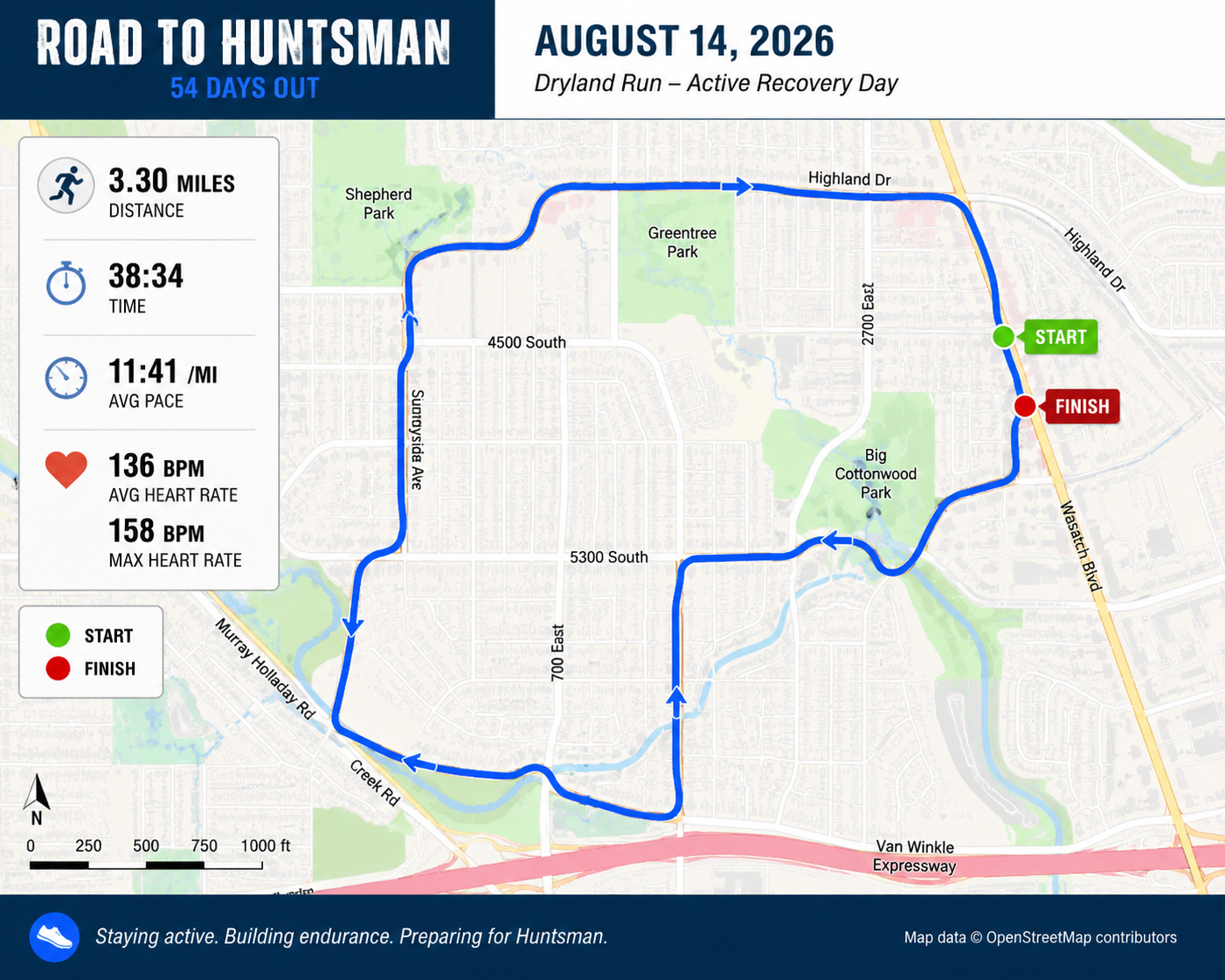
    So today’s Road to Huntsman workout was a 3.3-mile run.

    Road to Huntsman August 14 dryland run route map
    August 14 dryland run — 3.30 miles of active recovery away from the pool.

    August 14 Workout Summary

    Metric Result
    ActivityRunning
    Distance3.30 miles
    Time38:34
    Average Pace11:41 /mile
    Distance5.32 km
    Average Pace7:15 /km
    Average Heart Rate136 bpm
    Maximum Heart Rate158 bpm

    Run Structure

    The run wasn’t intended to be a race or a running benchmark. The objective was simply to stay aerobically active while taking swimming out of the equation for a day.

    Segment Time Pace
    Mile 111:3011:30 /mile
    Mile 210:4310:43 /mile
    Mile 312:0312:03 /mile
    Final 0.30 mile4:18Approximately 14:11 /mile
    Total38:3411:41 /mile

    The second mile was the quickest at 10:43. Pace then backed off during the second half, which was completely acceptable for the purpose of today’s workout. This wasn’t supposed to become another hard training test.

    Why Run Instead of Swim?

    One of the challenges in preparing for four swimming events is remembering that more swimming isn’t automatically better swimming.

    I’ve been deliberately holding the swimming volume down this week following two extremely long weekend workouts. The last three pool sessions were each limited to approximately 2,500 meters, but even reduced-volume swimming still repeatedly loads the shoulders, chest, back and the other muscles involved in freestyle and breaststroke.

    Today removed that repetitive swimming load completely.

    Running allowed me to continue working aerobically while giving the upper body a day away from thousands of additional swimming strokes.

    Recovery Doesn’t Always Mean Rest

    This week has reinforced an important distinction in my training plan: recovery and inactivity aren’t necessarily the same thing.

    There are certainly times when complete rest is appropriate. But today I wanted to remain active while changing the physical stress.

    A 38-minute run accomplished that.

    My cardiovascular system still had work to do. My legs had work to do. But my shoulders didn’t have to complete another freestyle pull or breaststroke recovery.

    That’s an important distinction as the training becomes increasingly specific over the next several weeks.

    The Recovery Week So Far

    This week wasn’t intended to produce another enormous training load. The goal has been to absorb the work from the previous weekends while continuing to train with purpose.

    Date Primary Focus Volume
    August 11Recovery + 200M breaststroke focus2,500 m swim
    August 12Recovery + 100M breaststroke focus2,500 m swim
    August 13Continuous mixed-stroke endurance2,500 m swim
    August 14Dryland / active recovery3.30-mile run

    The pattern is deliberate. Training hasn’t stopped, but the type and amount of stress have changed.

    No Swimming Benchmarks Today

    Obviously, today’s run doesn’t change any of my Huntsman swimming benchmarks.

    Event Current Training Best 2025 Bronze 2025 4th
    1500M Freestyle24:21.2625:04.7525:06.88
    800M Freestyle12:40.2512:32.8512:56.76
    200M Breaststroke3:31.713:39.924:00.27
    100M Breaststroke1:42.551:32.971:37.95

    But that doesn’t mean today was unrelated to those numbers.

    The purpose of recovery is to make the next quality workout better. A day away from the pool can contribute to an October swimming performance just as surely as another interval set can.

    54 Days to Go

    There are now 54 days until my first race at Huntsman.

    At this stage, one of the challenges is resisting the temptation to treat every day as an opportunity to add more meters.

    The fitness doesn’t improve during the workout itself. The workout provides the stimulus. The improvement comes when the body has an opportunity to recover and adapt to that stimulus.

    Today’s run was part of creating that opportunity.

    I stayed active. I got more than 38 minutes of aerobic work. I covered 3.3 miles. But for an entire day, my shoulders and swimming muscles didn’t have to do their normal job.

    Tomorrow they’ll be one day fresher because of it.

    Today’s headline: Sometimes the best swimming workout is not swimming. A 3.3-mile run kept the Road to Huntsman moving forward while giving the muscles that have been doing thousands of meters in the pool a needed day away from swimming.