Dew Point and Condensation
Dew-point temperature identifies the temperature at which moist air becomes saturated when it is cooled without changing its moisture content or pressure. If an exposed surface is colder than the surrounding air’s dew point, water vapor can condense on that surface.
This lesson follows air through the cooling and condensation sequence and shows how technicians use air dew point, surface temperature, insulation condition, airflow, and equipment operation to diagnose unwanted moisture.
What You Will Learn
Define dew-point temperature in practical HVAC/R terms.
Describe what changes as air is cooled to and below its dew point.
Compare surface temperature with air dew point to predict condensation.
Identify common HVAC/R surfaces where condensation occurs.
Distinguish normal cooling-coil condensate from unwanted sweating or leakage.
Follow a systematic condensation-troubleshooting process.
The Temperature at Which Air Reaches Saturation
Dew-point temperature is the temperature at which a sample of moist air becomes saturated when it is cooled at the same pressure without first adding or removing water vapor. At the dew point, the air has 100% relative humidity for that moisture condition.
Dew point is directly related to the amount of water vapor present. Air with a higher humidity ratio has a higher dew point at the same pressure. Heating the air without changing its moisture content changes relative humidity but does not significantly change dew point.
How Warm or Cool Is the Air?
Dry-bulb temperature can change through sensible heating or cooling without changing the air’s moisture content.
When Will Saturation Occur?
Dew point identifies the saturation temperature for the air’s present water-vapor content and pressure.
A higher dew point generally means more water vapor is present. This makes dew point useful for comparing moisture conditions even when the dry-bulb temperatures are different.
From Unsaturated Air to Condensation
When unsaturated air is cooled without removing moisture, its dry-bulb temperature falls and its relative humidity rises. The humidity ratio and dew-point temperature remain essentially unchanged until the air reaches saturation.
At the dew point, the air is saturated. If cooling continues while the air contacts a colder surface, some water vapor changes to liquid water. The humidity ratio of the remaining air decreases as condensate leaves the airstream.
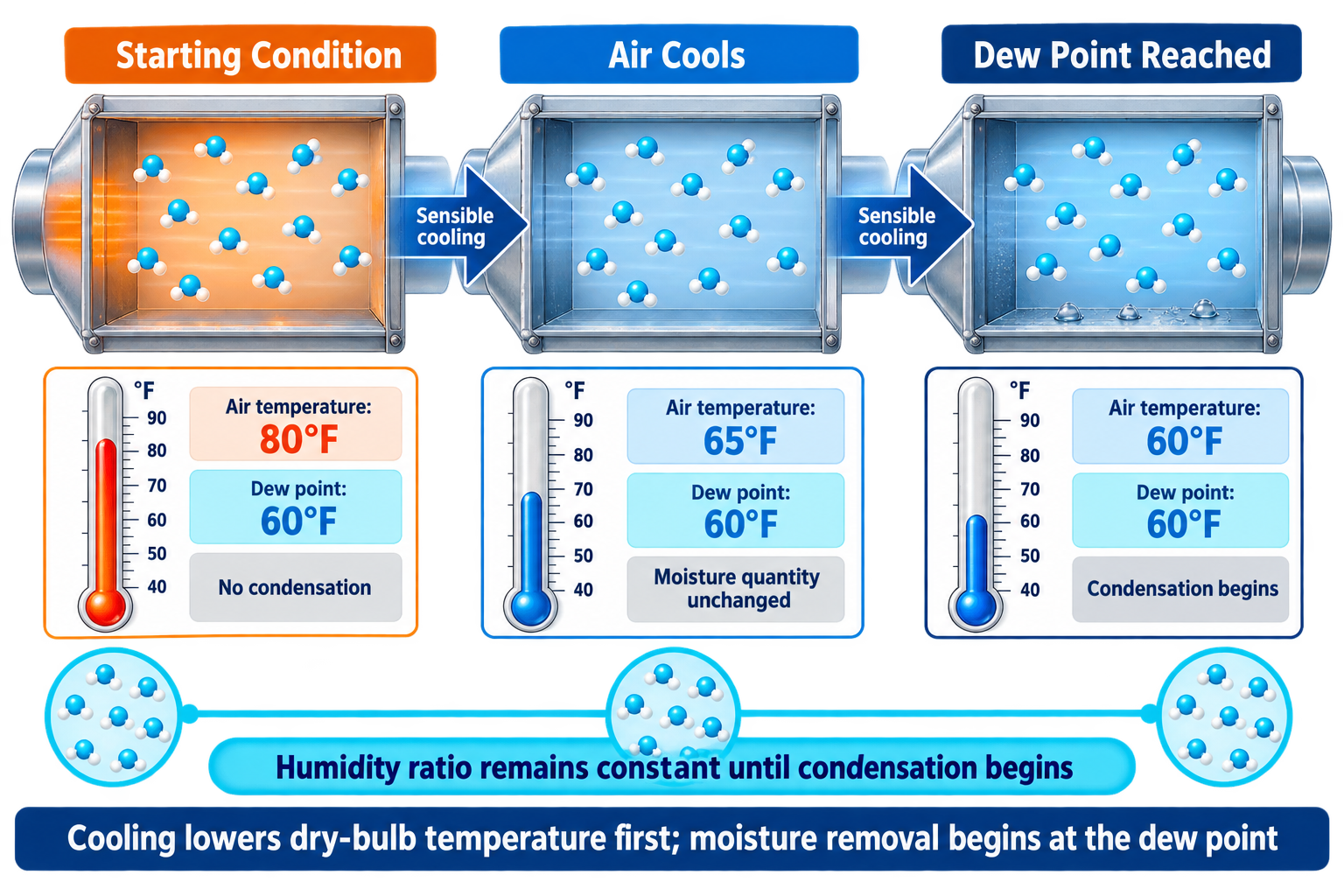
1. Above Dew Point
The air is unsaturated. Cooling raises relative humidity, but no condensate forms from the bulk airstream.
2. At Dew Point
The air reaches saturation at 100% relative humidity for its present moisture content and pressure.
3. Below Dew Point
Water vapor condenses when the air contacts a surface colder than its dew point, and the remaining air loses moisture.
A room sensor may show less than 100% relative humidity while condensation forms on a colder surface. The thin layer of air next to that surface is cooled to saturation even though the room air as a whole remains unsaturated.
Compare the Surface with the Air’s Dew Point
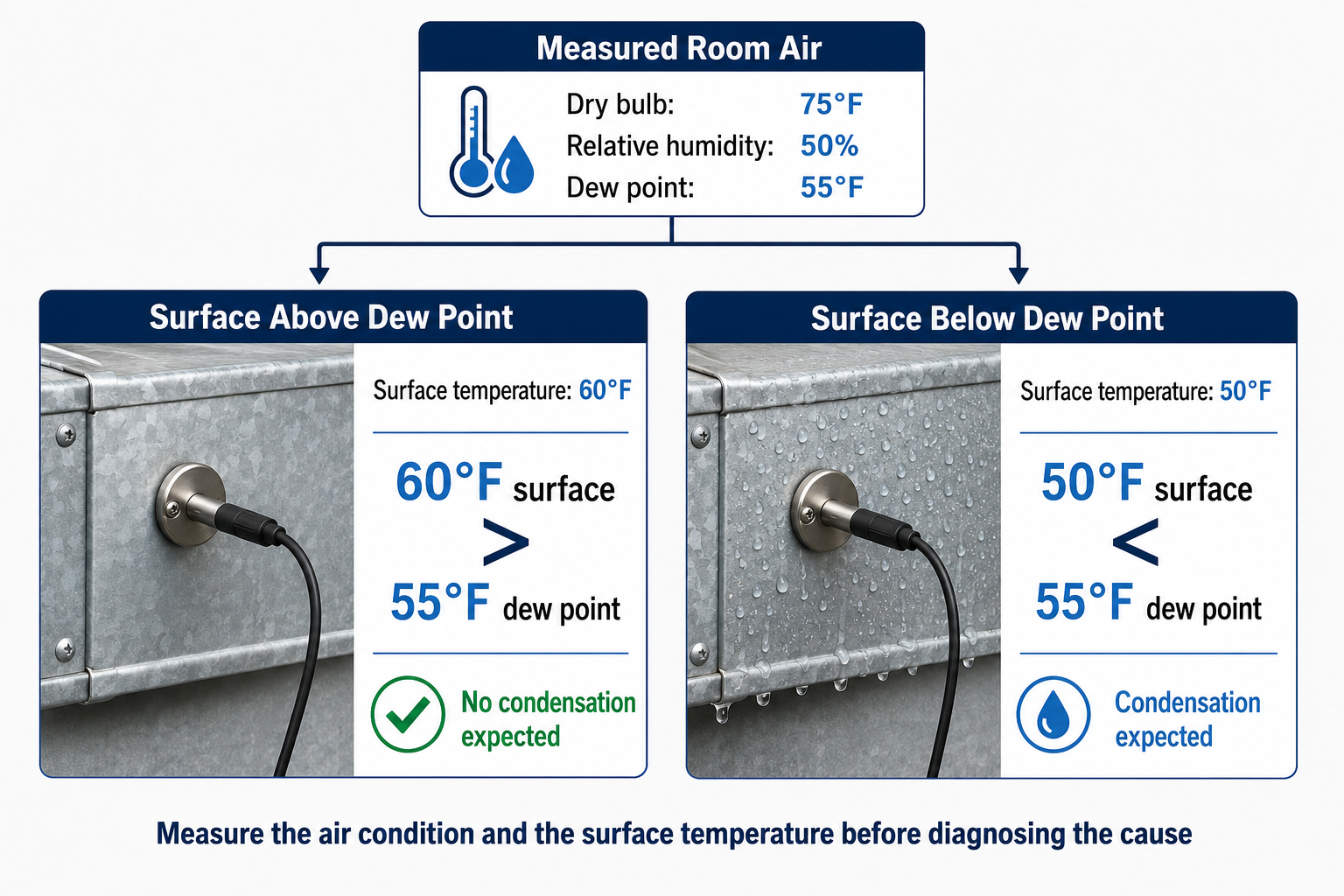
The most useful condensation comparison is simple: measure or determine the dew point of the air contacting the surface, then measure the surface temperature. The measurements must represent the same location and operating period.
Condensation Is Not Expected
If the surface remains warmer than the surrounding air’s dew point, the adjacent air should not reach saturation at that surface.
Condensation Can Occur
If the surface is at or below the dew point, air next to it can become saturated and water can condense.
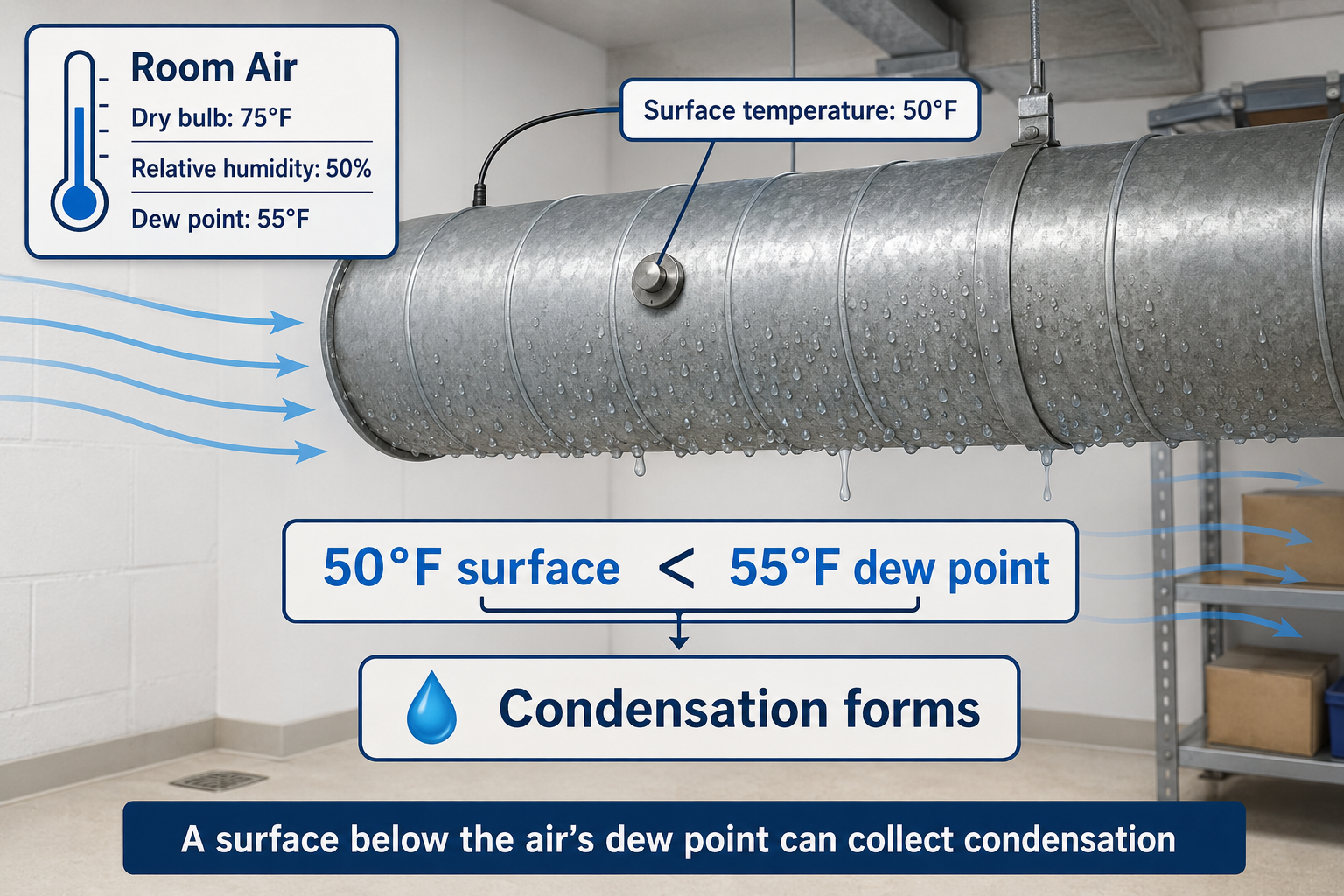
Example: If the surrounding air has a dew point of 58°F and the surface is 64°F, condensation is not expected. If the same surface falls to 52°F, it is below the dew point and condensation can occur.
Condensation on a Cooling Coil Is Often Intended
An air-conditioning evaporator is commonly operated with part of its surface below the entering air’s dew point. Water vapor condenses on the coil, drains into the condensate pan, and leaves through the drain system. This is the normal dehumidification process of a cooling coil.
The presence of water on the coil does not by itself indicate a fault. The technician must determine whether the water forms where intended, reaches the drain pan, and is removed without overflowing, leaking, being carried into the duct, or wetting surrounding materials.
Expected Condensation
Water forms on the cold evaporator surface, collects in the designed pan, and flows through an open, correctly trapped and pitched drain system.
Drainage Problem
Water forms normally but overflows or leaks because of a blocked drain, damaged pan, incorrect slope, trap problem, or installation defect.
Air-Carryover Problem
High air velocity, poor coil condition, incorrect pan arrangement, or airflow disturbance can carry droplets beyond the intended collection area.
Water near an air handler may be coil condensate, drain leakage, sweating on an exterior surface, plumbing leakage, rain entry, melted ice, or another source. Do not assume every nearby puddle came from the condensate drain.
Where HVAC/R Condensation Often Appears
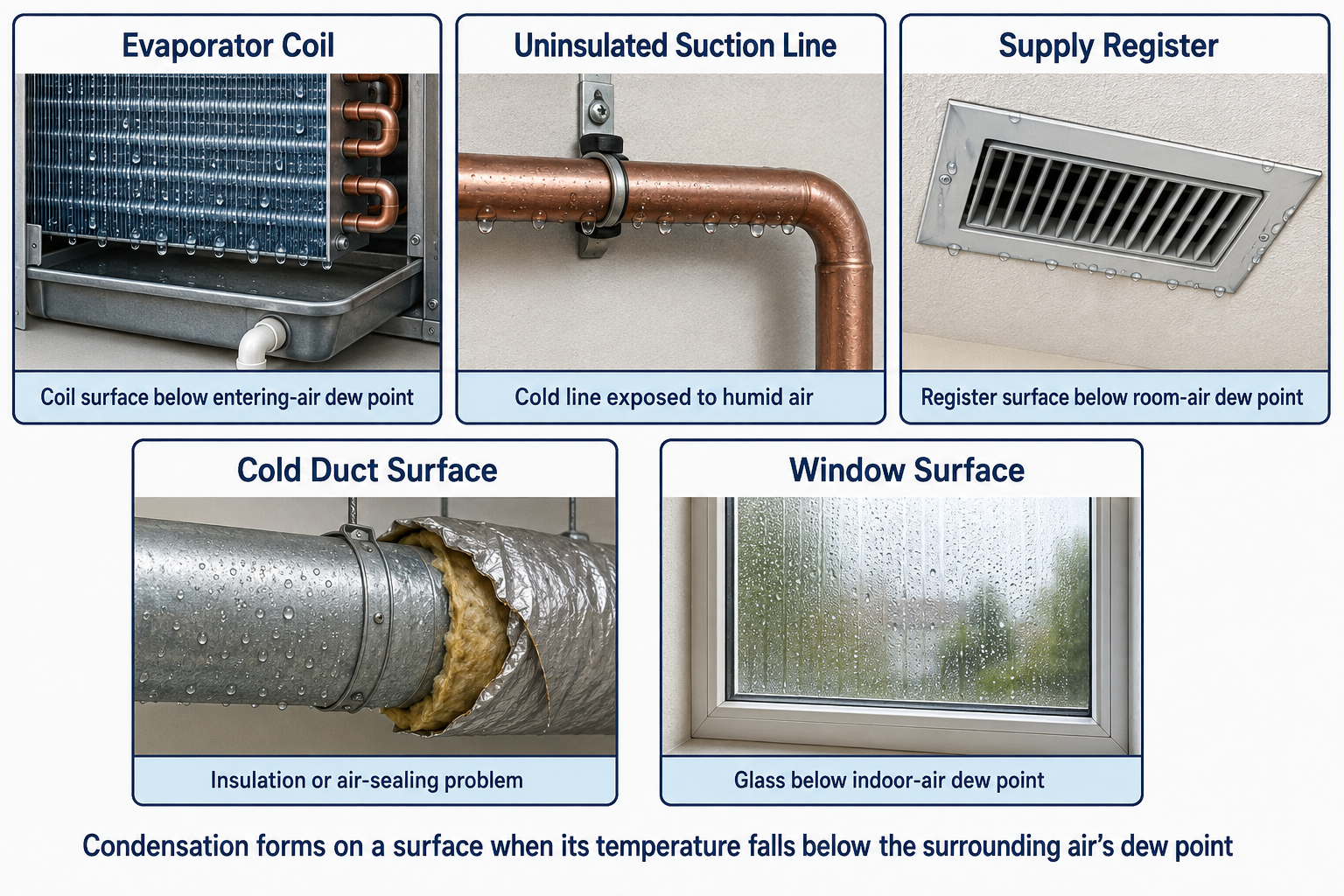
Cooling Coil and Drain Pan
Condensation is expected on the coil, but water must be collected and drained correctly.
Suction Line
Missing, damaged, compressed, or poorly sealed insulation can allow the outer surface to fall below the surrounding air’s dew point.
Supply Duct and Plenum
Insulation defects, air leakage, vapor-retarder damage, or unusually high surrounding dew point can cause exterior sweating.
Supply Diffuser
A cold diffuser exposed to humid room or ceiling-plenum air may drop below the local dew point.
Air-Handler Cabinet
Cabinet insulation gaps, panel leakage, poor seals, or high surrounding humidity can produce condensation on cold exterior surfaces.
Building Surfaces
Cold glass, wall areas, floors, pipes, and thermal bridges may condense moisture when humid air reaches them.
Insulation Raises the Exposed Surface Temperature
Insulation reduces heat transfer between a cold component and the surrounding air. Correctly installed insulation keeps the outer surface warmer and helps maintain it above the surrounding air’s dew point.
The vapor retarder on cold insulation also limits movement of water vapor toward the colder inner surface. Open seams, missing sections, wet insulation, compressed insulation, and damaged vapor retarders can create local cold spots and condensation.
Condensation may also result from unusually high indoor or outdoor-air moisture, duct leakage, negative building pressure, equipment or airflow problems, poor drainage, or air entering from an uncontrolled space. Diagnose the cause before selecting a repair.
Use Dew Point to Troubleshoot Condensation
1. Identify the Water Source
Determine exactly where moisture first appears and whether it is condensation, drain water, a plumbing leak, rain entry, or melted frost or ice.
2. Measure Local Air
Measure the temperature and humidity of the air contacting the surface and determine its dew point after the instrument stabilizes.
3. Measure the Surface
Measure the temperature where moisture forms, using an appropriate surface probe or properly applied instrument.
4. Compare the Values
If surface temperature is at or below local air dew point, the conditions support condensation at that location.
5. Find Why the Surface Is Cold or the Dew Point Is High
Inspect insulation, vapor retarders, seals, duct leakage, airflow, ventilation, infiltration, building pressure, equipment operation, and moisture sources.
6. Correct and Verify
Repair the cause, operate the system under representative conditions, repeat the measurements, and confirm that drainage and surrounding materials remain dry.
Room air, ceiling-plenum air, outdoor air, and air leaking from a duct can have different dew points. A measurement taken far from the wet surface may not represent the air responsible for the condensation.
Avoid These Condensation Errors
“Condensation requires 100% room RH.”
The room can remain below 100% relative humidity while air next to a colder surface reaches saturation and condenses.
“Relative humidity and dew point are the same.”
Relative humidity describes closeness to saturation at the current temperature. Dew point identifies the temperature at which saturation occurs for the present moisture content and pressure.
“Heating the air changes its dew point.”
Sensible heating alone lowers relative humidity but leaves humidity ratio and dew point essentially unchanged.
“Water near the unit proves the drain is blocked.”
A blocked drain is one possibility, but the water may come from cabinet sweating, refrigerant-line condensation, carryover, a damaged pan, icing, plumbing, or rain.
“All coil condensation is a problem.”
Condensation on a cooling coil is the intended method of dehumidification when the water is properly collected and drained.
“Insulation always eliminates condensation.”
Insulation helps keep exposed surfaces above dew point, but high moisture, air leakage, damaged vapor retarders, wet insulation, and equipment problems must also be addressed.
Can You Use Dew Point to Explain Condensation?
- What is dew-point temperature?
- What relative humidity exists when air reaches its dew point?
- What happens to relative humidity as unsaturated air is cooled without moisture removal?
- What happens when air is cooled below its dew point at a cold surface?
- If air dew point is 60°F and surface temperature is 67°F, is condensation expected?
- If air dew point is 60°F and surface temperature is 54°F, can condensation occur?
- Why can condensation form when room relative humidity is below 100%?
- Why is condensation on an operating cooling coil often normal?
- Name four HVAC/R locations where unwanted condensation commonly appears.
- How does insulation help prevent exterior sweating?
- Why must dew point be measured in the air that actually contacts the wet surface?
- What should be verified after a condensation repair?
What You Should Have Learned
Dew point is the temperature at which moist air becomes saturated when cooled at the same pressure without first changing its moisture content.
Cooling unsaturated air raises its relative humidity until the air reaches 100% relative humidity at the dew point.
Continued cooling below the dew point causes water vapor to condense and lowers the humidity ratio of the remaining air.
Condensation can occur when a surface is at or below the dew point of the air contacting it.
Room relative humidity does not have to reach 100% for condensation to form on a colder local surface.
Cooling-coil condensation is normal when the water is collected and drained as designed.
Insulation and its vapor retarder help keep exposed surfaces warmer and limit water-vapor movement toward cold components.
Successful diagnosis requires identifying the water source, measuring local dew point and surface temperature, finding the cause, and verifying the repair.