Relative Humidity, Humidity Ratio, and Saturation
Relative humidity and humidity ratio both describe moisture in air, but they do not describe it in the same way. Relative humidity compares the vapor present with the amount the air could support at its current temperature, while humidity ratio compares the mass of water vapor with the mass of dry air.
This lesson explains why relative humidity changes when temperature changes, how humidity ratio represents moisture quantity, how grains are used in HVAC/R work, and what happens when air reaches saturation.
What You Will Learn
Define relative humidity in practical terms.
Explain why relative humidity changes when air temperature changes.
Define humidity ratio as water-vapor mass compared with dry-air mass.
Convert between pounds of water and grains of water.
Describe saturation and the conditions that lead to condensation.
Select the moisture property that best answers a service question.
Relative Humidity Is a Temperature-Dependent Comparison
Relative humidity compares the actual water-vapor pressure in the air with the saturation water-vapor pressure at the same dry-bulb temperature. In simpler field language, it describes how close the air is to saturation at its present temperature.
A reading of 50% relative humidity does not mean that half of the air is water. It means the actual vapor pressure is one-half of the saturation vapor pressure for that temperature and pressure condition.
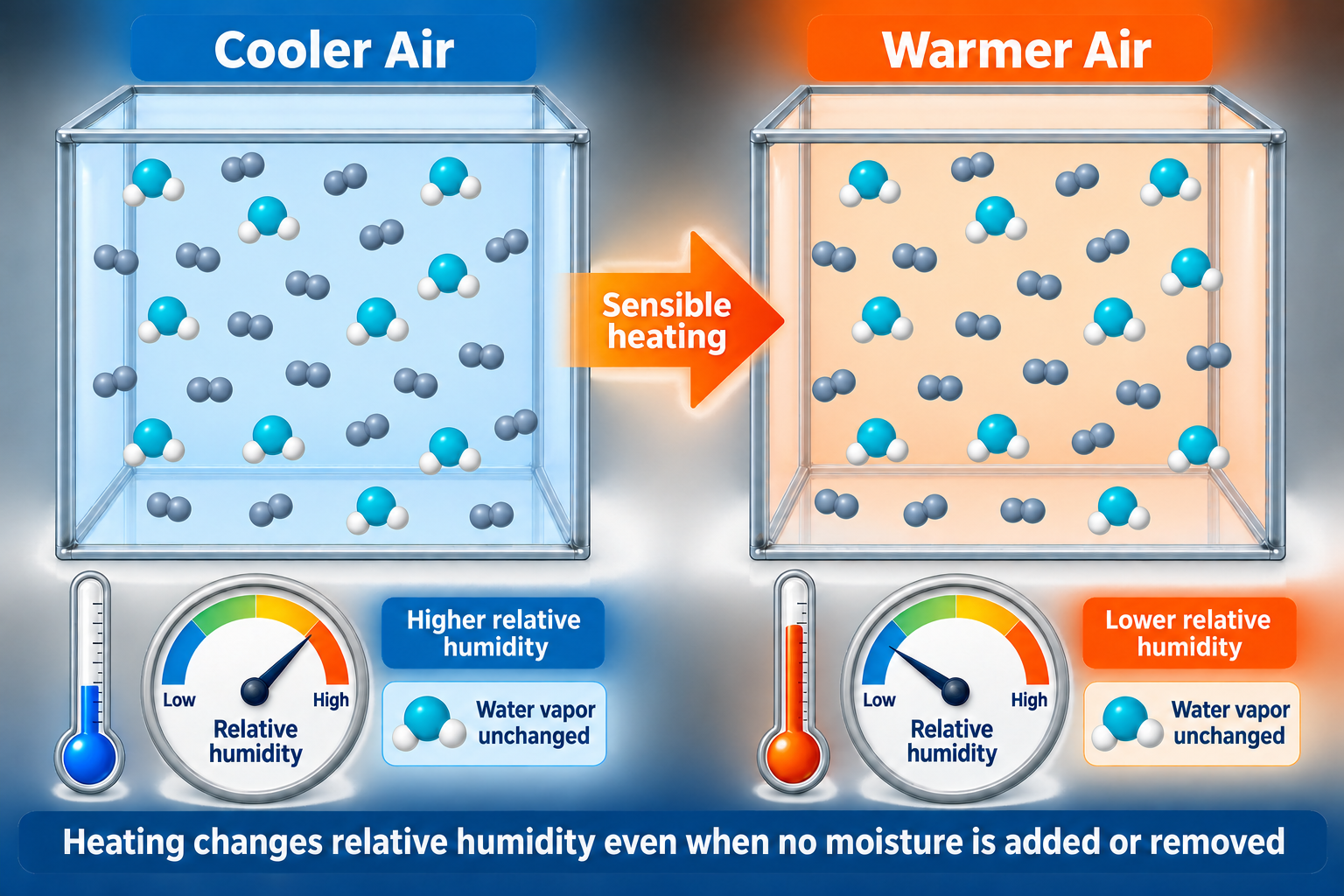
Warm air has a higher saturation vapor pressure than cool air. If air is heated without adding moisture, its relative humidity decreases. If air is cooled without removing moisture, its relative humidity increases.
Relative Humidity Can Change Without a Moisture Change
Consider a sample of air sealed from moisture sources and moisture removal. Heating the sample does not add water vapor, but it raises the saturation vapor pressure. The actual vapor pressure remains essentially unchanged while the value it is compared with becomes larger, so relative humidity falls.
Cooling the same sample lowers the saturation vapor pressure. The actual vapor pressure remains essentially unchanged until saturation is reached, so relative humidity rises. If cooling continues beyond saturation, some water vapor condenses and the moisture quantity begins to decrease.
Relative Humidity Decreases
When air is heated with no moisture added or removed, dry-bulb temperature rises, relative humidity falls, and humidity ratio remains constant.
Relative Humidity Increases
When air is cooled without condensation, dry-bulb temperature falls, relative humidity rises, and humidity ratio remains constant.
A heater can lower relative humidity simply by raising air temperature. To determine whether water vapor was actually removed, compare humidity ratio or another temperature-independent moisture indicator before and after the process.
Humidity Ratio Describes Moisture Quantity by Mass
Humidity ratio is the mass of water vapor divided by the mass of dry air in the same sample. It is commonly represented by the letter W and may be stated as pounds of water per pound of dry air, grains of water per pound of dry air, or grams of water per kilogram of dry air.
Because humidity ratio compares masses, heating or cooling air without adding water vapor, removing water vapor, or causing condensation does not change the humidity ratio. This makes it useful when evaluating humidification, dehumidification, and moisture removal across equipment.
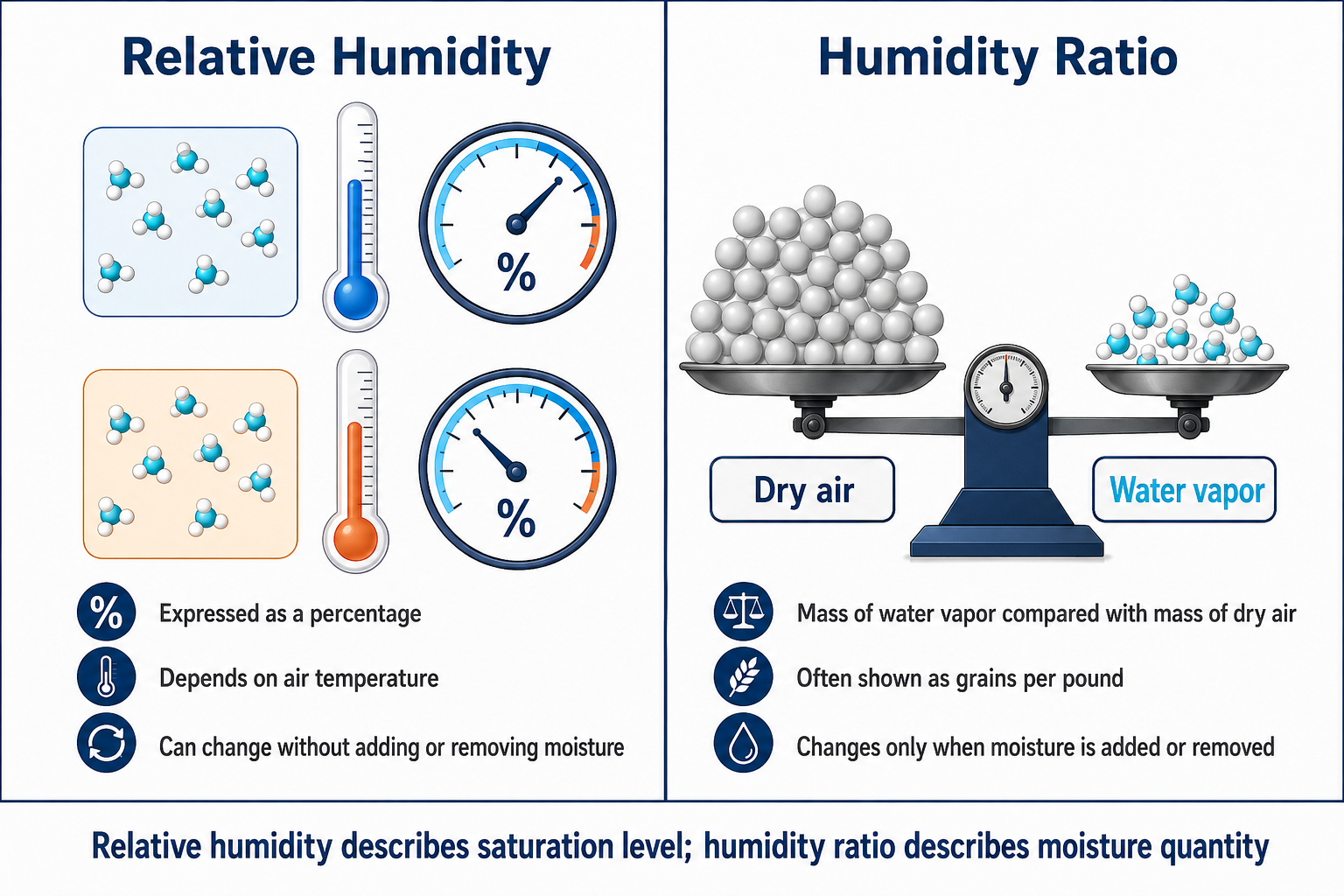
How Close Is the Air to Saturation?
Reported as a percentage and strongly affected by dry-bulb temperature.
How Much Vapor Is Present per Mass of Dry Air?
Reported as a mass ratio and unchanged by sensible heating or cooling alone.
Terminology: Humidity ratio is sometimes casually called absolute humidity, but the terms are not identical in precise psychrometric work. Use humidity ratio when the intended value is water-vapor mass per unit mass of dry air.
A Smaller Unit Makes Moisture Differences Easier to Read
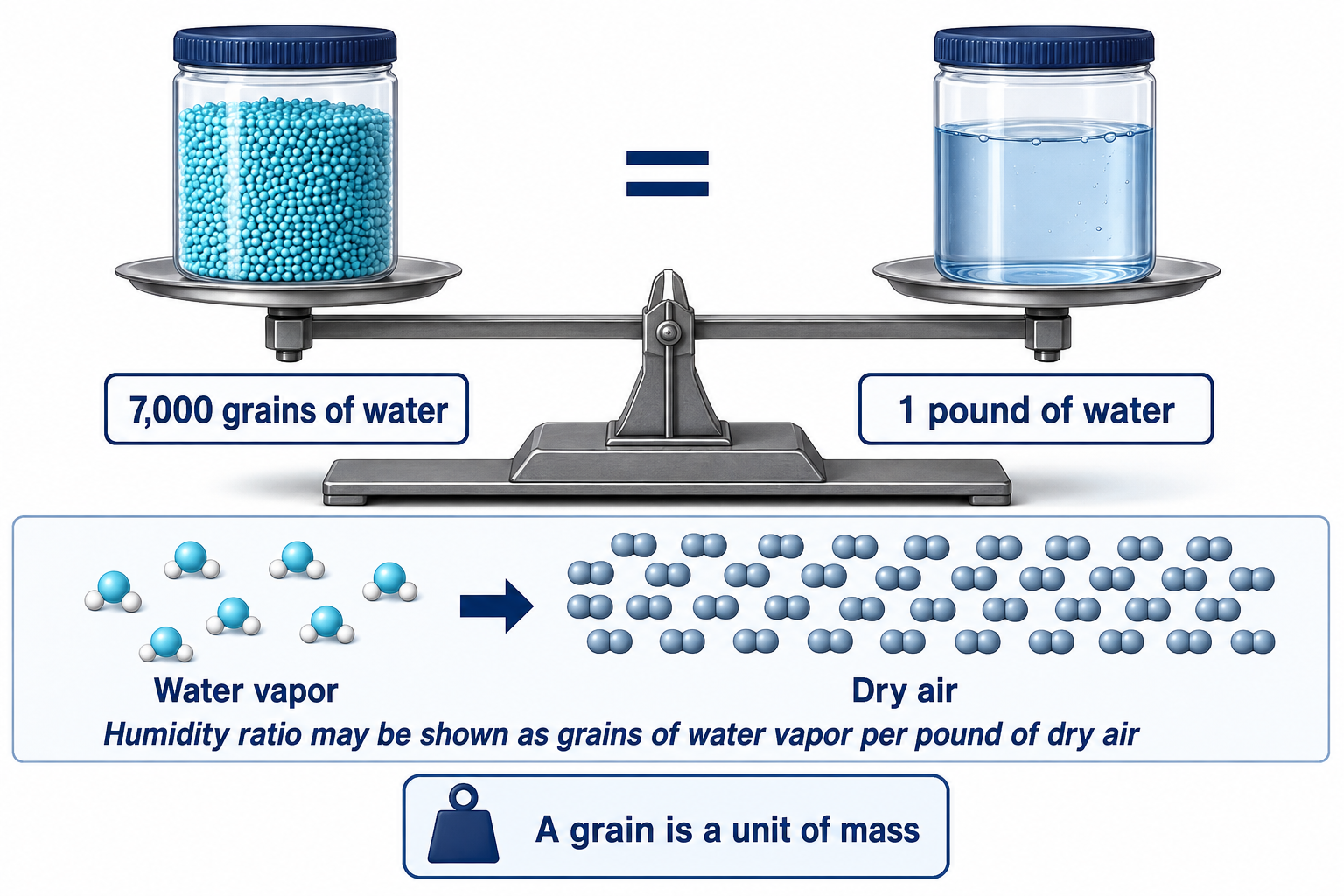
One pound contains 7,000 grains. HVAC/R technicians often express humidity ratio as grains of water vapor per pound of dry air because normal air-conditioning moisture quantities are small when written as pounds of water per pound of dry air.
1 pound of water = 7,000 grains of water
For example, a humidity ratio of 0.010 pound of water per pound of dry air is equal to 70 grains of water per pound of dry air. Multiply pounds of water per pound of dry air by 7,000 to obtain grains per pound.
Pounds to Grains
Multiply pounds of water per pound of dry air by 7,000. Example: 0.008 × 7,000 = 56 grains per pound.
Grains to Pounds
Divide grains of water per pound of dry air by 7,000. Example: 84 ÷ 7,000 = 0.012 pound per pound.
Moisture Difference
Subtract leaving-air grains from entering-air grains to identify the moisture-content reduction across dehumidifying equipment.
A value such as 70 grains is incomplete by itself. In psychrometric work, state it as 70 grains of water vapor per pound of dry air.
Saturated Air Is at Its Moisture Limit for That Condition
Saturation is the condition in which moist air is in equilibrium with liquid water or ice at the same temperature and pressure. On a psychrometric chart, saturated air lies on the 100% relative-humidity curve.
The maximum humidity ratio at saturation depends on temperature and pressure. At ordinary HVAC/R pressures, warmer saturated air has a higher humidity ratio than cooler saturated air.
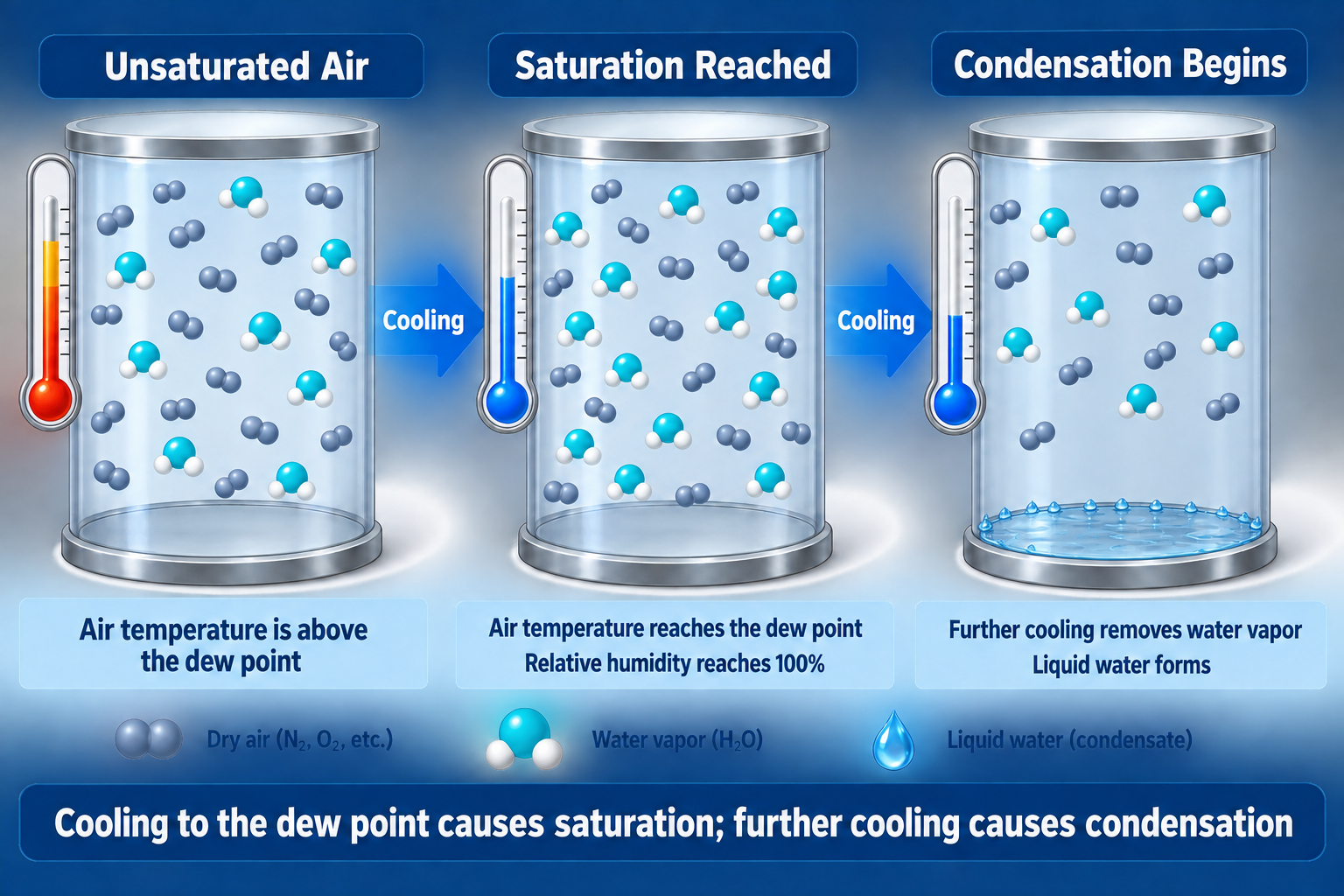
The common phrase “warm air holds more moisture” can be useful as a shortcut, but saturation is governed by water-vapor pressure, temperature, and total pressure. Heating air does not automatically add water vapor, and cooling air does not remove water vapor until condensation or another moisture-removal process occurs.
What Changes as Air Is Cooled?
1. Temperature Falls
Sensible cooling lowers dry-bulb temperature while the humidity ratio remains constant.
2. Relative Humidity Rises
The saturation vapor pressure falls as the air cools, so the unchanged actual vapor pressure becomes a larger percentage of the saturation value.
3. Saturation Is Reached
At the dew-point temperature, the air reaches 100% relative humidity for that moisture content and pressure.
4. Condensation Begins
If cooling continues below the dew point, some water vapor changes to liquid and the humidity ratio of the remaining air decreases.
Next lesson: Dew point and condensation are introduced here only to complete the saturation sequence. Lesson 4 examines those concepts in detail and applies them to coils, ducts, piping, diffusers, and building surfaces.
Match the Measurement to the Service Question
Comfort and Indoor Conditions
Relative humidity is commonly used with temperature when describing the indoor environment, but the complete comfort investigation must also consider air movement and other factors.
Moisture Removal
Humidity ratio or grains per pound helps determine whether the leaving air contains less water vapor per pound of dry air than the entering air.
Condensation Risk
Dew point, introduced fully in Lesson 4, is compared with surface temperature to determine whether condensation is expected.
Heating Without Humidification
Expect relative humidity to fall while humidity ratio remains nearly unchanged if no moisture is added or removed.
Cooling Before Condensation
Expect relative humidity to rise while humidity ratio remains unchanged until the air reaches its dew point.
Cooling with Dehumidification
When water condenses on a cooling coil and drains away, both the air temperature and humidity ratio can decrease.
Avoid These Moisture-Measurement Errors
“50% RH means the air is 50% water.”
Relative humidity is a vapor-pressure comparison with saturation at the same temperature, not the percentage of the air’s mass or volume that is water.
“Lower RH always means moisture was removed.”
Heating air can lower relative humidity while leaving the humidity ratio unchanged.
“Relative humidity and humidity ratio are interchangeable.”
Relative humidity changes with temperature, while humidity ratio describes water-vapor mass per mass of dry air.
“Cooling always removes moisture.”
Cooling alone does not lower humidity ratio until air reaches saturation at a cold surface and water vapor condenses or another removal process occurs.
“100% RH means the air is liquid water.”
At 100% relative humidity, the moist air is saturated. Liquid water forms when conditions move beyond saturation, such as continued cooling below the dew point.
“Grains per pound is a concentration by volume.”
In this use, grains per pound expresses the mass of water vapor for each pound of dry air.
Can You Distinguish Relative Humidity from Humidity Ratio?
- What does relative humidity compare?
- Why can relative humidity change when no water vapor is added or removed?
- What happens to relative humidity when air is heated without adding moisture?
- What happens to relative humidity when air is cooled without condensation?
- How is humidity ratio defined?
- Why does sensible heating alone not change humidity ratio?
- How many grains are in one pound?
- Convert 0.009 pound of water per pound of dry air to grains per pound.
- Convert 63 grains per pound to pounds of water per pound of dry air.
- What does saturation mean?
- What happens if saturated air continues to cool?
- Which property is more useful for comparing actual moisture content before and after a dehumidifying coil?
What You Should Have Learned
Relative humidity describes how the actual water-vapor pressure compares with saturation vapor pressure at the same temperature.
Heating air without changing moisture lowers relative humidity, while cooling it without condensation raises relative humidity.
Humidity ratio is the mass of water vapor divided by the mass of dry air.
Sensible heating or cooling does not change humidity ratio when no water vapor is added, removed, or condensed.
One pound contains 7,000 grains, and HVAC/R moisture content is often expressed as grains of water vapor per pound of dry air.
Saturated air is at 100% relative humidity for its temperature and pressure condition.
Continued cooling below the dew point causes water vapor to condense and lowers the humidity ratio of the remaining air.
Relative humidity is useful for describing closeness to saturation, while humidity ratio is useful for tracking moisture added to or removed from an airstream.