HFO Refrigerants: R-1234yf and R-1234ze(E)
Hydrofluoroolefin refrigerants, commonly called HFOs, represent another important stage in refrigerant development. Like HFC refrigerants, HFOs contain hydrogen, fluorine, and carbon and contain no chlorine. However, their molecular structure allows many HFO refrigerants to remain in the atmosphere for a much shorter period, resulting in very low global warming potential.
Two important HFO refrigerants are R-1234yf and R-1234ze(E). Both are classified A2L and therefore require lower-flammability service practices. R-1234yf is particularly well known for motor-vehicle air conditioning and as a component of modern refrigerant blends, while R-1234ze(E) is used in applications including chillers and other refrigeration equipment.
What You Will Learn
After completing this lesson, you should be able to:
Explain HFO Refrigerants
Recognize HFOs as fluorinated refrigerants with molecular characteristics that contribute to very low global warming potential.
Identify R-1234yf
Recognize R-1234yf as a single-component A2L HFO refrigerant used in motor-vehicle air conditioning and several stationary applications and blends.
Identify R-1234ze(E)
Recognize R-1234ze(E) as a single-component A2L HFO refrigerant used in chillers and other refrigeration applications.
Compare HFC and HFO Refrigerants
Explain why HFC and HFO refrigerants can both have zero ozone depletion potential while differing greatly in atmospheric lifetime and global warming potential.
Apply A2L Safety Practices
Recognize the ventilation, ignition-source control, leak detection, recovery, and service-tool requirements associated with HFO A2L refrigerants.
Recognize Their Role in Refrigerant Blends
Explain why HFO refrigerants are frequently combined with HFC refrigerants to produce lower-GWP blends with useful operating characteristics.
What Is an HFO?
HFO stands for hydrofluoroolefin. HFO refrigerants contain hydrogen, fluorine, and carbon but do not contain chlorine.
The term olefin refers to the presence of a carbon-carbon double bond in the molecule. This unsaturated molecular structure distinguishes HFOs from saturated HFC refrigerants and allows many HFO compounds to break down much more rapidly in the lower atmosphere.
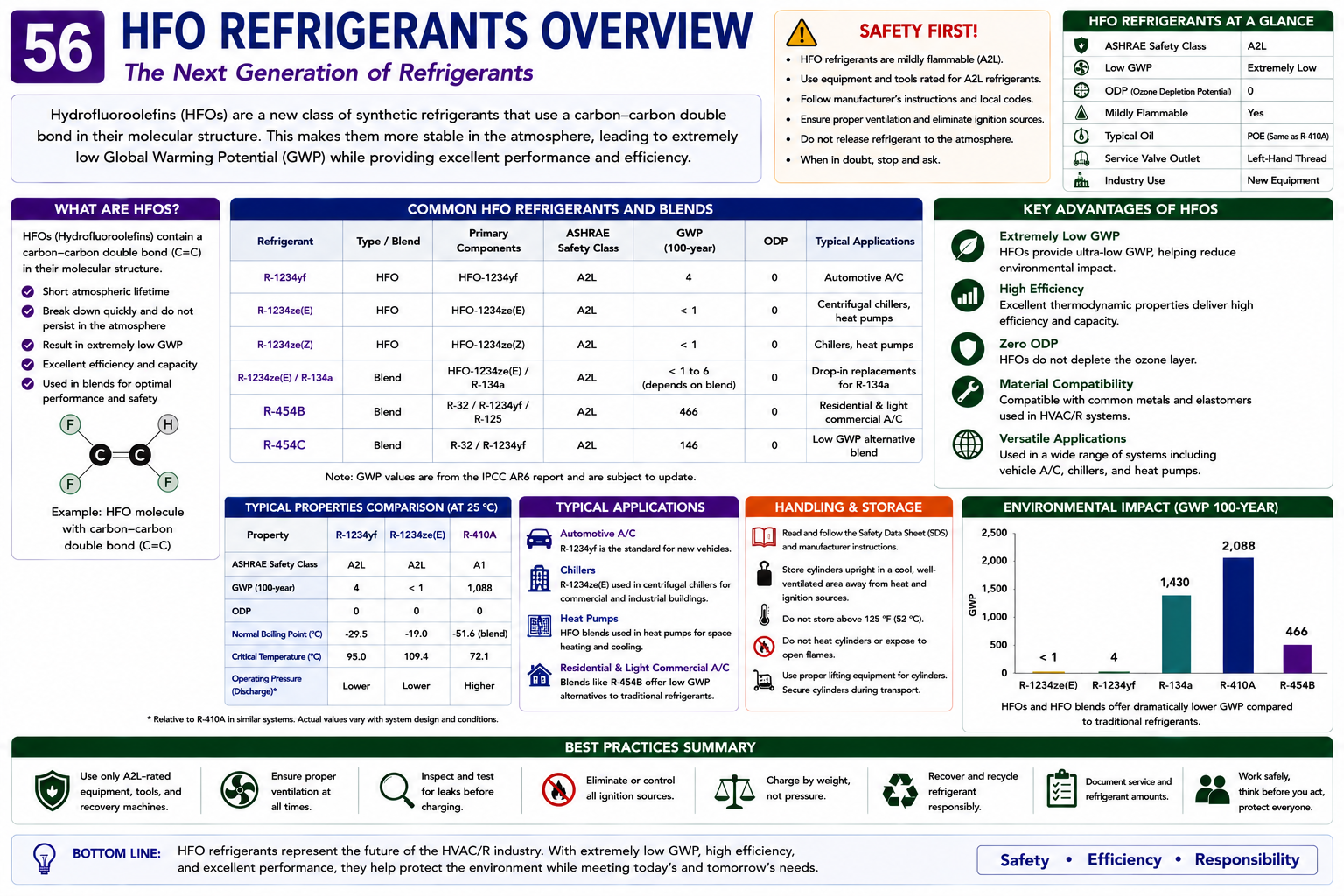
HFOs are fluorinated refrigerants, but fluorinated does not automatically mean high GWP. Molecular structure strongly influences how long a refrigerant remains in the atmosphere.
Atmospheric Lifetime Matters
Global warming potential depends partly on how strongly a gas absorbs infrared radiation and partly on how long it remains in the atmosphere.
Many traditional HFC refrigerants are chemically stable and can remain in the atmosphere for years or decades. HFO molecules containing a carbon-carbon double bond are generally more reactive in the lower atmosphere and break down considerably faster.
Traditional HFC
Often comparatively stable in the atmosphere, which can contribute to a relatively high GWP.
HFO
Generally breaks down much more rapidly in the lower atmosphere, helping produce a very low GWP.
HFOs have zero ozone depletion potential because they contain no chlorine or bromine. Their very low GWP results from a different characteristic: their comparatively short atmospheric lifetime.
Why HFO Names Look Different
Refrigerant designations such as R-1234yf and R-1234ze(E) contain more characters than familiar refrigerant numbers such as R-22 or R-32. The additional numbers and letters distinguish molecular structures and isomers.
For field service, the most important rule is simple: use the complete refrigerant designation. Do not shorten R-1234yf to “1234” or assume that all refrigerants beginning with 1234 have the same properties.
R-1234yf and R-1234ze(E) are different refrigerants. The letters are part of the refrigerant designation.
Refrigerant Identification
Refrigerant numbering and identification were introduced in Refrigerant Numbers, Identification, and Safety Classifications.
R-1234yf
R-1234yf is a single-component HFO refrigerant with an ASHRAE A2L safety classification. It has zero ozone depletion potential and extremely low global warming potential compared with refrigerants such as R-134a and R-410A.
R-1234yf became particularly well known as a lower-GWP replacement for R-134a in newly manufactured motor-vehicle air-conditioning systems. It is also used in stationary refrigeration applications and as a component of several modern refrigerant blends.
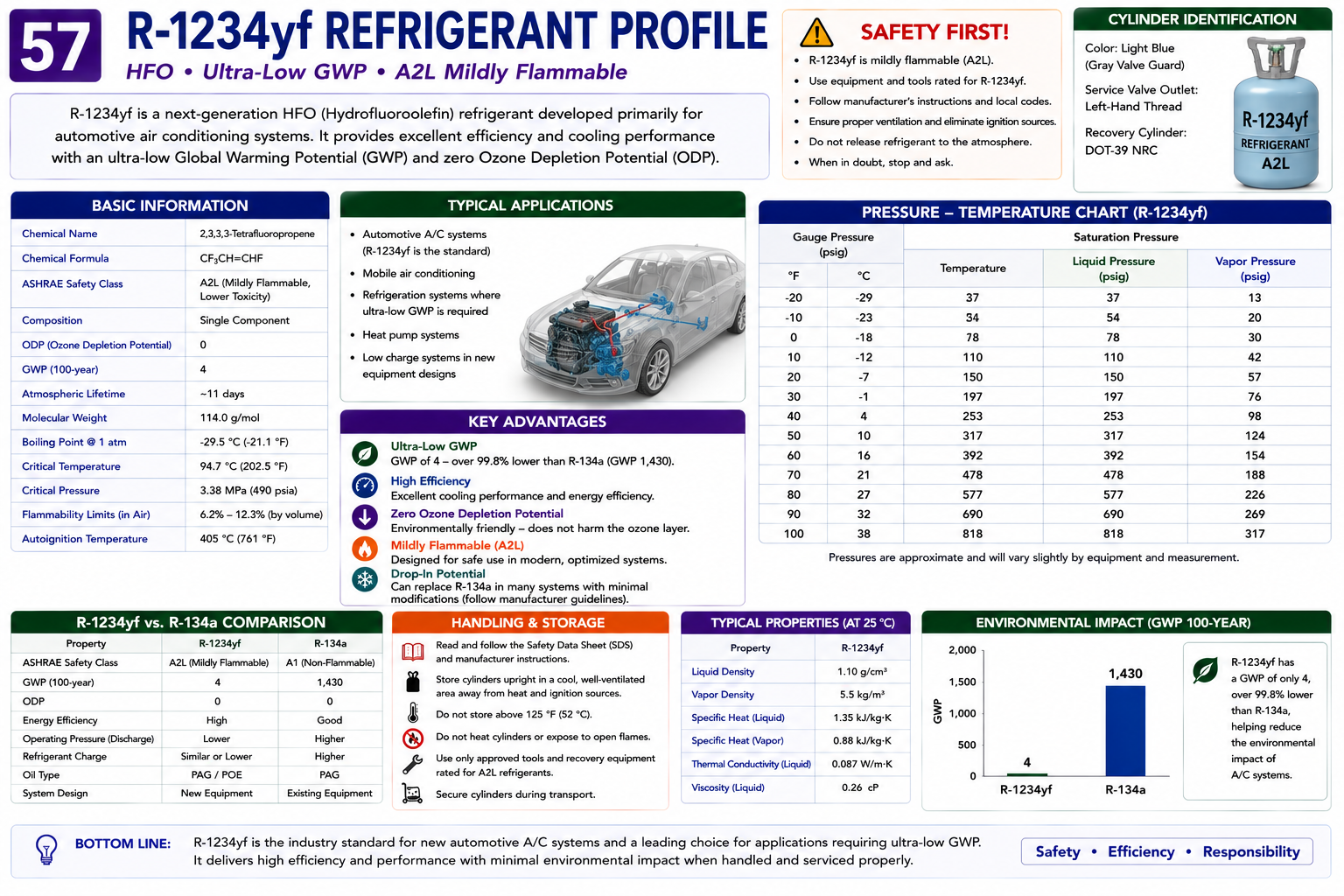
Designation
R-1234yf
Family
HFO — hydrofluoroolefin.
Composition
Single-component refrigerant.
Safety Classification
ASHRAE A2L.
ODP
0
GWP
Extremely low compared with conventional HFC refrigerants.
Motor Vehicles, Stationary Equipment, and Refrigerant Blends
R-1234yf is strongly associated with motor-vehicle air conditioning because it became an important successor to R-134a in newly manufactured vehicles.
However, R-1234yf is not exclusively an automotive refrigerant. EPA also lists it as acceptable subject to use conditions in several stationary refrigeration and air-conditioning end uses. :contentReference[oaicite:2]{index=2}
Motor-Vehicle Air Conditioning
A major modern application and an important lower-GWP successor to R-134a in new vehicles.
Stationary Refrigeration
Approved under specified conditions for several commercial refrigeration applications.
Chillers
Used or approved in certain chiller and air-conditioning applications.
Blend Component
Used as a component of refrigerant blends such as R-454B.
The Equipment Determines the Regulatory Program
R-1234yf is a good example of why the refrigerant alone does not determine which technician-certification program applies.
When R-1234yf is used in a motor-vehicle air-conditioning system, EPA Section 609 requirements apply. When it is used in stationary refrigeration or air-conditioning equipment covered by Section 608, the stationary-equipment requirements apply.
Our focus remains EPA Section 608. R-1234yf’s automotive role is included because technicians should recognize the application, but MVAC servicing procedures and Section 609 certification are separate subjects.
EPA currently lists HFO-1234yf as acceptable with use conditions in specified newly manufactured motor vehicles. :contentReference[oaicite:3]{index=3}
No Blend Fractionation or Temperature Glide
R-1234yf is a single chemical rather than a refrigerant blend. It therefore does not fractionate and does not have a bubble-to-dew temperature glide.
At a given saturation pressure, pure R-1234yf has one corresponding saturation temperature.
R-1234yf
Single component.
No blend fractionation.
No temperature glide.
R-454B
Blend of R-32 and R-1234yf.
Zeotropic.
Has temperature glide.
R-1234yf as a Blend Component
R-1234yf makes up approximately 31.1% of the R-454B blend discussed in R-454B Refrigerant.
R-1234ze(E)
R-1234ze(E) is another single-component HFO refrigerant with very low global warming potential and zero ozone depletion potential.
Like R-1234yf, it is classified A2L. Its physical and thermodynamic characteristics differ, however, so the two refrigerants serve different equipment designs and are not interchangeable.
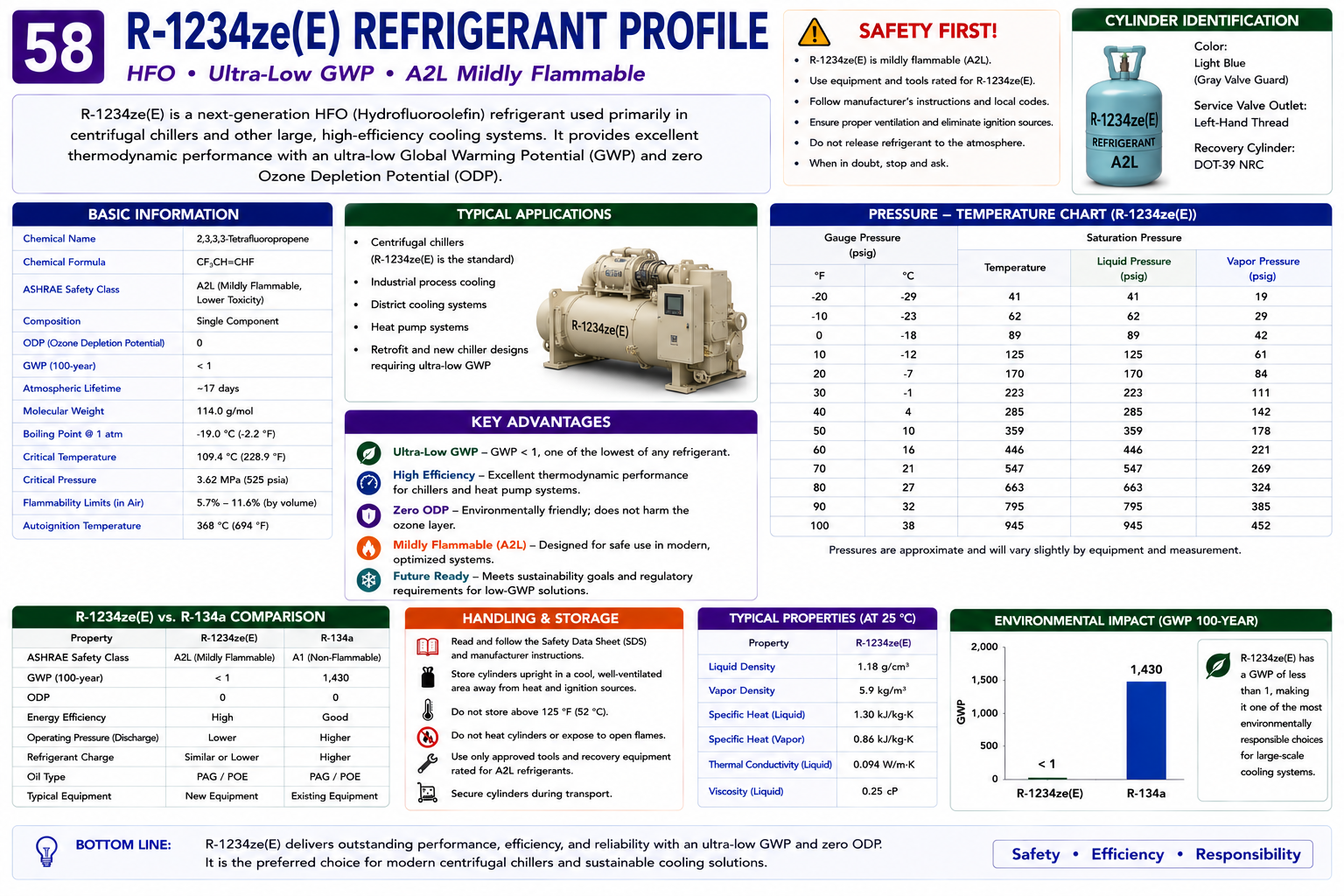
Designation
R-1234ze(E)
Family
HFO
Composition
Single-component refrigerant.
Safety Classification
ASHRAE A2L.
ODP
0
GWP
Extremely low compared with conventional HFC refrigerants.
Chillers and Commercial Refrigeration
R-1234ze(E) has been used in equipment including chillers and is listed by EPA as acceptable subject to use conditions in several stationary refrigeration applications.
Current EPA SNAP listings include both R-1234yf and R-1234ze(E) in applications such as remote condensing units, stand-alone equipment, and typical supermarket systems, subject to the applicable use conditions. :contentReference[oaicite:4]{index=4}
Do not interpret an EPA listing for one equipment category as permission to use the refrigerant in every refrigeration application. Always verify the current SNAP listing and equipment manufacturer’s requirements for the specific end use.
Same Refrigerant Family, Different Refrigerants
| Characteristic | R-1234yf | R-1234ze(E) |
|---|---|---|
| Family | HFO | HFO |
| Composition | Single component | Single component |
| ASHRAE Safety Class | A2L | A2L |
| ODP | 0 | 0 |
| GWP | Very low | Very low |
| Temperature Glide | None | None |
| Well-Known Application | Motor-vehicle A/C and blend component | Chillers and stationary refrigeration |
| Interchangeable? | No | No |
R-1234yf and R-1234ze(E) are different compounds with different pressure-temperature and equipment characteristics.
Similar Elements, Different Atmospheric Behavior
HFCs and HFOs both contain hydrogen, fluorine, and carbon and both avoid the chlorine responsible for ozone depletion by CFC and HCFC refrigerants.
The important chemical distinction is that HFO molecules contain a carbon-carbon double bond. This affects atmospheric stability and is a major reason many HFO refrigerants have dramatically lower global warming potential than traditional HFC refrigerants.
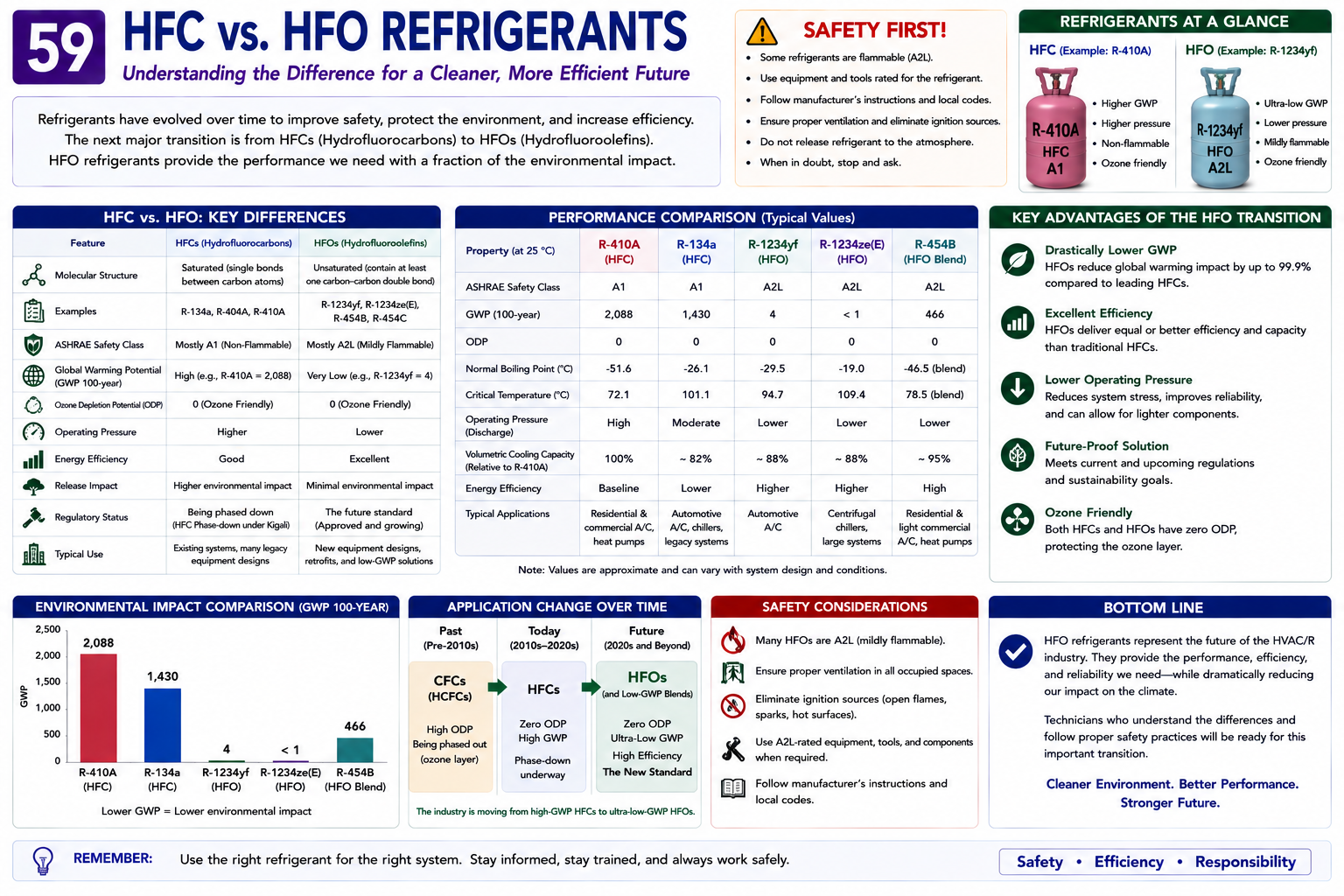
| Characteristic | Traditional HFC | HFO |
|---|---|---|
| Contains Chlorine | No | No |
| Typical ODP | 0 | 0 |
| Molecular Structure | Saturated fluorocarbon | Contains carbon-carbon double bond |
| Atmospheric Lifetime | Often comparatively long | Generally much shorter |
| GWP | Can be high | Generally very low for the HFOs discussed here |
| Examples | R-32, R-134a | R-1234yf, R-1234ze(E) |
Blend Components Can Balance Refrigerant Characteristics
Very low GWP is desirable, but refrigerant selection also depends on pressure, capacity, discharge temperature, critical temperature, lubricant compatibility, flammability, temperature glide, equipment design, and other properties.
Manufacturers can combine an HFO with one or more HFC refrigerants to produce a blend whose overall characteristics are appropriate for a particular application while substantially reducing GWP.
R-454B
R-32 + R-1234yf.
Lower GWP
The HFO component helps reduce the overall climate impact of the blend.
Performance
The HFC component can contribute pressure, capacity, and other thermodynamic characteristics desired for the application.
Tradeoffs
Blend design involves balancing environmental, performance, flammability, pressure, and service characteristics.
A modern refrigerant blend is engineered to produce a particular combination of properties. It is not simply a random mixture of refrigerants.
Both Refrigerants Require Lower-Flammability Service Practices
R-1234yf and R-1234ze(E) are classified A2L. Technicians must therefore recognize that they are capable of flame propagation under appropriate conditions even though their flammability is substantially lower than A3 hydrocarbon refrigerants.
A2L Refrigerants
Ventilation, ignition sources, refrigerant accumulation, leak detection, compatible service equipment, and the A1/A2L/A3 classifications were covered in Introduction to A2L Refrigerants.
Ventilation
Prevent refrigerant from accumulating in enclosed or poorly ventilated areas.
Ignition Sources
Control flames, sparks, electrical arcs, hot work, and other potential ignition sources.
Leak Detection
Use leak-detection equipment suitable for the specific refrigerant.
Service Equipment
Use recovery and other refrigerant-handling equipment suitable for A2L service.
Prevent Refrigerant Exposure to Extreme Heat
Fluorinated refrigerants should not be deliberately exposed to open flame or extremely hot surfaces. Thermal decomposition can produce hazardous compounds.
When hot work such as brazing is necessary, properly recover refrigerant and follow the manufacturer’s service procedure before applying a torch to the refrigeration circuit.
Recover refrigerant before performing hot work on the sealed refrigeration circuit and follow the equipment manufacturer’s A2L service procedure.
Every HFO Still Has Its Own P-T Relationship
Very low GWP does not tell a technician anything about the refrigerant’s saturation pressure at a particular temperature.
R-1234yf and R-1234ze(E) have their own distinct pressure-temperature relationships. Use the correct refrigerant selection on digital manifolds, applications, or P-T charts.
An HFO P-T chart does not exist. Use the P-T information for the exact refrigerant being serviced.
Follow the Equipment Specification
HFO refrigerants are used with lubricants selected for the particular compressor, refrigerant, and application. Synthetic lubricants such as POE or other formulations may be specified depending on the equipment.
Do not select a lubricant solely because another HFO system uses it.
Use the lubricant type and viscosity specified for the actual equipment. Refrigerant family alone does not establish the correct compressor oil.
Low GWP Does Not Make a Refrigerant Universally Suitable
The very low GWP of R-1234yf or R-1234ze(E) does not make either refrigerant a universal replacement for R-134a, R-410A, or another refrigerant.
Equipment must be designed or specifically approved for the refrigerant being used. Pressure, safety classification, compressor design, lubricant, charge quantity, controls, heat exchangers, metering devices, and regulatory requirements all matter.
Never select a substitute solely because it has lower GWP.
HFO Components Must Remain Identifiable
Do not mix R-1234yf, R-1234ze(E), R-134a, R-454B, or another refrigerant unless they are components of a manufactured refrigerant blend with an established refrigerant designation.
Creating an uncontrolled field mixture produces a refrigerant with unknown composition and operating characteristics.
R-454B is a manufactured blend containing R-1234yf. Adding R-1234yf to an R-454B system is not the same thing and changes the approved blend composition.
Very Low GWP Does Not Mean “Vent It”
Refrigerant should be handled according to applicable recovery requirements and equipment procedures. Low GWP does not mean that refrigerant should simply be released whenever a refrigeration circuit is opened.
Recovery also helps prevent an A2L refrigerant from accumulating in the work area before repair operations begin.
Keep recovered refrigerants properly identified and separated. Do not contaminate a cylinder containing known refrigerant with another refrigerant or an unidentified mixture.
Acceptability Is Based on the End Use
EPA’s SNAP program evaluates substitutes by specific refrigeration and air-conditioning end use. Current EPA stationary-equipment listings show both HFO-1234yf and HFO-1234ze(E) as A2L refrigerants with zero ODP and very low GWP in several end uses, subject to specified use conditions. :contentReference[oaicite:5]{index=5}
A refrigerant being acceptable in one application does not make it acceptable in every application. Verify the current SNAP listing, use conditions, and equipment requirements for the actual end use.
Each Generation Solves Different Problems
The history of refrigerants demonstrates that there is no single characteristic that defines an ideal refrigerant.
CFCs
Excellent refrigeration properties but serious ozone-depletion concerns.
HCFCs
Reduced ozone impact compared with CFCs but still contained chlorine.
HFCs
Zero ODP but some widely used HFCs have high GWP.
HFOs
Zero ODP and very low GWP, but many important HFOs introduce A2L flammability considerations.
Refrigerant development is a balance among environmental impact, safety, thermodynamic performance, materials, equipment design, cost, and serviceability.
What to Remember About HFO Refrigerants
HFO refrigerants connect refrigerant chemistry, environmental impact, safety classification, service procedures, refrigerant transitions, and SNAP end-use requirements.
Remember that R-1234yf and R-1234ze(E) are single-component HFO refrigerants with zero ODP, very low GWP, and A2L safety classifications. Their complete refrigerant designations matter, they are not interchangeable, and their A2L classification requires appropriate ventilation, ignition control, leak detection, recovery, and service equipment.
Avoid These HFO Errors
“HFO means nonflammable.”
No. Both R-1234yf and R-1234ze(E) are classified A2L.
“All 1234 refrigerants are the same.”
No. The letters and other designation information identify different compounds.
“R-1234yf is only an automotive refrigerant.”
No. It also appears in stationary applications and as a component of refrigerant blends.
“R-1234yf and R-1234ze(E) can be interchanged.”
No. They have different thermodynamic characteristics and equipment applications.
“Very low GWP means it can replace any HFC.”
No. Refrigerant suitability depends on the complete equipment and application.
“If an HFO is SNAP acceptable, it can be used anywhere.”
No. SNAP acceptability applies to specified end uses and may include required use conditions.
HFO Refrigerants
- What does HFO stand for?
- What major structural feature distinguishes an HFO from a traditional HFC?
- Do R-1234yf and R-1234ze(E) contain chlorine?
- What is the ozone depletion potential of these refrigerants?
- Why do many HFO refrigerants have very low GWP?
- What is the ASHRAE safety classification of R-1234yf?
- What is the ASHRAE safety classification of R-1234ze(E)?
- Is R-1234yf a single-component refrigerant or a blend?
- Does R-1234yf have temperature glide?
- What important motor-vehicle refrigerant did R-1234yf replace in many new vehicles?
- Which EPA technician-certification program generally applies to MVAC service?
- Name one important stationary application associated with R-1234ze(E).
- What refrigerant studied in Lesson 14 contains R-1234yf as a component?
- Why can R-1234yf not simply be added to an R-454B system?
- Why must EPA SNAP status be checked for the particular refrigeration end use?
What You Should Have Learned
HFO Means Hydrofluoroolefin
The carbon-carbon double bond distinguishes the molecular structure from traditional HFC refrigerants.
HFOs Can Have Very Low GWP
The HFOs discussed here break down relatively quickly in the lower atmosphere.
R-1234yf Is A2L
It is a single-component, zero-ODP HFO used in motor vehicles, stationary applications, and refrigerant blends.
R-1234ze(E) Is A2L
It is a distinct single-component HFO used in applications including chillers and commercial refrigeration.
The Complete Designation Matters
R-1234yf and R-1234ze(E) are different refrigerants and are not interchangeable.
HFOs Can Be Blend Components
Combining HFOs with other refrigerants can produce lower-GWP blends with characteristics tailored to a particular application.
A2L Procedures Still Apply
Very low GWP does not eliminate flammability, ventilation, ignition-control, or equipment-suitability requirements.
Application Determines Acceptability
EPA SNAP listings and manufacturer requirements must be checked for the specific refrigerant and end use.