R-407C Refrigerant
R-407C is an HFC refrigerant blend developed for air-conditioning and refrigeration applications historically served by R-22. It is especially useful for training because it demonstrates several important blend concepts in actual service work: temperature glide, bubble point, dew point, fractionation, and liquid charging.
R-407C has pressure characteristics that can resemble R-22 in some operating conditions, but it is not the same refrigerant and should never be treated as a simple direct substitute without considering lubricant compatibility, charging procedures, equipment requirements, and system performance.
What You Will Learn
After completing this lesson, you should be able to:
Identify R-407C
Recognize R-407C as a three-component HFC refrigerant blend with an A1 safety classification.
Explain Temperature Glide
Describe why R-407C has separate bubble-point and dew-point saturation temperatures.
Apply Bubble and Dew Correctly
Use dew-point temperature for superheat calculations and bubble-point temperature for subcooling calculations.
Explain Liquid Charging
Explain why R-407C should normally be withdrawn from the supply cylinder as liquid.
Recognize Retrofit Considerations
Explain why R-407C is not automatically a direct drop-in replacement for R-22.
Understand Service Implications
Recognize the importance of POE lubricant, blend composition, proper charging, and accurate P-T interpretation.
A Three-Component HFC Blend
R-407C is a zeotropic HFC refrigerant blend containing R-32, R-125, and R-134a. The three components are combined in carefully controlled proportions to produce operating characteristics suitable for many air-conditioning and refrigeration applications.
Because the components have different boiling characteristics, R-407C changes temperature as it evaporates or condenses at essentially constant pressure. This is one of the most important differences between R-407C and a single-component refrigerant such as R-22.
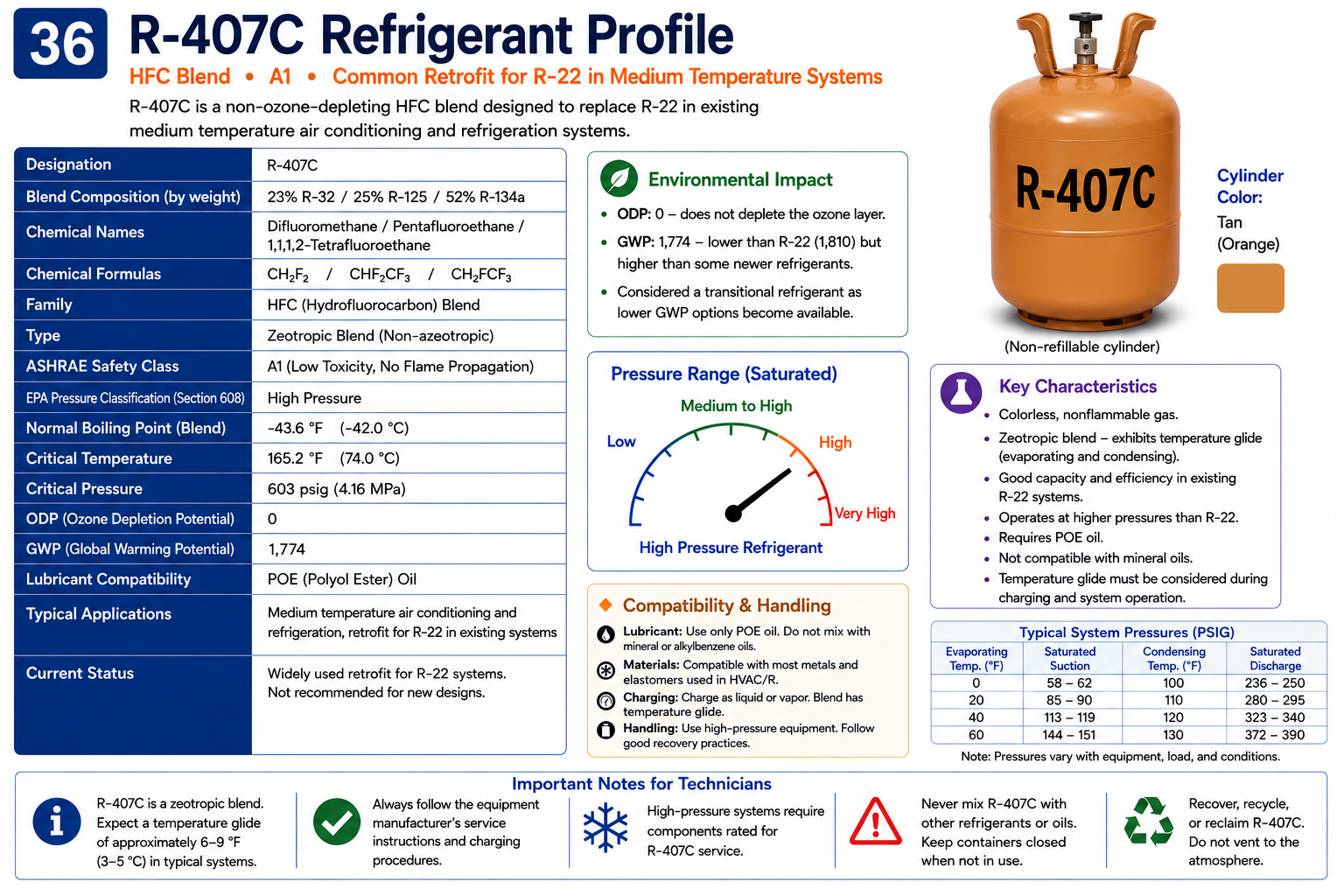
Designation
R-407C
Family
HFC blend
Components
R-32 / R-125 / R-134a.
Blend Type
Zeotropic.
Safety Classification
ASHRAE A1.
Typical Lubricant
Commonly associated with POE lubricant.
A Real-World Example of Temperature Glide
R-407C is particularly useful for understanding zeotropic blends because its temperature glide is large enough to matter in normal service calculations.
Unlike R-404A, whose glide is relatively small, R-407C can have a noticeable difference between bubble-point and dew-point saturation temperatures at the same pressure.
R-407C does not have one single saturation temperature at a given pressure while it is changing state. It has a bubble-point temperature and a dew-point temperature with a temperature range between them.
The Liquid-Side Saturation Reference
The bubble point is the saturation temperature at which the first bubble of vapor begins to form from saturated liquid at a given pressure.
When working with R-407C, bubble-point temperature is associated with the liquid side of the saturation range.
Bubble point = liquid-side saturation.
The Vapor-Side Saturation Reference
The dew point is the saturation temperature associated with the vapor side of the blend’s phase-change range.
During evaporation, dew point represents the condition at which the last remaining liquid has evaporated. During condensation, it represents the point at which the first liquid begins to form from vapor.
Dew point = vapor-side saturation.
The Difference Between Bubble and Dew
The difference between bubble-point and dew-point saturation temperatures at a given pressure is called temperature glide.
As R-407C evaporates, its temperature rises through this range while pressure remains approximately constant. During condensation, the refrigerant temperature falls through the glide range.
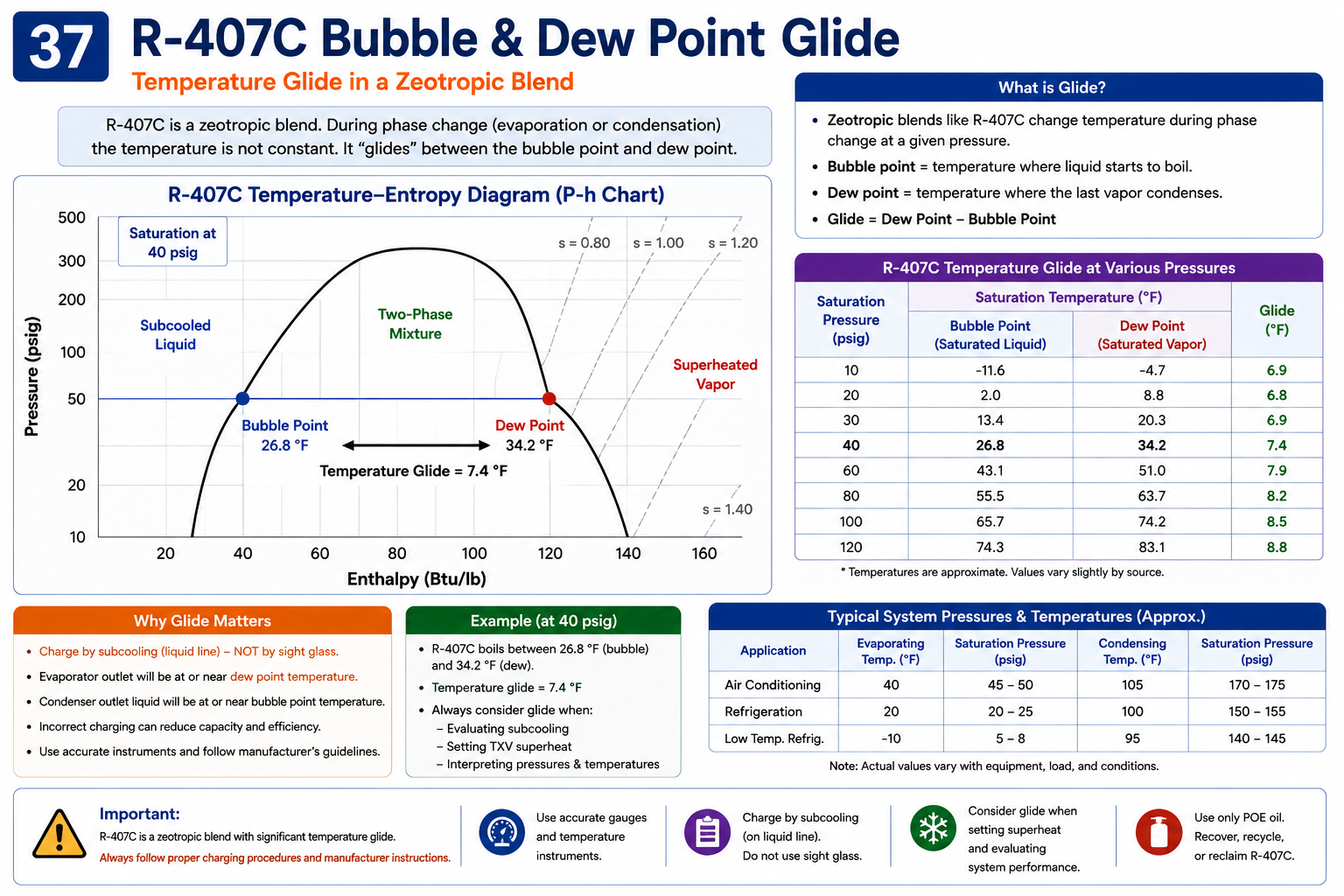
Bubble Point, Dew Point, and Glide
These concepts were introduced in Refrigerant Families, Types, and Blends. R-407C gives us a practical example of why they matter in the field.
Use Dew-Point Temperature
Superheat measures how far vapor temperature is above its saturation temperature. Because superheat is a vapor-side measurement, the correct saturation reference for R-407C is the dew-point temperature.
Measured Suction-Line Temperature
The actual refrigerant-line temperature measured near the appropriate service point.
Minus Dew-Point Saturation Temperature
The vapor-side saturation temperature corresponding to the measured suction pressure.
R-407C superheat = measured vapor temperature − dew-point saturation temperature.
Use Bubble-Point Temperature
Subcooling measures how far liquid refrigerant temperature is below its saturation temperature. Because subcooling is a liquid-side measurement, the correct saturation reference for R-407C is the bubble-point temperature.
Bubble-Point Saturation Temperature
The liquid-side saturation temperature corresponding to the measured liquid-line pressure.
Minus Measured Liquid-Line Temperature
The actual liquid-line temperature measured at the appropriate location.
R-407C subcooling = bubble-point saturation temperature − measured liquid temperature.
Using the Wrong Saturation Reference Creates Diagnostic Error
If a technician uses bubble-point temperature when calculating superheat, or dew-point temperature when calculating subcooling, the resulting values can be incorrect by several degrees.
That error can lead to incorrect conclusions about refrigerant charge, metering-device operation, airflow, evaporator feeding, or condenser performance.
When using an electronic manifold or digital refrigerant application, verify whether the displayed saturation temperature is bubble, dew, or both. Do not assume the instrument has selected the correct value for the calculation you are making.
R-407C Should Be Withdrawn as Liquid
Because R-407C is a zeotropic blend, the components can leave a refrigerant cylinder at different rates if refrigerant is repeatedly withdrawn as vapor.
Withdrawing R-407C as liquid helps preserve the intended composition of the refrigerant blend.
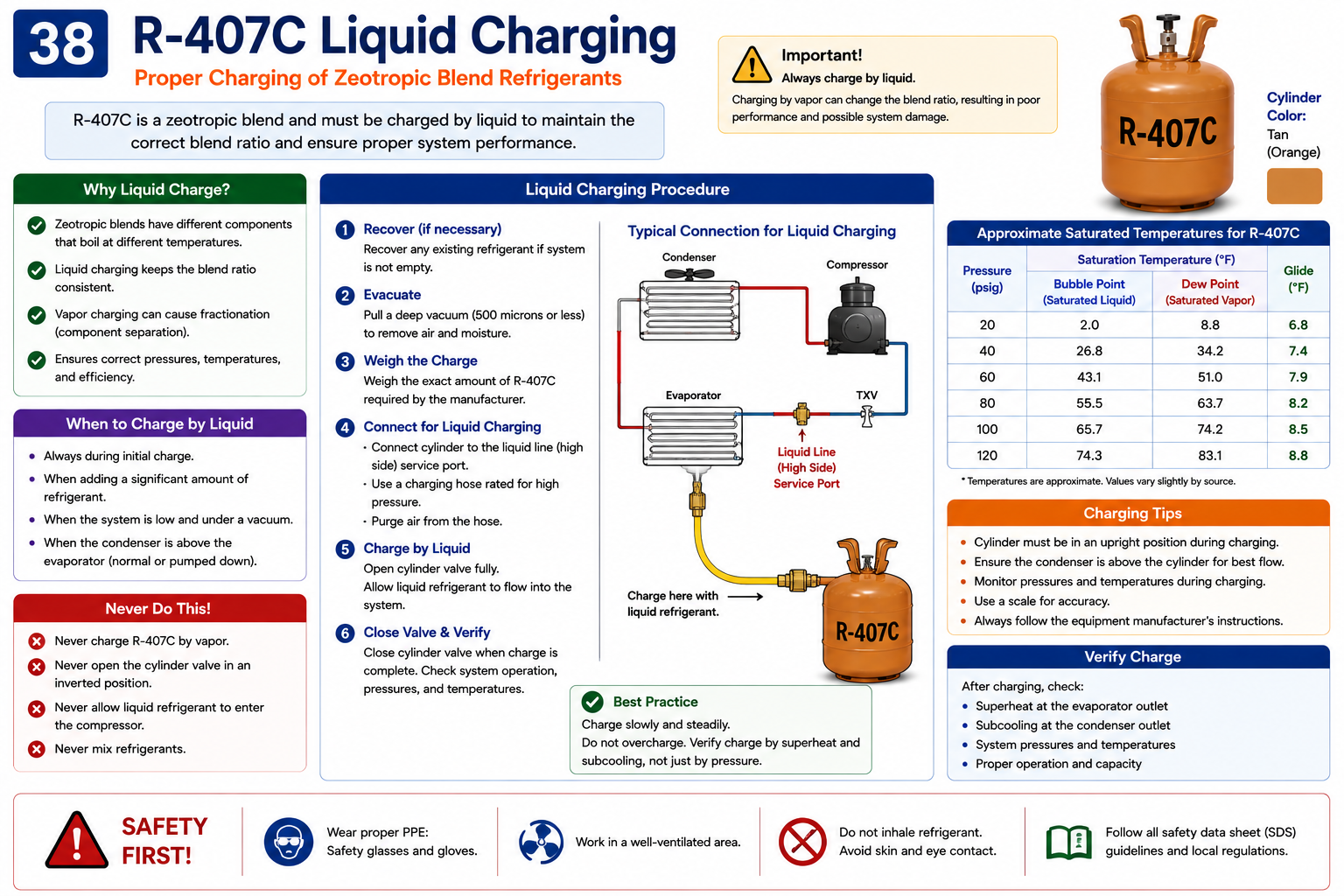
Liquid withdrawal from the cylinder does not mean uncontrolled liquid should enter a running compressor. Follow the equipment manufacturer’s charging procedure and meter or vaporize refrigerant when required.
The Blend Composition Can Change
Because the components of R-407C have different volatilities, the composition of the liquid and vapor phases is not always identical during phase change.
Improper charging, repeated vapor withdrawal, or refrigerant leakage under some conditions can alter the proportions of the components remaining in the system or cylinder. This is called fractionation.
If the blend composition changes, the refrigerant’s pressure-temperature relationship, capacity, glide, and other operating characteristics may also change.
Do Not Automatically Assume a Leaking Blend Must Be Replaced
Zeotropic blends can fractionate during leakage, but the actual effect depends on the refrigerant, leak location, system state, amount lost, and operating conditions.
For a significant loss of R-407C where refrigerant composition is uncertain, follow the equipment and refrigerant manufacturer’s service guidance rather than assuming that topping off will always restore the original blend.
Repair the leak first. Then determine whether the remaining charge can be retained or whether the system should be recovered and recharged with the correct refrigerant composition.
Similar Application Does Not Mean Identical Refrigerant
R-407C was developed for applications similar to those historically served by R-22. Their pressure characteristics can also appear relatively similar under many operating conditions.
However, R-22 is a single-component HCFC, while R-407C is a three-component HFC blend with temperature glide. Their lubricant requirements and service procedures can differ substantially.
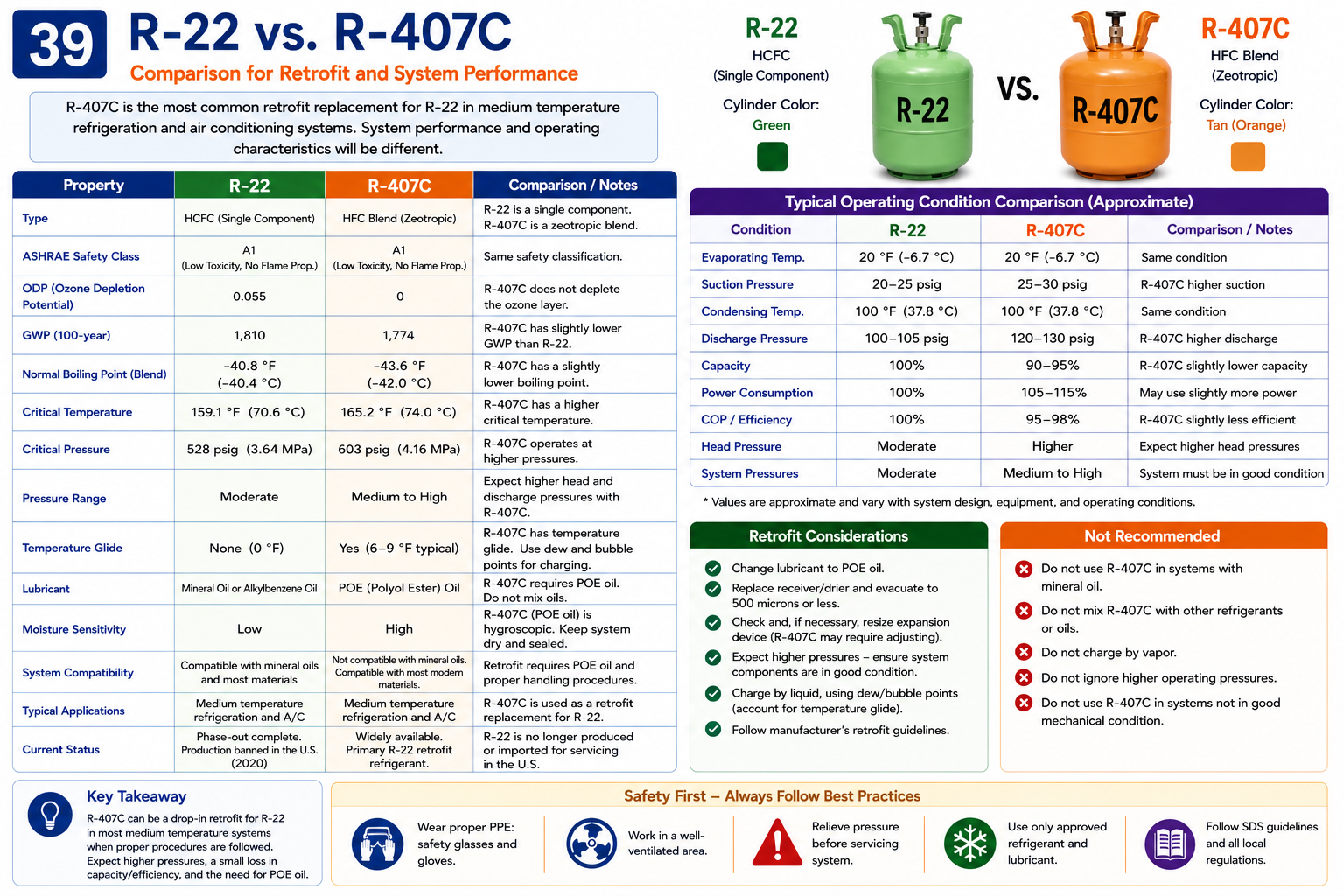
| Characteristic | R-22 | R-407C |
|---|---|---|
| Family | HCFC | HFC blend |
| Composition | Single component | R-32 / R-125 / R-134a |
| ASHRAE Safety Class | A1 | A1 |
| Temperature Glide | None | Significant |
| Bubble/Dew Values | Not required | Required for accurate calculations |
| Traditional Lubricant | Often mineral oil | Typically POE |
| Charging | Single-component refrigerant | Blend normally withdrawn as liquid |
| ODP | Greater than zero | 0 |
Conversion From R-22 Requires Planning
R-407C has been used in some R-22 retrofit applications, but an approved retrofit is more than a refrigerant exchange.
One of the most important issues is lubricant compatibility. Many traditional R-22 systems use mineral oil, while R-407C systems commonly require POE oil for satisfactory oil return.
Recover R-22
Do not mix the replacement refrigerant with the existing R-22 charge.
Evaluate Lubricant
Determine whether the compressor and retrofit procedure require conversion to POE or other specified lubricant.
Replace Filter-Driers
Install filter-driers appropriate for the new refrigerant and lubricant where required.
Check Seals and Components
Evaluate compatibility of elastomers, valves, controls, and other system components.
Charge Correctly
Charge the R-407C blend according to the retrofit and equipment instructions.
Relabel the Equipment
Clearly identify the new refrigerant and lubricant for future technicians.
Moisture Control Matters
R-407C equipment commonly uses POE lubricant. POE provides the refrigerant-oil compatibility needed for proper oil circulation but is hygroscopic and readily absorbs atmospheric moisture.
POE and Moisture
Oil compatibility, POE moisture absorption, evacuation, and contamination control were covered in Refrigerants and Lubricants.
Keep POE containers sealed, minimize open-system time, use appropriate filter-driers, and evacuate properly before returning the system to service.
Use an R-407C P-T Reference
Because R-407C is a blend with temperature glide, technicians need a pressure-temperature reference that clearly provides both bubble-point and dew-point values.
Do not attempt to diagnose an R-407C system using an R-22 P-T chart merely because the refrigerants can have similar pressures.
Correct refrigerant + correct pressure + correct bubble/dew reference = meaningful saturation information.
The Refrigerant Temperature Changes Through the Two-Phase Region
In an evaporator using R-407C, the refrigerant saturation temperature rises as the blend evaporates. In the condenser, the saturation temperature falls as the refrigerant condenses.
This means that the refrigerant does not maintain one constant saturation temperature throughout the entire two-phase portion of the heat exchanger.
Evaporator
R-407C generally enters the two-phase region closer to its bubble temperature and leaves the saturated region near its dew temperature.
Condenser
R-407C begins condensation near its dew temperature and completes condensation near its bubble temperature.
R-407C Is A1
R-407C is classified A1 under the ASHRAE safety-classification system. This places it in the lower-toxicity group with no flame propagation under the applicable test conditions.
As with other A1 refrigerants, technicians must still control pressure, frostbite, oxygen displacement, confined-space, and decomposition hazards.
A substantial refrigerant release can displace oxygen. Liquid refrigerant can cause severe cold burns, and exposure to high heat or flame can produce hazardous decomposition products.
Zero ODP, But Still an HFC Greenhouse Gas
R-407C contains no chlorine and therefore has zero ozone depletion potential. This made it suitable as part of the transition away from HCFC refrigerants such as R-22.
However, its HFC components contribute to global warming potential. As refrigerant policy and equipment design continue to move toward lower-GWP alternatives, R-407C may be replaced in some new applications while remaining in substantial numbers of existing systems.
Zero ODP and low GWP are not the same thing. R-407C solved the chlorine/ozone issue associated with R-22 but still has significant climate impact.
Expect to Continue Seeing R-407C
R-407C has been installed in air-conditioning, heat-pump, chiller, and refrigeration equipment and has also been used in approved retrofit applications.
Technicians therefore need to remain comfortable with its P-T characteristics, temperature glide, POE lubricant requirements, and liquid-charging procedures even as newer refrigerants enter the market.
Refrigerant transitions do not occur all at once. Technicians routinely service multiple generations of equipment containing legacy, transitional, and current refrigerants.
R-407C Must Remain a Known Blend
R-407C should never be added to an existing R-22 charge or mixed with another refrigerant. An uncontrolled mixture no longer follows the published pressure-temperature relationship for either refrigerant.
Mixed refrigerants also create problems for recovery, recycling, reclamation, charging, and system diagnosis.
Recover the original refrigerant before an approved conversion. Keep recovered R-407C separated from other refrigerants whenever practical.
What to Remember About R-407C
R-407C brings together several Section 608 concepts that technicians must be comfortable applying rather than simply memorizing.
Remember that R-407C is an HFC zeotropic blend containing R-32, R-125, and R-134a. It is A1, has zero ODP, exhibits significant temperature glide, uses separate bubble and dew saturation references, and should normally be withdrawn from the supply cylinder as liquid.
Avoid These R-407C Errors
“R-407C is basically R-22.”
No. They may serve similar applications, but their chemistry, lubricant requirements, and phase-change behavior are different.
“R-407C has one saturation temperature.”
No. As a zeotropic blend it has separate bubble-point and dew-point saturation temperatures.
“Bubble and dew can be used interchangeably.”
No. Dew is used for vapor-side superheat; bubble is used for liquid-side subcooling.
“R-407C can be charged from the cylinder as vapor.”
Repeated vapor withdrawal can alter blend composition. R-407C should normally be withdrawn as liquid.
“Similar pressure means direct drop-in.”
No. Lubricant, capacity, glide, seals, controls, and approved retrofit procedures must also be considered.
“A1 means no refrigerant hazard.”
No. Pressure, frostbite, oxygen displacement, and decomposition hazards still require safe handling.
R-407C Refrigerant
- What refrigerant family does R-407C belong to?
- What three refrigerants make up R-407C?
- Is R-407C a single-component refrigerant or a blend?
- What type of blend is R-407C?
- What is the ASHRAE safety classification of R-407C?
- What is temperature glide?
- What does bubble point represent?
- What does dew point represent?
- Which saturation value is used when calculating superheat?
- Which saturation value is used when calculating subcooling?
- Why should R-407C normally be withdrawn from the cylinder as liquid?
- What is fractionation?
- What lubricant is commonly associated with R-407C equipment?
- Why is R-407C not automatically a direct drop-in replacement for R-22?
- Why must an R-407C P-T chart be used rather than an R-22 chart?
What You Should Have Learned
R-407C Is an HFC Blend
It contains R-32, R-125, and R-134a.
R-407C Is Zeotropic
Its saturation temperature changes during evaporation and condensation.
Bubble and Dew Are Different
Bubble represents the liquid-side saturation reference; dew represents the vapor-side reference.
Superheat Uses Dew
Dew-point saturation temperature is used when evaluating vapor-side superheat.
Subcooling Uses Bubble
Bubble-point saturation temperature is used when evaluating liquid-side subcooling.
Liquid Charging Matters
R-407C is normally withdrawn from the supply cylinder as liquid to preserve blend composition.
POE Is Common
R-407C systems commonly use POE lubricant, requiring good moisture-control practices.
R-407C Is Not R-22
Similar applications and pressures do not make the refrigerants directly interchangeable.