Refrigerant Families, Types, and Blends
Refrigerants can be grouped into families based on their chemical composition and into types based on whether they contain one refrigerant or a mixture of several refrigerants. These distinctions affect environmental characteristics, operating behavior, charging procedures, service practices, and safety.
A technician does not need to become a chemist, but must be able to recognize the major refrigerant families, understand the difference between single-component and blended refrigerants, and know why bubble point, dew point, temperature glide, and fractionation matter when working with refrigerant blends.
What You Will Learn
After completing this lesson, you should be able to:
Identify Major Refrigerant Families
Recognize CFC, HCFC, HFC, HFO, hydrocarbon, inorganic or natural refrigerants, and refrigerant blends.
Distinguish Pure Refrigerants From Blends
Explain the difference between a single-component refrigerant and a mixture containing multiple refrigerants.
Explain Blend Behavior
Describe azeotropic, near-azeotropic, and zeotropic behavior and recognize temperature glide.
Use Bubble and Dew Points
Recognize why liquid and vapor saturation conditions may be different for a zeotropic blend.
Explain Fractionation
Describe how a refrigerant blend can change composition when its components separate during improper handling or leakage.
Recognize Proper Blend Handling
Explain why many refrigerant blends are removed from their cylinders as liquid.
Refrigerants Have Changed as Technology Has Changed
The refrigerants used in HVAC/R equipment have changed considerably over time. Early systems used a variety of substances, but later generations of synthetic refrigerants provided desirable operating characteristics and became widely used in air-conditioning and refrigeration equipment.
Environmental concerns eventually led to major changes in refrigerant selection. Refrigerants containing chlorine were replaced in many applications, followed by increasing use of refrigerants with lower global warming potential. Modern equipment may use HFCs, HFOs, HFO/HFC blends, hydrocarbons, carbon dioxide, ammonia, and other alternatives depending on the application.
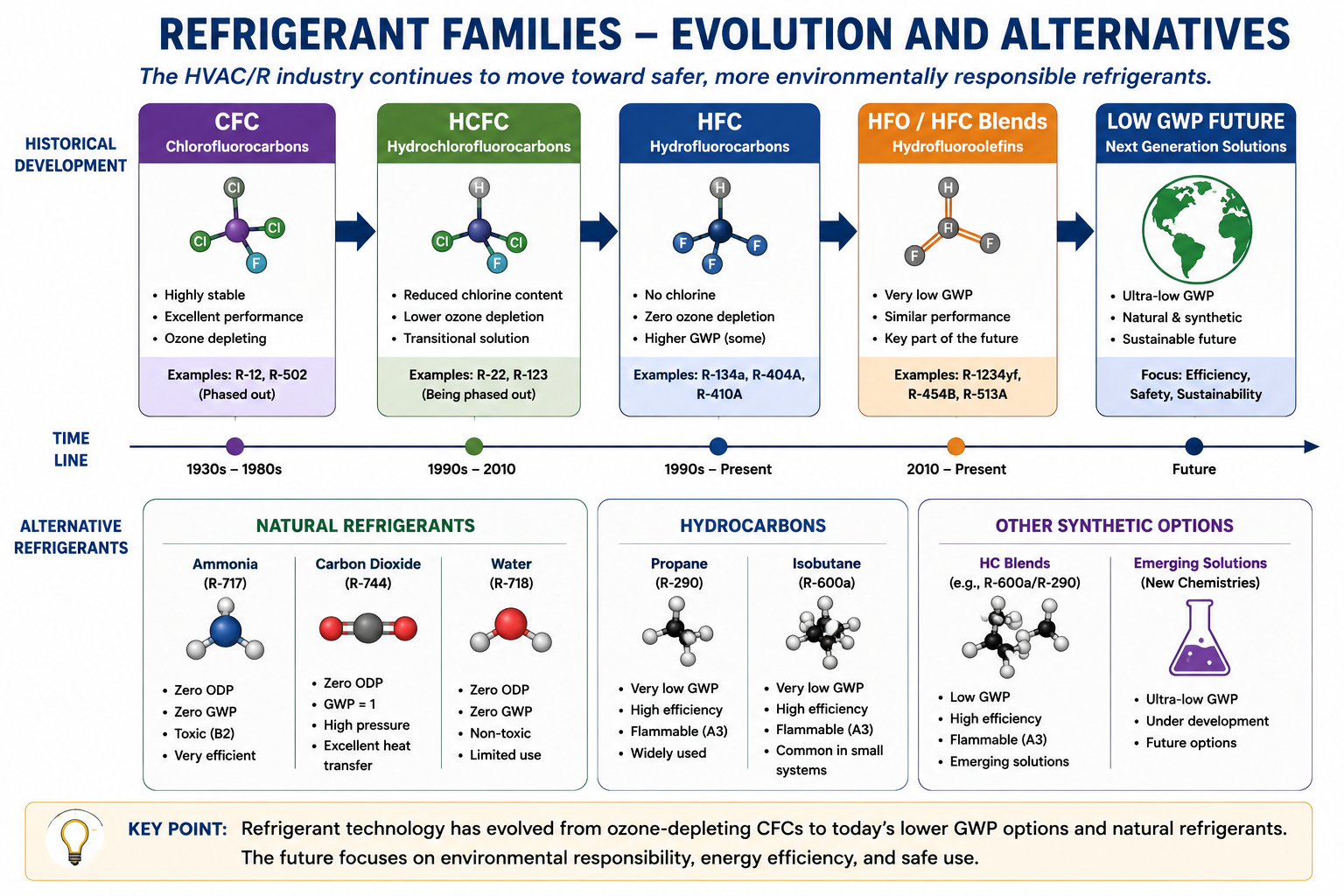
The family name tells us something about refrigerant chemistry, but it does not by itself tell us everything about operating pressure, flammability, toxicity, lubricant compatibility, or whether the refrigerant is suitable for a particular system.
Chlorofluorocarbons
CFC stands for chlorofluorocarbon. These refrigerants contain chlorine, fluorine, and carbon. CFC refrigerants were once widely used because many had desirable refrigeration characteristics and were relatively stable under normal system conditions.
The chlorine contained in CFC refrigerants contributes to stratospheric ozone depletion. As a result, CFC refrigerants were among the first major refrigerant families targeted for phaseout.
Common Historical Example
R-12 was one of the most familiar CFC refrigerants and was widely used in refrigeration and air-conditioning applications.
Current Relevance
Technicians may still encounter older equipment containing CFC refrigerants, so recognizing the family remains important even though these refrigerants are associated primarily with legacy equipment.
R-12 will receive limited historical coverage. Older R-12 equipment may remain in service, and replacement refrigerants may sometimes be used when appropriate, but replacement should never be assumed to be a simple direct substitution without considering equipment, oil, controls, capacity, and manufacturer guidance.
Hydrochlorofluorocarbons
HCFC stands for hydrochlorofluorocarbon. HCFC molecules include hydrogen in addition to chlorine, fluorine, and carbon.
HCFC refrigerants represented an important transition away from CFC refrigerants. They generally have less ozone-depletion potential than CFCs, but because they still contain chlorine, they can still contribute to ozone depletion.
R-22 is the HCFC refrigerant most technicians are likely to associate with older residential and light-commercial air-conditioning systems. It will receive a complete individual refrigerant profile later in this section.
Hydrofluorocarbons
HFC stands for hydrofluorocarbon. HFC refrigerants contain hydrogen, fluorine, and carbon but do not contain chlorine.
The absence of chlorine eliminates ozone depletion from the refrigerant itself, but many HFC refrigerants have significant global warming potential. This has driven another transition toward lower-GWP refrigerants and blends.
R-134a
A single-component HFC that has been widely used in refrigeration and other applications.
R-32
A single-component HFC now used directly in some air-conditioning equipment and also used as a component of several refrigerant blends.
R-404A
An HFC blend historically common in commercial refrigeration applications.
R-410A
An HFC blend widely associated with residential and light-commercial air-conditioning and heat-pump equipment.
Hydrofluoroolefins
HFO stands for hydrofluoroolefin. HFO refrigerants are another generation of fluorinated refrigerants developed to provide significantly lower global warming potential than many traditional HFC refrigerants.
HFO refrigerants may be used as individual refrigerants or as components of blends. Some modern lower-GWP replacement refrigerants combine HFO and HFC components to achieve desired pressure, capacity, temperature, and safety characteristics.
R-454B is a blend containing HFC and HFO components and is an important refrigerant in newer comfort-cooling equipment. Its A2L safety classification will be examined in detail later in this section.
Hydrocarbon Refrigerants
Hydrocarbon refrigerants are composed primarily of hydrogen and carbon. They can provide useful refrigeration performance with very low environmental impact, but their flammability requires equipment specifically designed for their use.
R-290
R-290 is propane used as a refrigerant. It is increasingly encountered in certain refrigeration applications.
R-600a
R-600a is isobutane and is commonly associated with small refrigeration appliances designed specifically for hydrocarbon refrigerants.
Hydrocarbon refrigerants require different service precautions from nonflammable refrigerants. Never introduce a hydrocarbon refrigerant into equipment that was not designed and approved for its use.
Refrigerants Are Not Limited to Fluorinated Chemicals
Several important refrigerants are naturally occurring substances or inorganic compounds. Some were used long before modern fluorinated refrigerants and continue to serve important roles in HVAC/R today.
R-717 — Ammonia
Ammonia is widely associated with industrial refrigeration because of its excellent refrigeration characteristics. Its toxicity and flammability require specialized equipment and safety procedures.
R-744 — Carbon Dioxide
Carbon dioxide is used as a refrigerant in applications ranging from commercial refrigeration to specialized systems. Its operating pressures and critical-point behavior differ considerably from many conventional refrigerants.
One Refrigerant, One Chemical Component
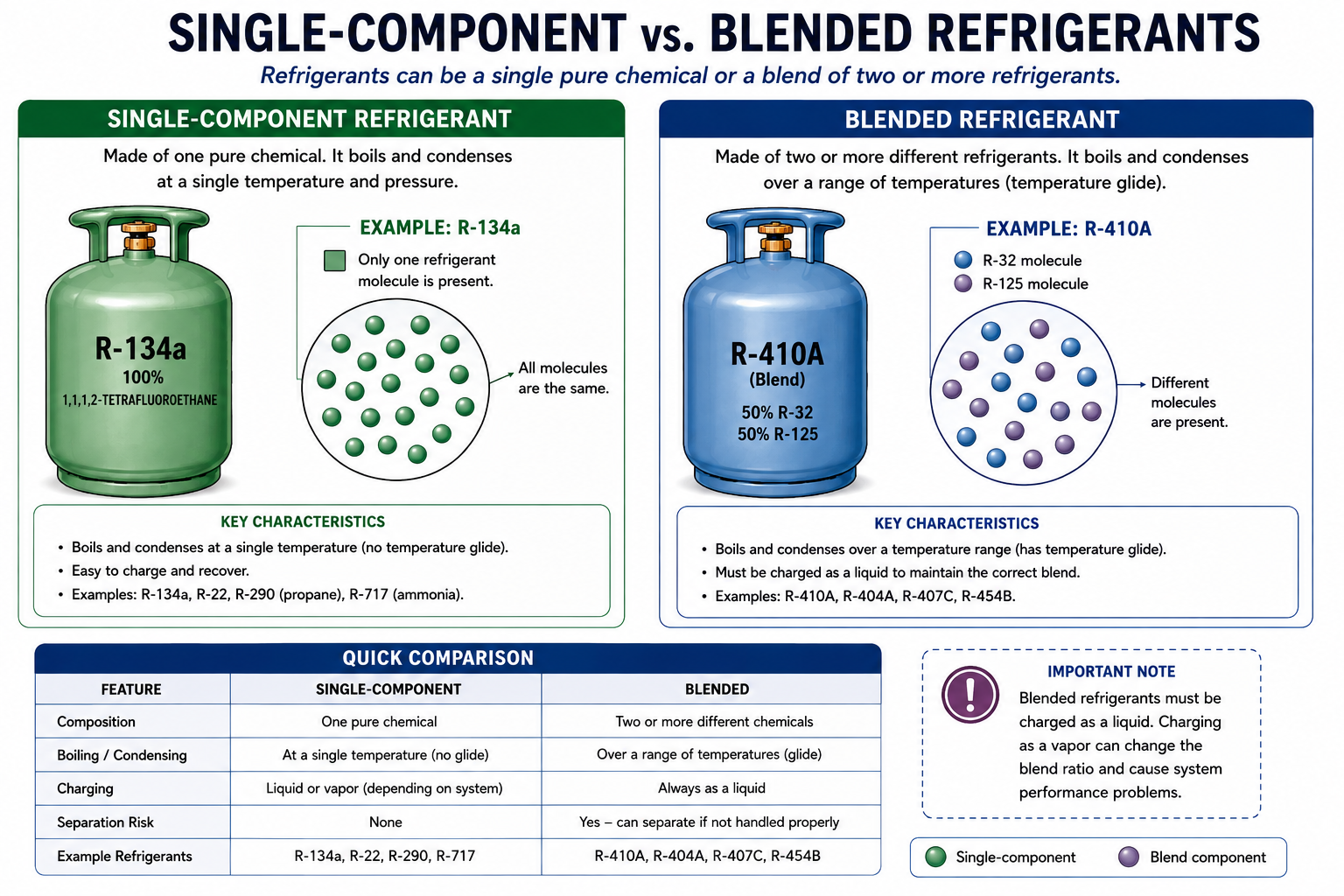
A single-component refrigerant consists essentially of one refrigerant chemical rather than a mixture of several refrigerants.
Examples include R-22, R-32, R-134a, R-290, R-717, and R-744. At a given pressure, a pure refrigerant has one saturation temperature at which liquid and vapor can exist together.
Saturation Conditions
The concepts of saturated liquid, saturated vapor, phase change, and refrigerant condition were introduced earlier in the Refrigeration Theory section. For a graphical review of the liquid, vapor, and two-phase regions, revisit Introduction to the Pressure-Enthalpy Diagram.
Two or More Refrigerants Combined
A refrigerant blend contains two or more refrigerant components mixed in carefully selected proportions. By combining refrigerants, manufacturers can obtain operating characteristics that may not be available from a single refrigerant alone.
Blends are manufactured to have specific compositions. That composition is important because changing the proportion of the individual components can change the way the refrigerant performs.
A refrigerant blend is not simply a random mixture of refrigerants. It is a formulated product whose component proportions are part of its designed operating characteristics.
Not All Refrigerant Blends Behave the Same Way
Refrigerant blends can be grouped according to how their components behave during boiling and condensation.
Azeotropic Blend
An azeotropic blend behaves much like a single-component refrigerant during phase change. Its components boil and condense together at essentially the same temperature under a given pressure.
Near-Azeotropic Blend
A near-azeotropic blend has only a small difference between the temperatures at which boiling begins and finishes. In ordinary service work, its glide may be small but should not automatically be ignored.
Zeotropic Blend
A zeotropic blend changes temperature as it boils or condenses at essentially constant pressure. The difference across this phase-change range is called temperature glide.
Why the Difference Matters
Blend behavior affects pressure-temperature chart use, superheat and subcooling calculations, leak behavior, charging, recovery, and system diagnosis.
A Blend Can Change Temperature During Phase Change
With a single-component refrigerant, the saturation temperature at a particular pressure is one temperature. A zeotropic blend behaves differently because its individual components have different boiling characteristics.
As the blend evaporates or condenses, the refrigerant composition in the liquid and vapor phases changes. The saturation temperature therefore moves through a range instead of remaining at one single value.
The difference between the beginning and ending saturation temperatures at the same pressure is called temperature glide.
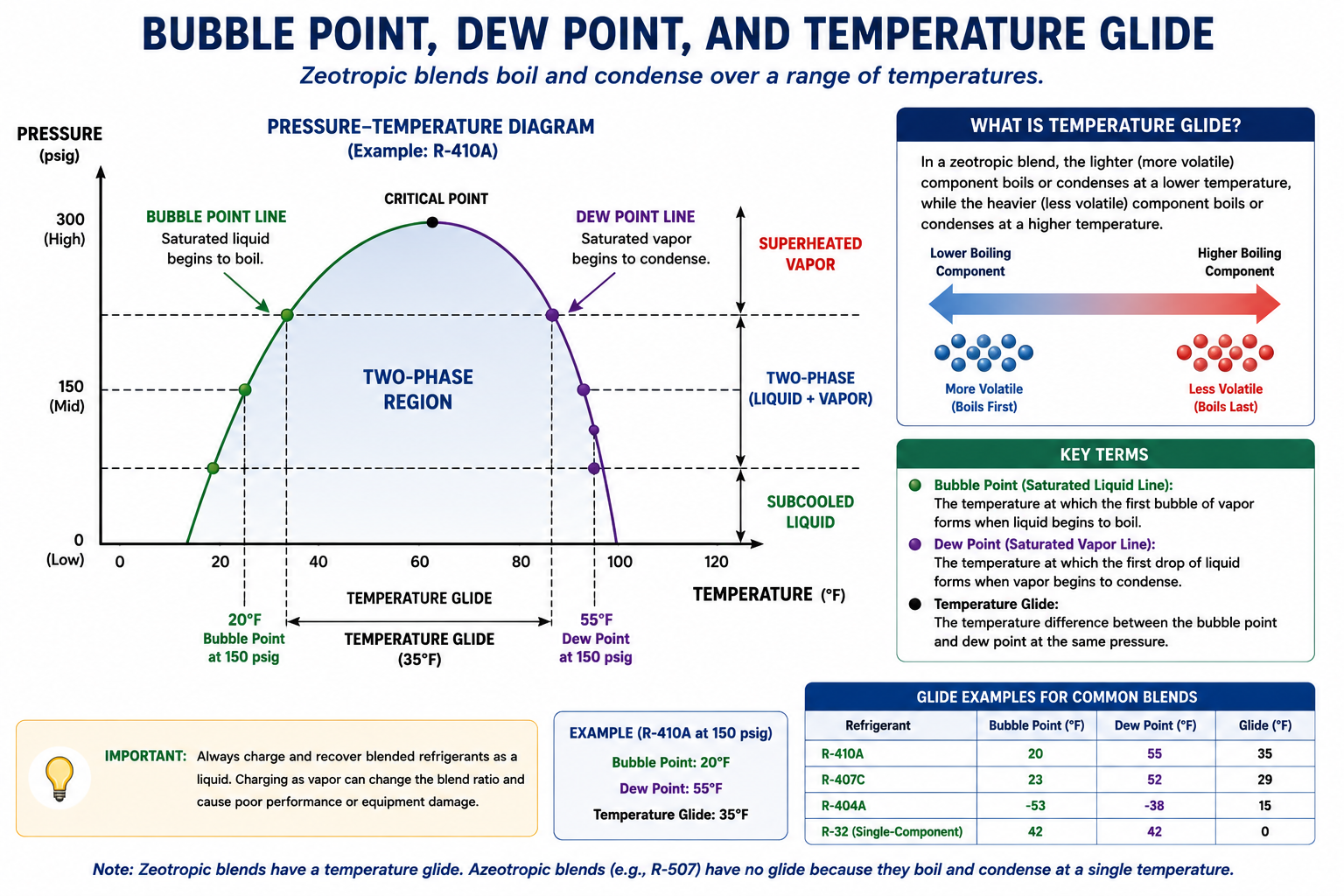
Temperature glide describes a temperature range during phase change. It is not the same thing as superheat or subcooling, which describe how far refrigerant temperature is above or below the appropriate saturation condition.
Where Boiling Begins
The bubble point is the saturation temperature at which the first bubble of vapor begins to form from a liquid refrigerant blend at a given pressure.
When working with a zeotropic blend, bubble-point information represents the liquid-side saturation condition.
Bubble point → liquid-side saturation condition.
Where Condensation Begins — or Evaporation Finishes
The dew point is the saturation temperature associated with the vapor side of the phase-change range. During evaporation, it represents the condition at which the final liquid has vaporized. During condensation, it represents the point where the first liquid begins to form from vapor.
Dew point → vapor-side saturation condition.
Superheat and Subcooling Depend on the Correct Saturation Reference
For blends with meaningful glide, technicians must know whether to use the liquid-side or vapor-side saturation value when evaluating system conditions. The same saturation, superheat, and subcooling concepts previously developed in Refrigeration Theory still apply; the difference is that a blend may provide separate bubble and dew saturation values.
When a Blend’s Composition Changes
Fractionation occurs when the individual components of a refrigerant blend separate enough that the remaining refrigerant no longer has the intended composition.
The components of a blend do not necessarily have identical volatility. If refrigerant vapor is removed from a cylinder or lost from a system under certain conditions, one component may leave more readily than another. The refrigerant that remains can then have a different composition from the original blend.
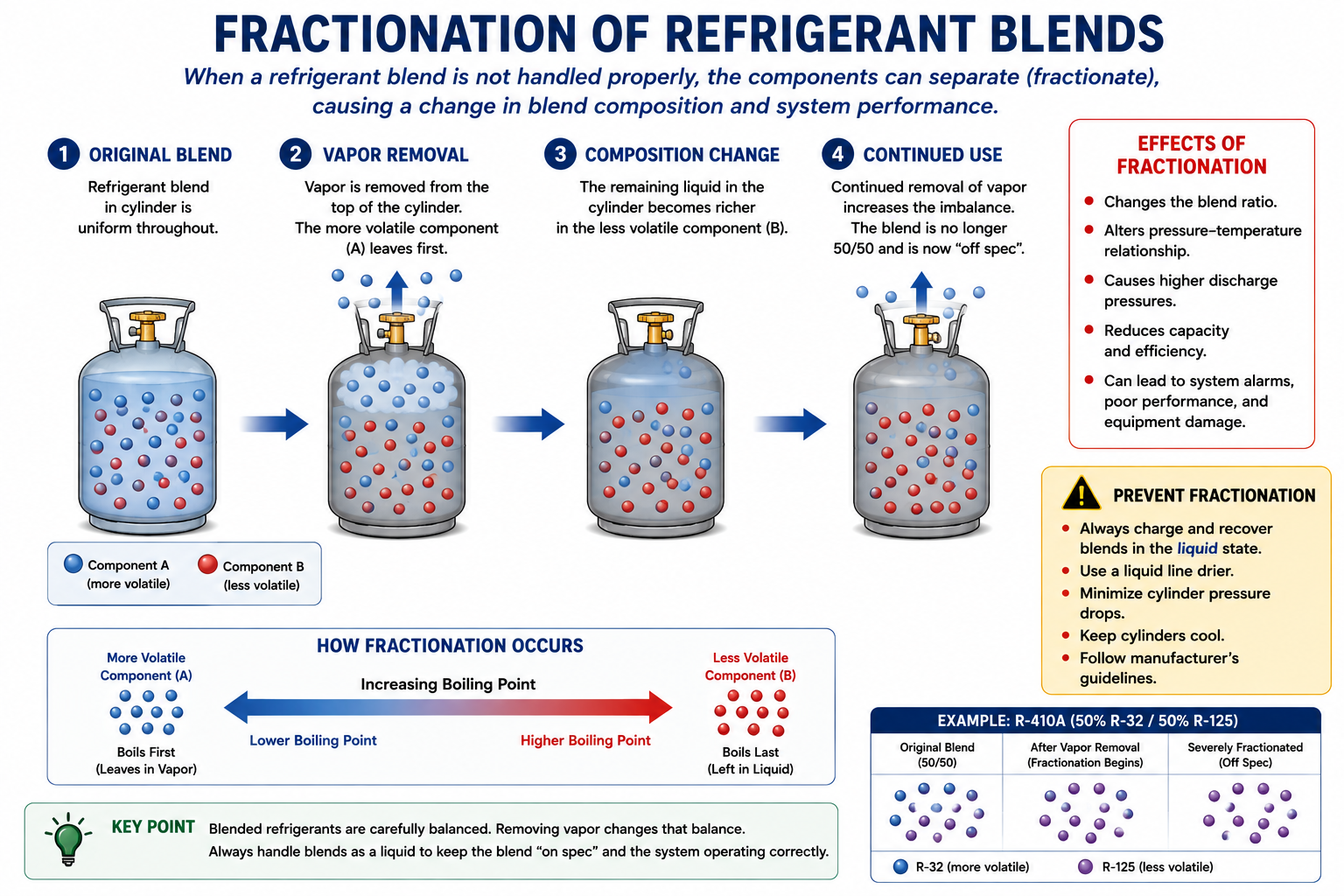
If a blend changes composition, its pressure-temperature relationship, capacity, temperature glide, and other operating characteristics may no longer match those expected for the original refrigerant.
Why Many Refrigerant Blends Are Removed From the Cylinder as Liquid
Removing a refrigerant blend from the cylinder as liquid helps preserve the manufacturer’s intended mixture because the liquid contains the refrigerant components in the designed proportions.
If a susceptible blend is repeatedly removed as vapor, the more volatile component may leave the cylinder at a different rate than the less volatile component. This can alter the composition of the refrigerant remaining in the cylinder.
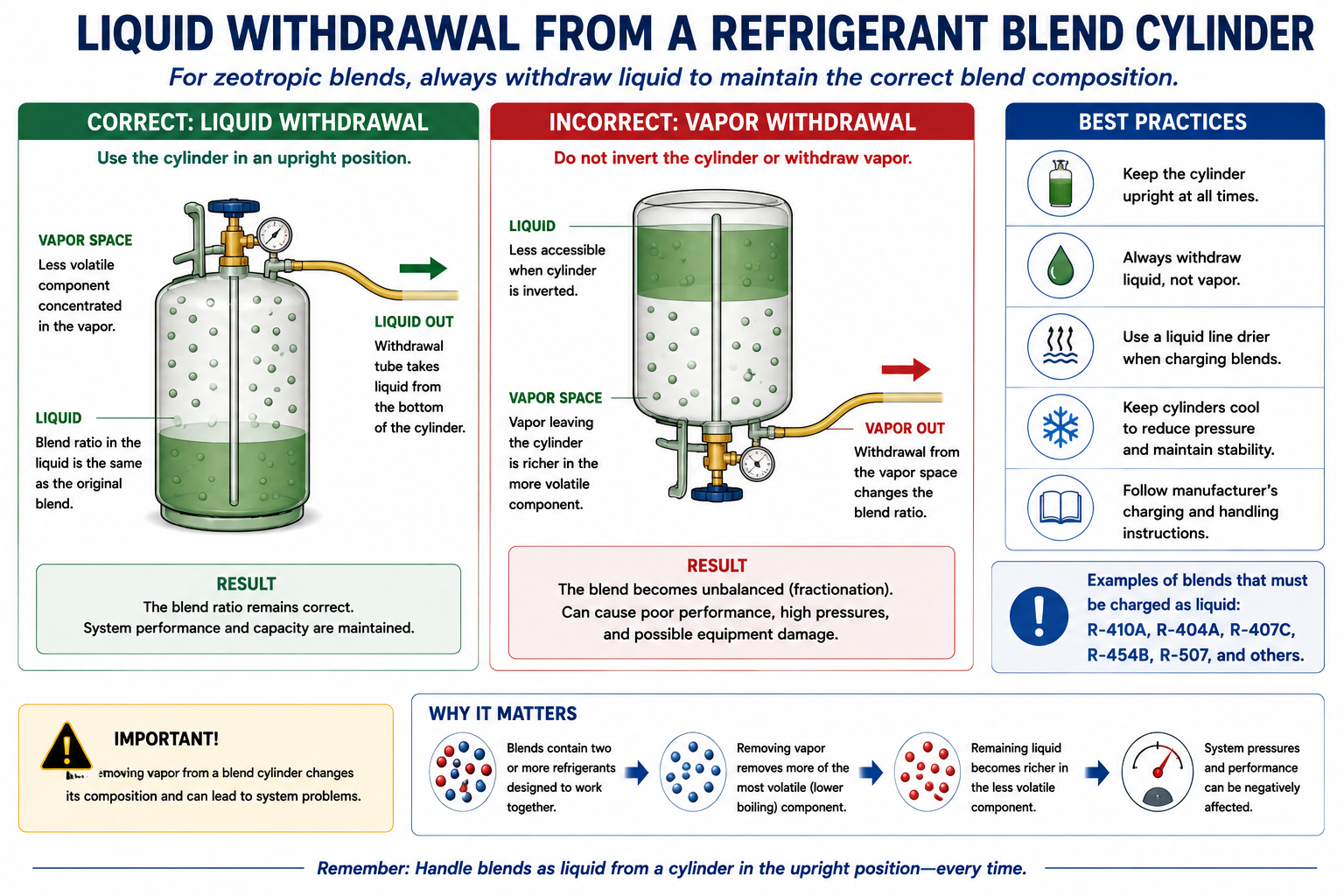
Removing refrigerant from the cylinder as liquid does not mean that uncontrolled liquid refrigerant should be allowed to enter a running compressor. The technician must use the charging method specified for the equipment and control refrigerant flow appropriately.
Examples From Several Refrigerant Families
The following refrigerants will receive more detailed treatment later in this section. For now, concentrate on recognizing that refrigerants may be single components or blends and may belong to different chemical families.
R-22
HCFC • Single component • Legacy air-conditioning and refrigeration applications.
R-32
HFC • Single component • Used directly and as a component of several modern blends.
R-134a
HFC • Single component • Widely used historically in refrigeration and other applications.
R-404A
HFC blend • Commonly associated with commercial refrigeration equipment.
R-407C
HFC blend • Zeotropic behavior with measurable temperature glide.
R-410A
HFC blend • Widely associated with comfort-cooling systems.
R-454B
HFO/HFC blend • Lower-GWP A2L refrigerant used in newer comfort-cooling equipment.
R-290
Hydrocarbon • Single component • Propane refrigerant used in equipment designed specifically for its flammability characteristics.
R-717
Ammonia • Single component • Important industrial refrigeration refrigerant.
R-744
Carbon dioxide • Single component • Used in specialized and commercial refrigeration applications.
Know the Terminology
Refrigerant characteristics and identification, including blend behavior and bubble/dew concepts, are part of the knowledge expected in Section 608 preparation. Do not rely only on memorizing refrigerant numbers; understand the terminology well enough to apply it to service situations.
Be able to distinguish: CFC, HCFC, HFC and HFO refrigerants; single-component refrigerants and blends; azeotropic and zeotropic behavior; bubble point and dew point; temperature glide; and fractionation.
Avoid These Refrigerant Blend Errors
“All refrigerants behave the same way.”
No. Refrigerants differ in pressure, temperature characteristics, chemical composition, safety, oil compatibility, environmental characteristics, and application.
“Every refrigerant blend has large temperature glide.”
No. Some blends have substantial glide, some have very little, and azeotropic blends behave essentially as though they have one saturation temperature.
“Bubble point and dew point are interchangeable.”
No. Bubble point refers to the liquid-side saturation condition, while dew point refers to the vapor-side saturation condition.
“Liquid charging means flood the compressor with liquid.”
No. Liquid withdrawal describes how refrigerant leaves the supply cylinder. Refrigerant must still be introduced into the system using the appropriate charging procedure.
“A blend can be topped off with one of its components.”
No. The refrigerant must maintain its specified formulation. Adding an individual component changes the intended composition.
“A replacement refrigerant is automatically a drop-in.”
No. Refrigerant substitution can affect pressures, oils, seals, controls, metering devices, capacity, safety, and approved equipment use.
Can You Identify Refrigerant Families and Blends?
- What does CFC stand for?
- What element in CFC and HCFC refrigerants is associated with stratospheric ozone depletion?
- What does HCFC stand for?
- What does HFC stand for?
- What does HFO stand for?
- Is R-32 a single-component refrigerant or a blend?
- What is a refrigerant blend?
- What is an azeotropic blend?
- What is a zeotropic blend?
- What is temperature glide?
- What does bubble point represent?
- What does dew point represent?
- What is fractionation?
- Why are many refrigerant blends removed from cylinders as liquid?
- Why does liquid withdrawal from a cylinder not mean that liquid refrigerant should be allowed to flood a compressor?
- Name one hydrocarbon refrigerant.
- What refrigerant number identifies ammonia?
- What refrigerant number identifies carbon dioxide?
What You Should Have Learned
Refrigerants Belong to Families
Major groups include CFC, HCFC, HFC, HFO, hydrocarbons, inorganic or natural refrigerants, and blends.
Chlorine Matters Environmentally
CFC and HCFC refrigerants contain chlorine and are associated with stratospheric ozone depletion.
A Refrigerant May Be Pure or Blended
Single-component refrigerants contain one refrigerant chemical, while blends contain multiple components in designed proportions.
Some Blends Have Temperature Glide
Zeotropic blends change saturation temperature as they evaporate or condense at a given pressure.
Bubble and Dew Are Different
Bubble point represents the liquid-side saturation condition; dew point represents the vapor-side saturation condition.
Fractionation Changes Composition
If blend components separate, the refrigerant may no longer have the intended formulation or operating characteristics.
Blend Handling Matters
Many blends are withdrawn from the supply cylinder as liquid to help maintain the intended refrigerant composition.
Refrigerants Are Not Automatically Interchangeable
Family, composition, pressure, lubricant compatibility, safety, environmental requirements, and equipment design all matter.