Introduction to Refrigerants
A refrigerant is the working fluid of a mechanical refrigeration system. It circulates continuously through the system, absorbing heat where cooling is required and carrying that heat to another location where it can be rejected.
Understanding what refrigerants do—and why their ability to change state is so important—provides the foundation for refrigerant identification, charging, recovery, safety, environmental regulations, and EPA Section 608 certification.
What You Will Learn
After completing this lesson, you should be able to:
Define Refrigerant
Explain the purpose of a refrigerant in a mechanical refrigeration system.
Explain Heat Transport
Describe how refrigerant absorbs heat at one location and rejects it at another.
Explain Phase Change
Describe why evaporation and condensation make refrigerants effective heat-transfer fluids.
Recognize Important Properties
Identify several characteristics that influence whether a substance is suitable for use as a refrigerant.
What Is a Refrigerant?
A refrigerant is a substance used to transfer heat from one location to another as it circulates through a refrigeration system. In most mechanical refrigeration systems, the refrigerant repeatedly changes between liquid and vapor as it moves through the refrigeration cycle.
The refrigerant does not create cold. Instead, it provides a practical means of moving heat. Heat is absorbed from the space, product, air, or process being cooled and is then transported by the refrigerant to another location where that heat can be rejected.
Refrigeration is the transfer of heat from a place where it is not wanted to a place where it can be rejected. The refrigerant is the working fluid that makes this transfer possible.
The Mechanical Refrigeration Cycle
This lesson assumes that you are already familiar with the compressor, condenser, metering device, and evaporator. If you need to review how these components work together, revisit Introduction to Mechanical Refrigeration before continuing.
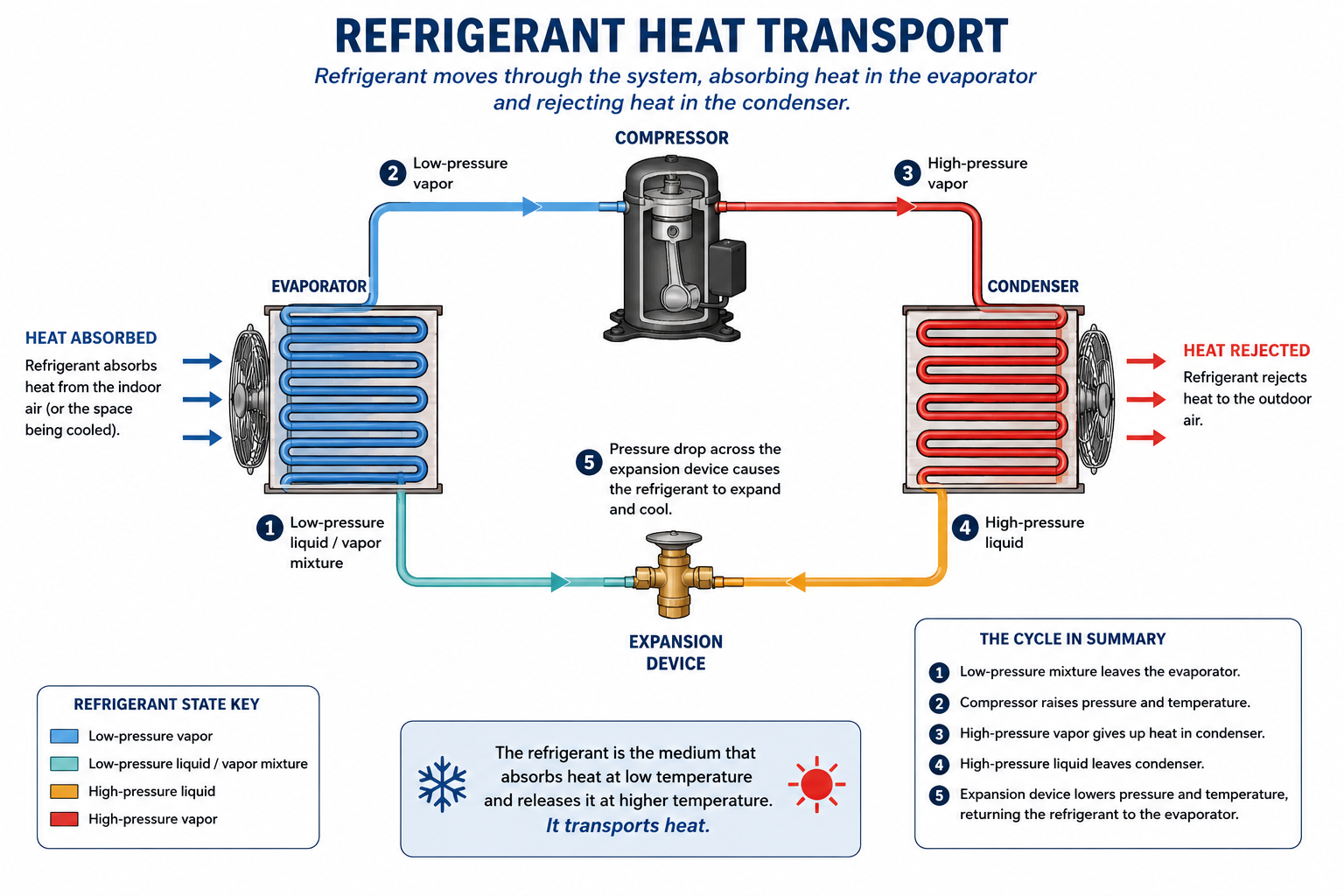
The Refrigerant Is a Heat Carrier
Think of the refrigerant as a continuously circulating heat carrier. The refrigeration system controls the refrigerant’s pressure so that it can absorb heat at a low temperature and reject heat at a higher temperature.
In the evaporator, low-pressure refrigerant absorbs heat from the material or space being cooled. As heat enters the refrigerant, the refrigerant boils and changes from liquid to vapor.
The compressor then moves this vapor through the system and raises its pressure. In the condenser, the refrigerant rejects heat to the surrounding air, water, or another heat sink. As heat leaves the refrigerant, the vapor condenses back into a liquid.
The metering device then reduces the refrigerant pressure so that it can return to the evaporator and repeat the process.
Absorb Heat
The refrigerant enters the evaporator at a low pressure and temperature and absorbs heat.
Move the Vapor
The compressor moves refrigerant vapor and creates the pressure difference required for circulation.
Reject Heat
High-pressure refrigerant rejects heat in the condenser and changes back into a liquid.
Reduce Pressure
The metering device reduces refrigerant pressure so the refrigerant can again absorb heat at a low temperature.
Why Refrigerants Change State
One of the most useful characteristics of a refrigerant is its ability to transfer a large amount of heat while changing state. A liquid refrigerant absorbs heat as it boils and becomes vapor. Refrigerant vapor rejects heat as it condenses and becomes liquid.
During these phase changes, a large amount of energy can be transferred without requiring an equally large change in refrigerant temperature. This energy associated with a change of state is called latent heat.
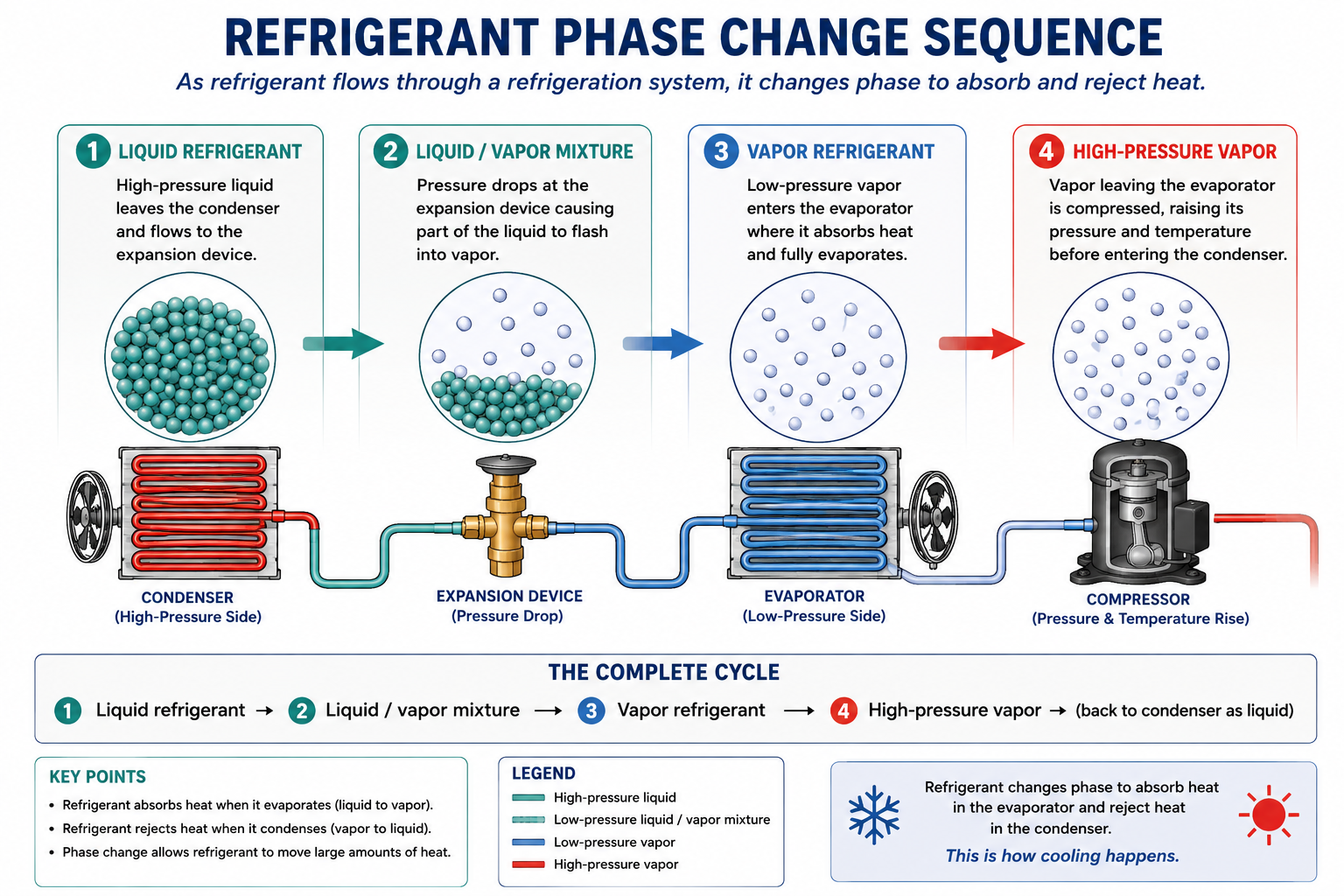
Evaporation
When liquid refrigerant absorbs sufficient heat at the proper pressure, it boils and changes into vapor.
Heat enters the refrigerant.
Condensation
When refrigerant vapor rejects sufficient heat at the proper pressure, it condenses and changes into liquid.
Heat leaves the refrigerant.
Evaporation absorbs heat. Condensation rejects heat. These two phase changes are fundamental to mechanical refrigeration.
Pressure Controls Refrigerant Saturation Temperature
A refrigerant does not have one fixed boiling temperature under all conditions. Its boiling temperature changes when its pressure changes.
Lowering refrigerant pressure lowers its saturation temperature. Raising refrigerant pressure raises its saturation temperature. The refrigeration system uses this relationship to make the refrigerant boil at a temperature low enough to absorb heat in the evaporator and condense at a temperature high enough to reject heat in the condenser.
Low Side
Low refrigerant pressure produces a lower saturation temperature, allowing the refrigerant to absorb heat in the evaporator.
High Side
Higher refrigerant pressure produces a higher saturation temperature, allowing the refrigerant to reject heat in the condenser.
Pressure, Temperature, and Enthalpy
The relationship between refrigerant pressure, temperature, heat content, and phase change is explored in greater detail in Introduction to the Pressure-Enthalpy Diagram. Refer back to that lesson whenever you need a more detailed thermodynamic explanation of what is happening to the refrigerant inside the system.
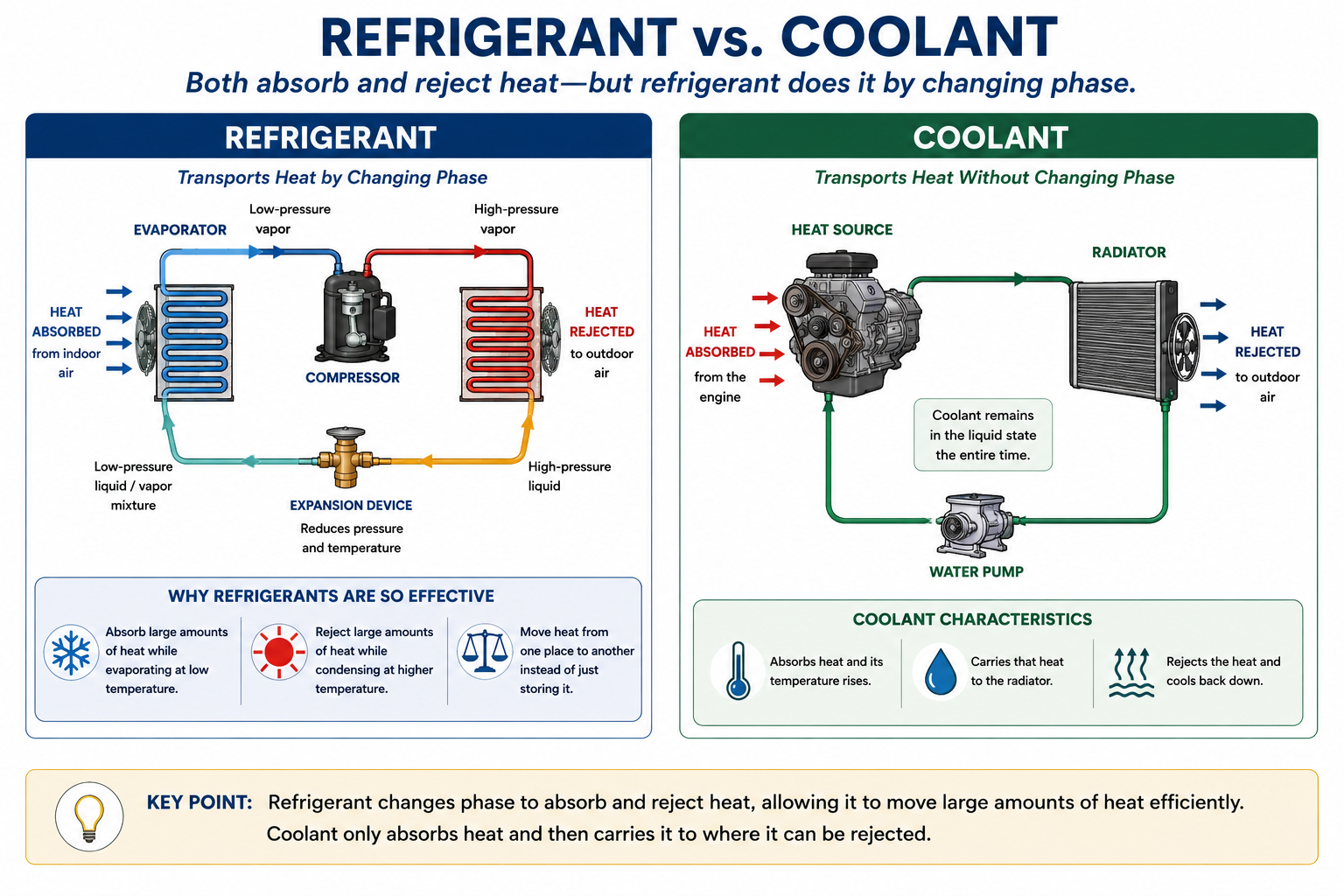
A Refrigerant Is More Than a Coolant
The words refrigerant and coolant are sometimes used as though they mean the same thing, but there is an important distinction in refrigeration work.
A coolant such as water or a water-glycol mixture can carry heat primarily by changing temperature while remaining in the same physical state. A refrigerant in a vapor-compression refrigeration system is specifically selected so that it can repeatedly evaporate and condense under useful operating pressures and temperatures.
Refrigerants are engineered or selected for specific refrigeration applications. Substituting one refrigerant for another simply because both can absorb heat can create serious problems involving pressure, capacity, lubricant compatibility, metering devices, safety, and regulatory requirements.
What Makes a Useful Refrigerant?
No refrigerant is ideal for every application. Refrigerant selection involves balancing thermodynamic performance, operating pressure, material compatibility, lubricant compatibility, safety, environmental impact, cost, and equipment design.
Useful Operating Pressures
The refrigerant must operate at pressures appropriate for the equipment and application.
Effective Heat Transfer
A useful refrigerant should be capable of absorbing and rejecting substantial amounts of heat during operation.
Chemical Stability
The refrigerant should remain stable under the temperatures and conditions encountered inside the system.
Material Compatibility
The refrigerant must be compatible with system metals, seals, gaskets, motor insulation, and other materials.
Lubricant Compatibility
The refrigerant and compressor lubricant must work together while allowing proper lubrication and oil return.
Acceptable Safety
Toxicity, flammability, operating pressure, and other hazards must be appropriate for the intended application.
Environmental Impact
Ozone depletion potential and global warming potential have become major factors in refrigerant selection and regulation.
Practical Serviceability
Technicians must be able to identify, recover, charge, transport, and service the refrigerant using appropriate equipment and procedures.
These characteristics will be examined individually throughout this section. Do not try to memorize every refrigerant property yet. The goal of this lesson is to understand what the refrigerant does before comparing the many refrigerants used in the field.
Why This Matters for Certification
EPA Section 608 certification requires more than recognizing refrigerant names. A technician must understand how refrigerants behave, how they are handled, why releases are regulated, and how refrigerant characteristics affect recovery and service procedures.
As you progress through this section, EPA-related material will be connected directly to the underlying refrigeration principles. Later lessons will bring those concepts together for Core, Type I, Type II, Type III, and Universal certification review.
Before learning recovery requirements and regulations, be certain you understand this basic principle: the refrigerant is the working fluid that absorbs, transports, and rejects heat as it circulates through the refrigeration system.
What You Should Have Learned
Refrigerant Is a Working Fluid
It circulates through the refrigeration system and provides the means of transporting heat.
Refrigeration Moves Heat
The system does not manufacture cold. It removes heat from one location and rejects it somewhere else.
Phase Change Is Important
Refrigerant absorbs heat while evaporating and rejects heat while condensing.
Pressure and Temperature Are Related
Changing refrigerant pressure changes its saturation temperature and allows the refrigeration cycle to operate.
Refrigerants Are Not Interchangeable
Different refrigerants have different pressures, properties, safety characteristics, environmental effects, and compatibility requirements.
There Is No Universal Refrigerant
Refrigerant selection depends on the application, equipment design, safety requirements, performance, and environmental considerations.