Sensible Cooling, Latent Cooling, and Dehumidification
A cooling coil may lower air temperature, remove water vapor, or do both at the same time. The temperature change is the sensible part of cooling, while the energy associated with water vapor condensing and leaving the air is the latent part.
This lesson separates sensible and latent cooling, follows both processes on the psychrometric chart, and connects the plotted changes with cooling-coil temperature, condensate, airflow, and field measurements.
What You Will Learn
Distinguish sensible cooling from latent cooling.
Explain why total cooling can include both sensible and latent heat removal.
Plot an ideal sensible-cooling process at constant humidity ratio.
Plot cooling and dehumidification as decreasing temperature and humidity ratio.
Relate coil surface temperature to dew point and condensate formation.
Use entering- and leaving-air measurements to evaluate coil operation.
Sensible Heat Changes Temperature; Latent Heat Changes Moisture
Sensible heat is energy associated with a temperature change that can be detected by a temperature sensor. Sensible cooling lowers dry-bulb temperature without changing the amount of water vapor in the air.
Latent heat is energy associated with a change of state. During air-conditioning dehumidification, water vapor changes to liquid water on a cold coil. Removing that vapor and its associated energy is the latent part of the cooling process.
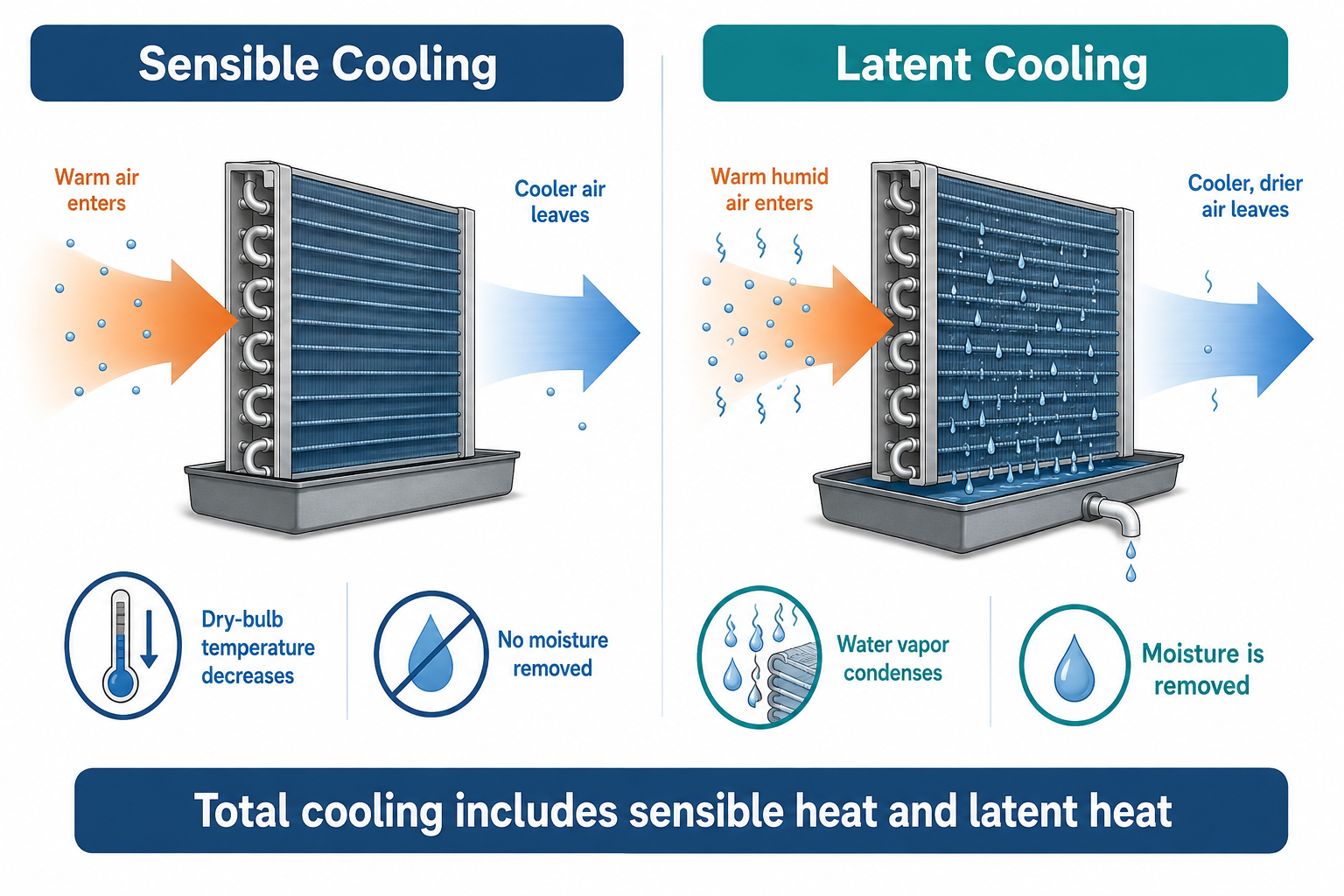
Dry-Bulb Temperature Decreases
No water vapor is removed, so humidity ratio and dew point remain constant while relative humidity rises.
Water Vapor Condenses
Moisture leaves the air as liquid condensate, so humidity ratio and dew point decrease.
A temperature drop shows sensible cooling, but it does not prove moisture was removed. Compare entering- and leaving-air humidity ratio or dew point and verify condensate formation under stable conditions.
Most Comfort-Cooling Coils Perform Both Tasks
Total cooling is the combined energy removed through sensible cooling and latent cooling. A coil may devote more of its capacity to temperature reduction under one condition and more to moisture removal under another.
The split depends on entering-air temperature and moisture, coil surface temperature, airflow, refrigerant or chilled-water conditions, coil size and cleanliness, equipment controls, and how long the system operates.
Mostly Sensible Load
The air needs substantial temperature reduction but little moisture removal, so most of the cooling effect lowers dry-bulb temperature.
Significant Latent Load
Humid air requires moisture removal, so a meaningful part of coil capacity is used to condense water vapor.
Changing Conditions
Outdoor air, occupancy, ventilation, infiltration, cooking, showers, processes, and weather can change the sensible and latent loads.
If equipment satisfies the thermostat quickly but removes too little water vapor, room temperature may be acceptable while humidity remains high. Diagnosis must include moisture measurements, airflow, run time, ventilation, infiltration, and equipment operation.
Move Left at Constant Humidity Ratio
An ideal sensible-only cooling process is shown by a horizontal line moving left. Dry-bulb temperature and enthalpy decrease, relative humidity increases, and humidity ratio and dew point remain constant because no water vapor is added or removed.
The example begins at 80°F dry bulb and 50% relative humidity with a humidity ratio of approximately 76 grains per pound of dry air. Cooling to 65°F at the same humidity ratio raises relative humidity to approximately 83%.
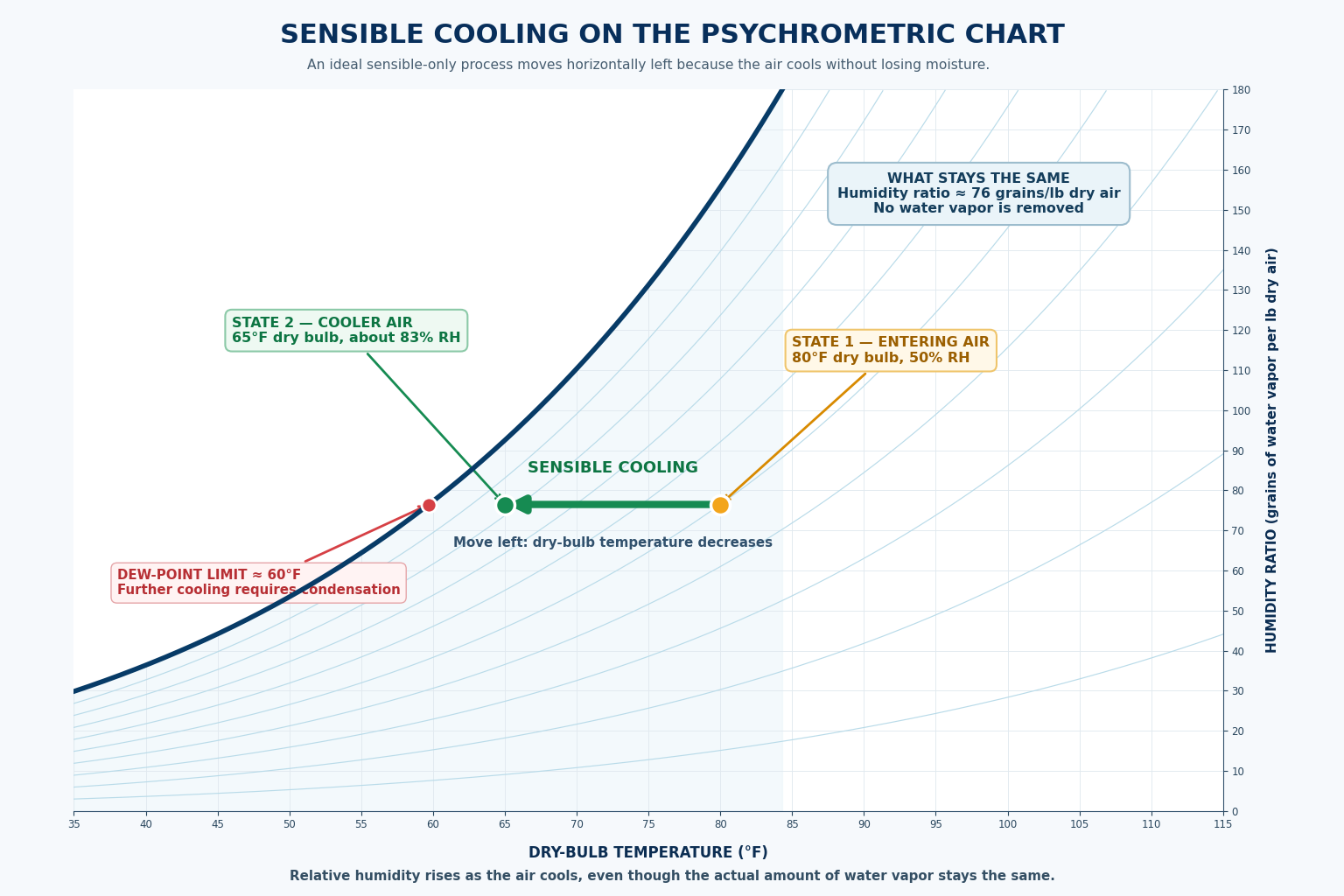
Dry Bulb
Decreases as the process moves left.
Humidity Ratio
Remains constant because no water vapor is removed.
Relative Humidity
Increases because the cooler air is closer to saturation.
Dew Point
Remains constant because the moisture content and pressure remain unchanged.
The horizontal process can continue only until it reaches the saturation curve at the entering air’s dew point. Further cooling requires water vapor to condense, so the humidity ratio must decrease.
Move Down and Left When Temperature and Moisture Both Decrease
When a cooling coil surface is below the entering air’s dew point, some air next to the coil reaches saturation and water vapor condenses. The leaving air is cooler and contains less water vapor per pound of dry air.
On the chart, the process moves left because dry-bulb temperature decreases and downward because humidity ratio decreases. Enthalpy and dew point also decrease.
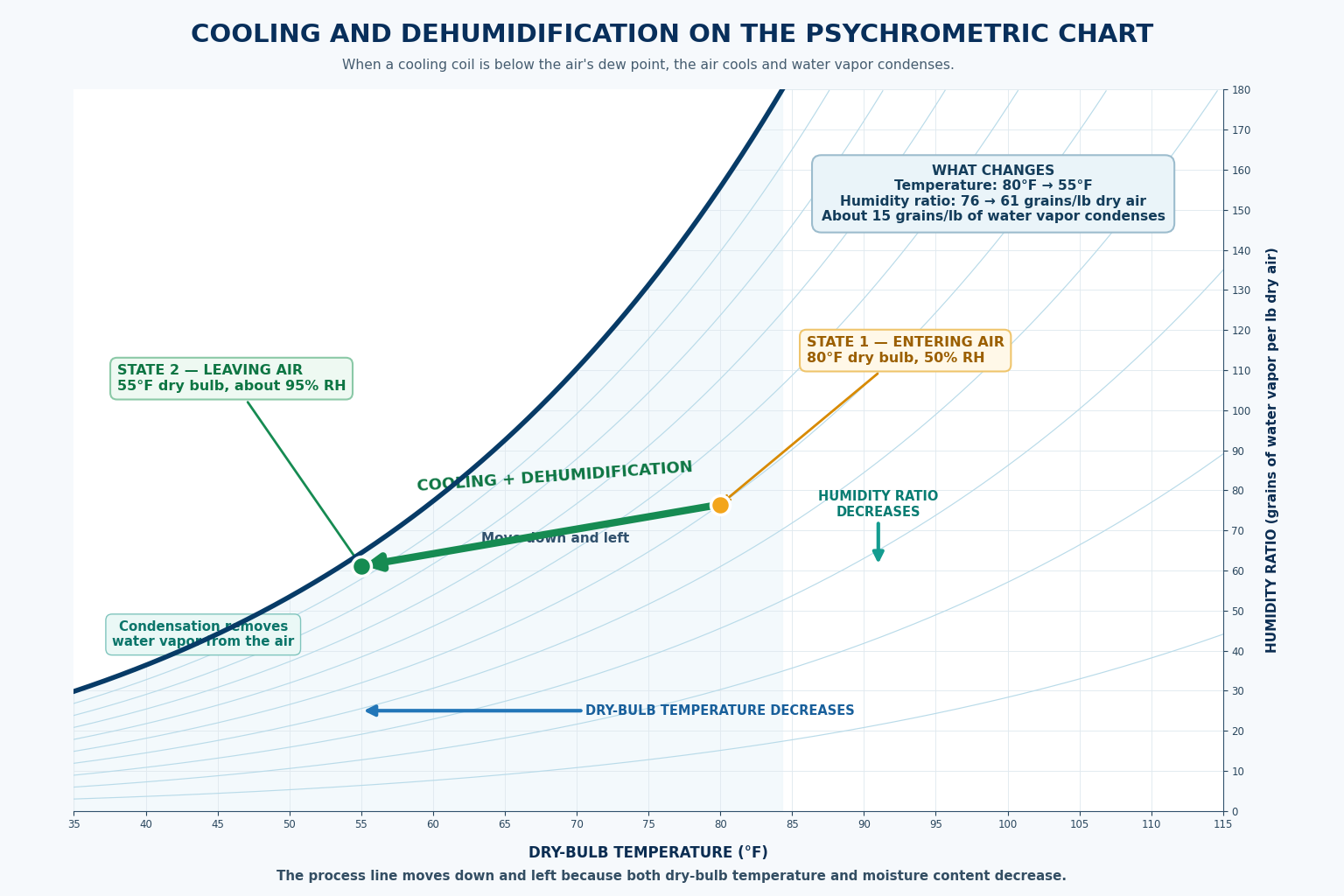
Entering Air
The example begins at 80°F dry bulb, 50% relative humidity, and approximately 76 grains per pound of dry air.
Leaving Air
The example ends at 55°F dry bulb, approximately 95% relative humidity, and approximately 61 grains per pound of dry air.
Moisture Removed
The humidity-ratio decrease is approximately 15 grains of water vapor per pound of dry air.
The example leaving air is near saturation because it is cold, yet its humidity ratio is lower than the entering air. Relative humidity increased while the actual moisture content per pound of dry air decreased.
Coil Temperature Determines Whether Condensation Can Begin
If the entire effective coil surface remains above the entering air’s dew point, the coil can provide sensible cooling but should not condense moisture from that air. When enough coil surface is below dew point, condensation and latent heat removal can occur.
A real coil does not bring every air molecule to one identical surface temperature. Some air passes close to cold surfaces and some passes through warmer paths, then the streams mix. For this reason, measured leaving air is often near saturation but not exactly at 100% relative humidity.
Coil Above Dew Point
Expect sensible cooling without condensate from the measured airstream.
Coil Below Dew Point
Condensation can form, allowing humidity ratio and dew point to decrease.
Mixed Leaving Air
Air contacting different parts of the coil mixes downstream, so leaving conditions depend on coil contact and bypass.
Measurement location matters: Measure far enough downstream for leaving air to be reasonably mixed, but before heat gain, duct leakage, or another airstream changes the condition.
Airflow Affects Coil Temperature and Contact Time
Airflow is one of several conditions that affect how a coil divides its capacity between sensible and latent cooling. Lower airflow may produce colder leaving air and more moisture removal per pound of dry air, while higher airflow may produce warmer leaving air and less moisture removal per pound.
These are general tendencies, not instructions to adjust airflow outside the manufacturer’s required range. Incorrect airflow can cause poor capacity, icing, liquid refrigerant return, noise, comfort problems, equipment damage, or other unsafe and unreliable operation.
Verify airflow against manufacturer data and diagnose equipment sizing, staging, controls, coil condition, refrigerant operation, ventilation, infiltration, and moisture loads before making adjustments.
Compare Entering Air, Leaving Air, and Condensate
1. Stabilize the System
Allow the equipment to operate under a representative load long enough for air and refrigerant conditions to stabilize.
2. Measure Entering Air
Record representative entering dry-bulb temperature and a moisture-related property at the coil inlet.
3. Measure Leaving Air
Record the same properties in reasonably mixed leaving air before another heat or moisture source changes them.
4. Plot Both States
Use the correct chart pressure and units, then connect the entering and leaving state points.
5. Compare the Changes
A lower dry-bulb temperature shows sensible cooling; a lower humidity ratio shows moisture removal.
6. Inspect the Complete System
Check airflow, coil cleanliness, condensate drainage, refrigerant or water conditions, controls, run time, ventilation, and moisture sources.
A wet drain shows that some condensation occurred. It does not by itself prove that the system is removing moisture at the expected rate or maintaining the intended indoor condition.
Avoid These Cooling and Dehumidification Errors
“A temperature drop proves dehumidification.”
A dry-bulb decrease proves sensible cooling. Humidity ratio or dew point must also decrease to show moisture removal.
“High leaving-air RH means the coil added moisture.”
Cold leaving air can have high relative humidity while containing fewer grains of water vapor per pound of dry air.
“All cooling is sensible cooling.”
When water vapor condenses on the coil, the total cooling also includes latent heat removal.
“All leaving air must be exactly saturated.”
Real coil contact and bypass produce mixed leaving air that is often near saturation but not necessarily at 100% relative humidity.
“More condensate always means better operation.”
Condensate amount depends on moisture load, airflow, coil condition, operating time, and other system conditions.
“Airflow should be lowered whenever humidity is high.”
Airflow must remain within manufacturer requirements, and the complete source of the humidity problem must be diagnosed.
Can You Separate Sensible and Latent Cooling?
- What property changes during sensible cooling?
- What happens to humidity ratio during ideal sensible-only cooling?
- Why does relative humidity rise during sensible cooling?
- What phase change occurs during latent cooling?
- What must happen to humidity ratio when water vapor is removed?
- In what direction does sensible cooling move on the chart?
- In what direction does cooling with dehumidification move?
- Why must a coil surface be below the entering air’s dew point for condensation to occur?
- Why can leaving air have high relative humidity while containing less moisture?
- Why is real leaving-coil air not always exactly saturated?
- What measurements show sensible cooling and latent moisture removal?
- Why should airflow not be reduced without checking manufacturer requirements?
What You Should Have Learned
Sensible cooling lowers dry-bulb temperature without removing water vapor.
Latent cooling removes energy as water vapor condenses and leaves the air as liquid water.
Total cooling can include both sensible temperature reduction and latent moisture removal.
Ideal sensible cooling moves horizontally left on the chart at constant humidity ratio and dew point.
Cooling with dehumidification moves down and left because dry-bulb temperature and humidity ratio both decrease.
A coil must be cold enough relative to entering-air dew point for condensation and latent heat removal to occur.
Cold leaving air can have high relative humidity while its humidity ratio and dew point are lower than those of the entering air.
Coil evaluation requires entering- and leaving-air properties together with airflow, drainage, equipment operation, controls, and moisture loads.