Refrigerant Safety and Personal Protection
Refrigerants make modern air conditioning and refrigeration possible, but the same physical properties that allow them to absorb and move heat can also create serious hazards during service work. Refrigerants may be stored under substantial pressure, rapidly cool when released, displace breathable air, expose the eyes and skin to liquid refrigerant, or create hazardous decomposition products when exposed to extreme heat or flame.
Safe refrigerant work begins before a hose is connected or a valve is opened. A technician must identify the refrigerant, understand its hazards, inspect the work area, select appropriate personal protective equipment, use pressure-rated tools and cylinders, and know what to do if an unexpected release occurs.
Learning Objectives
Recognize Refrigerant Hazards
Identify the pressure, temperature, inhalation, chemical, and physical hazards that may be present when working with refrigerants.
Select Appropriate PPE
Explain why eye protection, gloves, protective clothing, and other PPE must be selected according to the hazards of the specific task.
Work Safely With Pressurized Equipment
Understand the hazards associated with refrigerant cylinders, recovery equipment, service hoses, and compressed nitrogen cylinders.
Prevent Exposure and Injury
Apply safe work practices that reduce the possibility of frostbite, eye injury, pressure-related accidents, inhalation exposure, and exposure to refrigerant decomposition products.
Refrigerant Safety Involves More Than One Hazard
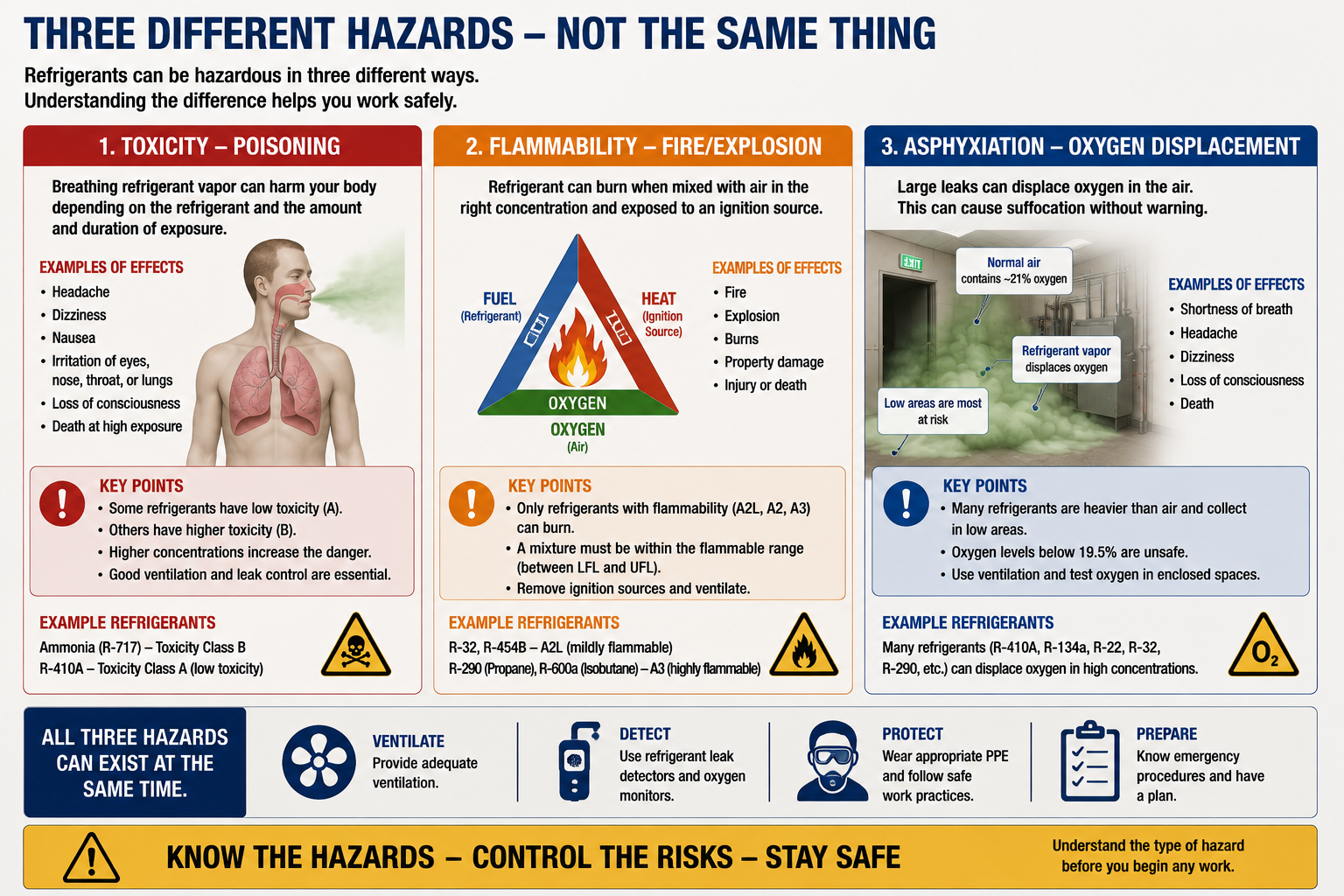
It is easy to think of refrigerant safety as simply avoiding leaks. In reality, technicians work with a combination of chemical, pressure, temperature, mechanical, and atmospheric hazards. The exact risks depend on the refrigerant, equipment, quantity involved, location of the work, and service procedure being performed.
Cold Liquid and Vapor
Liquid refrigerant that rapidly evaporates can remove heat from skin and eye tissue very quickly, creating a serious cold-contact injury.
Stored Pressure
Refrigerant cylinders and operating systems contain stored energy. A damaged hose, fitting, valve, cylinder, or component can release refrigerant suddenly and forcefully.
Atmospheric Exposure
Released refrigerant vapor can accumulate in an inadequately ventilated space and may reduce the amount of breathable oxygen available to workers.
Chemical Exposure
Health effects vary by refrigerant. Technicians must consult the Safety Data Sheet for the specific refrigerant rather than assuming all refrigerants have the same exposure characteristics.
Heat and Flame
Some refrigerants can decompose when exposed to very high temperatures, flames, or hot surfaces and form hazardous decomposition products.
Flammability
Some modern refrigerants are classified as flammable or mildly flammable. Refrigerant flammability and A2L service precautions are examined in detail in Lesson 30.
PPE Is the Last Line of Defense
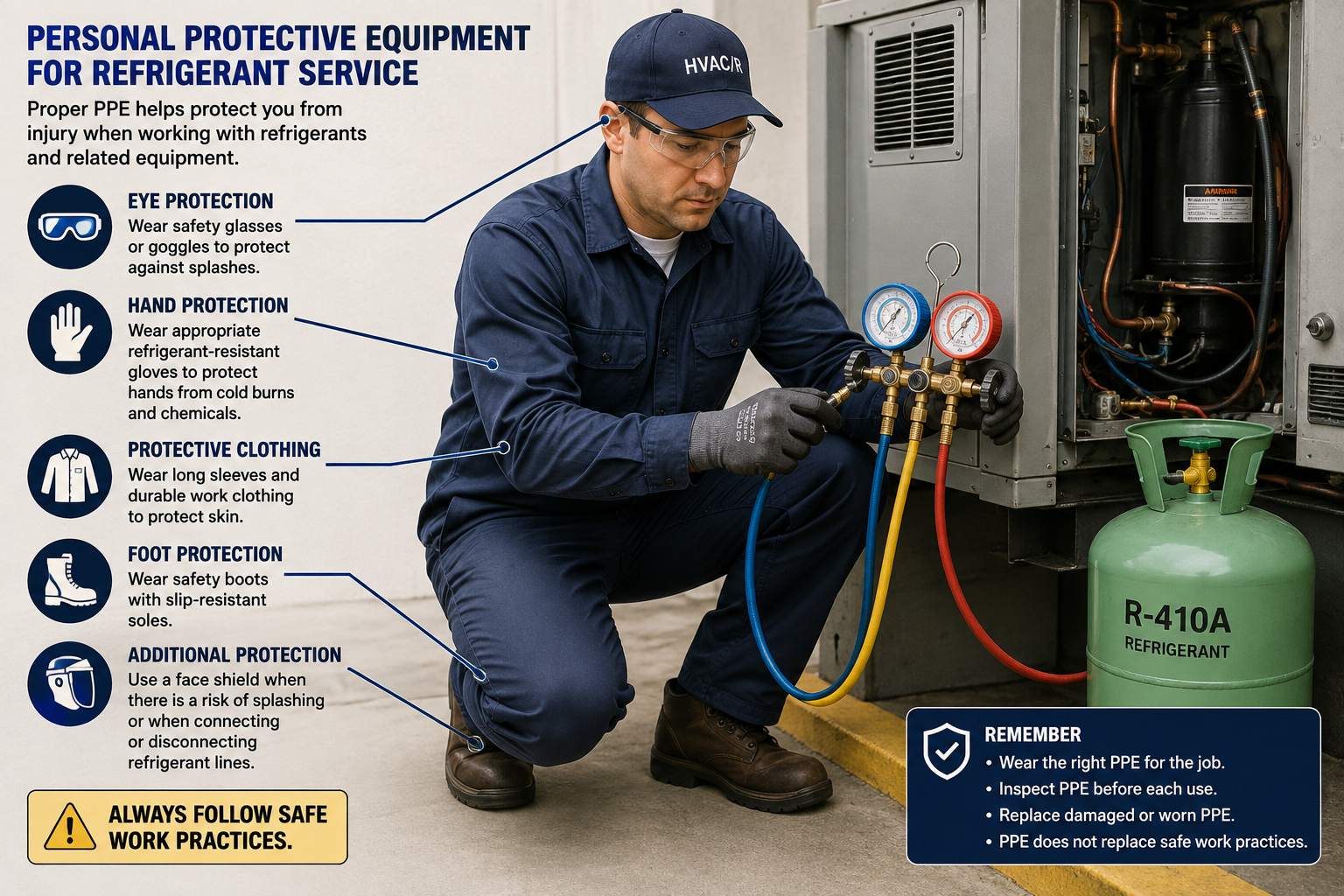
Personal protective equipment reduces the possibility or severity of injury when a worker is exposed to a hazard. PPE does not make an unsafe procedure safe, and it should not replace proper equipment, ventilation, leak prevention, pressure control, or good service practices.
OSHA workplace safety requirements require employers to evaluate workplace hazards and select appropriate PPE when hazards are present or likely to be present. The appropriate protection therefore depends on the work being performed rather than on a universal refrigerant-service clothing list.
Eye Protection
Appropriate safety glasses or goggles help protect the eyes from liquid refrigerant, particles, and unexpected spray when opening or disconnecting pressurized equipment.
Hand Protection
Gloves selected for the task can reduce exposure to cold refrigerant, sharp sheet metal, hot surfaces, oils, chemicals, and other service hazards.
Protective Clothing
Work clothing should provide suitable coverage for the hazards present and should not create additional hazards around rotating machinery, flames, or electrical equipment.
Foot Protection
Appropriate work footwear can help protect against dropped tools, cylinders, equipment, sharp objects, slippery surfaces, and other mechanical hazards.
EPA Section 608 and PPE Are Different Issues
EPA Section 608 establishes refrigerant-management requirements such as restrictions on intentional venting and requirements associated with refrigerant recovery. OSHA and other workplace-safety requirements address employee protection, including hazard assessment and PPE. A technician must understand both environmental regulations and workplace safety requirements.
Why Liquid Refrigerant Can Cause Frostbite
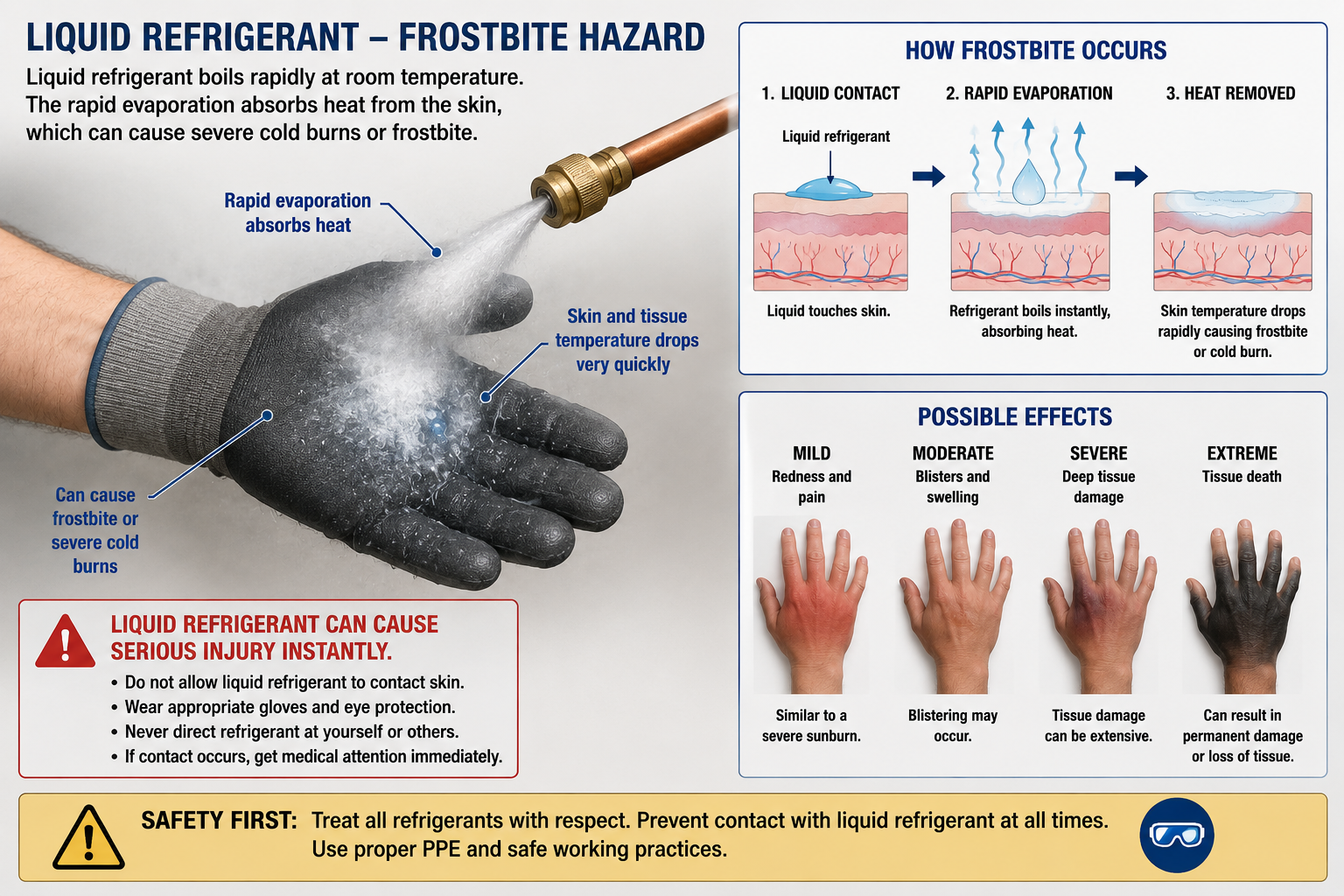
Many refrigerants are stored as liquids under pressure. When liquid refrigerant is released to a lower pressure, some or all of it can rapidly evaporate. Evaporation requires energy, and the refrigerant absorbs heat from the surrounding material as it changes state.
If that material is a technician’s skin, heat can be removed from the tissue very rapidly. The resulting cold-contact injury is commonly described as refrigerant frostbite. The danger is particularly significant when opening service connections, removing hoses, handling leaking valves, or working around damaged equipment.
Do Not Intentionally Use Your Hand to Check for Refrigerant
Never deliberately expose skin to refrigerant to determine whether a valve, hose, fitting, or system contains pressure. Use appropriate instruments and service procedures. An unexpected liquid release can injure tissue much faster than a technician can move away from it.
If refrigerant contacts the skin, stop the exposure and follow the first-aid instructions provided by the Safety Data Sheet for that specific refrigerant and your employer’s emergency procedures. Severe cold-contact injuries require prompt medical evaluation.
The Eyes Are Especially Vulnerable
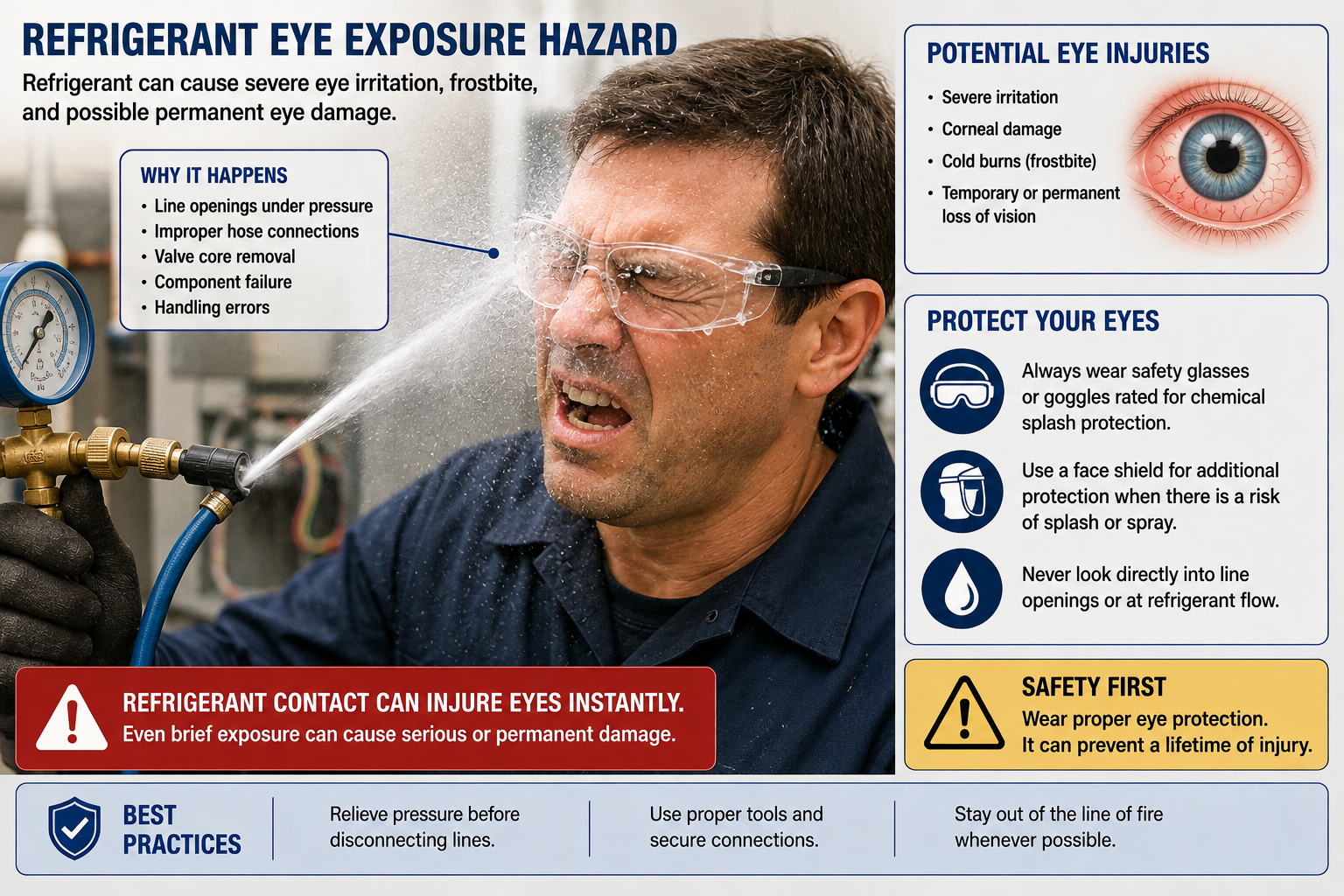
An unexpected refrigerant release does not always travel in the direction a technician expects. Pressurized liquid or vapor can be redirected by a fitting, hose, valve core, access port, or nearby surface and reach the face or eyes.
The eyes are particularly vulnerable to rapid cooling and chemical exposure. Suitable eye or face protection should therefore be used whenever the work presents a possibility of refrigerant spray or other eye hazards.
Eye Exposure Is an Emergency
If refrigerant enters the eyes, immediately follow the emergency eyewash and first-aid instructions in the refrigerant’s Safety Data Sheet and workplace emergency procedures. Obtain appropriate medical evaluation. Do not assume the eye is uninjured simply because pain decreases after the refrigerant evaporates.
Refrigerant Systems Contain Stored Energy
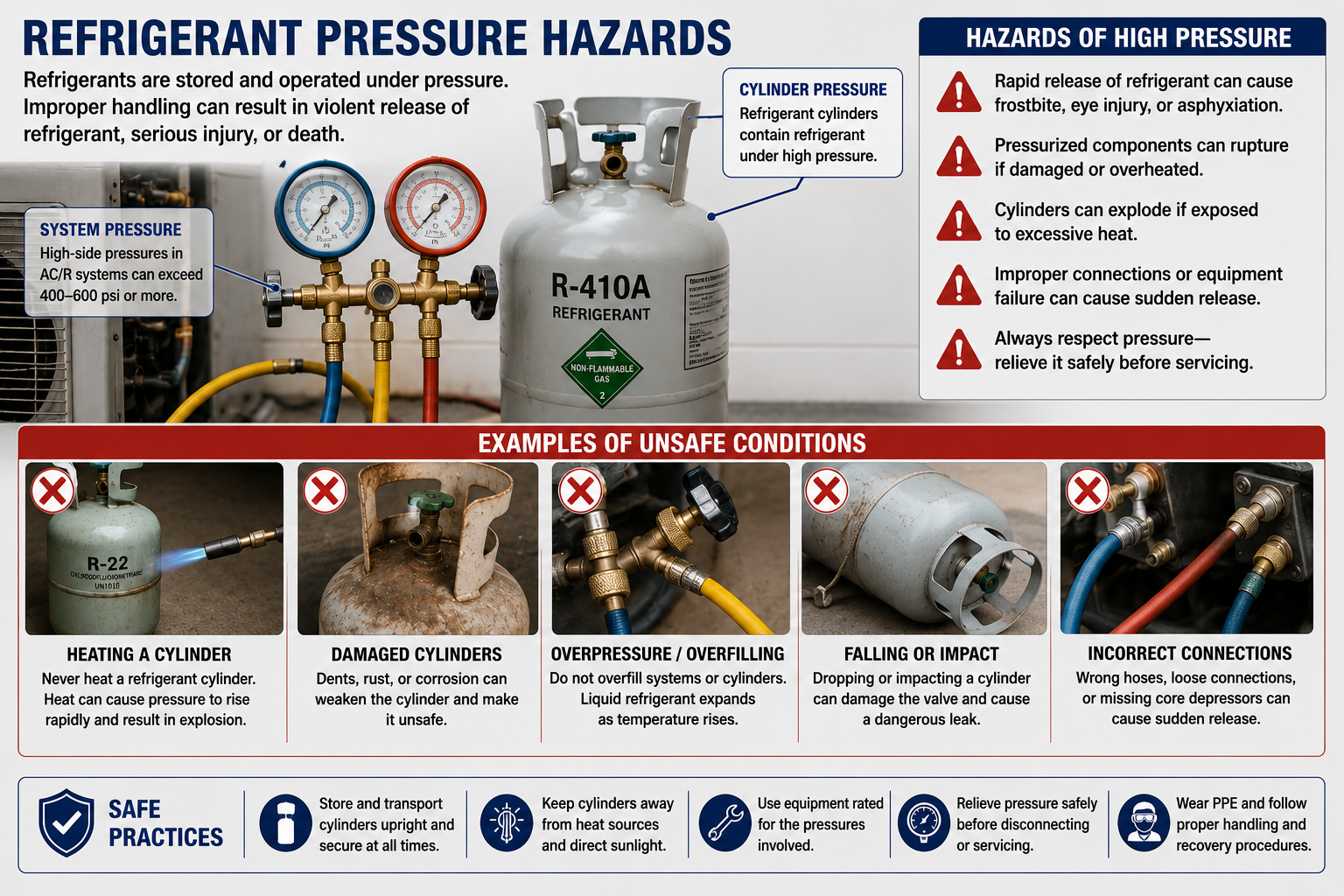
Refrigeration and air-conditioning systems operate under pressure, and refrigerant cylinders store refrigerant under pressure even when they are not connected to a system. Pressure itself is therefore a major service hazard.
A loose fitting, damaged hose, weakened cylinder, incorrect adapter, defective valve, or improper service procedure can create a sudden release. The refrigerant may escape at high velocity, move hoses violently, propel debris, or expose the technician to liquid refrigerant.
Inspect Before Connecting
Check hoses, seals, fittings, valves, gauges, and recovery equipment for damage before placing them under pressure.
Use Rated Equipment
Tools, hoses, manifolds, recovery equipment, regulators, and cylinders must be suitable for the pressures and refrigerants involved.
Open Valves Carefully
Do not assume a connection is depressurized. Control valves deliberately and position yourself so that an unexpected release is less likely to strike you.
Never Heat a Cylinder Improperly
Adding uncontrolled heat to a refrigerant cylinder can increase internal pressure and create a dangerous condition. Follow cylinder and equipment manufacturer instructions.
Nitrogen Is Useful, but It Is Still a High-Pressure Gas
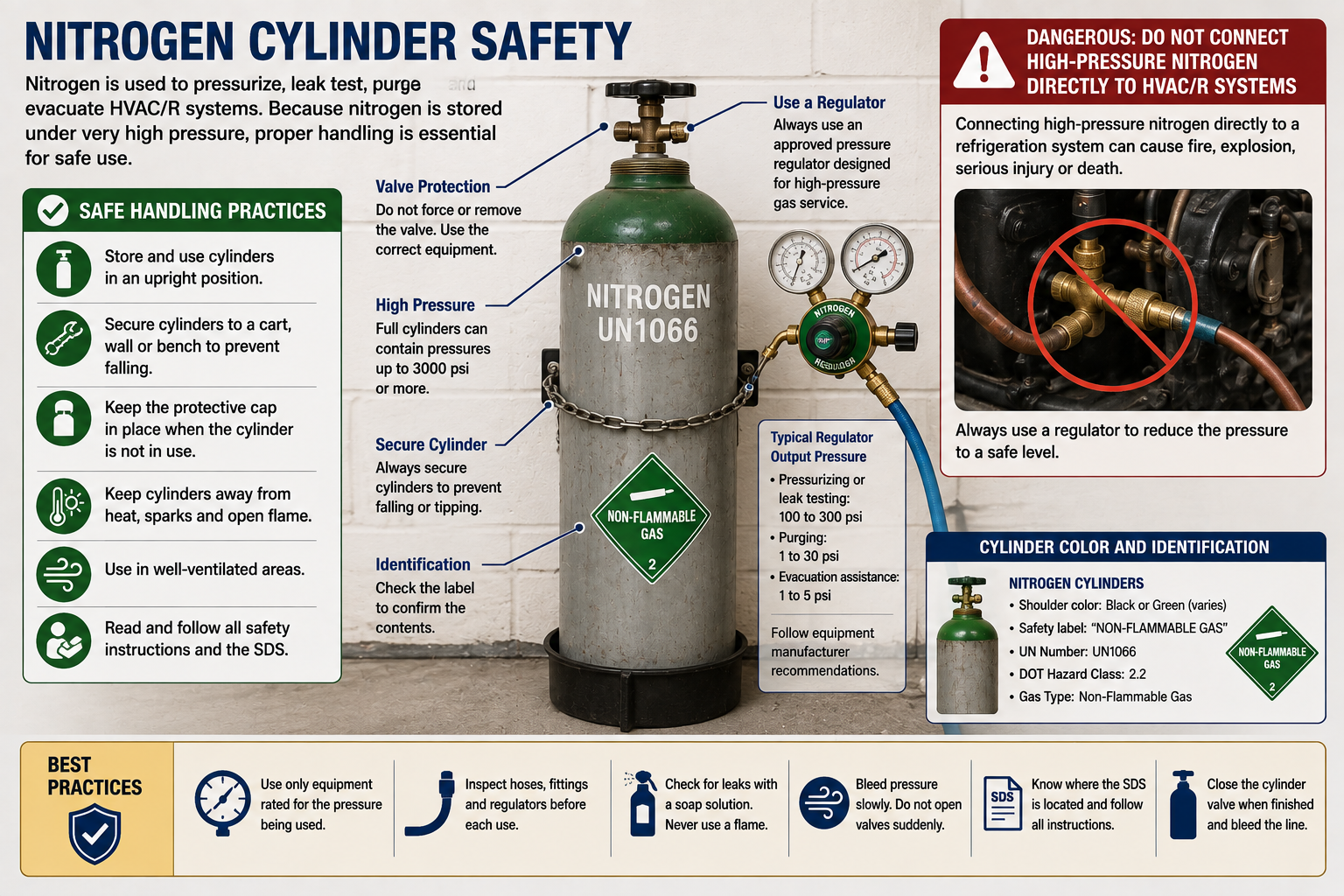
Dry nitrogen is widely used in HVAC/R work for pressure testing, purging, and other approved service procedures. Nitrogen is not a refrigerant, but the cylinder that contains it stores a large amount of energy under high pressure.
A compressed-gas cylinder must be handled as pressure equipment. Damage to the valve or uncontrolled release of the cylinder contents can create an extremely dangerous situation.
Secure the Cylinder
Protect cylinders from falling, rolling, or being struck. Use an appropriate cart, chain, strap, rack, or other securing method for the work environment.
Protect the Valve
The cylinder valve is a critical pressure-containing component. Protect it from impact and use the appropriate valve protection provided for the cylinder when required during movement or storage.
Use the Correct Regulator
Never attempt to control high cylinder pressure with a refrigerant manifold valve alone. Use a regulator designed and rated for the gas and service being performed.
Control Test Pressure
Apply pressure gradually and remain within the equipment manufacturer’s allowable test procedures and component pressure ratings.
Never Use Oxygen as a Substitute for Nitrogen
Oxygen must not be used to pressure-test refrigeration equipment. Oxygen can react violently with oils, lubricants, and other materials. Use the gas and procedure specified by the equipment manufacturer and accepted HVAC/R service practice.
Refrigerants Can Form Hazardous Decomposition Products
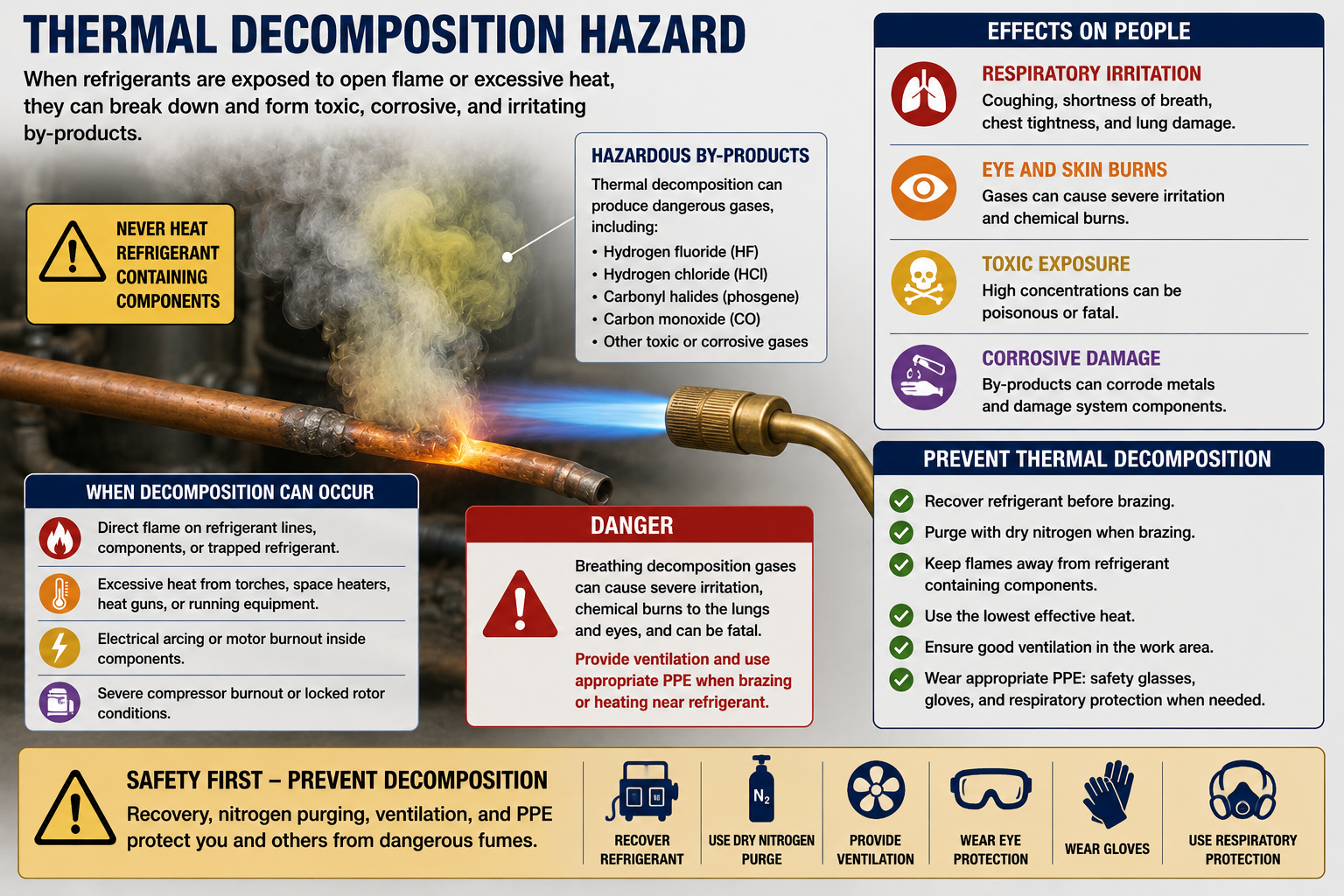
Refrigerants are chemical compounds, and their behavior can change when they are exposed to sufficiently high temperatures. A refrigerant that is relatively stable under normal system conditions may decompose when it contacts an open flame, extremely hot metal, an electric arc, or another intense heat source.
The decomposition products depend on the chemical composition of the refrigerant and the conditions involved. Halogenated refrigerants can produce hazardous, irritating, toxic, or corrosive decomposition products. Technicians should never identify decomposition products by odor or deliberately expose themselves to fumes to determine whether refrigerant is present.
Recover Refrigerant Before Applying Heat
Do not knowingly apply a torch or other intense heat to a refrigerant-containing section of a system. Properly isolate and recover refrigerant as required before opening or heating the refrigeration circuit, and use appropriate ventilation and hot-work procedures.
This is one reason brazing and refrigerant recovery must be treated as separate controlled service operations. The technician should know what is inside the tubing before applying heat.
The Refrigerant Determines the Precautions
Although many refrigerants share common hazards, they are not chemically identical. A procedure that is appropriate for one refrigerant may not address all of the hazards of another.
The Safety Data Sheet (SDS) provides refrigerant-specific information including hazard identification, first-aid measures, fire-fighting considerations, accidental-release measures, handling and storage information, exposure controls, personal protection, physical properties, stability and reactivity information, and other safety information.
Technicians should have access to the SDS for the refrigerants they service and should review it before working with an unfamiliar product. The SDS becomes especially important when the refrigerant has different toxicity, flammability, exposure, or decomposition characteristics than products the technician normally handles.
SDS, Not MSDS
The current term is Safety Data Sheet. Older technicians and older documents may use the term Material Safety Data Sheet (MSDS). The modern standardized document is the SDS. Lesson 31 examines the SDS and its 16-section format in detail.
Prevent the Exposure Instead of Depending on PPE
The best refrigerant injury is the one that never occurs. PPE is important, but safe procedures should first reduce the possibility that refrigerant will be released toward the technician.
Identify the Refrigerant
Know what refrigerant is in the equipment before beginning service. Review the equipment label, service information, and SDS when necessary.
Inspect the Work Area
Look for ventilation problems, ignition sources, confined or low areas, damaged equipment, electrical hazards, hot surfaces, and other conditions that may affect the job.
Inspect the Tools
Do not place damaged hoses, gauges, fittings, recovery machines, cylinders, regulators, or other service equipment under pressure.
Control Refrigerant Releases
Use proper recovery and service procedures so that refrigerant remains contained rather than being deliberately released into the work area or atmosphere.
Position Yourself Safely
Keep your face and body away from likely discharge paths when loosening fittings, opening valves, installing service tools, or disconnecting hoses.
Know the Emergency Plan
Know where emergency eyewash equipment, exits, communication equipment, first-aid resources, SDS information, and other required emergency resources are located before an incident occurs.
Environmental Compliance and Personal Safety Work Together
EPA Section 608 refrigerant-management regulations are primarily environmental regulations. Among other requirements, they restrict intentional venting of regulated refrigerants and require appropriate recovery practices when refrigerant is removed from covered refrigeration and air-conditioning equipment.
These requirements also encourage service procedures that keep refrigerant contained. However, Section 608 certification by itself does not replace an employer’s workplace-safety program, OSHA requirements, manufacturer instructions, equipment-specific training, or refrigerant-specific SDS information.
Regulation Versus Good Practice
EPA requirement: Refrigerant handling must comply with applicable Section 608 requirements, including restrictions on intentional venting and required recovery practices. Workplace safety requirement: Employers must address workplace hazards under applicable OSHA requirements. Industry practice: Technicians should combine those requirements with manufacturer instructions, refrigerant SDS information, pressure-rated service equipment, proper ventilation, and task-appropriate PPE.
What You Need to Remember
- Refrigerants can present temperature, pressure, inhalation, chemical, atmospheric, and sometimes flammability hazards.
- Rapid evaporation of liquid refrigerant can remove heat from tissue and cause frostbite or cold-contact injury.
- The eyes must be protected from possible refrigerant spray and other service hazards.
- Refrigerant cylinders, nitrogen cylinders, systems, hoses, and recovery equipment may contain substantial stored pressure.
- Use tools, hoses, cylinders, regulators, and service equipment that are appropriate for the refrigerant, pressure, and procedure.
- Compressed nitrogen must be handled as a high-pressure gas.
- Never use oxygen to pressure-test a refrigeration system.
- Extreme heat or flame can cause some refrigerants to form hazardous decomposition products.
- Review the Safety Data Sheet for refrigerant-specific hazards, PPE, handling, first aid, and emergency information.
- PPE does not replace proper ventilation, pressure control, refrigerant containment, equipment inspection, or safe service procedures.
- EPA Section 608 refrigerant-management requirements and OSHA workplace-safety requirements address different responsibilities.
- Intentional venting of regulated refrigerants during service is prohibited except for releases specifically permitted by EPA regulations.
Review Questions
1. Why can liquid refrigerant cause frostbite?
Answer: When liquid refrigerant is released to a lower pressure it can rapidly evaporate. The evaporation absorbs heat, and direct contact can remove heat from skin or eye tissue quickly enough to cause a serious cold-contact injury.
2. Why should a technician wear eye protection when connecting or disconnecting refrigerant hoses?
Answer: Refrigerant may remain under pressure in the system, hose, or fitting. An unexpected release can spray liquid or vapor toward the technician’s face and eyes.
3. Does wearing gloves make it safe to intentionally release liquid refrigerant onto your hand?
Answer: No. PPE reduces risk but does not make intentional exposure safe. Refrigerant pressure and rapid evaporation can cause injuries that exceed the protection provided by ordinary work gloves.
4. Why must a regulator be used with a compressed nitrogen cylinder?
Answer: The cylinder contains gas at high pressure. A suitable regulator allows that pressure to be reduced and controlled for the intended service procedure rather than exposing refrigeration equipment or service tools directly to cylinder pressure.
5. Why should oxygen never be substituted for nitrogen when pressure-testing refrigeration equipment?
Answer: Oxygen can react violently with oils, lubricants, and other materials. Refrigeration pressure testing must use the gas and procedure specified for the equipment and accepted service practice.
6. What can happen when some refrigerants contact an open flame or extremely hot surface?
Answer: The refrigerant can chemically decompose and produce hazardous, irritating, toxic, or corrosive decomposition products.
7. Where should a technician look for refrigerant-specific safety and first-aid information?
Answer: The Safety Data Sheet for the specific refrigerant provides hazard, exposure-control, PPE, first-aid, handling, storage, fire, accidental-release, and stability information.
8. Does EPA Section 608 establish all of the PPE requirements for refrigerant service?
Answer: No. Section 608 primarily regulates refrigerant management and emissions. Workplace hazard assessment and PPE requirements are addressed through OSHA and other applicable workplace-safety requirements.
Lesson 28 Summary
- Refrigerant service can involve temperature, pressure, chemical, inhalation, atmospheric, mechanical, and flammability hazards.
- Safe refrigerant handling begins with identifying the refrigerant and understanding the task before connecting service equipment.
- PPE must be selected for the hazards associated with the work being performed.
- Eye protection is important whenever refrigerant or other material could spray toward the face.
- Rapid evaporation of liquid refrigerant can cause serious frostbite or cold-contact injury.
- Refrigerant systems, cylinders, hoses, and service equipment can contain dangerous stored pressure even when electrical power is off.
- Compressed nitrogen cylinders must be secured, protected from damage, and used with suitable pressure-regulating equipment.
- Oxygen must never be substituted for nitrogen when pressure-testing refrigeration equipment.
- Some refrigerants can form hazardous decomposition products when exposed to extreme heat, flame, or other intense heat sources.
- The Safety Data Sheet provides refrigerant-specific hazard, PPE, first-aid, handling, storage, and emergency information.
- PPE is an important layer of protection, but it does not replace refrigerant containment, ventilation, properly rated tools, equipment inspection, and safe work procedures.
- EPA Section 608 environmental requirements and OSHA workplace-safety requirements serve different purposes and both may apply to refrigerant service work.