Evacuation and Dehydration
After a refrigeration system has been opened to the atmosphere, repairing the leak and sealing the tubing does not make the system ready for refrigerant. Air, water vapor, and other noncondensable gases can remain inside the refrigeration circuit. These contaminants must be removed before the system is placed back into normal operation.
Evacuation uses a vacuum pump to reduce the pressure inside the refrigeration system. As pressure decreases, trapped gases are removed and the boiling temperature of water decreases, allowing moisture to vaporize and be drawn from the system. Proper evacuation therefore involves much more than simply watching a compound gauge move below zero psig.
Learning Objectives
Explain Deep-Vacuum Evacuation
Describe how reducing system pressure helps remove air, noncondensables, and moisture from a refrigeration circuit.
Measure Vacuum Correctly
Understand why a micron gauge is used for deep-vacuum measurement and why gauge placement affects the reading.
Improve Evacuation Speed
Recognize how hose diameter, restrictions, valve cores, leaks, moisture, temperature, and vacuum-pump condition affect evacuation.
Verify System Integrity
Use isolation and vacuum decay to help determine whether a system is sufficiently dry and leak-tight before charging.
What Are We Trying to Remove?
Once a refrigeration circuit has been repaired, assembled, and leak tested, the system may still contain atmospheric air and water vapor. These substances must be removed before refrigerant is introduced.
A vacuum pump removes gas molecules from the refrigeration circuit and reduces the absolute pressure inside the system. As pressure decreases, conditions become favorable for liquid moisture trapped inside the system to boil into vapor so it can also be removed.
Air
Air contains nitrogen, oxygen, water vapor, and other gases that do not belong inside the refrigeration circuit.
Noncondensables
Gases that remain in the vapor state under normal condensing conditions can increase system pressure and reduce efficiency.
Water Vapor
Moisture can contribute to ice formation, corrosion, chemical reactions, lubricant degradation, and system failure.
Liquid Moisture
Liquid water must first vaporize before a vacuum pump can effectively remove it from the refrigeration circuit.
Pressure Must Be Measured on an Absolute Scale
A conventional compound refrigeration gauge is useful for measuring pressures near and below atmospheric pressure, but it does not provide the resolution required to evaluate a deep vacuum accurately.
Deep vacuum is normally measured in microns of mercury. One micron represents one-thousandth of a millimeter of mercury absolute pressure.
Reduce Restrictions Between the System and Vacuum Pump
A vacuum pump can only remove gas as quickly as the piping, hoses, valves, fittings, and service ports allow gas to reach the pump. A powerful vacuum pump connected through small, restrictive hoses may evacuate a system much more slowly than expected.

THE HOSE CONNECTIONS AND PLACEMENTS IN THIS IMAGE ARE NOT INTENTIONALLY CORRECT. MAKE SURE TO FOLLOW THE MANUAL FOR YOUR GAUGES, MICRON GAUGE, VACUUM PUMP, AND EQUIPMENT.
Use Large-Diameter Hoses
Larger evacuation hoses provide less flow restriction and can significantly improve evacuation speed.
Keep Hoses Short
Every additional length of hose increases restriction and internal volume.
Minimize Fittings
Unnecessary adapters, valves, and small passages create additional restrictions between the system and vacuum pump.
Evacuate Both Sides
Where equipment design and service procedures permit, provide effective evacuation paths to both sides of the refrigeration circuit.
Small Restrictions Can Have a Large Effect Under Vacuum
Schrader valve cores have relatively small flow passages. During normal pressure measurement this may not create a serious problem, but during deep evacuation the restriction can significantly reduce conductance between the refrigeration system and vacuum pump.
Valve-core removal tools allow the core to be removed while maintaining control of the refrigeration circuit. When appropriate for the equipment and procedure, removing valve cores can substantially improve evacuation speed.
The Goal Is Conductance
Evacuation speed depends not only on vacuum-pump capacity but also on how easily gas can travel from the refrigeration system to the pump. Large hoses, short connections, and fewer restrictions improve conductance.
Measure the System — Not Just the Vacuum Pump
A micron gauge should measure the pressure of the refrigeration system itself. If the gauge is installed directly beside the vacuum pump, the gauge may indicate the pressure at the pump before the rest of the refrigeration system has reached the same vacuum level.
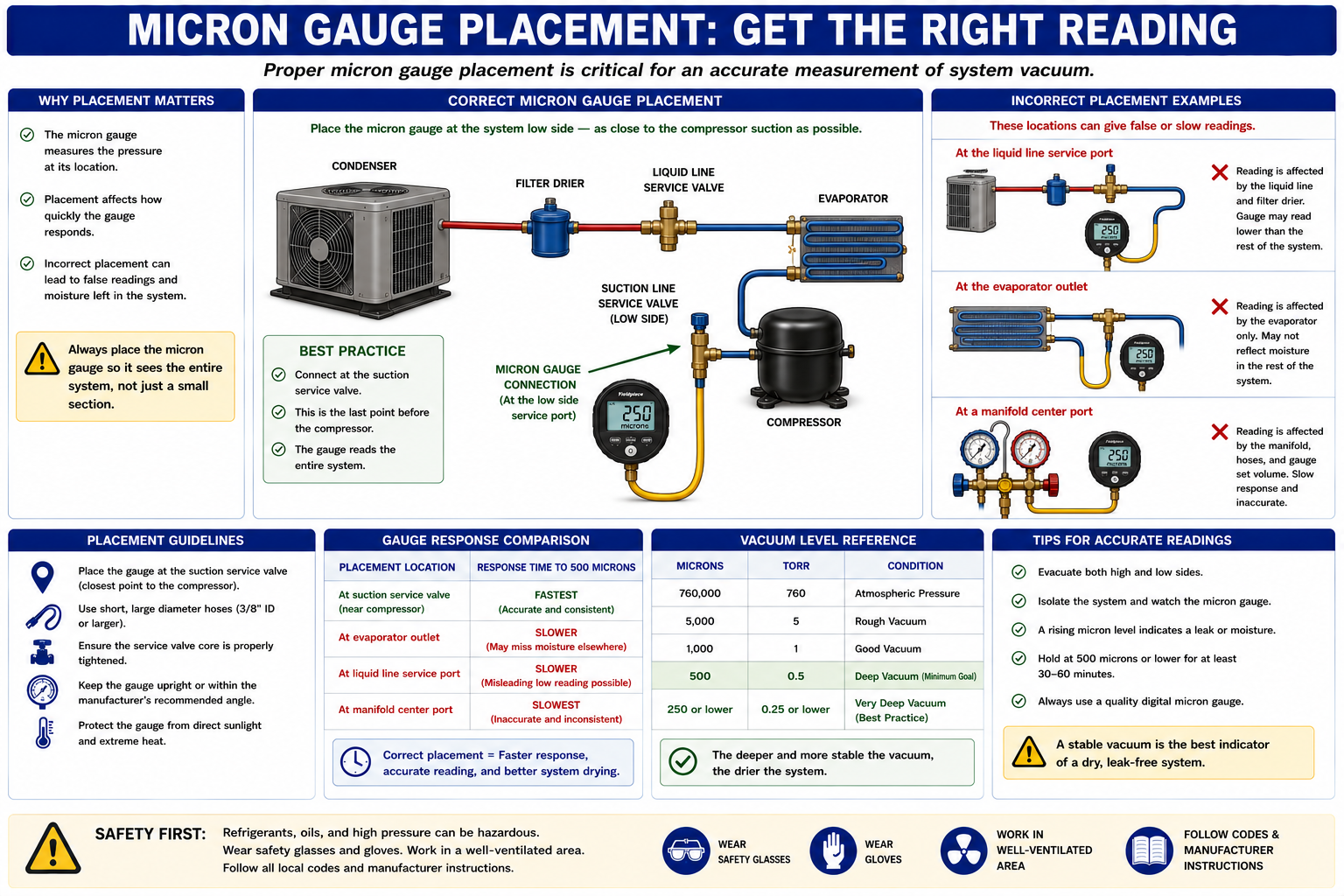
THE HOSE CONNECTIONS AND PLACEMENTS IN THIS IMAGE ARE INTENTIONALLY NOT CORRECT. MAKE SURE TO FOLLOW THE MANUAL FOR YOUR GAUGES, MICRON GAUGE, VACUUM PUMP, AND EQUIPMENT.
Understanding the Vacuum Scale
| Absolute Pressure | General Description |
|---|---|
| 760,000 microns | Approximately standard atmospheric pressure at sea level |
| 5,000 microns | Vacuum established, but considerable air and moisture may remain |
| 1,000 microns | Deep vacuum compared with ordinary service-gauge measurements |
| 500 microns | Common HVAC/R evacuation target when specified by equipment or service procedures |
| Below 500 microns | Deeper vacuum; final acceptable level should follow manufacturer and service requirements |
500 Microns Is Not a Universal Regulatory Number
Five hundred microns is widely used as a service target for dehydration, but the correct evacuation and acceptance procedure should follow the equipment manufacturer’s instructions and applicable service requirements. EPA refrigerant-recovery evacuation requirements are separate regulatory requirements and should not be confused with deep-vacuum dehydration targets.
Why Lower Pressure Helps Water Boil
Water boils when its vapor pressure equals the pressure surrounding it. At standard atmospheric pressure, water requires a relatively high temperature to boil. As surrounding pressure decreases, its boiling temperature also decreases.
By lowering the pressure inside a refrigeration system sufficiently, moisture can vaporize at normal service temperatures. The vacuum pump then removes that water vapor from the system.
A Warm System Evacuates More Easily Than a Cold One
Moisture requires energy to change from liquid to vapor. A warm refrigeration system therefore generally releases moisture more readily than a very cold system.
Cold ambient conditions can greatly slow dehydration because moisture vaporizes less readily. Technicians should consider system temperature when evaluating evacuation time and vacuum behavior.
Vacuum and Heat Work Together
Lowering pressure reduces the boiling temperature of water, while available heat provides energy for vaporization. This is why a warm, dry system generally evacuates more readily than a cold, wet one.
Two Different Procedures With Different Purposes
Recovery and evacuation are sometimes confused because both procedures remove material from a refrigeration system and reduce its pressure. They are not the same operation.
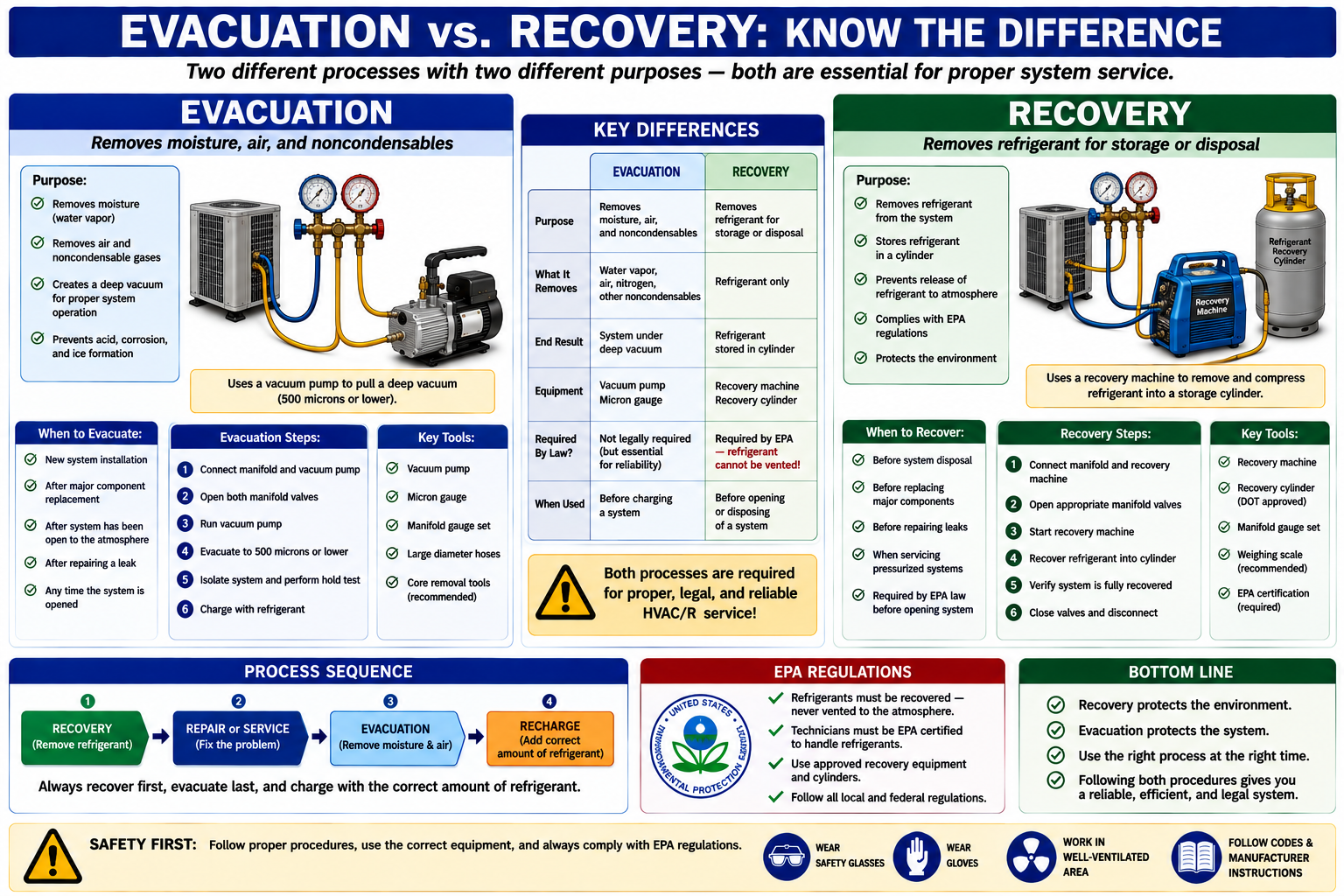
THE HOSE CONNECTIONS AND PLACEMENTS IN THIS IMAGE ARE INTENTIONALLY NOT CORRECT. MAKE SURE TO FOLLOW THE MANUAL FOR YOUR GAUGES, MICRON GAUGE, VACUUM PUMP, AND EQUIPMENT.
Recovery
Removes refrigerant from a refrigeration system and transfers it into an appropriate recovery container.
Evacuation
Uses a vacuum pump after the system is sealed to remove air, moisture, and noncondensable gases.
Do Not Confuse Service Dehydration With Regulatory Recovery Levels
EPA Section 608 uses the term evacuation in regulatory requirements describing how much refrigerant must be removed from certain appliances before they are opened for service, repair, or disposal. Those required levels depend on factors such as appliance type, refrigerant charge, and recovery equipment.
HVAC/R technicians also commonly use the term evacuation to describe the deep-vacuum dehydration process performed after the refrigeration circuit has been repaired and sealed.
Same Word — Different Measurements
EPA refrigerant-recovery requirements may be expressed in inches of mercury vacuum or other regulatory criteria. Deep-vacuum dehydration is normally evaluated with an absolute-pressure instrument such as a micron gauge. Always determine which procedure and measurement is being discussed.
A Typical Sequence
Repair and Seal
Complete system repairs and close the refrigeration circuit.
Leak Test
Verify system integrity using the appropriate pressure-test procedure.
Remove Test Gas
Safely release nitrogen or otherwise prepare the system according to the approved service procedure.
Connect Evacuation Equipment
Use clean, dry, low-restriction hoses and an appropriately placed micron gauge.
Evacuate
Operate the vacuum pump until the required vacuum level and stabilization conditions are achieved.
Isolate and Test
Isolate the refrigeration system from the vacuum pump and observe the micron reading.
Do Not Immediately Blame the Vacuum Pump
A refrigeration system that evacuates slowly can have many causes. Before assuming the vacuum pump is defective or too small, examine the entire evacuation setup.
Small Hoses
Long, small-diameter charging hoses can severely restrict flow under deep-vacuum conditions.
Valve Cores
Schrader cores and other small passages can restrict conductance.
Leaks
Air entering through a system leak, hose connection, manifold, or service tool can prevent the system from reaching deep vacuum.
Moisture
A wet system may remain at an elevated micron level while moisture continues to boil into vapor.
Cold Temperature
Low system temperature reduces the rate at which moisture vaporizes.
Vacuum Pump Condition
Contaminated pump oil, inadequate oil level, mechanical wear, or an undersized pump can reduce performance.
The Pump Oil Is Part of the Vacuum System
Vacuum pump oil helps create the internal seal required for a deep vacuum. As the pump removes moisture, refrigerant vapor, and contaminants, some of that material can enter the pump oil.
Contaminated oil can significantly reduce the pump’s ability to achieve a deep vacuum. Check and change vacuum-pump oil according to the manufacturer’s instructions.
Using Dry Nitrogen to Assist a Difficult Dehydration
A heavily contaminated or moisture-laden system may require more than a single evacuation. One service technique is triple evacuation, in which the system is evacuated and the vacuum is then broken with dry nitrogen before evacuation resumes.
The nitrogen helps dilute remaining water vapor and provides a dry gas that can assist in moving moisture from difficult areas of the system.
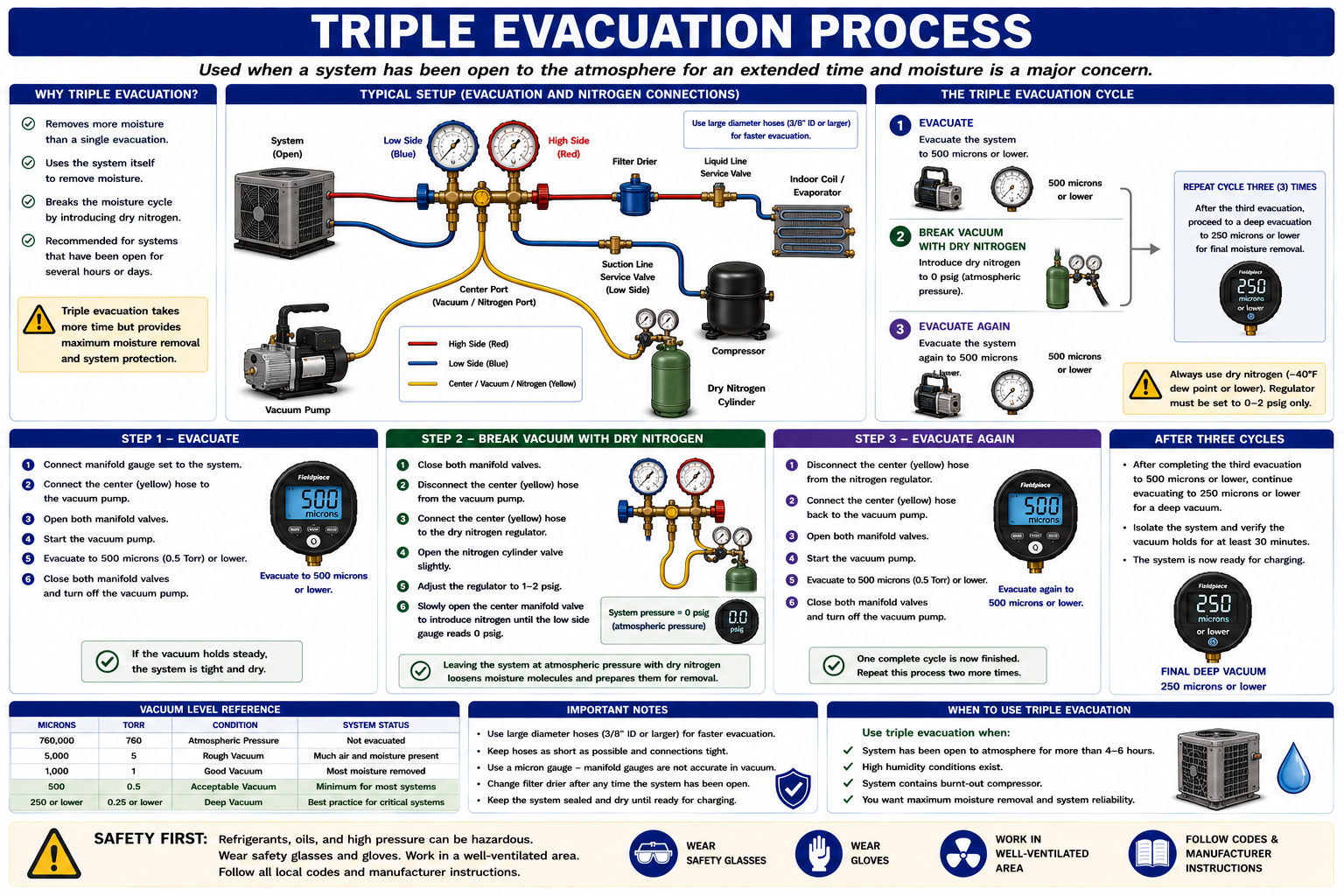
THE HOSE CONNECTIONS AND PLACEMENTS IN THIS IMAGE ARE INTENTIONALLY NOT CORRECT. MAKE SURE TO FOLLOW THE MANUAL FOR YOUR GAUGES, MICRON GAUGE, VACUUM PUMP, AND EQUIPMENT.
Do Not Substitute Refrigerant for Dry Nitrogen
Use dry nitrogen when the approved dehydration procedure calls for breaking the vacuum. Do not intentionally vent refrigerant as part of an evacuation procedure.
The Pump Is Off — What Happens Next?
Reaching a target micron level while the vacuum pump is running does not by itself prove that the refrigeration system is dry and leak-tight. The pump may simply be removing gas as quickly as it enters or vaporizes.
A vacuum decay test isolates the refrigeration system from the vacuum pump and observes how the system pressure changes over time.
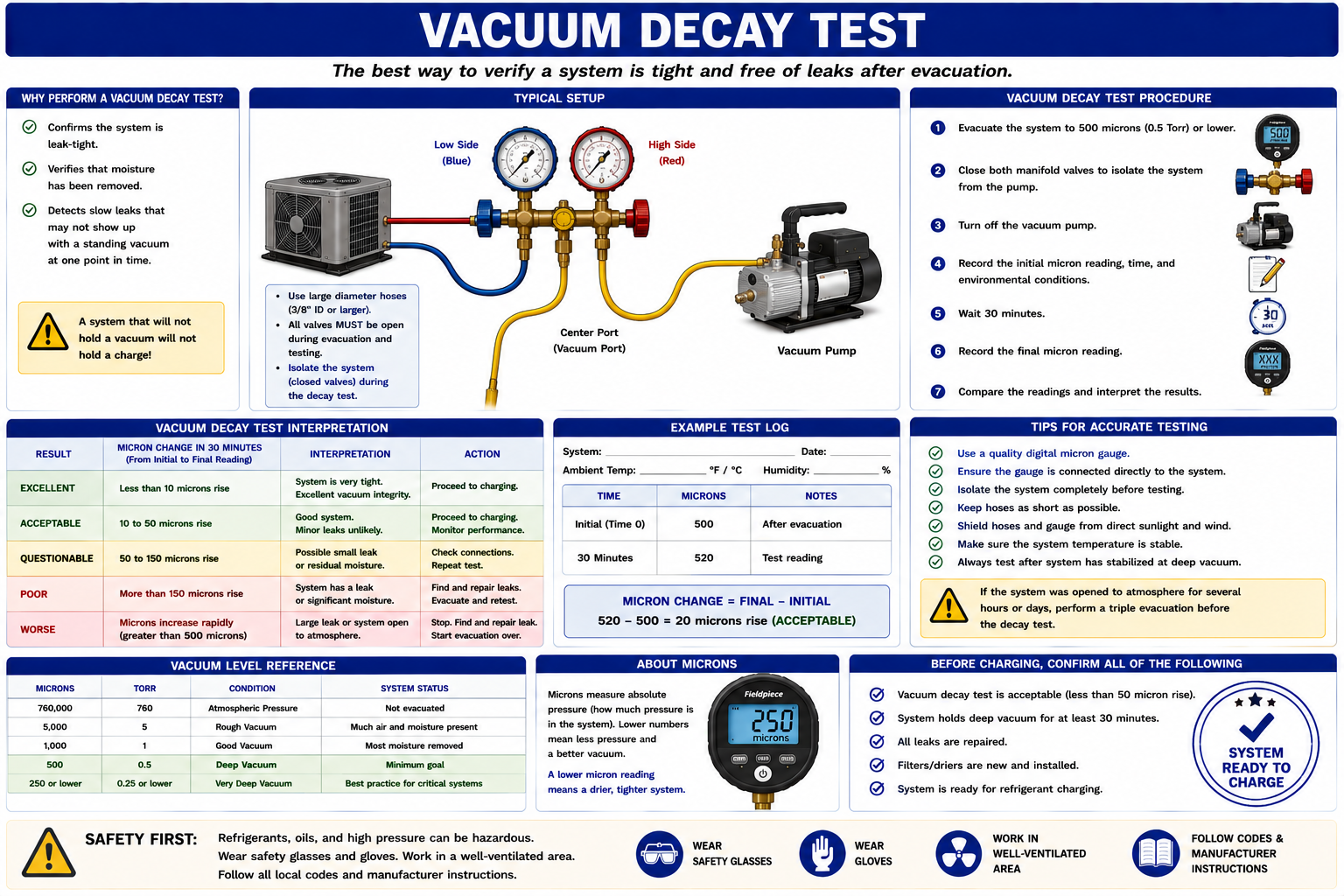
THE HOSE CONNECTIONS AND PLACEMENTS IN THIS IMAGE ARE INTENTIONALLY NOT CORRECT. MAKE SURE TO FOLLOW THE MANUAL FOR YOUR GAUGES, MICRON GAUGE, VACUUM PUMP, AND EQUIPMENT.
The Pattern Can Tell You Something
When the vacuum pump is isolated, some increase in micron reading can occur as gases trapped in oil, insulation, tubing surfaces, or other materials continue to migrate into the system volume.
The amount and pattern of pressure rise can help the technician distinguish between a dry, tight system and one that still contains moisture or has a leak.
Small Rise Then Stabilization
A modest increase followed by stabilization generally indicates that the system is holding vacuum and remaining gas is reaching equilibrium.
Slow Continued Rise
A gradual pressure increase may indicate remaining moisture or outgassing within the refrigeration system.
Rapid Continued Rise
A rapid and persistent increase can indicate a significant leak, an evacuation-equipment leak, or another problem requiring investigation.
Isolation Location Matters
A vacuum decay test should isolate the refrigeration system from the vacuum pump while leaving the micron gauge connected to the system being evaluated.
If the test includes unnecessary hoses, manifolds, or other service equipment, a leak in the service equipment can be mistaken for a leak in the refrigeration system.
Simplify the Test
The fewer unnecessary connections included in the isolated test volume, the easier it is to determine whether a vacuum rise is actually coming from the refrigeration system.
Avoid These Shortcuts
Using Only a Compound Gauge
A conventional refrigeration gauge cannot accurately measure deep-vacuum levels required for dehydration.
Micron Gauge at the Pump
This may show the vacuum pump’s pressure rather than the actual condition of the refrigeration system.
Using Long Charging Hoses
Small-diameter hoses and restrictive fittings can dramatically increase evacuation time.
Leaving Valve Cores Installed
Where appropriate, valve cores can create unnecessary restrictions during evacuation.
Ignoring Vacuum Pump Oil
Contaminated oil can prevent a good vacuum pump from reaching an adequate vacuum.
Charging Immediately
Reaching a low micron number without an isolation or decay evaluation may hide leaks or remaining moisture.
Evacuation Appears in Two Different Service Contexts
EPA Section 608 requires technicians to remove refrigerant to applicable regulatory levels before opening covered refrigeration and air-conditioning equipment for service, repair, maintenance, or disposal. Those required recovery levels vary with the appliance and service circumstances.
EPA technician-certification material also identifies the need to evacuate a system after service to eliminate air and moisture. That post-repair dehydration process is the deep-vacuum procedure described in this lesson.
- Recovery and evacuation are not the same procedure.
- Recovery removes refrigerant before equipment is opened.
- Deep-vacuum evacuation removes air, moisture, and noncondensables after the refrigeration circuit has been sealed.
- A conventional compound gauge is not sufficiently accurate for measuring deep vacuum.
- A micron gauge measures deep vacuum as absolute pressure.
- Lower micron numbers indicate a deeper vacuum.
- Micron gauge placement affects the reading.
- Measure the refrigeration system rather than simply measuring the pressure beside the vacuum pump.
- Larger hoses and fewer restrictions improve evacuation speed.
- Valve cores can restrict evacuation flow.
- Vacuum pump oil condition affects pump performance.
- Moisture vaporizes more readily as system pressure is reduced.
- A warm system generally dehydrates more easily than a cold system.
- Dry nitrogen can be used as part of an approved multiple-evacuation procedure.
- A vacuum decay test helps evaluate system tightness and remaining moisture.
- Reaching a target vacuum while the pump is running does not by itself prove the system is dry and leak-tight.
Review Questions
1. What is the primary purpose of deep-vacuum evacuation after a refrigeration system has been opened?
Answer: To remove air, moisture, and other noncondensable gases before the system is charged with refrigerant.
2. Why is a micron gauge used instead of a compound refrigeration gauge?
Answer: A micron gauge measures absolute pressure with the resolution required to evaluate a deep vacuum accurately.
3. Which represents the deeper vacuum: 500 microns or 1,000 microns?
Answer: 500 microns.
4. Why should the micron gauge not be located immediately beside the vacuum pump?
Answer: It may indicate the vacuum at the pump before the rest of the refrigeration system has reached the same pressure. The technician wants to measure the system condition.
5. Why do large-diameter evacuation hoses improve evacuation speed?
Answer: They reduce flow restriction and improve conductance between the refrigeration system and vacuum pump.
6. What is the difference between recovery and evacuation?
Answer: Recovery removes refrigerant from a system for storage or further processing. Deep-vacuum evacuation removes air, moisture, and noncondensables after the system is sealed.
7. What is the purpose of a vacuum decay test?
Answer: It observes how system pressure changes after the vacuum pump is isolated, helping evaluate whether the system is leak-tight and sufficiently dry.
8. What might a rapid micron increase after isolation indicate?
Answer: A significant leak in the refrigeration system or evacuation setup should be suspected and investigated.
9. What might a slow continuing micron rise indicate?
Answer: Remaining moisture or gas continuing to leave materials inside the refrigeration system may be causing the pressure to rise.
10. Why can changing vacuum-pump oil improve evacuation performance?
Answer: Pump oil can become contaminated with moisture, refrigerant, and other substances, reducing the pump’s ability to achieve a deep vacuum.
Lesson 27 Summary
- Air and moisture must be removed from a refrigeration circuit after it has been opened to the atmosphere.
- A vacuum pump removes gases and lowers system absolute pressure.
- Lower pressure reduces the boiling temperature of water and assists dehydration.
- Deep vacuum is measured in microns of mercury absolute pressure.
- Lower micron readings represent deeper vacuum.
- A micron gauge is required to accurately evaluate deep-vacuum conditions.
- The micron gauge should measure the refrigeration system rather than simply the vacuum pump.
- Large-diameter, short evacuation hoses improve conductance and evacuation speed.
- Valve cores and other restrictions can substantially slow evacuation.
- Vacuum pump oil condition directly affects pump performance.
- Warm systems generally release moisture more readily than cold systems.
- Recovery removes refrigerant; deep-vacuum evacuation removes air and moisture.
- EPA regulatory refrigerant-recovery evacuation requirements should not be confused with micron-based dehydration targets.
- Triple evacuation can assist in removing moisture from difficult systems by alternating evacuation with dry nitrogen.
- Reaching a low micron reading while the pump is operating does not by itself prove that the system is dry and leak-tight.
- A vacuum decay test evaluates how the isolated system behaves after the vacuum pump is removed from the test.
- A properly evacuated system should demonstrate both an adequate vacuum level and acceptable stability before refrigerant is introduced.