Moisture Removal and Air-Conditioning Calculations
Psychrometric calculations turn entering-air, leaving-air, and airflow measurements into estimates of moisture removal and air-side cooling capacity.
This lesson uses one cooling-and-dehumidification example to practice the calculation process. The goal is to keep the properties, units, and field meaning clear—not to replace load calculations, equipment ratings, or manufacturer service procedures.
What You Will Learn
Read humidity ratio, enthalpy, and specific volume at plotted air conditions.
Calculate moisture and enthalpy differences across a cooling coil.
Convert cfm to dry-air mass flow using specific volume.
Estimate total air-side cooling capacity from mass flow and enthalpy difference.
Estimate condensate removal from mass flow and humidity-ratio difference.
Interpret sensible, latent, and total capacity without treating an estimate as a building load.
A Calculation Cannot Correct a Poor Measurement
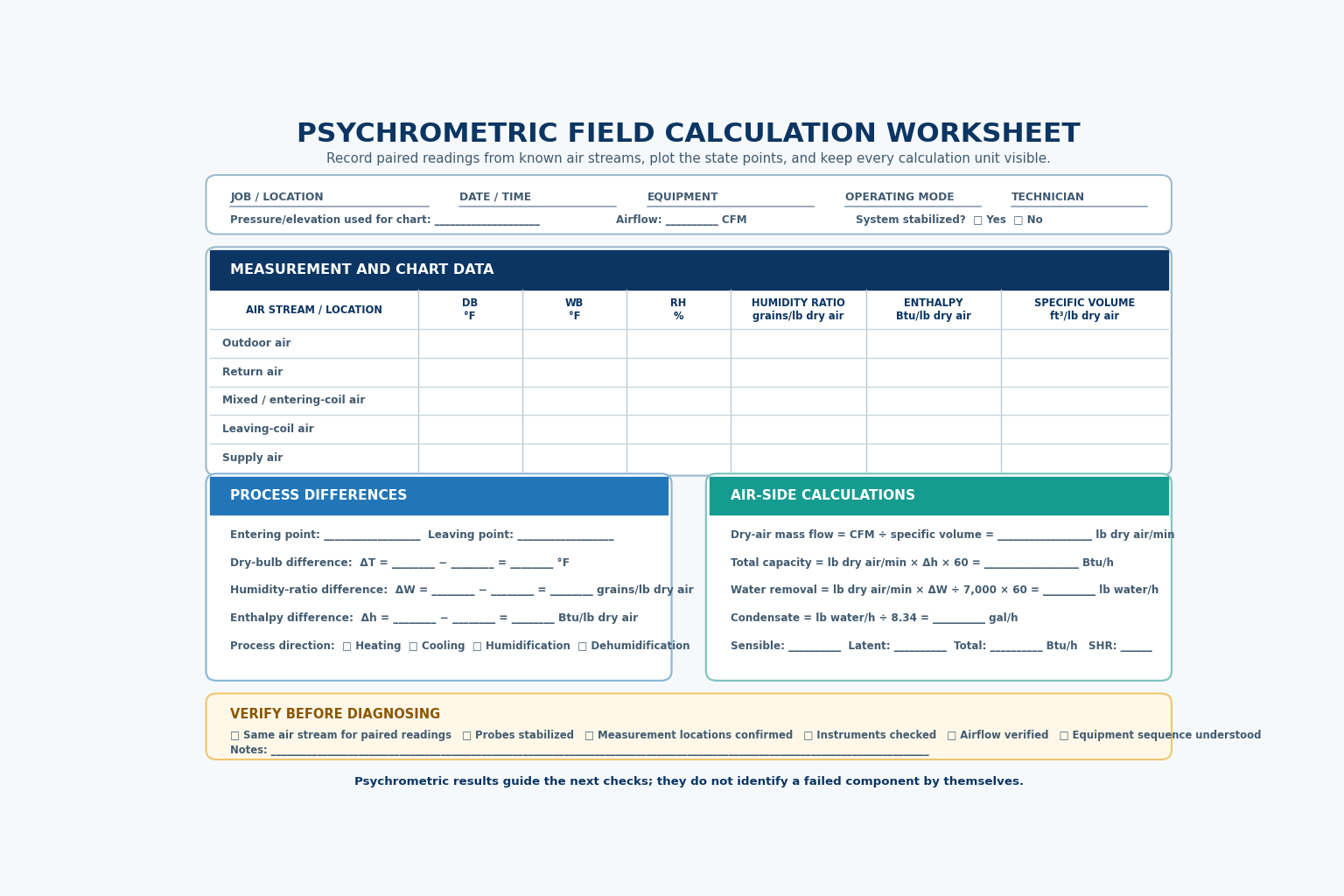
Measure the same airstream before and after the process under stable operation. Confirm instrument accuracy, measurement locations, airflow, operating mode, outdoor-air position, and the barometric-pressure basis of the chart or software.
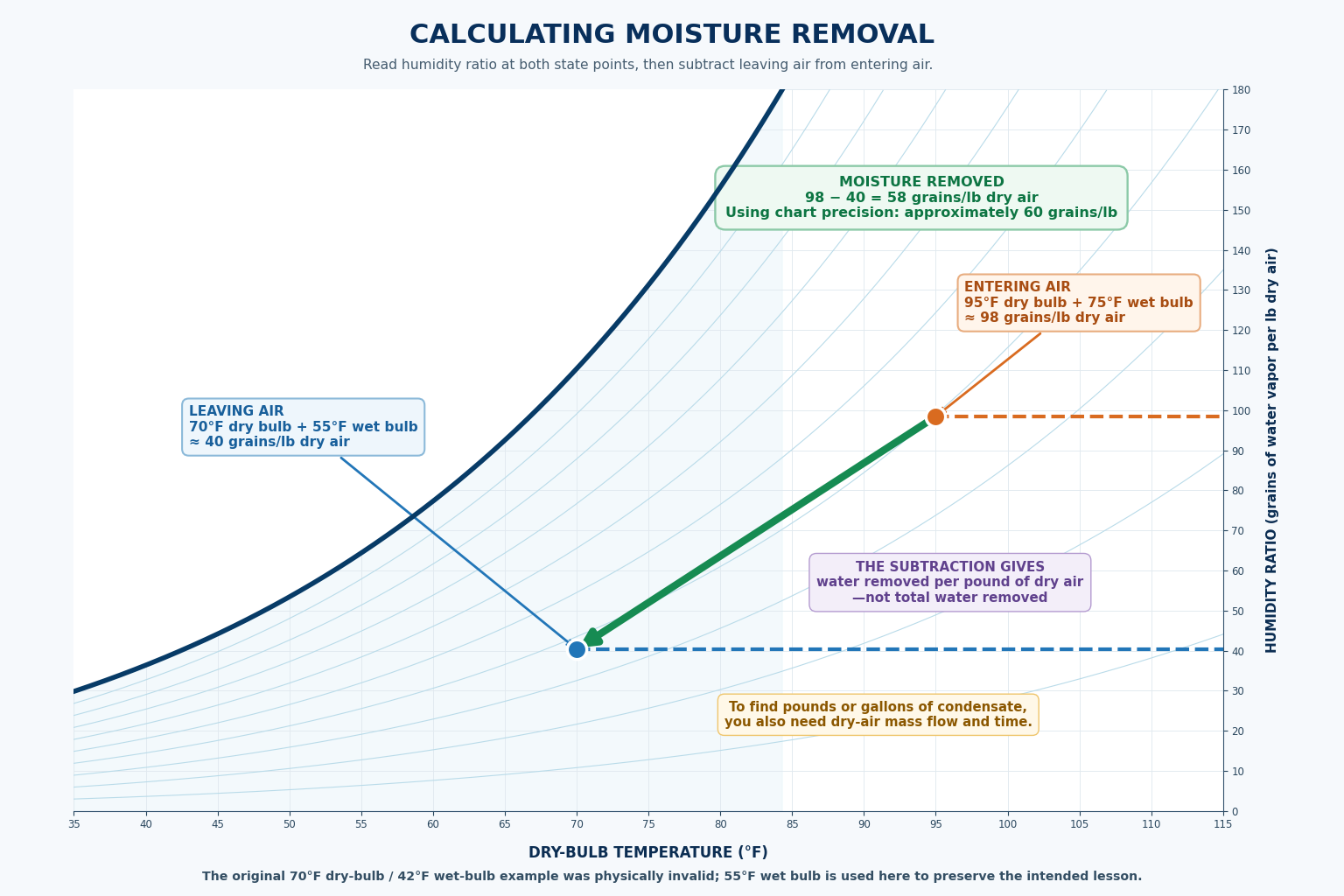
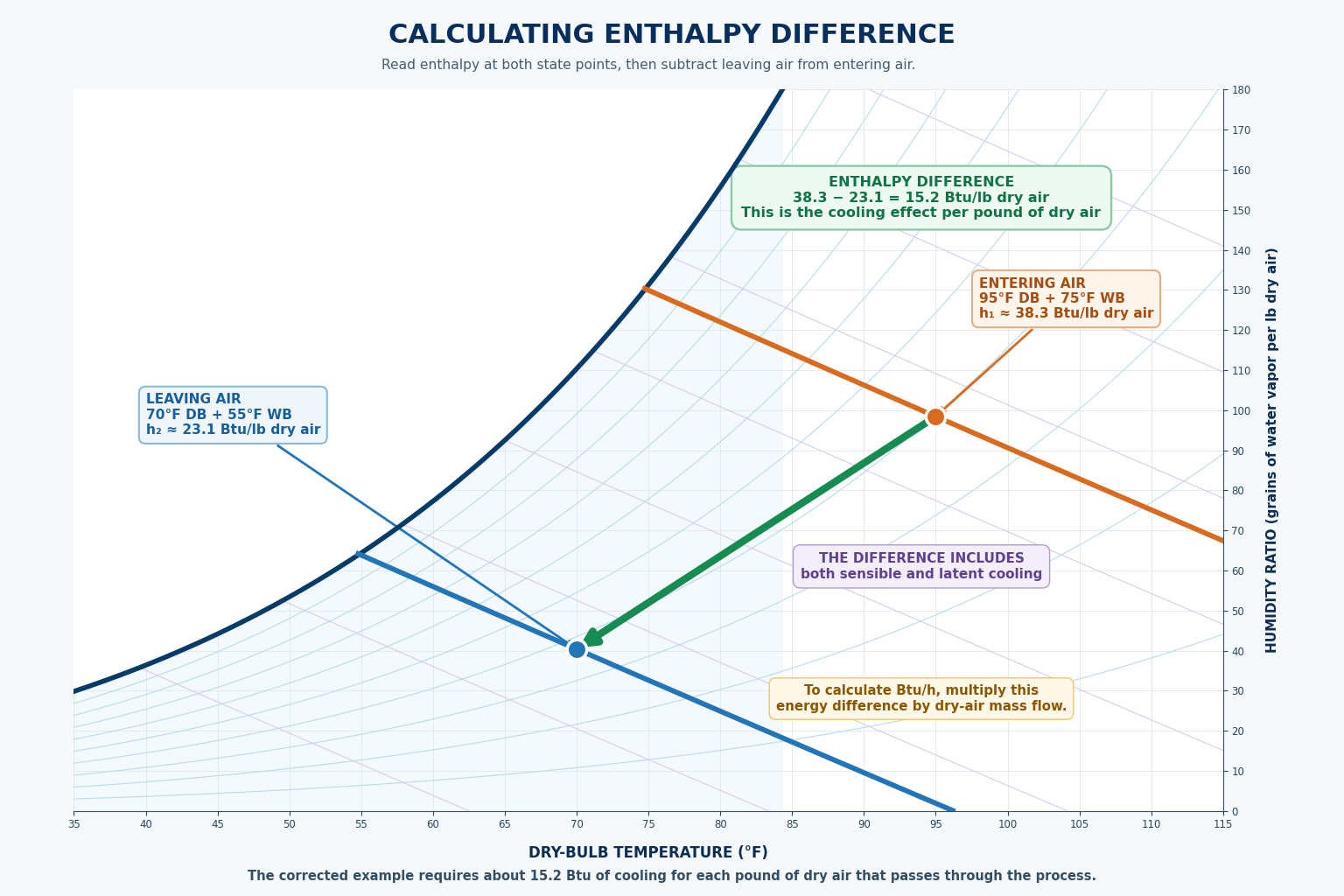
The example uses 5,000 cfm of air entering at 95°F dry bulb and 75°F wet bulb and leaving at 70°F dry bulb and 55°F wet bulb. Approximate chart readings are shown below and may vary slightly with chart resolution and rounding.
95°F DB and 75°F WB
Humidity ratio ≈ 98 grains/lb dry air, enthalpy ≈ 38.3 Btu/lb dry air.
70°F DB and 55°F WB
Humidity ratio ≈ 40 grains/lb dry air, enthalpy ≈ 23.1 Btu/lb dry air, specific volume ≈ 13.5 ft³/lb dry air.
Psychrometric-chart humidity ratio, enthalpy, and specific volume are commonly expressed per pound of dry air. Keep that basis visible throughout the calculation so unlike quantities are not mixed.
Enthalpy Combines Sensible and Latent Energy
Enthalpy is a convenient measure of the combined sensible and latent energy of moist air. After locating the state point, follow the chart’s enthalpy direction to the enthalpy scale and read the value in Btu per pound of dry air.
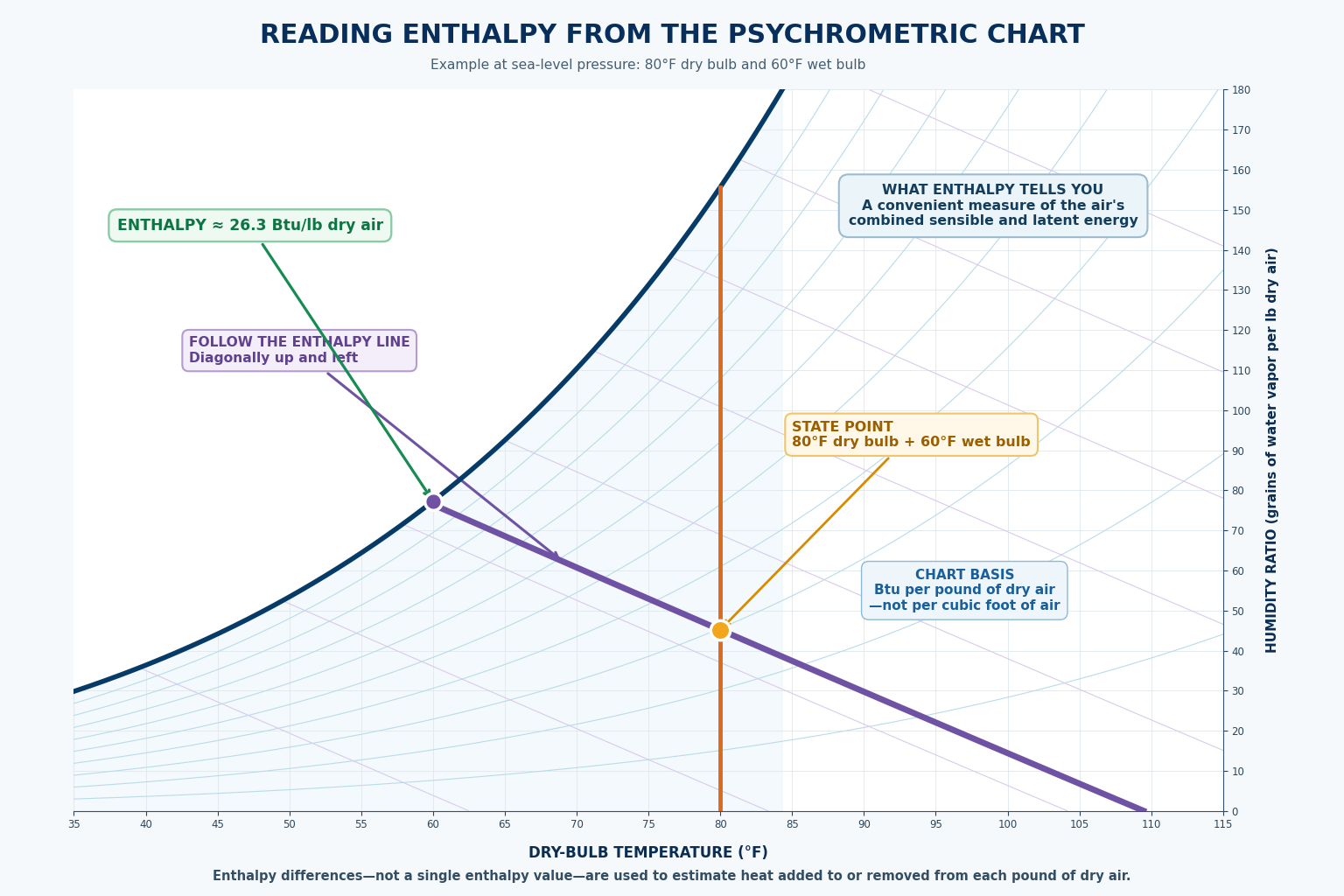
One enthalpy value describes one state. Cooling effect per pound of dry air is the entering enthalpy minus the leaving enthalpy.
Subtract Humidity Ratios, Not Relative Humidity
For a cooling-and-dehumidification process, subtract the leaving-air humidity ratio from the entering-air humidity ratio. In the example, 98 − 40 gives approximately 58 grains of water removed per pound of dry air.
Correct Property
Use humidity ratio in grains of water per pound of dry air.
Correct Direction
For cooling and dehumidification, use entering humidity ratio minus leaving humidity ratio.
Correct Meaning
The result applies to each pound of dry air and must still be multiplied by dry-air mass flow.
Find the Total Cooling Effect per Pound of Dry Air
Subtract leaving-air enthalpy from entering-air enthalpy. The example gives 38.3 − 23.1 = 15.2 Btu/lb dry air. That difference includes both sensible and latent cooling.
Rounding: Carry extra digits when possible and round the final answer. Values read from a printed chart are approximate, so small differences are expected.
Use Specific Volume to Convert CFM
CFM is cubic feet per minute, but psychrometric properties are based on pounds of dry air. Specific volume connects the two. Divide airflow in ft³/min by specific volume in ft³/lb dry air to obtain pounds of dry air per minute.
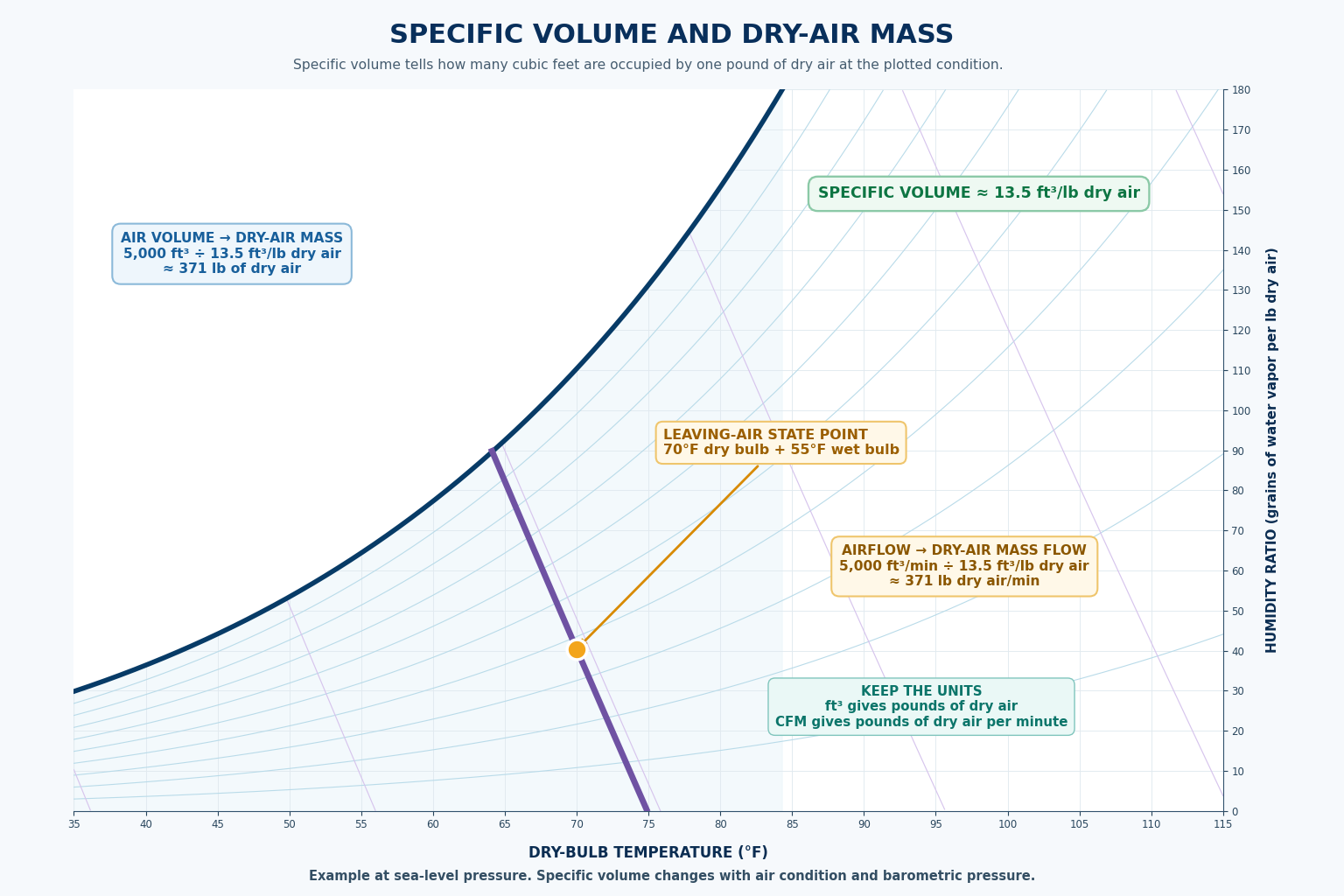
Specific volume changes with air temperature, moisture, and barometric pressure. Use a chart or software for the applicable pressure and a state point appropriate to the calculation; do not assume one air-density shortcut fits every location and condition.
Multiply Mass Flow by Enthalpy Difference
Total air-side cooling capacity is dry-air mass flow multiplied by the entering-to-leaving enthalpy difference. Multiply by 60 minutes per hour when mass flow is in pounds per minute and the answer is required in Btu/h.
Total Btu/h = (CFM ÷ specific volume) × enthalpy difference × 60.
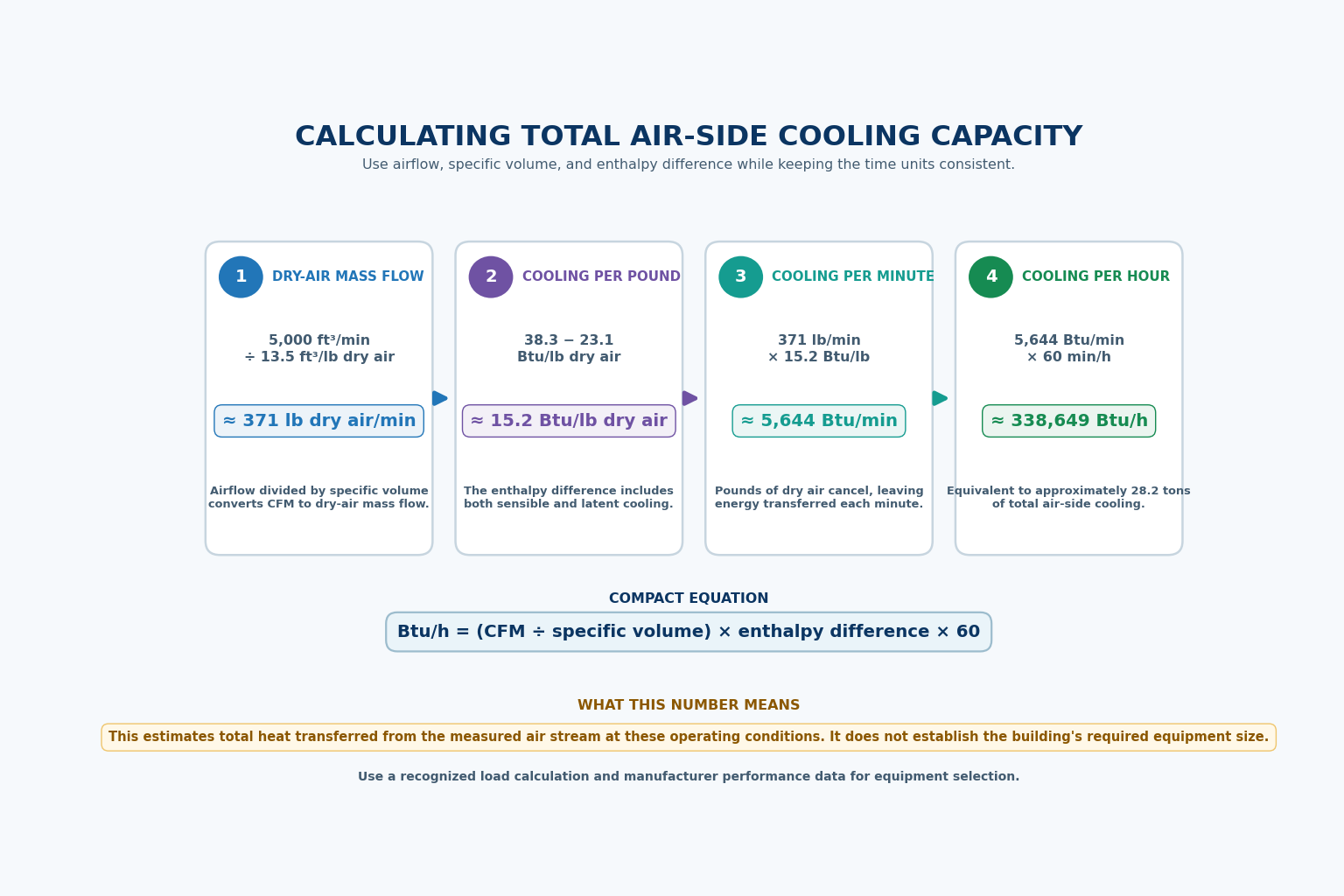
This result estimates heat transfer from the measured airstream at one operating condition. Use a recognized load calculation and manufacturer performance data when selecting equipment, and follow manufacturer procedures when evaluating equipment operation.
Convert the Humidity-Ratio Difference into Water per Hour
Multiply dry-air mass flow by the grains removed per pound of dry air. Divide by 7,000 grains per pound of water, multiply by 60 minutes per hour, and divide by approximately 8.34 pounds per gallon when a gallons-per-hour estimate is desired.
Gallons per hour = (lb dry air/min × grains removed/lb dry air ÷ 7,000) × 60 ÷ 8.34.
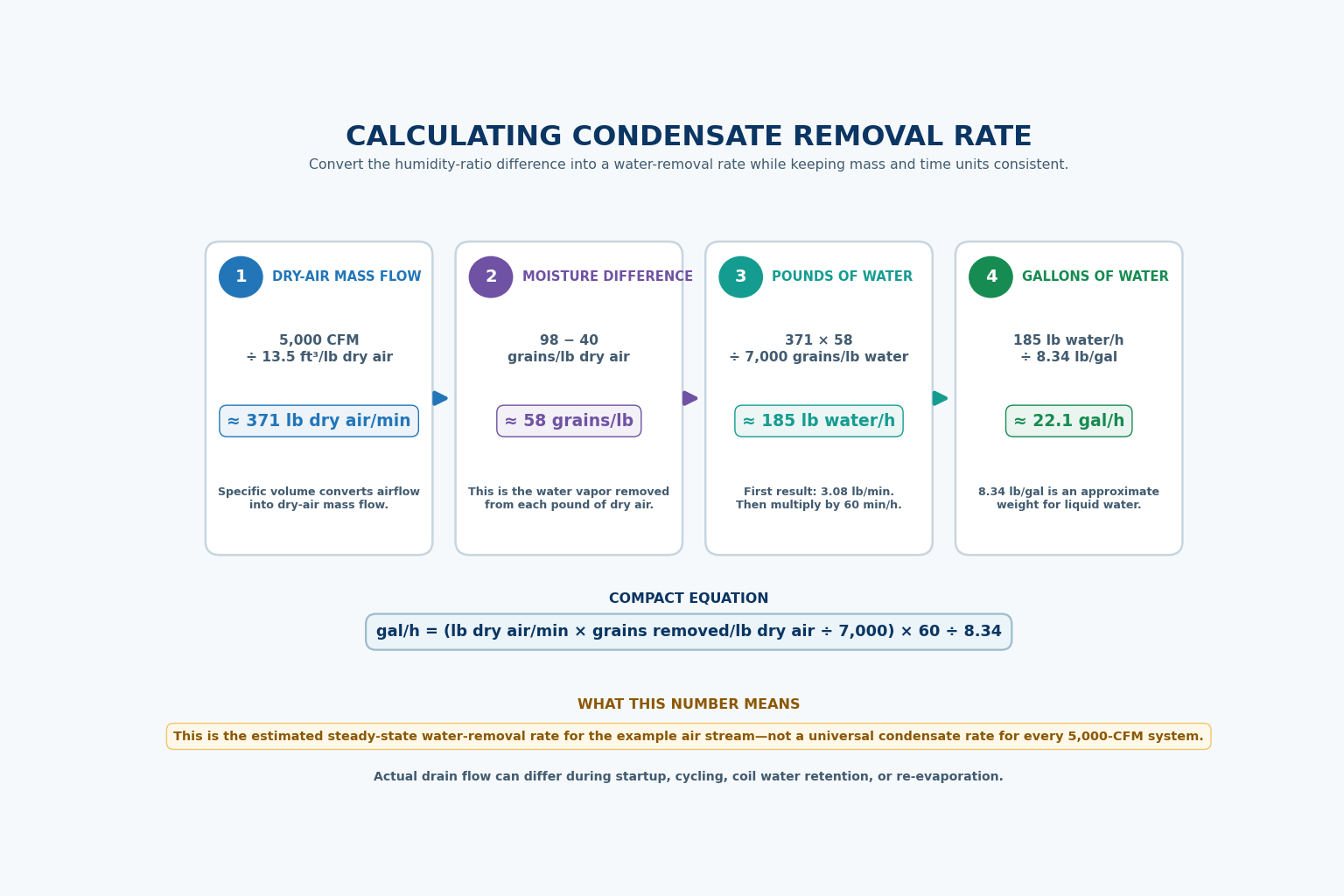
Drain-flow caution: Actual water leaving the drain may differ during startup, cycling, coil water retention, re-evaporation, trap problems, leakage, or changing entering conditions.
Separate the Temperature and Moisture Portions Carefully
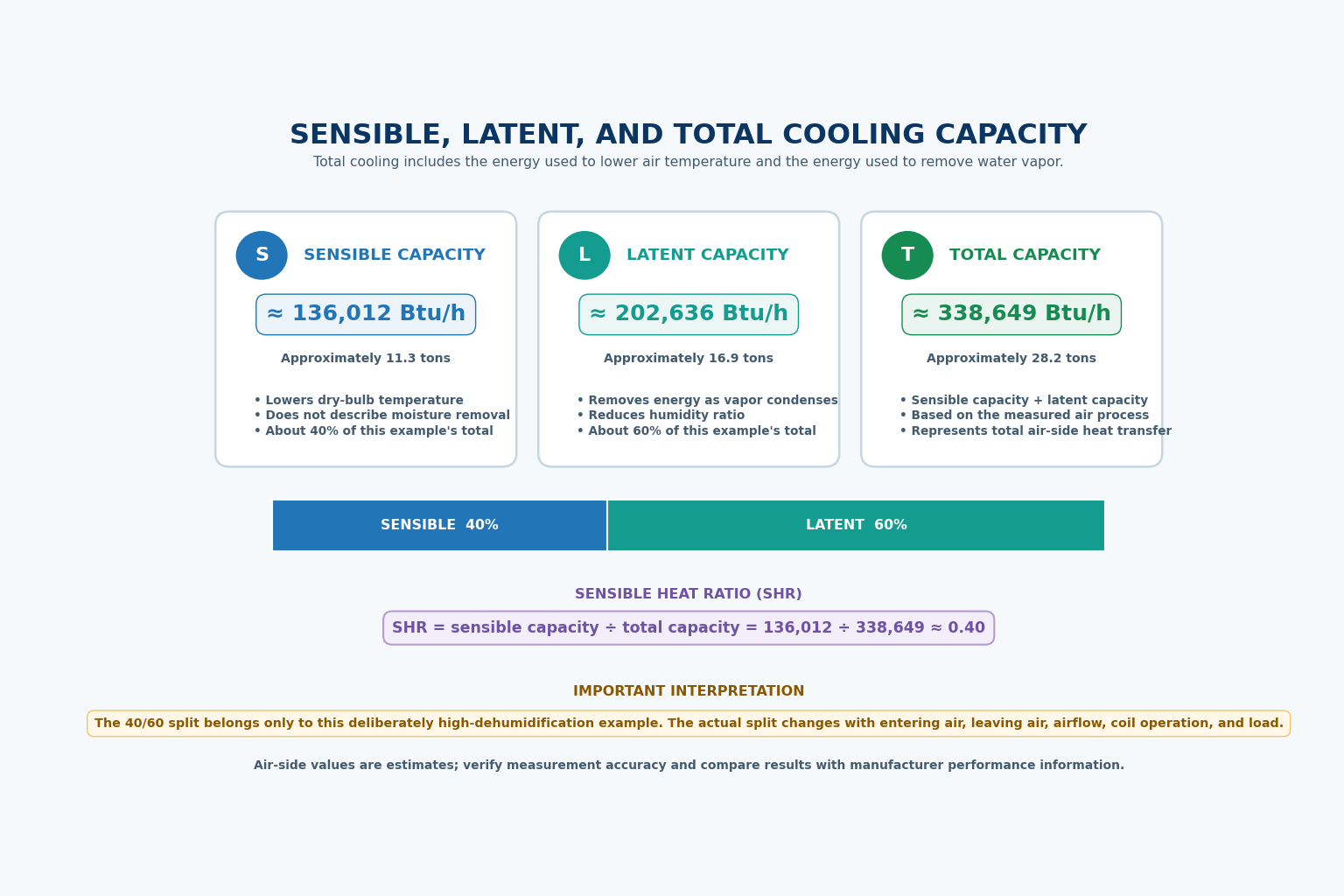
Sensible capacity is associated with lowering dry-bulb temperature. Latent capacity is associated with removing water vapor. Total capacity is the sum of the sensible and latent portions when all values use the same consistent basis.
Sensible Capacity
Energy transfer associated primarily with the dry-bulb temperature change.
Latent Capacity
Energy transfer associated with water vapor condensing from the air.
Sensible Heat Ratio
SHR = sensible capacity ÷ total capacity. A lower SHR indicates a larger latent share for that operating condition.
The sensible-to-latent split changes with entering air, leaving air, airflow, coil condition, refrigerant operation, outdoor-air load, and system control. The example’s 40% sensible and 60% latent split applies only to the example.
Write Down the Property and Unit at Every Step
A worksheet helps keep paired measurements, chart values, differences, mass flow, and final results together. Record the pressure or elevation basis, airflow source, operating mode, stabilization status, and exact measurement locations.
1. Stabilize and Measure
Confirm operating mode and collect representative entering, leaving, and airflow measurements.
2. Plot Both States
Use a chart or psychrometric software with the correct pressure basis.
3. Read the Properties
Record humidity ratio, enthalpy, and specific volume with their units.
4. Calculate Differences
For cooling, subtract leaving values from entering values and confirm the signs make sense.
5. Convert to Rates
Use dry-air mass flow and carry minutes, hours, grains, pounds, and gallons through each conversion.
6. Compare and Investigate
Compare the result with manufacturer data and the measured operating condition before deciding what to inspect next.
A Correct State Point Can Still Produce a Wrong Answer

“Subtract the RH readings.”
Relative humidity is temperature dependent. Subtract humidity ratios to determine moisture removed per pound of dry air.
“Cubic feet and cfm are interchangeable.”
Cubic feet is volume; cfm is a volume-flow rate. Keep the per-minute time unit through the calculation.
“One enthalpy reading is capacity.”
Use the difference between entering and leaving enthalpy, then multiply by dry-air mass flow.
“Btu/lb is the same as Btu/h.”
Btu/lb dry air is energy per mass. Capacity in Btu/h is an energy-transfer rate.
“Grains can be treated as pounds.”
There are 7,000 grains in one pound. Write the conversion so the grain unit cancels.
“Measured capacity sizes the equipment.”
A field estimate describes one measured condition; it is not a building load calculation or a replacement for manufacturer performance data.
Can You Keep the Properties, Units, and Meaning Straight?
- Why must entering and leaving measurements represent the same airstream?
- What does enthalpy describe, and what are its common I-P chart units?
- Why is an enthalpy difference used instead of one enthalpy value?
- Which property should be subtracted to find moisture removed per pound of dry air?
- Why should relative-humidity readings not be subtracted for that purpose?
- What does specific volume describe?
- How is cfm converted to pounds of dry air per minute?
- What three quantities are used to calculate total air-side Btu/h in this lesson?
- How many grains are in one pound?
- Why can measured drain flow differ from calculated steady-state moisture removal?
- What does sensible heat ratio compare?
- Why must measured air-side capacity not be treated as the building load?
What You Should Have Learned
Reliable calculations begin with representative paired measurements, verified airflow, stable operation, and the correct pressure basis.
Humidity-ratio difference describes water removed per pound of dry air, while enthalpy difference describes total cooling per pound of dry air.
Specific volume converts volumetric airflow in cfm to dry-air mass flow in pounds per minute.
Total air-side capacity equals dry-air mass flow multiplied by enthalpy difference with the time units converted consistently.
Condensate rate comes from dry-air mass flow and humidity-ratio difference, including the required grain, pound, hour, and gallon conversions.
Total capacity contains sensible and latent portions, and SHR is sensible capacity divided by total capacity.
The sensible-to-latent split changes with the measured operating condition and is not a fixed rule.
An air-side estimate supports diagnosis but does not replace load calculations, equipment ratings, or manufacturer service information.