Heating, Humidification, and Mixing Air
Heating equipment raises air temperature, humidifiers add water vapor, and ventilation systems mix outdoor air with return air. Each process changes a psychrometric state in a recognizable direction.
This lesson follows sensible heating, simplified humidification, and two-airstream mixing on the chart and connects those processes with furnaces, electric heat, steam and evaporative humidifiers, outdoor-air dampers, and mixed-air measurements.
What You Will Learn
Plot sensible heating at constant humidity ratio.
Explain why relative humidity decreases when air is heated without moisture addition.
Plot a simplified humidification process that increases humidity ratio.
Distinguish steam humidification from evaporative humidification.
Locate the mixture of two airstreams on the line connecting their state points.
Use heating, humidifier, and mixed-air measurements in field diagnosis.
Heating Alone Moves Horizontally Right
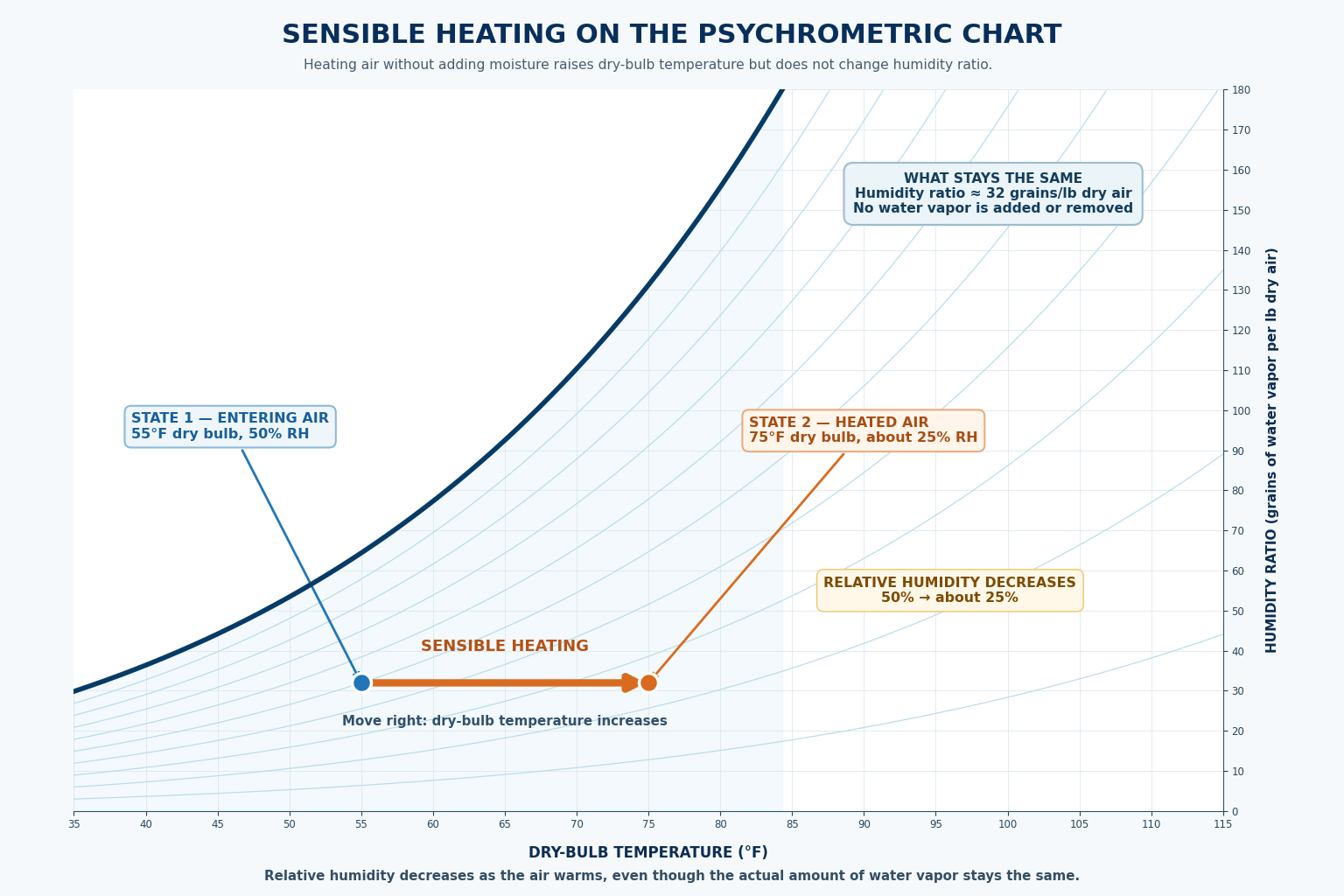
Sensible heating adds energy without adding or removing water vapor. Dry-bulb temperature and enthalpy increase, while humidity ratio and dew point remain constant. Relative humidity decreases because the warmer air is farther from saturation.
This ideal process describes air passing through a furnace heat exchanger, electric resistance heater, or heating coil when no humidifier or other moisture source affects the airstream.
Dry-Bulb Temperature
Increases as the process moves right.
Humidity Ratio
Remains approximately 32 grains per pound of dry air in the example because no water vapor is added or removed.
Relative Humidity
Decreases from 50% to approximately 25% as the example air warms from 55°F to 75°F.
Dew Point
Remains constant because moisture content and pressure remain unchanged.
Sensible heating lowers relative humidity but leaves humidity ratio and dew point unchanged. The air may feel drier and can accept more evaporation even though no water vapor was removed by the heater.
Compare Entering and Leaving Conditions
Across an ideal sensible heater, leaving dry-bulb temperature should be higher while humidity ratio remains nearly constant. A meaningful humidity-ratio change suggests another process, measurement error, air leakage, moisture addition, condensation elsewhere, or two different airstreams being compared.
Measure Representative Air
Take entering and leaving measurements where each airstream is reasonably mixed and away from direct radiant influence.
Allow Stabilization
Confirm that the heater, blower, dampers, and instruments have reached a representative operating condition.
Check Other Air Sources
Outdoor air, return leakage, humidifiers, bypass ducts, and zone dampers may change the measured leaving condition.
Relative humidity normally falls through a sensible heater. Compare humidity ratio or dew point if the question is whether water vapor was added or removed.
Adding Water Vapor Moves the State Upward
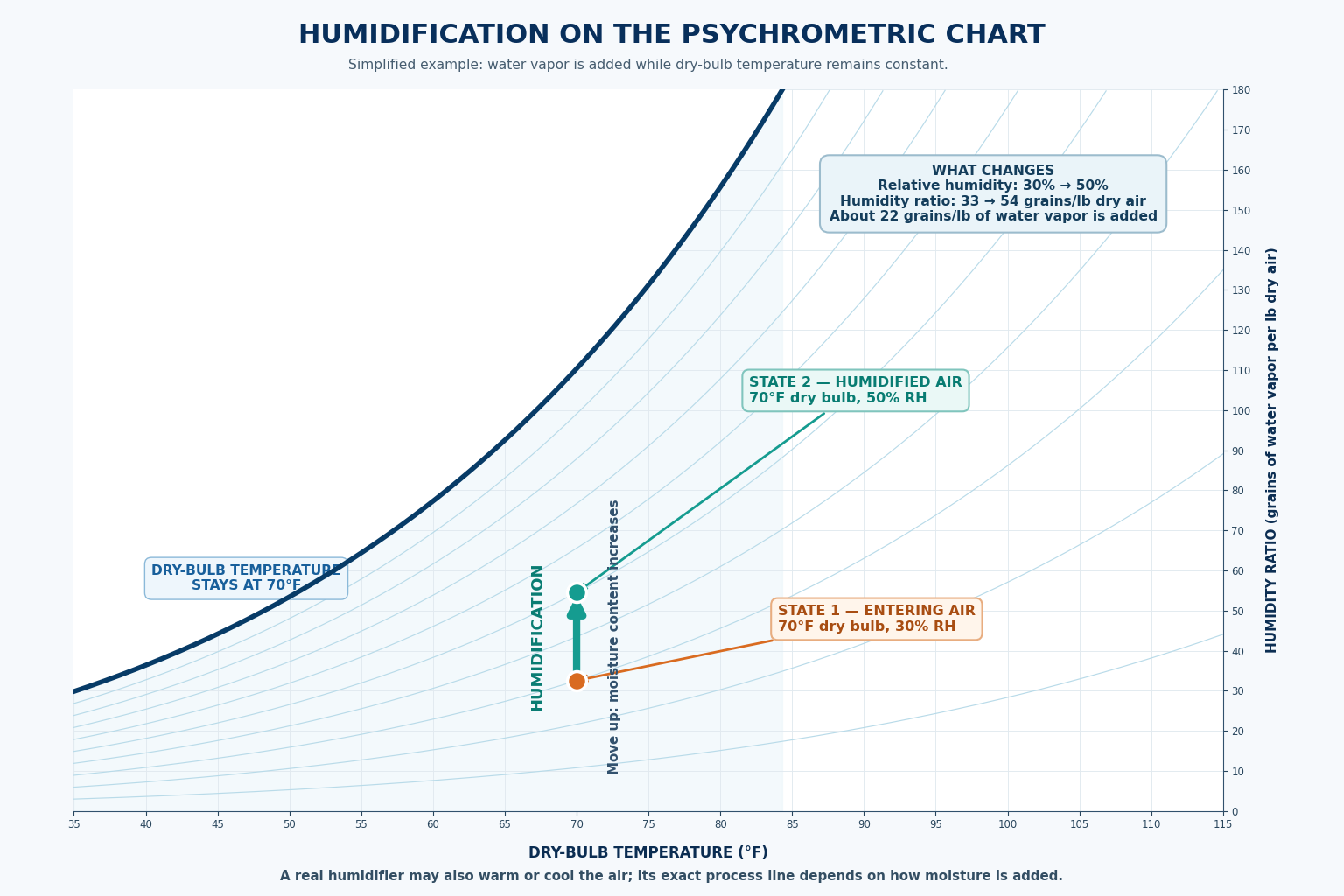
Humidification increases the humidity ratio and dew point of the air. Relative humidity usually increases, but the exact dry-bulb temperature change depends on the condition of the added water or steam and any heat exchanged during the process.
The simplified chart example holds dry-bulb temperature at 70°F while relative humidity increases from 30% to 50%. Humidity ratio increases from approximately 33 to 54 grains per pound of dry air, so about 22 grains per pound are added.
70°F and 30% RH
The example entering air contains approximately 33 grains of water vapor per pound of dry air.
70°F and 50% RH
The example leaving air contains approximately 54 grains per pound, an increase of about 22 grains per pound.
Rounding: The values are approximate chart readings, so the displayed difference may not exactly match subtraction of the rounded endpoint values.
The Moisture Source Changes the Process Direction
A real humidifier does not necessarily move straight upward on the chart. Steam carries substantial energy and may increase dry-bulb temperature as it adds moisture. Liquid water that evaporates into the air uses energy and may lower dry-bulb temperature unless heat is supplied.
Steam Humidification
Steam adds water vapor and energy. Humidity ratio rises, and dry-bulb temperature may also rise depending on the steam condition and system arrangement.
Evaporative Humidification
Liquid water evaporates into the air and uses sensible heat from the air or another source. Without added heat, dry-bulb temperature generally falls while humidity ratio rises.
Heated Evaporative Humidification
Supplemental heat can offset evaporative cooling, producing a process that adds moisture with less dry-bulb temperature reduction.
Use the manufacturer’s process information and measure entering and leaving air. The water temperature, steam condition, heat input, evaporation effectiveness, airflow, and control sequence affect the final condition.
Adding Moisture Requires Control and Maintenance
A humidifier must add the intended amount of moisture without allowing liquid carryover, duct wetting, mineral buildup, biological growth, drain problems, or condensation on downstream surfaces. The humidistat and limit controls must sense representative conditions.
Verify Moisture Increase
Compare entering and leaving humidity ratio or dew point rather than relying only on relative humidity.
Inspect Water and Drainage
Check supply, treatment, distribution, absorption distance, drain operation, scale, and cleanliness according to the manufacturer.
Check Downstream Conditions
Confirm that moisture is absorbed before elbows, filters, sensors, coils, or other surfaces that could become wet.
Check Condensation Risk
Compare the increased air dew point with cold ducts, windows, walls, piping, and other exposed surfaces.
A higher indoor humidity setting can create condensation inside or on building assemblies during cold weather. Equipment operation must remain within the humidifier, HVAC system, and building-design requirements.
The Mixed-Air Point Lies Between the Two Entering States
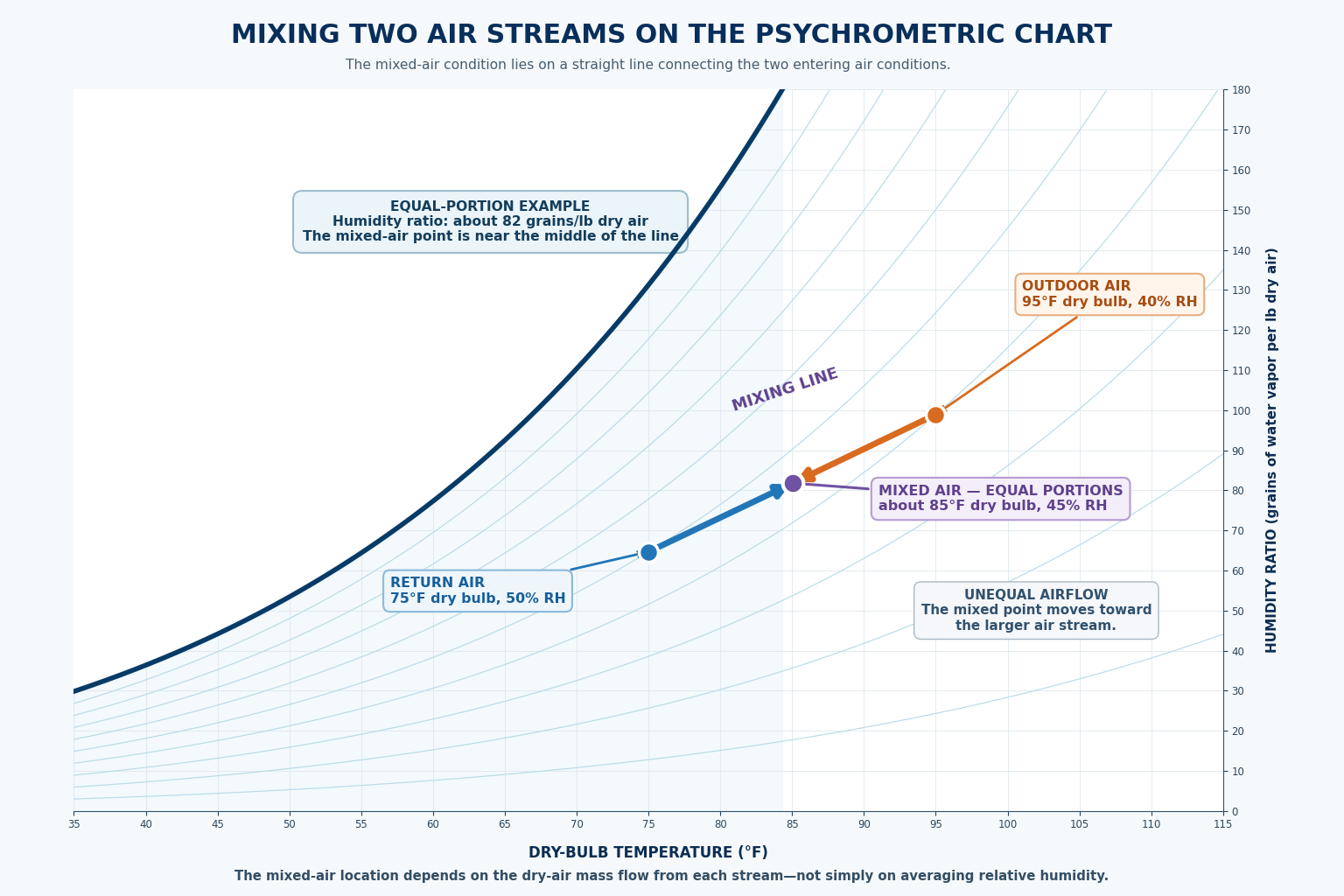
When two moist-air streams mix without significant heat or moisture exchange with the surroundings, the mixed state lies on a straight line connecting the two entering state points on the psychrometric chart.
The position along that line depends on the dry-air mass flow from each stream. Equal dry-air mass flows place the mixed point near the middle. A larger mass flow moves the mixed state closer to that airstream’s condition.
1. Plot Return Air
The example return air is 75°F dry bulb and 50% relative humidity.
2. Plot Outdoor Air
The example outdoor air is 95°F dry bulb and 40% relative humidity.
3. Connect the Points
Draw a straight line between the two entering-air states.
4. Apply the Flow Proportion
For equal dry-air mass flows, the mixed state is near the midpoint at approximately 85°F dry bulb and 45% relative humidity.
Relative humidity is temperature dependent and is not directly averaged to find the mixed state. Plot the two states and use dry-air mass flow, or use the appropriate mass and energy relationships.
Equal Volume Flow Is Not Always Equal Air Mass
The chart mixing relationship is based on dry-air mass flow. Two airstreams with equal cfm can have different dry-air mass flows because their specific volumes differ with temperature, moisture, and pressure.
For a simple field estimate under similar conditions, cfm proportions may be close enough for the intended purpose. For accurate calculations, convert each volumetric flow to dry-air mass flow using the applicable specific volume.
Practical warning: Outdoor-air damper position is not automatically equal to outdoor-air percentage. Damper characteristics, pressure, duct resistance, fan operation, wind, and leakage affect actual airflow.
Use the Three Air Conditions Together
Measure Outdoor Air
Measure representative intake air away from sun, rain, exhaust, condenser discharge, and heated building surfaces.
Measure Return Air
Choose a location upstream of the mixing section that represents the recirculated airstream.
Measure Mixed Air
Measure downstream where the streams are sufficiently blended and before a coil or another process changes the condition.
Plot All Three Points
The mixed point should fall near the line connecting the measured outdoor- and return-air states under steady conditions.
Investigate an Off-Line Point
Check sensor accuracy, poor mixing, heat gain, duct leakage, another airstream, changing conditions, or incorrect chart pressure and units.
Verify Damper Operation
Inspect linkages, actuators, seals, minimum-position settings, economizer sequence, pressure relationships, and actual airflow.
Outdoor and return air may have similar dry-bulb temperatures but very different humidity ratios. Measure a moisture-related property when the outdoor-air load or dehumidification requirement matters.
Avoid These Heating, Humidification, and Mixing Errors
“Heating removes moisture.”
Sensible heating lowers relative humidity but leaves humidity ratio and dew point unchanged.
“Every humidifier moves straight upward.”
The process direction depends on the energy and condition of the steam or liquid water and any additional heat exchange.
“More humidification is always better in winter.”
Excessive indoor dew point can create condensation on or inside cold building surfaces.
“Mixed-air RH is the average of the two RH readings.”
Relative humidity is not directly averaged. The mixed state follows dry-air mass and energy relationships.
“Equal cfm always means a midpoint mixture.”
The exact mixing relationship uses dry-air mass flow, and equal cfm does not always mean equal mass flow.
“Damper position equals outdoor-air percentage.”
Actual airflow also depends on damper characteristics, pressure, system resistance, fan operation, wind, and leakage.
Can You Follow Heating, Humidification, and Mixing Processes?
- In what direction does sensible heating move on the chart?
- What properties remain constant during sensible heating?
- Why does relative humidity decrease as air is heated?
- What property must increase when water vapor is added?
- Why does a real humidifier not always move vertically upward on the chart?
- How can steam humidification affect dry-bulb temperature?
- How can evaporative humidification affect dry-bulb temperature?
- Where does a mixed-air state lie relative to the two entering states?
- What determines the mixed point’s position on the connecting line?
- Why should relative-humidity percentages not be directly averaged?
- Why can equal cfm differ from equal dry-air mass flow?
- What could cause a measured mixed-air point to fall away from the expected mixing line?
What You Should Have Learned
Sensible heating moves horizontally right because dry-bulb temperature increases while humidity ratio remains constant.
Heating without moisture addition lowers relative humidity but does not remove water vapor.
Humidification increases humidity ratio and dew point, while its temperature effect depends on how water or steam is added.
Steam usually adds moisture and energy, while evaporation of liquid water can cool the air unless heat is supplied.
The mixture of two airstreams lies on the straight line connecting their state points.
The mixed point moves toward the condition of the airstream with greater dry-air mass flow.
Relative humidity should not be directly averaged, and equal cfm does not always mean equal dry-air mass flow.
Field diagnosis requires representative entering, leaving, outdoor, return, and mixed-air measurements together with equipment and control inspection.