Introduction to Psychrometrics
Psychrometrics is the study of the properties of moist air and the changes that occur when air is heated, cooled, humidified, or dehumidified. HVAC/R technicians use these relationships to understand comfort, condensation, airflow measurements, cooling-coil operation, and moisture removal.
This lesson introduces psychrometrics in practical terms. You will learn what moist air contains, why temperature alone does not describe an air condition, and how psychrometric information supports better service decisions.
What You Will Learn
Define psychrometrics in simple HVAC/R terms.
Describe moist air as a mixture of dry air and water vapor.
Explain why air temperature alone does not describe an indoor air condition.
Identify common HVAC/R tasks that require temperature and moisture information.
Recognize that comfort depends on environmental and personal factors.
Use a simple measure-compare-diagnose process when evaluating air conditions.
Psychrometrics Connects Air Conditions to HVAC/R Work
Air in a building carries heat and moisture. HVAC equipment changes one or both of these. A furnace raises air temperature, a cooling coil lowers temperature and may remove moisture, a humidifier adds moisture, and ventilation introduces outdoor air with its own temperature and moisture condition.
Psychrometrics gives technicians a consistent way to describe these air conditions and follow the changes produced by equipment. It turns measurements into useful information about comfort, condensation, moisture removal, and system performance.
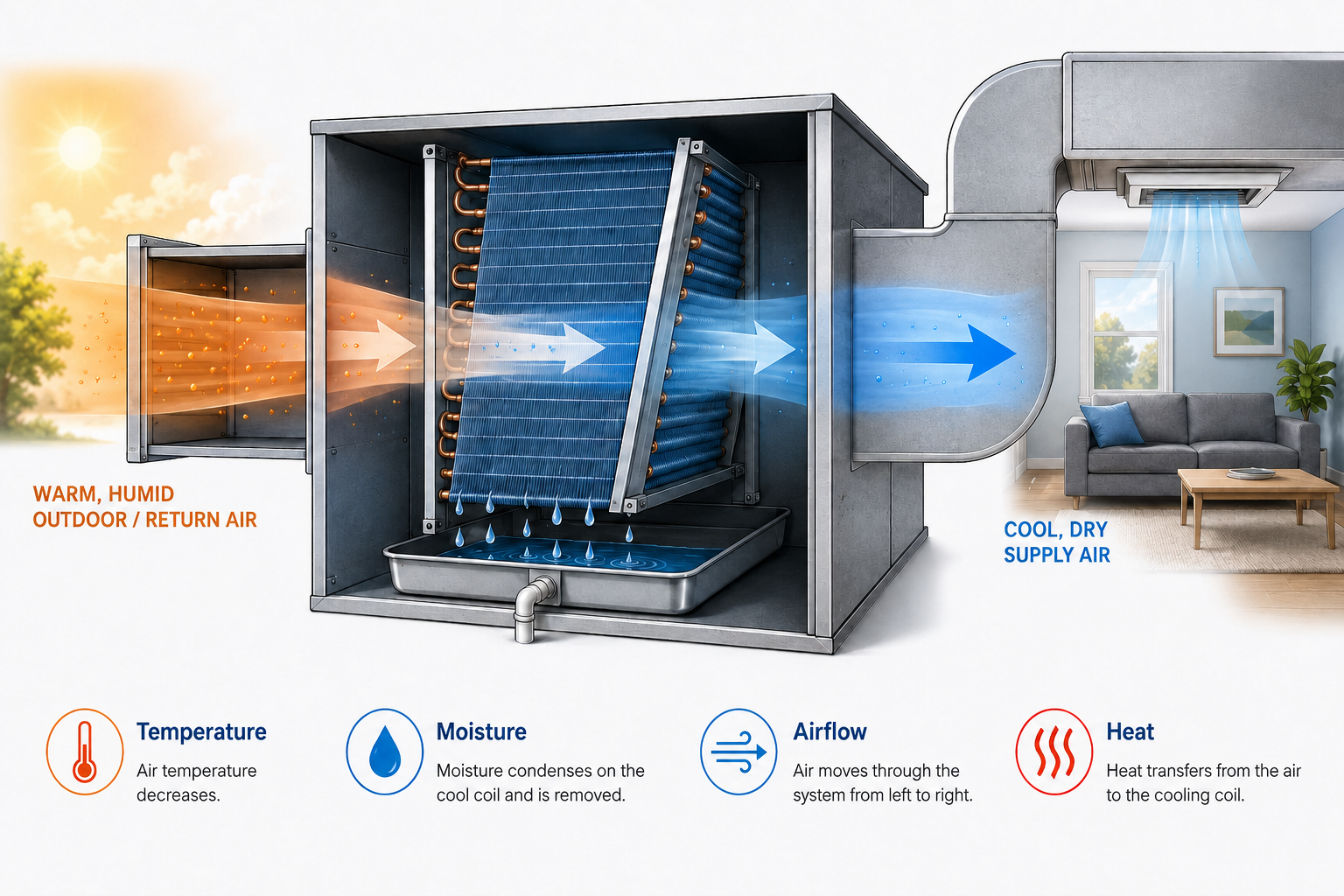
Psychrometrics is not just chart work. It is a practical way to understand what air contains, how equipment changes it, and whether the result matches the intended system operation.
Indoor Air Is a Mixture
In psychrometrics, moist air is treated as a mixture of dry air and water vapor. Dry air includes gases such as nitrogen and oxygen. Water vapor is water in its invisible gaseous form.
The amount of dry air in a sample and the amount of water vapor in that sample are considered separately. This matters because an HVAC system may change the air temperature without removing moisture, or it may cool the air enough for water vapor to condense and leave the airstream as liquid water.
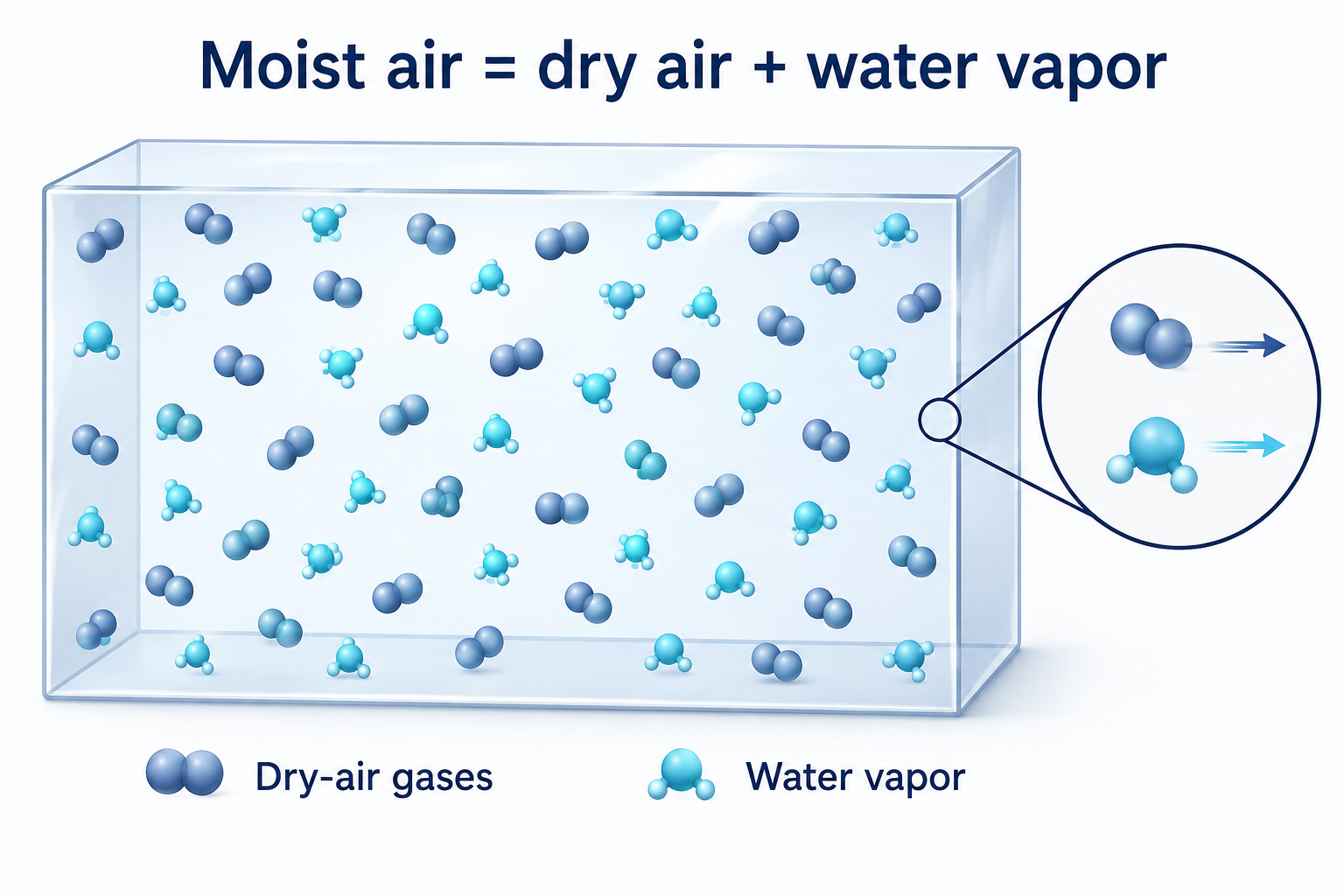
Water vapor is invisible. Fog, mist, and the cloud above a humidifier contain tiny liquid-water droplets that have formed after some vapor condensed.
Temperature and Moisture Must Be Considered Together
A dry-bulb temperature reading tells the technician how warm or cool the air is, but it does not show how much moisture is present. Two spaces can have the same dry-bulb temperature and still feel different or create different condensation risks because their moisture conditions are different.
Technicians commonly combine a temperature measurement with another moisture-related measurement, such as wet-bulb temperature, relative humidity, or dew point. Later lessons explain each property and show how to use them together.
How Warm or Cool Is the Air?
Dry-bulb temperature describes the air temperature measured by an ordinary temperature sensor that is properly shielded from unwanted heat sources.
What Is Happening with Water Vapor?
Wet-bulb temperature, relative humidity, humidity ratio, and dew point describe different parts of the air’s moisture condition.
Important: No single humidity term answers every service question. For example, relative humidity helps describe how close air is to saturation at its present temperature, while dew point helps predict whether moisture will condense on a cold surface.
Psychrometrics Supports Common Service Decisions
Comfort Complaints
Compare temperature and humidity information instead of assuming that thermostat temperature explains the entire complaint.
Cooling-Coil Operation
Determine whether a coil is only lowering air temperature or is also cooling the air below its dew point and removing moisture.
Condensation Problems
Compare a surface temperature with the surrounding air’s dew point to evaluate whether condensation should form.
Dehumidification
Evaluate the moisture condition of entering and leaving air to determine whether equipment is removing water vapor.
Ventilation and Mixed Air
Recognize that outdoor air can add or remove both heat and moisture when it mixes with return air.
System Troubleshooting
Use measured air conditions with airflow, refrigerant, electrical, and control information to diagnose the complete system.
Comfort Depends on More Than Thermostat Temperature
Temperature and humidity affect comfort, but they are not the only influences. Air speed and heat exchanged with surrounding surfaces also affect the indoor environment. A person’s activity and clothing affect how that environment is experienced.
This is why two people in the same room may not feel equally comfortable and why changing the thermostat setting does not always solve a comfort complaint.
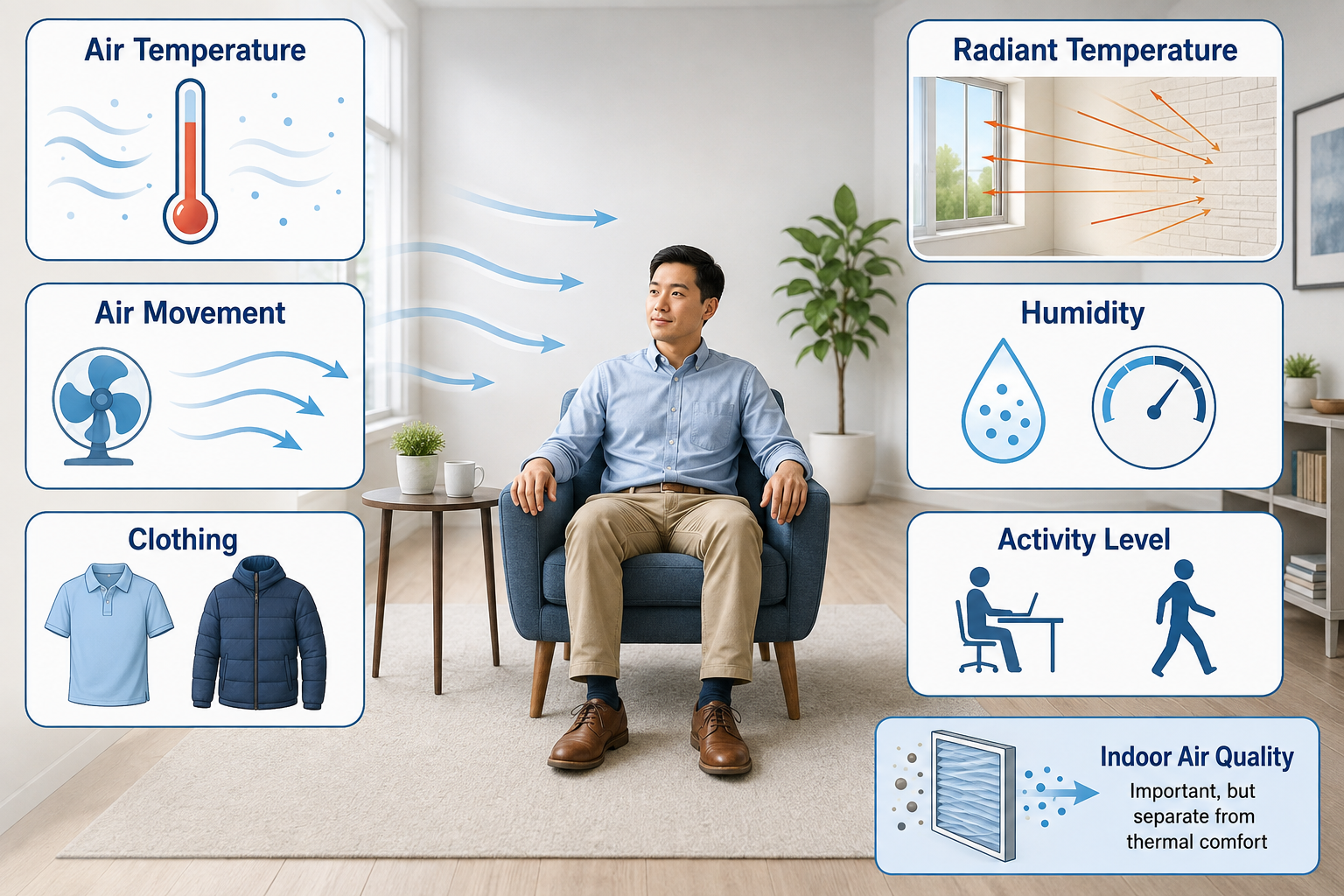
Verify temperature and humidity with appropriate instruments, consider air distribution and surface conditions, and ask where and when the problem occurs before changing equipment settings.
Measure, Compare, and Diagnose
1. Measure
Collect accurate temperature and moisture-related readings at locations that match the service question.
2. Compare
Compare entering air with leaving air, indoor air with outdoor air, or measured conditions with the equipment’s expected performance.
3. Diagnose
Use the air-condition results with airflow, equipment condition, refrigerant data, controls, and the manufacturer’s information before deciding what is wrong.
A single room-temperature or relative-humidity reading is only a snapshot. Useful diagnosis depends on accurate measurements, appropriate locations, stable operation, and a meaningful comparison.
Avoid These Introductory Errors
“Psychrometrics is only for engineers.”
Technicians use psychrometric relationships whenever they evaluate temperature, humidity, condensation, cooling, dehumidification, or mixed air.
“Room temperature tells the complete story.”
The same air temperature can exist with different moisture conditions, and comfort also depends on air speed, surrounding surfaces, activity, and clothing.
“Humidity and relative humidity mean exactly the same thing.”
Relative humidity is one way to describe moisture. Humidity ratio and dew point describe other useful parts of the moisture condition.
“A chart reading replaces system diagnosis.”
Psychrometric information is one part of diagnosis and must be considered with airflow, refrigeration, electrical, control, and equipment information.
Can You Explain the Purpose of Psychrometrics?
- What does psychrometrics study?
- What two components make up moist air?
- Is water vapor visible?
- Why does dry-bulb temperature alone not completely describe an air condition?
- Name three HVAC/R processes that change air temperature or moisture.
- How can psychrometrics help with a condensation complaint?
- Why can two spaces at the same temperature have different moisture conditions?
- Name four factors other than air temperature that can affect thermal comfort.
- Why should a technician compare entering and leaving air conditions?
- What other system information should be considered with psychrometric measurements?
What You Should Have Learned
Psychrometrics describes the properties of moist air and the changes produced by heating, cooling, humidification, and dehumidification.
Moist air is a mixture of dry air and invisible water vapor.
Temperature alone does not describe how much moisture is present in the air.
Psychrometric information helps technicians evaluate comfort, condensation, cooling-coil operation, dehumidification, ventilation, and mixed air.
Thermal comfort is affected by temperature, thermal radiation, humidity, air speed, activity, and clothing.
Useful diagnosis requires accurate measurements, meaningful comparisons, and the complete system condition.