Occupational Exposure Limits and Safety Data Sheets
Refrigerant safety involves more than preventing frostbite, controlling pressure, and avoiding flammable concentrations. Technicians must also understand how much of a chemical may be present in workplace air and where to find reliable information about health hazards, first aid, personal protective equipment, accidental releases, handling, storage, fire hazards, and chemical stability.
Occupational exposure limits provide benchmarks for evaluating airborne chemical exposure, while the Safety Data Sheet provides standardized information about a specific chemical product. Neither should be treated as a substitute for understanding the actual work environment. A technician must know which limit applies, what period of exposure it represents, and how to use the SDS before an emergency occurs.
Learning Objectives
Understand Occupational Exposure Limits
Explain the purpose of occupational exposure limits and distinguish common terms such as PEL, REL, TWA, STEL, ceiling, and IDLH.
Distinguish Different Types of Limits
Recognize the difference between enforceable OSHA limits, recommended exposure limits, short-term limits, ceiling values, and emergency exposure guidance.
Use a Safety Data Sheet
Locate important refrigerant safety information within the standardized 16-section SDS format.
Apply Safety Information in the Field
Use exposure information and the SDS to help plan routine service, respond to releases, select protective measures, and recognize when specialized safety assistance is required.
Concentration and Time Both Matter
A refrigerant released into the workplace becomes part of the surrounding atmosphere. The potential health effect depends on several factors, including the refrigerant involved, its concentration in the air, the length and frequency of exposure, the route of exposure, ventilation, and the health effects associated with that particular chemical.
This is why simply asking whether a refrigerant is “toxic” does not provide enough information. Even a refrigerant classified in the lower-toxicity Class A group can become hazardous at sufficiently high concentrations, and a large release can create an oxygen-displacement hazard in addition to any refrigerant-specific health effects.
What Is an OEL?
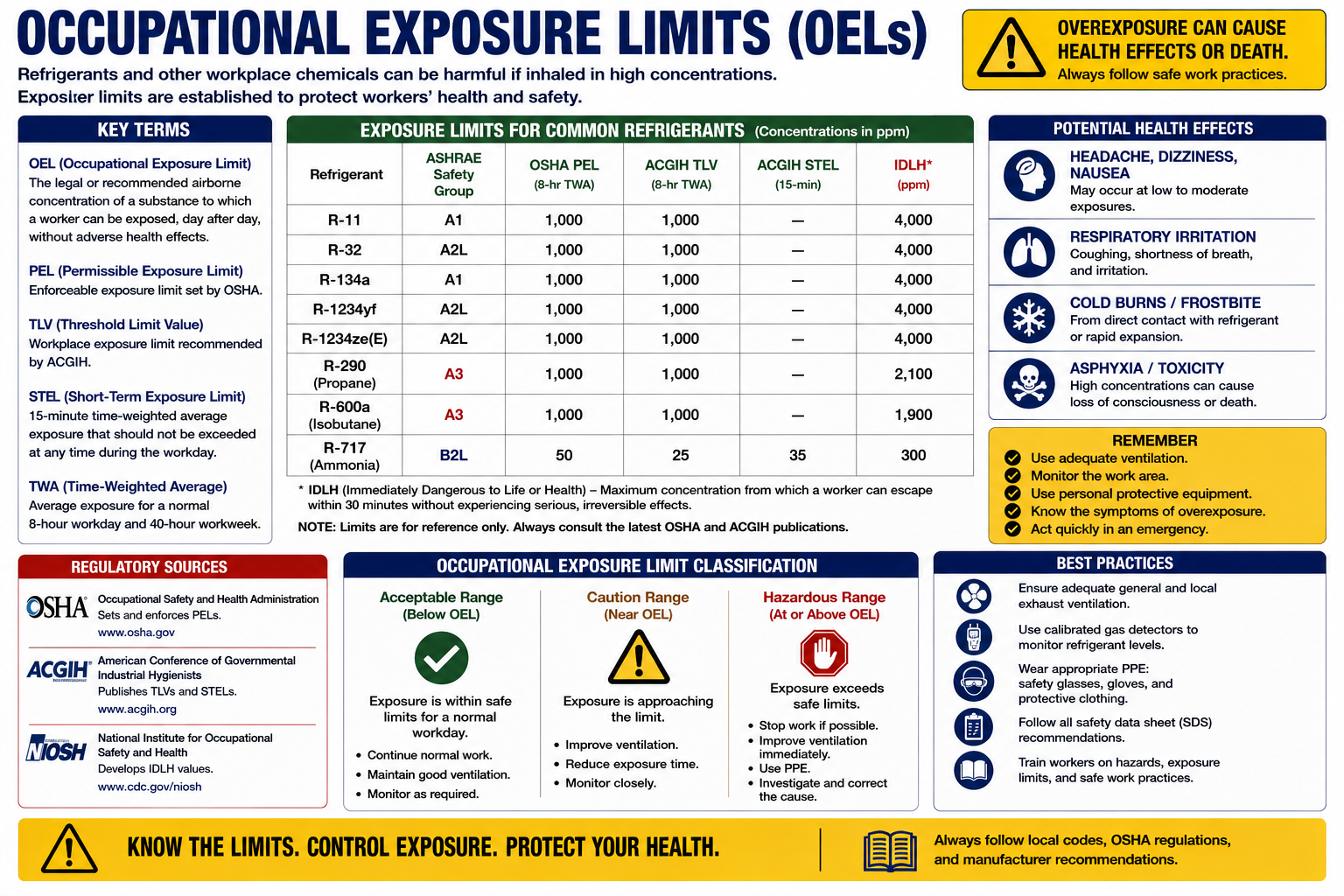
Occupational Exposure Limit (OEL) is a general term for a concentration used to evaluate worker exposure to a chemical in workplace air. Different organizations establish different types of occupational exposure limits, and those limits do not all have the same regulatory status.
An exposure limit is normally associated with a particular substance and a defined exposure period. The concentration may be expressed in units such as parts per million (ppm) or milligrams per cubic meter of air (mg/m3).
The technician must therefore identify both the numerical concentration and the type of limit. A value labeled as an OSHA PEL has a different regulatory meaning from a NIOSH REL or another professional exposure recommendation.
Do Not Assume Every Published Number Is an OSHA Limit
Refrigerant manufacturers, SDS documents, safety organizations, government agencies, and professional organizations may publish different exposure values. Determine who established the value, what exposure period it represents, and whether it is an enforceable regulation, a recommended limit, or another type of guidance.
PEL — Permissible Exposure Limit
An OSHA Permissible Exposure Limit (PEL) is an enforceable workplace exposure limit established by OSHA for a regulated substance. Many OSHA air-contaminant limits are contained in 29 CFR 1910.1000 and its Z tables, while some chemicals are addressed by substance-specific standards.
Many PELs are expressed as an eight-hour time-weighted average, although other forms of limits also exist. A technician should therefore read the applicable standard rather than assuming every OSHA PEL represents the same averaging period.
Not Every Refrigerant Has a Specific OSHA PEL
The absence of a substance-specific OSHA PEL does not mean that unrestricted exposure is safe. Other workplace-safety requirements, manufacturer information, SDS guidance, NIOSH recommendations, recognized professional guidance, ventilation requirements, and hazard-control practices may still be important.
REL — Recommended Exposure Limit
The National Institute for Occupational Safety and Health (NIOSH) publishes Recommended Exposure Limits (RELs) for many workplace chemicals. These recommendations are intended to help prevent occupational illness and injury but should not automatically be described as OSHA PELs.
NIOSH RELs commonly use time-weighted averages, short-term limits, ceiling values, or other exposure designations depending on the substance. The NIOSH Pocket Guide to Chemical Hazards is one useful source for this information.
TWA — Exposure Averaged Over Time
A Time-Weighted Average (TWA) represents average exposure over a specified work period. It recognizes that airborne concentration may rise and fall during the workday rather than remaining constant.
For example, a technician might experience very little exposure during most of a shift but a substantially higher concentration while recovering refrigerant or responding to a leak. The time-weighted average combines those different exposures according to how long each concentration occurred.
A Safe TWA Does Not Automatically Make Every Short Exposure Safe
A low average for an entire shift can hide a much higher short-duration exposure. This is why some substances also have short-term exposure limits or ceiling limits that control brief concentration peaks.
STEL — Short-Term Exposure Limit
A Short-Term Exposure Limit (STEL) establishes a limit for a relatively short period rather than an entire work shift. A 15-minute averaging period is commonly used for many STELs, although the technician must always verify the definition associated with the specific limit being used.
STELs are important because some substances can cause adverse effects from short periods of elevated exposure even when the average concentration across the entire workday remains relatively low.
TWA
Evaluates average exposure over a longer specified work period.
STEL
Controls elevated exposure over a shorter specified period.
A Ceiling Should Not Be Exceeded
A ceiling limit identifies a concentration that should not be exceeded during exposure according to the definition used by the organization or regulation establishing the limit. OSHA uses ceiling designations for certain air contaminants.
A ceiling differs from a time-weighted average because averaging a high concentration with a long period of low concentration does not make an excessive ceiling exposure acceptable.
IDLH Is an Emergency Concept, Not a Routine Exposure Target
IDLH means Immediately Dangerous to Life or Health. NIOSH establishes IDLH values to identify concentrations that pose an immediate threat to life, could cause irreversible or delayed adverse health effects, or could interfere with a person’s ability to escape from a dangerous atmosphere.
An IDLH concentration should never be treated as an acceptable routine occupational exposure level. It is used for emergency planning, respiratory protection decisions, escape considerations, and other high-hazard situations.
Do Not Enter an IDLH Atmosphere as Ordinary HVAC/R Service Work
Entry into an atmosphere that is known or suspected to be IDLH requires specialized respiratory protection, training, procedures, supervision, rescue capability, and other controls. Ordinary refrigerant service PPE does not make an IDLH atmosphere safe to enter.
A Refrigerant Exposure Limit Does Not Replace Oxygen Monitoring
Lesson 29 examined the possibility that refrigerant can displace air in an enclosed area. This hazard must be considered separately from a refrigerant’s occupational exposure limit.
An atmosphere can become unsafe because of reduced oxygen, excessive refrigerant concentration, flammability, or some combination of these conditions. Measuring only one hazard may therefore provide an incomplete picture of the atmosphere.
Different Measurements Answer Different Questions
An oxygen sensor measures oxygen concentration. A refrigerant-specific monitor measures the refrigerant it is designed to detect. A combustible-gas sensor evaluates a different hazard. Do not assume one instrument automatically evaluates every atmospheric danger.
Do Not Memorize One Number for All Refrigerants
Different refrigerants have different chemical and toxicological properties. An exposure value appropriate for one refrigerant cannot simply be transferred to another refrigerant because the products perform similar refrigeration functions.
Exposure information may also differ depending on the organization publishing the limit and the scientific or regulatory basis being used. For actual service work, technicians should use current information for the specific refrigerant and applicable workplace requirements.
Check the Current SDS
Do not rely solely on an exposure number remembered from training or copied from an old refrigerant chart. Consult the current SDS and applicable occupational-safety information for the exact refrigerant being handled.
The SDS Is the Technician’s Chemical Safety Reference
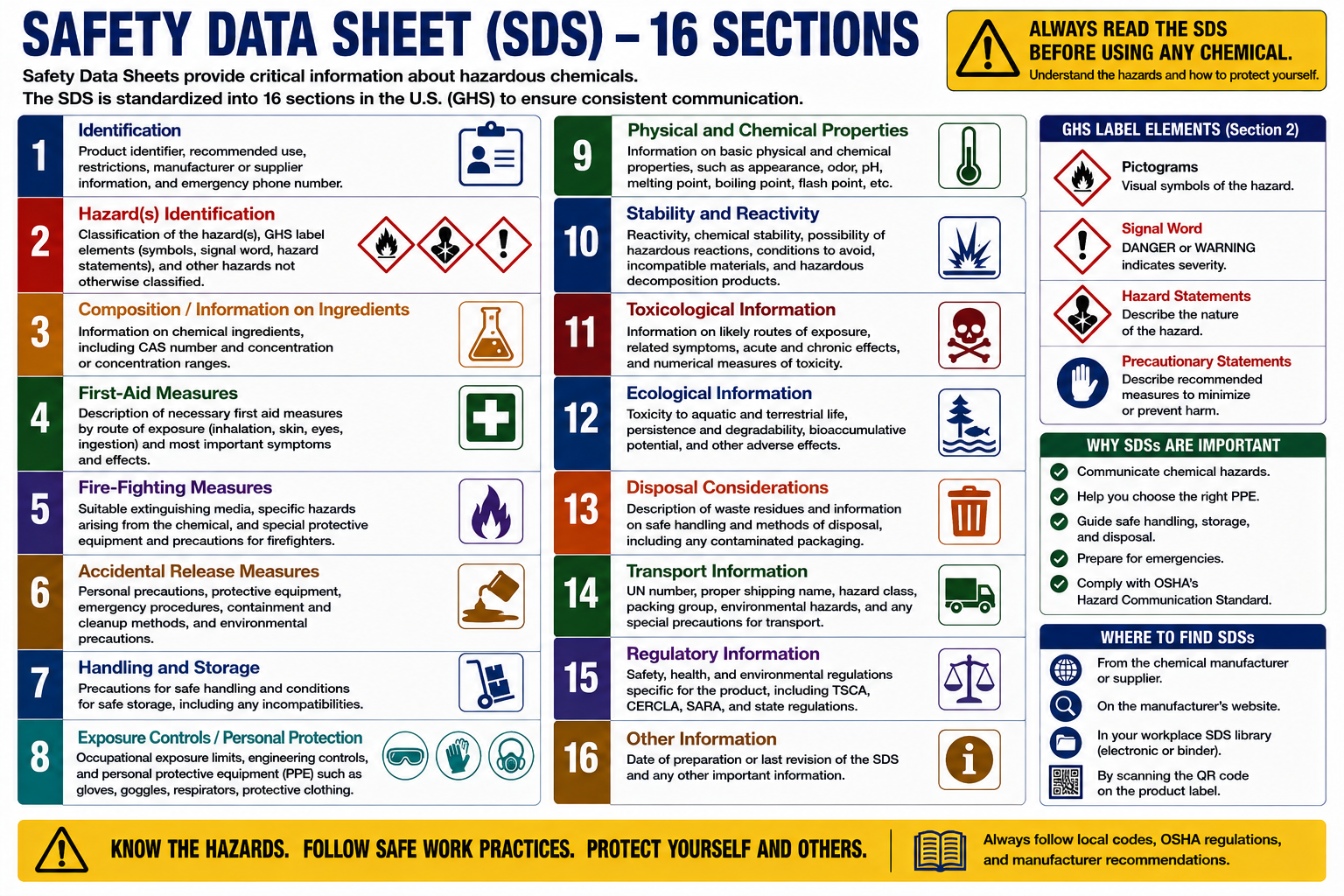
The Safety Data Sheet (SDS) is a standardized document used to communicate chemical hazards and protective information. OSHA’s Hazard Communication Standard requires employers to maintain SDS information for hazardous chemicals in the workplace and make it readily accessible to employees during their work shifts.
For HVAC/R technicians, the SDS provides a central source for identifying the refrigerant’s hazards, first-aid instructions, fire response information, accidental-release procedures, handling and storage requirements, exposure controls, PPE information, physical properties, stability information, and other safety information.
A Standardized Format Makes Information Easier to Find
| Section | Heading | Why an HVAC/R Technician May Need It |
|---|---|---|
| 1 | Identification | Identifies the product, recommended use, manufacturer or supplier, and emergency contact information. |
| 2 | Hazard(s) Identification | Identifies classified hazards, signal words, hazard statements, pictograms, and precautionary information. |
| 3 | Composition / Information on Ingredients | Identifies chemical ingredients and can be especially useful when working with refrigerant blends. |
| 4 | First-Aid Measures | Provides first-aid information for inhalation, skin, eye, or other exposures. |
| 5 | Fire-Fighting Measures | Describes suitable extinguishing methods and hazards that may occur during a fire. |
| 6 | Accidental Release Measures | Provides precautions, emergency procedures, containment information, and cleanup guidance. |
| 7 | Handling and Storage | Describes safe handling practices and storage conditions. |
| 8 | Exposure Controls / Personal Protection | Provides exposure limits, engineering controls, and recommended personal protective measures. |
| 9 | Physical and Chemical Properties | Provides properties such as appearance, odor information, boiling point, vapor pressure, density, and other physical data. |
| 10 | Stability and Reactivity | Identifies incompatible materials, conditions to avoid, and possible hazardous decomposition products. |
| 11 | Toxicological Information | Describes likely routes of exposure, symptoms, acute and chronic health effects, and toxicological information. |
| 12 | Ecological Information | Provides information about environmental effects where supplied. |
| 13 | Disposal Considerations | Provides disposal-related information where supplied. |
| 14 | Transport Information | Provides shipping and transportation information where supplied. |
| 15 | Regulatory Information | Provides regulatory information not already included elsewhere where supplied. |
| 16 | Other Information | May include the SDS preparation or revision date and other useful information. |
An Important OSHA Detail About Sections 12 Through 15
The standardized SDS format contains 16 sections. OSHA requires the information specified for Sections 1 through 11 and Section 16. Sections 12 through 15 appear in the standardized format, but OSHA does not enforce the content of those four sections because those subjects involve matters administered by other agencies.
Identification — Make Sure You Have the Right Product
Before using safety information, confirm that the SDS actually applies to the refrigerant or chemical being handled. Section 1 identifies the product and supplier and normally provides emergency contact information.
This sounds obvious, but similar refrigerant numbers and blend names can create confusion. The safety information for R-32, R-410A, R-454B, R-290, R-717, and other refrigerants cannot simply be assumed to be identical.
Hazard Identification — What Can Hurt You?
Section 2 summarizes the chemical’s classified hazards and required hazard-communication information. Depending on the product, this may include physical hazards, health hazards, signal words, pictograms, hazard statements, precautionary statements, and other hazard information.
For refrigerants, technicians should pay particular attention to hazards involving pressurized gas or liquefied gas, cold-contact injury, flammability where applicable, health effects, and other product-specific warnings.
Do Not Stop Reading at the Refrigerant Safety Classification
An ASHRAE designation such as A1 or A2L is useful, but it does not contain all of the information found in an SDS. The SDS addresses the chemical product from a workplace hazard-communication perspective and should be reviewed separately.
First Aid — Know Where to Look Before Someone Is Injured
Section 4 provides first-aid measures for the routes of exposure relevant to the product. For refrigerants, this can be especially important following eye contact, skin exposure to rapidly evaporating liquid refrigerant, or excessive inhalation exposure.
Technicians should follow the specific first-aid information for the refrigerant involved rather than relying on a generic refrigerant first-aid rule.
Do Not Wait Until an Exposure Occurs to Find the SDS
Emergency response is faster and safer when the SDS is already readily available. Know where the refrigerant SDS and workplace emergency resources are located before beginning service.
Fire and Accidental Release Information
Section 5 addresses fire-fighting measures. This information becomes especially important with A2L, A2, and A3 refrigerants and whenever a refrigerant container or refrigeration system is involved in a fire.
Section 6 addresses accidental releases. The information may include personal precautions, emergency procedures, protective equipment, ventilation considerations, containment, and cleanup methods appropriate to the chemical.
A substantial refrigerant release may require evacuation, ventilation, atmospheric monitoring, emergency response, and other controls well beyond ordinary leak repair. Technicians should follow the SDS, facility emergency plan, and applicable workplace procedures.
Handling and Storage
Section 7 provides precautions for safe handling and storage. Refrigerants often require attention to cylinder temperature, physical damage, ventilation, incompatible materials, valve protection, and other storage conditions.
The SDS should be used together with cylinder markings, manufacturer instructions, applicable transportation requirements, workplace rules, and the safe cylinder-handling practices covered earlier in this course.
Exposure Controls and Personal Protection
For a service technician, Section 8 is one of the most important parts of the SDS. It may identify occupational exposure limits and provide information about engineering controls, ventilation, eye protection, hand protection, respiratory protection, and other protective measures.
The exposure-limit table may contain more than one value because different organizations can publish different limits. Read the headings carefully. Do not describe a manufacturer recommendation, NIOSH REL, or other occupational guideline as an OSHA PEL unless that is actually what the SDS identifies.
Look for the Source
Determine whether the value is identified as an OSHA PEL, NIOSH REL, or another occupational exposure guideline.
Look for the Time Period
Determine whether the value is a TWA, STEL, ceiling, or another type of limit.
Look for Engineering Controls
Review recommendations for ventilation, enclosure, local exhaust, or other methods of reducing exposure.
Look for PPE
Review product-specific recommendations for eye, skin, hand, respiratory, and other protection.
Physical and Chemical Properties Help Explain Behavior
Section 9 contains physical and chemical information that can help a technician understand how a refrigerant behaves. Depending on the product, the SDS may provide boiling information, vapor pressure, vapor density, flammability information, appearance, and other properties.
These properties help explain why refrigerant may exist as a pressurized liquid in a cylinder, why a release can produce rapid cooling, why some vapors may accumulate in poorly ventilated locations, and why different refrigerants require different service equipment and procedures.
Stability, Reactivity, and Decomposition Products
Section 10 identifies chemical stability, conditions to avoid, incompatible materials, and hazardous decomposition products where applicable. This information is particularly important before brazing, welding, using an open flame, or exposing refrigerant to high temperatures.
Lesson 28 explained that some refrigerants can decompose when exposed to extreme heat and produce hazardous products. Section 10 is where the SDS provides product-specific information about those hazards.
Do Not Generalize Decomposition Chemistry
Different refrigerants have different chemical compositions. Consult the SDS for the actual refrigerant rather than assuming that every refrigerant produces exactly the same decomposition products when heated.
Toxicological Information
Section 11 provides information about health effects and routes of exposure. It may describe symptoms associated with inhalation, skin contact, eye contact, or other exposure pathways and may distinguish acute effects from longer-term health concerns.
This section helps explain why exposure limits and protective measures differ between chemicals. A refrigerant being classified as lower toxicity does not mean that very high exposure is harmless.
The Information Must Be Available When Workers Need It
An SDS provides little protection if employees cannot obtain it when needed. Under OSHA’s Hazard Communication requirements, employers must maintain SDSs for hazardous chemicals present in the workplace and ensure they are readily accessible to employees during their work shifts.
Electronic SDS systems can be useful, but workplace procedures should account for situations in which normal electronic access may be unavailable. Technicians should understand how their employer provides access to current chemical safety information.
Why the Name Changed
Technicians who have worked in the industry for many years may remember the term Material Safety Data Sheet (MSDS). Older documents, training materials, and technicians may still use that terminology.
The current OSHA Hazard Communication system uses the term Safety Data Sheet (SDS) and the standardized 16-section format. When discussing current workplace documentation, SDS is the correct term.
Historical Term
If an older manual tells you to “check the MSDS,” it is referring to the type of chemical safety information now standardized as the SDS. The underlying purpose remains chemical hazard communication, but the modern terminology and standardized format should be used in current training.
Turn the SDS Into a Work-Planning Tool
The SDS should not be thought of only as an emergency document. It can help a technician plan the job before the refrigeration circuit is opened.
Confirm the Product
Verify that the SDS matches the refrigerant or chemical actually being serviced.
Review the Hazards
Check Section 2 for the primary physical and health hazards associated with the product.
Review Exposure Controls
Check Section 8 for exposure limits, engineering controls, ventilation, and PPE information.
Plan for a Release
Review Section 6 so you understand the required precautions if the refrigerant escapes unexpectedly.
Review Heat and Fire Hazards
Check Sections 5 and 10 before hot work or any service operation that could expose refrigerant to heat or ignition sources.
Know the First Aid
Review Section 4 and know where emergency eyewash and other required emergency resources are located.
Having an SDS Is Not the Same as Using It Correctly
Wrong Refrigerant
Using the SDS for a similar refrigerant does not provide reliable product-specific information.
Old Revision
Use current safety information rather than assuming an old SDS remains the best available reference.
Reading Only Section 2
The hazard summary is important, but exposure controls, first aid, releases, handling, fire information, and reactivity are located in other sections.
Ignoring the Limit Type
A numerical concentration means little unless you know whether it represents a PEL, REL, TWA, STEL, ceiling, or another value.
Waiting for an Emergency
The middle of a refrigerant release is not the ideal time to learn how to navigate the SDS for the first time.
Treating the SDS as a Service Manual
The SDS describes chemical safety. Equipment charging, troubleshooting, repair, and operating procedures still come from appropriate manufacturer service information.
Different Information Serves Different Purposes
EPA Section 608 regulates refrigerant management and emissions from stationary refrigeration and air-conditioning equipment. Occupational exposure limits and OSHA’s Hazard Communication requirements address worker protection and chemical hazard communication.
These requirements complement one another but should not be confused. EPA Section 608 certification does not replace OSHA hazard communication, workplace exposure controls, respiratory-protection requirements, confined-space procedures, PPE requirements, or employer safety programs where those requirements apply.
Think in Layers
EPA Section 608: refrigerant management and environmental requirements. OSHA: workplace safety and hazard communication requirements. NIOSH and other occupational-health sources: research and recommended exposure guidance. SDS: product-specific chemical safety information. Manufacturer service literature: equipment-specific procedures. Safe HVAC/R service often requires information from several of these sources.
What You Need to Remember
- OEL is a general term for an occupational exposure limit.
- PEL commonly refers to an enforceable OSHA Permissible Exposure Limit.
- REL refers to a NIOSH Recommended Exposure Limit.
- TWA evaluates average exposure over a specified period of time.
- STEL limits shorter-duration exposure and commonly uses a short averaging period.
- A ceiling limit controls concentrations that should not be exceeded according to the applicable definition.
- IDLH means Immediately Dangerous to Life or Health and is not a normal occupational exposure target.
- An exposure limit for one refrigerant should not automatically be applied to another refrigerant.
- Exposure limits do not replace evaluation of oxygen deficiency, flammability, or other atmospheric hazards.
- The current term is Safety Data Sheet (SDS), not MSDS.
- The SDS uses a standardized 16-section format.
- Section 2 contains hazard identification information.
- Section 4 contains first-aid information.
- Section 6 addresses accidental releases.
- Section 7 addresses handling and storage.
- Section 8 addresses exposure controls and personal protection.
- Section 10 addresses stability, reactivity, incompatible materials, and decomposition hazards.
- OSHA requires the specified information in SDS Sections 1 through 11 and 16; Sections 12 through 15 are part of the standardized format but their content is not enforced by OSHA.
- The SDS should be reviewed before an emergency occurs.
Review Questions
1. What is an occupational exposure limit?
Answer: An occupational exposure limit is a concentration used to evaluate worker exposure to a chemical in workplace air. The meaning of the limit depends on who established it and the exposure period it represents.
2. What is the difference between an OSHA PEL and a NIOSH REL?
Answer: An OSHA Permissible Exposure Limit is an enforceable OSHA occupational exposure requirement where applicable. A NIOSH Recommended Exposure Limit is occupational-health guidance recommended by NIOSH and should not be described as an OSHA PEL.
3. What does TWA mean?
Answer: TWA means Time-Weighted Average. It represents average exposure over a specified period while accounting for changes in airborne concentration during that period.
4. Why might a chemical have both a TWA and a STEL?
Answer: A TWA controls average exposure across a longer period, while a STEL limits elevated short-duration exposure. A low shift average does not necessarily prevent an unsafe short-term concentration peak.
5. Is an IDLH concentration an acceptable level for routine refrigerant service?
Answer: No. IDLH means Immediately Dangerous to Life or Health and represents an emergency hazard condition requiring specialized protective measures and procedures.
6. Which SDS section should a technician check for exposure limits and PPE information?
Answer: Section 8, Exposure Controls / Personal Protection.
7. Which SDS section contains first-aid information?
Answer: Section 4, First-Aid Measures.
8. Which SDS section should be checked for hazardous decomposition products before brazing or other hot work?
Answer: Section 10, Stability and Reactivity. Section 5 should also be reviewed for fire-fighting information where appropriate.
9. Are all 16 SDS sections enforced by OSHA?
Answer: No. OSHA specifies required information for Sections 1 through 11 and Section 16. Sections 12 through 15 are included in the standardized SDS format, but OSHA does not enforce the content of those sections.
10. Why should technicians review an SDS before beginning work?
Answer: Reviewing the SDS in advance allows the technician to identify hazards, required exposure controls, PPE, handling precautions, release procedures, first-aid information, fire hazards, and chemical incompatibilities before an incident occurs.
Lesson 31 Summary
- Occupational exposure limits provide benchmarks for evaluating airborne chemical exposure in the workplace.
- The meaning of an exposure value depends on its source and the time period represented by the limit.
- OSHA PELs and NIOSH RELs have different regulatory status and should not be confused.
- Time-Weighted Average limits evaluate average exposure over a specified period.
- Short-Term Exposure Limits control shorter periods of elevated exposure.
- Ceiling limits restrict concentrations that should not be exceeded under the applicable definition.
- IDLH values identify emergency conditions that are immediately dangerous to life or health and are not routine workplace exposure targets.
- Refrigerant occupational exposure limits do not replace monitoring for oxygen deficiency, flammability, or other atmospheric hazards.
- Different refrigerants can have different health hazards and exposure guidance.
- The Safety Data Sheet is the standardized source of product-specific workplace chemical safety information.
- The current terminology is Safety Data Sheet, although older material may use the historical term Material Safety Data Sheet.
- The SDS contains 16 standardized sections.
- Sections 1 through 11 and Section 16 contain information required by OSHA’s SDS requirements.
- Sections 12 through 15 remain part of the standardized format, but OSHA does not enforce their content.
- Section 4 provides first-aid information, Section 6 addresses accidental releases, Section 8 provides exposure controls and PPE information, and Section 10 addresses stability and reactivity.
- Technicians should know how to locate and use the SDS before beginning work rather than waiting until an exposure or refrigerant release occurs.
- EPA Section 608 environmental requirements, OSHA workplace-safety requirements, occupational exposure guidance, SDS information, and manufacturer service procedures address different parts of safe HVAC/R work.