Recover, Recycle, and Reclaim Refrigerant
When refrigerant is removed from an air-conditioning or refrigeration system, the technician must decide what happens to it next. The words recover, recycle, and reclaim describe three different operations, and under EPA Section 608 they are not interchangeable terms.
Understanding the differences is important for both regulatory compliance and good service practice. Refrigerant may sometimes be returned to equipment owned by the same person after recovery or recycling, but used refrigerant that is transferred to a new owner for use as refrigerant must be reclaimed by an EPA-certified reclaimer. Reclamation also provides a verified purity level so that used refrigerant can re-enter the refrigerant supply chain.
Learning Objectives
Distinguish Recovery, Recycling, and Reclamation
Explain the EPA definitions of recover, recycle, and reclaim and understand why the terms describe different levels of refrigerant handling and processing.
Determine When Refrigerant May Be Reused
Understand when recovered or recycled refrigerant may be returned to equipment owned by the same person and when reclamation is required before refrigerant is transferred to a new owner.
Understand Recycling and Reclamation Processes
Describe how recycling removes common contaminants and how reclamation provides a higher level of processing and purity verification.
Understand AHRI 700 Purity
Explain why reclaimed refrigerant must meet applicable purity specifications and why laboratory verification distinguishes reclamation from ordinary field recycling.
Recover, Recycle, and Reclaim Are Not Synonyms
Technicians sometimes use the terms recovery, recycling, and reclamation casually, but EPA Section 608 gives these terms specific meanings. Each operation represents a different stage in handling used refrigerant.
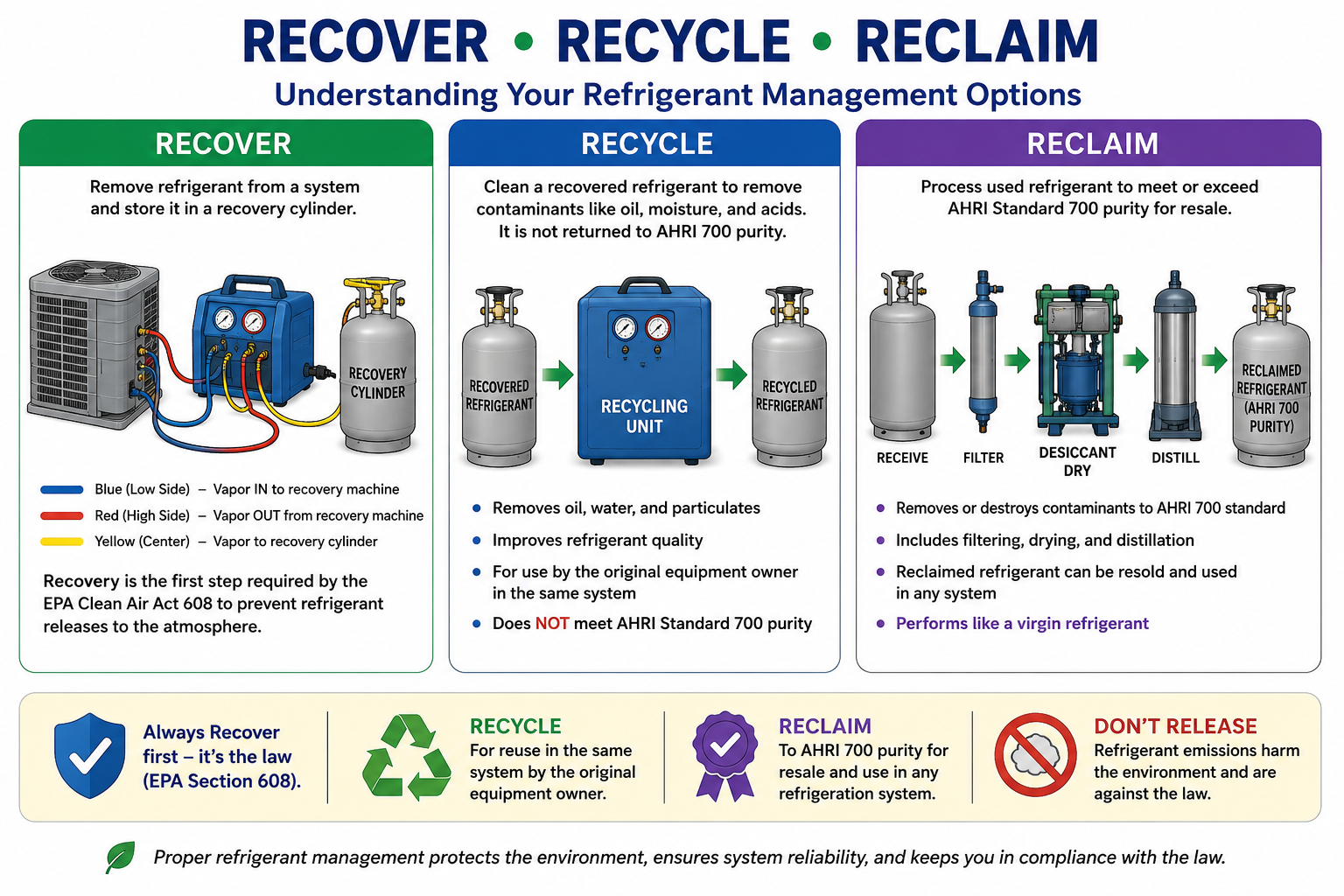
Recover
Remove refrigerant from an appliance and store it in an external container without necessarily testing or processing it.
Recycle
Remove refrigerant and clean it for reuse in equipment of the same owner without completing all of the processing and analytical verification required for reclamation.
Reclaim
Reprocess used refrigerant to the applicable purity specifications and verify that the refrigerant meets those specifications using the required analytical methods.
Recovery Is the First Step
Recovery means removing refrigerant from an appliance and storing it in an external container without necessarily testing or processing the refrigerant. In practical service work, the refrigerant normally moves from the refrigeration system through recovery equipment and into an approved recovery cylinder.
The purpose of recovery is containment. Instead of intentionally releasing refrigerant into the atmosphere when a system is opened, the technician captures the refrigerant so that it can later be reused, recycled, reclaimed, or otherwise managed appropriately.
Recovery alone does not tell the technician whether the refrigerant is clean, contaminated, mixed with another refrigerant, suitable for immediate reuse, or capable of meeting a reclamation purity specification.
Recovered Does Not Mean Clean
A cylinder labeled as recovered refrigerant may contain oil, moisture, acid, particulates, noncondensable gases, or other contaminants from the system from which it was removed. Its condition depends on the system, recovery procedure, equipment used, and whether contamination occurred before or during recovery.
Recovery Protects Both the Atmosphere and the Refrigerant Supply
EPA Section 608 restricts intentional venting of regulated refrigerants and requires appropriate refrigerant recovery practices when covered appliances are serviced, maintained, repaired, or disposed of. Recovery is therefore a fundamental environmental requirement of modern HVAC/R service.
Recovery also preserves refrigerant that may still have significant economic value. Refrigerant already in circulation can potentially be reused by the same owner, sent for recycling, or sent to an EPA-certified reclaimer rather than being unnecessarily lost.
Prevent Emissions
Capturing refrigerant prevents unnecessary release to the atmosphere during service and equipment retirement.
Preserve Refrigerant
Recovered refrigerant may remain useful rather than becoming waste simply because it was removed from a system.
Support Older Equipment
Recovered and reclaimed refrigerant can help support existing systems as production and consumption of some refrigerants decline.
Reduce New Production Demand
Reusing refrigerant already in circulation can reduce the need for newly produced refrigerant where reuse is appropriate and permitted.
Recycling Cleans Refrigerant for Reuse
Under EPA’s Section 608 definition for stationary refrigeration, recycling means extracting refrigerant from an appliance and cleaning it for reuse in equipment of the same owner without meeting all of the requirements for reclamation.
Recycling generally involves processes such as oil separation and one or more passes through devices such as filter-driers. These processes can reduce moisture, acidity, oil, and particulate contamination.
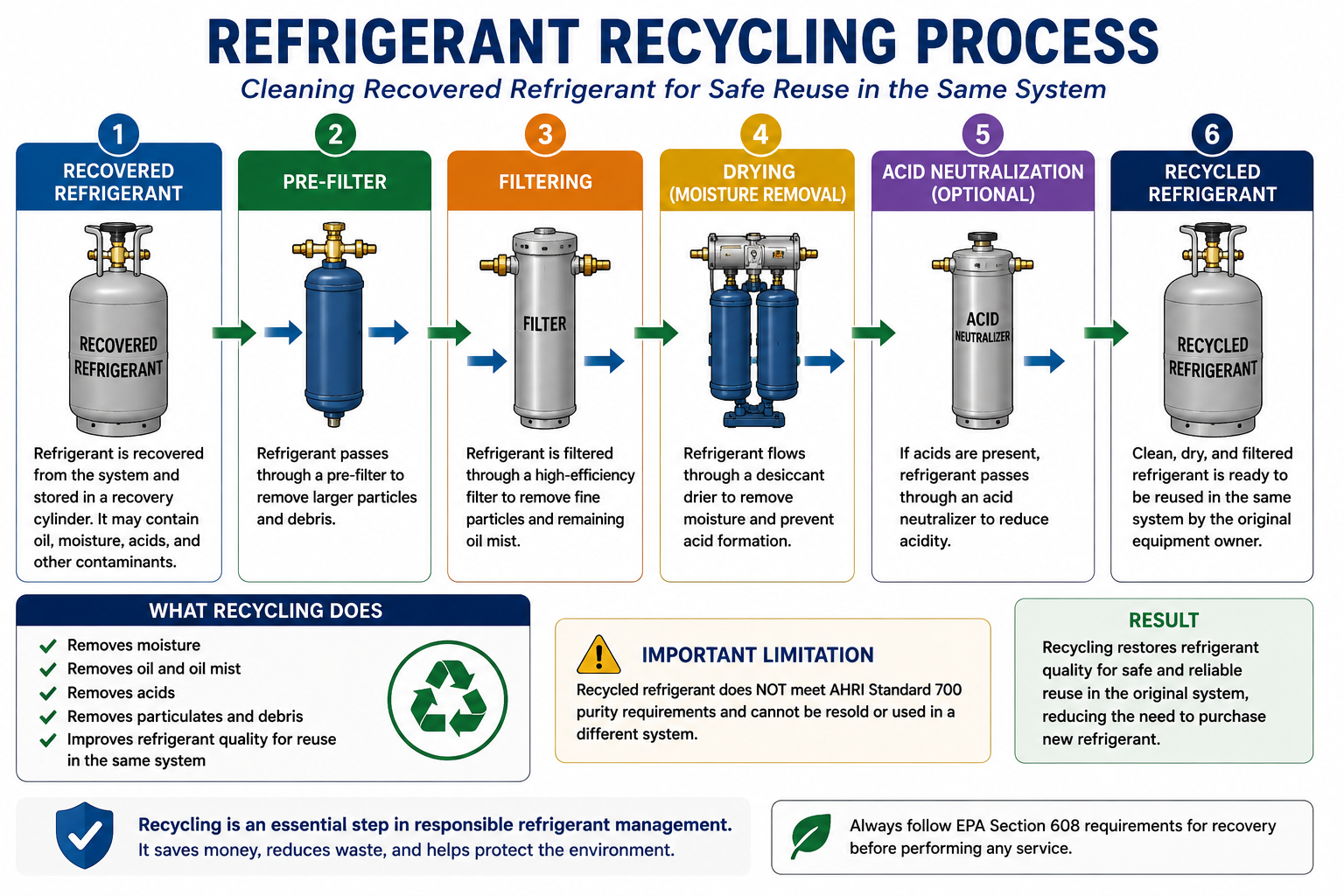
Recover the Refrigerant
Remove refrigerant from the appliance and contain it rather than releasing it into the atmosphere.
Separate Oil
Oil separation removes lubricant carried out of the refrigeration system with the refrigerant.
Filter Contaminants
Filters or filter-driers can reduce particulate matter and other contamination carried with recovered refrigerant.
Reduce Moisture and Acidity
Drying and filtering processes can reduce moisture and acidic contamination that could damage refrigeration equipment.
Recycling Is More Than Recovery
A recovery machine may simply transfer refrigerant to a cylinder, while recycling equipment incorporates processes that clean the refrigerant. Some equipment performs both recovery and recycling functions, but the technician should understand which operation is actually being performed.
Who Owns the Refrigerant Matters
EPA allows recovered or recycled refrigerant to be returned to the same appliance or to another appliance owned by the same person without requiring that the refrigerant first be reclaimed.
This ownership distinction is important. A contractor may remove refrigerant from one appliance belonging to a customer and later use appropriate recovered or recycled refrigerant in another appliance belonging to that same customer. The refrigerant does not automatically have to pass through a certified reclaimer simply because it moves between the customer’s appliances.
However, the fact that EPA permits same-owner reuse does not mean that every cylinder of recovered refrigerant should automatically be returned to a system. The technician must still consider refrigerant identity, contamination, system condition, compatibility, and good service practice.
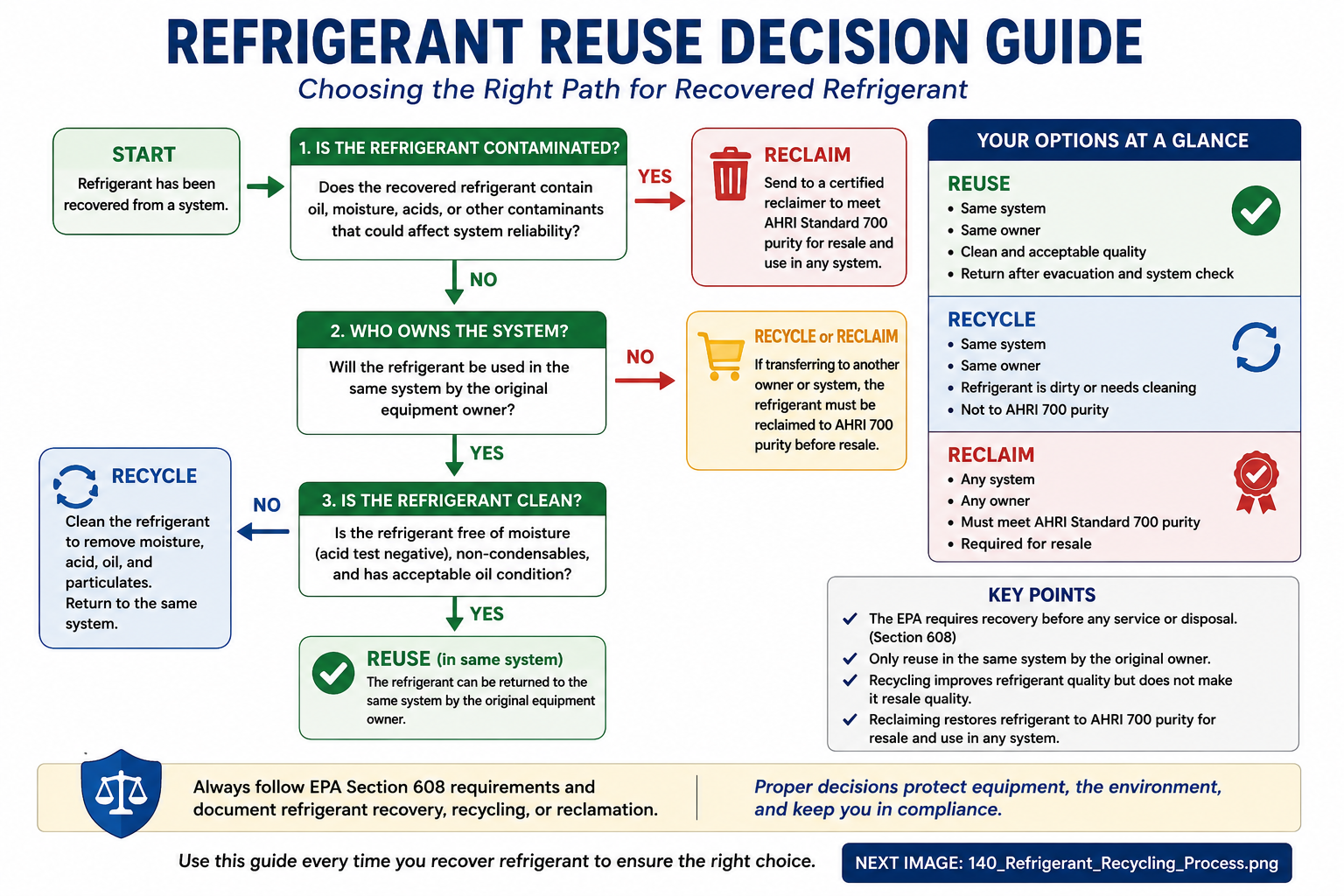
Legal Reuse Does Not Guarantee Good Refrigeration Practice
EPA’s same-owner provision addresses whether reclamation is required before reuse. It does not guarantee that recovered refrigerant is clean enough or suitable for a particular appliance. Refrigerant contaminated by a compressor burnout, mixed refrigerants, severe moisture contamination, or uncertain refrigerant identity may require additional processing or reclamation.
Same Technician Is Not the Same as Same Owner
One common misunderstanding is to focus on who recovered the refrigerant rather than who owns the equipment. The EPA rule concerns whether used refrigerant remains within equipment owned by the same person.
A service company may maintain equipment for many different customers. Refrigerant recovered from Customer A’s equipment does not become the service company’s unrestricted supply simply because the technician performed the recovery.
Reclamation Returns Used Refrigerant to a Verified Purity Standard
Reclamation is a more complete process than field recycling. EPA defines reclamation as reprocessing recovered refrigerant to the specifications applicable under its regulations and verifying that the refrigerant meets those specifications using prescribed analytical methods.
Reclamation facilities use specialized processing equipment and testing capabilities that are normally beyond what a service technician carries on a truck. The process may include separation, filtration, drying, removal of contaminants, and other treatment necessary to bring refrigerant back within the required purity limits.
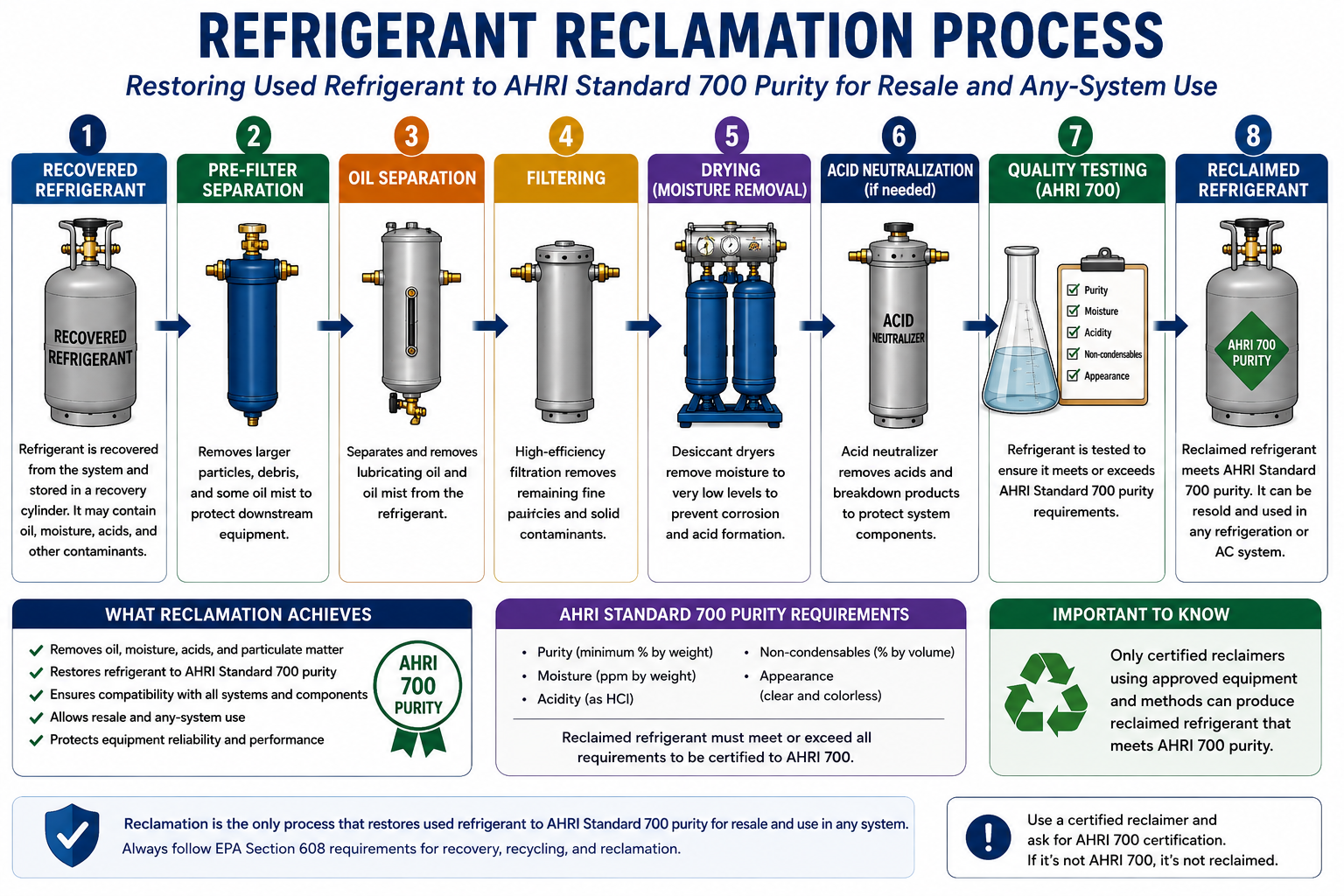
Receive and Identify
The reclaimer receives used refrigerant and evaluates its identity and condition before processing.
Remove Contamination
Processing may remove oil, moisture, acids, particulates, noncondensable gases, and other contaminants.
Restore Composition
Reclamation must result in refrigerant that meets the applicable composition and contaminant specifications for that refrigerant.
Verify Purity
Analytical testing verifies that the processed refrigerant satisfies the required purity specification before it is represented as reclaimed refrigerant.
Reclamation Is a Certified Activity
Refrigerant reclaimers that process used refrigerant for the purposes covered by Section 608 must be certified by EPA. This is different from technician certification. A Section 608-certified service technician is not automatically an EPA-certified refrigerant reclaimer.
Technicians and contractors commonly send recovered refrigerant to a refrigerant distributor, wholesaler, recovery company, consolidator, or directly to an EPA-certified reclaimer. A consolidator may collect and package used refrigerant before it is sent to the certified reclaimer.
Technician Certification Is Not Reclaimer Certification
A technician may be qualified to recover refrigerant from an appliance without having the laboratory equipment, processing capability, quality-control program, or EPA certification required to operate as a refrigerant reclaimer.
Used Refrigerant Entering a New Owner’s Supply Must Be Reclaimed
EPA regulations restrict the resale of used ozone-depleting refrigerants and substitute refrigerants, including HFCs, to a new owner for use as refrigerant unless the refrigerant has been reclaimed by an EPA-certified refrigerant reclaimer.
This requirement creates an important boundary between same-owner reuse and the refrigerant marketplace. Refrigerant can remain within the same owner’s equipment without reclamation when otherwise appropriate, but used refrigerant cannot simply be recovered from one customer’s system and sold as refrigerant to another customer.
Same Appliance
Recovered or recycled refrigerant may be returned to the appliance from which it was removed when appropriate.
Same Owner, Different Appliance
Recovered or recycled refrigerant may be used in another appliance owned by the same person without first being reclaimed.
New Owner
Used refrigerant transferred or sold for use as refrigerant by a new owner must first be reclaimed by an EPA-certified reclaimer.
Unknown or Contaminated Refrigerant
Refrigerant of uncertain identity or condition should be segregated and sent through an appropriate reclamation or disposition process rather than being casually returned to equipment.
Purity Must Be Measured, Not Assumed
Reclamation depends on a defined refrigerant purity specification. EPA’s current Section 608 reclamation requirements reference purity specifications in Appendix A to 40 CFR Part 82, Subpart F, which are based on AHRI Standard 700-2016 for the regulatory requirement.
AHRI Standard 700 establishes refrigerant purity specifications and test methods. The standard addresses composition and contaminant limits so that refrigerant quality can be evaluated objectively rather than relying on appearance, pressure, odor, or assumptions about how the refrigerant was processed.
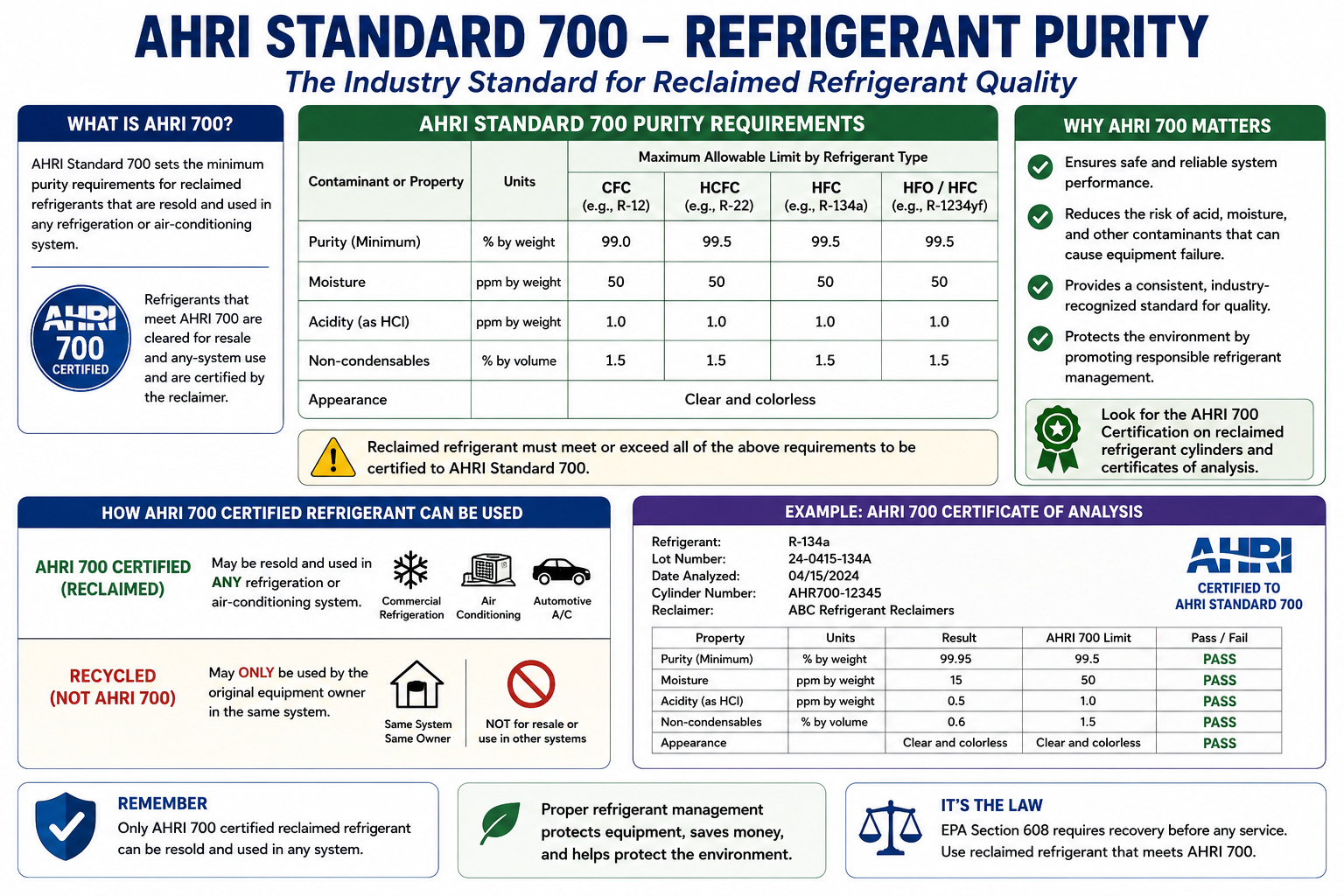
Current AHRI Standard Versus the EPA Regulatory Reference
AHRI maintains and updates Standard 700 as an industry standard. EPA’s current Section 608 reclamation regulation specifically references the purity requirements in Appendix A to Subpart F, based on AHRI Standard 700-2016. When determining legal compliance, use the standard and edition incorporated into the applicable regulation rather than assuming that a newer industry edition automatically replaces the regulatory reference.
Refrigerant Quality Is More Than Refrigerant Percentage
Refrigerant purity involves more than simply determining whether a cylinder contains the correct refrigerant number. Refrigerant quality can be affected by water, acidity, particulates, high-boiling residues, noncondensable gases, incorrect refrigerant components, and other contamination.
A system may operate poorly or suffer damage even when most of the material in the cylinder is technically the intended refrigerant. Moisture can contribute to corrosion or chemical reactions, noncondensables can raise system pressures, particulate contamination can damage components, and mixed refrigerants can create unpredictable pressure-temperature relationships and charging problems.
Correct Composition
The refrigerant must have the required chemical composition, including proper blend composition where applicable.
Controlled Moisture
Excess water can contribute to corrosion, freeze-up, lubricant problems, and chemical reactions inside the refrigeration system.
Controlled Acidity
Acid contamination can attack compressor insulation, metals, lubricants, and other refrigeration-system materials.
Controlled Noncondensables
Air and other noncondensable gases can increase condensing pressure and reduce system performance.
Purity Performance Can Be Equivalent Without the Refrigerant Being Newly Produced
Reclaimed refrigerant has previously been used and then reprocessed and tested to meet the applicable purity specification. Newly manufactured refrigerant has not gone through a previous service cycle.
From the technician’s perspective, the important issue is that properly reclaimed refrigerant has been processed and verified to satisfy the applicable purity requirements. Reclamation allows refrigerant already in circulation to return to productive use instead of requiring newly manufactured refrigerant for every service need.
Keep Recovered Refrigerants Separate
One of the most important steps a technician can take to preserve the value of recovered refrigerant is to avoid mixing different refrigerants in the same recovery cylinder. Mixed refrigerants can be difficult or uneconomical to separate and may greatly reduce the value of the material to a reclaimer.
Technicians should positively identify the refrigerant before recovery and use properly labeled recovery cylinders. If the refrigerant identity is uncertain, it should be treated as unknown rather than mixed with a cylinder of known refrigerant.
Do Not Create a “Mixed Refrigerant” Cylinder by Convenience
Combining different refrigerants because only one recovery cylinder is available can convert otherwise reusable or reclaimable refrigerant into a difficult contamination problem. Proper cylinder management begins before the recovery machine is connected.
The Condition of the System Matters
Refrigerant recovered from a clean system during a routine component replacement may be very different from refrigerant removed after a severe compressor burnout or other system failure.
A burnout can introduce acids, degraded lubricant, carbon, particulates, moisture, and other contaminants into the refrigeration circuit. Same-owner reuse may be legally possible in some circumstances, but the technician must still determine whether reuse is technically appropriate.
Regulatory Permission and Technical Suitability Are Different Questions
The first question may be, “Does EPA require this refrigerant to be reclaimed before reuse?” The second question must still be, “Is this refrigerant in suitable condition to be placed back into this equipment?” Good service practice requires both questions.
Why the Technician Cannot Verify AHRI 700 Purity With a Manifold Gauge
Pressure readings, temperature measurements, refrigerant identifiers, sight glasses, and field observations can provide useful information, but they do not perform the complete analytical testing required to establish reclaimed-refrigerant purity.
A field recycling machine can remove contamination and improve refrigerant condition, but that process is different from laboratory verification that the refrigerant meets the complete applicable reclamation specification.
Field Recycling
Primarily cleans refrigerant for same-owner reuse using separation, filtration, and drying processes.
Reclamation
Processes refrigerant and verifies its purity using the analytical requirements incorporated into the reclamation standard.
Identification Helps Prevent Contamination but Does Not Perform Reclamation
Refrigerant identifiers can be useful when refrigerant identity is uncertain or when contamination is suspected. They may help determine whether a cylinder contains the expected refrigerant or whether another refrigerant is present.
However, an identifier should not be confused with the analytical testing required for reclamation. A device that indicates that a sample appears to contain a particular refrigerant does not necessarily measure all of the purity characteristics required by the applicable reclamation specification.
Reclaimed Refrigerant Supports the Installed Equipment Base
Refrigerant transitions do not instantly remove older equipment from service. Large numbers of systems continue operating after production or consumption of their original refrigerant has been reduced or ended.
Reclamation allows refrigerant recovered from retired, retrofitted, or serviced equipment to return to the supply chain at verified purity. This can provide an important source of refrigerant for maintaining existing equipment while reducing demand for newly produced refrigerant.
Supports Legacy Equipment
Reclaimed refrigerant can provide service material for equipment that remains economically useful.
Preserves Existing Material
Reclamation allows refrigerant already manufactured to remain useful rather than being unnecessarily discarded.
Supports Refrigerant Transitions
Reclaimed supplies can help bridge the period between older installed equipment and newer systems using different refrigerants.
Reduces Emissions
A functioning recovery and reclamation system creates an economic and practical reason to capture refrigerant instead of releasing it.
Know What EPA Requires and What Good Service Adds
EPA regulations establish specific requirements concerning recovery, reclamation, resale of used refrigerant, and other refrigerant-management activities. These requirements establish the minimum legal framework.
Good HVAC/R practice may require additional judgment. A technician should not reuse refrigerant merely because the regulation permits same-owner reuse if there is reason to believe that refrigerant is contaminated, misidentified, mixed, or unsuitable for the system.
Two Questions to Ask
Regulatory question: May this recovered refrigerant legally be reused without reclamation? Technical question: Is the refrigerant sufficiently clean, correctly identified, compatible, and appropriate for this particular system? Both questions matter.
Use the Correct Word for the Process
“I Reclaimed It Into a Cylinder”
Simply transferring refrigerant from a system into a recovery cylinder is recovery, not reclamation.
“The Recovery Machine Cleaned It”
Some equipment may include recycling functions, but ordinary recovery alone does not guarantee that the refrigerant has been cleaned.
“Recycled Means AHRI 700”
Recycling does not include the complete purity verification required for reclaimed refrigerant.
“Same Contractor Means Same Owner”
A contractor servicing multiple customers does not turn those customers into one refrigerant owner.
“If It Looks Clean, It Is Reclaimed”
Refrigerant purity cannot be verified by color, appearance, cylinder pressure, or visual inspection.
“Recovered Refrigerant Is Waste”
Recovered refrigerant may have substantial value and may be reused, recycled, reclaimed, or otherwise managed depending on its condition and ownership.
What You Need to Remember
- Recover means removing refrigerant from an appliance and storing it in an external container without necessarily testing or processing it.
- Recycle means cleaning recovered refrigerant for reuse in equipment of the same owner without meeting all reclamation requirements.
- Recycling commonly uses oil separation, filtration, and drying to reduce contaminants.
- Reclaim means reprocessing refrigerant to the applicable purity specifications and verifying that purity using the required analytical methods.
- Recovered refrigerant is not automatically clean.
- Recycled refrigerant is not automatically reclaimed refrigerant.
- Recovered or recycled refrigerant may be returned to the same appliance or another appliance owned by the same person without first being reclaimed.
- Used refrigerant transferred or sold to a new owner for use as refrigerant must be reclaimed by an EPA-certified reclaimer.
- A Section 608-certified service technician is not automatically an EPA-certified refrigerant reclaimer.
- EPA’s current reclamation purity requirement is contained in Appendix A to 40 CFR Part 82, Subpart F and is based on AHRI Standard 700-2016.
- AHRI Standard 700 establishes refrigerant composition, contaminant specifications, and test methods.
- Field recycling equipment does not by itself provide the complete laboratory verification required for reclamation.
- Different refrigerants should be kept separate during recovery.
- Unknown or mixed refrigerant should not be added to a cylinder containing properly identified refrigerant.
- Legal same-owner reuse does not eliminate the technician’s responsibility to determine whether the refrigerant is technically suitable for reuse.
- Reclamation helps preserve refrigerant supplies and support existing equipment during refrigerant transitions.
Review Questions
1. What does refrigerant recovery mean?
Answer: Recovery means removing refrigerant from an appliance and storing it in an external container without necessarily testing or processing it.
2. How is recycling different from recovery?
Answer: Recovery primarily captures and stores the refrigerant. Recycling adds cleaning processes such as oil separation, filtration, and drying so the refrigerant can be reused in equipment owned by the same person.
3. How is reclamation different from recycling?
Answer: Reclamation reprocesses refrigerant to the applicable purity specifications and verifies that purity using prescribed analytical methods. Field recycling does not include all of those reclamation requirements.
4. May recovered refrigerant be returned to the same appliance without being reclaimed?
Answer: Yes. EPA allows recovered or recycled refrigerant to be returned to the same appliance without reclamation when otherwise appropriate.
5. May recovered refrigerant be used in another appliance belonging to the same owner without reclamation?
Answer: Yes. EPA allows recovered or recycled refrigerant to be used in another appliance owned by the same person without first requiring reclamation.
6. What must happen before used refrigerant is transferred to a new owner for use as refrigerant?
Answer: The used refrigerant must be reclaimed by an EPA-certified refrigerant reclaimer before it is sold or transferred to the new owner for use as refrigerant.
7. Does passing refrigerant through a filter-drier make it reclaimed refrigerant?
Answer: No. Filtration may be part of recycling or reclamation, but reclaimed refrigerant must also meet the applicable purity specifications and have that purity verified using the required analytical methods.
8. Why should different recovered refrigerants be kept in separate cylinders?
Answer: Mixing refrigerants creates contamination, can make reuse impossible, may make reclamation more difficult or expensive, and can reduce or eliminate the value of otherwise recoverable refrigerant.
9. What is the purpose of AHRI Standard 700?
Answer: AHRI Standard 700 establishes refrigerant purity specifications and test methods used to evaluate composition and contaminants. EPA’s current Section 608 reclamation requirements incorporate purity specifications based on AHRI Standard 700-2016.
10. Does EPA permission for same-owner reuse mean the technician should always reuse the recovered refrigerant?
Answer: No. The refrigerant must still be correctly identified, uncontaminated enough for the intended use, compatible with the appliance, and technically appropriate to return to service.
Lesson 32 Summary
- Recovery, recycling, and reclamation are three different refrigerant-management operations.
- Recovery removes refrigerant from an appliance and stores it externally without necessarily processing it.
- Recycling cleans refrigerant using processes such as oil separation, filtration, and drying.
- Under EPA’s stationary-refrigeration definition, recycling prepares refrigerant for reuse in equipment of the same owner without meeting full reclamation requirements.
- Reclamation is a more complete process that returns refrigerant to the applicable purity specification and verifies that purity analytically.
- Recovered or recycled refrigerant may be returned to the same appliance or another appliance owned by the same person without reclamation.
- Used refrigerant sold or transferred to a new owner for use as refrigerant must first be reclaimed by an EPA-certified refrigerant reclaimer.
- A technician’s Section 608 certification is different from EPA certification of a refrigerant reclaimer.
- AHRI Standard 700 establishes refrigerant purity specifications and analytical test methods.
- EPA’s current reclamation regulation references purity requirements in Appendix A to 40 CFR Part 82, Subpart F based on AHRI Standard 700-2016.
- Refrigerant purity involves composition as well as contaminants such as moisture, acidity, particulates, and noncondensable gases.
- Refrigerants should be positively identified and kept separated during recovery.
- Mixed or uncertain refrigerant should not be added to cylinders containing known refrigerant.
- Refrigerant from a contaminated or burned-out system may require reclamation or other processing even when same-owner reuse would otherwise be permitted.
- Regulatory permission to reuse refrigerant and technical suitability for reuse are separate questions.
- Reclamation helps keep refrigerant already in circulation available for servicing existing equipment during refrigerant transitions.