Refrigerant Exposure, Ventilation, and Confined Spaces
A refrigerant leak is not only a loss of refrigerant from the system. Once refrigerant enters the surrounding air, it can create a workplace exposure hazard. A large release in an enclosed or poorly ventilated area may displace breathable air, create refrigerant concentrations that exceed safe exposure limits, or produce a flammable atmosphere when a flammable refrigerant is involved.
The danger becomes greater in small rooms, pits, crawlspaces, equipment enclosures, and other locations where air movement is limited. Technicians must understand how refrigerant vapor behaves after a release, why ventilation matters, when atmospheric testing is necessary, and why entering a confined space can require controls far beyond normal HVAC/R service procedures.
Learning Objectives
Understand Oxygen Displacement
Explain how a refrigerant release can reduce the concentration of oxygen available in an enclosed work area.
Recognize Accumulation Hazards
Identify locations where refrigerant vapor may accumulate and understand why low areas and poorly ventilated spaces require special attention.
Understand Ventilation and Testing
Explain how ventilation and atmospheric monitoring are used to identify and control hazardous conditions following a refrigerant release.
Recognize Confined-Space Hazards
Understand why some HVAC/R work locations may meet the definition of a confined space or permit-required confined space and require specialized entry procedures.
A Refrigerant Leak Changes the Air Around You
Air is a mixture of gases containing approximately 20.9 percent oxygen under normal atmospheric conditions. When another gas or vapor is released into an enclosed area in sufficient quantity, it can change the composition of that atmosphere.
Refrigerant escaping from a refrigeration system does not create oxygen or replenish breathable air. Instead, refrigerant vapor mixes with and can displace some of the surrounding air. As the concentration of refrigerant increases, the percentage of oxygen in the atmosphere can decrease.
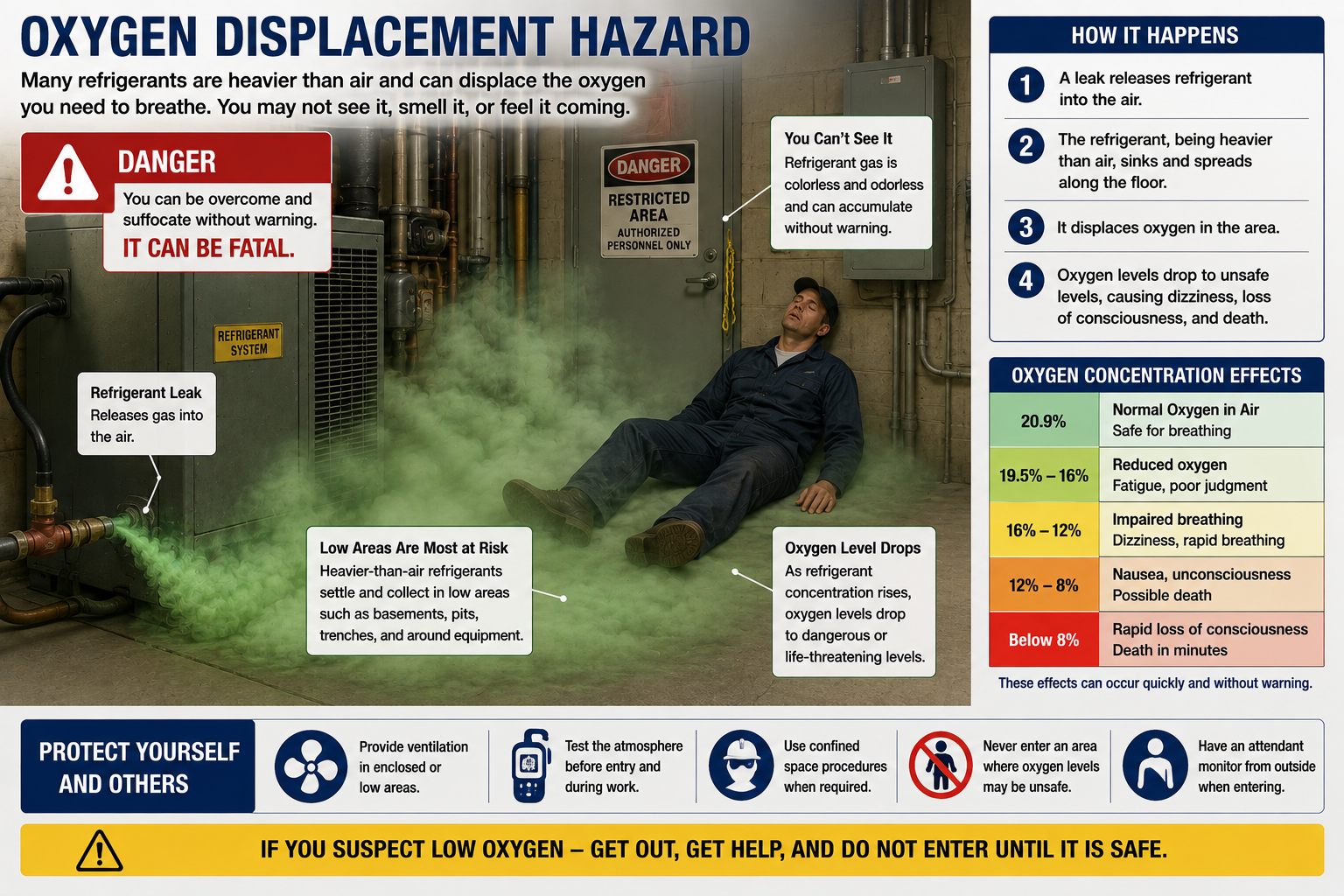
OSHA Uses 19.5 Percent Oxygen as an Important Safety Boundary
For OSHA general-industry confined-space requirements, an oxygen-deficient atmosphere is an atmosphere containing less than 19.5 percent oxygen by volume. This number is important because technicians may encounter confined or enclosed work areas where refrigerant, nitrogen, combustion, corrosion, or another process can change the atmosphere.
The 19.5 percent value should not be misunderstood as a target operating condition. Normal air contains considerably more oxygen. A reduced oxygen reading is evidence that the atmosphere has changed and that the cause must be understood before work proceeds.
You Cannot Reliably Detect Oxygen Deficiency With Your Senses
An atmosphere can become unsafe before a worker recognizes a problem. Do not depend on odor, breathing difficulty, dizziness, or other physical symptoms to determine whether an atmosphere is safe. Where atmospheric hazards may exist, use the required hazard evaluation and properly selected atmospheric monitoring equipment.
A worker who becomes confused, weak, dizzy, or unconscious in an oxygen-deficient atmosphere may no longer be capable of escaping without assistance. That is one reason atmospheric hazards must be identified before entry rather than discovered by the person entering the space.
Why Low Areas Deserve Special Attention
Many refrigerant vapors commonly encountered in HVAC/R work are denser than air under comparable conditions. Following a release, vapor movement is affected by temperature, air currents, mechanical ventilation, leakage rate, room geometry, and mixing with the surrounding air.
Technicians should therefore not imagine a refrigerant leak as a perfectly uniform cloud. Concentrations can vary within a room, and low or poorly ventilated locations can be particularly important when evaluating a release.
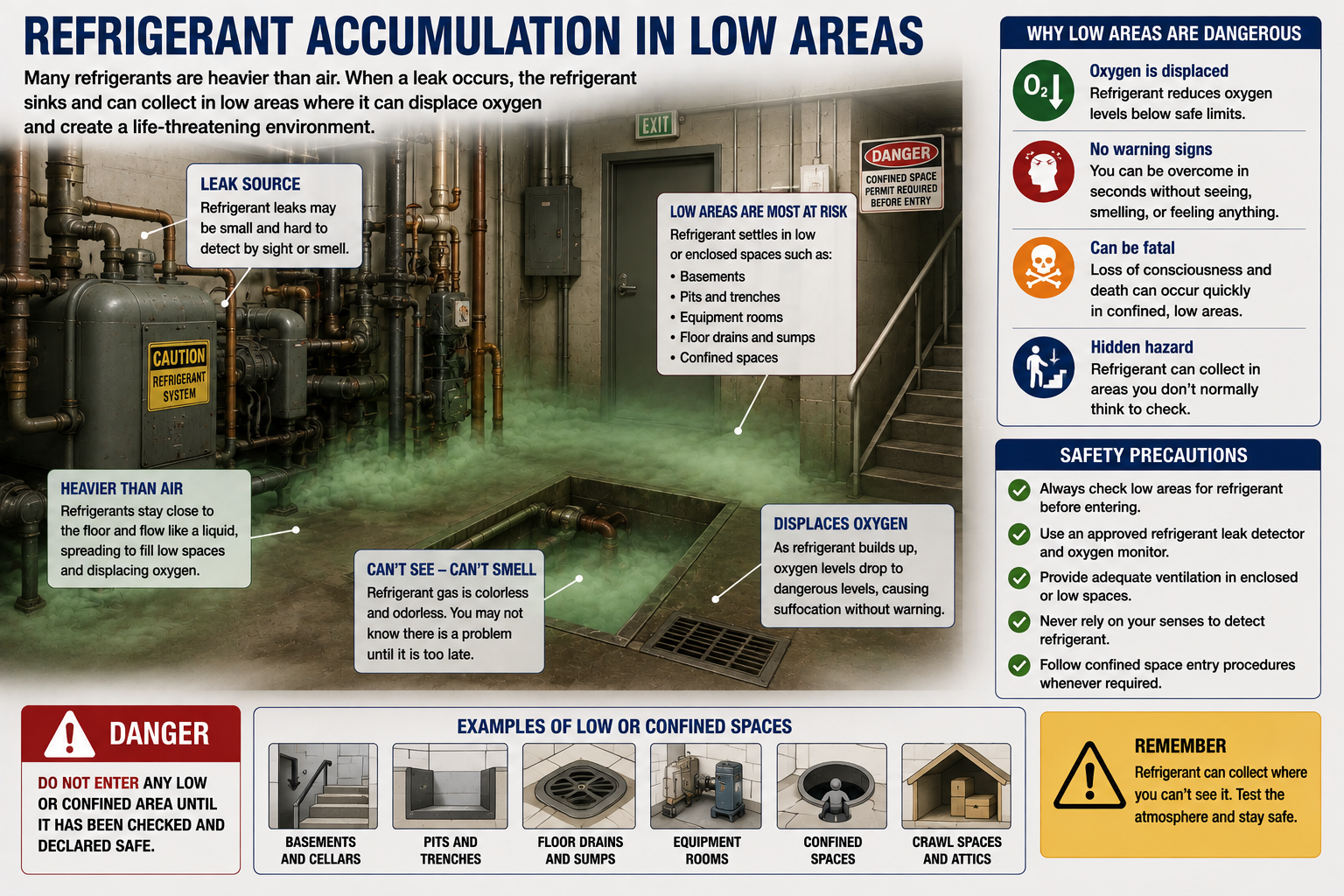
Equipment Pits
A pit below the surrounding floor may collect vapor and may have limited natural air movement.
Crawlspaces
Restricted access and poor ventilation can make it difficult for released refrigerant to disperse.
Basements
Refrigerant released from equipment or piping may migrate into lower portions of a building depending on the building configuration and air movement.
Equipment Enclosures
Machinery cabinets and other partially enclosed areas can temporarily contain a higher refrigerant concentration than the surrounding room.
Do Not Depend on the Phrase “Refrigerant Sinks”
Saying that refrigerant simply “sinks to the floor” is an oversimplification. Vapor density matters, but so do temperature, air currents, ventilation, release velocity, and mixing. The important service lesson is to evaluate the actual work area and consider where a hazardous concentration could develop.
Ventilation Controls the Concentration of Refrigerant in the Air
Ventilation introduces cleaner air, removes contaminated air, or does both. Proper ventilation can dilute refrigerant vapor and help prevent hazardous concentrations from accumulating in occupied areas.
Natural ventilation may be adequate for some ordinary work locations and minor service conditions, but it should not automatically be assumed adequate following a significant refrigerant release. Mechanical ventilation provides controlled air movement and is especially important where refrigerant could collect or where the room design limits natural circulation.
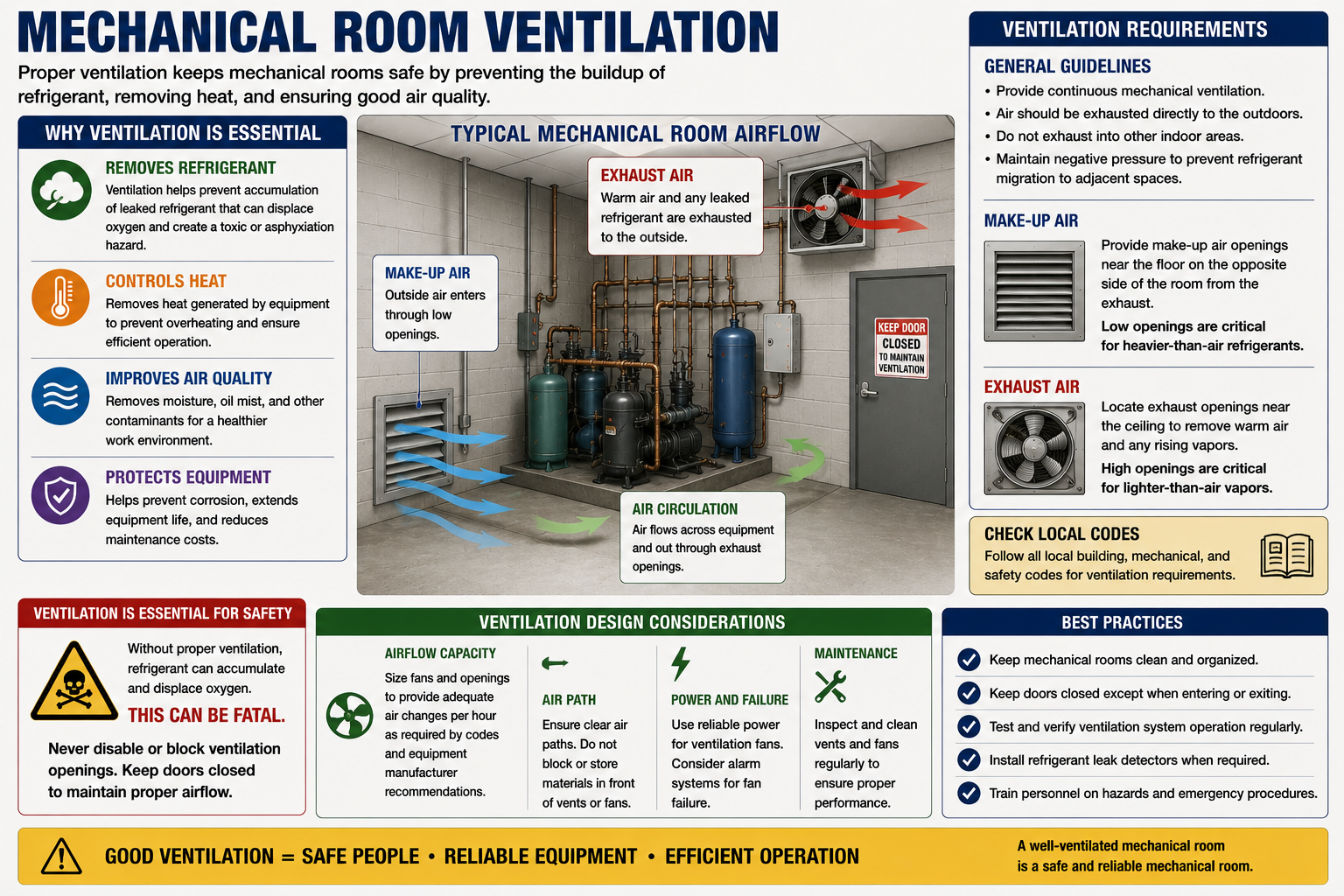
Provide Replacement Air
Air removed from a space must be replaced so that the ventilation system can establish effective airflow through the work area.
Remove Air From the Hazard Area
Exhaust locations should address where hazardous vapor could accumulate rather than simply moving air in an unrelated portion of the room.
Discharge Safely
Exhausted air should not simply transfer the hazard to another occupied area, air intake, doorway, or other location where people could be exposed.
Verify the Atmosphere
When atmospheric safety is uncertain, air movement alone does not prove that conditions are acceptable. Appropriate testing may be necessary to verify the result.
Mechanical Rooms Require Planned Ventilation
Large refrigeration systems may contain enough refrigerant that a major leak could rapidly change the atmosphere of a machinery room. For that reason, refrigeration-system design standards, mechanical codes, equipment requirements, and local regulations may require refrigerant detection, alarms, mechanical ventilation, emergency controls, or other safeguards depending on the system and application.
These building and refrigeration-system requirements should not be confused with EPA Section 608. EPA Section 608 primarily addresses refrigerant management and emissions. Machinery-room ventilation and worker protection involve building codes, mechanical codes, safety standards, OSHA requirements where applicable, and the design requirements governing the installation.
Do Not Memorize One Ventilation Rate for Every Machinery Room
Required ventilation depends on the applicable code or standard, refrigerant, system charge, room design, equipment, occupancy, and jurisdiction. Technicians should use the requirements that apply to the actual installation rather than assuming one airflow value applies to every refrigeration machinery room.
Measure the Atmosphere Instead of Guessing
Atmospheric testing provides information that human senses cannot reliably provide. Depending on the hazards identified, monitoring may include oxygen concentration, combustible-gas concentration, and specific toxic or refrigerant concentrations.
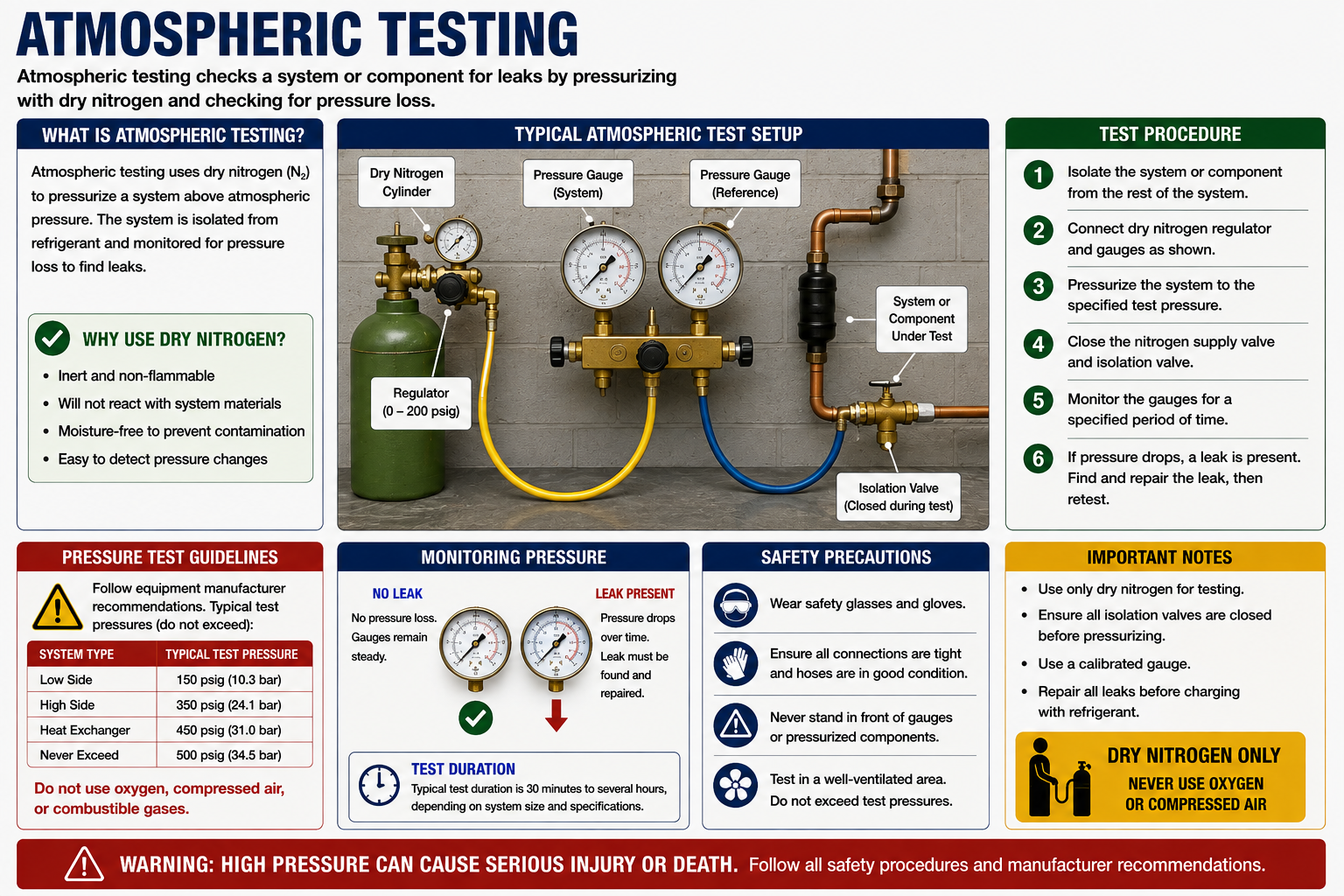
Under OSHA’s general-industry permit-required confined-space standard, atmospheric testing is performed in a specific order: oxygen first, combustible gases and vapors second, and toxic gases and vapors third. Oxygen is tested first because many combustible-gas instruments depend on sufficient oxygen to produce reliable readings.
Test Oxygen
Determine whether the atmosphere contains an acceptable oxygen concentration before relying on other atmospheric measurements.
Test for Flammability
Where a combustible or flammable atmosphere may be present, evaluate the concentration using equipment appropriate for that hazard.
Test Toxic Contaminants
Evaluate refrigerant or other toxic contaminants identified by the hazard assessment using sensors or instruments capable of measuring those substances.
Continue Monitoring When Required
Atmospheric conditions can change while work is underway. Confined-space procedures may require periodic or continuous monitoring depending on the entry method and hazards.
A Four-Gas Meter Does Not Detect Every Refrigerant
Never assume that an atmospheric monitor measures a substance simply because it displays several gas readings. The instrument must have sensors appropriate for the hazards being evaluated, must be maintained and calibrated as required, and must be used according to its manufacturer’s instructions.
Not Every Small Room Is a Confined Space
The term confined space has a specific workplace-safety meaning. Under OSHA’s general-industry standard, a confined space is large enough and configured so that an employee can bodily enter and perform assigned work, has limited or restricted means for entry or exit, and is not designed for continuous employee occupancy.
A small mechanical room is therefore not automatically an OSHA confined space simply because it is crowded. Conversely, an equipment pit, tank, vessel, vault, crawlspace, or similar location may meet the definition depending on its configuration and access.
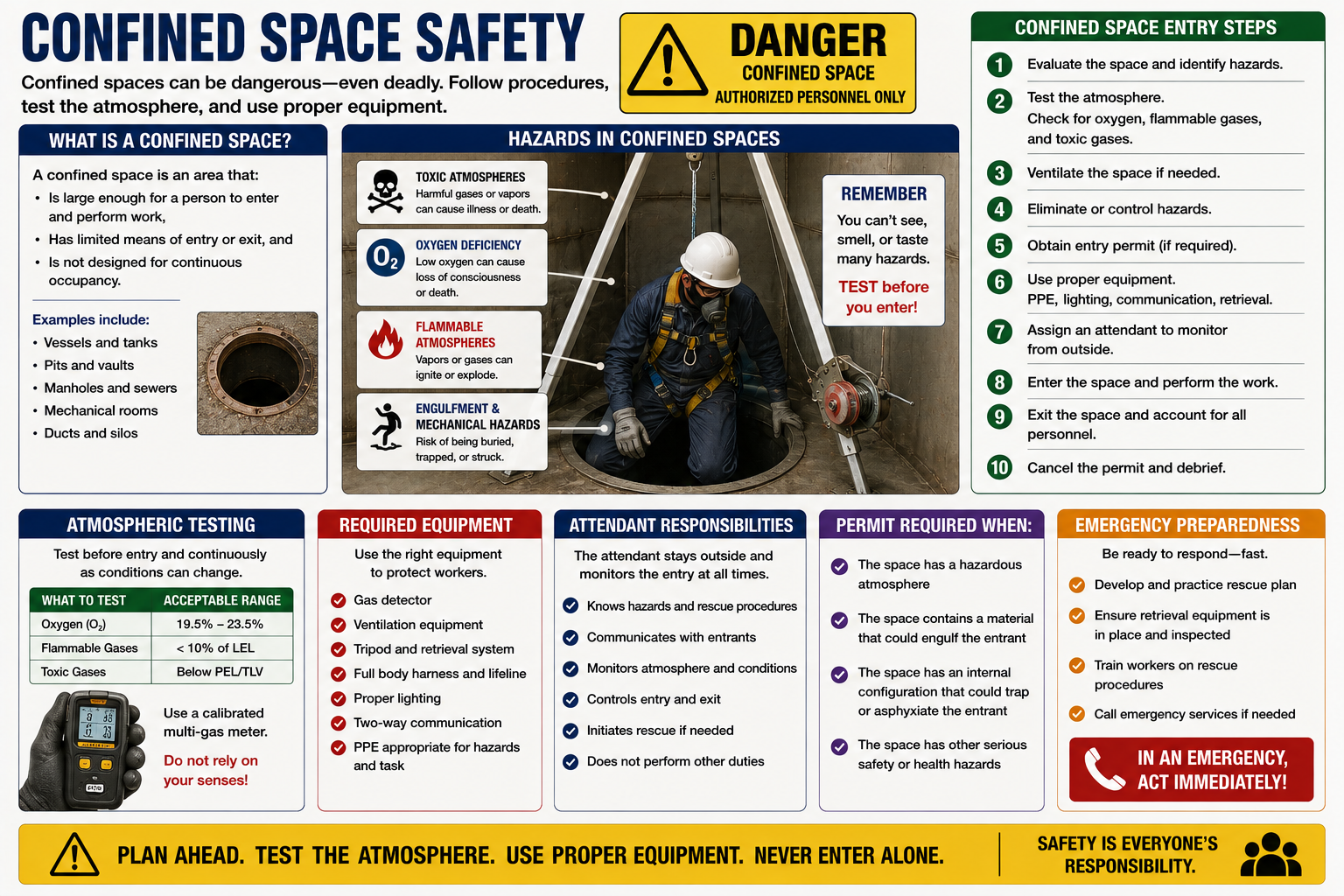
Confined Space Does Not Automatically Mean Permit-Required
OSHA distinguishes between a confined space and a permit-required confined space. A confined space becomes a permit space when it has one or more specified serious hazards, such as an actual or potential hazardous atmosphere, an engulfment hazard, a configuration that could trap or asphyxiate an entrant, or another recognized serious safety or health hazard.
A Refrigerant Leak Can Create a Hazardous Atmosphere
A confined space that contains or has the potential to contain a hazardous atmosphere may qualify as a permit-required confined space. A refrigerant leak is important because it can potentially create oxygen deficiency, excessive contaminant concentrations, or, with a flammable refrigerant, a flammable atmosphere.
For OSHA general industry, a hazardous atmosphere includes an oxygen concentration below 19.5 percent or above 23.5 percent, a flammable gas or vapor concentration above specified limits, excessive concentrations of regulated toxic substances, or another atmospheric condition that is immediately dangerous to life or health.
Evaluate Before Entry
The hazards of the space must be identified before a worker enters. Entering first and testing afterward defeats the purpose of atmospheric evaluation.
Isolate Hazards
Equipment, piping, electrical energy, mechanical movement, and other sources capable of creating a hazard may require appropriate isolation before entry.
Ventilate as Required
Properly designed forced-air ventilation may be used to control certain atmospheric hazards when the applicable confined-space procedure permits it.
Monitor Conditions
Atmospheric conditions must be tested or monitored as required because a space that was acceptable before entry may become hazardous during the work.
Confined-Space Rescue Requires Planning
One of the most dangerous reactions to a worker collapsing in a hazardous atmosphere is for an unprotected coworker to immediately enter the space. The same atmosphere that incapacitated the first person can incapacitate the rescuer.
Never Make an Unplanned Entry to Attempt a Rescue
If a person collapses in a suspected hazardous atmosphere, do not enter unless you are part of the properly trained and equipped rescue response required for that situation. Initiate the established emergency and rescue procedure. Multiple fatalities can occur when coworkers enter hazardous spaces one after another without appropriate respiratory protection, equipment, monitoring, and rescue controls.
Permit-required confined-space programs address rescue because getting a worker out of a restricted space can be much more difficult than ordinary first aid. Entry procedures may require an attendant, communication systems, retrieval equipment, designated rescue capability, respiratory protection, and other controls appropriate to the hazards.
Think About the Atmosphere Before Approaching the Equipment
When a substantial refrigerant release is suspected, the technician’s first concern should be personal safety rather than immediately finding the leak. The size of the release, refrigerant involved, room volume, ventilation, location of the equipment, ignition sources, and possibility of confined or low areas all affect the response.
Recognize the Release
Alarms, visible vapor, system pressure loss, unusual sounds, detector readings, or other evidence may indicate that refrigerant has escaped.
Protect People
Keep personnel away from a potentially hazardous atmosphere and follow the facility’s emergency procedures.
Evaluate the Atmosphere
Use the appropriate monitoring and hazard-assessment procedures rather than assuming the area is safe because refrigerant vapor is no longer visible.
Ventilate and Control the Source
Use approved ventilation and leak-control procedures only when they can be performed safely and in accordance with the facility’s emergency plan.
Different Rules Address Different Parts of the Problem
EPA Section 608 prohibits intentional venting of ozone-depleting refrigerants and their substitutes during maintenance, service, repair, and disposal except for releases specifically allowed by EPA regulations. Proper refrigerant recovery therefore reduces environmental emissions and also reduces the amount of refrigerant released into the technician’s work area.
Section 608, however, is not the source of OSHA confined-space requirements or the general workplace rules for oxygen-deficient atmospheres. Environmental compliance and worker protection overlap in practice, but technicians must understand which requirements apply to each situation.
Keep the Responsibilities Separate
EPA Section 608: addresses refrigerant management, recovery, emissions, and related environmental requirements. OSHA: addresses workplace hazards such as hazardous atmospheres and permit-required confined spaces where its standards apply. Codes and safety standards: may establish machinery-room ventilation, refrigerant detection, alarms, equipment construction, and other installation requirements. Manufacturer instructions and the SDS: provide equipment-specific and refrigerant-specific information.
What You Need to Remember
- A sufficiently large refrigerant release in an enclosed area can displace breathable air and create an asphyxiation hazard.
- A refrigerant does not have to be highly toxic to create a dangerous atmosphere.
- Many common refrigerant vapors are denser than air, so low and poorly ventilated areas require special attention.
- Do not depend on odor or physical symptoms to determine whether an atmosphere is safe.
- Ventilation reduces contaminant concentrations by introducing cleaner air, removing contaminated air, or both.
- Seeing a ventilation fan operating does not prove that the atmosphere is safe.
- Under OSHA general-industry confined-space rules, an oxygen-deficient atmosphere contains less than 19.5 percent oxygen by volume.
- Atmospheric testing for permit-required confined spaces is performed in the order oxygen, combustible gases and vapors, then toxic gases and vapors.
- An atmospheric monitor must have the correct sensors for the hazards being evaluated.
- A confined space has a specific regulatory definition; not every small mechanical room is automatically a confined space.
- A confined space with an actual or potential hazardous atmosphere may be a permit-required confined space.
- Never make an unplanned entry into a hazardous confined space to rescue another worker.
- EPA Section 608 environmental regulations and OSHA workplace-safety regulations address different responsibilities.
Review Questions
1. How can a refrigerant create an asphyxiation hazard even if it has relatively low toxicity?
Answer: A sufficiently large refrigerant release can displace some of the surrounding air. In an enclosed or poorly ventilated area, the resulting atmosphere may contain too little oxygen for safe occupancy.
2. Why are pits, crawlspaces, and other low areas important when evaluating a refrigerant release?
Answer: Many common refrigerant vapors are denser than air, and low or poorly ventilated spaces may allow elevated concentrations to develop. Actual vapor movement also depends on temperature, air currents, ventilation, release conditions, and room geometry.
3. What oxygen concentration does OSHA use to define an oxygen-deficient atmosphere under its general-industry confined-space standard?
Answer: Less than 19.5 percent oxygen by volume.
4. Can a technician determine that an atmosphere is safe because there is no refrigerant odor?
Answer: No. Human senses are not reliable atmospheric monitors. Where hazardous atmospheric conditions may exist, appropriate testing and hazard-assessment procedures must be used.
5. In what order does OSHA require atmospheric hazards to be tested for permit-required confined-space entry?
Answer: Oxygen first, combustible gases and vapors second, and toxic gases and vapors third.
6. Why is oxygen tested before combustible gases?
Answer: Many combustible-gas instruments depend on sufficient oxygen to provide reliable readings. An oxygen-deficient atmosphere can therefore affect the reliability of combustible-gas measurements.
7. Is every small mechanical room automatically an OSHA confined space?
Answer: No. A confined space must meet the applicable regulatory definition, including being large enough to enter and perform work, having limited or restricted means of entry or exit, and not being designed for continuous employee occupancy.
8. What should a technician do if a coworker collapses inside a space suspected of containing a hazardous atmosphere?
Answer: Initiate the established emergency and rescue procedure and do not make an unplanned entry. An unprotected rescuer can be overcome by the same atmosphere and become an additional victim.
Lesson 29 Summary
- Refrigerant released into an enclosed work area can change the composition of the surrounding atmosphere.
- A sufficiently large refrigerant release can displace air and reduce the concentration of oxygen available to workers.
- OSHA defines an oxygen-deficient atmosphere under its general-industry confined-space standard as less than 19.5 percent oxygen by volume.
- Many common refrigerant vapors are denser than air, making low and poorly ventilated areas important locations to evaluate after a release.
- Vapor movement also depends on temperature, air currents, ventilation, release conditions, and room geometry.
- Ventilation can dilute or remove refrigerant vapor but operating ventilation equipment alone does not prove that an atmosphere is safe.
- Atmospheric monitoring must use instruments and sensors appropriate for the hazards being evaluated.
- OSHA’s confined-space atmospheric-testing sequence is oxygen first, combustible gases and vapors second, and toxic gases and vapors third.
- A confined space has a specific definition and is not simply any small or crowded room.
- A confined space that contains or could contain a hazardous atmosphere may qualify as a permit-required confined space.
- Confined-space entry may require atmospheric testing, ventilation, isolation, communication, attendants, rescue planning, and other specialized controls.
- Workers should never make an unplanned entry into a hazardous atmosphere to attempt a rescue.
- EPA Section 608 refrigerant-management requirements, OSHA workplace-safety requirements, building and mechanical codes, and manufacturer requirements serve different but complementary purposes.