Moisture, Noncondensables, and System Contamination
A refrigeration system is designed to circulate refrigerant and lubricant through a clean, sealed circuit. Air, moisture, dirt, incompatible oil, oxidation products, and other contaminants do not belong inside that circuit. Even small amounts of contamination can change system pressures, interfere with refrigerant flow, damage components, and shorten equipment life.
Moisture and noncondensable gases are especially important because they may enter whenever a refrigeration system is opened to the atmosphere. Proper service procedures therefore do more than prevent refrigerant from escaping—they also prevent contaminants from entering.
Learning Objectives
Recognize Moisture Contamination
Explain how moisture enters a refrigeration system and identify problems that moisture can cause.
Understand Noncondensables
Explain why air and other gases that do not condense normally in the system interfere with refrigeration operation.
Prevent Contamination
Use proper service practices to keep moisture, air, dirt, and incompatible materials out of the refrigeration circuit.
Prepare for Evacuation
Understand why evacuation and dehydration are required after a refrigeration circuit has been opened to the atmosphere.
What Belongs Inside a Refrigeration Circuit?
Under normal conditions, a refrigeration circuit should contain the specified refrigerant and the lubricant required by the equipment manufacturer. Some systems may also contain manufacturer-approved additives or other materials intended for that specific application.
Anything else should be treated as a potential contaminant.
Refrigerant
The refrigerant absorbs and rejects heat as it changes pressure, temperature, and physical state throughout the refrigeration cycle.
Lubricant
The correct refrigeration oil lubricates the compressor and circulates through portions of the refrigeration circuit.
Moisture
Water does not belong in the refrigeration circuit and can create several mechanical and chemical problems.
Noncondensables
Air and other gases that do not condense under normal system conditions occupy space and contribute unwanted pressure.
Opening the System Opens It to the Atmosphere
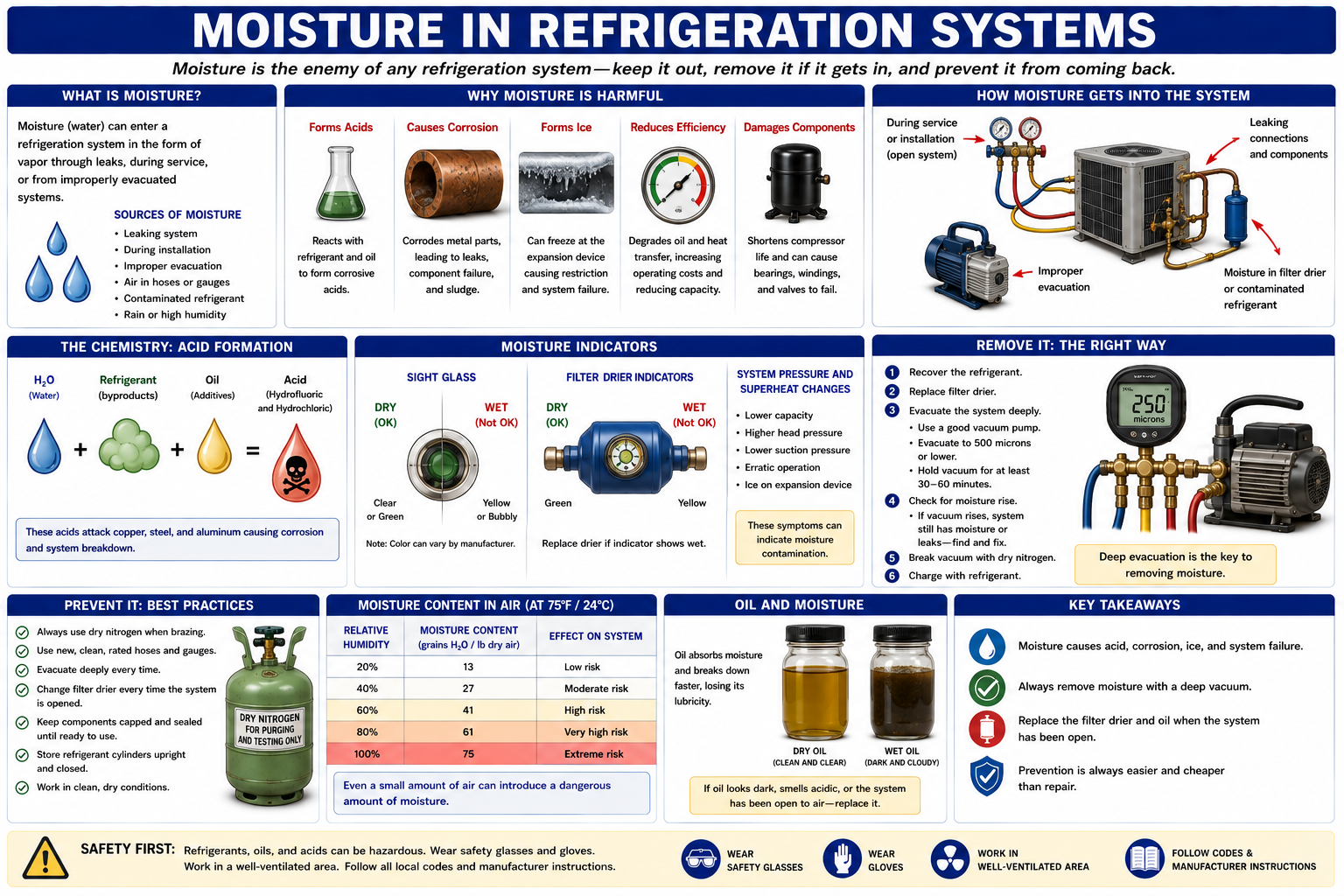
Air contains water vapor. Whenever a refrigeration circuit is opened to the atmosphere, moisture can enter with the surrounding air. The longer the system remains open, the greater the opportunity for moisture to enter and be absorbed by materials inside the system.
Moisture can also enter through improper service procedures, contaminated tools, wet components, damaged containers, or materials that were not properly stored before installation.
Open Tubing
Uncapped tubing allows humid atmospheric air to enter the refrigeration circuit.
Component Replacement
Compressors, evaporators, condensers, filter driers, and other components can introduce moisture if left open or improperly stored.
Service Hoses
Air and moisture inside service hoses can be introduced if the service setup is not properly managed.
Improper Evacuation
Simply pulling the system pressure below atmospheric pressure does not prove that sufficient moisture has been removed.
Water Creates More Than One Problem
Moisture inside a refrigeration system can exist as vapor, liquid water, or ice depending on system conditions. It can also participate in chemical reactions involving refrigerant, lubricant, metals, and other materials.
Ice Formation
Moisture can freeze at a metering device or other cold restriction and interfere with refrigerant flow.
Corrosion
Water can contribute to corrosion of metal surfaces and electrical components within the refrigeration system.
Chemical Reactions
Moisture can participate in undesirable chemical reactions involving refrigerant and lubricant, potentially contributing to acid formation and system deterioration.
Lubricant Contamination
Moisture absorbed by refrigeration oil can alter lubricant condition and contribute to long-term compressor problems.
A Small Amount Can Cause an Intermittent Restriction
The metering device is one of the coldest locations in many refrigeration systems. If moisture reaches sufficiently low temperatures at the metering device, it can freeze and partially or completely restrict refrigerant flow.
The resulting problem may appear intermittent. Refrigerant flow decreases when ice forms, system conditions change, the ice eventually melts, and refrigerant flow resumes. The restriction can then return when the moisture freezes again.
Some Modern Lubricants Readily Absorb Moisture
Many modern refrigeration and air-conditioning systems use synthetic lubricants such as polyolester oil. These lubricants can absorb moisture from atmospheric air, making proper storage and service practices particularly important.
Keep oil containers sealed except when actually dispensing lubricant, and keep refrigeration components capped or sealed until they are ready to be installed.
Do Not Leave Refrigeration Oil Open to the Atmosphere
Once moisture has been absorbed into lubricant, removing it can be much more difficult than preventing it from entering in the first place. Keep lubricant containers tightly closed and minimize the time system components remain open.
A Filter Drier Helps Control Contamination
A filter drier performs two important functions in a refrigeration system: it filters solid contaminants from the refrigerant and contains desiccant that captures a limited amount of moisture.
The filter drier is an important protective component, but it should not be treated as a substitute for proper evacuation and dehydration. A system that has been left open or contains substantial moisture requires proper service procedures rather than expecting the filter drier to remove all contamination.
Air Does Not Behave Like Refrigerant
A noncondensable is a gas that remains in the vapor state under conditions where the system refrigerant is expected to condense. Air introduced during installation or service is the most common example encountered by technicians.
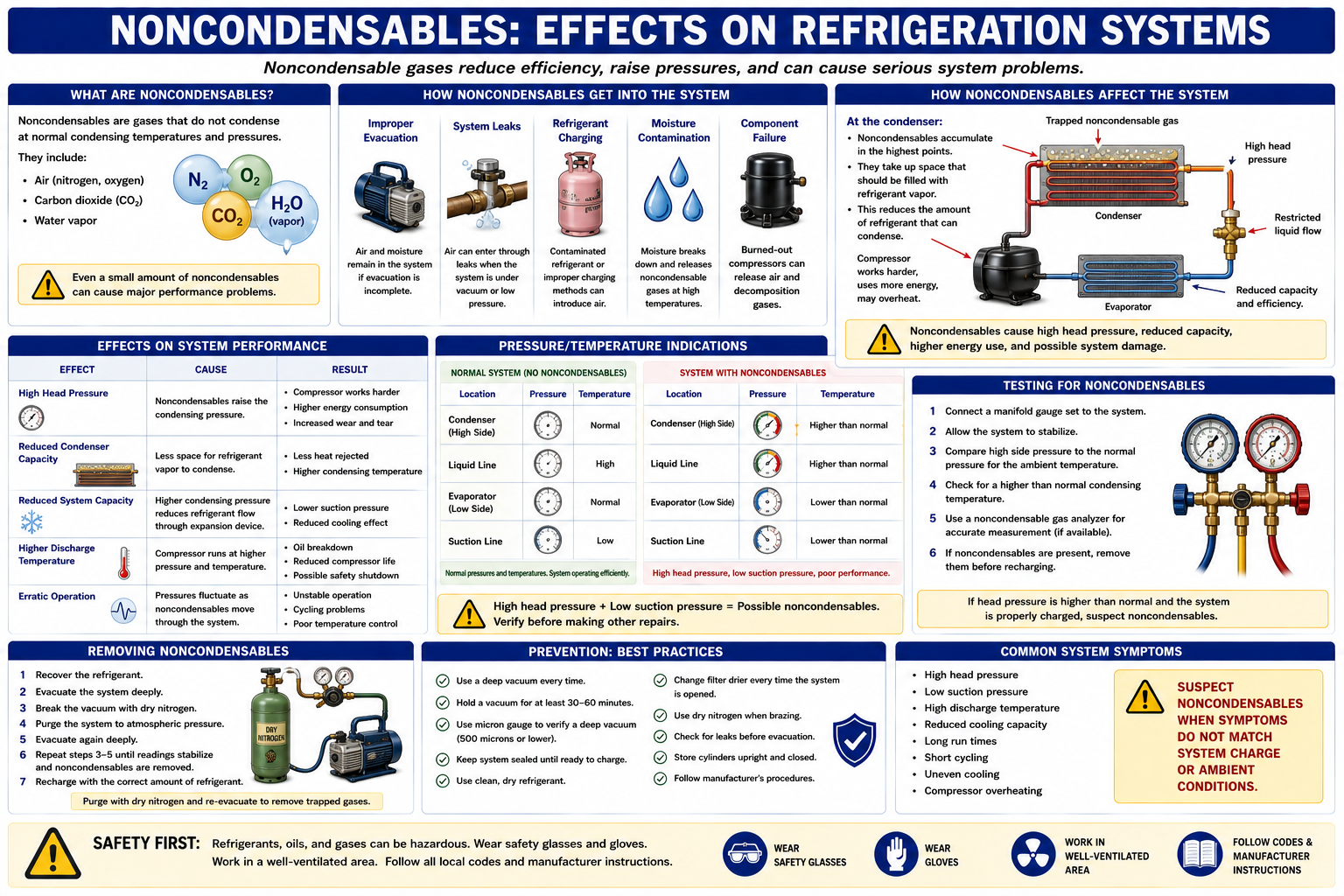
Inside the condenser, refrigerant vapor should reject heat and condense into liquid. A noncondensable gas does not participate in this phase change. Instead, it occupies space and contributes its own partial pressure to the total system pressure.
Total Pressure Includes More Than Refrigerant Pressure
When refrigerant vapor and a noncondensable gas occupy the same space, the pressure measured by a gauge is the combined pressure produced by all of the gases present.
This is an application of Dalton’s Law of Partial Pressures: the total pressure of a gas mixture equals the sum of the partial pressures contributed by the individual gases.
What Noncondensables Can Do
Increase High-Side Pressure
Noncondensable gases add pressure to the high side and can contribute to abnormally high condensing pressure.
Increase Compressor Work
Higher discharge pressure increases the pressure ratio against which the compressor must operate.
Increase Energy Use
Additional compressor work can reduce efficiency and increase electrical consumption.
Raise Discharge Temperature
Abnormal pressure conditions can contribute to increased compressor discharge temperature and additional thermal stress.
Reduce Condenser Effectiveness
Noncondensables occupy condenser space without undergoing the useful condensation process of the refrigerant.
Confuse Diagnosis
Pressure readings may no longer correspond normally with refrigerant temperature because the measured pressure includes noncondensable-gas pressure.
Most Noncondensable Problems Begin During Service
Air can enter whenever the refrigeration circuit is open to the atmosphere. It can also be introduced through improperly prepared service hoses or poor charging procedures.
A system operating below atmospheric pressure can draw air inward through a leak rather than losing refrigerant outward at that location. This is particularly important in systems that normally operate portions of the refrigeration circuit in a vacuum.
A Leak Does Not Always Leak Outward
When system pressure is below atmospheric pressure, a leak can allow air and moisture to enter the refrigeration circuit. The direction of leakage depends on the pressure difference across the opening.
Contamination Is Not Limited to Air and Water
Anything introduced into the refrigeration circuit that is not intended for the system can create problems. Service tools and poor repair practices are common routes for cross-contamination.
Wrong Refrigerant
Mixing refrigerants changes system properties and can make pressure-temperature information unreliable.
Wrong Lubricant
Lubricants differ in chemistry and compatibility. Use only the lubricant approved for the refrigerant and equipment.
Dirt and Metal Debris
Solid contaminants can restrict metering devices, damage moving components, and contaminate oil.
Oxidation Products
Improper brazing practices can create internal oxidation and scale that may circulate through the system.
Protect the Inside of the Tubing
When copper tubing is heated for brazing in the presence of air, oxidation can form on the inside surface of the tubing. This oxide scale can later break loose and circulate through the refrigeration system.
A low flow of dry nitrogen through the tubing during brazing displaces air and greatly reduces internal oxidation.
Severe Failures Can Contaminate the Entire Circuit
An electrical or mechanical compressor failure can produce contaminated oil, acids, carbonized material, metal debris, and other decomposition products. Simply replacing the failed compressor without addressing contamination can expose the replacement compressor to the same contaminated system.
Follow the equipment and compressor manufacturer’s cleanup procedure. Depending on the failure and system design, this may include replacing filter driers, evaluating the oil, cleaning or replacing contaminated components, and verifying system condition before the replacement equipment is placed into operation.
Do Not Treat a Burnout as an Ordinary Compressor Change
The failed compressor may be only one part of the problem. Contaminants distributed throughout the refrigeration circuit can damage the replacement compressor if they are not properly addressed.
Keeping Contamination Out Is Easier Than Removing It
Keep Components Sealed
Leave tubing and replacement components capped until immediately before installation.
Use Clean Service Tools
Prevent hoses, manifolds, recovery equipment, and fittings from transferring contamination between systems.
Flow Nitrogen While Brazing
Use the appropriate low nitrogen flow to reduce internal oxidation during brazing.
Evacuate Properly
After the system is sealed and leak tested, use deep-vacuum evacuation to remove air and moisture before charging.
Removing Refrigerant Does Not Make a System Dry
Recovery equipment is designed to remove refrigerant from a refrigeration system. Although recovery reduces system pressure, it is not the same process as evacuation and dehydration.
After a system has been opened to the atmosphere, air and moisture remain even if the refrigerant has been completely recovered. A vacuum pump and appropriate evacuation procedure are required to remove those contaminants before the system is recharged.
Lower Pressure Helps Remove Moisture
Water boils when its vapor pressure equals the pressure surrounding it. Reducing the pressure inside a refrigeration system lowers the temperature at which water can boil.
A vacuum pump reduces system pressure sufficiently that moisture can vaporize at ordinary service temperatures. The resulting water vapor can then be removed from the system by the vacuum pump.
This is why proper dehydration requires a deep vacuum rather than merely producing a reading below zero psig on a compound gauge.
Heat Can Help Evacuation
Moisture is generally easier to remove from a warm system than from a cold one because additional thermal energy helps liquid water vaporize. Evacuation procedures should still remain within equipment and manufacturer requirements.
What You Need to Remember
- A refrigeration system should remain clean, dry, and sealed.
- Air contains moisture that can enter whenever a refrigeration system is opened.
- Moisture can freeze at a metering device and restrict refrigerant flow.
- Moisture can contribute to corrosion, lubricant contamination, chemical reactions, and acid formation.
- Some synthetic refrigeration lubricants readily absorb moisture from atmospheric air.
- Keep refrigeration oil containers and system components sealed as much as practical.
- A filter drier removes solid contaminants and captures a limited amount of moisture.
- A filter drier does not replace proper evacuation.
- Air and other noncondensable gases contribute additional pressure without performing useful refrigeration work.
- Noncondensables can contribute to high head pressure, increased compressor work, and reduced efficiency.
- Pressure in a mixture of gases is the sum of the gases’ partial pressures.
- A system operating below atmospheric pressure can draw air and moisture inward through a leak.
- Flowing dry nitrogen during brazing helps prevent internal copper oxidation.
- Recovery and evacuation are different procedures.
- Recovery removes refrigerant; evacuation removes air and moisture.
- A deep vacuum lowers the boiling temperature of water and allows moisture to be removed as vapor.
Review Questions
1. How does moisture commonly enter a refrigeration system?
Answer: Moisture commonly enters with atmospheric air whenever the refrigeration circuit is opened or through improperly stored components, contaminated service tools, or poor service procedures.
2. What can happen when moisture reaches a cold metering device?
Answer: The moisture can freeze and create a partial or complete refrigerant-flow restriction.
3. What is a noncondensable gas?
Answer: It is a gas that remains in the vapor state under conditions where the system refrigerant is expected to condense. Air is a common example.
4. How can noncondensables affect high-side pressure?
Answer: They contribute their own partial pressure to the system, which can increase measured high-side pressure and compressor workload.
5. What does Dalton’s Law tell us about a mixture of refrigerant vapor and air?
Answer: The total pressure is the sum of the partial pressures produced by the refrigerant vapor and the air or other gases present.
6. Why is nitrogen flowed through tubing while brazing?
Answer: A low flow of dry nitrogen displaces air inside the tubing and reduces the formation of internal copper oxide scale.
7. Does recovering refrigerant adequately dehydrate a system that has been opened?
Answer: No. Recovery removes refrigerant. Proper evacuation with a vacuum pump is required to remove air and moisture.
8. Why does lowering system pressure help remove moisture?
Answer: Lowering pressure reduces the boiling temperature of water, allowing moisture to vaporize at normal service temperatures so the vacuum pump can remove it.
Lesson 26 Summary
- Only the correct refrigerant, lubricant, and manufacturer-approved materials belong inside a refrigeration circuit.
- Moisture commonly enters when a refrigeration system is exposed to atmospheric air.
- Moisture can freeze and restrict refrigerant flow at cold metering devices.
- Water can contribute to corrosion, chemical reactions, acid formation, and lubricant deterioration.
- Synthetic refrigeration lubricants can absorb moisture and should be protected from atmospheric exposure.
- Filter driers help control moisture and solid contaminants but have limited capacity.
- Noncondensables remain as gases rather than condensing with the refrigerant.
- Air inside the refrigeration system adds its partial pressure to refrigerant pressure.
- Noncondensables can increase head pressure, compressor work, discharge temperature, and energy consumption.
- Systems operating below atmospheric pressure can draw contaminants inward through leaks.
- Wrong refrigerants, incompatible lubricants, dirt, metal debris, and oxidation products are also contaminants.
- Flowing dry nitrogen while brazing helps prevent internal oxidation.
- Compressor burnout can distribute severe contamination throughout the refrigeration circuit.
- Keeping contamination out is easier than removing it later.
- Recovery removes refrigerant, while evacuation removes air and moisture.
- A deep vacuum allows moisture to vaporize at lower temperatures so it can be removed from the system.