Refrigerant Handling and Charging Fundamentals
Charging a refrigeration system means placing the correct refrigerant into the system in the correct amount and in the correct physical state for the procedure being performed. Accurate charging is essential because both undercharging and overcharging can reduce capacity, increase energy use, create abnormal operating pressures, damage components, and shorten equipment life.
The technician must also protect refrigerant purity during the charging process. Refrigerant identity, cylinder orientation, charging method, refrigerant composition, equipment condition, service-tool cleanliness, and manufacturer specifications must all be considered before refrigerant is transferred into a system.
Learning Objectives
Charge by Weight
Use a refrigerant scale and manufacturer charge information to accurately measure refrigerant added to a system.
Distinguish Liquid and Vapor Charging
Recognize when refrigerant is leaving a cylinder as liquid or vapor and understand why the charging method matters.
Charge Refrigerant Blends Correctly
Understand why zeotropic blends are normally removed from the supply cylinder as liquid to preserve the intended composition.
Prevent Contamination
Keep air, moisture, dirt, incompatible oils, and other refrigerants from entering the system during charging and service.
Charging Begins With Identification
Before refrigerant is added to a system, the technician must positively identify the refrigerant specified for the equipment and determine whether the existing refrigerant charge is known and uncontaminated.
Do not select refrigerant based only on equipment age, pressure readings, service-port size, cylinder color, or what was commonly used in similar equipment. Read the equipment nameplate, service information, and any retrofit labels.
Identify the Refrigerant
Confirm the exact refrigerant designation from the equipment and service information.
Verify System Condition
Determine whether repairs, leak testing, evacuation, or other service must be completed before charging.
Check the Required Charge
Use the equipment manufacturer’s charge specification and any adjustments required for the installed piping or accessories.
Select Correct Tools
Verify manifold, hose, scale, cylinder, and service-equipment suitability for the refrigerant and pressure involved.
A Controlled Refrigerant Transfer
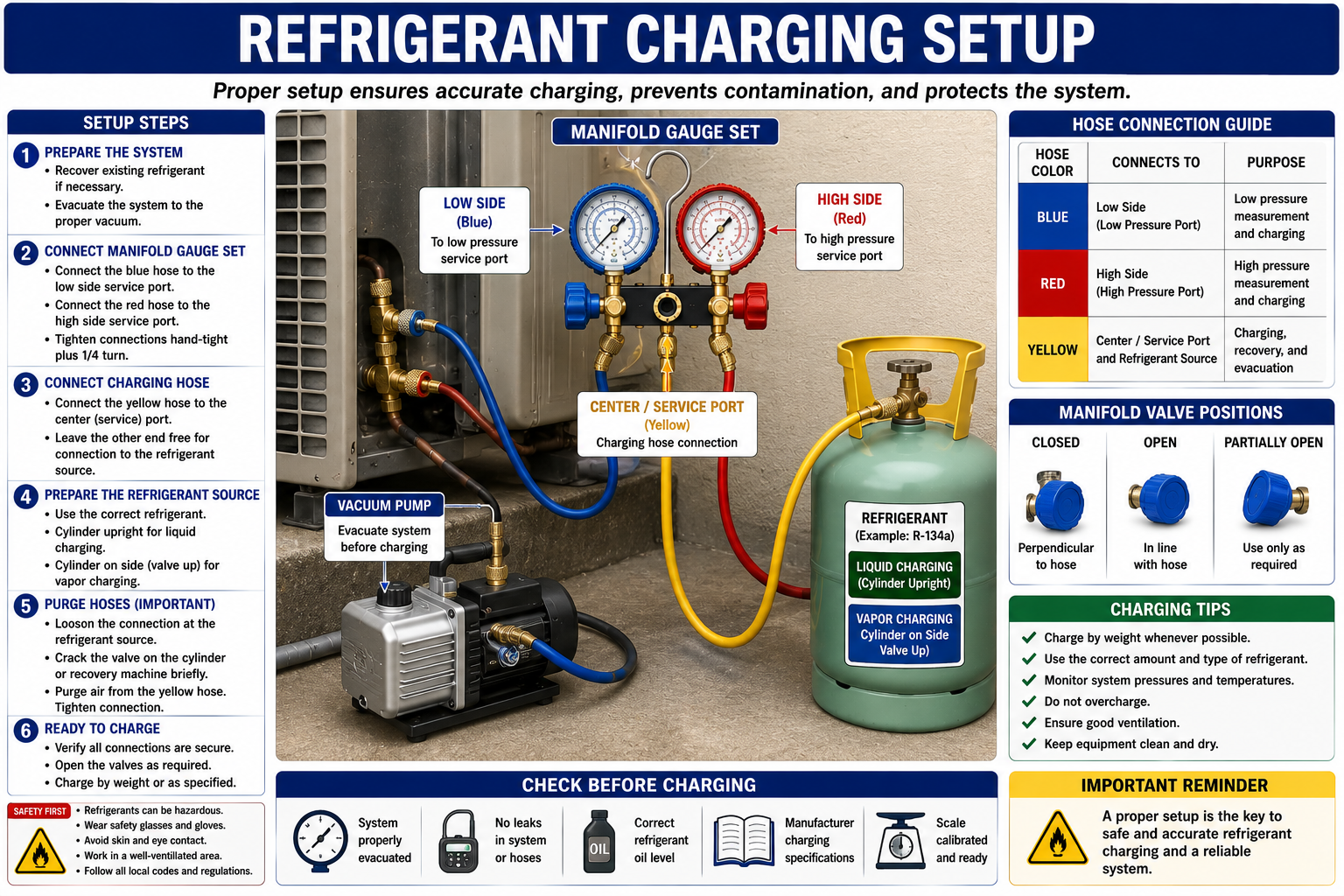
A charging setup creates a controlled path from the refrigerant cylinder to the refrigeration system. The exact arrangement depends on the equipment, refrigerant, and charging method, but the technician should understand the function and position of every valve and hose before refrigerant begins to flow.
The Refrigerant Scale Is the Primary Measuring Tool
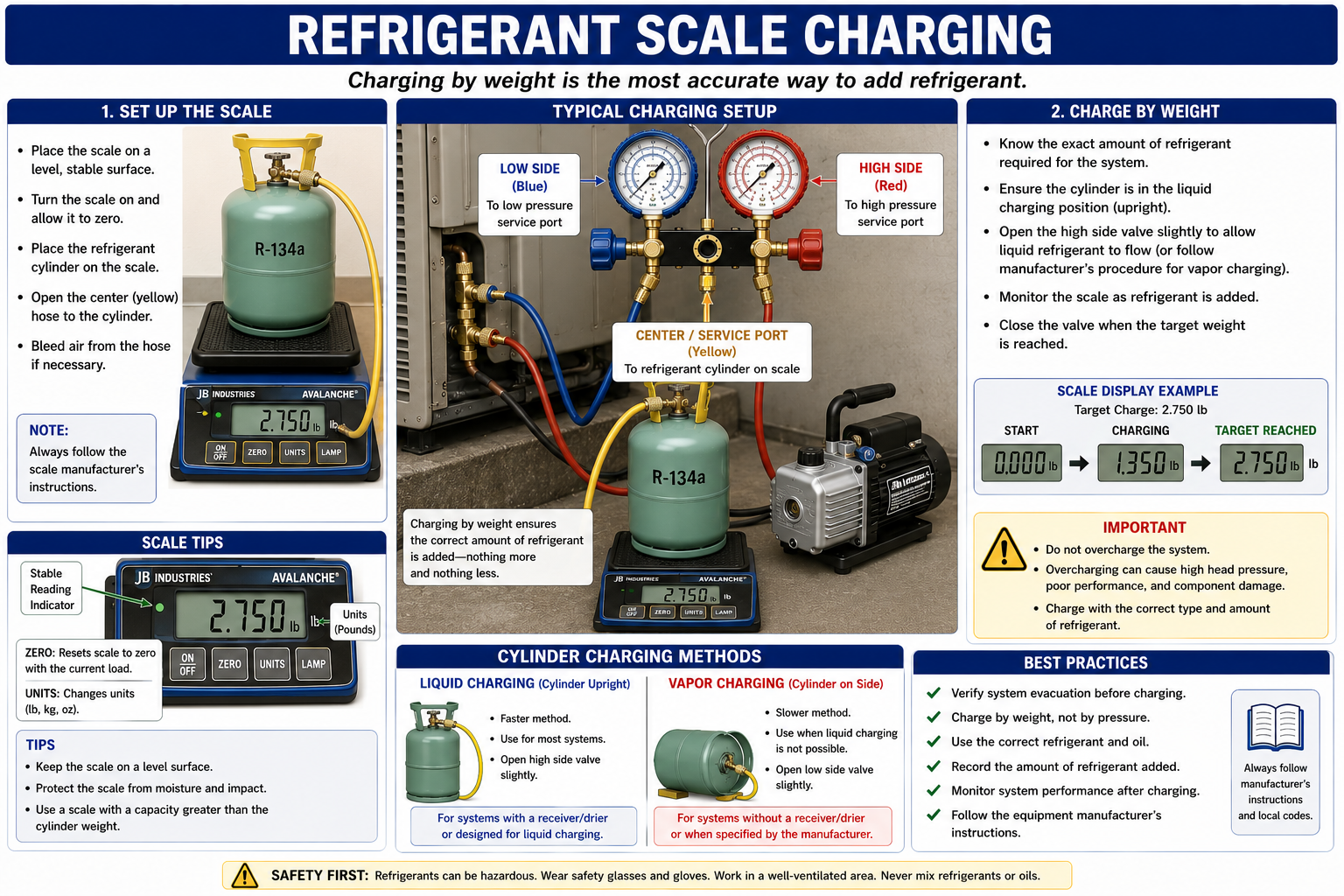
When the manufacturer specifies a refrigerant charge by mass, the most direct way to measure the amount transferred is with an accurate refrigerant scale.
The cylinder is placed on the scale, the scale is zeroed or the starting weight is recorded, and the technician monitors the change in weight as refrigerant is transferred.
Do Not Charge by Pressure Alone
System pressure is affected by refrigerant temperature, indoor and outdoor load, airflow, equipment design, and other operating conditions. Pressure readings are valuable diagnostic information, but they do not replace the manufacturer’s charging procedure.
Read What the Manufacturer Actually Specifies
Many air-conditioning and refrigeration units include a factory refrigerant charge identified on the equipment nameplate or installation instructions. That amount may apply only to a particular factory configuration or specified piping length.
Field-installed line sets, evaporators, receivers, accessories, or other system components may require a charge adjustment according to the manufacturer’s instructions.
Refrigerant Can Leave the Cylinder in Different States
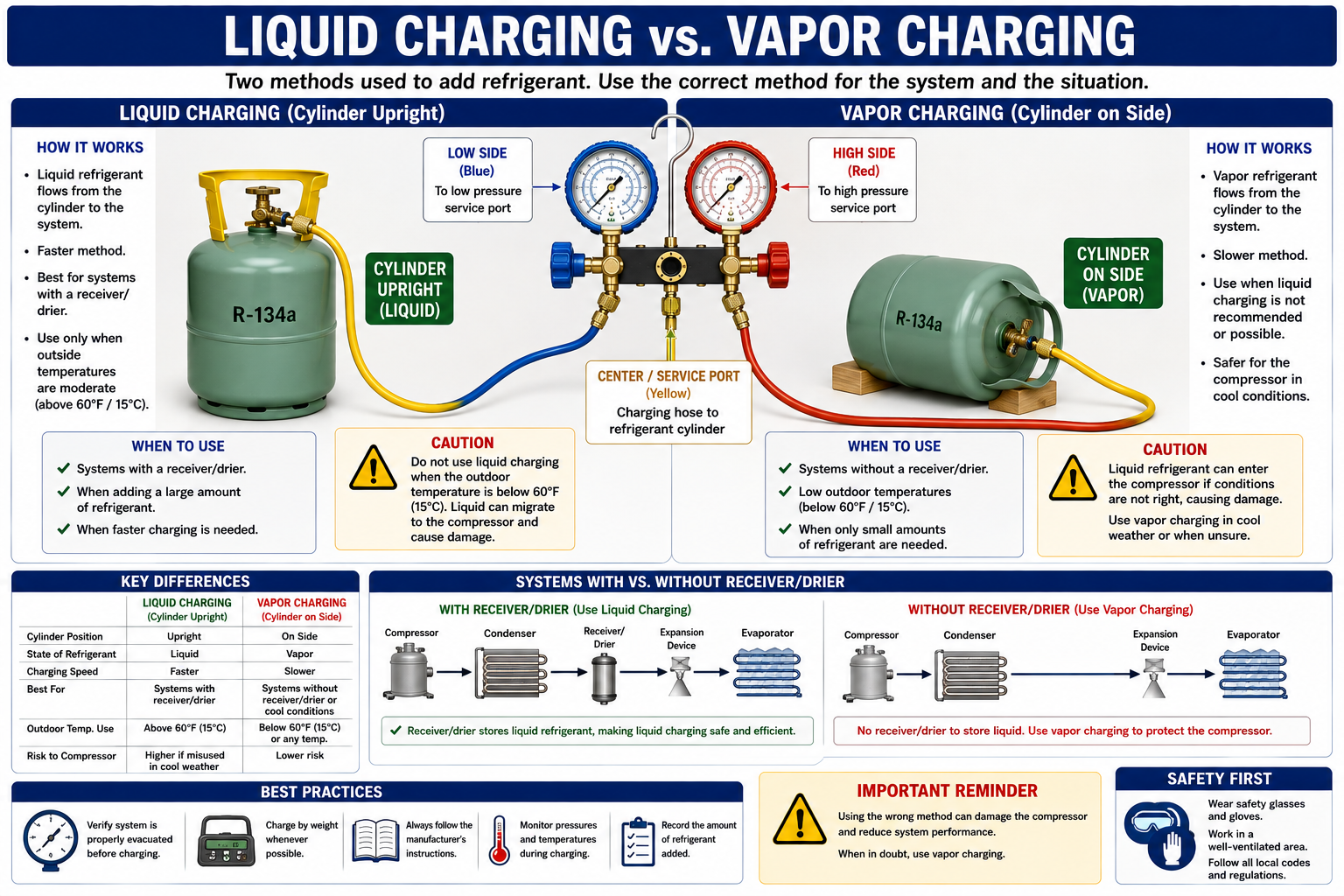
Refrigerant inside a cylinder can normally exist as both liquid and vapor when the cylinder temperature is within the saturated region. Whether liquid or vapor leaves the cylinder depends on the cylinder design, valve used, cylinder position, and service procedure.
Vapor Charging
Refrigerant enters the charging hose as vapor. Vapor transfer is generally slower because the refrigerant density is much lower than in the liquid state.
Liquid Charging
Refrigerant enters the charging hose as liquid. Liquid transfer can move refrigerant much more quickly and therefore requires careful control.
Protect the Compressor
A compressor designed to compress refrigerant vapor can be damaged if a large quantity of liquid refrigerant enters the compressor. This condition is often described as liquid slugging.
When a manufacturer’s procedure requires liquid refrigerant to be introduced through the low side of an operating system, the liquid flow must be controlled so that refrigerant entering the compressor is vaporized appropriately before reaching the compressor.
Do Not Flood a Running Compressor With Liquid
Never simply open a liquid refrigerant source fully into the suction side of an operating system. Follow the manufacturer’s procedure and use an appropriate method to meter or control refrigerant flow.
Composition Must Be Preserved
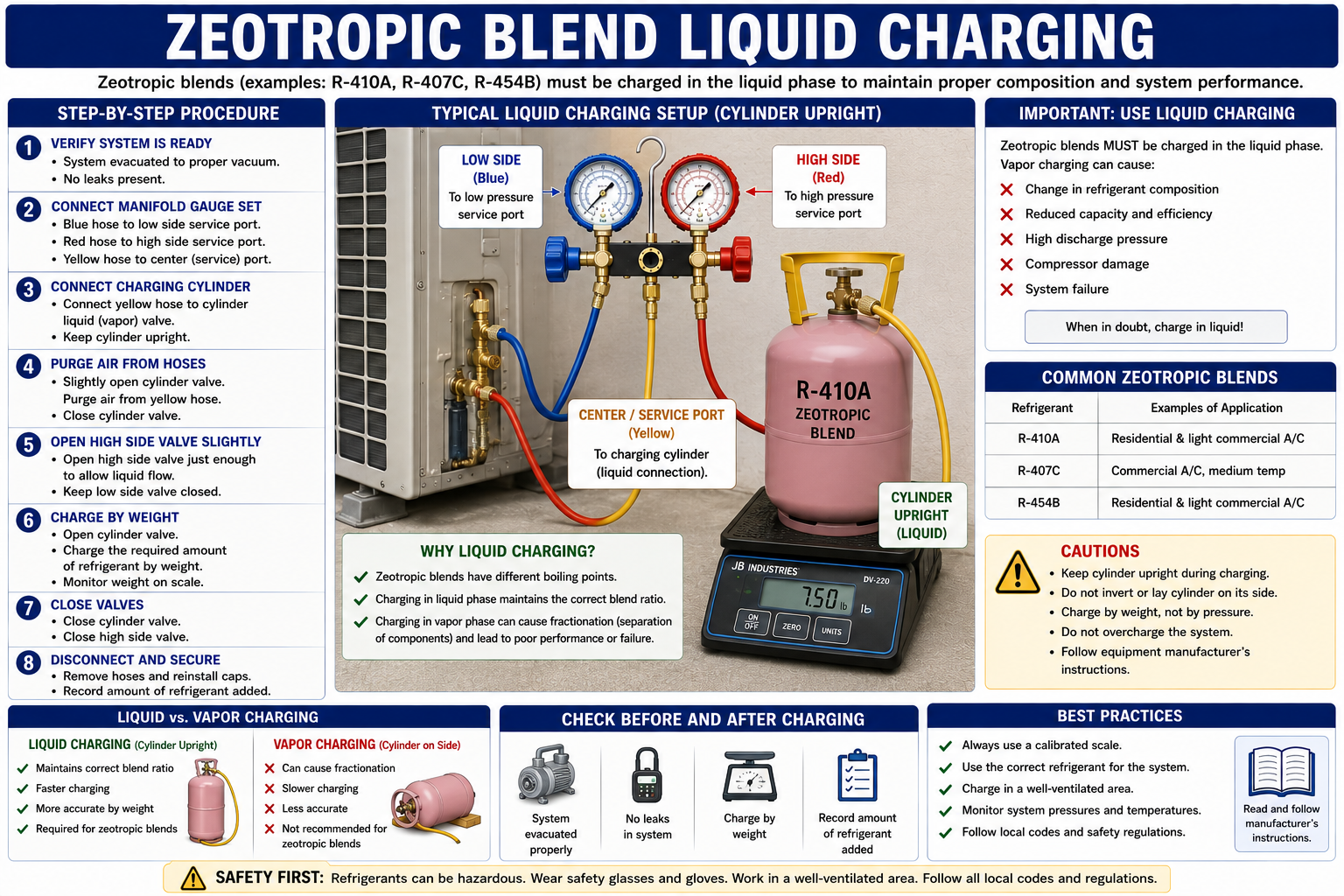
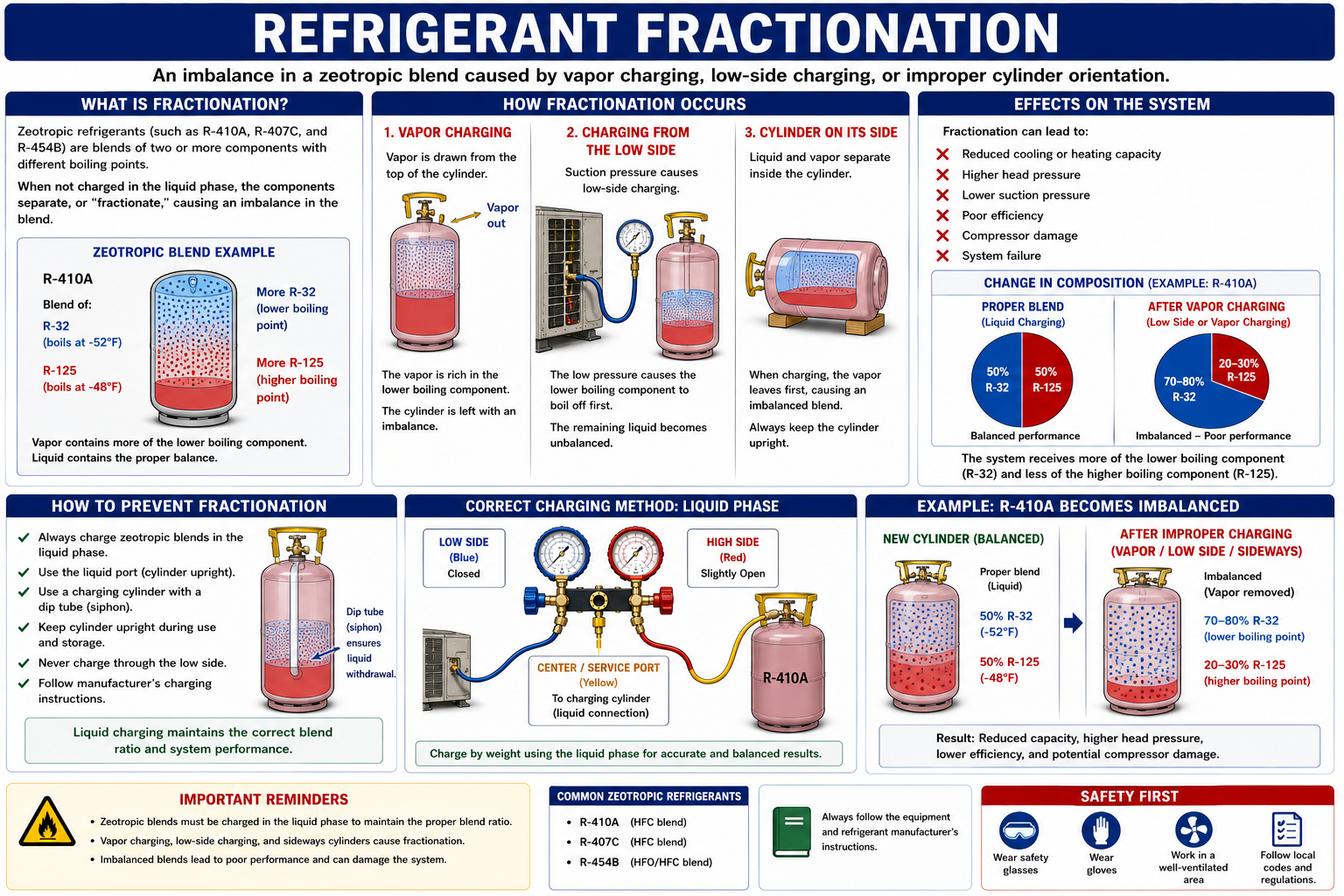
Zeotropic refrigerant blends contain two or more components with different boiling characteristics. If refrigerant is removed from a supply cylinder as vapor, the vapor composition may differ from the overall composition of the liquid remaining in the cylinder.
For this reason, zeotropic blends are normally removed from the supply cylinder as liquid so the intended blend composition is preserved.
When a Blend Changes Composition
Fractionation occurs when the components of a refrigerant blend separate or are lost in unequal proportions. This can occur because components in a zeotropic blend have different vapor pressures and boiling characteristics.
During Cylinder Withdrawal
Removing vapor from certain zeotropic refrigerant cylinders can change the composition of the refrigerant being transferred.
During a System Leak
Under some conditions, components of a blend can escape at different rates. The significance depends on the refrigerant, leak location, system condition, and amount lost.
During Improper Service
Mixing refrigerants or repeatedly adding an unknown quantity of replacement refrigerant can produce a system charge whose composition is uncertain.
Know Whether the Valve Supplies Liquid or Vapor
Traditional single-valve cylinders may supply vapor when upright and liquid when inverted, but cylinder designs vary. Some refillable or specialty cylinders provide dedicated liquid and vapor connections and do not require inversion.
Do not rely on cylinder appearance alone. Determine the cylinder design and follow the refrigerant supplier’s instructions.
Do Not Automatically Turn Every Cylinder Upside Down
Use the cylinder configuration required to obtain the desired refrigerant state. Dedicated liquid/vapor cylinders, recovery cylinders, and specialty containers may operate differently from a traditional single-valve supply cylinder.
Do Not Charge Air Into the System
Before refrigerant flows into an evacuated or properly prepared refrigeration system, air trapped in charging hoses must be managed according to the approved service procedure.
Introducing air into a refrigeration circuit adds noncondensables and moisture. These contaminants can increase condensing pressure, reduce efficiency, contribute to chemical breakdown, and interfere with system operation.
Keep the Refrigerant and System Clean
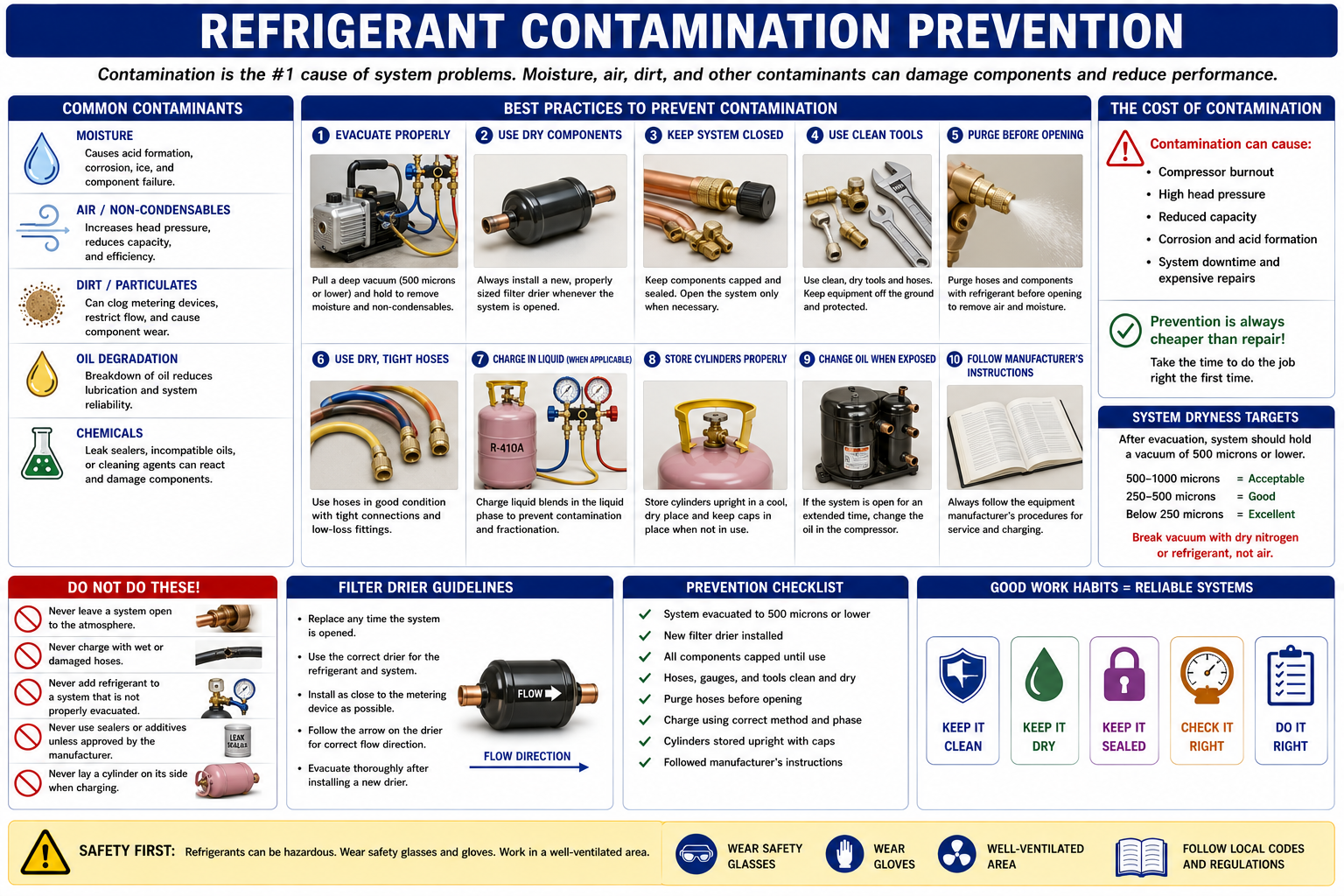
Charging is not simply moving refrigerant from one container to another. Every connection provides an opportunity for air, moisture, dirt, incompatible lubricant, or another refrigerant to enter the refrigeration circuit.
Use Clean Equipment
Keep manifolds, hoses, fittings, recovery equipment, and other service tools clean and properly maintained.
Keep Containers Closed
Do not leave refrigerant cylinders, oil containers, or system openings exposed unnecessarily.
Control Moisture
Complete appropriate leak testing, dehydration, and evacuation before charging a system that has been opened to the atmosphere.
Avoid Cross-Contamination
Do not allow refrigerants or lubricants from one system to contaminate another.
Diagnosis Comes Before Refrigerant
A low suction pressure or warm space does not automatically mean a system needs refrigerant. Restricted airflow, dirty heat exchangers, failed fans, metering-device problems, compressor problems, incorrect controls, or other faults can produce symptoms that resemble an improper refrigerant charge.
Weight Is Only One Part of Commissioning
When a system has been charged with the specified quantity, the technician should verify system operation according to the equipment manufacturer’s procedure.
Depending on the system, this may include checking operating pressures, superheat, subcooling, temperature differences, airflow, compressor current, refrigerant line temperatures, control operation, and other performance measurements.
Different Metering Devices Use Different Charging Procedures
Some systems are commissioned using subcooling, others using superheat, and some primarily by weighed charge or other manufacturer-specific procedures. Use the method specified for the actual equipment.
Unknown Refrigerant Requires a Different Decision
If there is reason to believe that the system contains the wrong refrigerant, an unknown refrigerant, or a contaminated mixture, adding more refrigerant does not correct the problem.
Recover and manage the refrigerant according to the appropriate procedure, determine the required refrigerant and lubricant condition, repair the system as necessary, evacuate it when required, and recharge with the correct refrigerant.
Never Create a Field Blend
Do not add a different refrigerant to an existing charge in an attempt to improve pressures or performance. A manufactured refrigerant blend has a defined composition. An uncontrolled mixture created in the field does not.
Flammability Changes Work-Area Requirements
Charging equipment containing A2L or A3 refrigerants requires the technician to consider refrigerant flammability in addition to the ordinary pressure and cold-contact hazards associated with refrigerant handling.
Follow the equipment manufacturer’s procedure and applicable safety requirements for ventilation, ignition-source control, leak detection, charge quantity, and service tools.
Verify the Refrigerant
Confirm the exact refrigerant and safety classification before opening the cylinder.
Control Ignition Sources
Follow the applicable procedure for flames, sparks, electrical equipment, and other potential ignition sources.
Ventilate Appropriately
Prevent released refrigerant from accumulating in a work area.
Use Suitable Equipment
Verify that charging, recovery, leak-detection, and other tools are suitable for the refrigerant.
Liquid Refrigerant Can Cause Severe Cold Injury
When pressurized liquid refrigerant expands through a valve or fitting, its temperature can fall rapidly. Contact with skin or eyes can cause frostbite or other serious cold injury.
Wear appropriate eye protection and gloves and position yourself so that an unexpected refrigerant release is not directed toward your face or body.
Never Deliberately Release Refrigerant Toward Your Skin
Even a small amount of liquid refrigerant escaping from a hose or fitting can cause injury. Treat every pressurized connection as capable of releasing refrigerant unexpectedly.
Charging Is Refrigerant Service
EPA includes adding refrigerant to or removing refrigerant from a covered appliance within the activities performed by a technician under Section 608. Proper refrigerant management therefore applies throughout charging, recovery, hose connection, and system service. :contentReference[oaicite:1]{index=1}
EPA also prohibits intentional venting of most refrigerants during maintenance, service, repair, or disposal, subject to specific regulatory exceptions. :contentReference[oaicite:2]{index=2}
- Positively identify the refrigerant before charging.
- Use the equipment manufacturer’s specified charging procedure.
- Use a refrigerant scale when charging by weight.
- Do not diagnose refrigerant charge from pressure alone.
- Know whether refrigerant is being transferred as liquid or vapor.
- Zeotropic blends are normally removed from the supply cylinder as liquid to preserve composition.
- Fractionation can change the composition of a refrigerant blend.
- Do not allow uncontrolled liquid refrigerant to enter a running compressor.
- Manage air in service hoses so noncondensables are not introduced into the system.
- Keep charging tools and refrigerant clean and properly identified.
- Do not mix different refrigerants in a system.
- Verify final system operation after charging.
- Use appropriate PPE when handling pressurized refrigerant.
Review Questions
1. What is the best way to measure a specified refrigerant charge?
Answer: Use an accurate refrigerant scale and charge according to the equipment manufacturer’s specified mass and adjustment procedure.
2. Why should a zeotropic refrigerant blend normally be removed from the supply cylinder as liquid?
Answer: Removing the blend as liquid helps preserve the manufacturer’s intended refrigerant composition and reduces fractionation during cylinder withdrawal.
3. What is fractionation?
Answer: Fractionation is a change in refrigerant-blend composition caused when components separate or are lost in unequal proportions.
4. Why is uncontrolled liquid refrigerant dangerous to a running compressor?
Answer: Compressors are designed primarily to compress vapor. A large quantity of incompressible liquid entering the compressor can cause liquid slugging and mechanical damage.
5. Why should air not be allowed into a refrigeration system during charging?
Answer: Air introduces noncondensables and moisture, which can increase operating pressures, reduce efficiency, contaminate the system, and contribute to chemical damage.
6. Does low suction pressure prove that a system is undercharged?
Answer: No. Airflow problems, restrictions, load conditions, metering-device problems, compressor problems, and other faults can also produce low suction pressure.
7. Should a lower-GWP refrigerant be added to a system containing a different refrigerant?
Answer: No. Do not create an uncontrolled refrigerant mixture. Use only the refrigerant approved for the equipment or an approved retrofit procedure.
Lesson 24 Summary
- Charging means transferring the correct refrigerant into a system in the correct amount and according to the correct procedure.
- Positive refrigerant identification must occur before charging begins.
- A refrigerant scale provides an accurate way to measure refrigerant transferred by weight.
- Factory charge specifications may require adjustment for the actual installation.
- Liquid and vapor charging move refrigerant in different physical states.
- Liquid refrigerant can damage a running compressor if introduced without proper control.
- Zeotropic blends are normally withdrawn from supply cylinders as liquid.
- Fractionation can alter refrigerant-blend composition.
- Cylinder orientation and valve design determine whether liquid or vapor is supplied.
- Air trapped in hoses must be managed so it is not introduced into the refrigeration system.
- Moisture, air, dirt, incompatible oils, and other refrigerants can contaminate a refrigeration system.
- Low pressure alone does not prove that a system needs refrigerant.
- Final charge verification should follow the manufacturer’s commissioning procedure.
- Different refrigerants should never be mixed to create an uncontrolled field blend.
- A2L and A3 refrigerants require additional attention to ventilation and ignition-source control.