Global Warming Potential and Refrigerant Transitions
The transition away from CFC and HCFC refrigerants greatly reduced the refrigeration industry’s contribution to stratospheric ozone depletion. However, many of the HFC refrigerants that replaced them created a different environmental concern. Although HFCs have zero Ozone Depletion Potential, many are powerful greenhouse gases with relatively high Global Warming Potentials.
The modern refrigerant transition therefore involves more than eliminating ozone-depleting substances. Refrigerant selection increasingly considers climate impact, energy efficiency, safety classification, operating pressure, equipment design, service requirements, and regulatory requirements together.
Learning Objectives
Understand Global Warming Potential
Explain what GWP measures and why carbon dioxide is used as the reference gas.
Distinguish ODP from GWP
Recognize that ozone depletion and climate warming are different environmental effects measured in different ways.
Follow the Refrigerant Transition
Trace the industry’s movement from CFCs and HCFCs to HFCs and toward lower-GWP HFOs, A2Ls, hydrocarbons, ammonia, and carbon dioxide.
Understand the HFC Phasedown
Describe the purpose of the AIM Act HFC phasedown and understand what a phasedown means for technicians and existing equipment.
Why Some Refrigerants Affect Climate
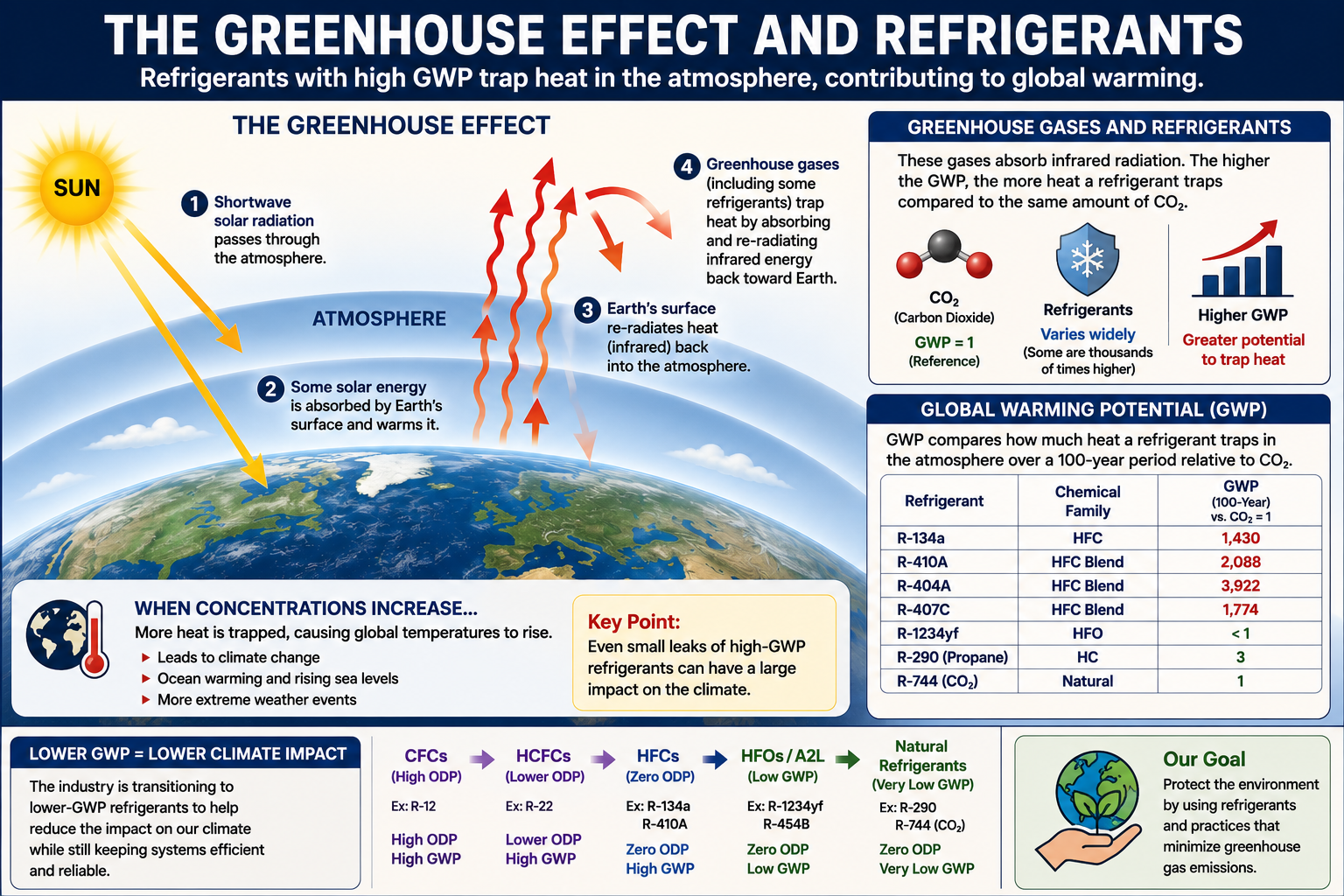
The Earth receives energy from the sun. Some of that energy is absorbed by the Earth’s surface and later emitted as infrared radiation. Greenhouse gases absorb some of this outgoing energy and slow the rate at which heat escapes to space.
The greenhouse effect is a natural process necessary for maintaining temperatures that support life. The environmental concern occurs when human activities increase atmospheric concentrations of greenhouse gases and strengthen that effect.
Some refrigerants are greenhouse gases. If these refrigerants are released into the atmosphere, they can contribute to climate warming. Different gases vary greatly in both how effectively they absorb energy and how long they remain in the atmosphere.
What Does GWP Mean?
Global Warming Potential (GWP) provides a way to compare the climate-warming effect of different greenhouse gases. Carbon dioxide, or CO2, is used as the reference gas and is assigned a GWP of 1.
GWP compares the amount of energy that the emission of a given mass of a gas will absorb over a specified period with the amount absorbed by the same mass of carbon dioxide. Refrigerant GWPs are commonly expressed using a 100-year time horizon.
A refrigerant with a GWP of 2,000 therefore has a much greater warming effect per unit mass than the same mass of carbon dioxide over the specified comparison period. GWP does not describe refrigerating capacity, efficiency, toxicity, flammability, pressure, or ozone depletion.
GWP Is a Relative Measurement
A larger GWP indicates greater potential climate impact for the same mass released. It does not tell us how much refrigerant is actually emitted from a particular system. Both the refrigerant’s GWP and the quantity released affect the climate impact of a leak.
ODP Is Not GWP
One of the most important concepts in understanding modern refrigerants is the difference between Ozone Depletion Potential (ODP) and Global Warming Potential (GWP).
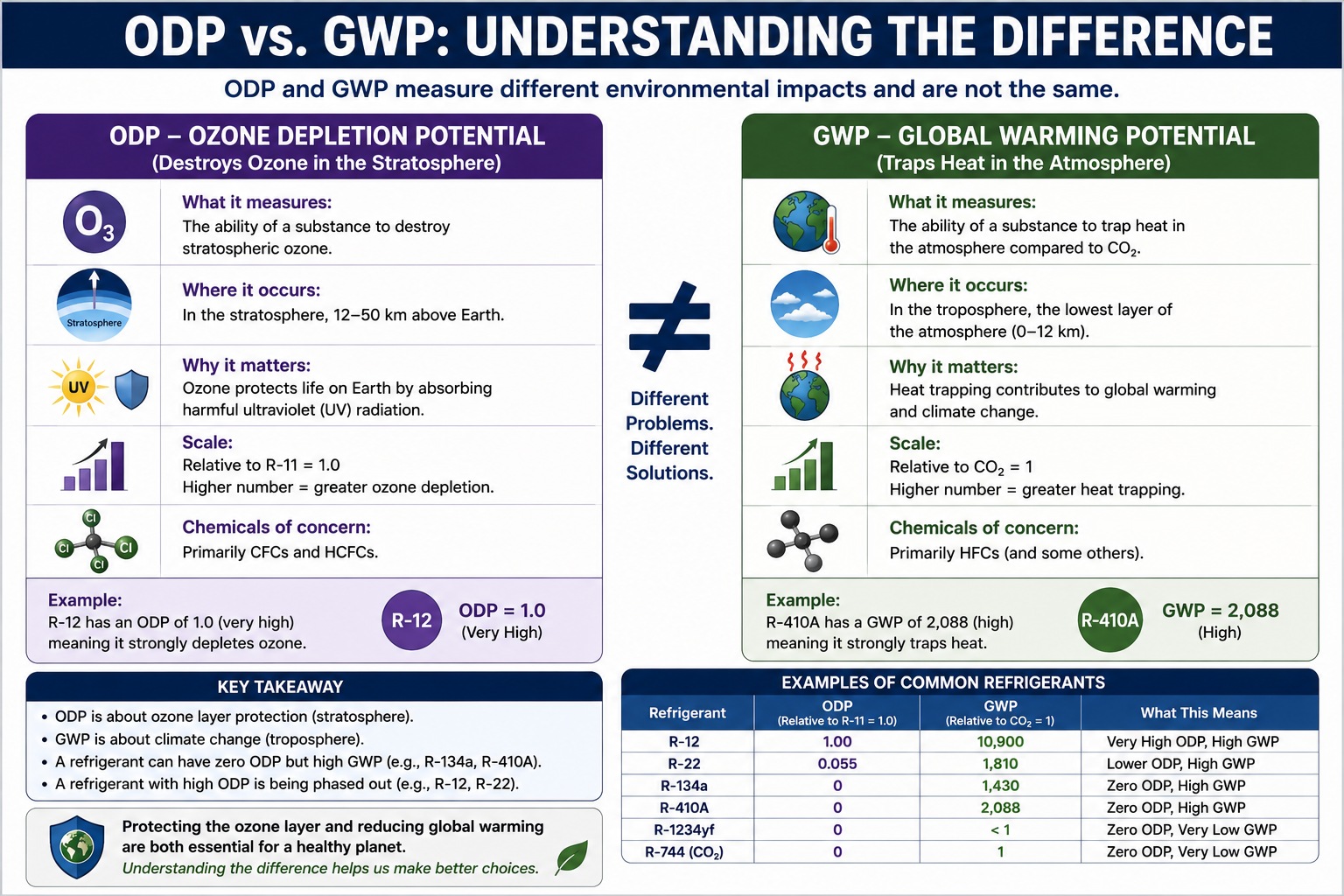
| Characteristic | ODP | GWP |
|---|---|---|
| Full Name | Ozone Depletion Potential | Global Warming Potential |
| Environmental Concern | Damage to stratospheric ozone | Climate warming |
| Common Reference | CFC-11 = 1.0 | CO2 = 1 |
| Important Refrigerant Characteristic | Presence of ozone-depleting chlorine or bromine | Atmospheric lifetime and ability to absorb energy |
| Can an HFC have zero ODP? | Yes | Its GWP may still be significant |
Common Mistake
Zero ODP does not mean zero environmental impact. HFC refrigerants solved the chlorine-related ozone problem, but many HFCs have substantial GWPs. That distinction is one of the reasons the refrigerant industry is undergoing another major transition.
Why Refrigerants Keep Changing
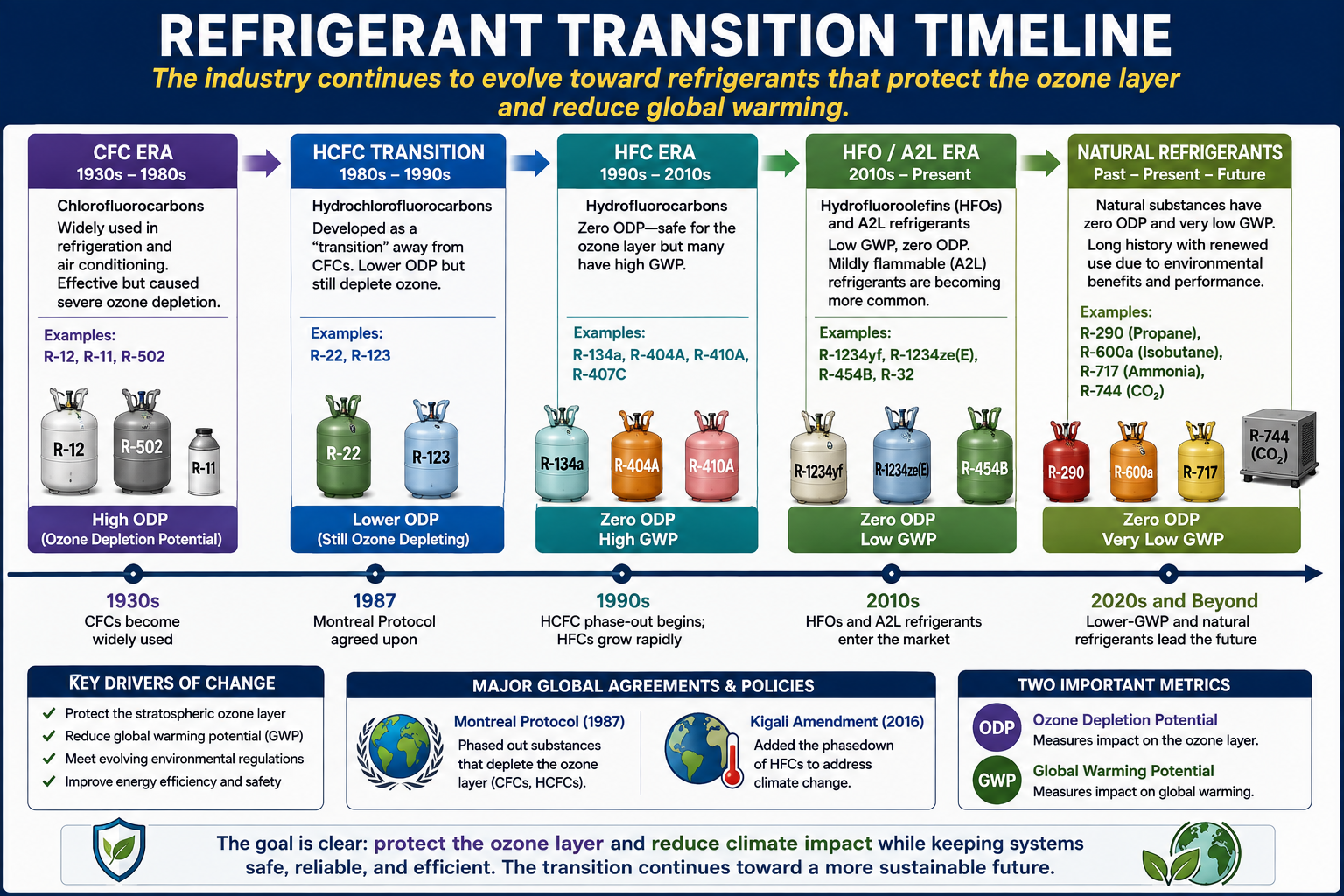
Refrigerant development has involved a series of tradeoffs. Refrigerants that solved one problem sometimes introduced another, while improvements in chemistry, equipment design, and safety controls made additional alternatives practical.
CFC Refrigerants
Refrigerants such as R-12 provided useful performance and safety characteristics but contained chlorine and had substantial ozone depletion potential.
HCFC Refrigerants
Refrigerants such as R-22 generally had lower ODP than CFCs and served as transitional refrigerants, but they still contained chlorine.
HFC Refrigerants
Refrigerants such as R-134a, R-404A, and R-410A eliminated chlorine and therefore have zero ODP, but many have relatively high GWP.
Lower-GWP Alternatives
HFOs, A2L blends, hydrocarbons, ammonia, carbon dioxide, and other technologies are increasingly used where their performance and safety characteristics are appropriate.
Refrigerants Can Have Very Different GWPs
The refrigerants studied in Part II demonstrate how widely environmental characteristics can differ. Some widely used HFC refrigerants have GWPs in the thousands, while many newer refrigerants and natural refrigerants have substantially lower values.
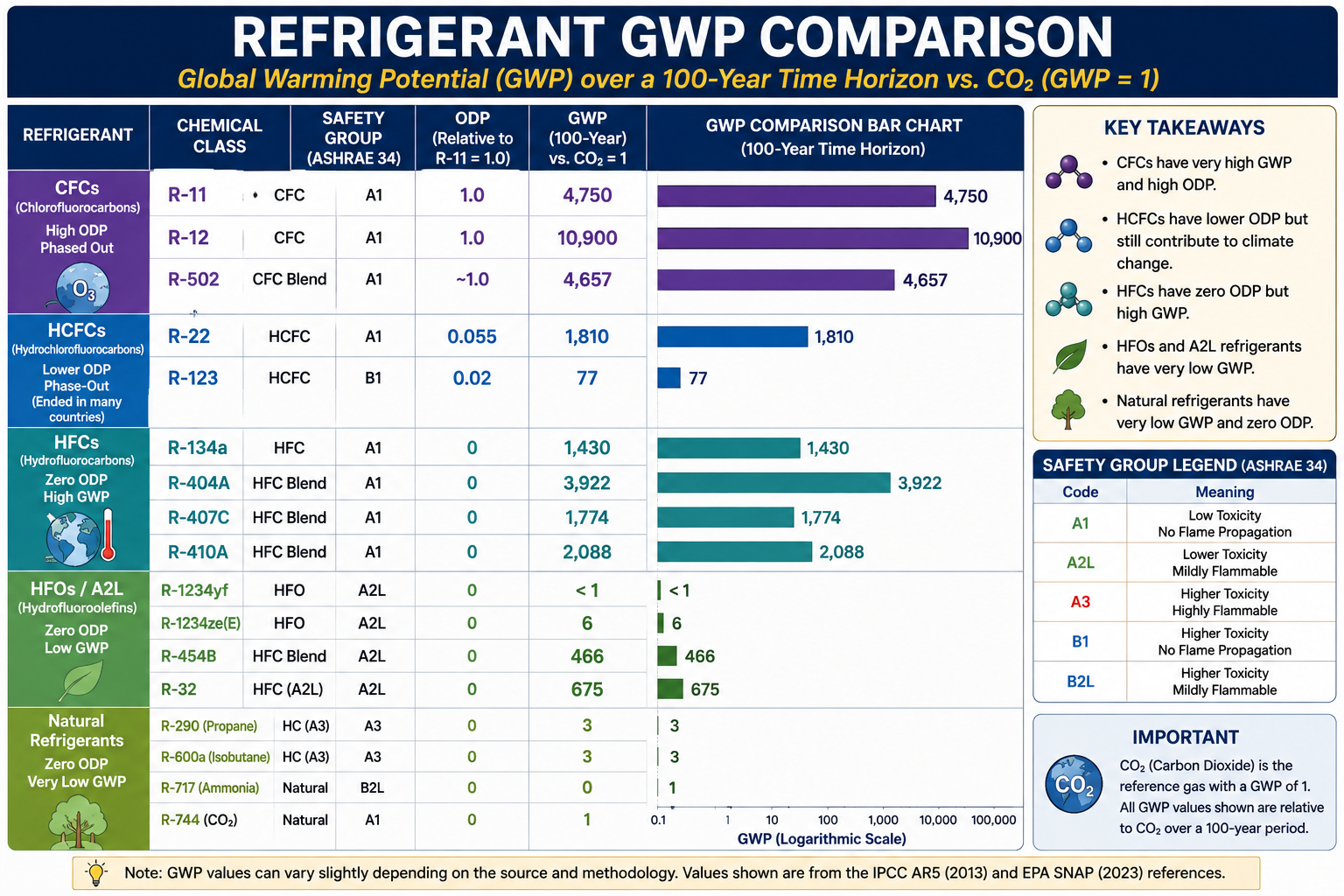
Exact GWP values can vary depending on the scientific assessment and regulatory reference being used. For service work, compliance, equipment selection, and examinations, technicians should use the value specified by the applicable regulation, manufacturer, or reference material rather than assuming every published table uses the same assessment basis.
The U.S. HFC Phasedown
The American Innovation and Manufacturing Act of 2020, commonly called the AIM Act, established a national program addressing hydrofluorocarbons. One major part of the law directs EPA to reduce the production and consumption of regulated HFCs through a stepwise allowance system.
The phasedown is based on the climate impact of HFCs rather than ozone depletion. HFCs generally have zero ODP, but regulated HFCs can have substantial GWPs.
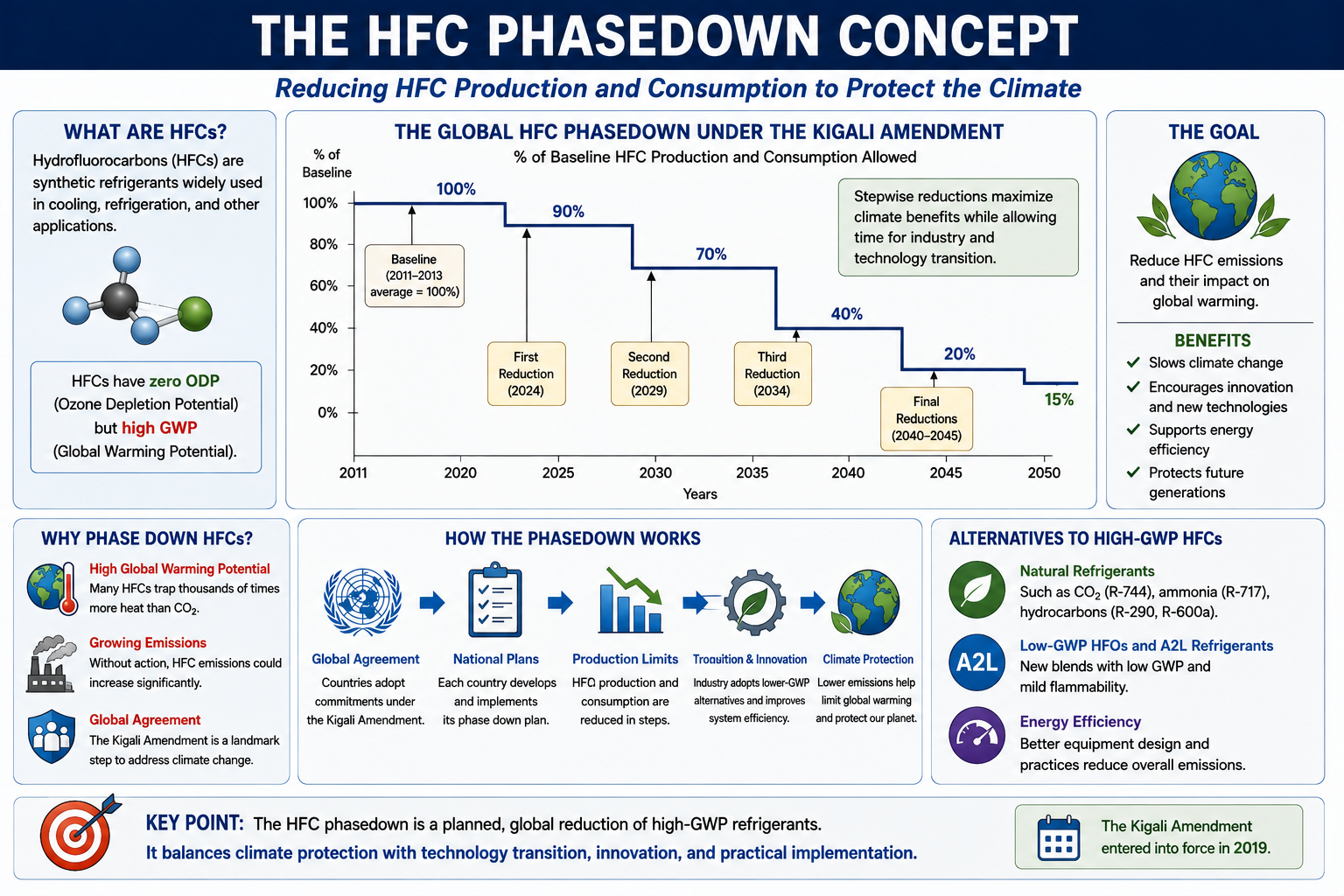
| Period | Maximum Production and Consumption Allowance Cap |
|---|---|
| 2022–2023 | 90% of baseline |
| 2024–2028 | 60% of baseline |
| 2029–2033 | 30% of baseline |
| 2034–2035 | 20% of baseline |
| 2036 and after | 15% of baseline |
Phasedown Is Not the Same as Phaseout
The AIM Act schedule does not reduce HFC production and consumption to zero. It establishes progressively lower allowance caps, reaching 15 percent of baseline beginning in 2036. The distinction between phasedown and phaseout is important.
Existing Equipment Does Not Instantly Become Obsolete
A refrigerant transition does not mean every existing air-conditioning or refrigeration system must immediately be replaced. Millions of systems remain in service after production or use restrictions begin changing.
Instead, refrigerant transitions affect the availability of refrigerants, the types of equipment manufactured for new installations, service practices, recovery and reclamation, retrofit decisions, and the economics of maintaining older equipment.
Existing Systems
Existing equipment may continue operating when permitted by applicable regulations. Technicians must service it using appropriate refrigerants and approved procedures.
Reclaimed Refrigerant
Recovered and reclaimed refrigerant can become increasingly important for maintaining installed equipment as production and consumption of higher-GWP refrigerants decrease.
New Equipment
Manufacturers increasingly design new equipment around refrigerants that satisfy current environmental, performance, safety, and regulatory requirements.
Technician Training
New refrigerants may introduce different pressures, flammability classifications, tools, charge limits, leak-detection requirements, and service procedures.
There Is No Single Replacement Refrigerant
The modern refrigerant transition is not simply replacing one refrigerant with another universal substitute. Different applications have different requirements, and several refrigerant technologies are being used simultaneously.
A2L Refrigerants
Refrigerants such as R-32 and R-454B provide lower-GWP alternatives for many air-conditioning applications but introduce lower-flammability service considerations.
HFO Refrigerants
HFOs such as R-1234yf and R-1234ze(E) have very low GWPs and are used directly or as components of lower-GWP blends.
Hydrocarbons
R-290 propane and R-600a isobutane have very low climate impact but are A3 refrigerants with higher flammability and application-specific charge restrictions.
R-717 Ammonia
Ammonia has long been used in industrial refrigeration and has very low direct climate impact, but toxicity and flammability require specialized system design and training.
R-744 Carbon Dioxide
CO2 has a GWP of 1 and is increasingly used in commercial refrigeration and other applications, but its very high operating pressures require specialized equipment and procedures.
Reclaimed Refrigerants
Recovery and reclamation allow existing refrigerant already in circulation to support legacy equipment while reducing the need for newly produced refrigerant.
Refrigerant Choice Is Only Part of the Environmental Equation
The direct climate effect of a refrigeration system occurs when refrigerant escapes into the atmosphere. A high-GWP refrigerant can create a substantial direct climate impact even when the mass released is relatively small.
However, refrigeration and air-conditioning equipment also consumes energy. Producing that energy may create greenhouse gas emissions. Equipment efficiency therefore contributes to the system’s overall climate impact.
A refrigerant with a lower GWP is desirable, but a successful transition must also maintain or improve system efficiency, reliability, safety, and useful equipment life. Refrigerant selection is therefore an engineering decision involving multiple factors rather than a comparison of GWP alone.
Do Not Retrofit by Refrigerant Number Alone
A lower-GWP refrigerant is not automatically a safe or approved replacement for the refrigerant originally specified for a system. Never substitute a refrigerant without confirming equipment compatibility, manufacturer guidance, safety requirements, lubricant requirements, pressure characteristics, and applicable regulations.
Good Service Practices Reduce Refrigerant Emissions
Regardless of which refrigerant a system uses, technicians can reduce environmental impact through good service practices. Preventing a refrigerant from escaping is preferable to replacing it after a leak.
Find and Repair Leaks
Correct leaks rather than repeatedly replacing lost refrigerant.
Recover Refrigerant
Use proper recovery equipment and procedures instead of intentionally releasing refrigerant during service.
Avoid Contamination
Keep recovered refrigerants properly identified and separated so that they remain suitable for recycling or reclamation.
Charge Accurately
Use manufacturer specifications and accurate charging procedures to avoid unnecessary refrigerant use and poor system performance.
What You Need to Remember
- ODP and GWP are different measurements.
- ODP measures relative potential to damage stratospheric ozone.
- GWP compares the climate-warming effect of a greenhouse gas with carbon dioxide.
- CO2 is the GWP reference gas and has a GWP of 1.
- GWP is commonly compared using a 100-year time horizon.
- HFC refrigerants generally have zero ODP because they do not contain chlorine or bromine, but many have substantial GWPs.
- The transition from CFCs and HCFCs to HFCs addressed ozone depletion but did not eliminate refrigerant-related climate concerns.
- The AIM Act establishes a phasedown of regulated HFC production and consumption, not a complete phaseout.
- The AIM Act schedule reaches 15 percent of baseline beginning in 2036.
- A lower-GWP refrigerant is not automatically a direct replacement for an existing refrigerant.
- Refrigerant recovery, reclamation, leak prevention, and accurate service procedures help reduce refrigerant emissions.
Review Questions
1. What does Global Warming Potential measure?
Answer: GWP compares the climate-warming effect of a greenhouse gas with the effect of the same mass of carbon dioxide over a specified period of time.
2. What gas is used as the reference for GWP?
Answer: Carbon dioxide, CO2, which is assigned a GWP of 1.
3. Can a refrigerant have zero ODP and still have a high GWP?
Answer: Yes. Many HFC refrigerants have zero ODP because they contain no chlorine or bromine but still have substantial Global Warming Potentials.
4. Does the AIM Act completely phase out HFCs?
Answer: No. It establishes a stepwise phasedown of regulated HFC production and consumption, reaching 15 percent of baseline levels beginning in 2036.
5. Can a technician replace a high-GWP refrigerant with any lower-GWP refrigerant?
Answer: No. Refrigerant compatibility depends on equipment design, pressure, capacity, lubricant, safety classification, charge limitations, manufacturer approval, and applicable regulations.
6. Why can reclaimed refrigerant become more important during a refrigerant transition?
Answer: Reclamation allows refrigerant already in circulation to be returned to an appropriate purity standard and used to support existing equipment while production and consumption of certain refrigerants decrease.
Lesson 21 Summary
- Some refrigerants are greenhouse gases and can contribute to climate warming when released.
- Global Warming Potential compares the warming effect of a gas with carbon dioxide.
- Carbon dioxide has a GWP of 1.
- Refrigerant GWPs are commonly expressed over a 100-year time horizon.
- ODP and GWP measure different environmental effects.
- HFCs solved the chlorine-related ozone-depletion problem but many have substantial GWPs.
- The refrigerant industry has progressed from CFCs and HCFCs toward HFCs and increasingly toward lower-GWP alternatives.
- Lower-GWP alternatives include HFOs, A2L refrigerants, hydrocarbons, ammonia, carbon dioxide, and other technologies.
- The AIM Act requires a stepwise reduction in U.S. production and consumption of regulated HFCs.
- The current statutory schedule reaches 15 percent of baseline beginning in 2036.
- Phasedown does not mean every existing HFC system must immediately be replaced.
- Lower GWP alone does not make a refrigerant suitable as a replacement.
- Recovery, reclamation, leak prevention, and proper service practices remain important throughout the refrigerant transition.