R-744 Carbon Dioxide Refrigerant
Carbon dioxide is one of the oldest refrigerants used in mechanical refrigeration and has returned to widespread use in modern commercial and industrial systems. Designated R-744, carbon dioxide provides zero ozone depletion potential, a global warming potential of 1, an A1 safety classification, and useful thermodynamic characteristics for refrigeration.
R-744 also operates very differently from most refrigerants technicians encounter. Its unusually low critical temperature and very high operating pressures require specialized equipment, controls, service tools, pressure-relief protection, and service procedures. Understanding CO₂ requires technicians to understand not only pressure-temperature relationships, but also the refrigerant’s critical point, triple point, subcritical operation, transcritical operation, and behavior during pressure loss.
What You Will Learn
After completing this lesson, you should be able to:
Identify R-744
Recognize R-744 as carbon dioxide, a single-component A1 refrigerant with zero ODP and a GWP of 1.
Explain the Critical Point
Explain why CO₂ cannot condense into a separate liquid phase above its critical temperature.
Explain the Triple Point
Recognize the conditions at which solid, liquid, and vapor CO₂ can coexist and why solid CO₂ can form during rapid pressure reduction.
Compare Subcritical and Transcritical Operation
Distinguish conventional condensing operation below the critical point from heat rejection above the critical point.
Recognize High-Pressure Hazards
Explain why every component, hose, gauge, valve, recovery device, and service procedure must be appropriate for CO₂ pressures.
Apply R-744 Safety Practices
Recognize pressure-relief, ventilation, oxygen-displacement, dry-ice formation, trapped-liquid, and specialized service-equipment considerations.
Carbon Dioxide as a Refrigerant
R-744 is the refrigerant designation for carbon dioxide, CO2. It is a naturally occurring, single-component refrigerant and contains no chlorine or fluorine.
CO₂ is familiar as a gas in the atmosphere, but inside a refrigeration system it is maintained at pressures high enough to exist as dense vapor, liquid, or supercritical fluid depending on temperature and pressure.
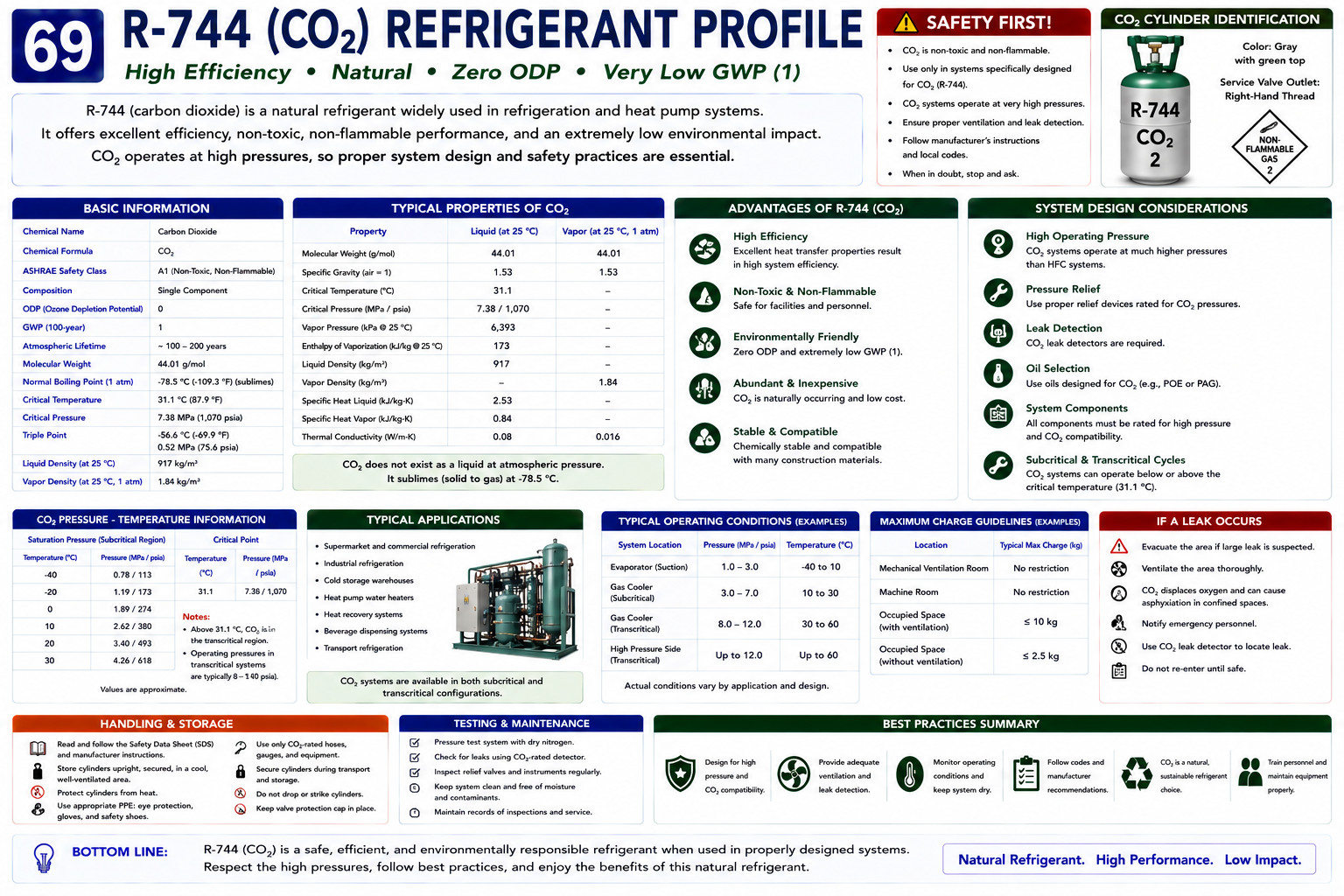
Designation
R-744
Chemical Formula
CO2
Composition
Single-component refrigerant.
Safety Classification
ASHRAE A1.
Ozone Depletion Potential
0
Global Warming Potential
1, the reference value used to compare other greenhouse gases.
Strong Environmental Characteristics and Useful Refrigeration Performance
R-744 has attracted renewed interest because it combines useful refrigeration characteristics with exceptionally low direct environmental impact.
It contains no chlorine and therefore has zero ozone depletion potential. Because carbon dioxide itself is the reference gas used in calculating global warming potential, R-744 has a GWP of 1.
ODP
0
R-744 does not contribute to stratospheric ozone depletion.
GWP
1
Carbon dioxide is the reference substance against which other greenhouse gases are compared.
Low environmental impact does not mean easy service. The primary engineering challenge with R-744 is its unusually high operating pressure and unique phase behavior.
Where Technicians Encounter R-744
Modern R-744 systems are increasingly common in commercial refrigeration and are also used in industrial refrigeration, cold storage, heat pumps, transport refrigeration, and other specialized applications.
Supermarkets
Transcritical booster systems can provide both medium- and low-temperature refrigeration throughout a store.
Cold Storage
R-744 can be used in large refrigerated warehouses and freezer applications.
Industrial Refrigeration
CO₂ can be used directly as a refrigerant or as part of cascade and secondary refrigeration systems.
Heat Pumps
R-744 can be useful in specialized heat-pump applications where high discharge temperatures are beneficial.
Transport Refrigeration
CO₂ technology is used in some refrigerated transport and mobile applications.
Stand-Alone Equipment
EPA SNAP lists R-744 as acceptable in specified stand-alone refrigeration applications.
Two Points Change Everything
Every refrigerant has critical and triple points, but these values are especially important with carbon dioxide because they fall within ranges directly relevant to refrigeration-system operation and service.
The critical point determines whether high-side heat rejection can occur by ordinary condensation. The triple point determines when liquid CO₂ can exist and when dry ice can form.
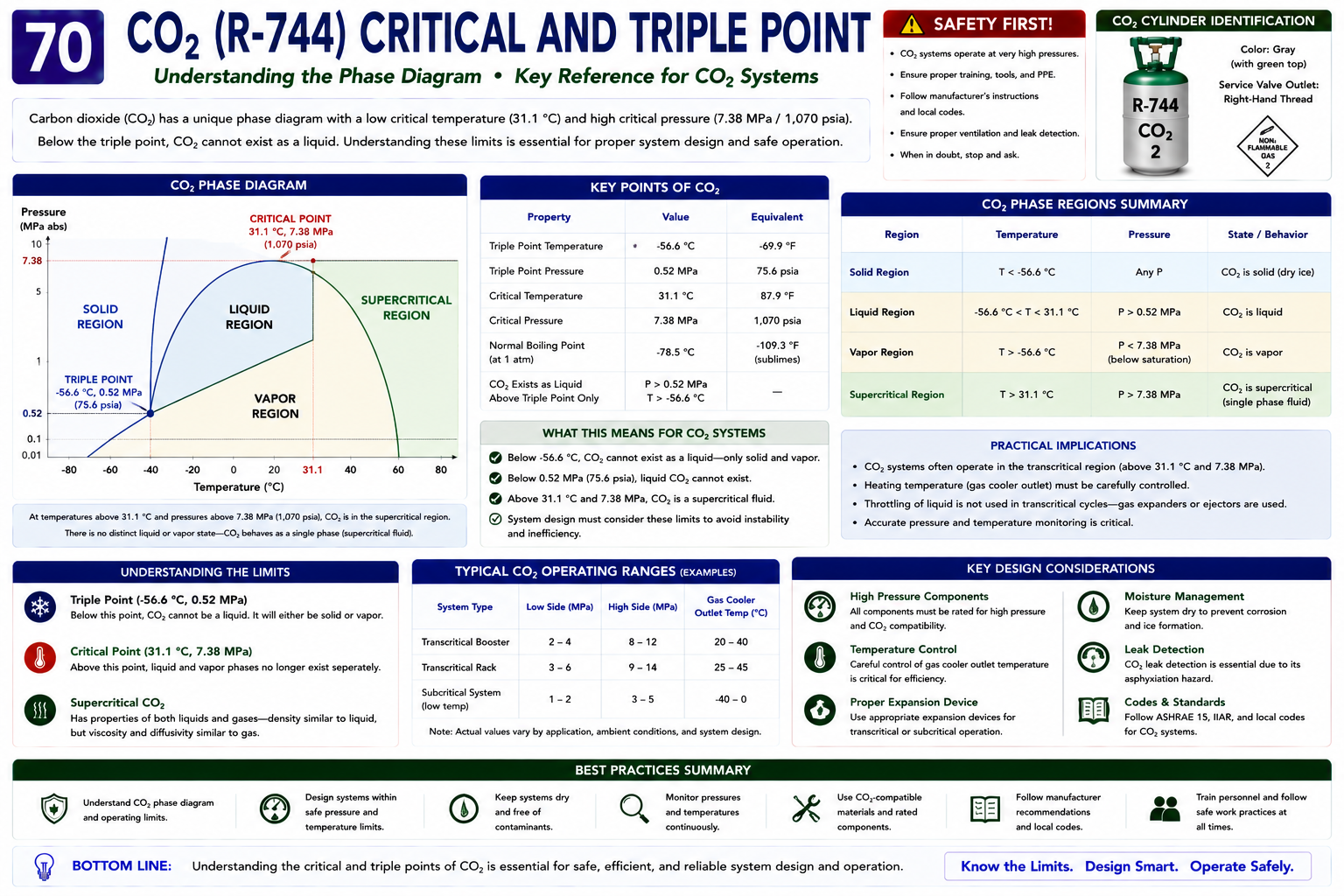
About 31°C — 88°F
The critical temperature of R-744 is approximately 31°C (88°F). Its critical pressure is approximately 7.38 MPa absolute, or about 1,070 psia.
Below the critical point, a distinct liquid and vapor phase can exist and vapor can condense into liquid. Above the critical temperature, there is no separate liquid-vapor phase boundary.
Above the critical temperature, increasing pressure cannot make CO₂ condense in the conventional sense. The high-side refrigerant exists as a supercritical fluid.
Outdoor Conditions Can Push the System Above the Critical Point
A critical temperature of approximately 88°F is low compared with most familiar HVAC/R refrigerants. Outdoor air temperatures and normal condenser temperature differences can therefore place an air-cooled CO₂ system above its critical point.
This is why many modern CO₂ systems are specifically designed to operate transcritically during at least part of the year.
In an R-410A condenser, the technician normally expects high-pressure vapor to condense into liquid as heat is rejected. A transcritical R-744 system can reject heat on the high side without condensation occurring there.
Where Solid, Liquid, and Vapor Meet
The triple-point temperature of carbon dioxide is approximately −56.6°C (−69.8°F). At the triple point, solid, liquid, and vapor CO₂ can exist in equilibrium.
Below the triple-point pressure, liquid CO₂ cannot exist. A rapid reduction in pressure can therefore cause some refrigerant to become solid carbon dioxide, commonly called dry ice.
Depressurizing CO₂ is not the same as depressurizing an ordinary HFC system. Rapid pressure reduction can create extremely low temperatures and solid CO₂.
Solid CO₂ Can Form During Pressure Reduction
At atmospheric pressure, carbon dioxide does not exist as a liquid. Solid CO₂ instead sublimates directly into vapor at approximately −78.5°C (−109.3°F).
If liquid CO₂ is rapidly depressurized, part of the refrigerant flashes to vapor and part can become dry ice. Solid CO₂ can restrict tubing, valves, hoses, fittings, and service equipment.
Follow the equipment manufacturer’s controlled pressure-reduction and recovery procedure. Do not assume that rapidly opening a valve is an acceptable way to depressurize an R-744 system.
Below the Critical Point, CO₂ Can Condense
A CO₂ refrigeration system operating with high-side conditions below the refrigerant’s critical point is operating subcritically.
Under these conditions, the high-pressure vapor rejects heat and condenses into liquid in a condenser in the same general manner familiar from conventional vapor-compression refrigeration.
Below the critical point: condensation can occur.
Above the Critical Point, There Is No High-Side Condensation
When the high-side CO₂ operates above the critical point, the system is operating transcritically. Heat is still rejected to the surroundings, but the refrigerant does not pass through a conventional vapor-to-liquid condensation process while above the critical point.
Instead of a condenser, the high-side heat exchanger is called a gas cooler.
Above the critical point: heat is rejected in a gas cooler without conventional condensation.
Two Different High-Side Operating Modes
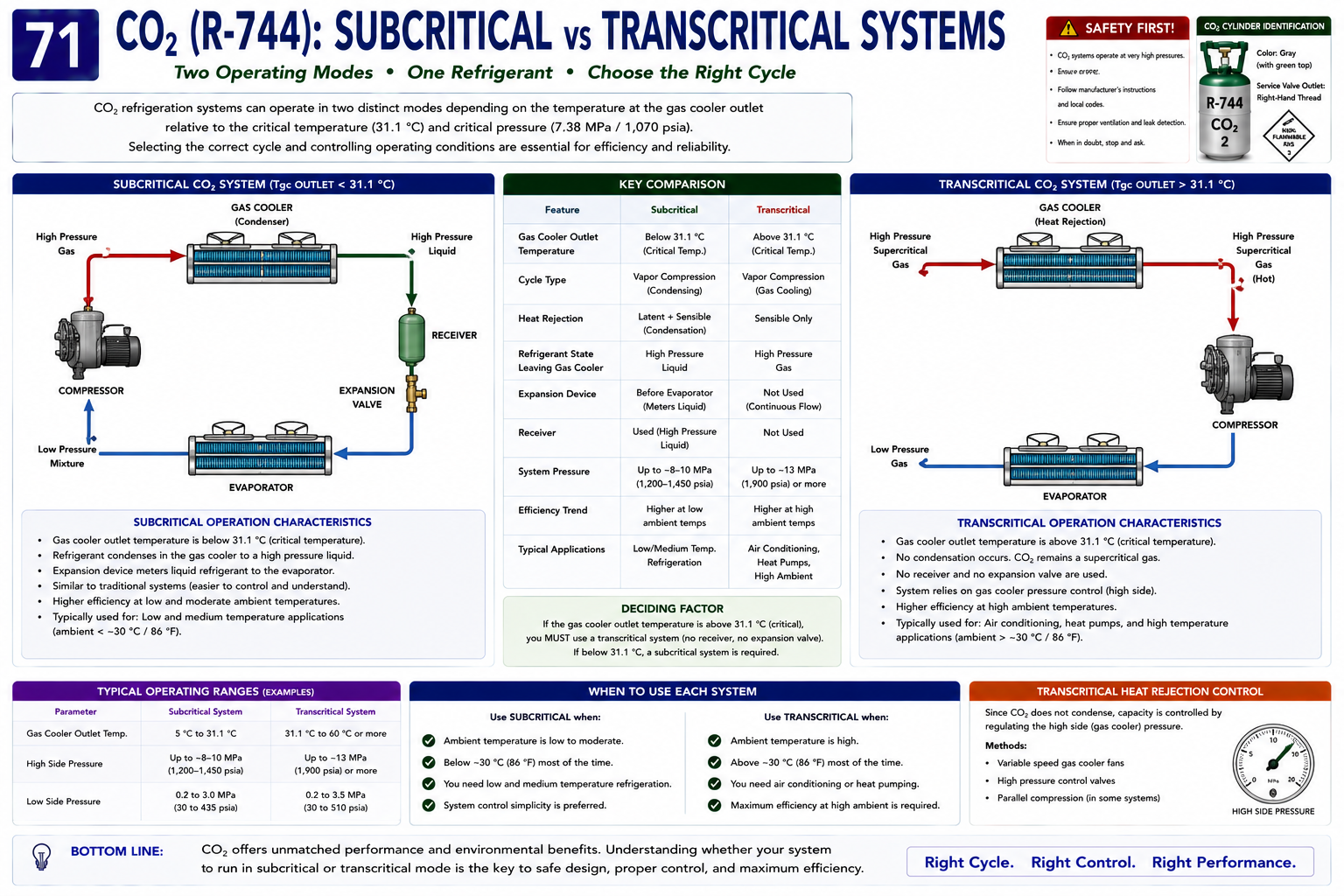
| Characteristic | Subcritical CO₂ | Transcritical CO₂ |
|---|---|---|
| High-Side Condition | Below critical point | Above critical point during transcritical operation |
| Heat-Rejection Component | Condenser | Gas cooler |
| High-Side Phase Change | Vapor condenses to liquid | No conventional condensation above critical point |
| Common Arrangement | Cascade or secondary systems | CO₂ booster and other direct systems |
| High-Side Pressure | High | Extremely high |
CO₂ Can Operate as the Low-Temperature Stage
One common subcritical arrangement uses CO₂ as the low-temperature refrigerant in a cascade system. The CO₂ rejects heat into another refrigeration circuit operating at a higher temperature.
The upper stage may use another refrigerant such as ammonia or another refrigerant appropriate for the application. Keeping the CO₂ high side below its critical point allows it to operate subcritically.
In a cascade system, the two refrigerants remain in separate circuits. A cascade heat exchanger acts as the condenser for one circuit and the evaporator for the other.
A Modern CO₂ Booster Arrangement
Transcritical CO₂ booster systems are increasingly common in supermarket refrigeration. A system can serve both medium-temperature refrigerated cases and low-temperature freezer loads while using CO₂ throughout the refrigeration system.
These systems contain several pressure levels and depend on electronic controls to manage gas-cooler pressure, receiver or flash-tank pressure, compressor capacity, expansion devices, and other operating conditions.
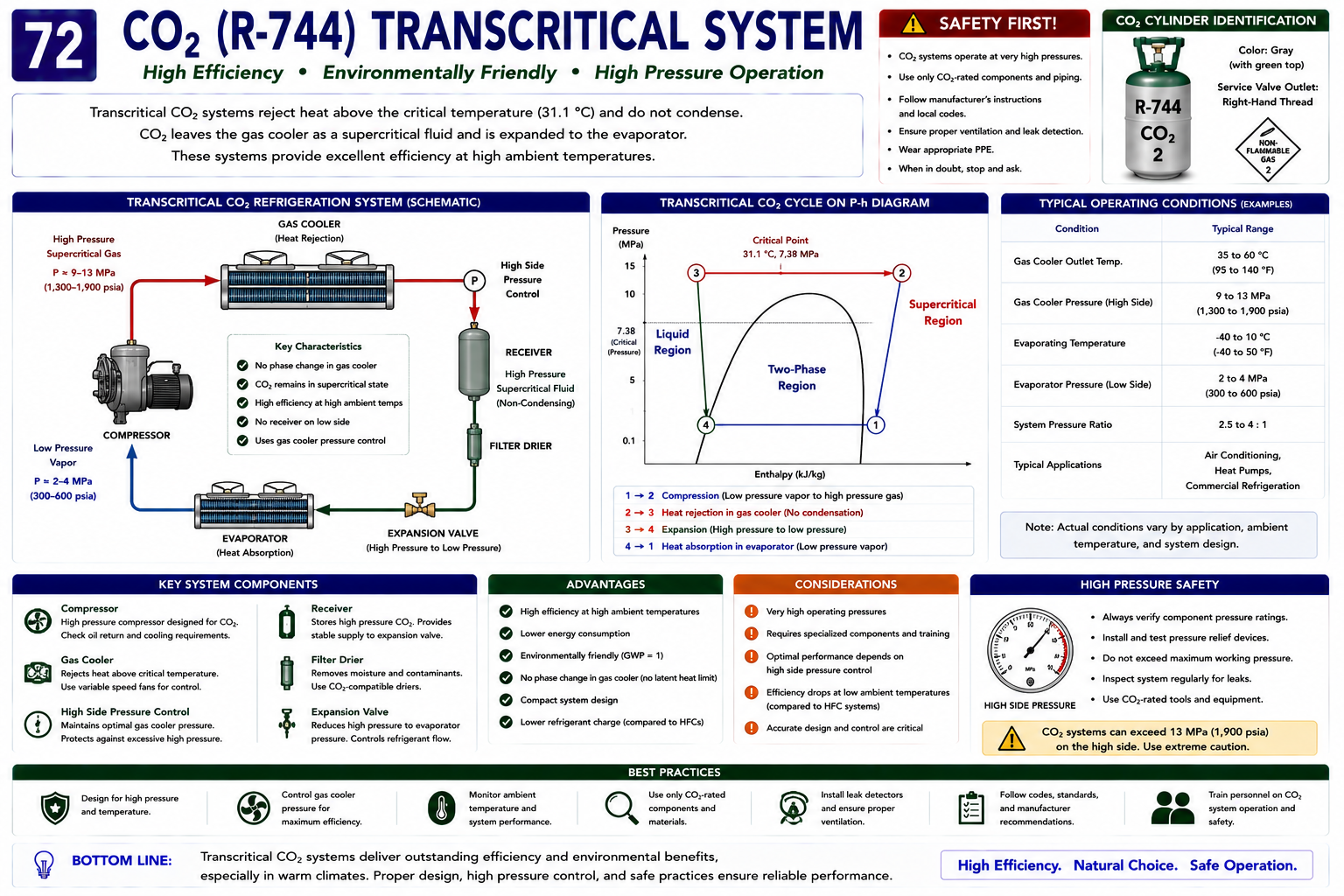
Do Not Automatically Call It a Condenser
During transcritical operation, the high-side heat exchanger reduces the temperature and enthalpy of the high-pressure CO₂ but does not cause conventional condensation. It is therefore called a gas cooler.
If system conditions fall below the critical point, some systems may operate subcritically and the same heat exchanger can function under condensing conditions.
Condenser describes a component in which vapor condenses. Gas cooler is the appropriate term when the R-744 high side operates above the critical point.
Pressure Becomes an Active Control Variable
In a conventional subcritical refrigeration system, condensing pressure is strongly related to saturation temperature. During transcritical CO₂ operation, there is no high-side saturation temperature above the critical point.
The system controller therefore actively regulates high-side pressure to obtain appropriate system capacity and efficiency under the current gas-cooler outlet and load conditions.
A technician should not evaluate a transcritical CO₂ high side using the same “condensing temperature” approach used with an ordinary R-410A or R-404A condenser.
CO₂ Pressure Is in a Different Category
R-744 operates at much higher pressure than most common refrigerants. Modern transcritical systems can operate at high-side pressures well above 1,000 psi, and equipment may be designed for substantially higher maximum pressures.
Actual design and operating pressures depend on the specific component and system. The technician must therefore know which pressure section is being serviced and the rated working pressure of every connected tool and component.
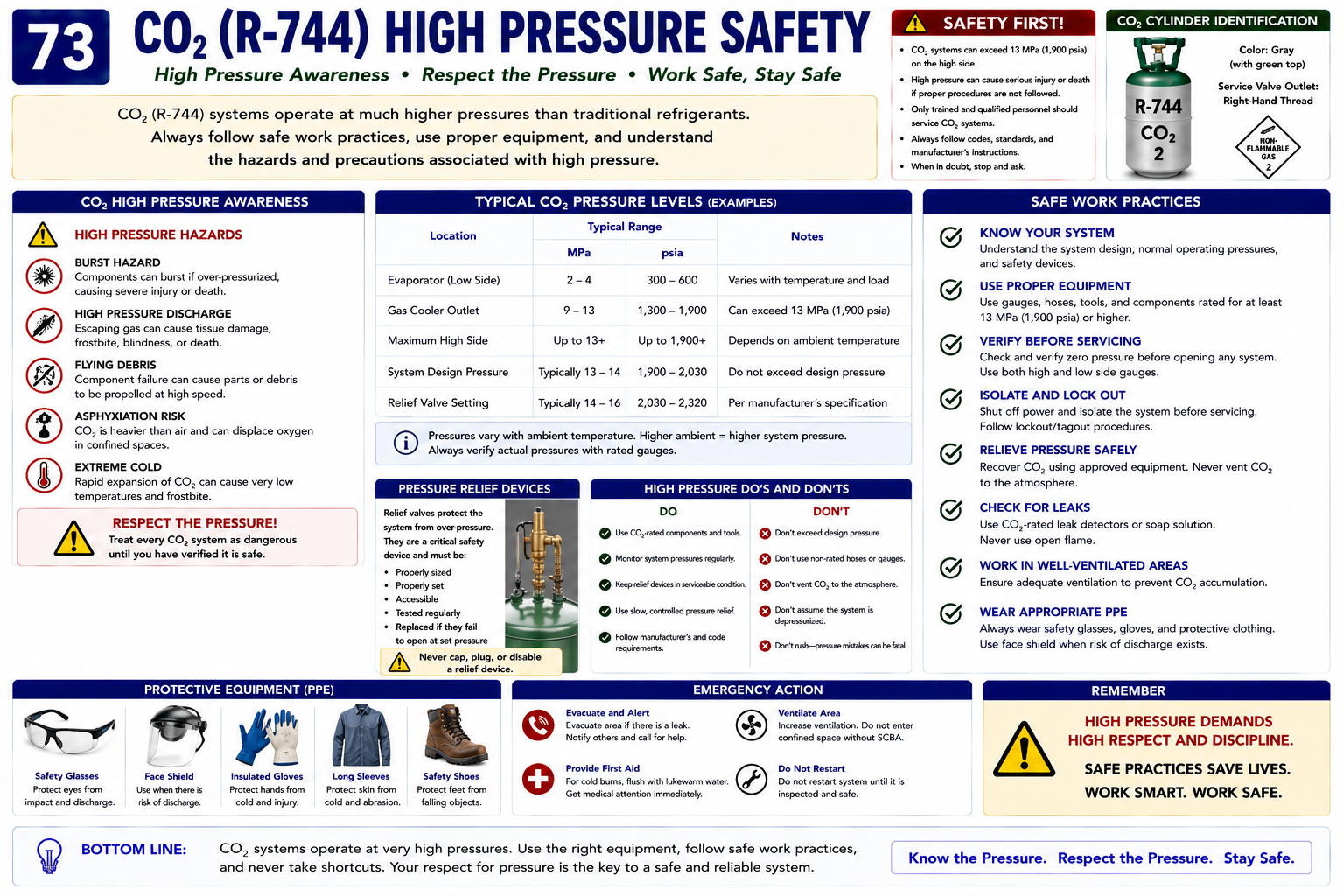
Never connect a gauge, hose, recovery device, valve, fitting, or other pressure-containing tool to a CO₂ system unless its pressure rating is appropriate for that portion of the system.
Know Where You Are Connected
A transcritical booster system can contain high-pressure, intermediate-pressure, medium-temperature suction, and low-temperature suction sections. These pressure zones can differ dramatically.
Valves and piping isolate the various sections during normal operation, but service procedures must account for the pressure that can develop in each section during operation and shutdown.
High Side
Gas cooler and high-pressure control portions of a transcritical system can operate at extremely high pressure.
Receiver / Flash Tank
Maintained at an intermediate pressure below the gas-cooler section.
Medium-Temperature Suction
Operates at pressure corresponding to medium-temperature evaporator conditions.
Low-Temperature Suction
Operates at a lower pressure corresponding to freezer evaporator conditions.
There is no useful single “normal R-744 pressure.” Pressure depends on the system section, refrigerant temperature, load, operating mode, ambient conditions, and control strategy.
The Pressure Can Rise After the System Stops
When a CO₂ refrigeration system stops operating, refrigerant remaining in isolated portions of the system absorbs heat from the surroundings. As refrigerant temperature rises, pressure can increase substantially.
System designers account for standstill pressure through component ratings, pressure-relief devices, receiver design, auxiliary cooling arrangements, or other engineered controls.
A stopped CO₂ system may still contain extremely high pressure, and pressure can continue increasing as trapped refrigerant warms.
Never Isolate Liquid Without Pressure Protection
Liquid refrigerant trapped between closed valves can experience a large pressure increase as its temperature rises. Because liquid is nearly incompressible, a relatively small temperature change can create dangerous hydraulic pressure.
CO₂ piping and components must be arranged with appropriate pressure-relief protection wherever liquid refrigerant can become trapped.
Never intentionally trap liquid CO₂ between isolation valves unless the section has the required engineered pressure-relief protection.
Relief Protection Is Part of the Refrigeration System
Pressure-relief valves protect pressure vessels and isolated portions of the refrigeration circuit from pressures above their design limits.
Relief devices must have the correct pressure setting, capacity, materials, installation, and discharge arrangement for the system design.
Never cap, isolate, plug, disable, or substitute a pressure-relief device outside the manufacturer’s and system-design requirements.
A1 Does Not Mean CO₂ Is Harmless
R-744 is classified A1, indicating lower toxicity under the refrigerant classification system and no flame propagation under the applicable test conditions.
However, carbon dioxide can create serious hazards at elevated concentrations. A large release can displace oxygen, and CO₂ itself can produce physiological effects as concentration increases.
Asphyxiation
A large release can reduce the available oxygen concentration in an enclosed space.
CO₂ Exposure
Elevated carbon dioxide concentration can itself cause adverse physiological effects.
High Pressure
Stored energy in high-pressure refrigerant creates substantial mechanical hazards.
Cold Injury
Rapidly expanding CO₂ and dry ice can cause severe cold burns or frostbite.
CO₂ Can Accumulate Without a Refrigerant Odor Warning
Carbon dioxide is colorless and does not provide the strong warning odor associated with ammonia. A significant release can therefore produce an unsafe atmosphere without an obvious refrigerant smell.
Facilities using larger CO₂ refrigeration systems may incorporate fixed carbon dioxide detection, alarms, and ventilation appropriate to the installation.
Do not use lack of odor as evidence that an area is safe. Where atmospheric concentration is a concern, use appropriate detection and monitoring equipment.
Consider Where Released CO₂ Can Collect
Carbon dioxide vapor is denser than air under ordinary conditions and can accumulate in pits, low areas, machinery spaces, coolers, equipment enclosures, and other poorly ventilated locations.
Before entering an enclosed area where a substantial CO₂ release may have occurred, follow the applicable facility atmospheric-monitoring and confined-space procedures.
A suspected large refrigerant release should be evaluated using appropriate safety procedures and instruments rather than by entering the area simply to determine whether refrigerant is present.
Purpose-Rated Tools Are Essential
Ordinary HVAC gauges and hoses cannot automatically be assumed suitable for R-744. Many CO₂ systems operate above the pressure ratings of tools intended for traditional HFC and HCFC refrigerants.
Manifold and Gauges
Must be appropriately rated for the pressure section being serviced.
Hoses
Working and burst-pressure ratings must be appropriate for R-744 service.
Valves and Fittings
Use components designed for CO₂ pressure and temperature conditions.
Recovery / Transfer Equipment
Use equipment and procedures specifically suitable for R-744.
Pressure Instruments
Verify range, accuracy, and maximum allowable pressure before connection.
Electronic Service Tools
Select R-744-specific refrigerant data and appropriate pressure sensors.
Pressure Must Be Reduced Deliberately
CO₂ systems require controlled procedures when refrigerant pressure must be reduced for service. Rapid decompression can produce extreme temperature reduction and dry-ice formation.
The correct procedure depends on the equipment design, refrigerant state, service location, and manufacturer’s instructions.
Do not rapidly dump system pressure simply because CO₂ is environmentally benign. Pressure, temperature, dry-ice formation, atmospheric concentration, and personnel safety must all be controlled.
Follow the Manufacturer’s Procedure Exactly
Charging a CO₂ system involves considerations beyond simply weighing refrigerant into an evacuated circuit. System pressure and temperature must be controlled so that refrigerant remains in an appropriate phase and components are not subjected to unsuitable conditions.
Different systems may specify vapor charging during part of the procedure followed by controlled introduction of additional refrigerant as operating conditions are established.
Use the charging procedure specified for the actual R-744 equipment. Do not adapt an R-410A or R-404A charging routine to CO₂.
R-744 Is Single Component — But the Critical Point Changes Interpretation
Below its critical point, R-744 behaves as a single-component refrigerant with a definite saturation pressure-temperature relationship.
Above the critical point there is no liquid-vapor saturation line. Therefore, a high-side pressure measurement in transcritical operation cannot simply be converted into a conventional condensing saturation temperature.
Below critical: normal saturation relationships apply. Above critical: there is no conventional condensing temperature.
Use Familiar Concepts Only Where They Physically Apply
Evaporator superheat remains a meaningful concept because the refrigerant evaporates below the critical point in normal refrigeration applications.
Conventional liquid subcooling can also be evaluated in portions of a subcritical system where liquid exists. However, conventional condenser subcooling does not describe the outlet of a transcritical gas cooler because the high-side refrigerant has not condensed into liquid there.
Understanding phase state is more important than memorizing diagnostic formulas. First determine what physical state the refrigerant can actually occupy at the measured pressure and temperature.
Lubricant Is Equipment-Specific
CO₂ compressors may use POE, PAG, PVE, or other lubricants depending on compressor construction and manufacturer requirements.
Do not assume that all R-744 systems use the same oil. Pressure, temperature, miscibility, viscosity, oil return, and compressor design all affect lubricant selection.
Refrigerants and Lubricants
For a review of lubricant selection, oil circulation, compatibility, migration, moisture contamination, and compressor protection, return to Refrigerants and Lubricants.
Pressure Rating Drives Component Selection
CO₂ systems may use steel, stainless steel, copper alloys specifically rated for CO₂ service, or other materials depending on the system design and pressure level.
The familiar appearance of a tube or fitting does not establish that it is safe for R-744. Material, wall thickness, connection method, temperature rating, and pressure rating all matter.
Never substitute an ordinary refrigeration component into a CO₂ system based solely on physical size or connection diameter.
R-744 Is Accepted in Many Refrigeration Applications
EPA SNAP lists R-744 as acceptable in numerous refrigeration end uses, including typical supermarket systems, cold-storage warehouses, industrial process refrigeration, stand-alone equipment, refrigerated food processing and dispensing equipment, and very-low-temperature refrigeration.
R-744 is listed with an A1 safety classification, zero ozone depletion potential, and GWP of 1.
Excellent environmental characteristics do not eliminate engineering and workplace hazards. R-744’s acceptability as a refrigerant does not change the need for pressure-rated equipment, relief protection, ventilation, detection, and safe service procedures.
The Refrigeration Cycle Is Familiar — The Engineering Is Not
A technician who understands compressors, evaporators, metering devices, heat exchangers, superheat, pressure-temperature relationships, electrical controls, and refrigeration theory already has a valuable foundation for R-744 service.
However, CO₂ equipment adds knowledge that is not normally required when servicing conventional residential HVAC systems.
Very High Pressure
Tools, components, procedures, and personal safety must account for substantially higher pressures.
Critical-Point Operation
Technicians must understand the difference between condensing and transcritical heat rejection.
Triple-Point Behavior
Improper pressure reduction can create dry ice and extremely low temperatures.
Advanced Controls
High-pressure valves, flash tanks, gas bypass, multiple compressor stages, and electronic controls are common.
Pressure Relief
Relief protection and standstill-pressure management are central system-design requirements.
Atmospheric Safety
Large releases require ventilation, detection, and awareness of confined and low-lying spaces.
Avoid These R-744 Errors
“CO₂ operates at ordinary refrigeration pressures.”
No. R-744 operates at substantially higher pressures than most familiar HVAC/R refrigerants.
“A transcritical system has a condenser.”
Not while the high side is above the critical point. Heat is rejected through a gas cooler without conventional condensation.
“Increasing pressure will always condense CO₂.”
No. Above the critical temperature, there is no distinct liquid-vapor phase boundary.
“CO₂ cannot become solid inside refrigeration equipment.”
No. Improper or rapid pressure reduction can cause dry ice to form.
“A1 means CO₂ is harmless.”
No. High pressure, cold injury, oxygen displacement, and elevated CO₂ concentration remain serious hazards.
“The system is safe when the compressor is off.”
No. Standstill pressure can rise as refrigerant absorbs heat from the surroundings.
“Liquid can safely be trapped between two valves.”
No. Warming trapped liquid can create dangerously high hydraulic pressure.
“Ordinary R-410A service tools are good enough.”
No. Every pressure-containing service tool must be appropriately rated for the R-744 pressure section being serviced.
What to Remember About R-744
R-744 combines refrigerant classification, pressure-temperature relationships, environmental impact, equipment design, pressure safety, phase behavior, and modern refrigeration-system control.
Remember that R-744 is carbon dioxide, CO2. It is a single-component A1 refrigerant with zero ODP and GWP 1. It operates at very high pressures, has a critical temperature near 31°C (88°F), and can form dry ice during improper pressure reduction. Below the critical point, CO₂ can operate subcritically and condense. Above the critical point, transcritical systems reject heat through a gas cooler without conventional condensation.
R-744 Carbon Dioxide Refrigerant
- What chemical does the refrigerant designation R-744 identify?
- Is R-744 a single-component refrigerant or a blend?
- What is the ASHRAE safety classification of R-744?
- What is the ozone depletion potential of R-744?
- What is the GWP of carbon dioxide?
- Approximately what is the critical temperature of CO₂?
- What happens to the distinction between liquid and vapor above the critical point?
- Approximately what is the CO₂ triple-point temperature?
- Why can dry ice form during rapid R-744 pressure reduction?
- What does subcritical operation mean?
- What does transcritical operation mean?
- What is the high-side heat exchanger called during transcritical operation?
- Why is it incorrect to calculate a conventional condensing temperature above the CO₂ critical point?
- Why must service gauges and hoses be specifically pressure-rated for R-744?
- What is standstill pressure?
- Why can liquid trapped between two closed valves create a dangerous condition?
- What purpose do pressure-relief devices serve?
- Why can an R-744 release create an atmospheric hazard even though the refrigerant is classified A1?
- Why should a technician not rely on odor to detect a CO₂ release?
- Why does R-744 require specialized technician training despite using the familiar vapor-compression refrigeration cycle?
What You Should Have Learned
R-744 Is Carbon Dioxide
It is a naturally occurring, single-component refrigerant with the chemical formula CO2.
R-744 Is A1
It has no flame propagation under its refrigerant safety classification, but pressure and atmospheric hazards remain important.
Environmental Characteristics Are Excellent
R-744 has zero ODP and a GWP of 1.
The Critical Point Matters
Above approximately 31°C, CO₂ cannot undergo conventional vapor-to-liquid condensation.
The Triple Point Matters
Improper pressure reduction can produce dry ice and extremely low refrigerant temperatures.
Subcritical and Transcritical Are Different
Subcritical systems can use conventional condensation; transcritical systems reject high-side heat through a gas cooler.
Pressure Is a Major Hazard
Every component and service tool must be suitable for the R-744 pressure and temperature conditions involved.
CO₂ Service Is Specialized
Pressure relief, standstill pressure, trapped liquid, dry-ice formation, gas-cooler control, multiple pressure levels, and atmospheric safety require specialized knowledge.