R-717 Ammonia Refrigerant
Ammonia is one of the oldest refrigerants still in widespread use, and it remains extremely important in industrial refrigeration. Designated R-717, ammonia provides excellent thermodynamic performance, zero ozone depletion potential, and extremely low direct climate impact.
Ammonia also introduces hazards that are very different from most refrigerants covered so far. Its current ASHRAE safety classification is B2L, reflecting higher toxicity and lower flammability. Ammonia systems therefore require specialized equipment, materials, ventilation, detection, operating procedures, emergency planning, and technician training.
What You Will Learn
After completing this lesson, you should be able to:
Identify R-717
Recognize R-717 as anhydrous ammonia, an inorganic single-component refrigerant widely used in industrial refrigeration.
Explain the B2L Classification
Recognize ammonia as a higher-toxicity refrigerant with lower-flammability characteristics.
Recognize Ammonia Hazards
Identify inhalation, chemical-burn, pressure, cold-temperature, flammability, and confined-space hazards.
Understand Material Compatibility
Explain why copper, brass, galvanized materials, and other ammonia-sensitive materials are generally unsuitable for ammonia refrigeration systems.
Recognize Industrial Applications
Identify cold storage, food processing, beverage production, ice plants, and other large industrial refrigeration applications.
Recognize Specialized Safety Requirements
Understand the importance of ventilation, detection, emergency response, exposure limits, process safety, and specialized training.
Ammonia as a Refrigerant
R-717 is the refrigerant designation for ammonia, NH3. Unlike CFCs, HCFCs, HFCs, HFOs, and hydrocarbons, ammonia is an inorganic refrigerant.
Refrigeration systems use high-purity anhydrous ammonia. The term anhydrous means without water. Refrigerant-grade ammonia should not be confused with household ammonia, which is a diluted ammonia-water solution.
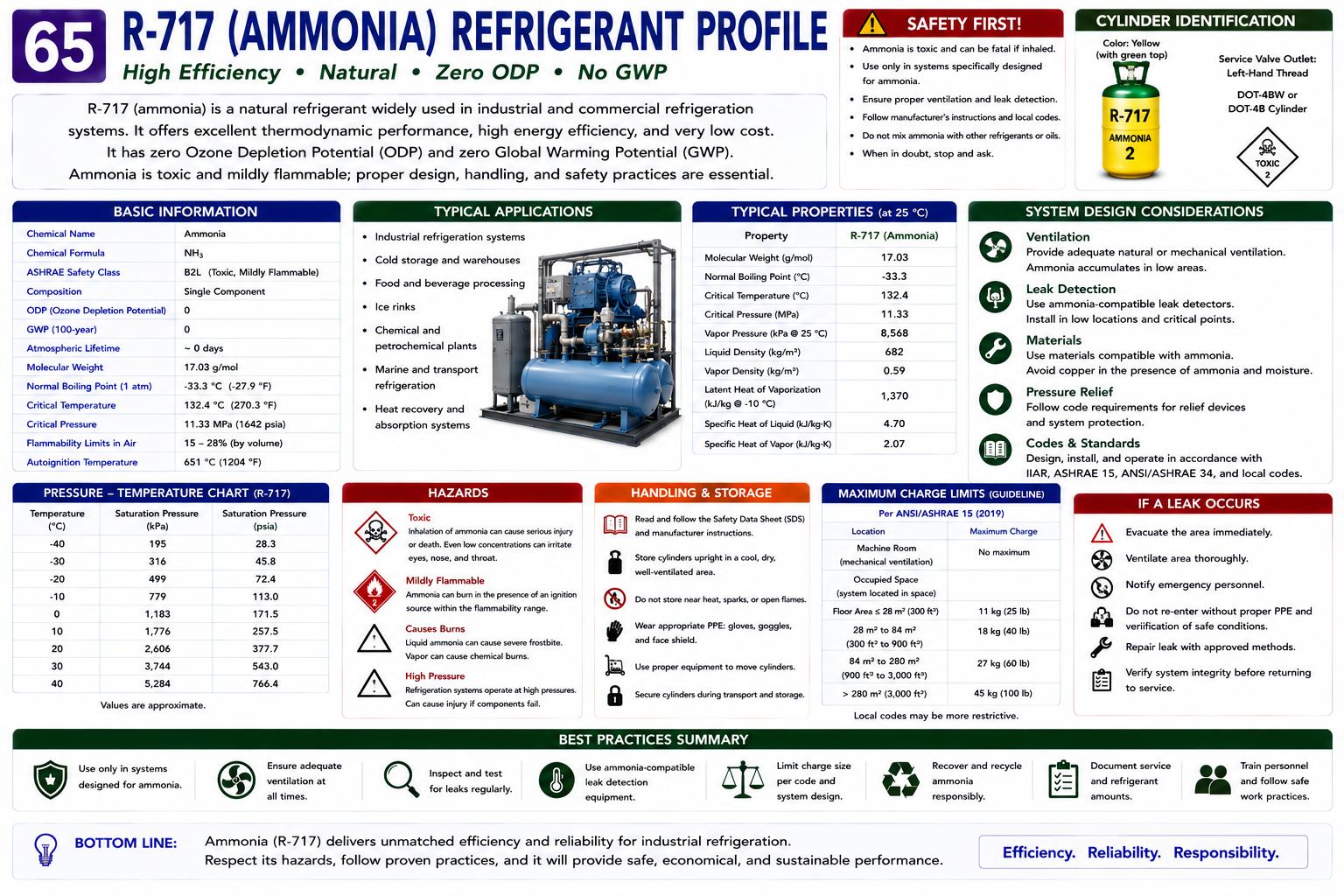
Designation
R-717
Chemical Formula
NH3
Refrigerant Type
Inorganic, single-component refrigerant.
Current ASHRAE Safety Class
B2L
Ozone Depletion Potential
0
Primary Application
Large commercial and industrial refrigeration.
Ammonia Is Different From the Refrigerants Covered So Far
Most refrigerants discussed earlier in this course have been in the A toxicity group. Ammonia is classified in the B toxicity group.
The current ASHRAE designation for R-717 is B2L. The B identifies the higher-toxicity group, while 2L identifies lower flammability with limited burning velocity.
B — Higher Toxicity
Exposure to ammonia vapor can injure the eyes, respiratory tract, skin, and other tissues. High concentrations can rapidly become life-threatening.
2L — Lower Flammability
Ammonia can burn under appropriate conditions, but its flammability characteristics are substantially different from A3 hydrocarbons such as propane.
Older EPA documents, refrigerant charts, and training materials may identify ammonia as B2. Current ASHRAE classification uses B2L because ammonia meets the burning-velocity criteria for the 2L subclass.
Excellent Refrigeration Performance
Ammonia has remained an important refrigerant for more than a century because it has excellent thermodynamic properties. It can absorb a large amount of heat for each pound of refrigerant circulated and can provide very efficient refrigeration when used in properly designed systems.
These characteristics make ammonia particularly attractive where large refrigeration capacities are required.
A relatively small mass flow of ammonia can provide a large refrigeration effect. That characteristic is especially valuable in large industrial refrigeration systems.
Where Ammonia Refrigeration Is Used
Ammonia is especially common in industrial facilities requiring large quantities of continuous refrigeration.
Cold Storage Warehouses
Large refrigerated and frozen-food storage facilities commonly use ammonia refrigeration.
Food Processing
Meat, poultry, seafood, dairy, produce, and other food-processing facilities frequently use ammonia systems.
Beverage Production
Breweries, wineries, soft-drink plants, and other beverage facilities may use industrial ammonia refrigeration.
Freezing Operations
Blast freezers, spiral freezers, plate freezers, and other large low-temperature systems.
Ice Production
Large industrial ice-making facilities can use ammonia as the primary refrigerant.
Industrial Processes
Ammonia is used where manufacturing or process equipment requires substantial refrigeration capacity.
The Same Basic Refrigeration Theory Still Applies
An ammonia vapor-compression system still uses the same fundamental refrigeration cycle studied earlier: compression, heat rejection, expansion, and heat absorption.
The major difference is not the basic thermodynamics. It is the equipment, piping, materials, controls, oil management, safety systems, and operating practices required for ammonia.
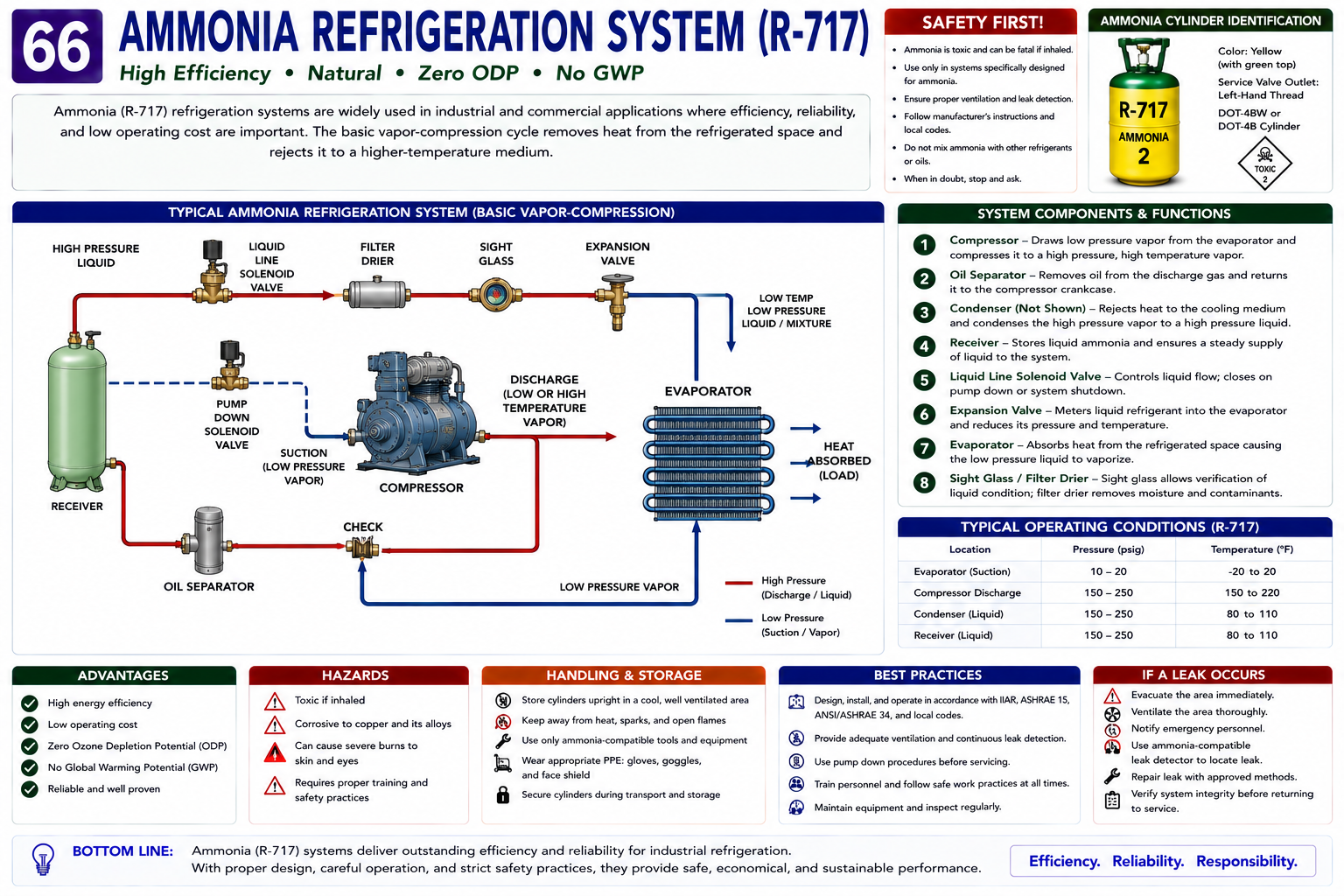
The Refrigeration Cycle
The compressor, condenser, metering device, evaporator, pressure relationships, and phase changes are based on the same theory developed earlier in the refrigeration course. For additional review, revisit Introduction to the Pressure-Enthalpy Diagram.
Refrigerant Grade Means Very High Purity
Industrial refrigeration systems use anhydrous ammonia, meaning ammonia containing very little water. Maintaining refrigerant purity is important to system reliability and performance.
Water, air, oil, and other contaminants can alter system operation and contribute to corrosion, freezing, efficiency loss, or equipment damage.
Household cleaning ammonia is an ammonia-water solution. It is not refrigerant-grade R-717 and must never be introduced into an ammonia refrigeration system.
A Strong Warning Property — But Not a Measuring Instrument
Ammonia has a powerful, irritating odor. This can provide an early warning of a release, often before concentrations reach immediately dangerous levels.
However, smell must never be used to determine whether a work area is safe or to estimate ammonia concentration. Proper detection and atmospheric monitoring equipment must be used when exposure conditions matter.
Odor may alert you that ammonia is present. It cannot tell you whether the concentration is safe.
Ammonia Is Corrosive to Living Tissue
Ammonia readily dissolves in moisture. Contact with the moisture in the eyes, respiratory tract, and skin can produce a strongly alkaline solution that damages tissue.
Exposure can cause eye irritation, respiratory irritation, coughing, chemical burns, breathing difficulty, lung injury, and at sufficiently high concentrations, death.
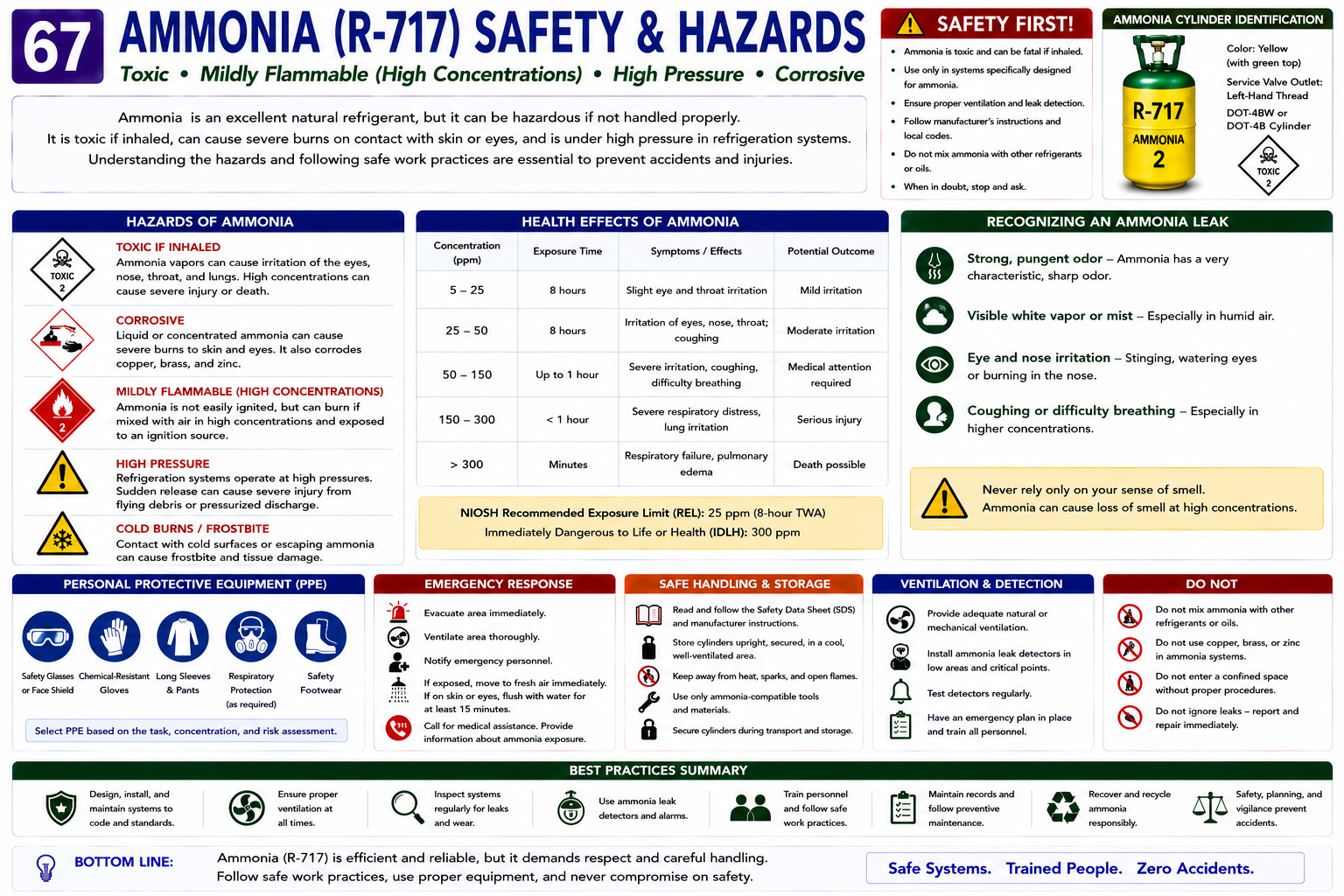
Unlike many familiar A1 refrigerants, ammonia exposure can produce serious toxic and corrosive effects at concentrations far below its flammable range.
Know What the Numbers Mean
Several different exposure values are commonly encountered in ammonia safety information. These numbers serve different purposes and should not be treated as interchangeable.
| Reference | Ammonia Concentration | Meaning |
|---|---|---|
| OSHA PEL | 50 ppm | 8-hour permissible exposure limit. |
| NIOSH REL | 25 ppm | Recommended time-weighted exposure limit. |
| NIOSH STEL | 35 ppm | Recommended 15-minute short-term exposure limit. |
| NIOSH IDLH | 300 ppm | Immediately Dangerous to Life or Health concentration. |
50 ppm is not an emergency threshold and 300 ppm is not an acceptable working concentration. The OSHA PEL addresses occupational exposure over the work period; the NIOSH IDLH value identifies an atmosphere posing an immediate serious hazard.
Current exposure values can be verified in the NIOSH Pocket Guide — Ammonia and applicable OSHA requirements.
300 ppm Requires an Emergency-Response Mindset
NIOSH identifies 300 ppm ammonia as immediately dangerous to life or health. An IDLH atmosphere is not an environment for routine HVAC service using ordinary work practices or ordinary respiratory protection.
Entry into an actual or potentially IDLH atmosphere requires an employer’s properly developed emergency-response or respiratory-protection program, suitable respiratory protection, trained personnel, backup capability, and other required safeguards.
A strong ammonia release can change a normal service call into a hazardous-material emergency. Technicians should understand the limits of their training and equipment and follow the facility emergency plan.
Mechanical Ventilation Is a Major Safety Control
Ammonia machinery rooms and industrial refrigeration installations are designed with ventilation provisions intended to prevent dangerous concentrations from accumulating and to assist with emergency release control.
Normal ventilation, emergency ventilation, ammonia detection, alarm systems, equipment layout, and discharge arrangements are governed by the applicable codes, standards, facility design, and equipment requirements.
Required ventilation rates depend on the installation and applicable code or standard. Technicians should not substitute a remembered generic airflow value for the engineered requirements of an ammonia machinery room.
Ammonia Can Turn an Enclosed Area Into a Serious Hazard
Pits, vessels, enclosed equipment spaces, machinery rooms, and other restricted areas require careful evaluation. A release can create a toxic atmosphere, and other atmospheric hazards may also be present.
If an area meets the definition of a permit-required confined space, OSHA confined-space procedures apply. Atmospheres must be evaluated with appropriate instruments rather than by odor.
Do not enter a suspected hazardous atmosphere merely to locate or stop an ammonia leak. Follow the facility’s confined-space and emergency-response procedures.
Ammonia Can Burn — But Toxicity Usually Becomes Critical First
Ammonia has a relatively narrow flammable range and requires a comparatively high concentration in air before combustion can occur. It is therefore less readily ignited than A3 hydrocarbon refrigerants.
Nevertheless, ammonia is classified B2L and its flammability must be considered, particularly during major releases, hot work, or conditions in confined spaces.
Ammonia can reach dangerous toxic concentrations long before it reaches concentrations associated with combustion. Do not allow discussion of flammability to overshadow the toxicity hazard.
Ammonia Systems Do Not Use the Same Materials as Typical Residential HVAC
One of the most important differences between ammonia refrigeration and ordinary residential HVAC is material compatibility. Ammonia attacks several materials routinely encountered in conventional refrigeration equipment.
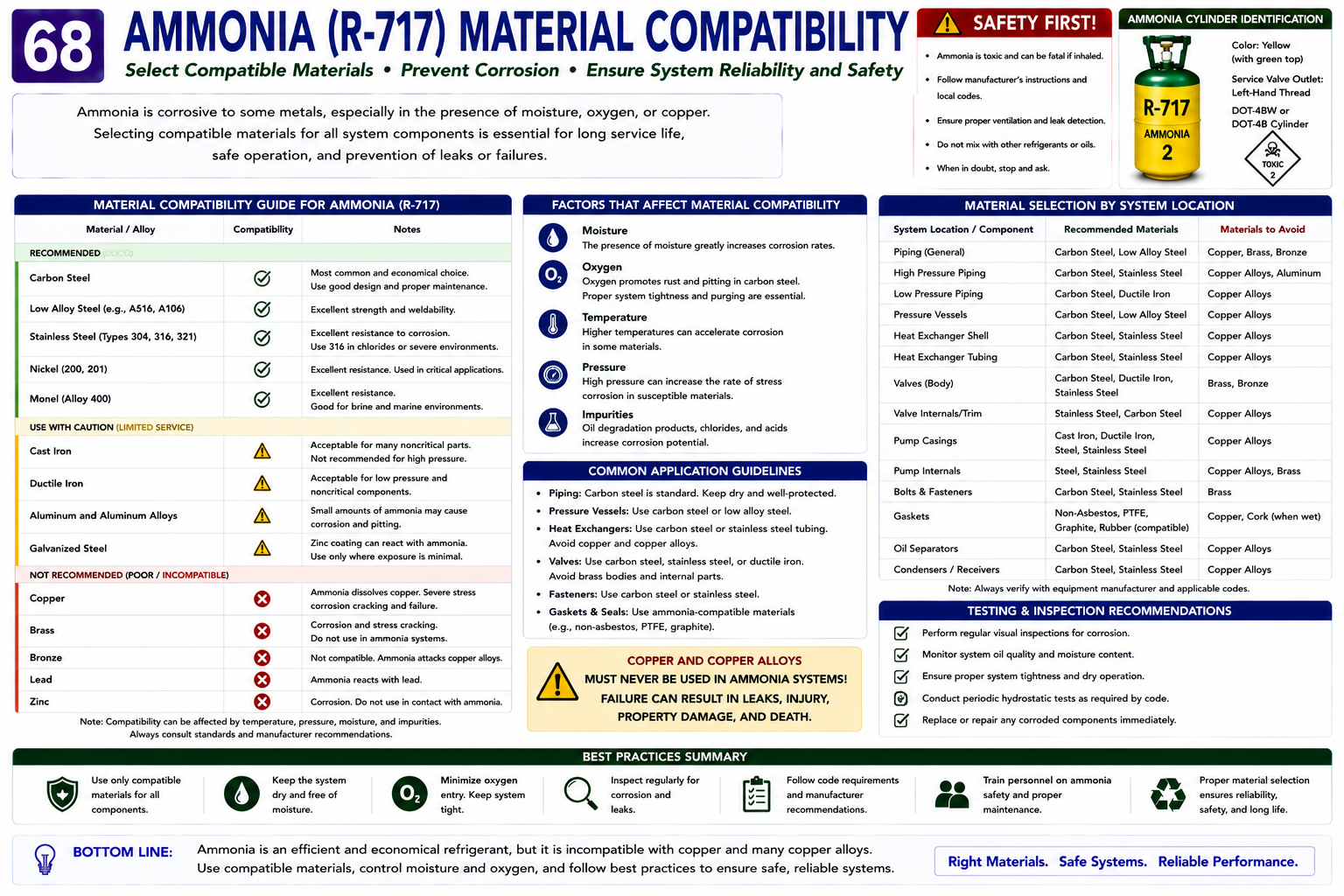
Copper
Generally unsuitable for anhydrous ammonia refrigeration service.
Brass and Copper Alloys
Generally unsuitable because ammonia can attack copper-containing alloys.
Galvanized Materials
Zinc-containing galvanized surfaces can be attacked by ammonia.
Steel
Steel is widely used for ammonia refrigeration piping and components when properly selected and protected.
Do not install ordinary copper refrigeration tubing, brass fittings, or copper-containing components in an ammonia system unless the component is specifically designed and approved for ammonia service.
This Changes Compressor and Motor Design
Conventional hermetic compressors commonly contain electric motors with copper windings exposed to the refrigerant environment. That construction is not suitable for ordinary ammonia service.
Industrial ammonia installations therefore use compressor and motor arrangements specifically designed for ammonia, including equipment that isolates incompatible electrical materials from the refrigerant.
An ammonia system is not a conventional HFC refrigeration system charged with ammonia. The materials and components are designed specifically for NH3.
Ammonia and Lubricating Oil Behave Differently
Oil management is important in industrial ammonia refrigeration. Depending on the lubricant and equipment design, oil and ammonia can separate significantly, allowing oil to accumulate in portions of the refrigeration system.
Oil separators, oil pots, drains, return systems, and operating procedures may be used to control oil movement and maintain heat-transfer efficiency.
Draining oil from an ammonia system can expose the technician to liquid ammonia and ammonia vapor. Oil-draining procedures must follow the system design, facility procedures, and applicable safety requirements.
R-717 Has Its Own P-T Characteristics
Ammonia is a single-component refrigerant and therefore has one saturation temperature at a given saturation pressure. It does not have blend temperature glide or fractionation.
Technicians must use R-717-specific pressure-temperature information when evaluating saturation conditions.
The concepts of saturation, superheat, subcooling, compression, condensation, expansion, and evaporation still apply. The actual R-717 pressure-temperature values are refrigerant-specific.
Detection Systems Are an Important Part of Facility Safety
Industrial ammonia facilities commonly use fixed ammonia detection and alarm systems in areas where a release could occur. Portable instruments can also be used for appropriate service and atmospheric evaluation.
The technician should understand alarm response procedures and must never disable or bypass required ammonia detection equipment merely to keep refrigeration equipment operating.
An ammonia alarm is a safety-system response, not a nuisance control to be defeated. Follow the facility emergency procedure.
PPE Depends on the Task and Exposure Hazard
Routine industrial ammonia work may require eye protection, gloves, protective clothing, footwear, and other equipment appropriate to the job. Tasks with a greater possibility of ammonia exposure require additional protection.
Respiratory protection requires much more than simply obtaining a respirator. OSHA respiratory-protection requirements address respirator selection, medical evaluation, fit testing, training, maintenance, and appropriate procedures.
Do not enter an ammonia release simply because a respirator is available. Respiratory protection must be selected and used as part of an appropriate employer program for the actual atmospheric hazard.
Know Whether You Are a Technician or an Emergency Responder
A small service problem and a major ammonia release require very different responses. Facilities using industrial ammonia normally have emergency procedures defining alarms, evacuation, notification, shutdown, response roles, and emergency contacts.
Technicians should understand their assigned role before an incident occurs. Personnel who are not trained, equipped, and authorized for emergency response should evacuate according to the facility plan rather than attempting an uncontrolled intervention.
The correct response to a major ammonia release may be evacuation and notification—not repair.
Ammonia Is Extremely Soluble in Water
Ammonia has a very strong attraction to water. This is why exposure is especially damaging to moist tissues such as the eyes and respiratory tract.
The same property is used intentionally in ammonia-water absorption refrigeration systems. However, water introduced unintentionally into a vapor-compression ammonia system is contamination and can adversely affect system operation.
Ammonia vapor-compression refrigeration and ammonia-water absorption refrigeration are different system types.
Large Ammonia Systems Carry Additional Regulatory Responsibilities
OSHA’s Process Safety Management standard applies to covered processes containing 10,000 pounds or more of anhydrous ammonia.
PSM goes far beyond ordinary HVAC service practices. Covered facilities must address process safety information, process hazard analysis, operating procedures, training, mechanical integrity, management of change, emergency planning, incident investigation, and other elements.
10,000 pounds is a regulatory PSM threshold—not a line separating a safe ammonia system from an unsafe one. Smaller ammonia systems still require appropriate hazard controls and can present serious release hazards.
OSHA provides an extensive Ammonia Refrigeration eTool covering industrial ammonia hazards, receiving and storage, emergency response, and related safety topics.
Zero ODP and Extremely Low Direct Climate Impact
Ammonia contains no chlorine or bromine and therefore has an ozone depletion potential of zero. It also has negligible direct greenhouse impact compared with high-GWP fluorinated refrigerants.
EPA SNAP tables historically list ammonia with a GWP of zero, while EPA’s current Technology Transitions reference table assigns R-717 a value of 1. Either convention illustrates the same practical point: ammonia’s direct climate impact is extremely small compared with refrigerants such as R-404A or R-410A.
Ozone Depletion Potential
0
Direct Climate Impact
Extremely low compared with conventional HFC refrigerants.
Ammonia demonstrates an important theme of this course: a refrigerant can have excellent environmental characteristics while requiring substantial toxicity and safety controls.
Ammonia Has Long Been an Accepted Industrial Refrigerant
EPA SNAP lists ammonia vapor-compression refrigeration as acceptable in industrial process refrigeration. Ammonia is also used in cold-storage and other industrial applications throughout the United States.
The refrigerant’s established use does not remove occupational-safety, process-safety, mechanical-code, equipment-design, or facility requirements.
EPA refrigerant acceptability and OSHA workplace safety are different regulatory questions. A refrigerant can be environmentally acceptable for an application while still requiring extensive controls to protect workers.
Ammonia Refrigeration Is a Specialty
A technician’s understanding of refrigeration theory transfers directly to ammonia refrigeration, but industrial ammonia service involves additional knowledge well beyond ordinary residential HVAC work.
Industrial Piping
Steel piping, welded systems, valves, vessels, and industrial refrigeration components.
System Controls
Industrial control valves, level controls, pressure controls, sequencing, and automated safety systems.
Ammonia Safety
Toxic exposure, respiratory protection, chemical burns, leak response, and emergency procedures.
Regulatory Programs
OSHA requirements, applicable environmental rules, facility procedures, and industry standards.
Mechanical Integrity
Piping, vessels, compressors, relief systems, valves, corrosion, inspection, and maintenance.
Emergency Planning
Detection, alarms, evacuation, isolation, emergency shutdown, and coordinated response.
Excellent Refrigerant Does Not Mean Universal Refrigerant
Ammonia’s thermodynamic and environmental advantages do not make it a practical replacement for R-410A, R-32, R-454B, or other refrigerants in conventional residential split systems.
Residential HVAC equipment commonly relies heavily on copper tubing, copper motor windings, small occupied spaces, and equipment arrangements that are fundamentally different from industrial ammonia refrigeration.
The best refrigerant for one application may be completely unsuitable for another.
What to Remember About R-717
Ammonia brings together refrigerant classification, industrial refrigeration, toxicity, material compatibility, pressure-temperature relationships, environmental impact, workplace safety, and specialized equipment design.
Remember that R-717 is ammonia, NH3. It is an inorganic, single-component refrigerant with zero ODP and extremely low direct climate impact. Current ASHRAE classification is B2L. Toxicity is a major hazard. Ammonia attacks copper and many copper-containing materials, so ammonia systems use materials specifically selected for NH3 service.
Avoid These Ammonia Refrigerant Errors
“Ammonia is too old to be important.”
No. R-717 remains one of the most important refrigerants in large industrial refrigeration.
“Ammonia is environmentally harmful because it is toxic.”
Toxicity and environmental climate impact are different characteristics. Ammonia has zero ODP and extremely low direct GWP.
“Ammonia is nonflammable.”
No. Current ASHRAE classification is B2L. Ammonia can burn under appropriate conditions.
“If I cannot smell ammonia, the area is safe.”
No. Atmospheric safety must be determined using appropriate instruments and procedures, not smell alone.
“If I can smell ammonia, the concentration must be IDLH.”
No. Odor does not provide a quantitative concentration measurement.
“Copper refrigeration tubing can be used because it handles the pressure.”
No. Pressure rating alone is insufficient. Copper and copper-containing materials are generally incompatible with ammonia.
“50 ppm is the emergency evacuation concentration.”
No. OSHA’s 50 ppm value is an 8-hour permissible exposure limit. Emergency-response thresholds serve different purposes.
“Only systems above 10,000 pounds are dangerous.”
No. The 10,000-pound quantity is an OSHA PSM applicability threshold, not a definition of whether ammonia presents a hazard.
R-717 Ammonia Refrigerant
- What chemical does the refrigerant designation R-717 identify?
- What does anhydrous mean?
- Is ammonia an organic or inorganic refrigerant?
- Is R-717 a single-component refrigerant or a blend?
- What is the current ASHRAE safety classification of R-717?
- What does the B in B2L indicate?
- What does the 2L portion indicate?
- What is the ozone depletion potential of ammonia?
- Why is ammonia attractive for large industrial refrigeration systems?
- Name three industries in which ammonia refrigeration is commonly used.
- Why should smell never be used to determine ammonia concentration?
- What is OSHA’s 8-hour permissible exposure limit for ammonia?
- What is the NIOSH recommended 15-minute STEL?
- What ammonia concentration does NIOSH identify as IDLH?
- Why are copper and brass generally unsuitable for ammonia refrigeration?
- Why do ammonia refrigeration systems use different compressor and piping construction from conventional residential systems?
- Why is ventilation important in an ammonia machinery room?
- What does OSHA’s 10,000-pound ammonia threshold relate to?
- Does being below the 10,000-pound threshold mean that an ammonia system is harmless?
- Why should a technician understand the facility emergency plan before working around a large ammonia system?
What You Should Have Learned
R-717 Is Ammonia
Ammonia is an inorganic single-component refrigerant with the chemical formula NH3.
Ammonia Is B2L
Current ASHRAE classification identifies higher toxicity and lower flammability.
Toxicity Is a Major Hazard
Ammonia can seriously injure the eyes, lungs, skin, and other tissues.
Exposure Limits Matter
OSHA and NIOSH publish occupational and emergency exposure values that serve different purposes.
Materials Are Different
Copper, brass, and several other familiar HVAC materials are generally unsuitable for ammonia service.
Industrial Applications Dominate
Ammonia is particularly important in large cold-storage, food-processing, freezing, and industrial refrigeration systems.
Environmental Characteristics Are Excellent
R-717 has zero ODP and extremely low direct climate impact.
Ammonia Service Is Specialized
Industrial system design, toxicity, emergency response, regulatory requirements, and mechanical integrity demand additional training beyond ordinary HVAC service.