Refrigerant Numbers, Identification, and Safety Classifications
Refrigerant names such as R-22, R-410A, R-32, and R-454B are more than convenient labels. The standardized refrigerant designation system gives technicians a common way to identify refrigerants without relying on trade names, cylinder colors, or lengthy chemical names.
Refrigerant identification also includes safety classification. ASHRAE Standard 34 assigns refrigerants toxicity and flammability classifications that help technicians understand important hazards before selecting tools, opening equipment, recovering refrigerant, or beginning service work.
What You Will Learn
After completing this lesson, you should be able to:
Recognize Refrigerant Designations
Explain the purpose of the standardized R-number system used to identify refrigerants.
Recognize Blend Numbering
Identify the general difference between 400-series and 500-series refrigerant blends.
Identify Refrigerant Correctly
Use cylinder labels, equipment labels, manufacturer information, and other positive identification methods rather than relying on cylinder color alone.
Interpret ASHRAE Safety Classes
Explain the A and B toxicity groups and the 1, 2L, 2, and 3 flammability classifications.
Recognize Common Safety Classes
Identify commonly encountered A1, A2L, A3, and B2L refrigerants.
Connect Classification to Service
Explain why refrigerant safety classification affects equipment design, tools, ventilation, ignition control, recovery, and service procedures.
Why Refrigerants Have Standard Numbers
Refrigerants may have chemical names, manufacturer trade names, or product names, but technicians need a consistent identification system that works across manufacturers and applications. The standardized refrigerant designation system provides that common language.
The letter R simply identifies the substance as a refrigerant designation. The numbers and letters that follow distinguish one refrigerant from another. Examples include R-22, R-32, R-134a, R-290, R-404A, R-410A, R-454B, R-507A, R-717, and R-744.
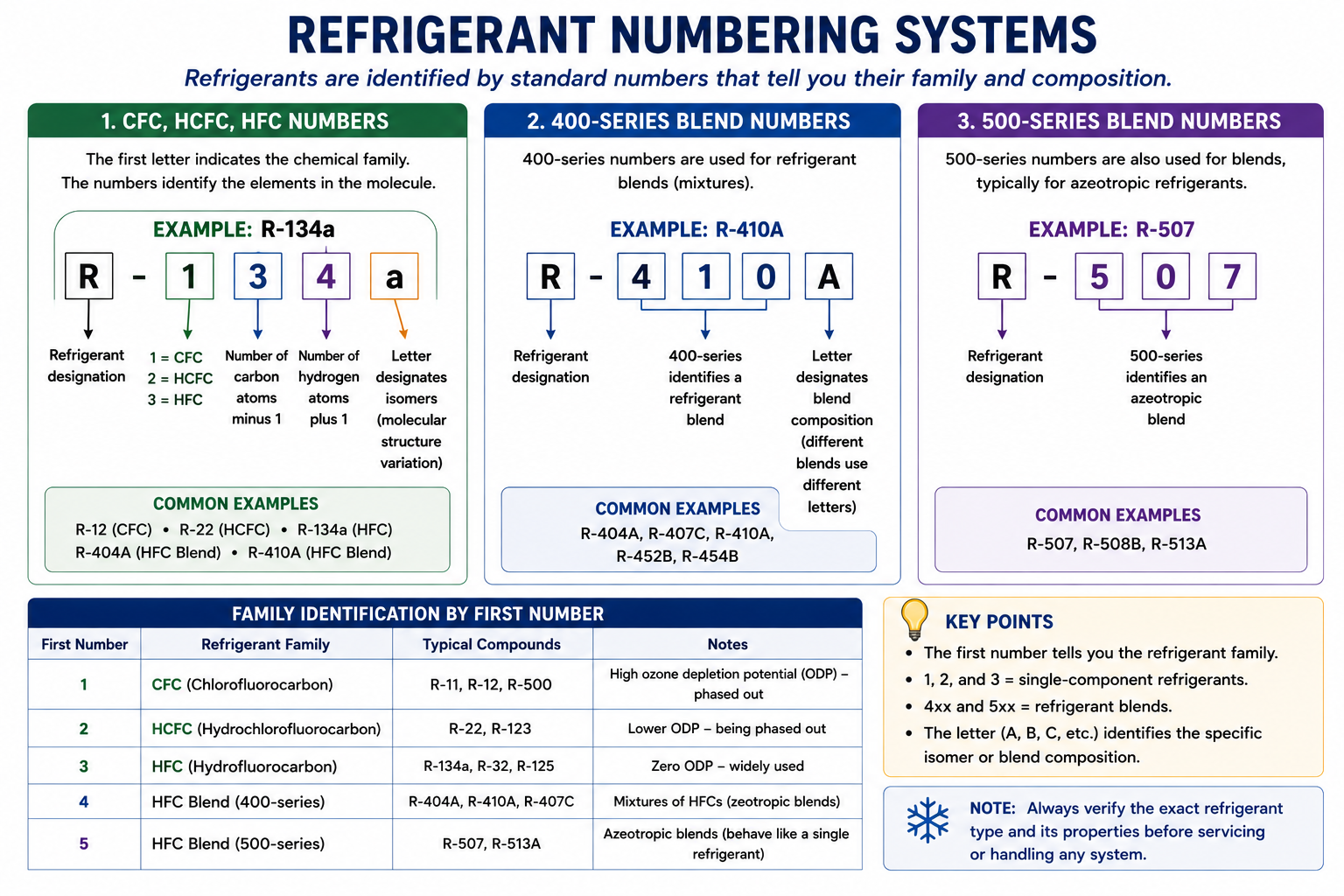
The refrigerant number identifies the refrigerant formulation. It does not by itself tell a technician everything about operating pressure, toxicity, flammability, environmental characteristics, or equipment compatibility.
Some Refrigerant Numbers Contain Chemical Information
For several families of single-component organic refrigerants, the digits in the refrigerant designation are derived from the refrigerant’s molecular structure. This is why older refrigerants such as R-12, R-22, and R-134a have number patterns that differ from the numbers assigned to blends.
The detailed chemistry behind every refrigerant number is not necessary for routine field service. What matters most for a technician is being able to accurately recognize the refrigerant designation and distinguish that refrigerant from another product with different pressures, properties, safety requirements, or lubricant compatibility.
Do not attempt to identify an unknown refrigerant by guessing its chemical structure from the number. Use the equipment nameplate, cylinder label, service documentation, and refrigerant identification equipment when necessary.
Zeotropic and Near-Azeotropic Refrigerant Blends
Refrigerant designations in the 400 series are assigned to zeotropic refrigerant blends. These blends contain two or more refrigerant components and may exhibit temperature glide during evaporation and condensation.
Letters such as A, B, or C following the blend number indicate different compositions using the same component refrigerants. For example, two blends may contain the same refrigerant components but in different percentages, resulting in different operating characteristics.
Temperature Glide, Bubble Point, and Dew Point
Zeotropic blend behavior, temperature glide, bubble point, dew point, and fractionation were covered in Refrigerant Families, Types, and Blends. Review that lesson if these terms are not familiar.
Azeotropic Refrigerant Blends
Refrigerant designations in the 500 series are assigned to azeotropic blends. These mixtures behave much more like a single-component refrigerant during phase change because the mixture evaporates and condenses at essentially one saturation temperature at a given pressure.
R-507A is an example of a 500-series refrigerant blend. It consists of R-125 and R-143a in equal mass proportions.
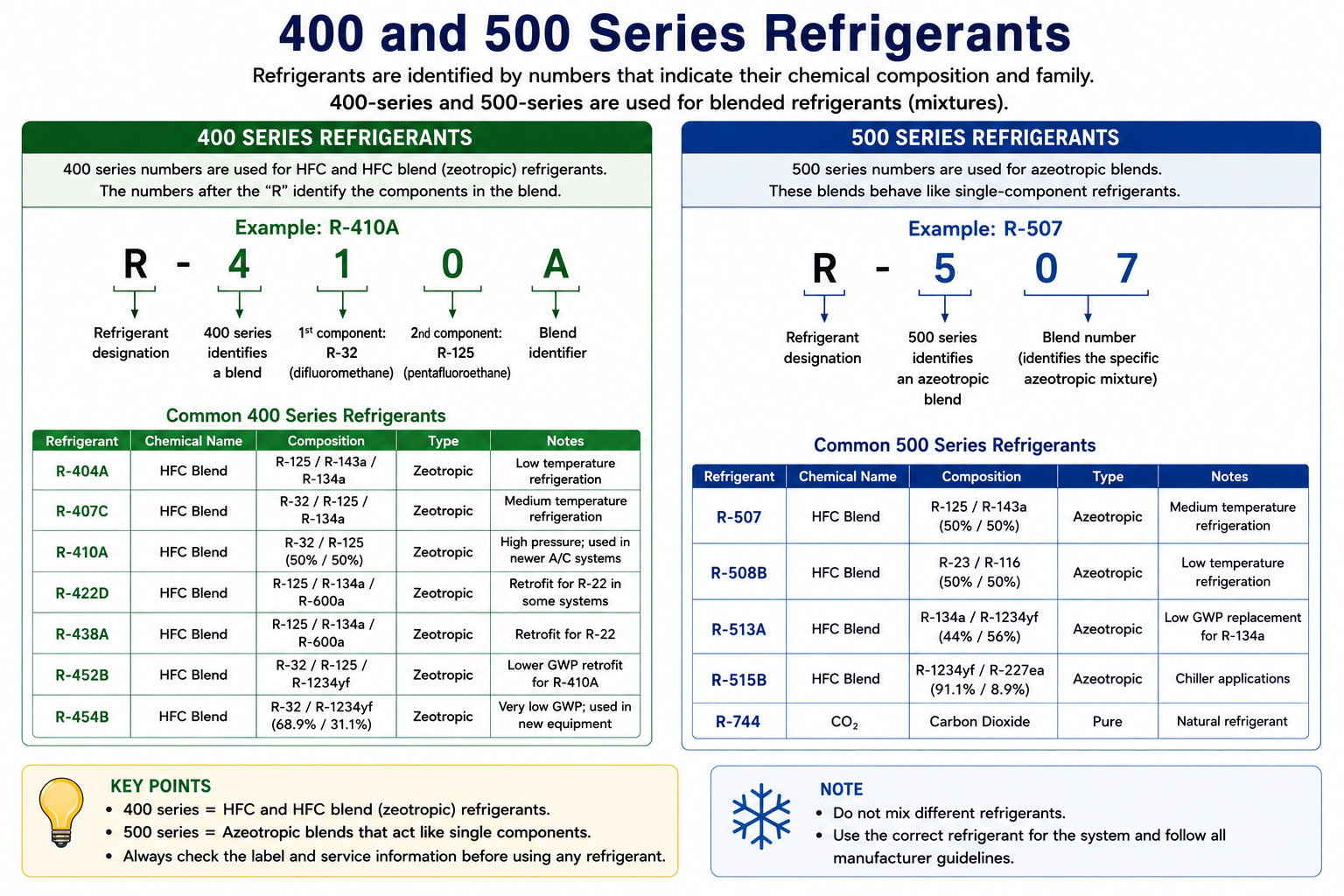
Be able to recognize the general distinction: 400 series = zeotropic blends; 500 series = azeotropic blends.
Not Every Refrigerant Follows the Same Number Pattern
Some refrigerant designation groups are based on categories rather than the same molecular-numbering rules used for many halocarbon refrigerants.
R-600 Series
Several hydrocarbon refrigerants appear in the 600 range, including R-600a isobutane.
R-700 Series
Many inorganic refrigerants use 700-series designations. Examples include R-717 ammonia and R-744 carbon dioxide.
Four-Digit Refrigerants
Unsaturated fluorinated refrigerants such as HFO refrigerants may use four-digit designations such as R-1234yf and R-1234ze(E).
Blend Letters Matter
The final letter in designations such as R-404A, R-407C, R-410A, and R-454B is part of the refrigerant designation and should not be omitted.
Never Assume You Know What Refrigerant Is Present
Correct refrigerant identification is essential before connecting gauges, adding refrigerant, recovering a charge, or opening a refrigeration system. Mixing incompatible refrigerants can contaminate both the system and recovery equipment and may make recovered refrigerant unsuitable for normal recycling or reclamation processes.
The equipment manufacturer’s nameplate or refrigerant label should identify the refrigerant for which the appliance was designed. The refrigerant supply cylinder should also be positively identified from its label and required markings.
Read the Equipment Label
Determine which refrigerant the manufacturer specifies for the appliance.
Read the Cylinder Label
Confirm the refrigerant designation, hazards, and other required identification before use.
Compare Service Information
Confirm that the refrigerant and service procedure match the actual equipment.
Test When Necessary
Use appropriate refrigerant identification equipment when the contents of a system or recovery cylinder are uncertain.
Traditional Cylinder Colors Are a Reference — Not Positive Identification
Technicians historically learned refrigerant cylinder colors as a quick way to recognize commonly used refrigerants. Those traditional colors remain useful to recognize because older cylinders, training material, and certification-preparation questions may still reference them.
However, modern refrigerant identification should never depend on paint color alone. AHRI’s current container-color guidance recommends a common light green-gray container color for refrigerants, with the refrigerant label serving as the primary means of identification.
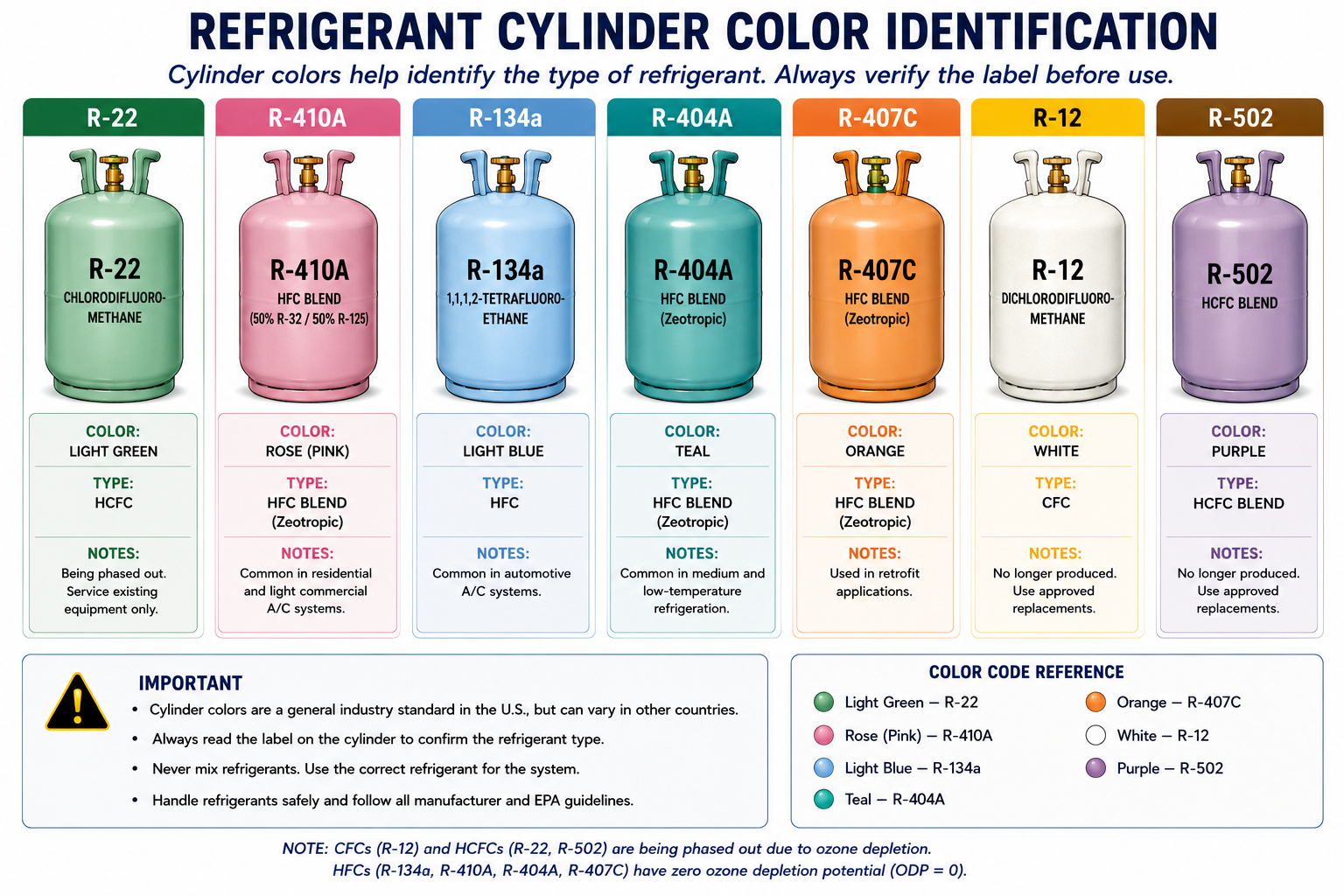
Read the label. Never connect a cylinder to a refrigeration system solely because the cylinder paint color appears familiar.
Traditional refrigerant cylinder colors may appear in older Section 608 study material. Know the traditional associations, but also understand that current field identification is made from labels and markings rather than cylinder paint color.
The Label Tells You What Is Actually in the Cylinder
A refrigerant cylinder label provides information technicians need before handling or using the refrigerant. Depending on the product and container, the label may include the refrigerant designation, chemical or product name, manufacturer information, hazard warnings, safety pictograms, shipping information, and other required markings.
Before using any refrigerant cylinder, verify that the label is present and readable and that the refrigerant is correct for the equipment being serviced.
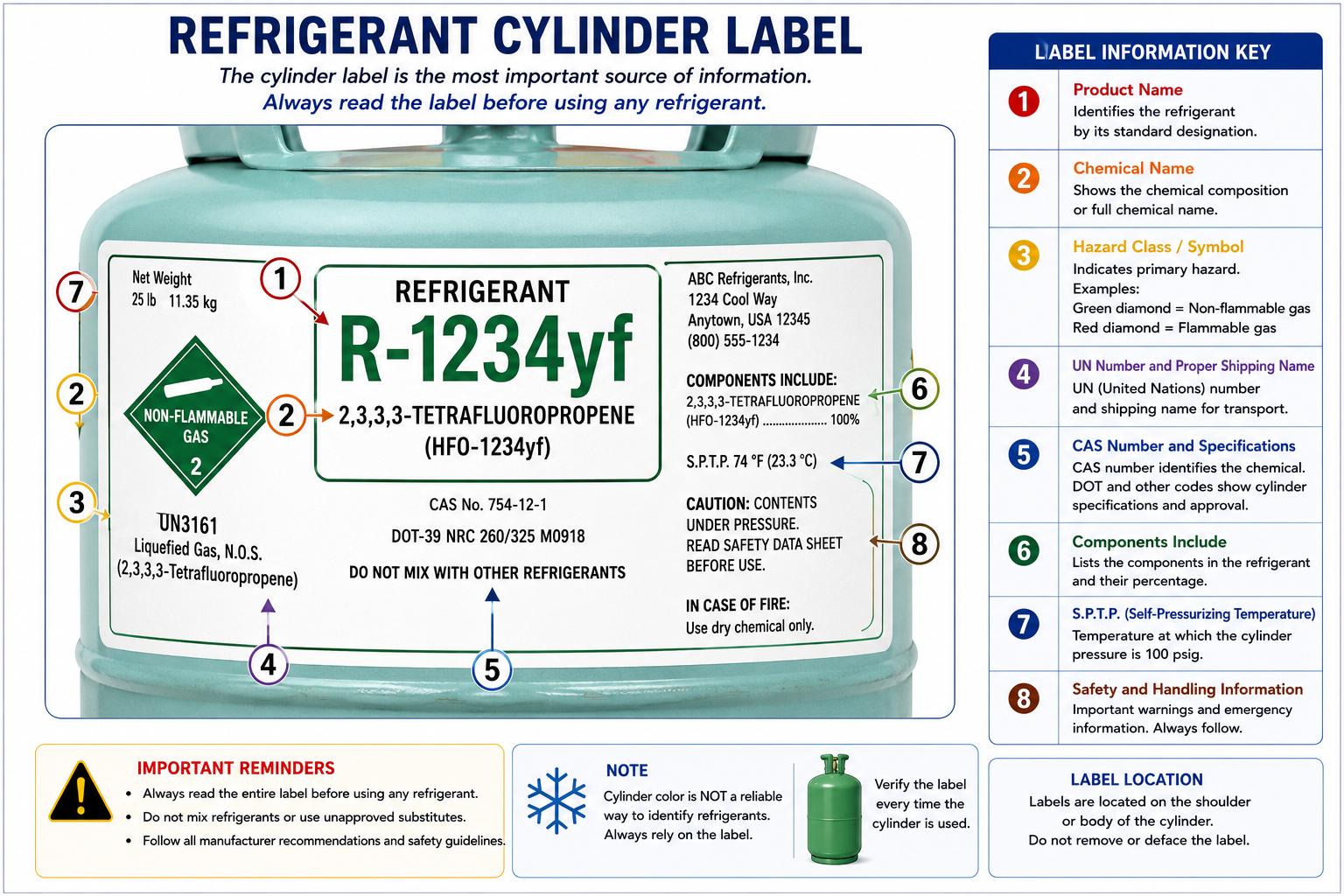
Refrigerant cylinders, recovery cylinders, cylinder markings, storage, transportation, filling limits, and shipping requirements will be covered in much greater detail later in this section.
Refrigerants Are Classified for Toxicity and Flammability
ASHRAE Standard 34 provides both refrigerant designations and safety classifications. The safety classification combines a letter representing toxicity with a number representing flammability.
The result is a two-part classification such as A1, A2L, A3, or B2L.
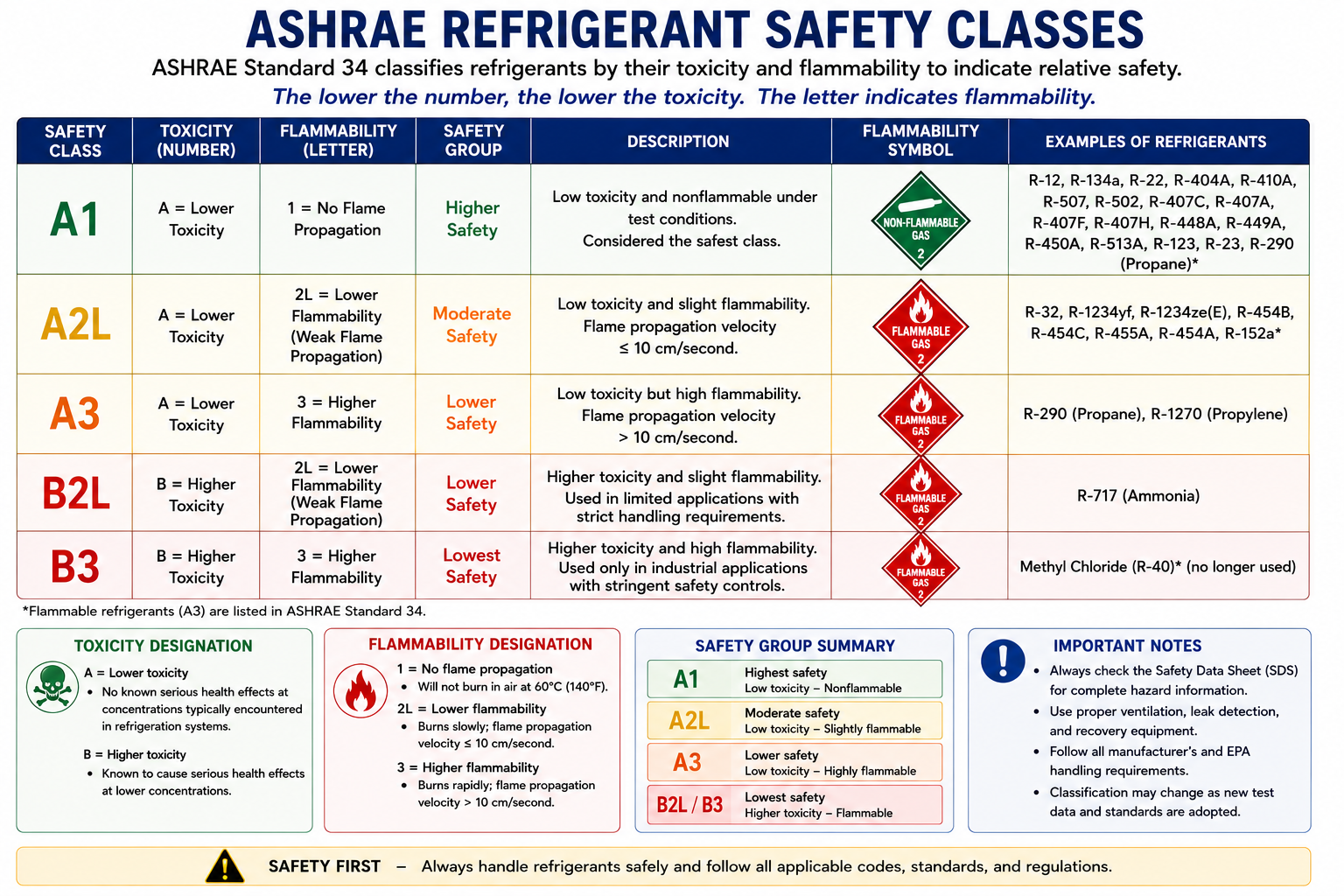
In a classification such as A2L, the A describes toxicity classification and the 2L describes flammability classification.
A and B Describe Toxicity
Class A
Class A refrigerants are assigned to the lower-toxicity group under the criteria established by ASHRAE Standard 34.
Class B
Class B refrigerants are assigned to the higher-toxicity group under the criteria established by ASHRAE Standard 34.
A Class A refrigerant is not harmless. Refrigerants can still displace oxygen, cause frostbite, create pressure hazards, produce hazardous decomposition products, or present other exposure risks. The classification addresses a specific toxicity criterion and does not eliminate the need for safe handling.
1, 2L, 2, and 3 Describe Flammability
Class 1
Refrigerants in Class 1 do not propagate flame under the test conditions used by the classification system.
Class 2L
Class 2L identifies refrigerants with lower flammability characteristics and limited burning velocity compared with Class 2 refrigerants.
Class 2
Class 2 refrigerants have greater flammability than 2L refrigerants but do not fall into the highest flammability category.
Class 3
Class 3 identifies refrigerants with the highest flammability classification within the ASHRAE system.
Lower Flammability Limit, Upper Flammability Limit, ignition sources, burning velocity, A2L refrigerants, and A3 refrigerants will be covered in a dedicated refrigerant-flammability lesson.
Examples Technicians Should Recognize
The classification system becomes easier to understand when it is connected to refrigerants commonly encountered in the field.
A1 Examples
Common A1 refrigerants include familiar nonflammable, lower-toxicity refrigerants used in many legacy and current systems.
A2L Examples
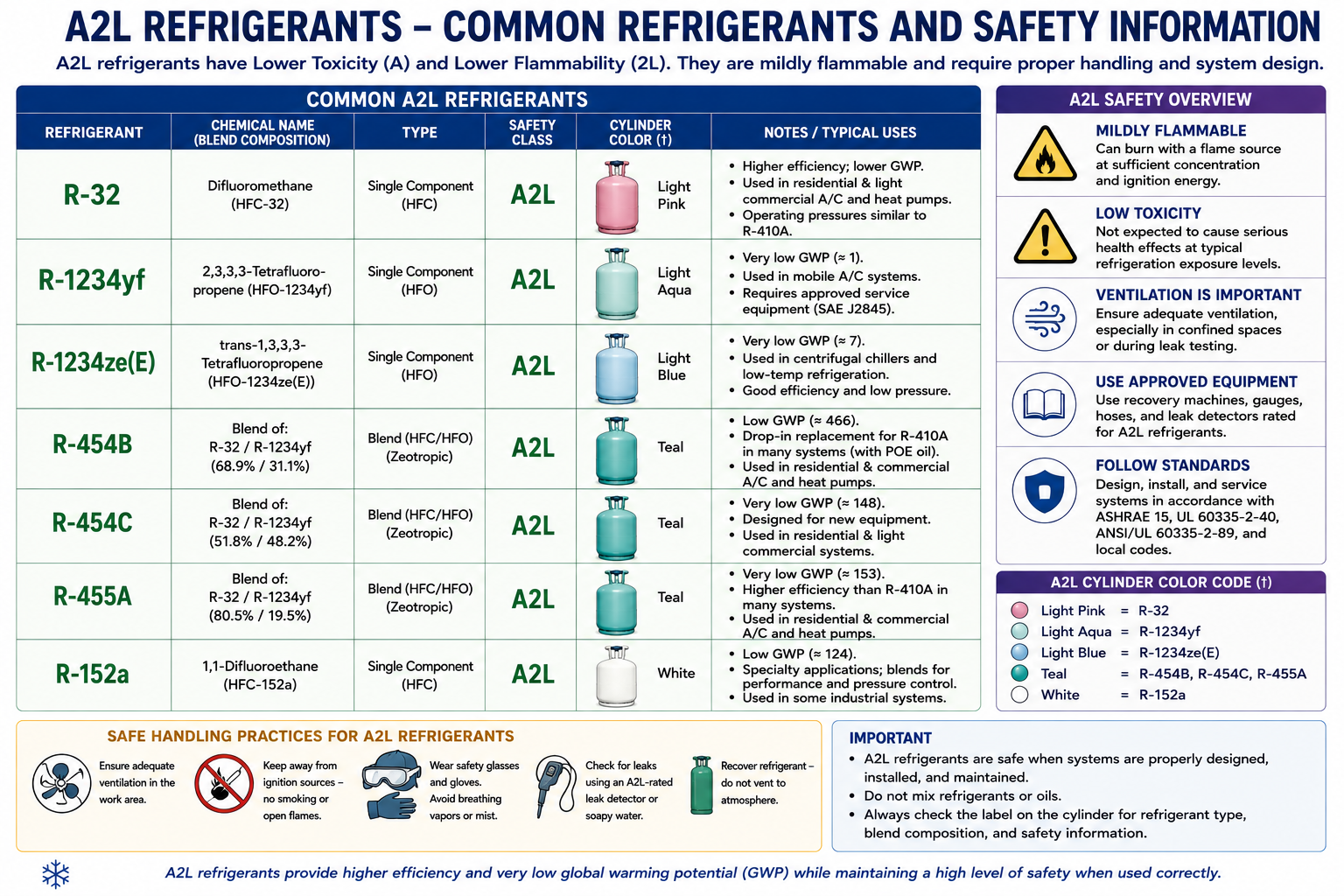
Important A2L refrigerants include R-32 and R-454B, which are increasingly important in modern comfort-cooling equipment.
A3 Example
R-290 propane is an A3 refrigerant. Its higher flammability requires equipment and procedures specifically designed for hydrocarbon refrigerants.
B2L Example
R-717 ammonia is an important example of a refrigerant with a higher-toxicity classification and lower-flammability characteristics.
A Classification Technicians Will Encounter More Often
A2L refrigerants have become increasingly important as newer lower-GWP refrigerants enter air-conditioning and refrigeration applications. The designation indicates lower toxicity under the ASHRAE classification system together with lower flammability and a limited burning velocity.
R-32 and R-454B are especially important examples for technicians working on newer comfort-cooling equipment. Other A2L refrigerants are used in refrigeration, chillers, mobile applications, and specialized systems.
The term mildly flammable does not mean “ignore the flammability.” A2L systems require equipment, service procedures, tools, ignition-source controls, and safety practices appropriate for the refrigerant and the equipment design.
Safety Classification Changes How Equipment Is Designed and Serviced
Refrigerant classification is not simply information to memorize for an examination. It affects practical decisions throughout the life of the equipment.
Equipment Design
Refrigerant characteristics influence equipment construction, electrical components, ventilation provisions, charge limits, and safety controls.
Service Tools
Recovery machines, vacuum pumps, leak detectors, and other tools may need to be approved or suitable for the refrigerant classification being serviced.
Ignition Sources
Flammable refrigerants require careful control of flames, sparks, hot surfaces, and other possible ignition sources.
Ventilation
Refrigerant releases can create atmospheric hazards. Ventilation requirements become especially important where toxicity or flammability is a concern.
Leak Detection
The appropriate leak-detection method and instrument must be compatible with the refrigerant being serviced.
Recovery
Recovery equipment and cylinders must be appropriate for the refrigerant and its hazards.
Storage and Transportation
Refrigerant properties affect cylinder handling, labeling, storage, separation, and transportation requirements.
Personal Safety
Technicians must understand the actual hazards of the refrigerant rather than assuming all refrigerants require identical precautions.
Do Not Confuse Safety Class With Refrigerant Pressure Class
ASHRAE safety classification describes toxicity and flammability. EPA refrigerant pressure classifications describe refrigerants according to their pressure characteristics for Section 608 purposes.
These are completely different classification systems. An A1 refrigerant is not automatically a low-pressure refrigerant, and an A2L refrigerant is not automatically a high-pressure refrigerant merely because of its safety designation.
ASHRAE A/B + 1/2L/2/3 = toxicity and flammability.
EPA low/medium/high/very-high pressure = refrigerant pressure classification.
The next lesson examines refrigerant properties and the EPA low-, medium-, high-, and very-high-pressure classifications in detail.
Identification Comes Before Service
Section 608 preparation expects technicians to recognize refrigerant characteristics and identification terminology. Correct refrigerant identification also prevents cross-contamination and helps ensure that the correct recovery equipment and procedures are used.
Know the difference between 400-series and 500-series blends, understand that refrigerant identification should be based on labels and positive identification rather than cylinder color alone, and recognize the basic meaning of commonly encountered safety classifications such as A1, A2L, A3, and B2L.
Avoid These Identification and Classification Errors
“The cylinder color tells me which refrigerant is inside.”
Not reliably. Cylinder color may provide historical context, but the refrigerant label and markings must be used for positive identification.
“A2L means the refrigerant is almost nonflammable.”
No. A2L is a flammability classification with specific criteria. A2L refrigerants still require appropriate ignition controls, tools, equipment, and procedures.
“Class A means the refrigerant is nontoxic.”
No. Class A means lower toxicity under the classification criteria. Other inhalation, pressure, frostbite, decomposition, and atmospheric hazards can still exist.
“R-410A and R-410B are the same refrigerant.”
No. The suffix letter is part of the refrigerant designation and can indicate a different blend composition.
“All 400-series refrigerants have identical glide.”
No. They are zeotropic blends, but the amount of temperature glide varies significantly among refrigerants.
“ASHRAE safety class tells me EPA pressure class.”
No. Safety classification and EPA pressure classification describe different refrigerant characteristics.
Can You Identify and Classify Refrigerants?
- What does the letter R indicate in a refrigerant designation?
- Why is a standardized refrigerant-numbering system useful?
- What general type of refrigerants are found in the 400 series?
- What general type of refrigerants are found in the 500 series?
- What is the significance of the letter in a designation such as R-407C or R-454B?
- What refrigerant designation identifies ammonia?
- What refrigerant designation identifies carbon dioxide?
- Why should cylinder color not be used as the sole method of refrigerant identification?
- What should be used as the primary method of identifying refrigerant in a supply cylinder?
- What does the letter A indicate in an ASHRAE safety classification?
- What does the letter B indicate?
- What does flammability class 1 indicate?
- What is the purpose of the 2L classification?
- Which safety class includes R-32 and R-454B?
- What safety classification is commonly associated with R-290?
- What safety classification is commonly associated with R-717 ammonia?
- Does an ASHRAE safety classification tell you the EPA refrigerant pressure class?
- Why must a technician identify the refrigerant before connecting recovery or service equipment?
What You Should Have Learned
Refrigerant Numbers Standardize Identification
The R-number system provides a common designation independent of manufacturer trade names.
400-Series Refrigerants Are Blends
The 400 series is used for zeotropic refrigerant blends.
500-Series Refrigerants Are Azeotropes
The 500 series is used for azeotropic refrigerant blends.
Labels Provide Positive Identification
Current field practice relies on cylinder labels, equipment markings, and positive identification rather than cylinder paint color.
ASHRAE Uses Two Safety Factors
The letter indicates toxicity classification and the number indicates flammability classification.
A2L Refrigerants Are Important
R-32 and R-454B are important A2L refrigerants increasingly encountered in newer HVAC equipment.
Different Refrigerants Require Different Precautions
Classification affects tools, equipment design, ventilation, leak detection, ignition control, recovery, storage, and service procedures.
Pressure and Safety Classes Are Different
ASHRAE safety classification should never be confused with EPA refrigerant pressure classification.