BASIC ELECTRICAL FOR THE HVAC TECHNICIAN
11. The Transformer
One device. Two electrically separate circuits.
Transformers are used throughout HVAC equipment to transfer
electrical energy from one circuit to another while changing
the voltage level.
To understand a transformer, you must understand the different
jobs performed by its primary and secondary windings.
What You Should Learn
By the end of this lesson you should be able to:
Identify the primary and secondary windings of a transformer.
Explain why the primary is a load on its supplying circuit.
Explain why the secondary is the power source for the
secondary circuit.
Explain how energy is transferred from the primary
circuit to the secondary circuit.
Distinguish between step-down and step-up transformers.
Explain how a transformer provides low-voltage power
for an HVAC control circuit.
A Transformer Is Both a Load and a Source
A transformer is an electrical device with no moving parts.
It contains two windings that perform two very different jobs.
PRIMARY
The Load Side
The primary is the winding to which
the input voltage is applied.
Current flowing through the primary winding creates
a changing magnetic field in the transformer core.
From the perspective of the circuit supplying the
transformer, the primary winding is a
load.
SECONDARY
The Power Source Side
The secondary winding has voltage
induced in it by the changing magnetic field created
by the primary.
That voltage is then available to operate a separate
electrical circuit.
Therefore, the secondary is the
power source or supply for the secondary circuit.
Important Certification Concept
The primary is a load on the circuit
supplying the transformer.
The secondary is the power source for
the circuit connected to the secondary.
In a typical HVAC step-down transformer, the secondary
becomes the source of power for the low-voltage control circuit.
Primary, Core and Secondary
A basic transformer has three important parts that you need
to recognize:
Primary Winding
Connected to the input voltage. Current through this
winding creates a changing magnetic field.
Core
Provides a magnetic path that couples the magnetic
field produced by the primary to the secondary winding.
Secondary Winding
Voltage is induced in this winding by the changing
magnetic field. The secondary supplies electrical
power to its own circuit.
How a Transformer Transfers Energy
AC voltage is applied to the primary winding.
Current through the primary produces a changing
magnetic field.
The transformer core carries the changing magnetic field.
The changing magnetic field induces voltage in the
secondary winding.
The secondary becomes the power source for the
secondary circuit.
Notice what is missing.
There is no direct electrical connection between the
primary and secondary windings in the transformer shown
in this lesson.
Electrical energy is transferred from one circuit to
the other through the changing magnetic field.
Transformer Turns Ratio
A transformer can change the voltage level because the primary
and secondary windings can contain different numbers of turns
of wire.
The voltage changes approximately in the same ratio as the
number of turns in the two windings.
Primary Voltage
120 V
10 : 1
Example Turns Ratio
Secondary Voltage
≈ 12 V
For example, if a transformer has a 10:1 primary-to-secondary
turns ratio and 120 volts is applied to the primary, the
secondary voltage will be approximately 12 volts.
A transformer does not convert AC to DC.
A transformer changes the voltage level of alternating
current. Converting AC to DC requires additional circuitry.
Step-Down and Step-Up Transformers
STEP-DOWN
Lower Secondary Voltage
A step-down transformer produces a lower voltage at
the secondary than the voltage applied to the primary.
This is the type of transformer you will commonly
encounter in HVAC control circuits.
→
24 VAC
STEP-UP
Higher Secondary Voltage
A step-up transformer produces a higher voltage at
the secondary than the voltage applied to the primary.
Step-up transformers are used in applications where
a higher output voltage is required.
→
Higher Voltage
Line Voltage and Control Voltage
Earlier in this course we separated HVAC electrical systems
into line-voltage circuits and
control-voltage circuits.
The transformer is the device that allows us to transfer
energy from the line-voltage circuit and create a separate
lower-voltage power source for the control circuit.
Line Voltage
120 VAC
208 / 230 VAC
460 VAC
Commonly used to power compressors, motors, heaters
and other higher-power loads.
Control Voltage
Typically about 24 VAC
Commonly used to operate thermostats, relay coils,
contactor coils and other HVAC control devices.
Follow the Two Circuits
Figure 23 combines the concepts from this lesson into one
ladder diagram.
Do not look at the transformer as though the entire drawing
were one electrical circuit. There are
two separate circuits.
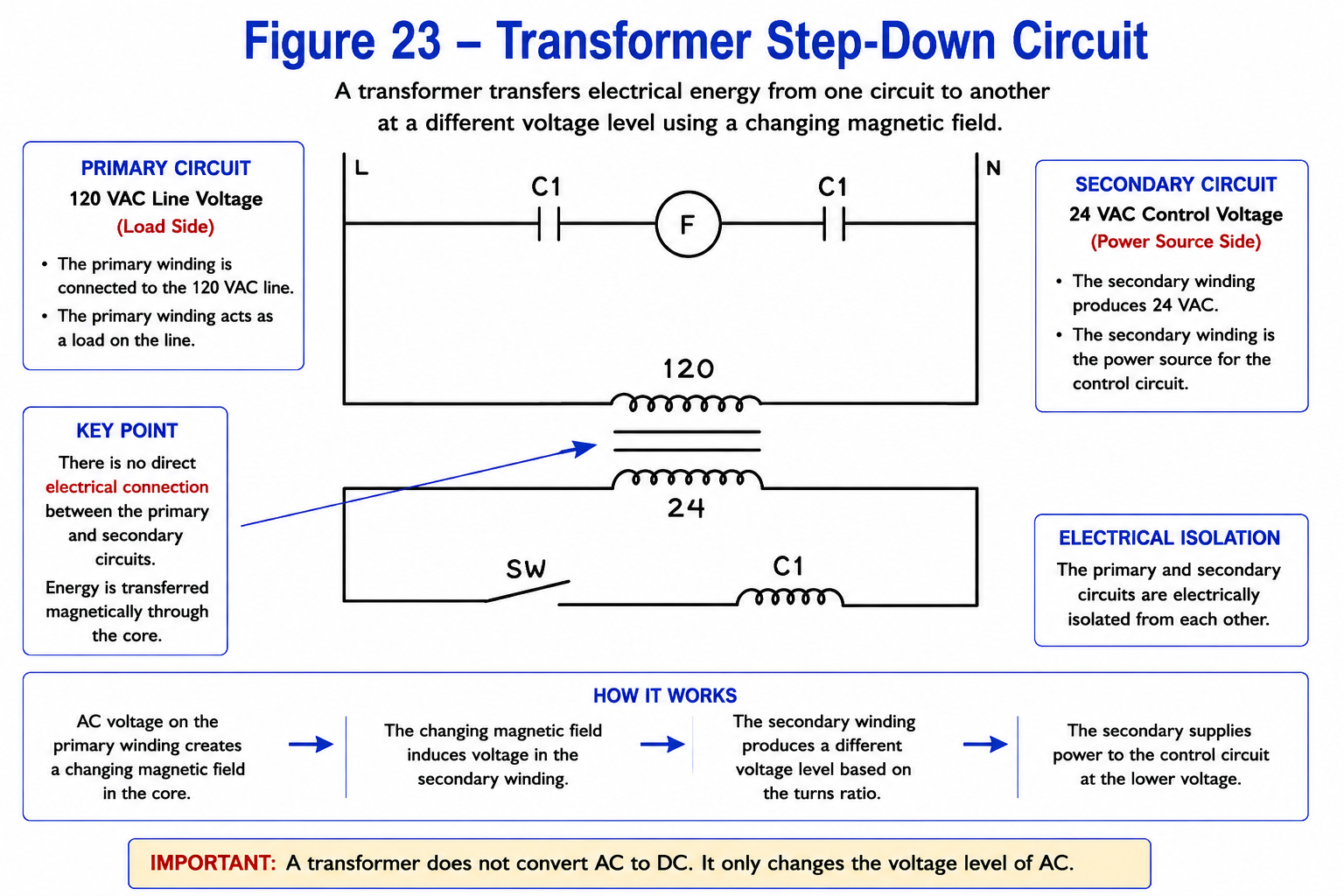
Transformer step-down circuit.
Reading Figure 23
120 VAC Circuit
The primary winding is connected across L and N.
In this circuit the transformer primary is a
load.
24 VAC Circuit
The secondary winding supplies the separate
low-voltage circuit containing SW and the C1 relay coil.
In this circuit the transformer secondary is the
power source.
Follow the secondary circuit exactly as you would any other circuit.
Start at one side of the secondary power source, follow
the path through the switch and relay coil, and return
to the other side of the secondary.
Closing SW completes the 24 VAC circuit and energizes
the C1 relay coil. The C1 contacts in the 120 VAC circuit
then change state.
Why HVAC Systems Use Control Voltage
Line voltage is appropriate for loads such as compressors,
motors and electric heaters, but it is generally undesirable
to run line voltage through thermostats and other control devices.
A step-down transformer allows the equipment to use the
available line voltage while creating a separate low-voltage
source for the control system.
Supplies the transformer primary
→
Transfers energy magnetically
→
Power source for the control circuit
Common Transformer Mistakes
Calling the secondary a load. The secondary is the
source supplying its circuit.
Treating the primary and secondary as one continuous
electrical circuit.
Assuming a transformer converts AC to DC.
Troubleshooting the secondary without first verifying
that the primary has the correct input voltage.
A Troubleshooting Habit to Start Now
When troubleshooting a transformer, think of it as the
dividing point between two circuits.
Is the correct voltage being supplied to the primary?
If the primary voltage is correct, is the expected
voltage present across the secondary?
If the secondary voltage is correct, troubleshoot
the secondary circuit from its power source outward.
Glossary of Key Terms
Primary
The input winding of the transformer. In the circuit
supplying the transformer, the primary acts as a load.
Secondary
The output winding of the transformer. It is the
supply or power source for the secondary circuit.
Transformer Core
The magnetic path that couples the changing magnetic
field from the primary winding to the secondary winding.
Step-Down Transformer
A transformer whose secondary voltage is lower than
its primary voltage.
Step-Up Transformer
A transformer whose secondary voltage is higher than
its primary voltage.
Control Voltage
The lower voltage used to operate the control portion
of an HVAC system, commonly about 24 VAC.
What You Should Remember
The transformer primary is connected to the input
circuit and acts as a load on that circuit.
The transformer secondary is the power source for
the secondary circuit.
Energy is transferred from primary to secondary
through a changing magnetic field.
The primary and secondary shown in this lesson are
electrically isolated from one another.
A step-down transformer produces a lower secondary
voltage than the voltage applied to its primary.
A transformer changes AC voltage levels; it does not
by itself convert AC into DC.
Where We Go Next
You have already used a relay to control a line-voltage
circuit. You now know how a transformer creates a separate
low-voltage power source.
In the next shop project, we will combine those concepts.
You will use a 24 VAC control circuit
to operate a relay that controls
120 VAC loads.