TXV Applications and Service
Understanding how a thermostatic expansion valve operates is only part of working with TXVs. Correct sensing-bulb installation, proper equalization, evaporator pressure-drop considerations, refrigerant distribution, and careful adjustment are all necessary for the valve to control refrigerant correctly.
This lesson builds on the TXV operating principles from Lesson 3 and concentrates on how the valve is installed, applied, checked, and serviced in air-conditioning and refrigeration systems.
What You Will Learn
By the end of this lesson you should be able to:
Explain correct TXV sensing-bulb installation.
Describe why bulb location, pipe contact, mounting position, tightness, and insulation affect TXV operation.
Compare internally and externally equalized TXVs.
Explain how each valve senses evaporator pressure and why evaporator pressure drop can require external equalization.
Explain the purpose of the external equalizer line.
Describe how the equalizer allows the TXV to respond to pressure at the evaporator outlet rather than pressure near the evaporator inlet.
Explain evaporator distributors.
Describe how a distributor divides refrigerant among multiple evaporator circuits after the TXV.
Understand TXV adjustment.
Explain how spring-pressure adjustment affects superheat and why adjustment should not be the first response to an abnormal reading.
Recognize special TXV designs.
Identify maximum operating pressure, balanced-port, and dual-port TXVs and understand why specialized valves may be used.
The TXV Can Only Respond to What the Bulb Senses
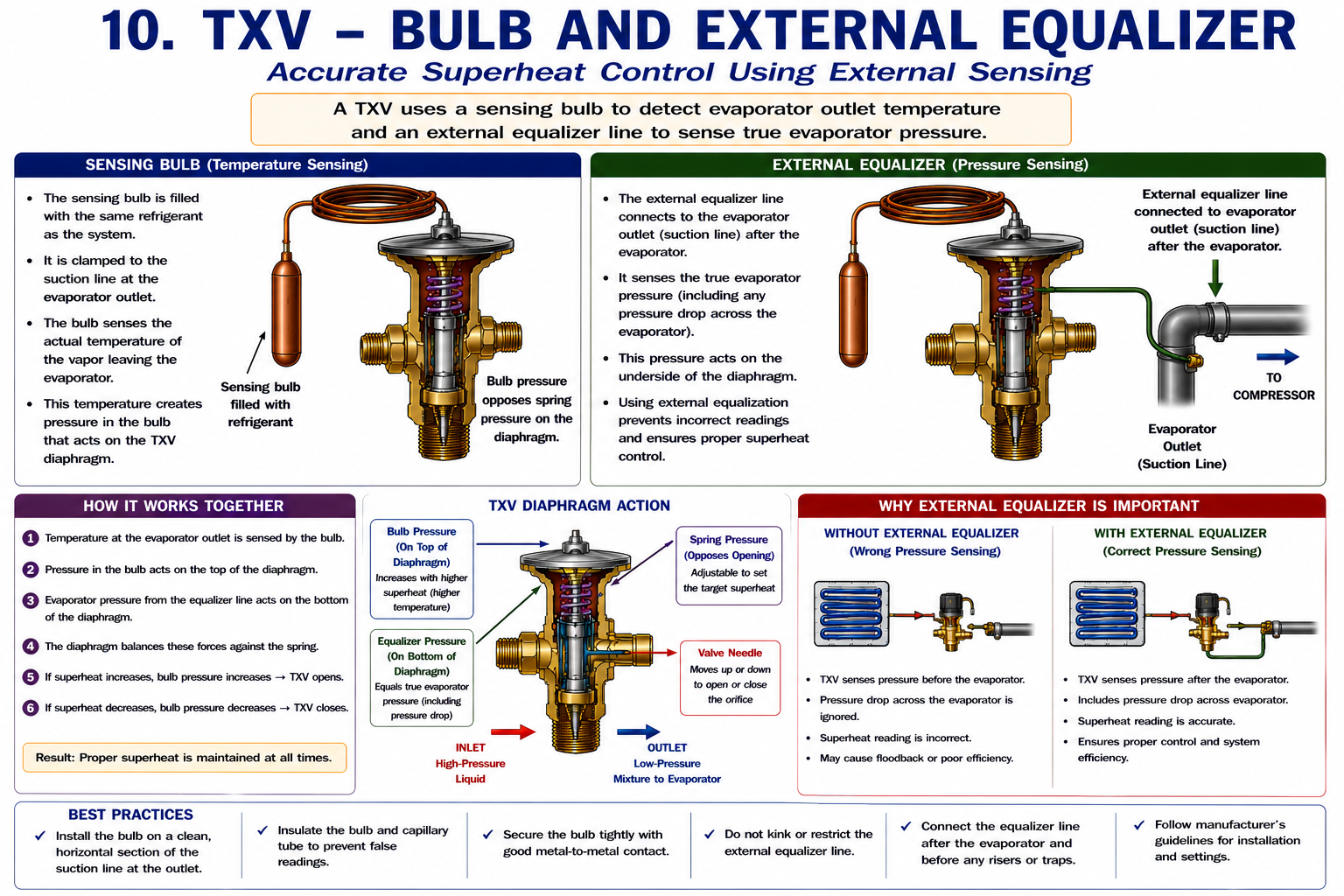
In Lesson 3 you learned that the sensing bulb develops the opening force that acts on the TXV diaphragm. Because the bulb responds to suction-line temperature, its installation directly affects valve operation.
Use a Clean Mounting Surface
The bulb must make good thermal contact with the suction line. Dirt, corrosion, paint, or other material between the bulb and tubing can interfere with heat transfer.
Secure the Bulb Tightly
The bulb must remain in firm contact with the suction line. A loose bulb may respond slowly or sense a temperature that does not accurately represent the refrigerant line.
Use the Correct Position
The bulb is normally installed on a horizontal section of suction line in the position recommended by the valve or equipment manufacturer.
Insulate the Bulb
Insulation helps prevent surrounding air, radiant heat, or other external conditions from influencing the bulb temperature.
Oil and any liquid refrigerant traveling along the bottom of the suction line can cause the bulb to sense conditions that do not accurately represent the vapor leaving the evaporator.
If TXV operation appears abnormal, inspect the bulb installation before adjusting the valve. A loose, poorly positioned, uninsulated, or poorly contacted bulb can produce symptoms that resemble an incorrectly adjusted or defective TXV.
Where Should the Bulb Be Located?
The sensing bulb should monitor the evaporator outlet before the suction line has been influenced by other components or system conditions that could distort the measurement.
On an externally equalized TXV installation, the sensing bulb is normally located between the evaporator outlet and the external equalizer connection.
This arrangement allows the sensing bulb to respond to evaporator outlet temperature while the external equalizer communicates evaporator outlet pressure to the TXV.
A properly installed externally equalized TXV effectively receives temperature information from the sensing bulb and pressure information from the equalizer connection near the evaporator outlet.
Why Does Evaporator Pressure Drop Matter?
The TXV must balance sensing-bulb pressure against evaporator pressure and spring pressure. The question is: what evaporator pressure is acting on the valve?
Pressure Is Sensed Inside the Valve
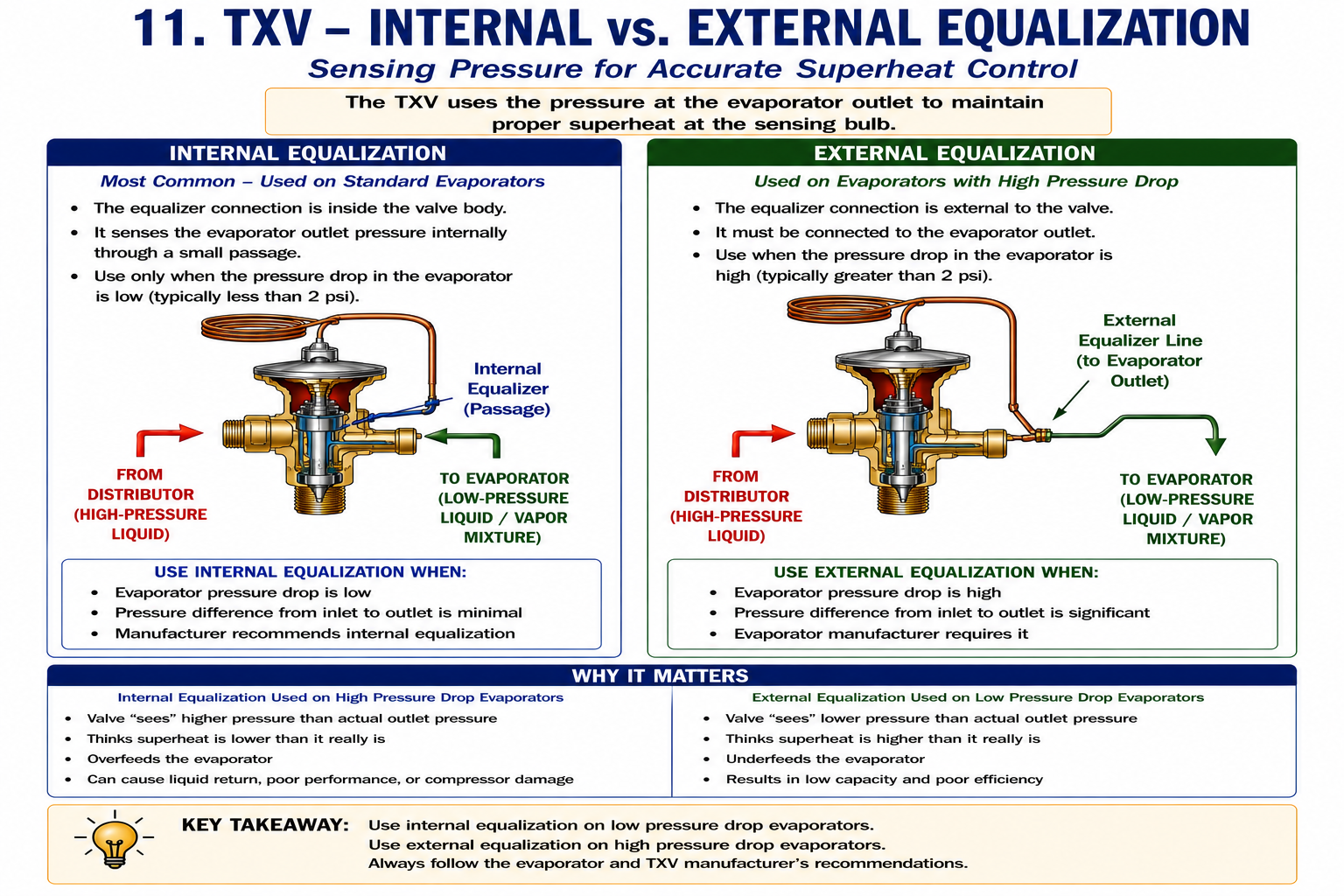
An internally equalized TXV uses pressure available at or near the valve outlet as the evaporator-pressure closing force.
This arrangement can work properly when pressure drop through the evaporator and distributor is small enough that inlet and outlet pressures are reasonably close.
Pressure Is Sensed at the Evaporator Outlet
An external equalizer line connects the TXV to the suction line near the evaporator outlet.
This allows the valve to use the actual evaporator outlet pressure as one of the forces controlling the diaphragm.
Pressure Can Fall Across the Evaporator
Refrigerant does not necessarily remain at exactly the same pressure from the TXV outlet to the evaporator outlet. Resistance through distributors, tubing, fittings, and the evaporator circuits can cause pressure to decrease as refrigerant flows through the coil.
If an internally equalized TXV responds to pressure near the evaporator inlet while the bulb responds to temperature at the evaporator outlet, the valve is using pressure and temperature from different locations.
An externally equalized TXV corrects for this by bringing evaporator outlet pressure back to the valve through the equalizer line.
A small pressure-sensing line connecting the TXV to the suction line near the evaporator outlet so the valve can respond to the pressure at the same general location where the sensing bulb measures temperature.
The external equalizer is a pressure-sensing connection. Refrigerant feeding the evaporator still passes through the main TXV inlet and outlet.
Feeding Multiple Evaporator Circuits
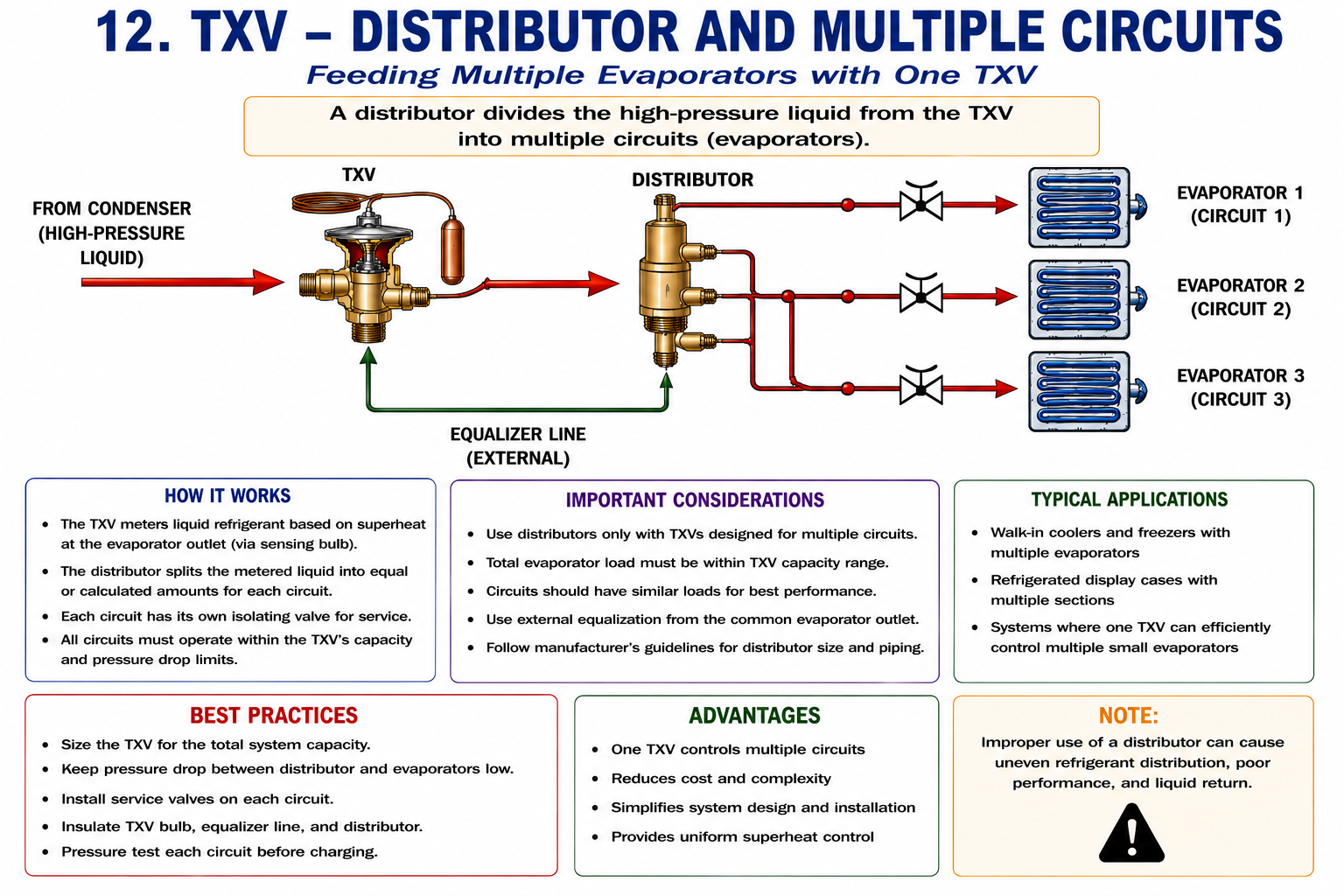
Larger evaporators are often divided into several parallel refrigerant circuits. Instead of sending all refrigerant through one continuous tube, the system divides the refrigerant among several paths through the evaporator.
A refrigerant distributor is installed after the TXV to divide the refrigerant mixture among these circuits.
Metered refrigerant
Divides flow
The distributor must divide refrigerant properly among the evaporator circuits. Poor distribution can cause some circuits to be overfed while others are underfed, even if the TXV itself is operating correctly.
A distributor and its feeder tubes create additional resistance between the TXV and evaporator outlet. This is one reason externally equalized TXVs are commonly used on multi-circuit evaporators.
Spring Pressure Changes the Superheat Setting
On an adjustable TXV, the adjustment mechanism changes spring pressure. As you learned in Lesson 3, spring pressure is one of the forces that tends to close the valve.
Increase Spring Pressure
Greater spring force tends to move the valve toward closed, reducing refrigerant feed and increasing evaporator superheat.
Decrease Spring Pressure
Lower spring force allows the valve to open farther, increasing refrigerant feed and reducing evaporator superheat.
TXVs are normally factory set. Before changing the adjustment, verify the manufacturer’s specifications and check for other causes of incorrect superheat such as refrigerant charge, airflow, evaporator load, bulb mounting, restrictions, system contamination, or incorrect valve application.
If an adjustment is actually required, make a small change and allow the refrigeration system enough time to stabilize before deciding whether another adjustment is necessary.
Use the Bulb Location as Your Reference
The TXV responds to temperature at the sensing-bulb location and to evaporator pressure. When evaluating valve operation, temperature and pressure should therefore represent the same part of the system as closely as practical.
Measure Suction-Line Temperature
Measure the line temperature at or near the TXV sensing bulb.
Determine Evaporator Saturation Temperature
Use the appropriate evaporator pressure and the refrigerant pressure-temperature relationship.
Determine Superheat
Subtract the evaporator saturation temperature from the measured suction-line temperature.
Compare With Specifications
Evaluate the result using the equipment or valve manufacturer’s required operating information.
This is the same superheat relationship covered in the evaporator lesson. Here the emphasis is not on reteaching the calculation, but on understanding why the TXV sensing location matters when evaluating valve operation.
TXV Problems Can Be Caused by Other System Problems
A technician may see high or low superheat and immediately suspect the TXV. However, many conditions outside the valve can change evaporator operation and produce similar symptoms.
Bulb Installation
A loose, poorly positioned, uninsulated, or poorly contacted bulb can cause incorrect valve response.
Incorrect Refrigerant Charge
The TXV cannot compensate for every effect of an undercharged or overcharged refrigeration system.
Liquid-Line Restriction
A restriction before the TXV can reduce the supply of liquid refrigerant available to the valve.
Insufficient Liquid at the Valve
Flash gas in the liquid line ahead of the TXV can reduce valve capacity and interfere with proper refrigerant feed.
Evaporator Airflow or Load
Incorrect airflow or abnormal refrigeration load can change evaporator superheat without the TXV itself being defective.
Distributor or Circuit Problem
A restricted distributor tube or uneven evaporator circuit can create symptoms that may initially appear to be a TXV problem.
Before replacing or adjusting a TXV, determine whether the valve is receiving proper liquid refrigerant, whether the evaporator has the expected load and airflow, whether the bulb and equalizer are installed correctly, and whether refrigerant can flow freely through the distributor and evaporator circuits.
Not Every TXV Is Built for the Same Application
TXVs can be designed for specialized operating conditions. The technician must therefore select replacement valves by application and manufacturer specifications rather than simply matching connection size.
Maximum Operating Pressure (MOP) TXV
An MOP valve limits how far the valve opens when evaporator pressure becomes high. This can help limit compressor loading during high-load operating conditions.
Balanced-Port TXV
A balanced-port valve is designed to reduce the influence that changing liquid-line pressure has on valve position, allowing more consistent control over a wider range of operating conditions.
Dual-Port TXV
A dual-port design uses more than one valve port to provide refrigerant-control characteristics needed for applications with a particularly wide range of load conditions.
Valve capacity, refrigerant, evaporating temperature, pressure drop, equalization method, connection type, charge characteristics, and intended application can all matter when selecting a replacement TXV.
Why Would a TXV Limit Evaporator Pressure?
Some refrigeration systems can experience very high evaporator loads during startup or after a warm product load is introduced. Under these conditions, suction pressure and compressor load can rise substantially.
A maximum operating pressure TXV is designed to limit valve opening above a particular evaporator-pressure range. This can limit refrigerant feed during extremely high-load conditions and help prevent excessive compressor loading.
The original course describes MOP TXVs as valves that limit evaporator pressure by preventing the valve from opening fully during heavy-load conditions. :contentReference[oaicite:3]{index=3}
Reducing the Effect of Liquid Pressure
Liquid pressure at the TXV inlet can change as outdoor temperature, condensing conditions, and system operation change. In an ordinary valve design, these pressure changes can influence the force acting on the valve port.
A balanced-port TXV is designed so much of this liquid-pressure force is balanced or canceled within the valve mechanism. This allows the valve to regulate refrigerant flow more consistently as the pressure difference across the valve changes.
Conventional Port
Changes in liquid-line pressure can exert additional force on the needle and influence valve position.
Balanced Port
The valve geometry reduces the effect of inlet pressure on the needle so bulb, evaporator, and spring forces have greater control of valve position.
The original material specifically associates balanced-port valves with low-ambient operation where liquid pressure may fall and notes that the design cancels liquid-pressure force across the valve mechanism. :contentReference[oaicite:4]{index=4}
A Logical Way to Check a TXV System
Confirm that the system has the correct refrigerant and is operating under appropriate load conditions.
Inspect the sensing bulb for correct location, clean contact, tight mounting, proper position, and insulation.
Identify whether the TXV is internally or externally equalized and inspect the external equalizer connection when one is used.
Verify that liquid refrigerant is reaching the TXV and investigate possible liquid-line restrictions or flash gas ahead of the valve.
Check evaporator airflow, load, distributor operation, and other system conditions that can affect superheat.
Measure superheat using temperature and pressure information representative of the evaporator outlet.
Compare the operating conditions with manufacturer specifications before deciding that adjustment is required.
If adjustment is appropriate, make only a small change and allow the system to stabilize before making another change.
Can You Apply and Service a TXV?
You should be able to answer these questions before continuing.
- Why must the TXV sensing bulb make good thermal contact with the suction line?
- Why is the sensing bulb normally insulated?
- Why should the bulb generally not be mounted on the bottom of a horizontal suction line?
- What is the difference between an internally equalized and externally equalized TXV?
- Why can pressure drop through an evaporator make external equalization necessary?
- Where is the sensing bulb normally located in relation to the external equalizer connection?
- What is the purpose of a refrigerant distributor?
- Why are distributors commonly associated with externally equalized TXVs?
- What happens to TXV superheat when spring pressure is increased?
- Why should TXV adjustment not be the first response to an abnormal superheat reading?
- What is the purpose of an MOP TXV?
- What advantage does a balanced-port TXV provide?
What You Should Have Learned
Correct sensing-bulb mounting is essential because the bulb supplies the temperature-responsive opening force that controls the TXV.
The sensing bulb should have clean, tight thermal contact with the suction line, be correctly positioned, and normally be insulated from surrounding conditions.
An internally equalized TXV senses evaporator pressure near the valve, while an externally equalized TXV uses a separate line to sense pressure near the evaporator outlet.
External equalization becomes important when pressure drop through the distributor or evaporator causes outlet pressure to differ significantly from pressure near the TXV outlet.
A refrigerant distributor divides refrigerant leaving the TXV among multiple evaporator circuits.
Increasing TXV spring pressure generally raises superheat, while decreasing spring pressure generally lowers superheat.
TXV adjustment should only be considered after bulb installation, refrigerant supply, evaporator conditions, system charge, and other possible causes of abnormal operation have been checked.
MOP, balanced-port, and other specialized TXVs are designed for particular operating conditions and must be correctly matched to the refrigeration system.