Thermostatic Expansion Valves (TXVs)
A thermostatic expansion valve, commonly called a TXV, is a modulating metering device. Unlike a capillary tube or fixed orifice, the TXV can change the size of its refrigerant opening as evaporator conditions change.
The TXV uses evaporator outlet temperature, evaporator pressure, and an adjustable spring force to regulate the amount of refrigerant entering the evaporator and maintain the intended evaporator superheat.
What You Will Learn
By the end of this lesson you should be able to:
Explain the basic purpose of a TXV.
Describe how a TXV regulates refrigerant entering the evaporator as operating conditions and evaporator load change.
Identify the major TXV components.
Recognize the sensing bulb, diaphragm, needle, seat, spring, refrigerant inlet, and refrigerant outlet.
Explain the three TXV operating forces.
Describe how sensing-bulb pressure, evaporator pressure, and spring pressure act on the valve.
Explain how the sensing bulb affects valve position.
Describe how changing evaporator outlet temperature changes bulb pressure and therefore the opening force on the TXV.
Relate evaporator load to TXV operation.
Explain why the valve generally opens farther when evaporator load increases and moves toward closed as load decreases.
Connect TXV operation to evaporator superheat.
Build on the completed superheat lesson by explaining how the TXV uses evaporator outlet conditions to regulate refrigerant feed.
How Is a TXV Different From a Fixed Restriction?
In Lesson 2 you learned that capillary tubes and fixed orifices have restrictions whose physical size does not actively change during operation. A TXV works differently.
The TXV contains a movable valve mechanism. As evaporator conditions change, forces acting on the valve change. The valve needle can then move toward the seat or away from the seat, decreasing or increasing refrigerant flow.
Restriction Stays Fixed
A capillary tube or fixed orifice cannot directly reposition itself when evaporator load changes.
Opening Can Modulate
The valve can move open or closed as the forces acting on the diaphragm and valve mechanism change.
The TXV does not simply turn refrigerant flow completely ON and OFF during normal operation. It continually seeks a valve position that supplies the evaporator with the refrigerant required for the present operating conditions.
Inside a Thermostatic Expansion Valve
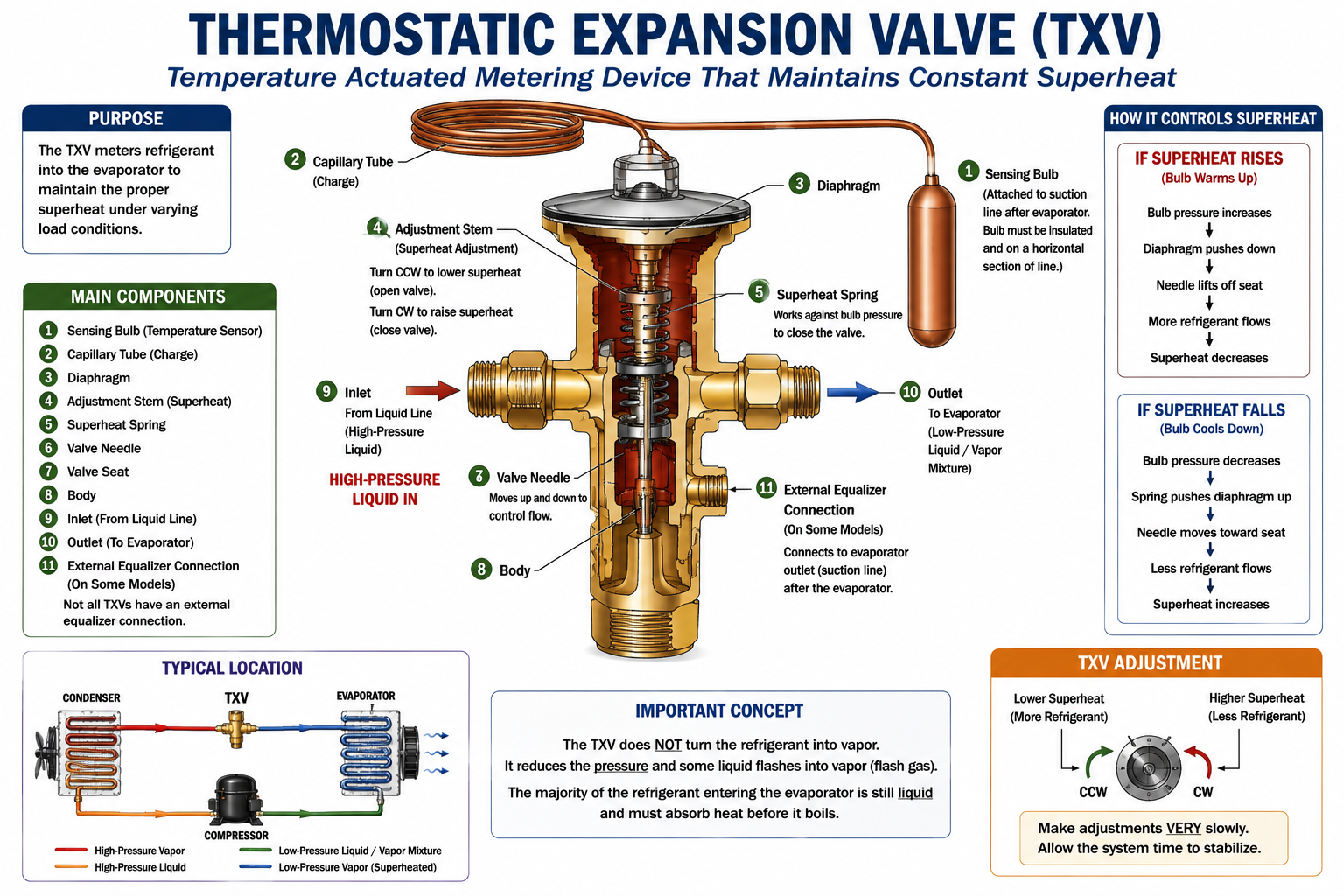
Although TXV designs vary, the basic operating principle depends on several common components working together.
Sensing Bulb
The sensing bulb is attached to the suction line at the evaporator outlet. It responds to the temperature of the suction line and develops pressure that acts on the valve diaphragm.
Power Element and Diaphragm
Pressure from the sensing bulb acts on the diaphragm and creates the primary force that tends to open the valve.
Needle
The needle moves with the valve mechanism. Its position determines how large the refrigerant opening is.
Seat
The seat is the stationary surface against which the needle moves. Movement between the needle and seat changes refrigerant flow through the valve.
Spring
The spring applies a closing force to the valve. On adjustable TXVs, changing spring tension changes the superheat setting.
Refrigerant Ports
High-pressure liquid refrigerant enters the valve through the inlet and leaves toward the evaporator as a low-pressure liquid/vapor mixture after passing through the restriction.
The needle and seat form the actual variable restriction. As the needle moves away from the seat, the opening becomes larger and refrigerant flow increases. As the needle moves toward the seat, the opening becomes smaller and refrigerant flow decreases.
The TXV Watches the Evaporator Outlet
The sensing bulb is mounted on the suction line after the evaporator. Its job is to respond to the temperature of the refrigerant line at the evaporator outlet.
The bulb contains a charge that develops pressure as bulb temperature changes. That pressure is transmitted through the capillary tube to the power element above the diaphragm.
Evaporator outlet temperature changes
Sensing-bulb pressure changes
Diaphragm force changes
Valve opening changes
The sensing bulb responds to evaporator outlet temperature, but the TXV is not controlled by bulb temperature alone. Evaporator pressure and spring pressure oppose the bulb force. The position of the valve results from the balance of all three forces.
What Opens and Closes the Valve?
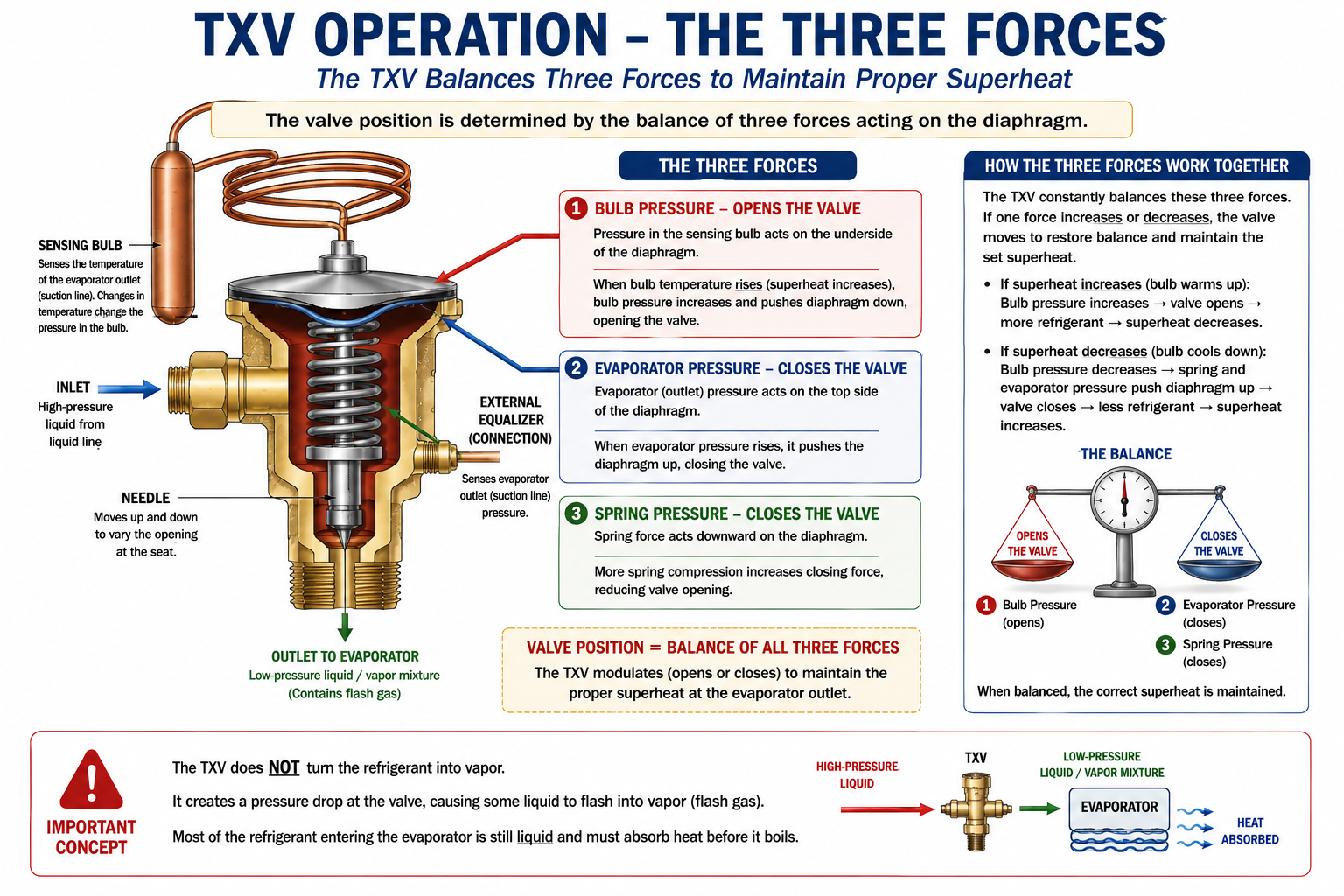
Sensing-Bulb Pressure
Pressure from the sensing bulb acts on the top side of the diaphragm and tends to push the valve open.
Evaporator Pressure
Evaporator pressure acts against the diaphragm and tends to push the valve toward the closed position.
Spring Pressure
The valve spring adds another closing force. On an adjustable TXV, spring pressure is the force that can be changed by the adjustment mechanism.
During stable operation, these forces continually work against one another. A change in one force causes the valve to move until a new operating balance is reached.
A TXV operates by continually seeking a balance between the opening force created by the sensing bulb and the closing forces created by evaporator pressure and spring pressure.
How Does the TXV Respond to More Heat?
Suppose more heat enters the conditioned space or refrigerated product. The evaporator must absorb a greater heat load.
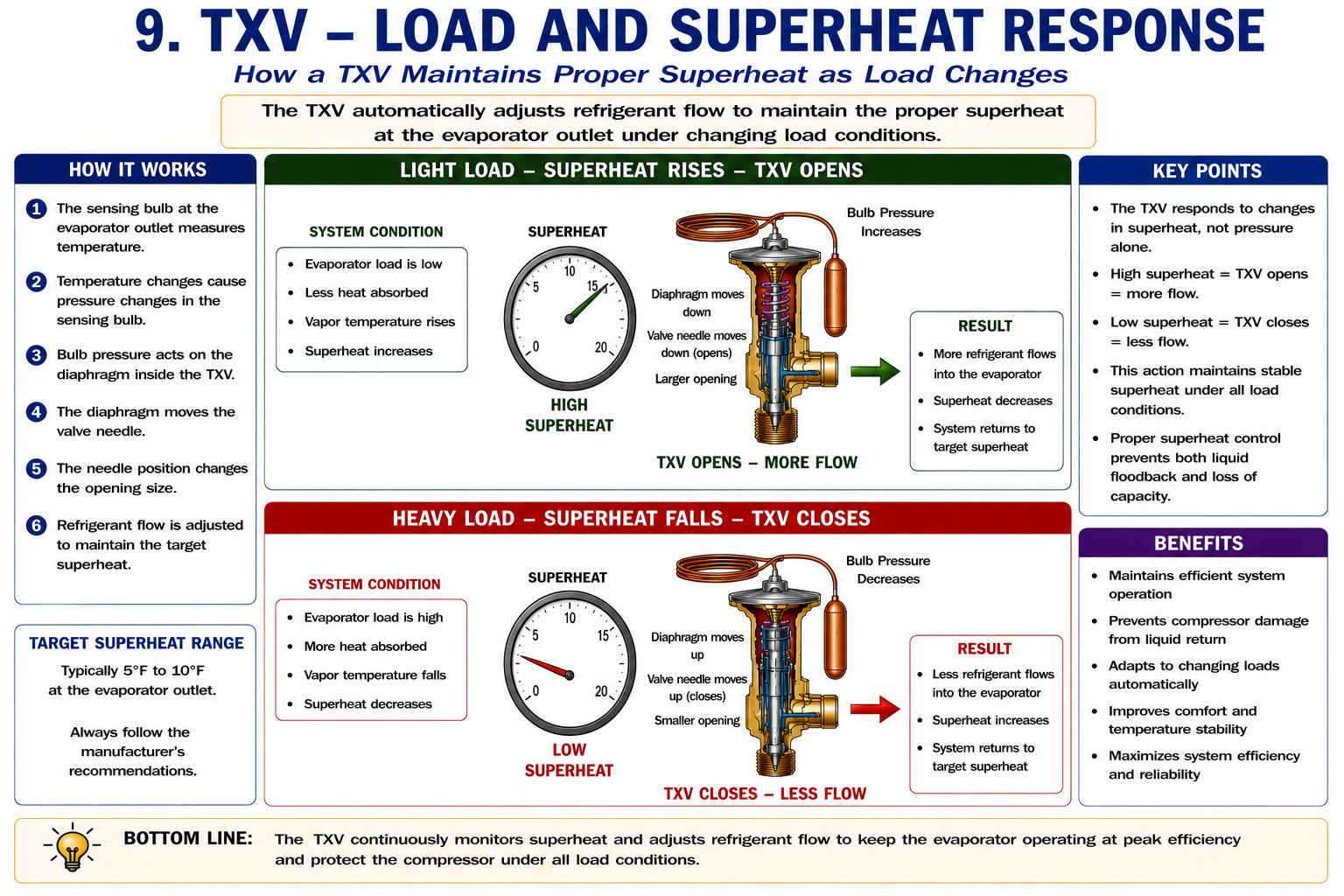
Evaporator load increases.
More heat is available for the refrigerant to absorb.
The evaporator outlet tends to become warmer.
The higher outlet temperature increases the temperature of the sensing bulb.
Sensing-bulb pressure increases.
The opening force acting on the diaphragm becomes greater.
The valve opens farther.
The needle moves away from the seat and the available refrigerant-flow area increases.
More refrigerant enters the evaporator.
The increased refrigerant feed helps the evaporator handle the greater heat load.
The original course summarizes this sequence as the sensing bulb warming, the valve opening, more liquid entering the evaporator, and superheat decreasing. :contentReference[oaicite:2]{index=2}
How Does the TXV Respond to Less Heat?
When the evaporator load decreases, less heat is available to boil the refrigerant being fed into the coil. The TXV responds by moving toward a more closed position.
Evaporator load decreases.
Less heat is being transferred into the refrigerant.
The evaporator outlet tends to become cooler.
The sensing bulb responds to the lower suction-line temperature.
Sensing-bulb pressure decreases.
The opening force acting on the diaphragm becomes weaker.
The closing forces become relatively stronger.
Evaporator pressure and spring pressure move the valve toward the closed position.
Refrigerant flow decreases.
Less refrigerant is fed into the evaporator as the cooling load decreases.
The original course describes this as the bulb cooling, pressure on the diaphragm decreasing, the valve moving toward closed, refrigerant flow decreasing, and superheat rising. :contentReference[oaicite:3]{index=3}
Building on the Evaporator Lesson
You already learned how evaporator superheat is determined and what it tells the technician about refrigerant condition at the evaporator outlet. This lesson does not repeat that calculation.
Instead, the important point here is that a TXV uses evaporator outlet conditions as part of a feedback process that regulates refrigerant entering the evaporator.
More Refrigerant Is Needed
The sensing-bulb opening force increases and the TXV moves farther open.
Less Refrigerant Is Needed
The bulb opening force decreases and the closing forces move the TXV toward closed.
The primary purpose of the TXV is to regulate refrigerant feed in response to evaporator outlet conditions so the evaporator operates at the intended superheat. A different device, the automatic expansion valve, is designed around maintaining evaporator pressure and will be covered later.
The TXV Is Still a Metering Device
Although the TXV has a more sophisticated control mechanism than a capillary tube or fixed orifice, the refrigerant-state change across the device remains the same.
Liquid refrigerant from the liquid line reaches the TXV inlet.
The pressure drop causes part of the refrigerant to become flash gas while the remaining liquid enters the evaporator.
A TXV does not send only vapor into the evaporator. High-pressure liquid enters the TXV and a low-pressure liquid/vapor mixture leaves it. The remaining liquid must still absorb heat and boil in the evaporator.
TXV Operation Is a Balancing Process
The TXV does not normally remain at one fixed opening. Changes in evaporator load, suction-line temperature, and evaporator pressure continually change the forces acting on the valve.
Bulb Force Increases
The valve tends to move farther open.
Bulb Force Decreases
The closing forces tend to move the valve toward closed.
Evaporator Pressure Changes
The closing force acting against the diaphragm changes.
System Reaches a New Balance
The valve settles at a new position appropriate for the present operating conditions.
A TXV controls refrigerant flow into the evaporator. It cannot correct an improperly charged system, contamination, incorrect airflow, an undersized or oversized valve, or other system problems simply by opening or closing.
Vocabulary You Should Know
TXV
Thermostatic Expansion Valve. A modulating refrigerant metering device.
Sensing Bulb
The temperature-responsive bulb attached to the suction line at the evaporator outlet.
Power Element
The bulb, connecting capillary tube, and diaphragm assembly that develops the TXV opening force.
Needle and Seat
The parts that form the variable refrigerant opening inside the valve.
Spring Pressure
The mechanical closing force that helps establish the TXV superheat setting.
Evaporator Pressure
A closing force acting against the diaphragm and opposing sensing-bulb pressure.
Follow TXV Operation Step by Step
High-pressure liquid refrigerant reaches the TXV from the liquid line.
The sensing bulb responds to suction-line temperature at the evaporator outlet.
Bulb pressure creates the primary force that tends to open the valve.
Evaporator pressure and spring pressure oppose the bulb pressure and tend to close the valve.
The balance of these three forces determines needle position and therefore refrigerant flow.
When evaporator load increases, the TXV generally opens farther and supplies more refrigerant.
When evaporator load decreases, the valve moves toward closed and refrigerant flow decreases.
The TXV continually modulates refrigerant feed to maintain the intended evaporator superheat.
Can You Explain TXV Operation?
You should be able to answer these questions before continuing.
- What is the basic purpose of a thermostatic expansion valve?
- How does a TXV differ from a fixed-orifice metering device?
- Where is the TXV sensing bulb located?
- What does the sensing bulb respond to?
- What two components form the variable refrigerant restriction inside the TXV?
- What force tends to open the TXV?
- What two forces tend to close the TXV?
- What generally happens to the valve when evaporator load increases?
- What generally happens to refrigerant flow when evaporator load decreases?
- What is the state of refrigerant entering the TXV?
- What is the state of refrigerant leaving the TXV and entering the evaporator?
- Why does a TXV continually move toward a new equilibrium during operation?
What You Should Have Learned
A thermostatic expansion valve is a modulating metering device that changes refrigerant flow as evaporator operating conditions change.
The TXV sensing bulb is mounted at the evaporator outlet and develops pressure in response to suction-line temperature.
Sensing-bulb pressure creates the primary TXV opening force.
Evaporator pressure and spring pressure create closing forces that oppose the sensing-bulb pressure.
The balance of the three operating forces determines the position of the needle relative to the seat and therefore the amount of refrigerant flow.
As evaporator load increases, the TXV generally opens farther and feeds more refrigerant into the evaporator.
As evaporator load decreases, the TXV moves toward closed and refrigerant flow decreases.
The TXV regulates evaporator refrigerant feed to maintain the intended superheat rather than maintaining a fixed refrigerant-flow rate.