Services
The electrical service is the connection between the serving utility and the premises wiring system. Service installations are governed primarily by NEC Article 230 and include important requirements for service conductors, service equipment, disconnecting means, overcurrent protection, grounding, bonding, capacity, location, and installation methods.
This lesson explains the basic structure of an electrical service, the significance of the service point, the difference between utility conductors and premises service conductors, and the Code-navigation process used to analyze service questions on the NASCLA Electrical Contractor examination.
From the Serving Utility to the Premises Wiring
The NEC defines a service as the conductors and equipment connecting the serving utility to the wiring system of the premises served. This definition makes the service a distinct portion of the electrical distribution system rather than simply another feeder.
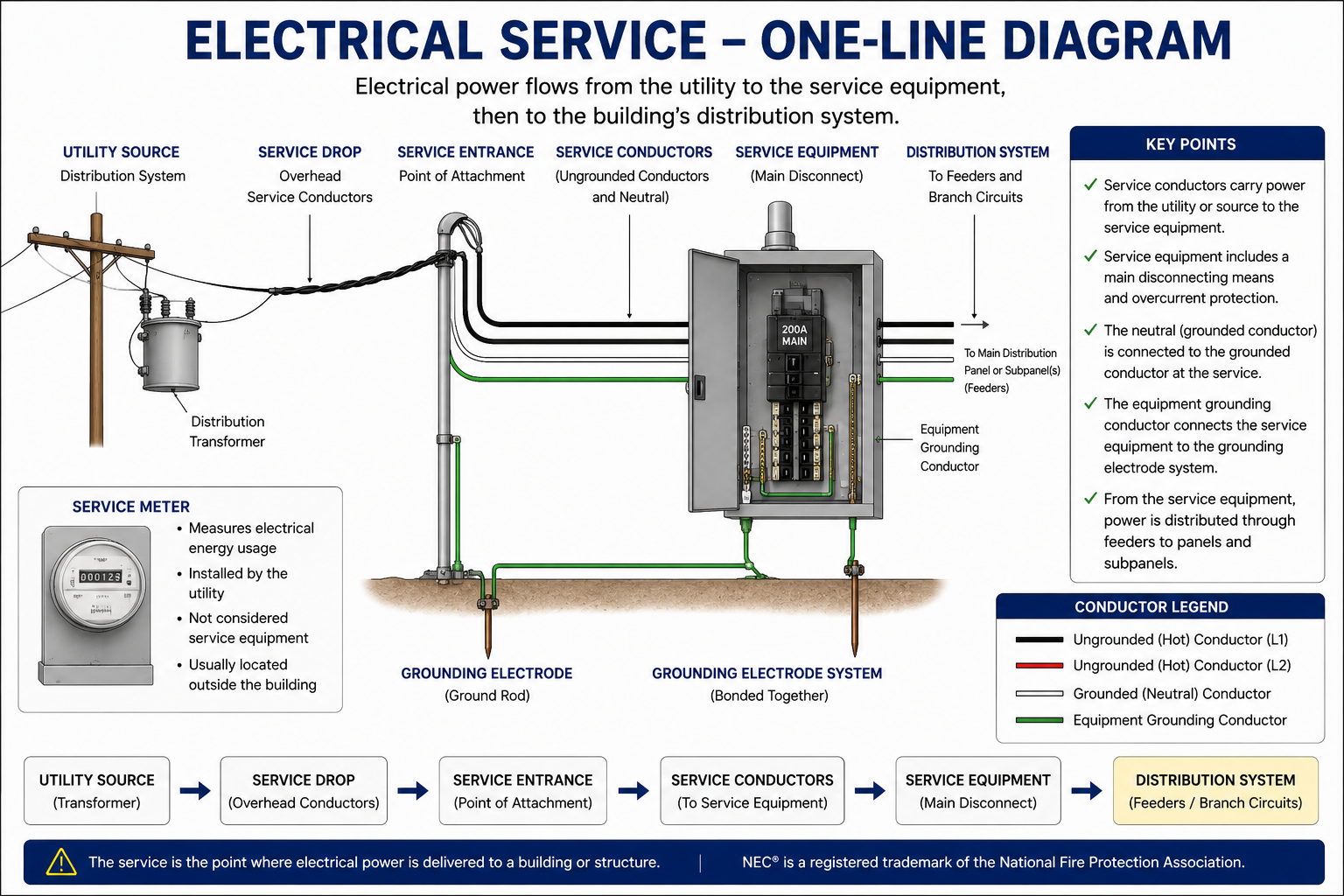
A typical service includes a service point, service conductors, metering equipment where required by the utility, service disconnecting means, service overcurrent protection, and service grounding and bonding connections. The exact physical arrangement varies with utility requirements and whether the service is overhead or underground.
What Is an Electrical Service?
An electrical service consists of the conductors and equipment that connect the serving utility to the premises wiring system. The service therefore occupies a specific location in the overall electrical distribution system and is governed by rules that differ from feeder and branch-circuit requirements.
Serving Utility
The serving utility supplies electrical energy to the premises and generally establishes the conditions and location of the service connection.
Service Point
The service point is the point of connection between the serving utility facilities and the premises wiring. It establishes the important boundary between utility-controlled wiring and premises wiring.
Service Conductors
Service conductors extend from the service point to the service disconnecting means and are subject to the applicable Article 230 requirements.
Service Equipment
Service equipment contains the main control and disconnecting means for the supply from the serving utility.
Find the Service Point First
When analyzing a service diagram, identify the service point before deciding which conductors are governed by NEC service-conductor rules. Conductors on the serving-utility side of the service point are generally utility facilities, while conductors on the premises side of the service point can be NEC service conductors until the service disconnecting means is reached.
Where the Service Fits in the System
The service forms the upstream portion of a typical utility-supplied premises distribution system. Feeders and branch circuits are located downstream of the service equipment.
Utility Distribution System
The serving utility distributes electrical energy through its transmission and distribution system to the location being served.
Service Point
The service point establishes the point of connection between the utility facilities and the premises wiring system.
Service Conductors
Service conductors carry electrical energy from the service point toward the service disconnecting means.
Service Equipment
The service equipment provides the main control and disconnecting means and normally includes the service overcurrent protective device or devices.
Feeders
Conductors leaving the load side of service equipment can supply downstream panelboards or other distribution equipment as feeders.
Branch Circuits
Final branch-circuit overcurrent protective devices supply branch circuits that deliver electrical energy to outlets and utilization equipment.
The Utility-Premises Boundary
The service point is one of the most important definitions in a service installation because it determines where the serving utility facilities end and premises wiring begins. The exact location is normally established by the serving utility and can differ between installations.
In one overhead installation, the service point may be at the building connection. In another arrangement, utility rules may establish the service point at a different location. Underground installations likewise vary depending on utility ownership and the point where the utility system connects to the premises wiring.
Do Not Assume the Meter Is the Service Point
The location of the meter does not by itself define the service point. Metering equipment may be located on either side of a particular service boundary depending on utility requirements and installation design. Use the service-point definition and the information provided in the examination question rather than assuming that the meter marks the NEC boundary.
Overhead Service Arrangements
An overhead electrical service commonly involves utility conductors approaching a building or structure through the air and connecting to the premises wiring at the service point. The exact terminology used for the conductors depends on which side of the service point they are located.
Utility-Side Conductors
Conductors controlled by the serving utility on the utility side of the service point are not premises service conductors merely because they physically extend toward the building.
Service Conductors
Once the premises wiring begins at the service point, the conductors extending toward the service disconnecting means are service conductors.
Point of Attachment
Overhead services require suitable mechanical support, clearances, weather protection, and other installation features governed by Article 230 and utility requirements.
Service Head
Where raceways or service-entrance cable arrangements require protection against moisture entry, listed fittings or service-head arrangements are used as required by the wiring method and installation.
Underground Service Arrangements
An underground electrical service carries electrical energy from an underground utility distribution system toward the service equipment. As with overhead installations, the location of the service point determines which conductors are utility facilities and which are premises service conductors.
Underground services require attention to raceway or cable type, physical protection, burial or installation depth where applicable, entrance into the building or equipment, conductor ratings, and utility specifications. Required depth and protection cannot be reduced to one universal dimension because the applicable wiring method and installation conditions control the requirement.
The Main Control and Disconnect
Service equipment consists of the necessary circuit breakers, switches, fuses, and associated accessories connected to the serving utility and intended to constitute the main control and disconnect of the supply. Service equipment therefore has a specific Code function rather than simply referring to every component near the electrical service.
For example, metering equipment may be installed as part of the physical service arrangement, but a meter enclosure is not automatically service equipment unless it performs the functions required by the applicable definition and listing.
Service Equipment Is a Functional Definition
Do not label every enclosure between the utility and the building distribution system as service equipment. Determine which equipment actually provides the main control and disconnect of the serving-utility supply and whether it is identified and installed as service equipment.
Disconnecting the Premises from the Supply
The service disconnecting means provides a means to disconnect the premises wiring from the serving utility. Article 230 establishes requirements for the number, arrangement, location, grouping, accessibility, ratings, and identification of service disconnecting means.
Current NEC editions include significant requirements affecting emergency disconnects and service disconnect arrangements for certain dwelling installations. Because these provisions are edition-sensitive, examination questions should be answered from the Code edition specified for the NASCLA examination rather than from memory of a different edition.
The Service Must Be Adequate for the Calculated Load
A service must have sufficient capacity to supply the calculated premises load. Service load calculations are performed using Article 220 and any additional provisions applicable to the occupancy and connected equipment.
The calculated load is used along with applicable conductor-ampacity, equipment-rating, service-size, and overcurrent-protection requirements. As with feeder calculations, the calculated load is one step in the process and should not be treated as the automatic final rating of every service component.
Why Service Conductors Are Different
Service conductors occupy a unique position in the electrical system because they are located ahead of the service disconnect and service overcurrent protective device. They therefore do not have the same premises overcurrent-protection arrangement as feeder and branch-circuit conductors located downstream of service equipment.
This difference is one reason the NEC contains specific rules for service conductor installation, physical protection, routing, insulation, sizing, and separation from other conductors.
Service Conductors Are Not Feeders
Conductors between the service point and the service disconnecting means are service conductors, not feeder conductors. Feeders are located downstream of the service equipment or originate from another permitted source and extend toward the final branch-circuit overcurrent protective devices.
The Service Is the Principal Bonding Location
At a typical utility-supplied service, the grounded service conductor is bonded to the service equipment enclosure and equipment grounding terminal through the main bonding jumper. This connection establishes the effective ground-fault current path between grounded and normally non-current-carrying conductive parts at the service.
The grounding electrode conductor connects the grounded service conductor or permitted service grounding point to the grounding electrode system. This connection to earth performs a different function from the equipment grounding and bonding path used to carry ground-fault current back toward the source.
Earth Is Not the Normal Fault-Current Return Path
The grounding electrode system connects the electrical system to earth, but the earth is not relied upon as the effective low-impedance path for clearing ordinary ground faults. Equipment grounding conductors, bonding conductors, metallic bonding paths, and the service bonding connection establish the effective ground-fault current path back toward the source.
General Rule for the Number of Services
Article 230 establishes a general principle that a building or other structure is supplied by only one service unless one of the specific permitted conditions allows additional services. These permissions address defined circumstances such as special occupancies, special capacity requirements, different characteristics, fire pumps, and other Code-recognized conditions.
When an examination question shows multiple supplies to one building, do not immediately assume that the arrangement violates the NEC. Determine whether the supplies are actually separate services and then check whether an Article 230 permission applies.
How to Analyze a Service Question
Locate the Service Point
Determine where the serving utility facilities end and the premises wiring begins.
Identify the Service Conductors
Follow the conductors from the service point to the service disconnecting means.
Identify the Service Equipment
Determine which equipment provides the main control and disconnect of the serving-utility supply.
Determine the Calculated Load
Use the applicable Article 220 load-calculation provisions and specialized equipment requirements.
Check Conductor Requirements
Verify conductor ampacity, wiring method, clearances, physical protection, routing, insulation, and other applicable service-conductor requirements.
Check Disconnecting and Protection Requirements
Verify the service disconnecting means, service equipment rating, overcurrent protection, identification, accessibility, and applicable emergency-disconnect provisions.
Check Grounding and Bonding
Confirm the main bonding jumper, grounded service conductor, grounding electrode conductor, grounding electrode system, and equipment-bonding relationships.
Do Not Begin with Conductor Size
Service questions often include enough information to tempt you into immediately calculating conductor size. First identify the service point, service conductors, service equipment, system voltage, load, and applicable service configuration. Correctly classifying the installation determines which NEC rules and tables should be used.
Electrical Services
Service
The service is the conductors and equipment connecting the serving utility to the premises wiring system.
Service Point
The service point marks the connection between serving-utility facilities and premises wiring and is generally established by the utility.
Service Conductors
Service conductors extend from the service point to the service disconnecting means.
Service Equipment
Service equipment provides the main control and disconnect of the serving-utility supply.
Article 230
Article 230 contains the primary NEC requirements governing services, service conductors, service equipment, and service disconnecting means.
Grounding and Bonding
The service bonding arrangement establishes an effective fault-current path, while the grounding electrode system connects the electrical system to earth for its separate grounding functions.
Lesson 31 — Service Conductors and Service Equipment
The next lesson examines the service in greater detail, including overhead and underground service conductors, conductor installation requirements, service disconnects, and the equipment that forms the main control and protection point for the premises wiring system.
Return to Part IV
Review the complete Wiring and Protection lesson sequence or continue directly to Lesson 31.