Sensible Heat, Latent Heat, and Specific Heat
Not all added or removed heat produces a temperature change. Sometimes heat changes the temperature of a substance, and at other times heat changes the physical state of that substance while its temperature remains essentially constant.
These distinctions are fundamental to refrigeration. Refrigerants absorb and reject large quantities of heat during evaporation and condensation, making latent heat especially important to the operation of the refrigeration cycle.
What You Will Learn
By the end of this lesson you should be able to:
Define sensible heat.
Explain how sensible heat changes the temperature of a substance without changing its physical state.
Define latent heat.
Explain how latent heat changes the state of a substance without producing an immediate temperature change.
Recognize common phase changes.
Identify melting, freezing, vaporization, condensation, and sublimation.
Explain specific heat.
Describe why different substances require different amounts of heat for the same mass and temperature change.
Follow a heating curve.
Distinguish temperature-changing regions from phase-change regions as heat is added to a substance.
Relate latent heat to refrigeration.
Explain why evaporation and condensation make refrigerants effective heat-transfer media.
Sensible Heat Changes Temperature — Latent Heat Changes State
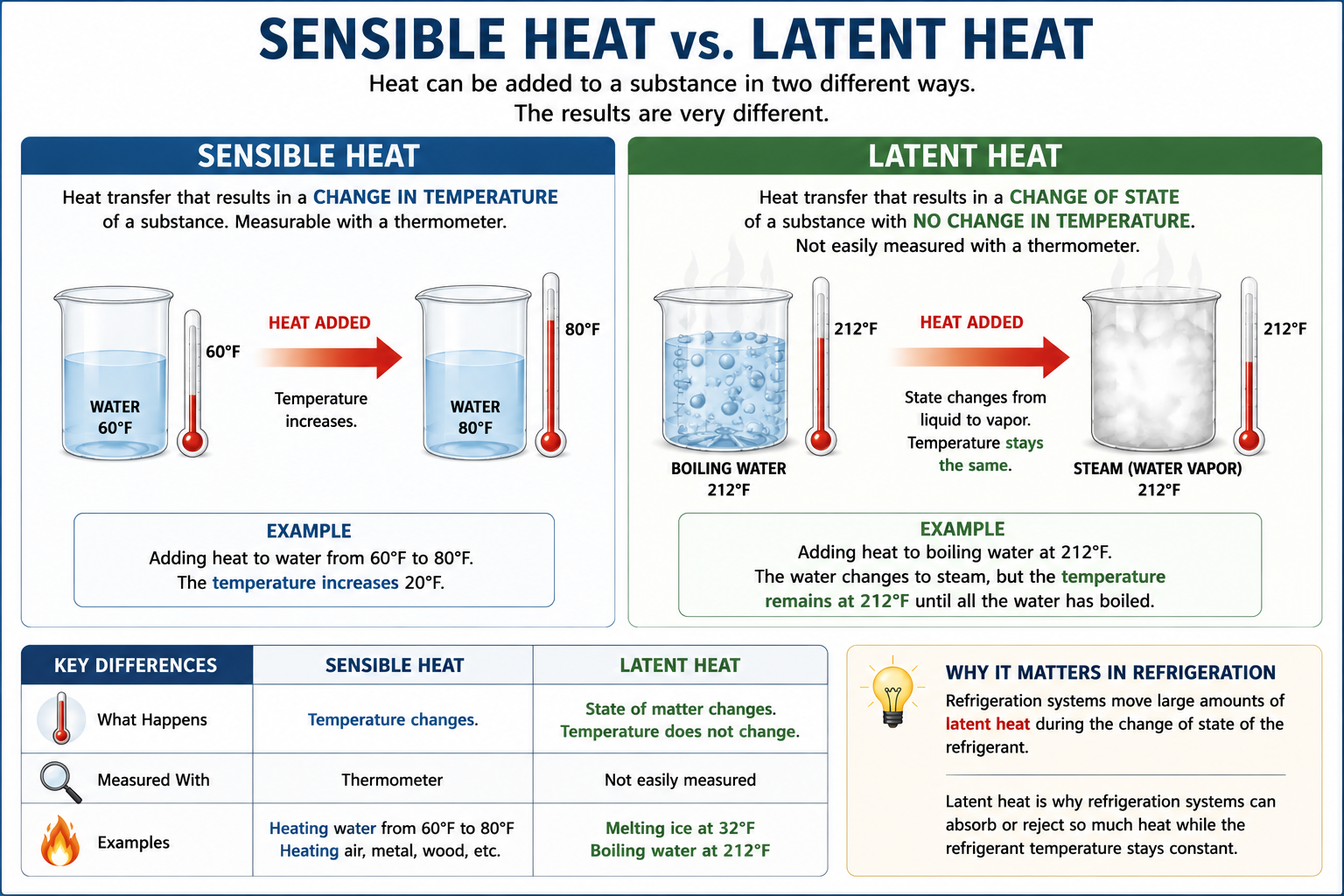
Temperature Changes
Sensible heat is heat transfer that causes the temperature of a substance to rise or fall while the substance remains in the same physical state.
State Changes
Latent heat is heat transfer associated with a change of state. During the phase change, the temperature remains essentially constant while energy is absorbed or released.
If water warms from 70°F to 80°F, a thermometer clearly shows the sensible heat change. During boiling, however, large quantities of heat can continue entering the water while its temperature remains at the boiling temperature until the liquid has changed to vapor.
Heat That Changes Temperature
When sensible heat is added to a substance, its temperature increases. When sensible heat is removed, its temperature decreases.
Water before heat is added
→
Water after heat is added
The water began as a liquid and remained a liquid. The added heat changed only its temperature, so the heat transfer was sensible.
Heat That Changes State
During a phase change, energy is used to overcome or strengthen molecular attraction rather than immediately changing temperature.
Water at its boiling point at standard atmospheric pressure
→
Steam at the same saturation temperature
The temperature can remain constant during the phase change even though a substantial amount of energy is being transferred. That energy is called latent heat.
Different Phase Changes Have Different Names
Latent Heat of Fusion
Melting occurs when a solid becomes a liquid. Freezing occurs when a liquid becomes a solid.
Latent Heat of Vaporization
Vaporization occurs when a liquid becomes vapor. Condensation occurs when vapor becomes liquid.
Latent Heat of Sublimation
Sublimation is the direct change between solid and vapor without passing through the liquid state.
Refrigeration systems repeatedly vaporize refrigerant in the evaporator and condense it in the condenser. These two processes move much of the heat handled by the system.
Follow Heat Through Several States of Matter
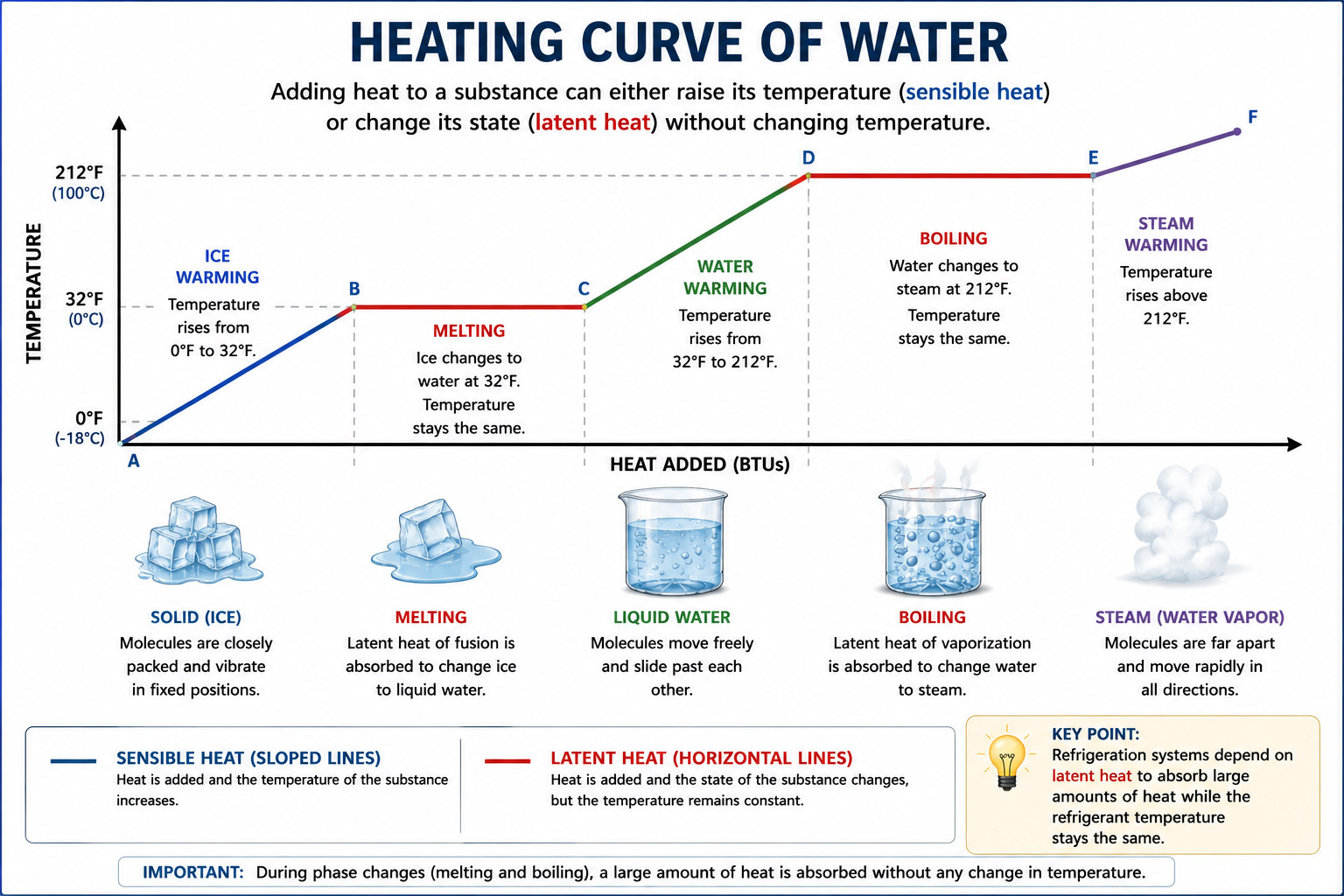
A heating curve is useful because it shows that added heat does not always produce the same result.
Ice Warms
Sensible heat raises the temperature of solid ice until it reaches the melting temperature.
Ice Melts
Latent heat changes solid ice into liquid water while the temperature remains essentially constant.
Liquid Water Warms
Sensible heat raises the temperature of the liquid until it reaches the boiling temperature.
Water Boils
Latent heat changes liquid water into vapor while the temperature remains essentially constant.
Vapor Superheats
After all liquid has become vapor, additional sensible heat raises the vapor temperature above saturation.
Different Substances Respond Differently to Sensible Heat
Specific heat describes the amount of heat required to raise the temperature of one pound of a substance by one degree Fahrenheit.
Heat required to raise 1 pound of a substance by 1°F.
Liquid water is commonly used as the reference and has a specific heat of approximately 1.0 BTU per pound per degree Fahrenheit. Other substances require different amounts of heat for the same temperature change.
Water
BTU/lb·°F
Ice
BTU/lb·°F
Air
BTU/lb·°F
The exact value can vary with conditions. For introductory calculations, representative values are often used to show why equal masses of different materials require different quantities of heat for the same temperature change.
Weight, Specific Heat, and Temperature Change
A basic sensible-heat calculation combines three factors: the amount of material, its specific heat, and the amount of temperature change.
Q = heat transferred, BTU
m = mass or weight of the substance, lb
c = specific heat, BTU/lb·°F
ΔT = temperature difference, °F
How much sensible heat is required to warm 20 pounds of water from 60°F to 70°F?
Q = 20 lb × 1.0 BTU/lb·°F × (70°F − 60°F)
Q = 20 × 1.0 × 10
Phase Change Requires a Large Amount of Energy
The uploaded theory material uses water to demonstrate how much energy can be involved in a phase change. Melting one pound of ice at 32°F requires about 144 BTU while the temperature remains at 32°F. Vaporizing one pound of water at 212°F requires far more heat than simply raising its temperature through many degrees.
Water 32°F → 212°F
Temperature increases through 180°F while the water remains liquid.
Water 212°F → Steam 212°F
State changes from liquid to vapor while temperature remains essentially constant.
Much more energy can be absorbed during vaporization than during a modest sensible temperature increase. Refrigeration systems take advantage of this property by boiling refrigerant inside the evaporator.
Latent Heat Is the Workhorse of the Refrigeration Cycle
Refrigerant Absorbs Latent Heat
Low-pressure liquid refrigerant boils as it absorbs heat. The phase change from liquid to vapor allows the evaporator to absorb a large amount of energy.
Refrigerant Rejects Latent Heat
High-pressure refrigerant vapor condenses as it rejects heat. The phase change from vapor to liquid releases latent heat to the outdoor air or another cooling medium.
Much of the useful heat transfer in a refrigeration system occurs while refrigerant changes state. Understanding this prevents the common mistake of thinking that refrigeration depends only on sensible temperature changes.
Air Conditioning Often Does Both at the Same Time
An air-conditioning evaporator can remove both sensible and latent heat from indoor air.
Sensible Cooling
The dry-bulb temperature of the air decreases as heat is transferred from the air to the evaporator.
Latent Cooling
Water vapor in the air condenses on the cold evaporator surface, removing moisture and latent heat from the air stream.
This relationship becomes especially important later when we study humidity and psychrometrics. For now, remember that comfort cooling involves both lowering air temperature and often removing moisture.
Avoid These Errors
“If heat is being added, temperature must rise.”
Not during a phase change. Heat can be absorbed while temperature remains essentially constant.
“Latent heat means there is no heat transfer.”
The opposite is true. Latent heat can represent a very large amount of energy transfer even though the thermometer does not show a temperature change.
“Every material needs the same heat to change temperature.”
Different substances have different specific heats and therefore require different energy quantities for the same mass and temperature change.
“Evaporator heat transfer is only sensible.”
Refrigerant boiling inside the evaporator absorbs latent heat, while the air stream may experience both sensible and latent cooling.
Can You Identify the Type of Heat Transfer?
- What is sensible heat?
- What is latent heat?
- What happens to temperature during a sensible heat transfer?
- What happens to temperature during an ideal phase change?
- What is melting?
- What is vaporization?
- What is condensation?
- What does specific heat describe?
- Why does water require more sensible heat than the same mass of air for an equal temperature increase?
- What three quantities are used in the basic sensible-heat formula?
- Why is latent heat of vaporization important to the evaporator?
- What form of latent heat is rejected in the condenser?
- How can an air-conditioning evaporator provide both sensible and latent cooling?
- Why can a large amount of heat be transferred without a thermometer showing a temperature change?
What You Should Have Learned
Sensible heat changes the temperature of a substance without changing its state.
Latent heat changes the physical state of a substance while temperature remains essentially constant during the phase change.
Melting and freezing involve latent heat of fusion, while vaporization and condensation involve latent heat of vaporization.
Specific heat describes how much heat is required to change the temperature of a particular mass of a substance.
Sensible heat can be calculated from mass, specific heat, and temperature difference.
A heating curve shows temperature-changing sensible regions and constant-temperature latent phase-change regions.
Refrigerant absorbs large amounts of latent heat while vaporizing in the evaporator.
Refrigerant rejects latent heat while condensing from vapor to liquid in the condenser.