Refrigeration Capacity and the Ton of Refrigeration
Refrigeration equipment must move heat at a sufficient rate to handle the load placed on the system. In HVAC/R work, that heat-transfer rate is commonly expressed in BTU per hour and in tons of refrigeration.
The term “ton” can be confusing because it sounds like a measurement of weight. In refrigeration, however, a ton describes cooling capacity. One ton of refrigeration equals a heat-transfer rate of 12,000 BTU per hour.
What You Will Learn
By the end of this lesson you should be able to:
Distinguish BTU from BTU/hr.
Explain the difference between a quantity of heat and a rate of heat transfer.
Define refrigeration capacity.
Describe capacity as the rate at which a refrigeration system can remove heat.
Define one ton of refrigeration.
Recognize that one ton equals 12,000 BTU/hr.
Explain where the ton came from.
Follow the traditional ice-melting calculation used to define a ton of refrigeration.
Convert tons and BTU/hr.
Perform basic refrigeration-capacity conversions.
Separate capacity from efficiency.
Explain why equipment tonnage does not tell us how efficiently the equipment operates.
Capacity Is a Rate of Heat Transfer
Refrigeration capacity describes how much heat a system can remove over a period of time. In U.S. HVAC/R work, capacity is commonly expressed in BTU per hour or tons of refrigeration.
Quantity of Heat
A BTU describes an amount of thermal energy.
Rate of Heat Transfer
BTU per hour describes how quickly heat is being transferred.
A 36,000 BTU/hr air conditioner is capable of removing heat at a nominal rate of 36,000 BTU per hour under its rated conditions. The number does not mean the equipment can remove only 36,000 BTU during its entire life.
One Ton Equals 12,000 BTU per Hour
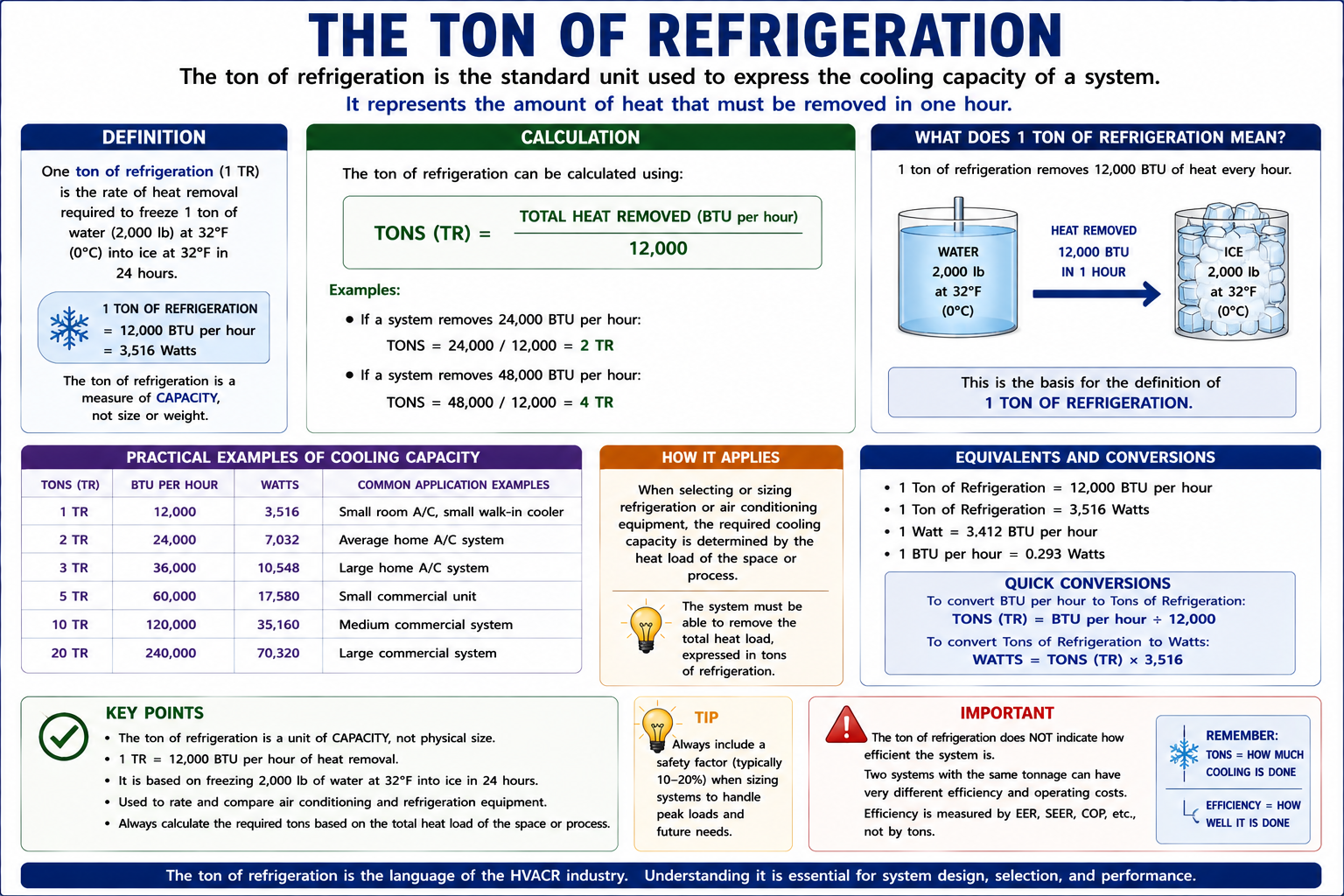
The word “ton” in this context refers to refrigeration capacity, not the physical weight of the air conditioner or refrigerant.
The Ice-Melting Definition
The traditional definition of a ton of refrigeration comes from the amount of heat required to melt one ton of ice over a 24-hour period.
One Ton of Ice
Latent Heat of Fusion
Total Heat
288,000 BTU
Total heat over 24 hours
24 Hours
One day
12,000 BTU/hr
One ton of refrigeration
Refrigeration Capacity Predates Modern Mechanical Cooling
Before widespread mechanical refrigeration, ice was commonly used for cooling. The cooling effect of melting ice provided a familiar way to compare the capacity of early refrigeration machines.
A machine capable of removing heat at the same average rate as melting one ton of ice in 24 hours was described as having one ton of refrigeration capacity.
The ice itself is only the historical reference. Modern refrigeration equipment does not need to produce or melt ice to be rated in tons.
Convert Tons to BTU/hr
Convert Tons to BTU/hr
A residential air-conditioning system is rated at 3.5 tons. What is the nominal cooling capacity in BTU/hr?
BTU/hr = 3.5 × 12,000
Convert BTU/hr to Tons
An air-conditioning system is rated at 30,000 BTU/hr. What is its nominal capacity in tons?
Tons = 30,000 ÷ 12,000
Rated Tonnage Does Not Mean Constant Capacity
A system described as three tons is commonly referred to as a nominal 36,000 BTU/hr system. Actual operating capacity can vary with equipment design and operating conditions.
Indoor Temperature
Changes in indoor sensible and latent load affect system performance.
Indoor Humidity
Moisture removal consumes part of the system’s total cooling capacity.
Outdoor Temperature
Higher outdoor temperature generally increases condenser load and changes system capacity.
Airflow
Incorrect airflow can reduce useful capacity and change evaporator operation.
Refrigerant Conditions
Improper charge, restrictions, or component problems can reduce actual heat-transfer capacity.
Equipment Design
Variable-capacity and inverter-driven systems may operate over a wide range of capacities rather than at one fixed output.
The nominal equipment rating identifies the system’s general capacity class. Determining actual delivered cooling requires operating measurements and appropriate performance data.
Cooling Capacity Can Be Used in Different Ways
Air-conditioning equipment commonly performs both sensible cooling and latent cooling.
Lowers Air Temperature
Heat removal that reduces dry-bulb temperature without directly representing moisture removal.
Removes Moisture
Cooling capacity used to condense water vapor from the air stream.
Sensible + Latent
The total cooling effect produced by the equipment.
How that total capacity divides between sensible and latent cooling depends on equipment design and operating conditions.
The Equipment Must Match the Heat Gain
The cooling load is the rate at which heat enters the space or must otherwise be removed. Equipment capacity is the rate at which the refrigeration system can remove that heat.
Heat Entering
Solar gain, outdoor air, people, lighting, equipment, infiltration, products, and other sources add heat.
Heat Removed
The refrigeration system must remove heat at a rate appropriate for the load.
Capacity Lower Than the Load
If the heat load is greater than the available refrigeration capacity, the system may operate continuously and still be unable to maintain the desired temperature.
Heat Load
Available Capacity
Temperature Rises
The system cannot remove heat as quickly as it enters.
More Capacity Is Not Always Better
An oversized air-conditioning system may satisfy the sensible temperature load very quickly but operate for short cycles.
Shorter Run Time
The thermostat can be satisfied before the equipment has operated long enough for steady moisture removal.
Humidity Control
Short cycling can reduce latent performance and leave the conditioned space uncomfortable even at the desired temperature.
Equipment Cycling
Frequent starting and stopping can affect comfort and equipment operation.
Variable-Capacity Systems
Modern variable-capacity equipment can reduce output at partial load, which changes some traditional oversizing concerns.
A Larger System Is Not Automatically More Efficient
Tonnage tells us how much heat the system is designed to move. Efficiency describes how much energy is required to produce that cooling.
How Much Cooling?
Examples: BTU/hr or tons of refrigeration.
How Much Energy Is Required?
Efficiency is evaluated using separate performance metrics and energy consumption.
The correct capacity is the capacity needed for the application. Larger tonnage simply means greater nominal heat-transfer capability.
The Same Concept Applies Beyond Residential Air Conditioning
Residential Air Conditioning
Equipment is commonly described in nominal tons or thousands of BTU/hr.
Commercial Air Conditioning
Larger packaged equipment and chillers may be rated from several tons to hundreds or thousands of tons.
Walk-In Refrigeration
Capacity may be expressed directly in BTU/hr at specified evaporating and condensing conditions.
Process Refrigeration
Capacity is selected according to the required rate of product cooling or process heat removal.
Capacity Comes From Refrigerant Heat Transfer
The refrigeration system produces capacity by circulating refrigerant and absorbing heat in the evaporator.
Refrigerant Flow
A certain mass of refrigerant moves through the evaporator.
Heat Absorbed per Pound
Each pound of refrigerant absorbs a certain amount of heat as it moves through the evaporator.
Refrigeration Capacity
The rate at which heat is removed from the cooled space.
Later calculations can use refrigerant mass flow and enthalpy differences to determine refrigeration effect and system capacity. The next lesson introduces the pressure-enthalpy diagram used to visualize those relationships.
Avoid These Capacity Errors
“A ton is the weight of the equipment.”
In refrigeration, a ton is a measure of cooling capacity equal to 12,000 BTU/hr.
“BTU and BTU/hr mean the same thing.”
BTU is a quantity of energy. BTU/hr is a rate of energy transfer.
“Three tons means exactly 36,000 BTU/hr under every condition.”
Three tons is a nominal capacity classification. Actual capacity varies with operating conditions and equipment performance.
“Bigger equipment always cools better.”
Equipment should be matched to the load. Excess capacity can create comfort and cycling problems.
“Tonnage tells me efficiency.”
Tonnage describes capacity. Efficiency is a separate measure of energy performance.
“All cooling capacity lowers temperature.”
Air-conditioning capacity can be divided between sensible cooling and latent moisture removal.
Can You Explain Refrigeration Capacity?
- What is refrigeration capacity?
- What is the difference between BTU and BTU/hr?
- How many BTU/hr equal one ton of refrigeration?
- How many pounds are in the traditional ton of ice used in the definition?
- Approximately how many BTU are required to melt one pound of ice at 32°F into water at 32°F?
- How many BTU are required to melt 2,000 pounds of ice?
- Why is the total divided by 24 hours?
- What is the nominal BTU/hr capacity of a 2-ton system?
- What is the nominal tonnage of a 48,000 BTU/hr system?
- Why can actual system capacity differ from nominal tonnage?
- What is sensible cooling capacity?
- What is latent cooling capacity?
- What is total cooling capacity?
- What happens when the heat load is greater than system capacity?
- Why can oversized equipment create comfort problems?
- Why does tonnage not indicate system efficiency?
What You Should Have Learned
Refrigeration capacity describes the rate at which a system removes heat.
BTU describes a quantity of heat, while BTU/hr describes a heat-transfer rate.
One ton of refrigeration equals 12,000 BTU/hr.
The traditional ton of refrigeration comes from melting 2,000 pounds of ice over a 24-hour period.
Melting one ton of ice requires approximately 288,000 BTU, which averages 12,000 BTU/hr over 24 hours.
Tons can be converted to BTU/hr by multiplying by 12,000, and BTU/hr can be converted to tons by dividing by 12,000.
Nominal equipment tonnage does not mean the system produces exactly that capacity under every operating condition.
Total air-conditioning capacity can be divided into sensible and latent cooling capacity.
Equipment capacity should be matched appropriately to the heat load.
Capacity and efficiency describe different aspects of equipment performance.