Pressure, Temperature, and Changes of State
A substance does not always boil or condense at one fixed temperature. The temperature at which a liquid boils or a vapor condenses depends on the pressure acting on that substance.
This pressure-temperature relationship is one of the most important ideas in refrigeration. By controlling refrigerant pressure, a refrigeration system controls the temperature at which refrigerant absorbs and rejects heat.
What You Will Learn
By the end of this lesson you should be able to:
Explain why boiling temperature changes.
Describe how increasing or decreasing pressure changes the temperature at which a liquid boils.
Explain condensation temperature.
Understand that condensation temperature is also determined by pressure.
Define saturation.
Recognize the condition where liquid and vapor can exist together at a corresponding pressure and temperature.
Identify saturated liquid and saturated vapor.
Distinguish the liquid and vapor conditions at the boundaries of a phase change.
Relate pressure to evaporator temperature.
Explain why low-side pressure determines the approximate boiling temperature of saturated refrigerant in the evaporator.
Relate pressure to condenser temperature.
Explain why high-side pressure determines the approximate condensing temperature of saturated refrigerant in the condenser.
Pressure Changes Boiling Temperature
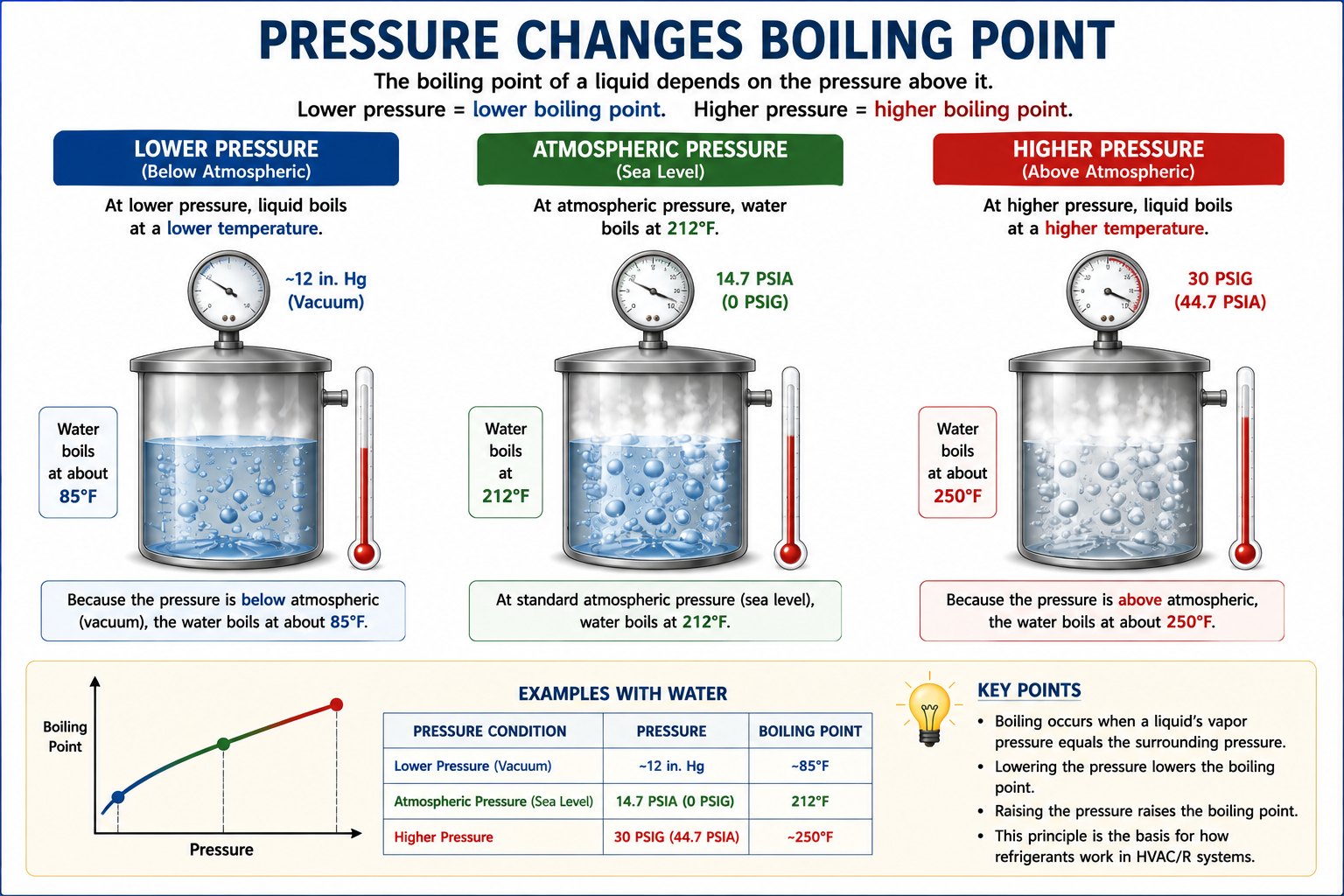
Lower Boiling Temperature
Reducing pressure makes it easier for molecules to escape the liquid and enter the vapor state.
Known Boiling Temperature
At a given pressure, a pure substance has a corresponding saturation temperature.
Higher Boiling Temperature
Increasing pressure makes it more difficult for molecules to escape the liquid, so a higher temperature is required.
The evaporator operates at low pressure so refrigerant can boil at a low temperature. The condenser operates at higher pressure so refrigerant can condense at a higher temperature.
Water Does Not Always Boil at 212°F
Water boils at approximately 212°F only at standard atmospheric pressure. Change the pressure, and the boiling temperature changes.
Water can boil below 212°F.
Water boils at approximately 212°F.
Water must reach a temperature above 212°F before boiling.
A pressure cooker raises the pressure above the water, increasing its boiling temperature and allowing food to cook at a temperature above the normal atmospheric boiling point.
Boiling Is a Change From Liquid to Vapor
When a liquid reaches its saturation temperature at the existing pressure, additional heat can cause the liquid to change into vapor.
Molecules remain primarily in the liquid state.
→
The substance is changing state at saturation.
→
The liquid has completely vaporized.
For a pure refrigerant, or a refrigerant behaving with essentially no glide, a specific saturation pressure corresponds to a specific saturation temperature while liquid and vapor coexist.
The Same Relationship Works in Reverse
Condensation is the change from vapor to liquid. At a given pressure, vapor begins to condense when it reaches the corresponding saturation temperature.
Refrigerant is entirely in the vapor state.
→
Condensation occurs at saturation conditions.
→
The refrigerant has completely condensed.
At the same pressure, the saturation temperature that allows liquid to boil is also the temperature at which vapor can condense.
Saturation Is the Boundary Between Liquid and Vapor
Saturation describes the condition where liquid and vapor can exist together in equilibrium at a corresponding pressure and temperature.
Liquid at the point where the addition of more heat will begin producing vapor.
Liquid and vapor exist together while the phase change is occurring.
Vapor at the point where all liquid has just completed vaporization.
These boundaries matter later. Heating saturated vapor produces superheated vapor. Cooling saturated liquid produces subcooled liquid.
Low Pressure Creates a Low Boiling Temperature
The refrigeration system maintains a relatively low pressure in the evaporator. That low pressure allows refrigerant to boil at a temperature lower than the air, water, or product being cooled.
For heat to flow from indoor air into the evaporator, the evaporator refrigerant must be maintained at a lower temperature than the air passing across the coil.
Higher Pressure Creates a Higher Condensing Temperature
The compressor raises refrigerant pressure before it enters the condenser. At this higher pressure, the refrigerant has a higher saturation temperature.
For heat to leave an air-cooled condenser, the refrigerant must condense at a temperature higher than the outdoor air moving across the condenser coil.
The Compressor Creates the Pressure Difference
The compressor does more than move refrigerant. It creates the pressure difference that allows the evaporator and condenser to operate at different saturation temperatures.
Low Pressure
Allows refrigerant to boil at a low temperature.
Raises vapor pressure
High Pressure
Allows refrigerant to condense at a higher temperature.
The Metering Device Creates the Major Pressure Drop
After refrigerant leaves the condenser as high-pressure liquid, the metering device restricts refrigerant flow and creates the transition into the low-pressure side.
High-Pressure Liquid
Leaving the condenser
Metering Device
Pressure drops sharply
Low-Pressure Refrigerant
Entering the evaporator
The pressure drop across the metering device lowers the refrigerant’s saturation temperature so it can absorb heat at the evaporator.
Refrigerants Are Selected for Useful Phase-Change Temperatures
Water is useful for demonstrating pressure-temperature relationships, but conventional refrigeration systems use refrigerants selected because they can boil and condense at practical temperatures and pressures.
Low-Temperature Boiling
Refrigerants can vaporize at temperatures suitable for air conditioning, refrigeration, and freezing applications.
Controlled Condensation
At higher pressures, refrigerants can condense at temperatures high enough to reject heat to outdoor air or water.
Large Latent Heat Transfer
Phase change allows refrigerants to absorb and reject large quantities of energy.
Repeatable P-T Behavior
Known refrigerant pressure-temperature relationships allow technicians to infer saturation conditions from measured pressure.
Not Every Refrigerant Changes State at One Temperature
The basic pressure-temperature concept is easiest to understand with pure refrigerants and azeotropic refrigerants, where saturation is represented by essentially one temperature at a given pressure.
Some zeotropic refrigerant blends change phase across a range of temperatures at a given pressure. This range is called temperature glide.
Single Saturation Temperature
A given saturation pressure corresponds to essentially one saturation temperature.
Temperature Glide
Phase change occurs across a temperature range between bubble point and dew point.
Temperature glide will be covered in detail in the next lesson when we begin using refrigerant pressure-temperature data.
Avoid These Pressure-Temperature Errors
“Every liquid has one fixed boiling point.”
Boiling temperature changes when pressure changes.
“Lower pressure means refrigerant gets colder by itself.”
Lower pressure lowers saturation temperature. Heat transfer and refrigerant condition determine the actual temperature at a given point.
“Boiling only happens when something is very hot.”
A liquid can boil at very low temperatures if the pressure is low enough.
“All refrigerants have one saturation temperature at each pressure.”
Zeotropic blends can have temperature glide and use bubble and dew temperatures rather than a single phase-change temperature.
Can You Relate Pressure to Phase Change?
- What happens to boiling temperature when pressure is reduced?
- What happens to boiling temperature when pressure is increased?
- Why does water not always boil at 212°F?
- What is vaporization?
- What is condensation?
- What is saturation?
- What is saturated liquid?
- What is saturated vapor?
- Why does the evaporator operate at relatively low pressure?
- Why does the condenser operate at relatively high pressure?
- What role does the compressor play in the pressure-temperature relationship?
- What role does the metering device play?
- Why must evaporator saturation temperature be below the temperature of the material being cooled?
- Why must condenser saturation temperature be above the temperature of the cooling medium?
- What is temperature glide?
What You Should Have Learned
Reducing pressure lowers the temperature at which a liquid boils.
Increasing pressure raises the temperature at which a liquid boils or vapor condenses.
Saturation describes the condition where liquid and vapor can coexist during a phase change.
Saturated liquid is at the beginning of vaporization, while saturated vapor is at the completion of vaporization.
Low evaporator pressure creates a low saturation temperature suitable for absorbing heat.
High condenser pressure creates a higher saturation temperature suitable for rejecting heat.
The compressor creates the high-pressure side, while the metering device creates the major pressure reduction into the low side.
Some refrigerant blends exhibit temperature glide and therefore change state across a temperature range.