Introduction to Metering Devices
The metering device controls the flow of refrigerant into the evaporator and creates the pressure drop that separates the high-pressure side of the refrigeration system from the low-pressure side.
Understanding what happens to the refrigerant as it passes through the metering device is essential before studying capillary tubes, fixed-orifice devices, thermostatic expansion valves, automatic expansion valves, and electronic expansion valves.
What You Will Learn
By the end of this lesson you should be able to:
Locate the metering device in the refrigeration cycle.
Identify the metering device between the high-pressure liquid line and the low-pressure evaporator.
Explain the purpose of the metering device.
Describe how the device controls refrigerant flow and creates the pressure drop between the high side and low side of the system.
Describe the refrigerant entering and leaving the device.
Recognize that high-pressure liquid enters the metering device and a low-pressure liquid/vapor mixture leaves it.
Explain flash gas.
Describe why part of the liquid refrigerant immediately boils after the pressure drop and why the remaining liquid must boil inside the evaporator.
Identify the major types of metering devices.
Recognize capillary tubes, fixed-orifice devices, thermostatic expansion valves, automatic expansion valves, and electronic expansion valves.
Where Is the Metering Device?
The metering device is located between the liquid line and the evaporator. Refrigerant arriving at the metering device is on the high-pressure side of the refrigeration system. Refrigerant leaving the device enters the low-pressure side.
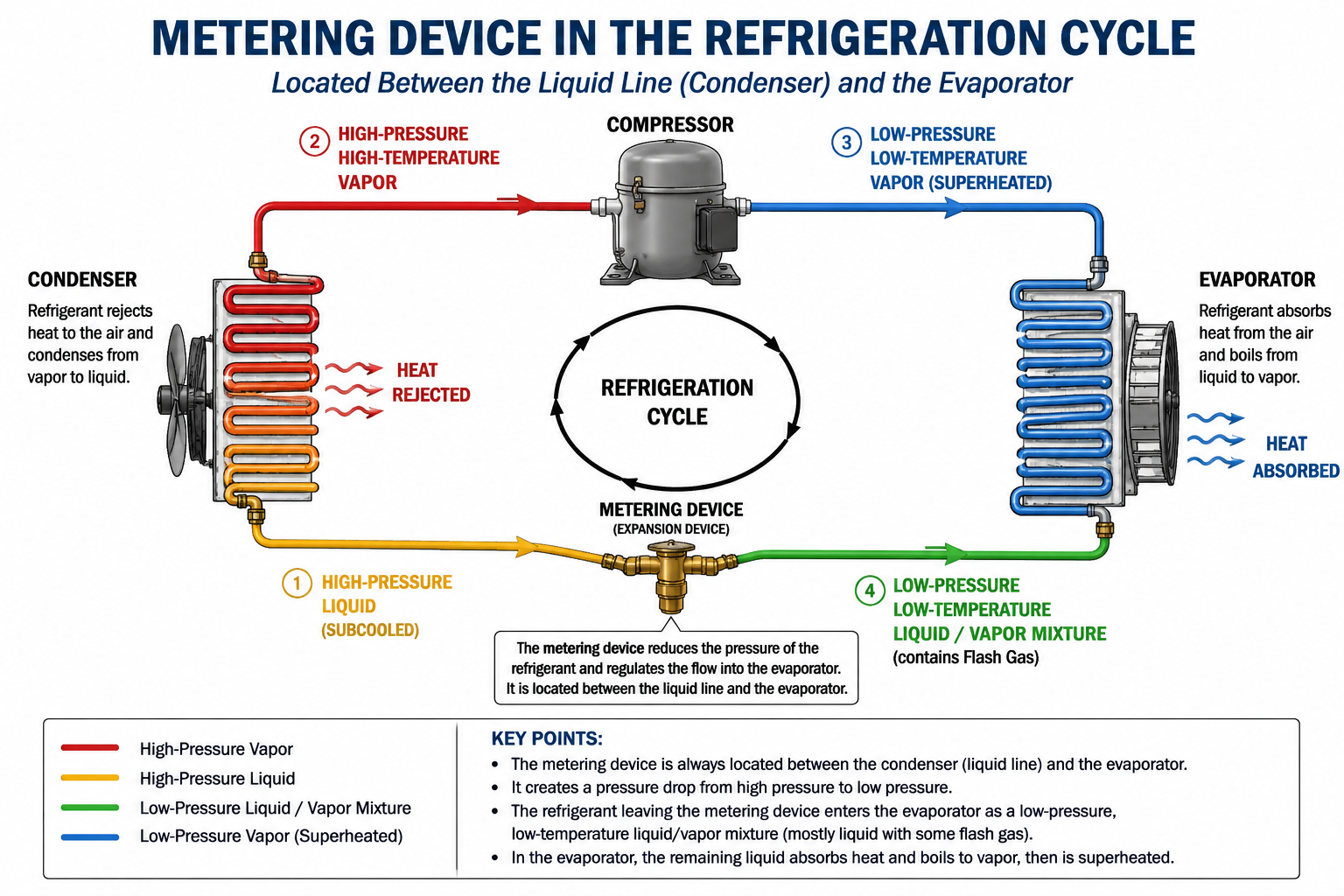
After leaving the condenser, refrigerant travels through the liquid line toward the metering device. Under normal operating conditions, the refrigerant reaching the metering device should be liquid.
The metering device restricts the refrigerant flow. This restriction produces a large pressure drop as the refrigerant passes into the evaporator.
The metering device is the dividing point between the high-pressure liquid side of the refrigeration system and the low-pressure evaporator side.
High-Pressure Liquid Enters the Device
The condenser rejects heat from the refrigerant and changes the refrigerant from vapor to liquid. That liquid then travels through the liquid line toward the metering device.
The refrigerant is on the high-pressure side of the refrigeration system and is normally liquid as it reaches the metering device.
After the pressure drop, part of the liquid has flashed into vapor while the rest remains liquid and enters the evaporator.
This change is sometimes misunderstood. The metering device does not normally change all of the liquid refrigerant into vapor. It lowers the refrigerant pressure, and that pressure reduction causes only part of the liquid to immediately boil.
What Happens as Refrigerant Passes Through the Metering Device?
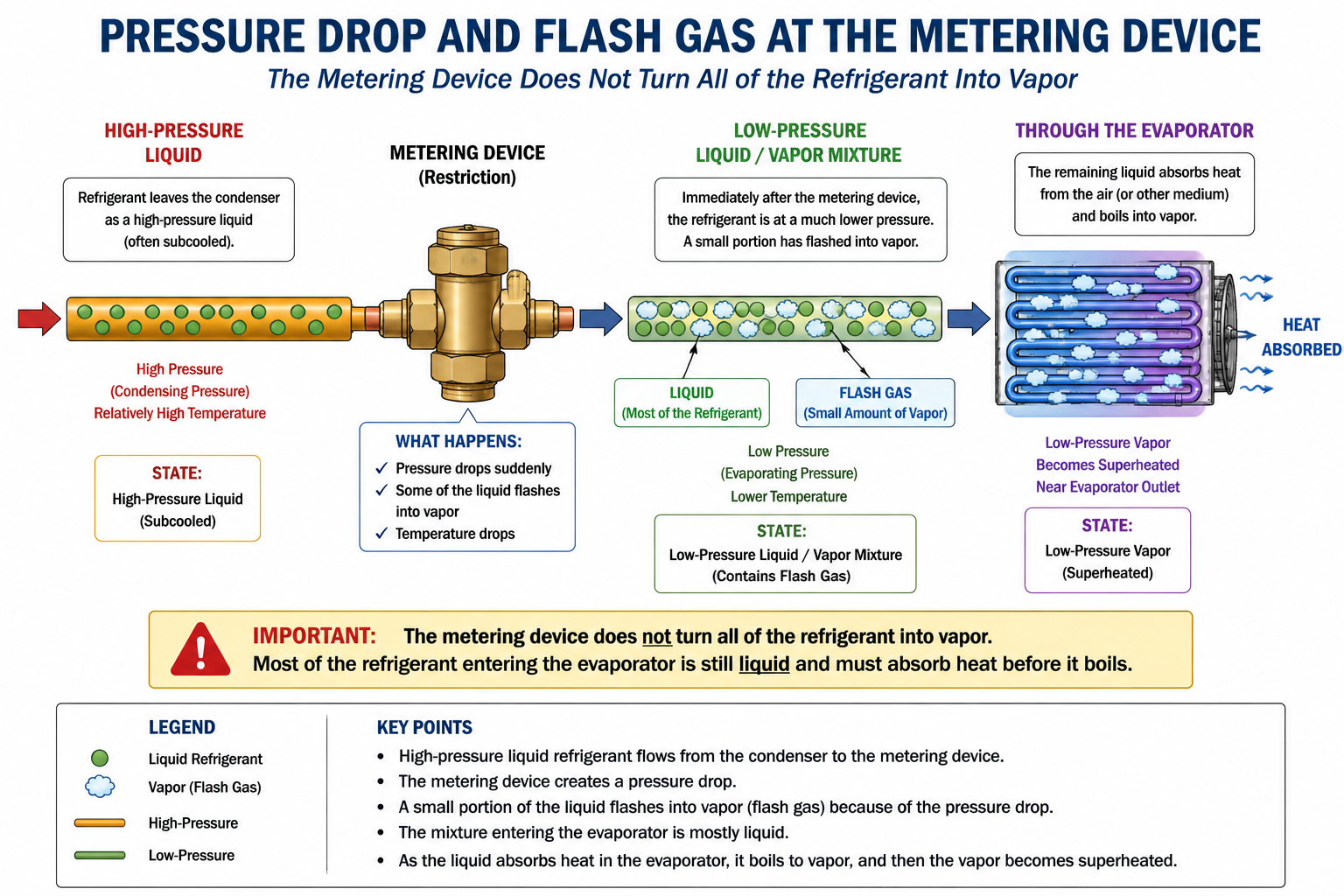
High-pressure liquid arrives.
Liquid refrigerant from the condenser and liquid line reaches the inlet of the metering device.
Refrigerant passes through a restriction.
The metering device restricts refrigerant flow and produces a large pressure drop.
The boiling point drops.
The lower refrigerant pressure corresponds to a lower saturation temperature, allowing some of the liquid refrigerant to boil immediately.
A liquid/vapor mixture enters the evaporator.
Only part of the refrigerant has changed to vapor. The remaining liquid continues into the evaporator where it can absorb heat and boil.
Flash Gas
Flash gas is the portion of liquid refrigerant that immediately changes to vapor because of the sudden reduction in pressure as the refrigerant passes through the metering device.
Imagine high-pressure liquid refrigerant arriving at the metering device. When the refrigerant passes through the restriction, its pressure suddenly falls. At the new lower pressure, some of the liquid immediately boils. That vapor is called flash gas.
The refrigerant entering the evaporator is therefore a mixture. Some of it is already vapor, but a significant portion remains liquid.
The metering device does not boil all of the refrigerant. The pressure drop causes only a portion of the liquid refrigerant to flash into vapor. The remaining liquid refrigerant must absorb heat inside the evaporator before it can boil.
This is why the evaporator can absorb heat. Liquid refrigerant remaining after the metering device boils as it moves through the evaporator, absorbing heat from the air, product, water, or other substance being cooled.
Flash gas is important refrigeration terminology and may appear in certification, national, and EPA-related examination questions. Know both the term and what causes it.
What Does a Metering Device Do?
Controls Refrigerant Flow
The metering device limits and controls the amount of refrigerant that can enter the evaporator.
Creates a Pressure Drop
The restriction reduces the high liquid-line pressure to the much lower pressure required in the evaporator.
Separates High and Low Sides
The metering device establishes the boundary between the high-pressure liquid line and the low-pressure evaporator.
Feeds the Evaporator
The device supplies low-pressure refrigerant to the evaporator so the remaining liquid can absorb heat and boil.
The metering device controls refrigerant entering the evaporator. The evaporator then provides the heat-transfer area where the remaining liquid refrigerant can absorb heat and change to vapor.
Different Devices Perform the Same Basic Job
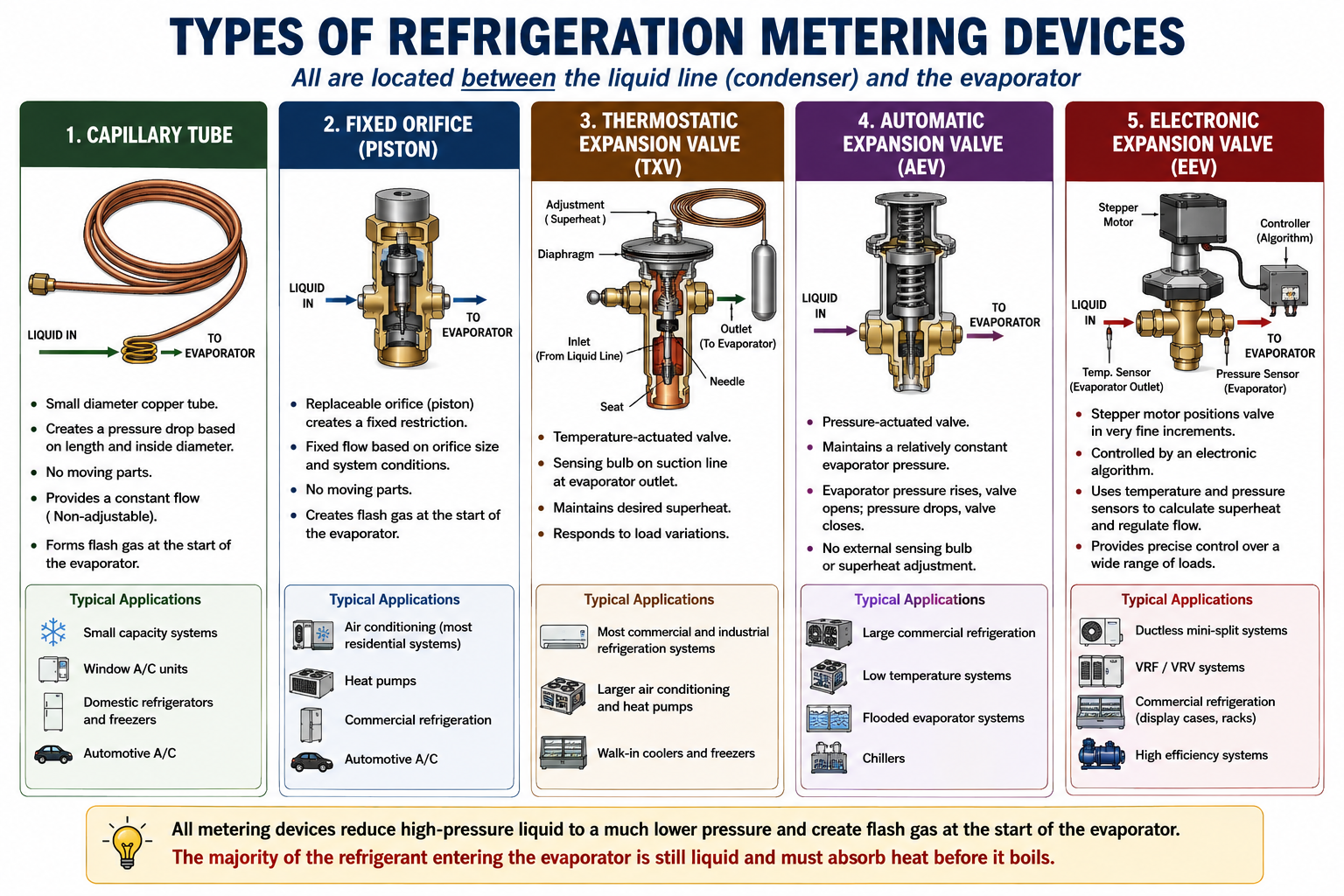
Air-conditioning and refrigeration equipment uses several different types of metering devices. Their operating methods are different, but each must control refrigerant flow while allowing the required pressure drop between the high and low sides of the system.
Capillary Tube
A long, small-diameter tube that creates a pressure drop through its length and internal restriction. It has no moving mechanical parts.
Fixed Orifice
A precisely sized opening restricts refrigerant flow. The opening does not actively change size as the system load changes.
Thermostatic Expansion Valve
The TXV regulates refrigerant flow in response to evaporator outlet conditions and is designed to control evaporator superheat.
Automatic Expansion Valve
The AEV, also called a constant-pressure expansion valve, regulates refrigerant flow in an attempt to maintain a relatively constant evaporator pressure.
Electronic Expansion Valve
The EEV uses electronic sensors, a controller, and an electrically operated valve to precisely regulate refrigerant flow.
Metering Devices Are Used in Many Types of Equipment
Metering devices are not limited to residential air-conditioning systems. The same basic refrigeration principles apply to air conditioning, commercial refrigeration, household refrigeration, freezers, ice machines, heat pumps, chillers, and many other vapor-compression refrigeration systems.
Air Conditioning
Split systems, packaged equipment, heat pumps, and other comfort-cooling systems use several different types of metering devices depending on their design.
Commercial Refrigeration
Walk-in coolers, reach-ins, display cases, ice machines, and other refrigeration equipment require metering devices matched to their operating conditions and loads.
High-Efficiency and Variable-Capacity Equipment
Modern equipment may use electronically controlled metering devices that can continually reposition themselves as compressor capacity and operating conditions change.
Ductless and Inverter Systems
Ductless mini-split and variable-speed systems commonly use electronic expansion valves because refrigerant flow must be controlled across a wide range of operating capacities.
Metering Devices and Evaporator Superheat
In the evaporator lessons you learned that refrigerant enters the evaporator as a low-pressure liquid/vapor mixture, the remaining liquid boils as it absorbs heat, and refrigerant leaving the evaporator should be vapor.
You also learned how evaporator superheat describes the temperature of vapor above its saturation temperature after all of the liquid refrigerant has boiled.
Metering devices and superheat are closely related, but they are not the same subject. In these lessons we will concentrate on how refrigerant is fed into the evaporator and how different metering devices respond to changing operating conditions.
Follow the Refrigerant Through the Metering Device
High-pressure liquid refrigerant travels from the condenser through the liquid line toward the metering device.
The metering device restricts and controls the flow of refrigerant.
The restriction causes a large pressure drop between the liquid line and evaporator.
The refrigerant saturation temperature drops as its pressure drops.
Part of the liquid refrigerant immediately boils because of the pressure reduction. This vapor is called flash gas.
A low-pressure liquid/vapor mixture enters the evaporator. The refrigerant is not all vapor.
The remaining liquid refrigerant absorbs heat in the evaporator and boils before the refrigerant returns to the compressor.
Can You Explain the Metering Device?
You should be able to answer these questions before continuing.
- Where is the metering device located in the refrigeration cycle?
- What is the physical state of the refrigerant that should normally enter the metering device?
- Is the refrigerant entering the metering device on the high-pressure side or low-pressure side of the system?
- What happens to refrigerant pressure as it passes through the metering device?
- What is flash gas?
- Does all of the liquid refrigerant boil as it passes through the metering device?
- What is the physical state of refrigerant entering the evaporator?
- What happens to the remaining liquid refrigerant as it moves through the evaporator?
- Name the five major types of metering devices introduced in this lesson.
- Why should metering devices be studied in both air-conditioning and refrigeration applications?
What You Should Have Learned
The metering device is located between the high-pressure liquid line and the low-pressure evaporator.
High-pressure liquid refrigerant should normally enter the metering device.
The metering device restricts refrigerant flow and creates the pressure drop between the high and low sides of the refrigeration system.
After the pressure drop, refrigerant entering the evaporator is a low-pressure liquid/vapor mixture.
Flash gas is the portion of liquid refrigerant that immediately boils because of the sudden pressure reduction.
The remaining liquid refrigerant must absorb heat inside the evaporator before it boils.
Capillary tubes, fixed orifices, TXVs, AEVs, and EEVs use different methods to accomplish the basic job of metering refrigerant.
Metering devices are used throughout air-conditioning and refrigeration equipment, including modern variable-capacity and electronically controlled systems.