Heat Transfer: Conduction, Convection, and Radiation
Heat does not simply disappear from one place and appear in another. It must move through one or more physical heat-transfer processes.
The three basic methods of heat transfer are conduction, convection, and radiation. HVAC/R systems rely heavily on all three, although conduction and convection dominate most coil and air-distribution processes.
What You Will Learn
By the end of this lesson you should be able to:
Define conduction.
Explain how heat moves through a material or between materials that are in direct contact.
Define convection.
Explain how heat is transferred by the movement of air or another fluid.
Distinguish natural and forced convection.
Recognize the difference between buoyancy-driven fluid movement and movement created by fans or pumps.
Define radiation.
Explain how heat can travel by electromagnetic energy without direct material contact.
Apply all three methods to HVAC/R.
Identify conduction, convection, and radiation in coils, ducts, piping, buildings, and equipment.
Recognize combined heat transfer.
Understand that real HVAC/R systems frequently use more than one heat-transfer method at the same time.
Heat Moves by Conduction, Convection, or Radiation
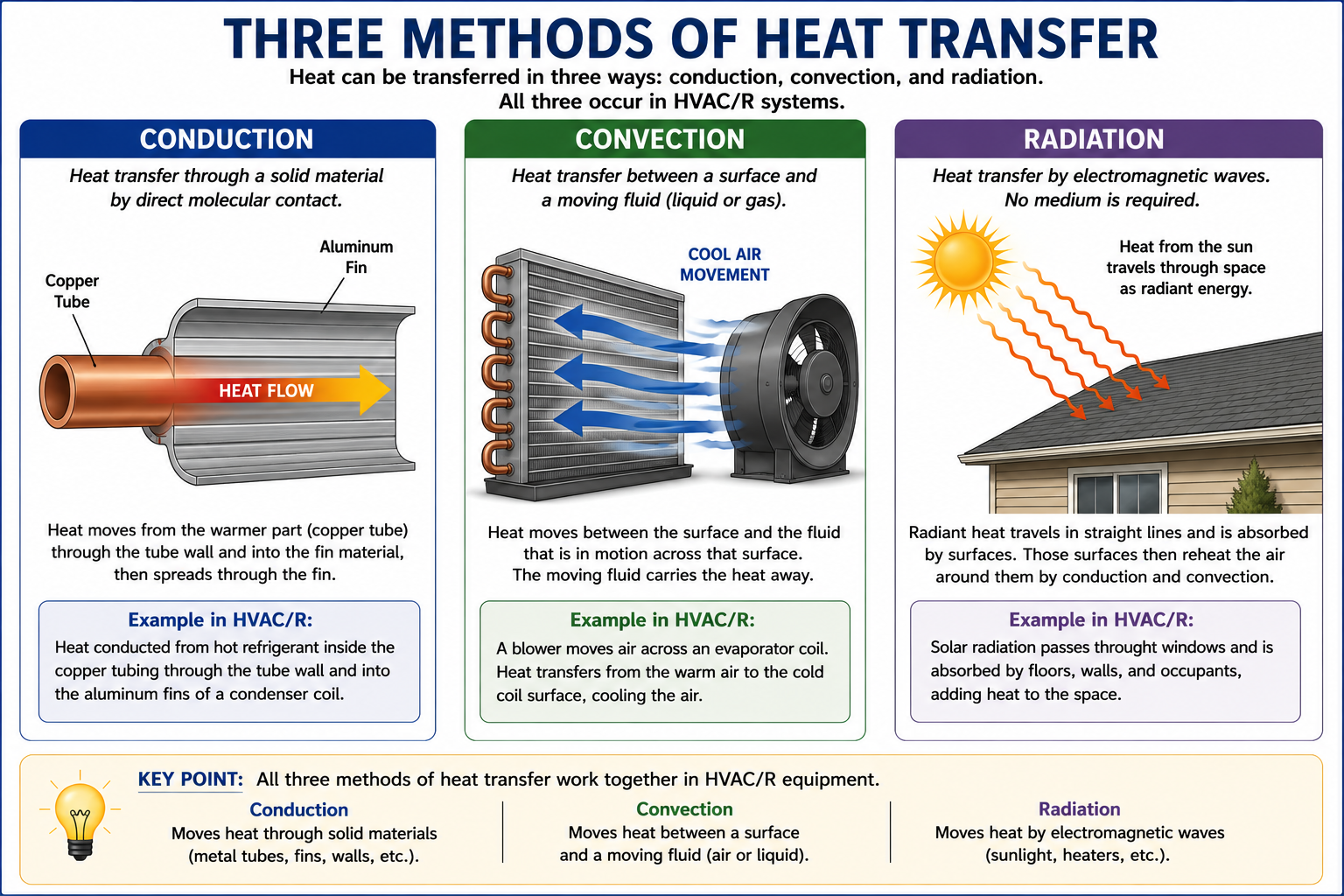
Heat Through Contact
Heat moves through a material or between materials that are touching.
Heat Through Fluid Movement
Heat is carried by the movement of air, water, refrigerant, or another fluid.
Heat Through Electromagnetic Energy
Heat travels through space without requiring direct physical contact between the source and the receiving surface.
Heat Transfer Through Direct Contact
Conduction occurs when thermal energy moves from molecule to molecule within a material or from one material directly into another material that it touches.
Higher-energy molecules
Energy transfers through neighboring molecules.
Lower-energy molecules
Copper and aluminum are widely used in HVAC/R heat exchangers because they transfer heat much more readily than many insulating materials.
Heat Must Pass Through Coil Materials
Consider an air-conditioning evaporator. Heat from the indoor air must eventually reach the refrigerant inside the coil.
Air Warms the Fin
Heat reaches the aluminum fin from the warmer indoor air.
Fin Conducts to Tube
Heat conducts through the metal fin toward the copper tubing.
Tube Conducts to Refrigerant
Heat conducts through the tube wall to the colder refrigerant inside.
Dirt, corrosion, damaged fins, or insulating debris can interfere with heat transfer between the air and the coil surface.
Heat Transfer by Moving Fluids
Convection is heat transfer associated with the movement of a fluid. In HVAC/R work, the fluid may be air, water, glycol, refrigerant, or another liquid or gas.
Movement Caused Naturally
Density differences cause warmer fluid to rise and cooler fluid to fall, creating natural circulation without a fan or pump.
Movement Created Mechanically
A fan, blower, or pump moves the fluid and increases heat transfer.
Warm Fluids Rise and Cooler Fluids Fall
When a fluid is heated, it often becomes less dense. Cooler, denser fluid tends to move downward while warmer fluid rises. This creates natural circulation.
Less dense
More dense
Natural convection can move useful amounts of heat, but forced convection generally provides much greater and more controllable heat-transfer rates.
Fans and Pumps Increase Heat Transfer
Most modern air-conditioning systems rely heavily on forced convection.
Indoor Blower
Moves return air across the evaporator coil and distributes cooled air through the duct system.
Condenser Fan
Moves outdoor air across the condenser coil so heat can be rejected from the refrigerant.
Hydronic Pump
Moves water or glycol through piping and heat exchangers.
Refrigerant Flow
The compressor creates the pressure difference that moves refrigerant through the refrigeration circuit.
If airflow across a coil is too low, the coil cannot exchange heat with the air at its intended rate. Many refrigeration symptoms that appear to be refrigerant problems can actually begin with an airflow problem.
Heat Transfer Without Direct Contact
Radiation transfers heat by electromagnetic energy. Unlike conduction and convection, radiation does not require direct contact or fluid movement between the heat source and the receiving surface.
Heat Source
The sun emits radiant energy.
Building Surface
Roof, walls, windows, and other surfaces absorb some of that energy.
Radiant energy from the sun reaches the earth through space. This is fundamentally different from conduction and convection, which require matter to transfer heat.
Solar Radiation Becomes an HVAC Load
Radiant heat entering a building can significantly increase the cooling load.
Roof
Solar radiation heats the roof surface, which then transfers heat inward through the structure.
Walls
Sun-exposed walls absorb radiant energy and become warmer than shaded surfaces.
Windows
Solar radiation can pass through glazing and heat interior floors, furniture, and other surfaces.
People and Equipment
Occupants, lights, and equipment also exchange radiant heat with surrounding surfaces.
Real Systems Rarely Use Only One Method
An HVAC/R heat exchanger usually involves several heat-transfer processes occurring at the same time.
Moving air transfers heat to or from the coil surface.
Heat moves through fins and tubing.
Heat enters or leaves the refrigerant inside the tubing.
Conduction, convection, and radiation describe the physical methods of heat transfer, but the driving force remains a temperature difference between warmer and cooler regions.
How Heat Reaches the Refrigerant
Warm Return Air
The blower forces warmer room air across the cold evaporator coil.
Convection
Heat transfers from the moving air to the colder coil surface.
Conduction
Heat moves through the aluminum fins and copper tubing.
Refrigerant Absorbs Heat
The refrigerant absorbs energy and vaporizes inside the evaporator.
How Heat Leaves the Refrigerant
Hot Refrigerant
High-pressure refrigerant enters the condenser hotter than the outdoor air.
Conduction
Heat moves from the refrigerant through the copper tube and coil fins.
Forced Convection
The condenser fan moves cooler outdoor air across the coil.
Heat Rejected
The moving air carries the rejected system heat away from the condenser.
Sometimes We Want to Slow Heat Transfer
HVAC/R systems do not always try to increase heat transfer. In refrigerant lines, ducts, piping, and building surfaces, insulation is often used to reduce unwanted heat movement.
Suction-Line Insulation
Reduces unwanted heat gain into the cold suction line and helps prevent condensation.
Duct Insulation
Reduces heat gain or loss between conditioned air and surrounding spaces.
Building Insulation
Reduces conduction through roofs, walls, floors, and ceilings.
Pipe Insulation
Reduces heat loss or heat gain from hydronic and refrigeration piping.
Insulation slows the rate of heat transfer. As long as a temperature difference exists, some heat transfer can still occur.
Avoid These Heat-Transfer Errors
“Convection only means warm air rising.”
That is natural convection. Forced convection also occurs when fans or pumps mechanically move a fluid.
“Radiation requires air.”
Radiation can travel through empty space and does not require air or another fluid.
“A coil transfers heat only by conduction.”
Heat conducts through the metal coil, but convection transfers heat between the coil surface and the moving air.
“Insulation prevents all heat flow.”
Insulation reduces the rate of heat transfer but does not eliminate it completely.
Can You Identify the Heat-Transfer Method?
- What is conduction?
- Why are copper and aluminum commonly used in HVAC/R heat exchangers?
- What is convection?
- What is the difference between natural convection and forced convection?
- What creates forced convection across an evaporator coil?
- What creates forced convection across an air-cooled condenser?
- What is radiation?
- Why can radiant heat travel through space?
- How does solar radiation affect building cooling load?
- What heat-transfer method carries heat through a copper tube wall?
- What heat-transfer method moves heat between air and a coil surface?
- Why does low airflow reduce heat transfer across a coil?
- How can conduction and convection occur together in an evaporator?
- Why does insulation reduce but not completely stop heat transfer?
What You Should Have Learned
Conduction transfers heat through direct contact within a material or between materials that touch.
Convection transfers heat through the movement of air or another fluid.
Natural convection results from density differences, while forced convection uses fans or pumps.
Radiation transfers heat through electromagnetic energy and does not require direct contact or fluid movement.
HVAC/R coils commonly use convection between the fluid and coil surface and conduction through the coil materials.
Solar radiation contributes directly to building cooling loads.
Airflow is critical because forced convection determines how effectively many HVAC coils exchange heat with the air.
Insulation slows unwanted heat transfer but does not eliminate heat transfer completely.