Grounding Electrode Systems
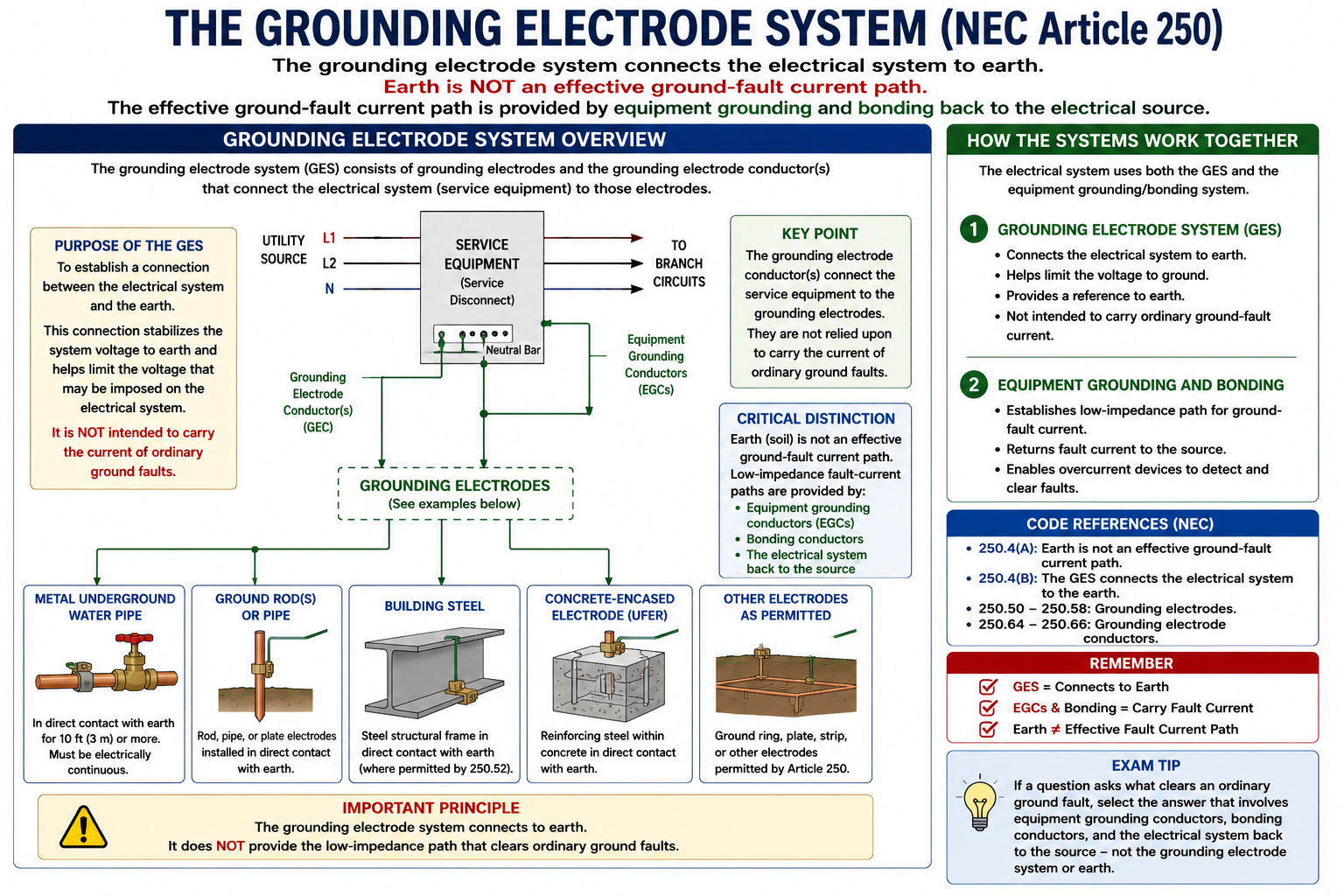
Grounding electrode systems connect electrical systems and equipment to earth. Article 250 establishes which electrodes qualify, how available electrodes are combined into a grounding electrode system, and how the electrical system is connected to that system through grounding electrode conductors.
For the NASCLA examination, one of the most important concepts is distinguishing grounding to earth from equipment grounding and bonding. The grounding electrode system serves important voltage-stabilization and overvoltage-limiting functions, but earth is not the effective ground-fault current path relied upon to operate ordinary overcurrent protective devices.
Connecting the Electrical System to Earth
A grounding electrode system consists of qualifying grounding electrodes that are bonded together and connected to the electrical system as required by Article 250. Depending on the building or structure, the system can include underground metal water pipe, qualifying in-ground metal support structures, concrete-encased electrodes, ground rings, rods, pipes, plates, and other electrodes recognized by the NEC.
The grounding electrode system should not be confused with the equipment grounding and bonding system. Grounding electrodes establish the connection to earth. Equipment grounding and bonding provide the effective conductive fault-current path back toward the electrical source.
Why Electrical Systems Are Grounded
Article 250 establishes several distinct purposes for grounding and bonding. Keeping those purposes separate is essential for understanding the Code and answering examination questions correctly.
Connect to Earth
A grounded electrical system is intentionally connected to earth through the grounding electrode system.
Limit Imposed Voltage
System grounding helps limit voltage imposed by lightning, line surges, or unintentional contact with higher-voltage conductors.
Stabilize Voltage
The connection to earth helps stabilize system voltage to earth during normal operation.
Fault-Current Path
Equipment grounding and bonding establish an effective conductive path for ground-fault current back to the source so protective devices can operate.
Earth Is Not an Effective Ground-Fault Current Path
The NEC specifically states that earth shall not be considered an effective ground-fault current path. Ordinary ground faults are cleared through the intentionally constructed equipment grounding and bonding path back toward the electrical source, not by relying on soil resistance between a grounding electrode and the source.
Two Related but Different Functions
The words grounding and bonding are often used casually as though they describe the same function. Article 250 treats them as related but distinct parts of electrical safety.
Grounding Electrode System
Connects the electrical system to earth and performs the system-grounding functions required by Article 250.
Equipment Grounding
Connects normally non-current-carrying conductive equipment parts into the fault-current path.
Bonding
Joins conductive parts together to establish electrical continuity and conductivity.
Effective Fault Path
Provides a deliberately constructed low-impedance conductive path capable of carrying ground-fault current back toward the source.
Grounding Electrode Conductor vs. Equipment Grounding Conductor
A grounding electrode conductor, or GEC, connects the grounding electrode system to the grounded conductor, equipment grounding conductor, or both at the location permitted or required by Article 250. An equipment grounding conductor, or EGC, connects normally non-current-carrying metal parts of equipment into the effective ground-fault current path. They have different functions and are sized under different NEC rules.
The Grounding Electrode System
NEC 250.50 requires qualifying grounding electrodes that are present at a building or structure to be bonded together to form the grounding electrode system. The installer does not normally select one convenient qualifying electrode and ignore the other qualifying electrodes that are present.
If none of the qualifying electrodes specified by Article 250 exist at the building or structure, an electrode or electrode system permitted by Article 250 must be installed and used.
Use the Electrodes That Are Present
When a question states that multiple qualifying grounding electrodes are present at a building, do not assume that only one is required. Article 250 generally requires qualifying electrodes that are present to be bonded together to form the grounding electrode system.
Recognized Grounding Electrodes
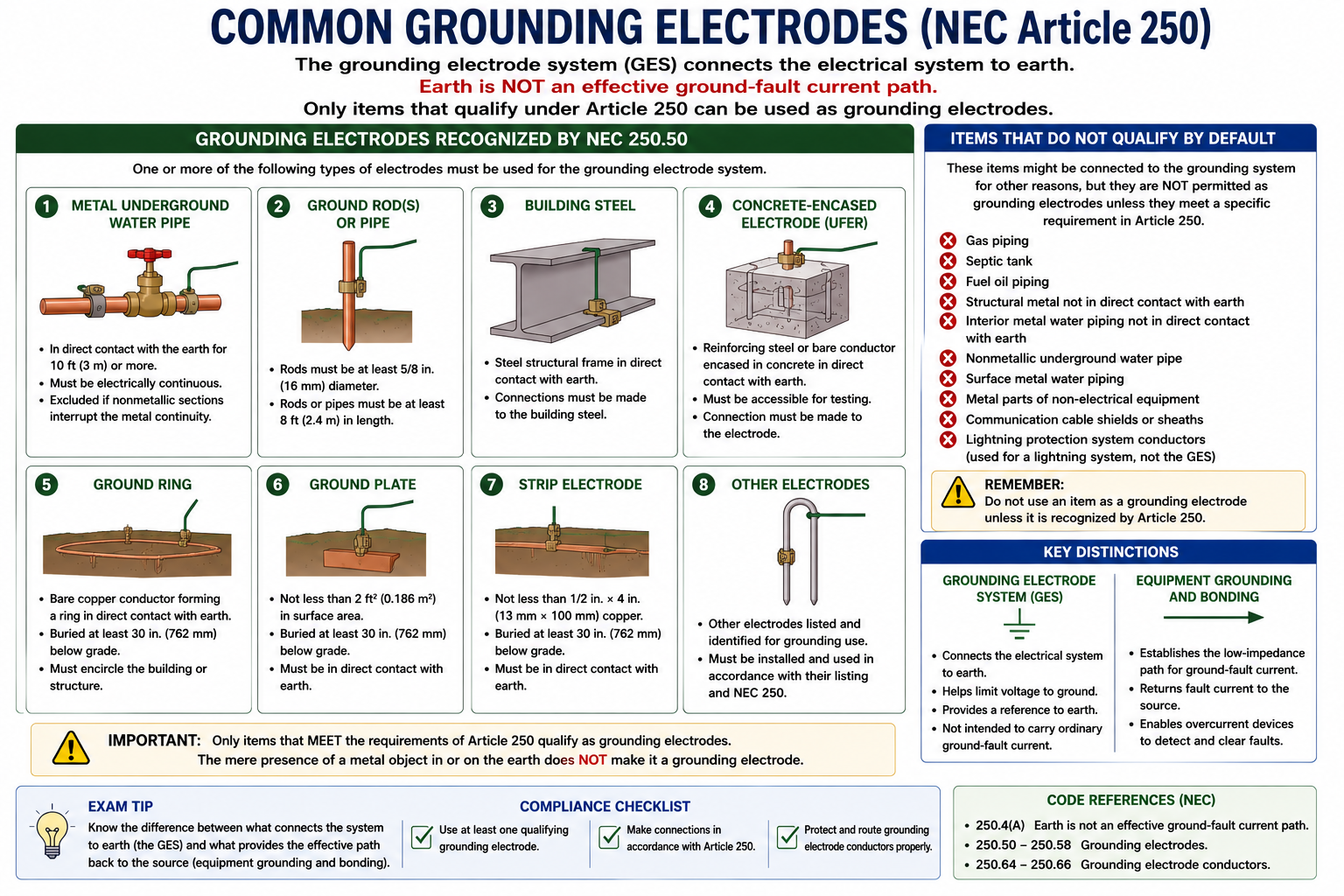
Article 250 identifies specific conductive objects and systems that can qualify as grounding electrodes when they meet the applicable requirements. Simply being metallic and touching the earth does not automatically make an object a grounding electrode.
Metal Underground Water Pipe
A metal underground water pipe can qualify as a grounding electrode when it is in direct contact with earth for the length required by Article 250. The familiar examination value is 10 feet or more of qualifying metal water pipe in direct contact with earth.
Electrical continuity must also be maintained around insulating joints, meters, or other components that interrupt the conductive path where required. A qualifying metal underground water pipe electrode has additional supplemental-electrode requirements under Article 250.
Metal Water Pipe Does Not Automatically Mean Electrode
Interior metal water piping, short underground sections, and piping isolated from earth by nonmetallic components do not automatically satisfy the requirements for a metal underground water-pipe grounding electrode. Read the facts in the question before classifying the piping.
Qualifying Metal in the Building Structure
Structural metal can serve as a grounding electrode only when it meets the applicable Article 250 requirements. The presence of a steel building frame by itself does not automatically establish a grounding electrode.
When evaluating structural metal, determine whether the particular metal support structure satisfies the Code conditions for use as an electrode rather than assuming every beam or column qualifies.
The Concrete-Encased Electrode
A concrete-encased electrode is commonly associated with concrete foundations and is often called a Ufer ground in field terminology. Article 250 specifies the conductive material, minimum length, concrete encasement, and relationship to earth required for the electrode to qualify.
A common configuration uses at least 20 feet of qualifying reinforcing steel within concrete that is in direct contact with earth. Article 250 also recognizes a qualifying bare copper conductor installed as a concrete-encased electrode when the applicable requirements are satisfied.
Ground Ring Electrodes
A ground ring is installed around a building or structure and consists of qualifying bare copper conductor in direct contact with earth. Article 250 establishes minimum conductor size, length, and burial requirements.
For examination purposes, associate a ground ring with at least 20 feet of bare copper conductor not smaller than 2 AWG and the burial requirements specified by Article 250.
Rod and Pipe Electrodes
Rod and pipe electrodes are common installed grounding electrodes. Article 250 establishes material, dimensions, installation, and earth-contact requirements for these electrodes.
A rod electrode generally must have at least 8 feet of length in contact with the soil. Rod dimensions and material requirements depend on whether the electrode is listed and on the particular type of rod or pipe being used.
One Rod or Two?
Article 250 contains an important rule for rod, pipe, and plate electrodes. Where a single electrode does not meet the applicable resistance-to-earth condition, an additional electrode is required unless compliance with the permitted resistance criterion is demonstrated.
On an examination, do not assume that installing one ground rod automatically completes every grounding-electrode installation. Identify the electrode type and then apply the specific Article 250 installation requirements.
Do Not Memorize “Two Ground Rods” as a Universal Rule
The NEC rule is more specific than the common field statement that every installation requires two rods. Determine the electrode involved, whether another qualifying electrode is present, and whether the resistance provisions for a single rod, pipe, or plate electrode are relevant to the question.
Plate Grounding Electrodes
Article 250 also recognizes qualifying plate electrodes. A plate electrode must meet minimum surface-area, material, thickness, burial, and earth-contact requirements established by the applicable provisions of Article 250.
Plate electrodes are less visually familiar than ground rods, but they remain an important recognized electrode type and can appear in examination questions.
Other Recognized Electrodes
Article 250 recognizes other listed grounding electrodes and certain qualifying underground metal systems in addition to the common electrode types discussed above. The critical examination principle is to verify that the object meets a category recognized by 250.52 and satisfies that category’s requirements.
Items That Cannot Be Used as Grounding Electrodes
Article 250 also identifies items that are prohibited from being used as grounding electrodes. A conductive object can require bonding for safety while still being prohibited from serving as the grounding electrode itself.
Gas Piping
Underground metal gas piping is not permitted to be used as a grounding electrode.
Aluminum
Aluminum is not permitted for grounding electrodes under the applicable Article 250 restrictions.
Pool Steel
Swimming-pool reinforcing steel is not used as the building grounding electrode merely because it is bonded as part of the pool equipotential bonding system.
Other Metal Objects
Metal objects do not become grounding electrodes simply because they are buried, conductive, or connected to other bonded metal.
Connecting the Electrical System to the Electrodes
The grounding electrode conductor provides the required electrical connection between the grounding electrode system and the electrical system. At a grounded service, this connection is associated with the grounded service conductor and service grounding and bonding arrangement established by Article 250.
Grounding electrode conductors must be installed, protected, connected, and sized according to the applicable Article 250 requirements.
Grounding Electrode Conductor Size
Grounding electrode conductor sizing is not the same as equipment grounding conductor sizing. The general service GEC sizing rules are associated with NEC 250.66 and the size of the ungrounded service-entrance conductors or equivalent area, subject to specific rules and sizing limitations for particular electrode types.
For example, Article 250 provides special maximum required GEC sizes when the conductor connects only to certain electrodes such as rod, pipe, plate, concrete-encased, or ground-ring electrodes. These rules become especially important in Lesson 40 when grounding and bonding calculations are covered in detail.
Do Not Size a GEC from the Breaker Rating
A common examination mistake is to select a grounding electrode conductor directly from the service disconnect ampere rating. Start with the sizing rule specified by Article 250 and identify the conductors and electrode type involved before selecting the required GEC size.
One Grounding Electrode System
When multiple qualifying grounding electrodes are present, they are bonded together to form a grounding electrode system rather than operating as unrelated grounding systems. This creates a common grounding electrode system for the building or structure as required by Article 250.
The electrode connections and bonding jumpers must comply with the applicable requirements for materials, connection methods, accessibility, protection, and conductor sizing.
What Happens During a Ground Fault?
Suppose an ungrounded conductor contacts the metal enclosure of electrical equipment. The intended fault-current path is through the equipment grounding and bonding system back toward the electrical source. The resulting fault current should be sufficient to cause the applicable overcurrent protective device to operate quickly.
The grounding electrode system can be electrically connected to this system, but the soil itself is not relied upon as the effective conductive path for clearing the ordinary fault.
Follow the Fault Back to the Source — Not Into the Earth
When an exam question asks how an ordinary ground fault is cleared, trace the metallic equipment grounding and bonding path back toward the source. If an answer depends on fault current traveling through the earth to operate the breaker or fuse, it is generally describing the fault-clearing function incorrectly.
Ground Rods Do Not Replace Equipment Grounding Conductors
Installing a ground rod at equipment does not substitute for an equipment grounding conductor where the NEC requires an equipment grounding conductor. A grounding electrode and an equipment grounding conductor perform different functions.
This distinction becomes especially important with detached buildings, feeders, separately derived systems, and equipment located away from service equipment.
How to Analyze a Grounding Electrode Question
Identify the System or Structure
Determine whether the question concerns service grounding, a separately derived system, a separate building or structure, or another Article 250 application.
Identify the Electrodes Present
List the conductive systems described in the question before deciding which ones qualify as grounding electrodes.
Apply 250.52
Determine whether each item satisfies one of the NEC-recognized grounding-electrode categories and its qualification requirements.
Apply 250.50
Determine which qualifying electrodes must be bonded together to form the grounding electrode system.
Check Electrode Installation Rules
Apply the installation, supplemental-electrode, spacing, burial, resistance, and other requirements that apply to the specific electrode type.
Identify the GEC
Determine where the grounding electrode conductor connects and which Article 250 sizing and installation rules apply.
Separate Grounding from Fault Clearing
Determine whether the question concerns connection to earth or the effective ground-fault current path. Do not substitute one function for the other.
Identify the Function Before Looking for a Number
Article 250 questions often contain several similar terms and several possible tables or sections. Before searching for a conductor size, resistance value, electrode dimension, or installation requirement, determine whether the question concerns a grounding electrode, grounding electrode conductor, equipment grounding conductor, bonding jumper, or grounded conductor.
Grounding Electrode Systems
Connection to Earth
The grounding electrode system provides the required connection between the electrical system and earth.
250.50
Qualifying grounding electrodes that are present are generally bonded together to form the grounding electrode system.
250.52
The NEC identifies the conductive systems and electrode types that can qualify for use as grounding electrodes.
GEC
The grounding electrode conductor connects the grounding electrode system to the electrical system at the location required or permitted by Article 250.
EGC and Bonding
Equipment grounding and bonding provide the effective conductive path used to carry ordinary ground-fault current back toward the source.
Earth
Earth is not considered an effective ground-fault current path and must not be relied upon to clear ordinary electrical faults.
Lesson 37 — Equipment Grounding
The next lesson follows the fault-current path through equipment grounding conductors and other permitted grounding paths, explaining how normally non-current-carrying metal parts are connected so that a ground fault can produce enough current to operate the circuit overcurrent protective device.
Return to Part IV
Review the complete Wiring and Protection lesson sequence or continue directly to Lesson 37.