Evaporator Superheat
Superheat tells us how far refrigerant vapor has been heated above its saturation temperature at the pressure where the measurement is made.
Inside the evaporator, low-pressure refrigerant absorbs heat and boils. Once the final liquid refrigerant has evaporated, additional heat raises the temperature of the refrigerant vapor. That temperature increase above saturation is called superheat.
Understanding superheat requires three ideas: refrigerant saturation temperature, actual refrigerant vapor temperature, and the location where those values are determined.
What You Will Learn
By the end of this lesson you should be able to:
Describe superheat as the temperature of refrigerant vapor above its saturation temperature.
Recognize that superheat begins after the final liquid refrigerant has boiled into vapor.
Convert measured low-side refrigerant pressure into the corresponding saturation temperature for the refrigerant in the system.
Use a temperature probe securely attached to the suction line at the appropriate measurement location.
Subtract saturation temperature from the actual refrigerant vapor temperature.
Understand how superheat confirms that refrigerant leaving the evaporator is vapor rather than a liquid-vapor mixture.
Evaporator Temperature and Superheat
Refrigerant pressure and refrigerant temperature are closely related while the refrigerant is undergoing a phase change.
When liquid and vapor are both present in the evaporator, the refrigerant is at or near its saturation temperature for the pressure at that location.
After all remaining liquid has boiled into vapor, the refrigerant can absorb additional sensible heat and its temperature begins to rise above saturation.
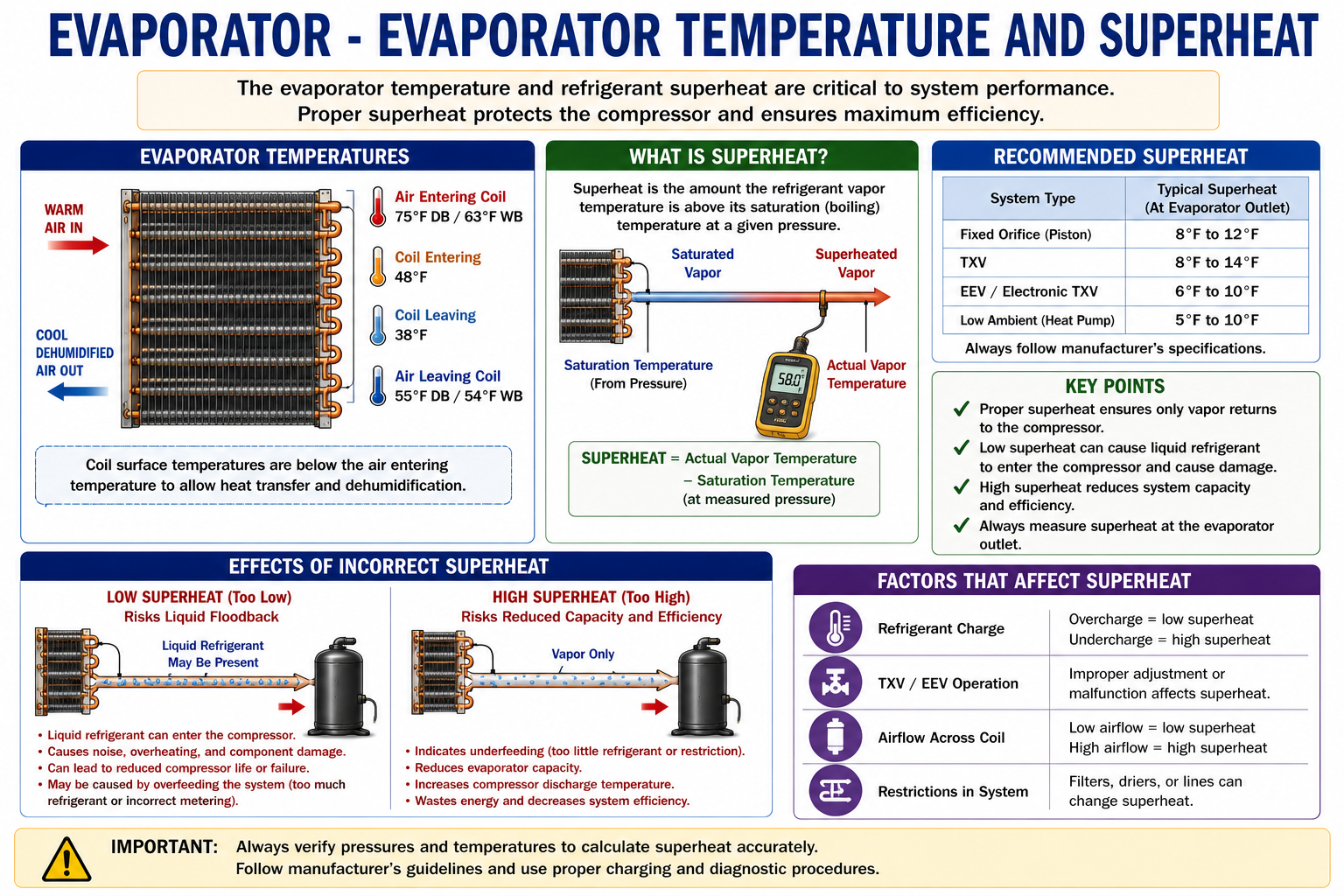
Superheat is not simply the suction-line temperature. A temperature measurement becomes a superheat value only after it is compared with the refrigerant saturation temperature corresponding to the measured pressure.
Follow the Refrigerant Through the Evaporator
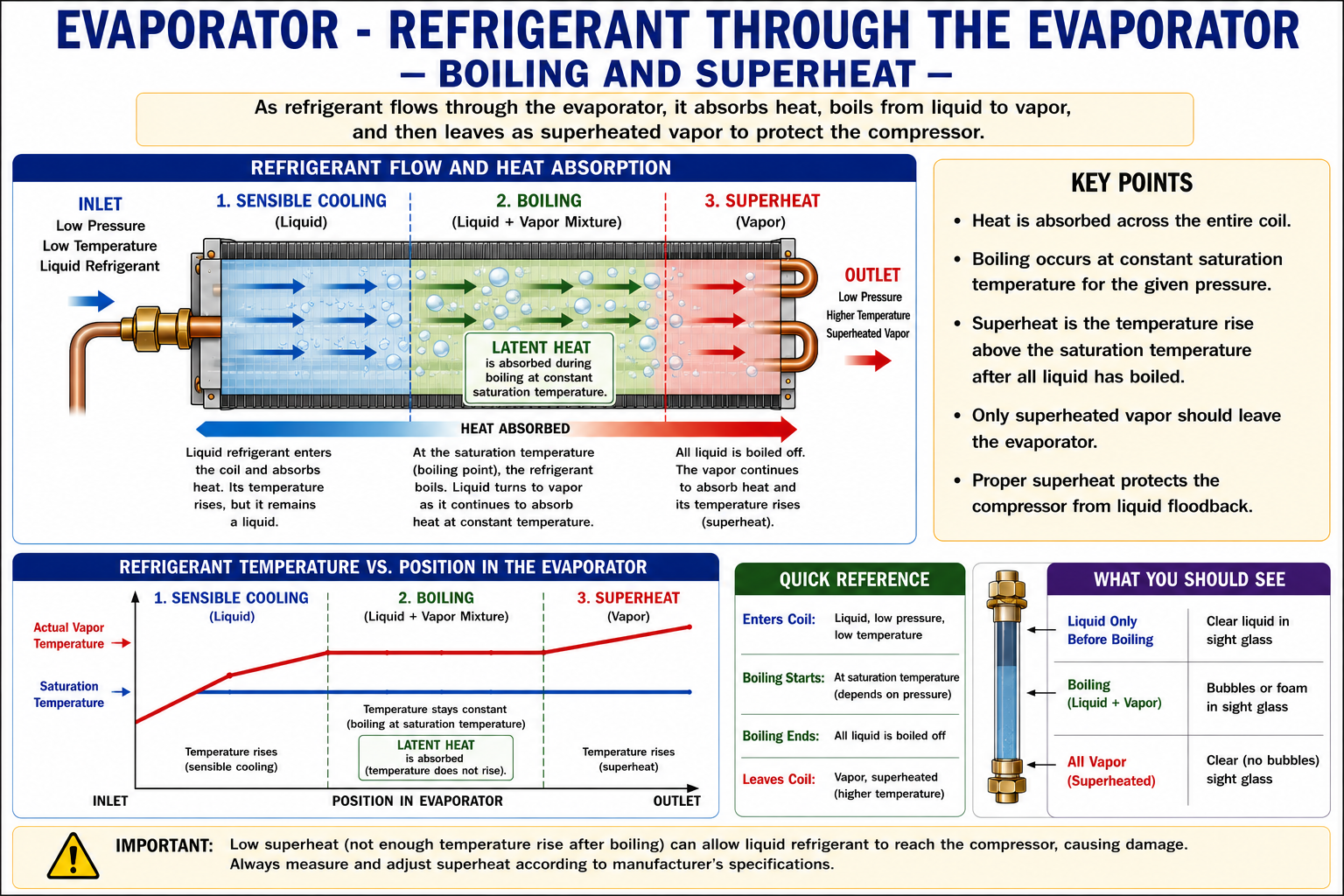
Liquid-Vapor Mixture Enters
Low-pressure refrigerant entering the evaporator contains liquid refrigerant along with vapor.
Refrigerant Boils
Heat absorbed from the conditioned air supplies the latent heat required to change the remaining liquid refrigerant into vapor.
The Final Liquid Evaporates
At some point in a properly operating direct-expansion evaporator, the remaining liquid refrigerant finishes boiling.
Superheat Begins
Additional heat absorbed after the refrigerant is completely vapor raises the vapor temperature above its saturation temperature.
Superheated Vapor Leaves
Refrigerant leaves the evaporator as vapor and continues through the suction line toward the compressor.
Latent Heat Comes Before Superheat
The distinction between latent heat and sensible heat is especially important when studying evaporator superheat.
While Refrigerant Is Boiling
Heat absorbed by the refrigerant is primarily causing the remaining liquid refrigerant to change state into vapor.
This is latent heat.
After Boiling Is Complete
Additional heat raises the temperature of the refrigerant vapor above saturation.
This produces superheat.
Boiling must be complete before refrigerant vapor can become superheated.
Saturation Temperature
Saturation temperature is the temperature at which a refrigerant changes state at a particular pressure.
Because refrigerants have different pressure-temperature relationships, the pressure reading must be interpreted for the actual refrigerant in the system.
Measure Refrigerant Pressure
Obtain the low-side pressure at the location being evaluated.
Identify the Refrigerant
The correct refrigerant pressure-temperature relationship must be used.
Convert Pressure to Saturation Temperature
The corresponding saturation temperature becomes the reference temperature used in the superheat calculation.
Pressure Alone Is Not Superheat
A pressure gauge tells you refrigerant pressure. That pressure must be converted into the corresponding saturation temperature before superheat can be calculated.
Actual Refrigerant Vapor Temperature
The second value needed for superheat is the actual temperature of the refrigerant vapor at the measurement point.
A temperature probe or clamp is securely attached to the suction line so that it measures the pipe temperature as accurately as practical.
Pressure Measurement
Provides the information needed to determine saturation temperature.
Temperature Measurement
Provides the actual refrigerant vapor temperature at the same general operating location.
Pressure and temperature must represent the same part of the refrigeration system. Pressure drop and heat gained by the suction line can change the values as refrigerant travels away from the evaporator.
Calculating Superheat
The actual vapor temperature must be higher than the saturation temperature for superheated vapor to exist.
Superheat Example
Assume the measured refrigerant pressure corresponds to a saturation temperature of 40°F, and the measured suction-line temperature is 52°F.
40°F
52°F
52°F − 40°F = 12°F
The refrigerant vapor is 12°F above its saturation temperature at the measurement point.
Measuring Evaporator Superheat
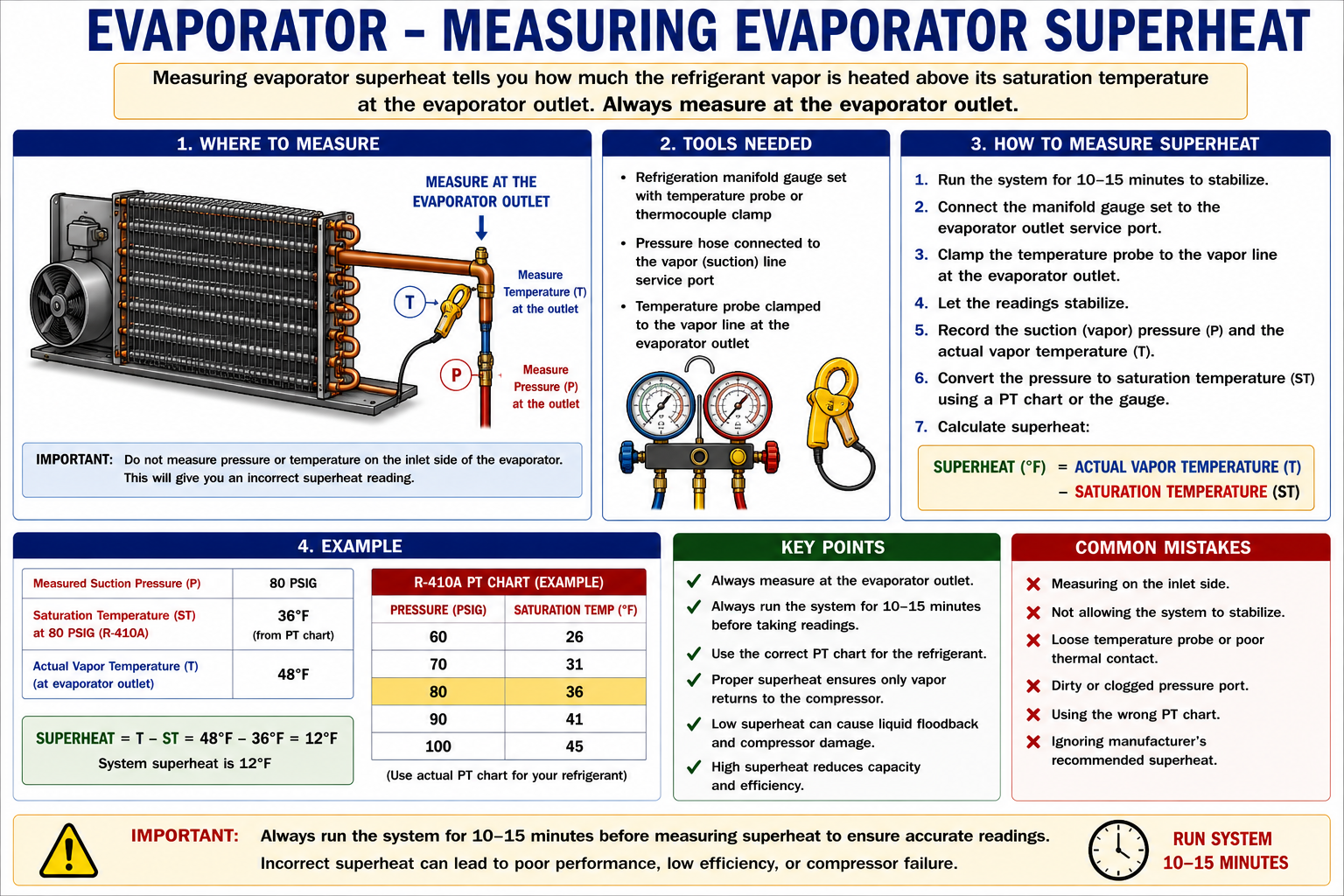
Allow the System to Stabilize
Operate the system under a steady cooling load before recording superheat measurements.
Measure Low-Side Pressure
Measure the refrigerant pressure at the appropriate low-side service location.
Determine Saturation Temperature
Convert the measured pressure to the corresponding saturation temperature for the refrigerant in the system.
Measure Suction-Line Temperature
Attach a temperature probe securely to the suction line at the proper measurement location.
Calculate Superheat
Subtract saturation temperature from the actual measured vapor temperature.
Allow the System to Stabilize
Always run the system for approximately 10–15 minutes before measuring superheat.
The equipment should be operating under a stable load before the readings are used for diagnosis or adjustment.
Why Is Superheat Important?
The compressor is designed to compress refrigerant vapor. Liquid refrigerant reaching the compressor can create serious mechanical and lubrication problems.
Superheat provides information about the condition of the refrigerant vapor leaving the evaporator.
Superheated Vapor
The refrigerant temperature is above saturation, confirming that the refrigerant at the measurement point is vapor rather than a saturated liquid-vapor mixture.
Liquid Refrigerant Present
If liquid refrigerant is still present where vapor should be leaving the evaporator, the compressor may be exposed to liquid refrigerant floodback.
Superheat Is About More Than Temperature
The value helps the technician understand how completely the refrigerant has boiled and how much sensible heating of the vapor has occurred after evaporation is complete.
What Does Low Superheat Suggest?
A low superheat reading means the actual vapor temperature is only slightly above the refrigerant saturation temperature.
This can indicate that refrigerant is continuing to boil very near the evaporator outlet or farther into the suction line.
Boiling Continues Too Far
Little evaporator length remains after the final liquid refrigerant has boiled.
Floodback Risk Can Increase
If liquid refrigerant leaves the evaporator, it can travel toward the compressor.
A low superheat reading is a symptom, not a diagnosis by itself. Airflow, load, refrigerant charge, refrigerant distribution, and metering conditions can all affect the result.
What Does High Superheat Suggest?
A high superheat reading means the refrigerant vapor has been heated substantially above its saturation temperature.
This generally means the final liquid refrigerant finished boiling earlier in the evaporator, leaving more coil surface exposed primarily to vapor.
Liquid Boils Off Early
A larger portion of the evaporator may contain only refrigerant vapor.
Evaporator Surface May Be Underused
Part of the heat-transfer surface may no longer be receiving the latent-heat benefit of boiling refrigerant.
High superheat is also a symptom rather than a complete diagnosis. The technician must evaluate the rest of the system before deciding why the value is high.
There Is No Single Correct Superheat for Every System
The proper operating superheat depends on the equipment design, refrigerant, operating conditions, evaporator load, and the method used to control refrigerant flow.
Do not assume that one superheat value is correct for every air-conditioning or refrigeration system. Use the equipment manufacturer’s specifications and charging or diagnostic procedure.
Metering devices affect evaporator refrigerant flow and therefore influence superheat, but their detailed operation will be covered separately.
Evaporator Superheat vs. Total Superheat
Superheat can be measured at different locations, so technicians should identify which superheat value they are discussing.
Evaporator Superheat
Measured near the evaporator outlet and used to evaluate the condition of refrigerant as it leaves the evaporator.
Total or System Superheat
Measured farther downstream, commonly near the compressor, and includes additional heat absorbed by the suction line after refrigerant leaves the evaporator.
Refrigerant vapor can gain additional heat while traveling through the suction line, so total superheat can be higher than evaporator-outlet superheat.
Superheat and Subcooling Are Related Concepts
Superheat and subcooling are both temperature differences measured relative to refrigerant saturation temperature, but they occur on opposite sides of the refrigeration cycle.
Evaporator Superheat
Actual Vapor Temperature − Saturation Temperature
Describes vapor heated above its boiling or saturation temperature.
Condenser Subcooling
Saturation Temperature − Actual Liquid Temperature
Describes liquid cooled below its condensing or saturation temperature.
Common Superheat Measurement Errors
Measuring Too Soon
Readings taken before the system stabilizes may not represent normal operating conditions.
Using the Wrong Refrigerant
The wrong pressure-temperature relationship produces an incorrect saturation temperature.
Poor Temperature-Probe Contact
A loose probe or poor contact with the suction line can produce an inaccurate temperature measurement.
Comparing Different Locations
Pressure and temperature readings taken from significantly different portions of the system may not represent the same refrigerant condition.
Ignoring Airflow
Evaporator airflow directly affects heat load and therefore affects superheat.
Assuming the Reading Gives the Diagnosis
Superheat is one diagnostic measurement and must be interpreted with the rest of the system information.
Put the Concepts Together
Superheat begins after the final liquid refrigerant has boiled into vapor.
Refrigerant absorbs latent heat while boiling and sensible heat after it becomes completely vapor.
Saturation temperature is determined from refrigerant pressure using the correct pressure-temperature relationship.
Actual vapor temperature is measured with a temperature probe on the suction line.
Superheat equals actual vapor temperature minus saturation temperature.
The system should operate for approximately 10–15 minutes and stabilize before superheat measurements are evaluated.
Low superheat can indicate that boiling is continuing too close to the evaporator outlet and can increase the risk of liquid floodback.
High superheat can indicate that liquid refrigerant finished boiling early and part of the evaporator is primarily heating vapor.
Correct superheat depends on system design and operating conditions rather than one universal value.
Superheat is a diagnostic measurement that must be interpreted together with airflow, load, pressures, temperatures, and other system information.
Can You Explain Evaporator Superheat?
You should be able to answer these questions before continuing.
1. What is superheat?
2. When does superheat begin inside the evaporator?
3. What type of heat is absorbed while liquid refrigerant is boiling?
4. What type of heat raises the temperature of refrigerant vapor after boiling is complete?
5. How is saturation temperature determined?
6. What two values are required to calculate superheat?
7. What is the formula for superheat?
8. If saturation temperature is 40°F and actual vapor temperature is 52°F, what is the superheat?
9. Why should the system run for approximately 10–15 minutes before measuring superheat?
10. Why can very low superheat be a concern?
11. What can high superheat tell us about where the refrigerant finished boiling?
12. Why should one superheat value not be considered correct for every system?
13. What is the difference between evaporator superheat and total superheat?
14. Why must airflow be considered when interpreting superheat?
What You Should Have Learned
Superheat is the amount that refrigerant vapor temperature is above saturation temperature.
Superheat begins only after all remaining liquid refrigerant has boiled.
Low-side pressure is converted to saturation temperature using the correct refrigerant pressure-temperature relationship.
Actual suction-line temperature provides the second value required for the calculation.
Superheat equals actual vapor temperature minus saturation temperature.
Stable system operation is necessary before the measurement is evaluated.
Evaporator superheat and total superheat refer to measurements made at different locations.
Superheat helps confirm the refrigerant condition leaving the evaporator and provides useful diagnostic information.
Next: Condensate Management
Cooling the air is only part of what the evaporator does. When the coil surface is below the dew-point temperature of the air, moisture condenses on the evaporator and must be removed safely.
The next lesson examines condensate drain pans, drain piping, positive- and negative-pressure systems, traps, vents, air breaks, and double-trap prevention.
Moisture Condenses · Pan Collects · Drain Removes