Evaporator Capacity and Design Factors
An evaporator must absorb the required amount of heat while maintaining proper airflow, refrigerant flow, pressure drop, and oil return.
Evaporator capacity depends on more than the physical size of the coil. Surface area, temperature difference, airflow, refrigerant velocity, circuiting, tubing dimensions, material conductivity, and pressure drop all influence how effectively the evaporator transfers heat.
Understanding these relationships helps a technician recognize why two evaporators that appear similar can operate very differently.
What You Will Learn
By the end of this lesson you should be able to:
Relate surface area, temperature difference, airflow, refrigerant velocity, material conductivity, and metal thickness to heat-transfer performance.
Describe how circuit length, tubing size, refrigerant flow, and coil construction influence pressure loss through the evaporator.
Recognize how parallel circuits can reduce individual circuit length while maintaining useful refrigerant velocity.
Understand the relationship between refrigerant velocity, pressure drop, heat transfer, and oil return.
Recognize that adequate air movement is required to continually deliver heat to the evaporator surface.
Identify conditions that can lead to excessive pressure drop, poor oil return, reduced heat transfer, and underused coil surface.
Evaporator Capacity Is Heat-Transfer Capacity
Evaporator capacity describes how much heat the evaporator can absorb under a particular set of operating conditions.
The evaporator cannot absorb heat efficiently unless heat can move from the conditioned air or secondary fluid, through the heat exchanger, and into the refrigerant.
Brings heat to the evaporator.
Conducts heat through fins, tubing, plates, or other surfaces.
Absorbs the heat and evaporates.
Anything that reduces heat reaching the refrigerant can reduce evaporator capacity.
Major Factors Affecting Evaporator Capacity
Surface Area
A larger effective heat-transfer surface provides more area through which heat can move into the refrigerant.
Temperature Difference
Heat transfer increases as the temperature difference between the refrigerant and the material being cooled increases, assuming other operating conditions remain appropriate.
Refrigerant Velocity
Refrigerant must move through the evaporator at a useful velocity to support heat transfer and oil return without creating excessive pressure drop.
Air Volume
Forced-convection evaporators require sufficient airflow to continually bring additional heat to the coil surface.
Material Conductivity
The thermal conductivity of the coil material affects how readily heat moves through the heat exchanger.
Metal Thickness
Heat must conduct through the coil material, so the thickness and construction of the heat-transfer surface influence thermal resistance.
Surface Area
Increasing effective evaporator surface area allows more of the air or secondary fluid to contact the heat exchanger.
In a fin-and-tube evaporator, fins dramatically increase the air-side surface area beyond what the refrigerant tubing alone could provide.
More Effective Surface
Provides additional area through which heat can move toward the refrigerant.
Surface Must Be Used
Additional coil area provides little benefit if airflow bypasses the surface or refrigerant is poorly distributed through the coil.
Physical Size Is Not the Whole Story
A physically large coil can still have poor performance if airflow, refrigerant distribution, or heat-transfer conditions prevent the available surface from being used effectively.
Temperature Difference
Heat moves because a temperature difference exists between the substance being cooled and the refrigerant inside the evaporator.
Contains heat that must be removed.
Provides the temperature difference required for heat transfer.
Absorbs heat as latent heat.
The exact temperature relationship required depends on the equipment design and application. A comfort air-conditioning evaporator, freezer evaporator, and chilled-water evaporator do not operate under identical temperature conditions.
Air Volume and Airflow
A forced-convection evaporator requires the correct amount of air to pass through the coil.
The blower continually replaces cooled air at the evaporator surface with warmer air containing additional heat.
Insufficient Airflow
Reduces the amount of heat delivered to the evaporator and can cause evaporator temperature to fall excessively.
Proper Airflow
Allows the designed air volume to contact the available coil surface and supports normal heat transfer and dehumidification.
Before interpreting refrigerant pressures and temperatures, verify that the evaporator is receiving appropriate airflow.
Evaporator Pressure Drop
Refrigerant pressure decreases as refrigerant flows through the evaporator because of friction and other flow resistance.
Some pressure drop is unavoidable. Excessive pressure drop, however, can interfere with evaporator performance because saturation temperature changes with refrigerant pressure.
Refrigerant Enters the Circuit
The refrigerant begins moving through the evaporator passage at a particular pressure.
Flow Resistance Creates Pressure Loss
Friction through tubing, fittings, distributors, turns, and internal passages reduces refrigerant pressure as it travels.
Saturation Temperature Changes
Because saturation temperature follows refrigerant pressure, excessive pressure drop can create unwanted temperature differences through the evaporator.
What Increases Pressure Drop?
Long Refrigerant Circuits
The longer refrigerant travels through a circuit, the more opportunity there is for frictional pressure loss.
Small Flow Passages
Reducing the internal flow area can increase refrigerant velocity and flow resistance.
High Refrigerant Flow
Increasing mass flow through a given passage can increase pressure loss.
Restrictions
Debris, oil accumulation, damaged tubing, poor distribution, or other restrictions can create additional pressure loss.
Evaporator Circuiting
One way to control excessive pressure drop in a large evaporator is to divide the coil into several shorter parallel refrigerant circuits.
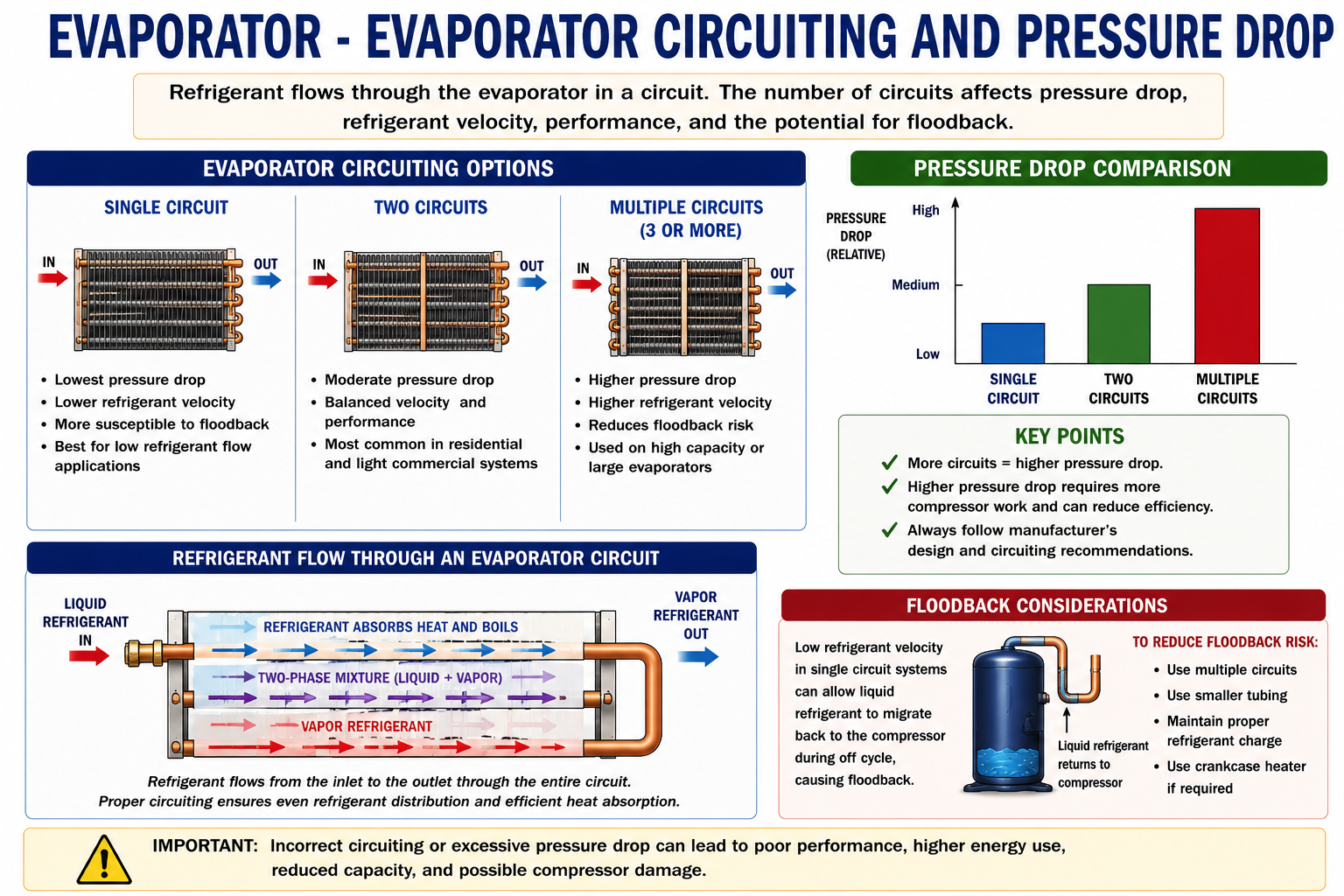
One Very Long Circuit
Can create excessive refrigerant pressure drop and may make it difficult to maintain uniform evaporating conditions through the entire coil.
Several Shorter Parallel Circuits
Divide the refrigerant flow among shorter paths and can reduce individual circuit pressure drop while allowing the full coil surface to be used.
Circuiting Is a Balance
Adding parallel refrigerant circuits can reduce pressure drop, but simply adding more circuits is not automatically better.
If refrigerant flow is divided among too many passages, refrigerant velocity in each circuit can become too low.
Too Few Circuits
Longer refrigerant paths can create excessive pressure drop.
Useful velocity with acceptable pressure drop
Too Many Circuits
Refrigerant velocity can become too low for good distribution and oil return.
Why Refrigerant Velocity Matters
Refrigerant must move through the evaporator fast enough to support good distribution and carry compressor oil through the refrigeration circuit.
Velocity that is too high can contribute to excessive pressure drop. Velocity that is too low can contribute to poor oil return.
Velocity Too High
Flow resistance and pressure drop can become excessive.
Velocity Too Low
Oil can separate from the refrigerant and remain in the evaporator instead of returning reliably toward the compressor.
Evaporator Design and Oil Return
Compressor oil circulates in small quantities with the refrigerant and must eventually return to the compressor.
Refrigerant vapor moving through the evaporator and suction piping helps carry oil along with it.
Oil Travels With the Refrigerant
A small amount of compressor oil can circulate through the refrigeration system.
Refrigerant Velocity Helps Move the Oil
Moving refrigerant helps sweep or carry oil through the evaporator passages.
Oil Returns Toward the Compressor
Proper system design allows circulating oil to return instead of accumulating in the evaporator.
Low Velocity Can Cause Oil Logging
If refrigerant velocity becomes too low, oil can accumulate in portions of the evaporator. Oil coating the internal heat-transfer surface can reduce heat transfer and can also reduce the amount of oil available to lubricate the compressor.
The Refrigerant “Scrubbing” Effect
Older refrigeration training often describes adequate refrigerant velocity as providing a scrubbing effect inside the evaporator tubing.
The useful concept is that moving refrigerant helps carry oil and contaminants along the internal surface instead of allowing material to settle and accumulate in low-velocity areas.
The important technician concept is maintaining sufficient refrigerant velocity for reliable oil transport and clean internal flow passages without creating excessive pressure drop.
Tubing and Passage Size
The internal size of the refrigerant passage affects both velocity and pressure drop.
Smaller Passage
For the same refrigerant mass flow, velocity generally increases, but pressure drop can also increase.
Larger Passage
Pressure drop may decrease, but refrigerant velocity can also decrease if the passage becomes too large for the required flow.
Evaporator circuit dimensions are therefore selected as part of the complete heat-exchanger design rather than by considering tubing size alone.
Material Conductivity and Thickness
Heat must move through the physical evaporator material before it reaches the refrigerant.
Different metals conduct heat at different rates, and heat-transfer resistance also changes with material thickness, bonding between surfaces, and overall heat-exchanger construction.
Good Thermal Conductivity
Helps heat move efficiently through the evaporator material.
Good Surface Contact
Fins, tubing, plates, and other heat-transfer surfaces must maintain effective thermal contact with one another.
The Design Factors Interact
Evaporator design is a balancing process. Changing one factor frequently affects several others.
Pressure drop may increase.
Pressure drop may decrease, but velocity in each circuit may also decrease.
More heat may be delivered to the evaporator, but air-side pressure drop and blower requirements also change.
Potential heat-transfer capacity increases, but the entire surface must still receive proper airflow and refrigerant distribution.
Signs of Poor Evaporator Performance
Excessive Pressure Drop
Can produce unwanted pressure and saturation-temperature differences through the evaporator.
Poor Oil Return
Can allow oil to accumulate in the evaporator and reduce compressor lubrication.
Uneven Refrigerant Distribution
Can leave portions of the evaporator underfed while other portions operate differently.
Poor Airflow
Reduces the heat delivered to the evaporator and can leave available coil surface underused.
Dirty Heat-Transfer Surface
Acts as insulation and can also restrict airflow through the evaporator.
Oil-Coated Internal Surface
Oil accumulation inside the evaporator can interfere with heat transfer between the tubing and refrigerant.
Think Like a Technician
Evaporator capacity problems should not automatically be treated as refrigerant-charge problems.
Verify airflow and inspect filters, blower operation, duct restrictions, and coil cleanliness.
Evaluate refrigerant pressures and temperatures only after the air side is reasonably understood.
Consider evaporator pressure drop when pressure measurements are taken at locations away from the evaporator outlet.
Look for signs of poor refrigerant distribution or uneven coil temperature.
Consider whether low refrigerant velocity could be contributing to poor oil return.
Evaluate the system as a heat-transfer system rather than relying on one pressure or temperature reading.
Put the Concepts Together
Evaporator capacity is the ability of the evaporator to absorb heat under a particular set of operating conditions.
Surface area, temperature difference, airflow, refrigerant velocity, material conductivity, and metal thickness affect heat transfer.
Refrigerant loses pressure as it travels through the evaporator because of flow resistance.
Excessively long refrigerant circuits can create excessive pressure drop.
Multiple parallel circuits shorten individual refrigerant paths and help control pressure drop.
Too many parallel circuits can reduce refrigerant velocity if flow is divided excessively.
Refrigerant velocity must be high enough to support oil return without creating excessive pressure loss.
Low refrigerant velocity can contribute to oil accumulation in the evaporator.
Proper airflow is necessary to continually bring heat to the evaporator surface.
Evaporator design is a balance among heat transfer, pressure drop, refrigerant velocity, airflow, and equipment reliability.
Can You Explain Evaporator Capacity and Design?
You should be able to answer these questions before continuing.
1. What does evaporator capacity describe?
2. How does surface area affect evaporator heat transfer?
3. Why is temperature difference necessary for heat transfer?
4. Why does airflow affect evaporator capacity?
5. What causes refrigerant pressure to decrease as it moves through an evaporator circuit?
6. Why can a very long evaporator circuit create problems?
7. How do multiple parallel circuits help control pressure drop?
8. Why can too many parallel circuits create a refrigerant-velocity problem?
9. Why is refrigerant velocity important for oil return?
10. What can happen if oil accumulates inside the evaporator?
11. How does passage size affect refrigerant velocity and pressure drop?
12. Why should evaporator-capacity problems not automatically be diagnosed as refrigerant-charge problems?
What You Should Have Learned
Evaporator capacity depends on the complete heat-transfer process rather than coil size alone.
Surface area and temperature difference are fundamental heat-transfer factors.
Air volume determines how much conditioned air continually reaches the evaporator surface.
Refrigerant pressure drop increases with flow resistance and excessive circuit length.
Parallel circuits can reduce circuit length and help control pressure drop.
Refrigerant velocity must remain high enough for good distribution and oil return.
Material conductivity, metal thickness, and surface contact influence heat transfer through the evaporator.
Good evaporator design balances capacity, pressure drop, refrigerant velocity, airflow, and oil return.
Next: A2L Refrigerant Leak Detection
Modern air-conditioning equipment may use mildly flammable A2L refrigerants and may include refrigerant leak detection near the indoor evaporator.
The next lesson introduces the purpose, location, and recognition of A2L refrigerant leak detectors without moving into control-board logic or detailed leak-mitigation sequences.
Recognize the Sensor · Understand Its Purpose · Follow Manufacturer Requirements