Electronic Expansion Valves (EEVs)
Electronic expansion valves combine a precisely controlled refrigerant valve with electronic sensors and a controller. Instead of depending entirely on mechanical forces, an EEV can continually reposition itself as refrigeration load and system operating conditions change.
EEVs have become increasingly important in modern refrigeration and air-conditioning equipment because electronic control allows precise refrigerant flow over a wide operating range. They are commonly found in commercial refrigeration, high-efficiency air-conditioning and heat-pump equipment, variable-capacity systems, chillers, VRF equipment, and ductless mini-splits.
What You Will Learn
By the end of this lesson you should be able to:
Explain the purpose of an EEV.
Describe how an electronic expansion valve controls refrigerant flow into an evaporator.
Identify the major parts of an EEV system.
Recognize the valve, actuator, temperature sensor, pressure sensor or transducer, and electronic controller.
Explain closed-loop superheat control.
Describe how the controller uses temperature and pressure information to determine evaporator superheat and continually adjust refrigerant flow.
Explain stepper-motor valve operation.
Describe how electrical pulses move an EEV through many small positions rather than simply turning refrigerant flow on or off.
Recognize modern EEV applications.
Explain why electronic metering is particularly useful in refrigeration, high-efficiency equipment, variable-capacity systems, and ductless equipment.
Approach EEV troubleshooting as a system.
Recognize that an apparent EEV problem may involve the valve, actuator, sensors, wiring, controller, refrigerant circuit, or operating conditions.
What Is an Electronic Expansion Valve?
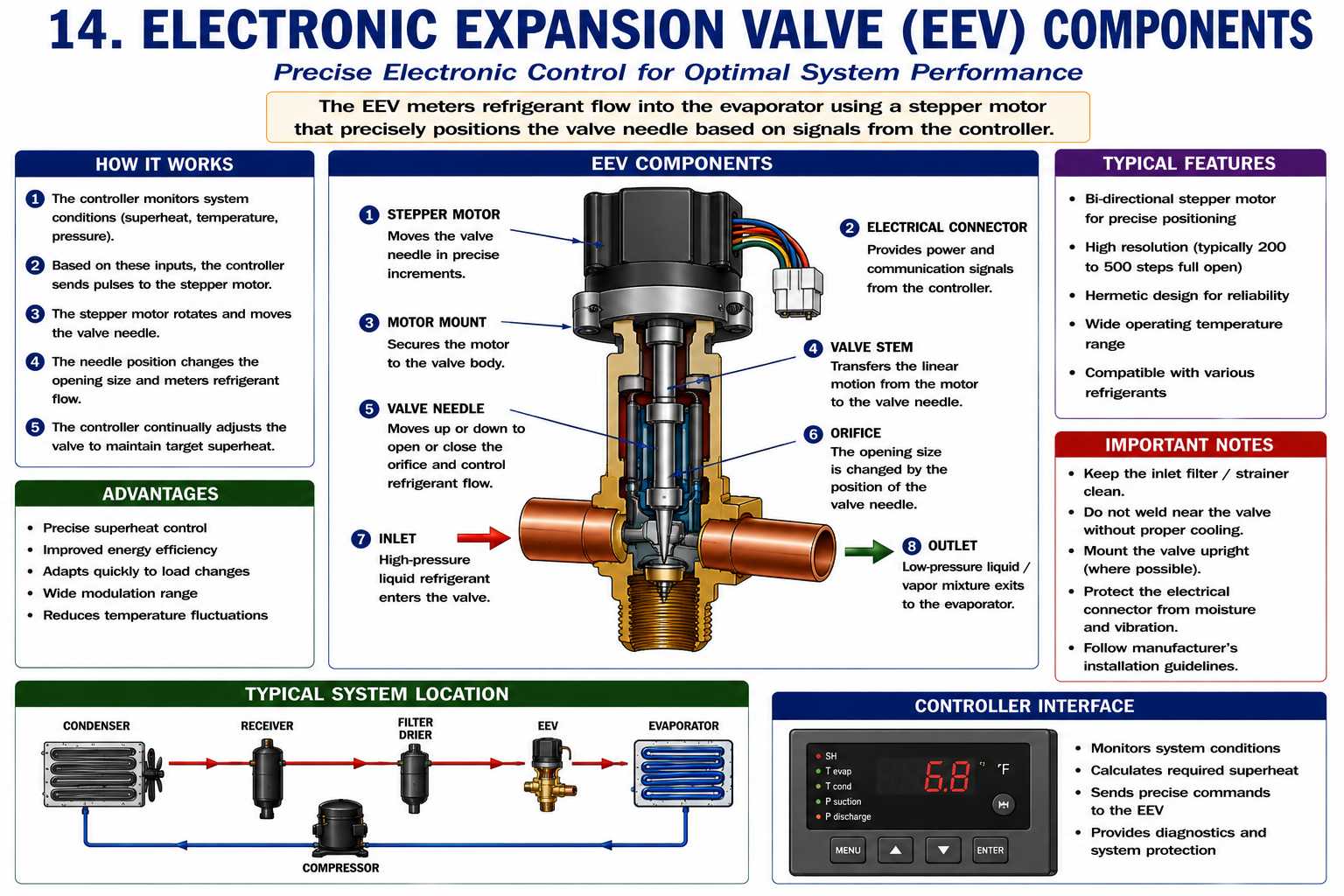
An electronic expansion valve is a variable metering device whose opening is controlled electrically. The valve performs the same basic refrigeration-cycle function as other metering devices: it controls refrigerant flow into the evaporator and creates the pressure difference between the high-pressure and low-pressure sides of the system.
The important difference is how the valve is controlled. Instead of using a fixed restriction or relying entirely on mechanical pressure and spring forces, an EEV receives commands from an electronic controller.
An electrically operated variable refrigerant metering device whose position is controlled by an electronic system using sensor information and programmed control logic.
The EEV is still a metering device. Its electronic actuator changes how precisely refrigerant flow can be controlled, but the valve still produces the pressure drop required between the high-pressure liquid side and the low-pressure evaporator side.
What Happens to the Refrigerant?
The refrigerant-state change through an EEV is the same fundamental process you learned with the other metering devices.
Liquid refrigerant arrives from the high-pressure side of the system.
The sudden pressure reduction causes a portion of the refrigerant to flash into vapor.
The refrigerant does not leave the EEV as all vapor. Only part of the liquid refrigerant flashes into vapor because of the pressure drop. The remaining liquid must absorb heat in the evaporator before it boils. The vapor formed during the pressure drop is called flash gas.
Immediately after the EEV, the refrigerant should normally be a low-pressure mixture of liquid and vapor. The evaporator provides the heat needed to boil the remaining liquid refrigerant.
The EEV Is Only One Part of the System
When technicians refer to an EEV, they often mean more than the valve itself. Proper operation normally depends on several components working together.
Electronic Expansion Valve
The valve contains the variable opening that physically controls refrigerant flow into the evaporator.
Valve Actuator
An electrical actuator, commonly a stepper motor, moves the valve mechanism to the position commanded by the controller.
Temperature Sensor
A temperature sensor measures refrigerant-line temperature at a location selected by the equipment manufacturer.
Pressure Transducer
A pressure transducer converts refrigerant pressure into an electrical signal that the controller can use.
Electronic Controller
The controller receives sensor information, performs the required calculations, and determines whether the valve should open, close, or remain at its present position.
Wiring and Connections
The sensors, actuator, and controller depend on proper electrical connections. A wiring fault can therefore produce symptoms that appear to be a refrigeration problem.
How Can an EEV Be Positioned So Precisely?
Many EEVs use a stepper motor. Unlike a conventional motor that simply rotates continuously when energized, a stepper motor moves through controlled increments called steps.
Controller Sends Pulses
The electronic controller energizes the motor windings in a controlled sequence.
Motor Moves in Steps
Each electrical command moves the motor a small, predictable amount.
Valve Position Changes
Motor movement changes the position of the valve mechanism and therefore changes the effective refrigerant-flow opening.
Flow Is Precisely Modulated
The controller can position the valve at many points between closed and fully open.
A stepper-motor EEV is not normally just an electrically operated shutoff valve. The controller can command many intermediate positions to closely regulate refrigerant flow.
The Controller Measures, Calculates, and Corrects
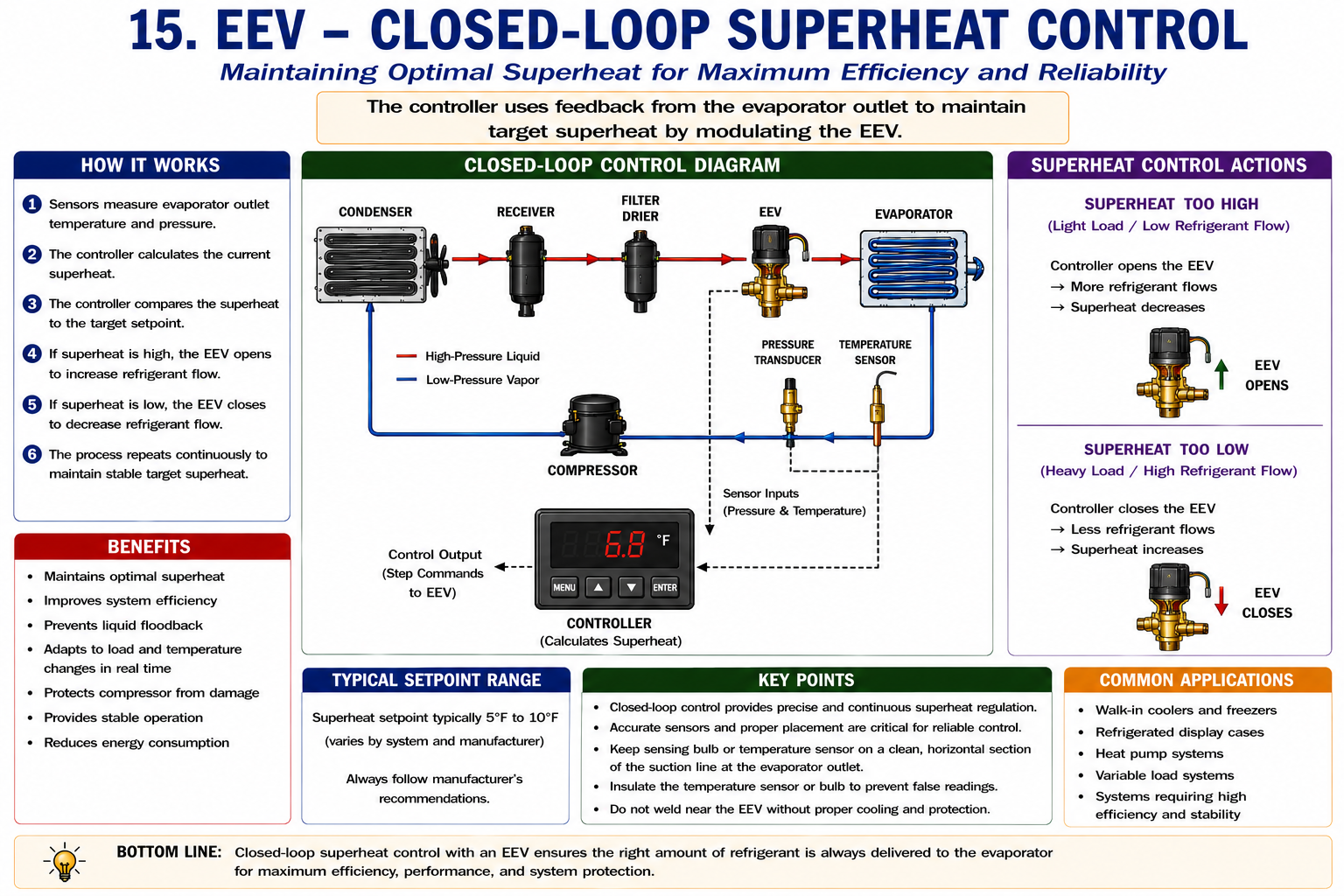
Many EEV systems use closed-loop control. This means the controller does not simply command a valve position and forget about it. The controller measures the result of its action and then makes another correction when necessary.
Temperature and pressure sensors report evaporator conditions.
The controller determines operating conditions such as superheat.
The measured condition is compared with the controller’s target.
The controller commands the EEV to open or close.
A control process in which the result of a control action is measured and fed back to the controller so additional corrections can be made.
How Does the Controller Know How Much Refrigerant to Feed?
One common EEV control strategy is to regulate evaporator superheat. The controller uses refrigerant pressure to determine saturation temperature and compares that value with the measured refrigerant-line temperature.
Evaporator Pressure
The controller uses refrigerant pressure to determine the corresponding saturation temperature.
Actual Line Temperature
The temperature sensor reports the actual refrigerant-line temperature at the selected sensing location.
Superheat
The controller determines the difference and uses that information when positioning the valve.
You have already learned how superheat is determined and why it is important. The new concept here is that an electronic controller can perform this comparison continuously and automatically use the result to control refrigerant flow.
Changing Valve Position Changes Superheat
Controller Opens the EEV
When the controller determines that evaporator superheat is higher than desired, it can command the valve farther open.
Controller Closes the EEV
When superheat is lower than desired, the controller can reduce valve opening.
System conditions continually change. A closed-loop EEV controller therefore makes repeated corrections as load, compressor capacity, outdoor conditions, evaporator conditions, and other operating variables change.
Electronic Control Replaces the Mechanical Feedback System
| Characteristic | TXV | EEV |
|---|---|---|
| Valve Positioning | Mechanical force balance | Electronic actuator |
| Temperature Input | Sensing bulb pressure | Electronic temperature sensor |
| Pressure Input | Internal or external equalization | Pressure sensor or transducer in many systems |
| Decision Making | Mechanical balance of forces | Electronic controller and programmed logic |
| Superheat Control | Mechanical modulation | Electronic closed-loop modulation |
| Additional Inputs | Limited by mechanical design | Controller may use multiple system inputs |
| Electrical Power Required | No electrical power required for basic valve operation | Electrical power and control signals required |
Both TXVs and many EEV systems regulate evaporator feeding while maintaining appropriate superheat. The TXV accomplishes this mechanically; the EEV accomplishes it with sensors, electronics, and an electrically positioned valve.
Electronic Control Provides a Wide Operating Range
Mechanical expansion valves remain effective in many applications, but electronic control provides capabilities that are particularly valuable when equipment must operate efficiently over a wide range of conditions.
Precise Refrigerant Control
Many intermediate valve positions allow refrigerant flow to be closely matched to operating conditions.
Wide Capacity Range
The valve can respond as equipment capacity changes from very low load to high load.
Fast Electronic Response
The controller can detect changing sensor conditions and command a valve-position change without depending entirely on mechanical thermal response.
Multiple Inputs
The equipment controller can consider more than one operating condition when determining the desired valve position.
System Integration
The EEV can operate as part of the overall equipment-control strategy rather than as an independent mechanical component.
Efficiency Optimization
Precise evaporator feeding can help equipment operate efficiently as compressor capacity and refrigeration load change.
EEVs Are Not Just Air-Conditioning Components
Electronic expansion valves are widely used in commercial refrigeration. Refrigerated cases, walk-in coolers and freezers, refrigerated warehouses, condensing units, and other refrigeration systems can benefit from precise electronic refrigerant control.
Refrigerated Display Cases
Electronic control can closely regulate evaporator operation as product load and store conditions change.
Walk-In Coolers and Freezers
EEVs can provide precise superheat control across changing refrigeration loads and operating temperatures.
Commercial Refrigeration Systems
Electronic valves can be integrated with centralized refrigeration controls and monitoring systems.
Low-Temperature Equipment
Electronic control is useful where accurate evaporator feeding is needed over demanding operating conditions.
The principles in this subsection are not limited to residential air conditioning. Metering devices are fundamental components of vapor-compression refrigeration systems used for comfort cooling, food refrigeration, freezers, heat pumps, chillers, and many other applications.
Why EEVs Work Well With Variable-Speed Compressors
A fixed-speed compressor generally operates at one primary capacity whenever it is running. Modern inverter-driven and variable-speed compressors can operate across a much wider capacity range.
Refrigerant mass flow and system capacity change.
Sensors report the changing refrigeration conditions.
Refrigerant feed is adjusted to match the new operating condition.
At low compressor capacity, the evaporator may require only a small refrigerant flow. At high capacity, much more refrigerant may be required. An EEV can be repositioned over a wide range to follow these changes.
Variable-capacity equipment cannot be understood by looking at the compressor alone. Compressor speed, refrigerant mass flow, evaporator load, and EEV position are coordinated by the equipment’s control system.
EEVs Are Central to Many Mini-Split Systems
Ductless mini-splits and VRF systems commonly combine inverter-driven compressors with electronic expansion valves. The ability to precisely change refrigerant flow is especially useful because system capacity can vary substantially during operation.
Load Changes
Room temperature, outdoor temperature, operating mode, and the number of active zones can change system demand.
Compressor Capacity Changes
The inverter system changes compressor speed rather than simply cycling the compressor on and off.
EEV Position Changes
The control system adjusts refrigerant flow to match the operating condition.
System Continually Rebalances
Sensors provide feedback so compressor capacity and refrigerant flow can continue to be adjusted.
Pressures, temperatures, compressor speed, fan speed, and EEV position may all be changing at the same time. Manufacturer service information and operating data become especially important when troubleshooting electronically controlled equipment.
EEVs Help the Entire System Operate as a Coordinated Machine
Modern high-efficiency equipment often achieves part of its efficiency improvement by allowing components to operate at something other than full capacity. Compressors, indoor blowers, condenser fans, and refrigerant metering can all be varied.
The EEV gives the equipment controller direct control over refrigerant feed. This allows refrigerant flow to be coordinated with changing compressor capacity and heat-exchanger load rather than relying on a fixed restriction.
Do Not Condemn the Valve First
An EEV system contains both refrigeration and electrical components. A problem that appears to be incorrect refrigerant flow does not automatically mean that the valve itself has failed.
Temperature Sensor
An inaccurate temperature sensor can cause the controller to calculate the wrong operating condition and command an incorrect valve position.
Pressure Transducer
An incorrect pressure signal can result in an incorrect calculated saturation temperature and superheat.
Valve Actuator
An open winding, shorted winding, damaged connector, or actuator problem can prevent the valve from moving as commanded.
Valve Mechanism
The controller and motor may be operating while the mechanical valve is restricted, damaged, or stuck.
Wiring
Loose connections, damaged wiring, incorrect connections, or corrosion can interrupt sensor or actuator signals.
Controller
The controller must receive valid inputs and provide the correct output commands. Fault codes and manufacturer diagnostics can be important clues.
Refrigerant Circuit
Incorrect charge, liquid-line restrictions, inadequate subcooling, or flash gas before the valve can affect operation even when the EEV is functioning correctly.
System Operating Conditions
Variable compressor and fan operation can produce pressures and temperatures that differ from what a technician expects from conventional fixed-speed equipment.
Troubleshooting may require both refrigeration measurements and electrical measurements. Pressure gauges alone cannot determine whether the controller, sensors, wiring, actuator, and valve are operating correctly.
Manufacturer Procedures Become More Important
TXVs from different manufacturers operate according to the same general mechanical principles. EEV systems add software, sensor calibration, motor characteristics, valve step counts, control sequences, and diagnostic functions that can differ significantly between equipment designs.
Identify the System
Determine the equipment model, refrigerant, valve type, controller, and intended operating sequence.
Check Fault Information
Review stored fault codes, diagnostic information, and manufacturer service procedures before replacing components.
Verify Sensor Readings
Compare reported temperature and pressure values with independent measurements when the service procedure permits.
Verify Valve Operation
Use the manufacturer’s specified resistance, voltage, command, position, or functional checks for the particular valve and actuator.
Stepper-motor winding resistance, operating voltage, number of steps, wiring sequence, and test procedures vary by manufacturer and valve design. Always use the service information for the equipment being tested.
What Happens When the Controller Loses Power?
An electronic valve depends on electrical control. Depending on the valve and system design, the valve may remain in its last position, move to a commanded position before shutdown, require a closing sequence, or use additional hardware to provide shutdown protection.
For this reason, the technician should not assume that every EEV automatically closes when power is removed.
Some controllers perform an initialization or homing procedure so the controller can establish a known valve position. The exact procedure depends on the equipment and valve design.
How Metering Devices Decide Refrigerant Flow
| Metering Device | Type of Control | What Determines Refrigerant Flow? |
|---|---|---|
| Capillary Tube / Fixed Orifice | Fixed | Physical restriction and pressure difference across the device |
| TXV | Mechanical modulation | Balance of bulb pressure, evaporator pressure, and spring pressure |
| AEV | Mechanical modulation | Balance of evaporator pressure and spring pressure |
| EEV | Electronic modulation | Electronic controller using sensor inputs and programmed control logic |
All of these devices meter refrigerant and create the required high-side-to-low-side pressure drop. What changes is the method used to determine how much refrigerant flows through the device.
Follow the Process Step by Step
High-pressure liquid refrigerant reaches the electronic expansion valve.
The EEV creates the pressure drop and meters refrigerant into the evaporator as a low-pressure liquid/vapor mixture.
Temperature and pressure sensors measure evaporator operating conditions.
The electronic controller interprets the sensor information and determines the current operating condition.
When superheat control is being used, the controller compares calculated superheat with its target value.
The controller sends electrical commands to the valve actuator.
The actuator moves the EEV to a new position, changing refrigerant flow.
The sensors measure the resulting conditions and the closed-loop process repeats.
Can You Explain an Electronic Expansion Valve?
You should be able to answer these questions before continuing.
- What basic refrigeration-cycle function does an EEV perform?
- What state should the refrigerant be in when it enters the EEV?
- What state is the refrigerant in immediately after leaving the EEV?
- What is flash gas?
- What is a stepper motor?
- Why can a stepper-motor EEV control refrigerant flow more precisely than a simple on/off valve?
- What information can a temperature sensor and pressure transducer provide to an EEV controller?
- What is closed-loop control?
- How does an EEV controller respond when superheat is above its target?
- How does an EEV differ from a TXV?
- Why are EEVs particularly useful with variable-capacity compressors?
- Why are EEVs common in ductless mini-splits and VRF systems?
- Why should a technician not immediately replace the EEV when refrigerant flow appears incorrect?
- Why is manufacturer service information especially important when troubleshooting an EEV system?
What You Should Have Learned
An EEV is an electrically positioned variable metering device controlled by an electronic system.
High-pressure liquid refrigerant enters the EEV, and a low-pressure liquid/vapor mixture containing flash gas leaves the valve and enters the evaporator.
Many EEVs use stepper motors that allow the controller to position the valve at many points between closed and fully open.
Temperature sensors and pressure transducers provide electronic information that the controller can use to determine evaporator operating conditions.
Closed-loop control means that the system measures the result of its control action and continually makes corrections.
Many EEV systems regulate evaporator superheat electronically, accomplishing a similar control goal to a TXV by a different method.
EEVs are used in both refrigeration and air-conditioning equipment and are particularly valuable in high-efficiency, variable-capacity, VRF, and ductless systems.
EEV troubleshooting requires evaluating the complete system, including sensors, wiring, controller, actuator, valve mechanism, refrigerant circuit, and operating conditions.